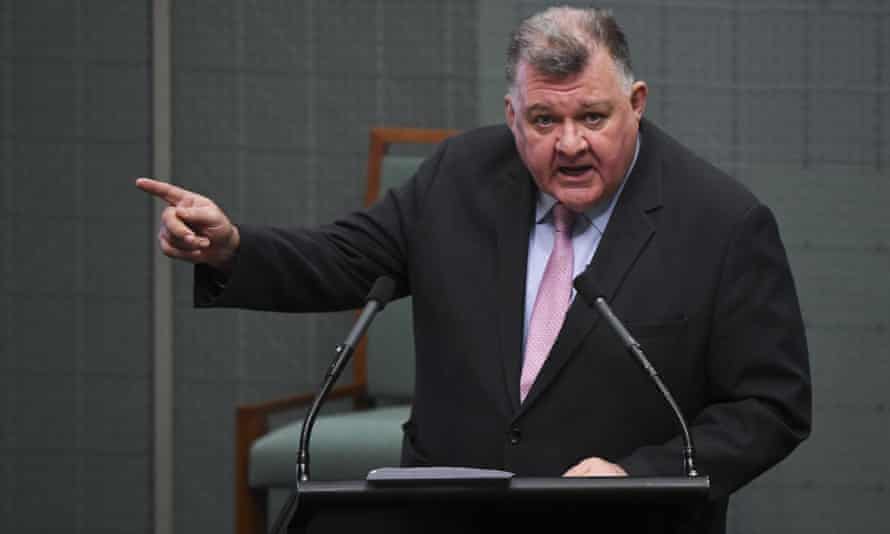
Controversial Liberal MP Craig Kelly’s relentless promotion of conspiracy theories and unproven coronavirus cures on social media have led to a campaign to boot him out of politics – a push being mounted by his own community.
The latest global Corruption Perception Index (CPI) rankings places Australia at 11 out of 180 countries.
For almost 20 years, Australia ranked in the top ten (least corrupt) countries. In 2012, Australia ranked seventh with a score of 85. By 2018, it had fallen to 13th with a score of 77. In the latest 2020 rankings, it has also scored 77.
Being ranked 11th out of 180 is relatively good. But falling by eight points is not good. It is a wake-up call and raises serious questions about the ethical underpinnings of politics in this country.
When the banking royal commission wrapped up in early 2019, the government said it was committed to enacting change. Senior business reporter Ben Butler explains how two years on, most recommendations have either been delayed or abandoned
The Government’s fetish for deregulation plays right into the hands of predatory multinationals Uber and Deliveroo which exploit both Australia’s tax and labour laws to siphon profits overseas. Michael West and Callum Foote report on Uber’s exploitation and the prospective tsunami of lawsuits rolling its way.
It gave Scott Morrison a Howard moment — “we’ll decide who searches Australia and the manner in which they search!” — as he huffed, “we don’t respond to threats”. (This will surely be news to anyone who follows the LNP-News Corp relationship.)
So, is Morrison’s behaviour a lack of leadership, which seems likely given his stance or lack of it on so many issues, or is it a demonstration of his and the right-wing intolerance, insensitivity and racism towards our own Indigenous peoples? Perhaps he is simply appealing to his base and it is all about votes. Whatever the case, history will not be kind to him when it judges his performance. Or is it all three. I suspect it is the latter.
When recovery hasn’t been equally distributed it’s not a recovery and when the gov refocuses on cutbacks it’s even worse
“The Morrison government’s plans to cut income support and introduce industrial relations legislation which cuts workers’ pay and conditions will worsen unemployment, increase insecure work and further drive down wage growth,” O’Neil warned.
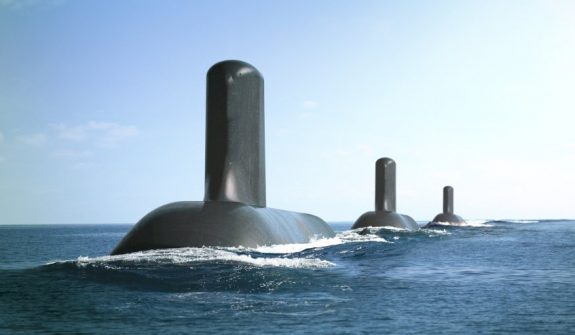
One only gets into the submarine procurement business to spite government treasurers and economic managers. Efficiency and effectuality are bonus additions, but hardly necessary. Witness the evolving disaster that is Australia’s SEA 1000 Future Submarine program, won by France’s DCNS, now Naval Group, in 2016.
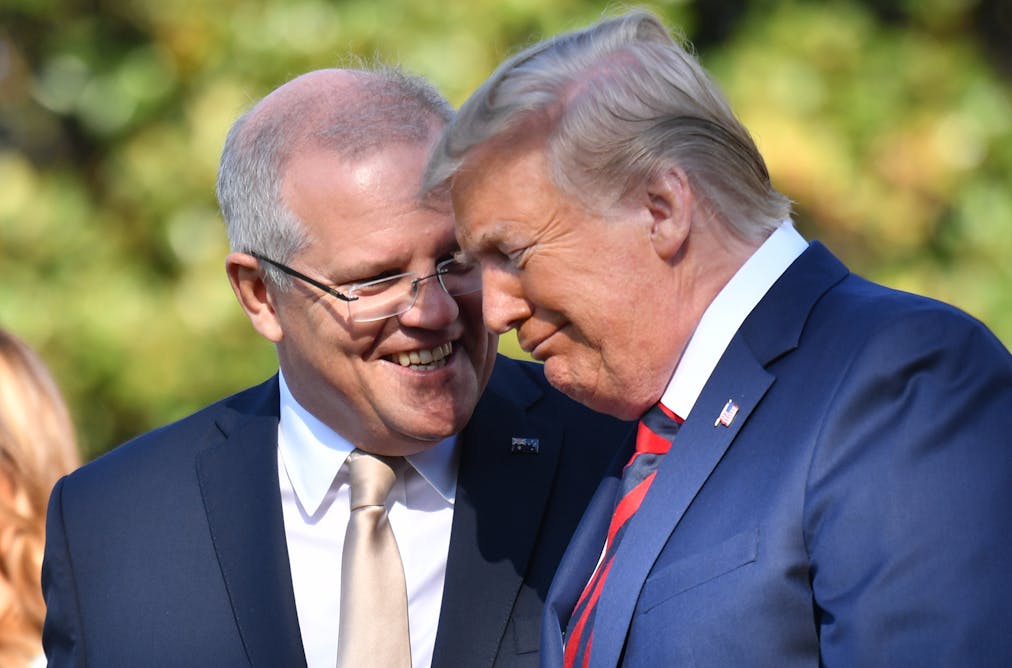
The Labor leader thundered that Scott Morrison had gone “too far” in his support for the defeated President, claiming “Trumpists” were the “bedrock” of the Prime Minister’s supporters. While it’s no secret Mr Morrison enjoyed a far better relationship with Mr Trump than most world leaders – feted with a state dinner, lauded as the “man of titanium”, and awarded the Legion of Merit – what is less clear is how the Trump era changed Australian politics.
Why is it we allow our PM to get away with BULLSHIT. Bring back the ABC
When Prime Minister Scott Morrison was invited at a recent press conference to condemn far-right conspiracy theories promoted by government members such as George Christensen, he refused. He also defended another Liberal backbencher, Craig Kelly, who has undermined the government’s health message by spreading false information about COVID-19. At the time, Morrison said: “There’s such a thing as freedom of speech in this country and that will continue.”
But if Australians followed the 2020 presidential race in the United States with greater-than-usual interest, it was because when boiled down, it presaged a plausible descent for Australia’s politics, too.
This loosely is how the Google/Australian media controversy has gone. If I use Google to look up Scott Morrison to see whether he’s announced that he’s taking another break and I’m directed to an article by newspaper that doesn’t have a paywall, then they’ll be relying on advertising from the traffic that goes to their site in order to make money. Why they’d argue that Google should be forced to pay, I can’t work out. It would be different if Google was plagiarising the articles or breaching their copyright, but if the media companies aren’t happy with this arrangement, then they can put all their articles behind a paywall.
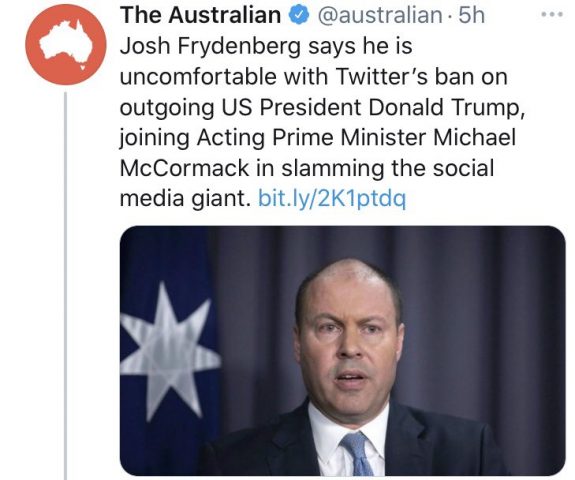
Members of the Morrison government have saved their loudest outrage for Twitter, the social media platform Trump used to incite his followers, and the platform that has finally banned Trump for life. This, it appears, is the great injustice, an affront to “free speech,” and, wait for it, censorship.
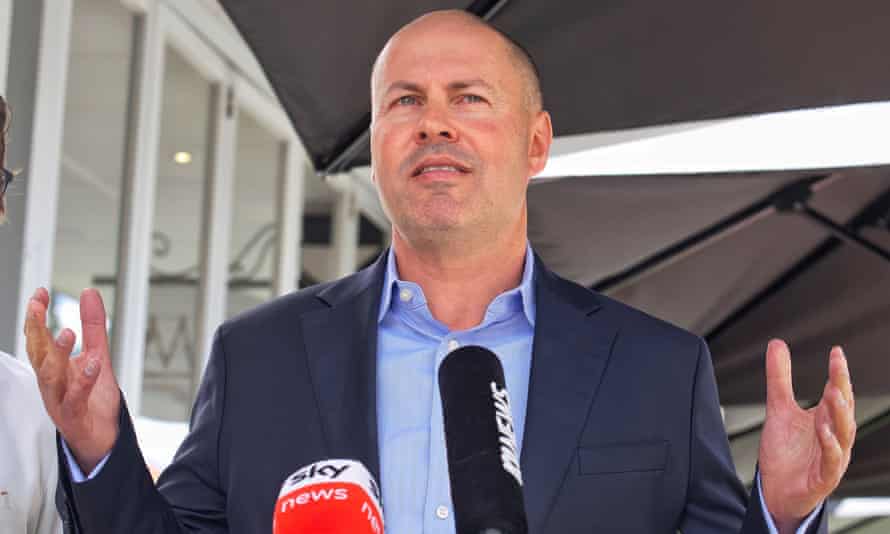
Frydenberg, McCormack, Kelly and even Morrison shame our nation. They believe inciting encouraging and promoting sedition, violence, and insurrection is simply allowable and to prevent it a matter of “suppression of free speech”. Rest assured they don’t practice what they preach at home in the workplace or other of their social and cultural situations. Swearing like drunken sailors isn’t tolerated in their homes. Do they seriously listen to what they are saying? All readily condemning whistleblowers and journalists, so much so, that they demand we maintain and even strengthen the laws that prosecute them are (ODT)appropriate. They don’t speak up for Julian Assange who the American government wants to put away for 174 years. Not so poor old Don the victim of Twitter.( ODT)
Senior government ministers have lashed Twitter’s ban on Donald Trump as multiple social media giants removed the outgoing US President from their platforms.
Labor’s health spokesman, Chris Bowen, seized on the controversy, arguing the social media giant had “called out ‘Conspiracy Craig’s’ medical disinformation campaign” after the prime minister, Scott Morrison, and federal health minister, Greg Hunt, failed to do so.
The overall population projection Treasury is now making is that once international borders fully re-open and things go back to “normal”, the population will grow at around 350,000 per annum for the second half of the 2020s. So, can we believe this latest population projection? Is Treasury really now being transparent?
Australia seems hell-bent of damaging its economic security in the interests of being in the vanguard of a growing international anti-China “cabal”, writes William Briggs.
How did an Australian-made transponder, a key part of drone technology, end up in the conflict between Armenia and Azerbaijan where human rights abuses are prolific? Michelle Fahy investigates the murky trail of the drone bit and the cagey response of the Defence establishment from DFAT to DoD to Minister Marise Payne.
As Jobkeeper, JobSeeker and other stimulus measures are wound back in 2021, it is doubtful the Morrison Government will rise to the enormous economic challenges ahead, writes Tarric Brooker.
Yes, confirmation bias is hard to overcome. If I use Gladys Berejiklian as my final example, I have to ask myself would I be upset if the premier of my state had kept their relationship with a corrupt politician a secret, failed to declare various conflicts of interest, shredded documents and removed computer files that gave information about pork-barrelling, failed to make masks mandatory because well, it’s just more rules, isn’t it, told us that there’s no real concerns about behaviour that some consider corrupt because everybody is and failed to protect koalas? Somehow I don’t think I’d be saying that they’re only human.
He reminds his daughters that if the economy can’t afford drugs for a child their age with Cystic Fibrosis, the child doesn’t get to breathe. No pressure. No emotional blackmail. What a mensch! What a man for our times. Yet as the pandemic becomes endemic, as his government’s debacle in its megaphone diplomacy with China begins to cost, the Morrison’s government’s hollow promises, lies and incompetence will be its undoing. Looking at the debacle that is the NSW government’s response to what may well prove to be a new wave of coronavirus cases surely no-one can miss the criminally negligent federal government behind the scenes. Our challenge is to hold it to account.
But with major pharmaceutical companies rolling out vaccines and millions of doses being bought by the United States, Britain, the European Union and Australia, developing countries argue such attempts to give them purchasing power in the market will only go so far. In October, India and South Africa asked the World Trade Organisation to temporarily waive intellectual property (IP) protections so that vaccines and other equipment for fighting COVID-19 could be made more cheaply at greater scale. Australia joined Britain, the US and the EU in opposing the move, arguing that existing rules on licensing would be sufficient to meet demand.
Top economists want the dole permanently increased in 2021 and a closer review of the federal government’s wage subsidy scheme JobKeeper to determine the future of the $100 billion lifeline.
It was the first time Liberal government had lost a vote in the house since Peter Gutwein took over as Premier in January this year. Sue Hickey is often described as “maverick Liberal MP”. Maverick or not, it is highly unusual for parliamentarians to cross the floor, to side with their political adversaries rather than their colleagues, and Hickey’s decision spoke volumes about the subject matter at hand.
Charging exorbitant prices for travellers stranded overseas while raking in record government subsidies. Qantas and Virgin are the quintessential cases of “privatise the profits, socialise the losses”. Tasha May.looks at the airlines’ fine balancing act in corporate socialism during the pandemic.
“If one does not know to which port one is sailing, no wind is favourable.” In many ways, Australia heading into 2021 is broadly summed up in this way.
When it comes to the managing of the COVID-19 pandemic in Australia, there is plenty of blame to go around. But don’t look to the federal government to accept its fair share.
The Morrison government has proposed sweeping changes to Australian labor laws intended to cut wages, entrench precarious work, and cripple unions. The proposed changes would sweep away the remnants of collective bargaining and hand dictatorial power to bosses.
Families who lost loved ones to COVID-19 in Victorian aged care homes say it’s “unacceptable” the federal government has kept them in the dark about an inquiry into the outbreak. It comes amid revelations the Morrison government is a month behind schedule and won’t be publicly releasing a report into the handling of the virus until Christmas.
All foreign investment bids for Australian assets must be screened by the Foreign Investment Review Board
From December 31, foreign buyers will face even more scrutiny when bidding for sensitive assets
Experts say restrictions are being used to screen out bids by Chinese companies and are counterproductive to trade relations
For Australia, lessons can be learned from Japan. New Prime Minister Yoshihide Suga used his first overseas trip to visit Indonesia and Vietnam. Suga signed a defence export deal with Hanoi and provided a $670 million low-interest loan to Jakarta. Suga also deepened security relations with Australia through a defence pact.
Suga is making clear and systematic moves to diversify relations and contain Chinese expansion, yet is doing so without the belligerent bluster and crude diplomatic noise found in Morrison’s public displays. Japan has ongoing disputes with China over the South China Sea and tensions remain over Japan’s security arrangements with the United States, yet the two maintain productive and mutually beneficial trade and diplomatic relations.
Former Prime Minister and specialist in Sino-Australia relations, Kevin Rudd, has described Japan’s approach as “do more, talk less”. For attention-hungry Morrison, such a strategy is inconceivable.
When one-third of casuals work full-time hours, almost 60% have been with their employer for more than a year, and more than half cannot choose the days they work, is the “flexibility” of a casual job really for the benefit of employees? Professor David Peetz reports.
With the cost of energy generated from wind and solar now less than coal, the share of Australia’s electricity coming from renewables has reached 23%. The federal government projects the share will reach 50% by 2030. It is at this point that integrating renewables into the energy system becomes more costly. We can add wind and solar farms at little extra cost when their share is low and other sources – such as coal and gas generators now – can compensate for their variability. At a certain point, however, there comes a need to invest in supporting infrastructure to ensure supply from mostly renewable generation can meet demand.
Rumours are flying thick and fast over Scott Morrison’s impending ministerial reshuffle this week, but one particularly spicy one lasted barely minutes before being seemingly shut down.
The federal government’s industrial relations “reform” bill offers a new definition of “casual” employment that creates more problems than it solves. It effectively defines a casual job as anything described that way by the employer at the time a job commences, so long as the employer initially makes “no firm advance commitment to continuing and indefinite work”. Anyone defined as such loses any entitlement to leave they might otherwise have got through two recent Federal Court decisions. Fair enough, you might think. Casual jobs are meant to be flexible. There can’t be an ongoing commitment.
The best interests of older people are not uppermost in this government’s thinking. Referring to older people requiring care as “consumers”, describing the transfer of residents to hospital as “decanting”, talk of “cohorting” residents into specific sections of a home and other dehumanising language set the scene for its priorities. Using aged care homes as a dumping ground to provide work for people who are unemployed is just the latest ploy, writes Dr Sarah Russell.
The government’s Cashless Debit Card almost fell apart on Wednesday night. Senator Rex Patrick’s refusal to support the government’s plans to make the scheme permanent gave some hope that this expensive, ideological and cruel policy would end.
“I think if the Australian government was sensible, it would bite the bullet and allow the people who are in Australia to stay,” Thom says, describing it as the most obvious solution – particularly in light of the halt to migration caused by Covid-19. “But given Australia has a policy of never allowing these people to stay permanently, then it has to accept other offers that are being made in good faith, like the New Zealand offer.” The home affairs department says Australia remains committed to its regional processing policy and is establishing an enduring regional processing capability in Nauru. “The Australian government’s policy remains steadfast: no one under regional processing arrangements will be settled in Australia,” it says.
Morrison coined the term “On the Water Matters” and flooded the Government
In days gone by, government ministers never survived misleading parliament, for example. But Prime Minister Scott Morrison’s offensive, bellicose ramblings about former Prime Minister Kevin Rudd on Monday (7 December), provide another case study in how to avoid scrutiny. Morrison was asked by Deputy Opposition Leader Richard Marles in Parliament: “Why have Tony Abbott and Alexander Downer been able to leave and re-enter Australia multiple times this year when there are thousands of vulnerable, stranded Australians who haven’t been able to get home once?” Morrison replied by alleging Rudd had also obtained privileged travel exemptions. Except Rudd hadn’t.
Porter’s attack on workers will do something else as well. It is workers and households that have been the heroes of the recovery. While business has hidden in its bunker, Australians have endured lockdown, complied with often draconian restrictions on their freedom, then emerged to get back to work and start spending in exactly the way the government has urged them to. Their reward for that? Workchoices 2.0, designed to undermine their wages and further tilt the industrial relations playing field in favour of employers. It’s vicious, ideological and idiotically self-defeating.
Remember the promise of the Casual worker’s bonus for benefit sacrifice that was a Trumpian promise still in waiting.
The government sat on a report into the retirement income system for four months because it was so politically sensitive and then released it on the day the Brereton report into potential war crimes in Afghanistan was released. Harry Chemay looks at what’s at stake in the debate around the rise in superannuation guarantee levy.



























 olddogthoughts
You must be logged in to post a comment.