Month: January 2015

Charlie Hebdo and the hypocrisy of pencils

It was Herald Sun cartoonist Mark Knight who tipped me over the edge.

To be fair, he wasn’t wholly responsible. If it wasn’t for all the lunacy that preceded him, I probably would have dismissed his cartoon as just another Herald Sun atrocity, more a piece of Murdoch-madness to be mocked rather than trigger for outrage. But context is everything. And after days of sanctimonious blather about freedom of speech and the Enlightenment values of Western civilisation, his was one pencil-warfare cartoon too many.

The cartoon in question depicts two men – masked and armed Arab terrorists (is there any other kind of Arab?) – with a hail of bomb-like objects raining down on their heads. Only the bombs aren’t bombs. They are pens, pencils and quills. Get it? In the face of a medieval ideology that only understands the language of the gun, the West – the heroic, Enlightenment-inspired West – responds by reaffirming its commitment to resist barbarism with the weapons of ideas and freedom of expression.

It is a stirring narrative repeated ad nauseam in newspapers across the globe. They have been filled with depictions of broken pencils re-sharpened to fight another day, or editorials declaring that we will defeat terrorism by our refusal to stop mocking Islam.

It is well past time to call bullshit. Knight’s cartoon made the point exceptionally clear, but every image that invoked the idea that Western culture could and would defend itself from Islamist extremism by waging a battle of ideas demonstrated the same historical and political amnesia.

Reality could not be more at odds with this ludicrous narrative.

For the last decade and a half the United States, backed to varying degrees by the governments of other Western countries, has rained violence and destruction on the Arab and Muslim world with a ferocity that has few parallels in the history of modern warfare.

It was not pencils and pens – let alone ideas – that left Iraq, Gaza and Afghanistan shattered and hundreds of thousands of human beings dead. Not twelve. Hundreds of thousands. All with stories, with lives, with families. Tens of millions who have lost friends, family, homes and watched their country be torn apart.

To the victims of military occupation; to the people in the houses that bore the brunt of “shock and awe” bombing in Iraq; to those whose bodies were disfigured by white phosphorous and depleted uranium; to the parents of children who disappeared into the torture cells of Abu Ghraib; to all of them – what but cruel mockery is the contention that Western “civilisation” fights its wars with the pen and not the sword?

And that is only to concern ourselves with the latest round of atrocities. It is not even to consider the century or more of Western colonial policies that through blood and iron have consigned all but a tiny few among the population of the Arab world to poverty and hopelessness.

It is not to even mention the brutal rule of French colonialism in Algeria, and its preparedness to murder hundreds of thousands of Algerians and even hundreds of French-Algerian citizens in its efforts to maintain the remnants of empire. It is leaving aside the ongoing poverty, ghettoisation and persecution endured by the Muslim population of France, which is mostly of Algerian origin.

The history of the West’s relationship with the Muslim world – a history of colonialism and imperialism, of occupation, subjugation and war – cries out in protest against the quaint idea that “Western values” entail a rejection of violence and terror as political tools.

Of course the pen has played its role as well. The pens that signed the endless Patriot Acts, anti-terror laws and other bills that entrenched police harassment and curtailed civil rights. The pens of the newspaper editorialists who whip up round after round of hysteria, entrenching anti-Muslim prejudice and making people foreigners in their own country. But the pens of newspaper editors were strong not by virtue of their wit or reason, but insofar as they were servants of the powerful and their guns.

Consideration of this context not only exposes the hypocrisy of those who create the narrative of an enlightened West defending freedom of speech, it also points to the predictability and inevitability of horrific acts of terrorism in response. Of course we will never know what was going through the minds of the three men who carried out this latest atrocity. But it is the height of ahistorical philistinism to ignore the context – both recent and longstanding – in which these attacks took place.

The idea that Muslim outrage at vile depictions of their religious icons can be evaluated separately from the persecution of Muslims in the West and the invasion and occupation of Muslim countries is the product of a complete incapacity to empathise with the experience of sustained and systemic oppression.

What is extraordinary, when even the most cursory consideration of recent history is taken into account, is not that this horrific incident occurred, but that such events do not happen more often. It is a great testament to the enduring humanism of the Muslim population of the world that only a tiny minority resort to such acts in the face of endless provocation.

In the days ahead, a now tired and exhausting theatre of the absurd will continue to play out its inevitable acts. The Western politicians who lock up their own dissidents and survey the every movement of their citizenry will go on waxing lyrical about freedom of thought. Muslim leaders of every hue will continue to denounce a terrorism they have nothing to do with, and will in turn be denounced for not doing so often or vigorously enough. The right will attack the left as sympathisers of Islamist terrorism, and demand we endlessly repeat the truism that journalists should not be killed for expressing their opinions. They will also demand that we accept that white Westerners, not Muslims, are the real victims of this latest political drama.

Meanwhile, Muslims in the West will, if they dare to walk the streets, do so in fear of the inevitable reprisals. And pencils aren’t what they will be afraid of.

Opinion » Columnists Je suis les victimes du Boko Haram!

Je suis les victimes du Boko Haram!. 54350.jpeg

Je suis les victimes du Boko Haram! I am the victims of Boko Haram in northern Nigeria, who were slaughtered in their thousands this week, a story overclouded by the terrorist attacks in which twenty people died in Paris. Another forgotten Africa story in a callous two-faced world with two sets of weights and measures.

So where was the solidarity march of Hollande, Cameron, Sarkozy, Poroshenko and Netanyahu, and company, in Nigeria? After all they were quick to show up in Paris, walking some fifty meters towards the media on a street which had been cleared of people and which had on both sidewalks armed police looking on, before the politicians split up and went their separate ways to the airport. All you have to do is see a photograph which was taken from a different angle.

So the Charlie Hebdo attack and subsequent shootings elsewhere served to further their own political careers – Cameron in his election year, Sarko clinging onto the fringes of French politics, Hollande sans femme, Bibi welcoming all French Jews to Israel and Poroshenko waving madly at some non-existent fairy on the empty sidewalk. What about Africa?

What about Africa, indeed? You know, the dark continent full of dark people and dark stories. A continent of danger, disease, disaster… or so our media would have us believe. That is why, ladies and gentlemen, in 2015, the benchmark year of the Millennium Development Goals, the vast majority of humankind is speaking about Charlie Hebdo’s sell-out print run of three million copies today yet is unaware that anything happened in northern Nigeria.

In the town of Baga and the surrounding villages, this week on a six-day killing spree, terrorists from the Boko Haram militant group slaughtered, according to some reports, up to two thousand civilians – including women, children and the elderly. Twenty thousand people fled and are now living in precarious conditions in the bush around Baga, terrified for their lives. Buildings were razed to the ground, everyone that moved was slaughtered in cold blood. The motive appears to be an attempt to frighten people away from voting in the upcoming Presidential election on February 14.


The point is, why so many tears over twenty victims in Paris and none over two thousand victims in Nigeria? It is not necessary for anyone to answer the question, because the answer comes with western foreign policy and the media outlets which whitewash this and tarnish regions and continents outside North America, the EU and Australia as being threatening and menacing, justifying measures which increase security. In other words, justifying control of lobbies and the politicians they place in power, through the manipulation of fear, creating a powerful “id” to justify the “ego”, a powerful “them” to justify the “us”.

And so people are indifferent. They and their elected politicians (pawns used by the banking, energy, food, finance, pharmaceutical and weapons lobbies to further their interests) show indignation when a handful of white people are killed by a couple of psychopaths, when the right to freedom of expression is attacked. Yet they say nothing when western agents hack into social media and systematically try to interfere with e-mail accounts, social media accounts and websites. That for them is fair game. So much for freedom of expression.

But when two thousand Africans are slaughtered and twenty thousand others have to flee from their homes (whatever the exact figures) then nobody wants to know. It’s Africa after all, the continent which hits the headlines with Ebola, drought and floods and massacres – disease, disaster and death – which apparently generates no good news stories.

And so ladies and gentlemen welcome to our comfy squeaky clean little world, where you can chortle in amusement watching belches on the Simpsons as you sip your Port wine, slurp your beer, guzzle your carbonated drinks and stuff yourselves with potato chips or bagels, throw into the trash thirty percent of the produce in your fridges every week, and swallow what the media feed you hook, line and sinker.

This is exactly why countries like France, the UK and US (the FUKUS Axis) manage to get away with their own terrorist acts in Libya (where they deployed munitions against civilians, where they sided with terrorists on their own lists of proscribed groups), in Syria (where they sided with those who perpetrated chemical attacks and then blamed President Assad, where they sided again with terrorists to overthrow a Government) and acts of intrusion and interference such as in Ukraine, where the democratically elected President was ousted in a Fascist coup, before Fascist massacres were perpetrated by those with whom the west sides.

And for the victims of Boko Haram in Nigeria? Where are Cameron, Hollande, Netanyahu and Poroshenko? Nowhere! Je suis les victims du Boko Haram!

Timothy Bancroft-Hinchey

Bali Nine member Myuran Sukumaran to be executed after decision is made on Andrew Chan clemency – ABC News (Australian Broadcasting Corporation)

Bali Nine drug trafficker Myuran Sukumaran

Bali Nine member Myuran Sukumaran to be executed after decision is made on Andrew Chan clemency – ABC News (Australian Broadcasting Corporation).

News Corp magazine’s provocative ad for interns an ‘error in judgment’: News Corp denies the truth of their thinking.

Ad featuring photograph of young woman in lingerie posed on a bed, headlined ‘Interns wanted’, since removed

apology
Sunday Style’s apology for the intern ad posted on their Instgram account. Photograph: Twitter

News Corp Australia’s most popular magazine insert has advertised for fashion interns by using a photo of a young woman dressed in underwear on all fours on a bed.

View image on Twitter

The ad, since removed, was posted on Instagram and asked people who were interested in being a fashion intern to email their CV “or tag friends who might be good candidates”.

Murdoch’s glossy magazine insert, Sunday Style – which appears in weekend papers the Sunday Herald Sun and the Sunday Telegraph – conceded “an error in judgment” in posting the ad for interns.

“We made an error in judgment today with an image used in a recent Instagram post calling for interns that has since been taken down. We take our intern program seriously and apologise for any offence caused,” read a post on the Sunday Style Instagram feed.

The original post – featuring the ad – was deleted.

A spokeswoman for NewsLifeMedia, the company’s magazine arm, declined to comment and referred Guardian Australia to the apology on Instagram.

Sunday Style has a circulation of almost 900,000 and is the most popular glossy insert in the newspaper market. The magazine features style, beauty and celebrity stories.

The intern ad was lampooned on Twitter after being brought to light by an Age journalist, Suzanne Carbone, when she posted it on Twitter, although many Twitter users believed the original was a parody.

‘Free’ media? How about ‘responsible’ as well?

‘Free’ media? How about ‘responsible’ as well?.

Why jihadism appeals to religiously illiterate loners. Who more often hadn’t read more than ‘Islam for Dummies’

After killing 12 people at the offices of Charlie Hebdo, brothers Chérif and Saïd Kouachi were heard proclaiming, “we have avenged the Prophet Muhammad”. Amateur footage also revealed the killers invoking God with the Arabic phrase “Allahu Akbar”. This otherwise innocuous everyday religious utterance is frequently usurped as a jihadist battlecry.

The sanctimonious declarations made by these killers about acting in defence of their religion are often heard from jihadists. Even though two of the victims in the Paris attack were Muslims, the two brothers made self-aggrandising assertions about being moral arbiters of religious sensitivities and sanctities.

We continue to see jihadist terrorism as being about religion more than anything else but “religious avengers” of this kind are often actually religiously illiterate. This is particularly true of Western Muslims who have been lured to fight for Islamic State, or who have carried out attacks at home.

Those drawn to jihadism are usually not particularly religious prior to their involvement with violence. They are either raised in largely secular households or possess only a rudimentary grasp of their parental faith, which rarely extends to religious practice of any sort.

As we try to make sense of what has happened, we have to acknowledge that religious meaning is often tacked on to crimes to validate them. Religion might provide the motif or stamp of approval but it is not the original motive.

Yusuf Sarwar bought Islam for Dummies. West Midlands Police, CC BY-SA
Click to enlarge

Mohammed Ahmed and Yusuf Sarwar are a recent telling example. These two young British men were jailed for travelling to Syria to join a Jihadist group in 2013, as part of their religious duty. They were found to have bought two books before leaving that showed just how much they knew about that religion before making their life-changing choice – Islam for Dummies and The Koran for Dummies.

Similarly, the Kouachi brothers, orphaned children of Algerian immigrants, were not raised as pious Muslims. Chérif led a decidedly non-devout and hedonistic lifestyle, smoking marijuana, drinking alcohol, listening to gangster rap, and had numerous girlfriends. Indeed, during his trial in 2008 for helping transport jihadist fighters from France to Iraq, Chérif’s lawyer revealed his client described himself as an “occasional Muslim”.

Fall-back identity

This is not to exonerate religion in any sense. But religion is also a product of social, economic, political and other factors that offer solutions to something.

Chérif has been described as a “confused chameleon”, aptly summing up the troubled identity crises commonly experienced by many jihadists. They feel alienated by their ethnic or parental culture and the mainstream culture in which they live. They are unable or unwilling to fulfil either group’s expectations and can develop a cultural schizophrenia and a sense of a lack of belonging. Religion provides an emphatic rejoinder to the identity offered by Western society.

The Kouachi brothers. EPA
Click to enlarge

In France, Charlie Hebdo’s cartoons reflect a broader rise in anti-Muslim and anti-immigration sentiment. Many depicted ordinary French Muslims and other minority groups in a way that was, at best, tasteless and, at worst, revelatory of an underlying French racism that is implicitly tolerated.

This fear of Islam and immigrants is what leads to the desecration of gravestones of French Muslim World War II veterans, opposition to Muslim women’s dress, and the publication of fear-mongering bestsellers that imagine an Islamic takeover of France. Most significantly it is helping boost support for the far-right Front National. In this context, it is not difficult to see why a welcoming religious identity might be more appealing than a tainted national one.

But the new religious identity also offers something else – it allows religion to be interpreted anew, as a distinct fundamentalist brand of Islam. They turn to Salafism or Wahhabism as a way to adopt a religion that is free from the cultural baggage attached to their parental or ethnic identity.

Take for instance the case of Umar Farouk Abdulmuttalab, the Nigerian student who was recruited by al-Qaeda and tried to detonate explosive-laden underwear on a trans-Atlantic flight in 2009. In his final text messages to his devout Muslim father in Nigeria, he said he had found “real Islam” and was no longer his son.

These sorts of melodramatic crises of identity can prove useful for Jihadist recruiters. They can use the confusion to sell a new utopian identity around the Ummah or global community of believers – which does not recognise colour, race or nationality and is besieged from all sides by evil forces. This radical interpretation of a religious community becomes the sole locus of identity and belonging.

Those who buy into it should be thought of as the “born again” variety of believer. They have much in common with religious converts found in all faiths. It is no accident that Islamic converts are disproportionately represented among jihadists. Recent terrorist attacks carried out in Ottawa, Quebec, and New York were the work of recent converts to Islam, as was the hostage crisis in the kosher supermarket in Paris that played out alongside the siege that led to the death of the Kouachi brothers.

With little previous religious socialisation, no effective spiritual counterweight in their immediate circle, and a desperate desire to prove their religious credentials, the born again are far more likely to accept totalitarian visions of Islam and to do it with zeal.

Zero to hero

This particular form of religiosity also offers meaning and purpose in the lives of those who desperately lack it. Life in the banlieues is, for many French Muslims, a mix of unemployment, crime, drugs, institutional racism and endemic cycles of poverty and disenfranchisement. It is in these scenarios that jihadism potentially offers a way out of the banal and inane drudgery of daily life.

Some feel excluded from French values. EPA
Click to enlarge

In direct contrast to feelings of boredom, purposelessness and insignificance, the jihadists offer redemption through the image of the chivalrous warrior, recast as some sort of avenging hero.

Following the Charlie Hedbo attack, Islamic State’s official radio station praised the “jihadi heroes who had avenged the Prophet”, validating the Kouachi brothers transformation from petty criminals and nobodies into heroes of Islam.

Recent jihadist social media agitprop has also included the phrases “Sometimes people with the worst pasts create the best futures,” and “Why be a loser when you can be a martyr?”

Religion is important to these murderers. But only because, for many, it serves as the most emphatic critique of the failed promise of the French Republic, enshrined in her motto “Liberty, Equality and Fraternity” for all.

Speech in France is not so free as Section 18C critics would have it

French comedian Dieudonné has just been charged as an ‘apologist for terrorism’ for his Facebook posting ‘Je me sens Charlie Coulibaly’ (I feel I am Charlie Coulibaly)

Recent commentary about the so-called “French” idea of free speech is fuelling confusion and misinformation in the debate about Section 18C of the Racial Discrimination Act 1975 in Australia.

Human Rights Commissioner Tim Wilson has said that a publication like French satirical weekly Charlie Hebdo, target of last week’s terrorist attack, would be “shut down” in Australia under Section 18C. New South Wales Solicitor-General Michael Sexton has written that:

… those who say they are Charlie should support changes to 18C.

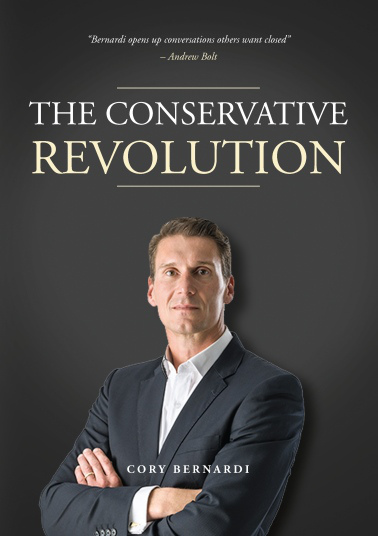
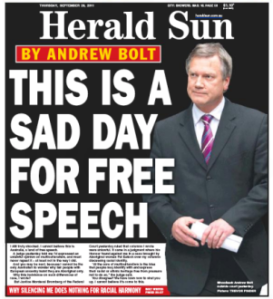
Wilson and Sexton join the likes of News Corp columnist Andrew Bolt and Liberal senator Cory Bernardi, who have similarly argued that publications such as Hebdo wouldn’t be permitted because of Section 18C.

There is at least some truth to these claims. A publication like Charlie Hebdo wouldn’t survive in Australia – not because of 18C – but because two major corporations dominate our mainstream media. We simply don’t have the same plurality of the press as they do in France. Anyone who has travelled in France would know of the diversity of French print media – with an impressive total of some 15,000 titles – which operates largely thanks to generous government subsidies.

France is tougher on hate speech

As for Section 18C, hate speech is subject to much stricter regulations in France (under both civil and criminal law) than in Australia.

In July last year, for example, Front National politician Anne-Sophie Leclère was sentenced to nine months’ imprisonment and fined 50,000 euros for comparing Attorney-General Christiane Taubira (who is black) to a monkey on her Facebook page. The criminal penalties imposed on Leclère seemed to pass without uproar or outrage. What did arouse public debate for going “too far” was the court’s decision to impose an additional fine of 30,000 euros on Front National.

Recall also French comedian Dieudonné, whose shows were banned last year because of his controversial quenelle gesture (an upside-down Nazi salute). His latest arrest came just 48 hours after the massive march in Paris in support of freedom of expression. His Facebook post, “Tonight, as far as I’m concerned, I feel like Charlie Coulibaly” – linking one of the Charlie Hebdo killers to the tribute “Je suis Charlie” – reportedly prompted the charge of being an “apologist for terrorism”.

Dieudonné has been the subject of numerous court proceedings. In February 2014, a French judge found him guilty of incitement of ethnic or racial hatred and denial of crimes against humanity over videos on his YouTube account. In October 2009, Dieudonné was fined 10,000 euros for “public insult of people of Jewish faith or origin”. The following year he was again forced to pay 10,000 euros, after the International League against Racism and Anti-Semitism brought defamation proceedings. In February 2007, a French court found his remarks in an interview printed in Lyon Capitale to be offensive and hence a necessary restriction on the freedom of speech.

It is worth noting that these were criminal penalties, not civil as with Section 18C. The point is that the portrayal of the French legal system put forward by some conservative commentators is simplistic and misleading. So too is the portrayal of Section 18C as draconian.

Australian lacks strong right to free speech

In France, freedom of expression has been protected since the Declaration of the Rights of Man and Citzen of 1789. Also, as in other liberal democracies, the right to free speech is not absolute, but must be balanced against other competing rights with reference to the circumstances of each case. Hence the Law on the Freedom of the Press of 29 July 1981, which offers protections from racist and defamatory declarations, anti-terrorism legislation, Holocaust denial and insult and incitement to discrimination, hate or violence against individuals.

Charlie Hebdo itself has a chequered history of legal proceedings. French media report nearly 50 court cases, or one every six months. These include criminal proceedings brought in 2007 against then editor Philippe Val by the Grand Mosque of Paris. Val was acquitted. As in this 2007 court case, Charlie Hebdo won the majority of these decisions not due to freedom of speech tout court, but thanks to the protections on caricature, droit a la caricature.

Columnist Andrew Bolt’s defence in Section 18C proceedings against him failed due to serious factual errors in his articles. AAP/Julian Smith

It is also worth recalling that the case that fuelled opposition to Section 18C, Eatock v. Bolt, concerned printed articles – not cartoons or caricature. Section 18D of the Racial Discrimination Act includes various exceptions, including for fair comment, artistic work and performance. In the Bolt case, the judge found against fair comment in the public interest because the articles contained significant factual errors.

Australia, unlike France and other democracies, has only an implied right to freedom of speech on political affairs in the constitution. Those with genuine concerns about lack of free speech protections in Australia would do better to campaign for a bill of rights rather than pursue misdirected battles against Section 18C.

When the anti-18C campaign does not extend to other legislated restrictions – for example, section 578C of the Crimes Act, which includes publication of offensive or indecent articles, or section 35P of the ASIO Act – there is good reason to be cynical. When couched in terms of one’s “right to be a bigot”, even more so.

Context and facts are missing from debate

What conservative commentators don’t seem to understand is that they are not Charlie Hebdo; such a comparison is laughable. It is a satirical left-wing magazine that makes fun of all religions, political parties and themselves.

More importantly, Charlie Hebdo is part of France’s rich comic culture. Accordingly, its articles and cartoons must be understood in terms of parody, satire and, above all, with reference to political and cultural context.

This last point seems to have been missed entirely in the debate on Charlie Hebdo in Australia. Other things that are missing include reference to actual legislation and court proceedings.

A debate on reforming Section 18C should be informed by research and reason, not ideological cheap shots.

French Television Show Eviscerates Fox News | Crooks and Liars: Murdoch’s Newscorp, Charlie was irreverent Fox News simply lies.

French News interviews people in Paris at the end of this keep watching. Charlie Hebdo was irreverent but Fox simply lies

French Television Show Eviscerates Fox News | Crooks and Liars.

Juan Cole: Twitter Mirth Erupts After Fox’s Steve Emerson Reveals ‘No-Go’ Zone for Non-Muslims in U.K. – Juan Cole – Truthdig : Fox News Practises Freedom of Press but No Truth

View image on Twitter

Juan Cole: Twitter Mirth Erupts After Fox’s Steve Emerson Reveals ‘No-Go’ Zone for Non-Muslims in U.K. – Juan Cole – Truthdig.

It’s compulsory patriotism o’clock : Australians will now be expected to stop what they’re doing at midday on Australia Day to sing our not actually very good national anthem

firstdog australiaday

Would Prophet Muhammad say ‘Je Suis Charlie’? Not according to Wahhabism and the justification for despotic rule.

Would Prophet Muhammad say ‘Je Suis Charlie’? – Opinion – Al Jazeera English.

Middle East Time Bomb: The Real Aim of ISIS Is to Replace the Saud Family as the New Emirs of Arabia

KING ABDULLAD

This article is Part II of Alastair Crooke’s historical analysis of the roots of ISIS and its impact on the future of the Middle East. Read Part I here.

BEIRUT — ISIS is indeed a veritable time bomb inserted into the heart of the Middle East. But its destructive power is not as commonly understood. It is not with the “March of the Beheaders”; it is not with the killings; the seizure of towns and villages; the harshest of “justice” — terrible though they are — that its true explosive power lies. It is yet more potent than its exponential pull on young Muslims, its huge arsenal of weapons and its hundreds of millions of dollars.

“We should understand that there is really almost nothing that the West can now do about it but sit and watch.”

Its real potential for destruction lies elsewhere — in the implosion of Saudi Arabia as a foundation stone of the modern Middle East. We should understand that there is really almost nothing that the West can now do about it but sit and watch.

The clue to its truly explosive potential, as Saudi scholar Fouad Ibrahim has pointed out (but which has passed, almost wholly overlooked, or its significance has gone unnoticed), is ISIS’ deliberate and intentional use in its doctrine — of the language of Abd-al Wahhab, the 18th century founder, together with Ibn Saud, of Wahhabism and the Saudi project:

Abu Omar al-Baghdadi, the first “prince of the faithful” in the Islamic State of Iraq, in 2006 formulated, for instance, the principles of his prospective state … Among its goals is disseminating monotheism “which is the purpose [for which humans were created] and [for which purpose they must be called] to Islam…” This language replicates exactly Abd-al Wahhab’s formulation. And, not surprisingly, the latter’s writings and Wahhabi commentaries on his works are widely distributed in the areas under ISIS’ control and are made the subject of study sessions. Baghdadi subsequently was to note approvingly, “a generation of young men [have been] trained based on the forgotten doctrine of loyalty and disavowal.”

And what is this “forgotten” tradition of “loyalty and disavowal?” It is Abd al-Wahhab’s doctrine that belief in a sole (for him an anthropomorphic) God — who was alone worthy of worship — was in itself insufficient to render man or woman a Muslim?

He or she could be no true believer, unless additionally, he or she actively denied (and destroyed) any other subject of worship. The list of such potential subjects of idolatrous worship, which al-Wahhab condemned as idolatry, was so extensive that almost all Muslims were at risk of falling under his definition of “unbelievers.” They therefore faced a choice: Either they convert to al-Wahhab’s vision of Islam — or be killed, and their wives, their children and physical property taken as the spoils of jihad. Even to express doubts about this doctrine, al-Wahhab said, should occasion execution.

“Through its intentional adoption of this Wahhabist language, ISIS is knowingly lighting the fuse to a bigger regional explosion — one that has a very real possibility of being ignited, and if it should succeed, will change the Middle East decisively.”

The point Fuad Ibrahim is making, I believe, is not merely to reemphasize the extreme reductionism of al-Wahhab’s vision, but to hint at something entirely different: That through its intentional adoption of this Wahhabist language, ISIS is knowingly lighting the fuse to a bigger regional explosion — one that has a very real possibility of being ignited, and if it should succeed, will change the Middle East decisively.

For it was precisely this idealistic, puritan, proselytizing formulation by al-Wahhab that was “father” to the entire Saudi “project” (one that was violently suppressed by the Ottomans in 1818, but spectacularly resurrected in the 1920s, to become the Saudi Kingdom that we know today). But since its renaissance in the 1920s, the Saudi project has always carried within it, the “gene” of its own self-destruction.

THE SAUDI TAIL HAS WAGGED BRITAIN AND U.S. IN THE MIDDLE EAST

Paradoxically, it was a maverick British official, who helped embed the gene into the new state. The British official attached to Aziz, was one Harry St. John Philby (the father of the MI6 officer who spied for the Soviet KGB, Kim Philby). He was to become King Abd al-Aziz’s close adviser, having resigned as a British official, and was until his death, a key member of the Ruler’s Court. He, like Lawrence of Arabia, was an Arabist. He was also a convert to Wahhabi Islam and known as Sheikh Abdullah.

St. John Philby was a man on the make: he had determined to make his friend, Abd al-Aziz, the ruler of Arabia. Indeed, it is clear that in furthering this ambition he was not acting on official instructions. When, for example, he encouraged King Aziz to expand in northern Nejd, he was ordered to desist. But (as American author, Stephen Schwartz notes), Aziz was well aware that Britain had pledged repeatedly that the defeat of the Ottomans would produce an Arab state, and this no doubt, encouraged Philby and Aziz to aspire to the latter becoming its new ruler.

It is not clear exactly what passed between Philby and the Ruler (the details seem somehow to have been suppressed), but it would appear that Philby’s vision was not confined to state-building in the conventional way, but rather was one of transforming the wider Islamic ummah (or community of believers) into a Wahhabist instrument that would entrench the al-Saud as Arabia’s leaders. And for this to happen, Aziz needed to win British acquiescence (and much later, American endorsement). “This was the gambit that Abd al-Aziz made his own, with advice from Philby,” notes Schwartz.

BRITISH GODFATHER OF SAUDI ARABIA

In a sense, Philby may be said to be “godfather” to this momentous pact by which the Saudi leadership would use its clout to “manage” Sunni Islam on behalf of western objectives (containing socialism, Ba’athism, Nasserism, Soviet influence, Iran, etc.) — and in return, the West would acquiesce to Saudi Arabia’s soft-power Wahhabisation of the Islamic ummah (with its concomitant destruction of Islam’s intellectual traditions and diversity and its sowing of deep divisions within the Muslim world).

“In political and financial terms, the Saud-Philby strategy has been an astonishing success. But it was always rooted in British and American intellectual obtuseness: the refusal to see the dangerous ‘gene’ within the Wahhabist project, its latent potential to mutate, at any time, back into its original a bloody, puritan strain. In any event, this has just happened: ISIS is it.”

As a result — from then until now — British and American policy has been bound to Saudi aims (as tightly as to their own ones), and has been heavily dependent on Saudi Arabia for direction in pursuing its course in the Middle East.

In political and financial terms, the Saud-Philby strategy has been an astonishing success (if taken on its own, cynical, self-serving terms). But it was always rooted in British and American intellectual obtuseness: the refusal to see the dangerous “gene” within the Wahhabist project, its latent potential to mutate, at any time, back into its original a bloody, puritan strain. In any event, this has just happened: ISIS is it.

Winning western endorsement (and continued western endorsement), however, required a change of mode: the “project” had to change from being an armed, proselytizing Islamic vanguard movement into something resembling statecraft. This was never going to be easy because of the inherent contradictions involved (puritan morality versus realpolitik and money) — and as time has progressed, the problems of accommodating the “modernity” that statehood requires, has caused “the gene” to become more active, rather than become more inert.

Even Abd al-Aziz himself faced an allergic reaction: in the form of a serious rebellion from his own Wahhabi militia, the Saudi Ikhwan. When the expansion of control by the Ikhwan reached the border of territories controlled by Britain, Abd al-Aziz tried to restrain his militia (Philby was urging him to seek British patronage), but the Ikwhan, already critical of his use of modern technology (the telephone, telegraph and the machine gun), “were outraged by the abandonment of jihad for reasons of worldly realpolitik … They refused to lay down their weapons; and instead rebelled against their king … After a series of bloody clashes, they were crushed in 1929. Ikhwan members who had remained loyal, were later absorbed into the [Saudi] National Guard.”

King Aziz’s son and heir, Saud, faced a different form of reaction (less bloody, but more effective). Aziz’s son was deposed from the throne by the religious establishment — in favor of his brother Faisal — because of his ostentatious and extravagant conduct. His lavish, ostentatious style, offended the religious establishment who expected the “Imam of Muslims,” to pursue a pious, proselytizing lifestyle.

King Faisal, Saud’s successor, in his turn, was shot by his nephew in 1975, who had appeared at Court ostensibly to make his oath of allegiance, but who instead, pulled out a pistol and shot the king in his head. The nephew had been perturbed by the encroachment of western beliefs and innovation into Wahhabi society, to the detriment of the original ideals of the Wahhabist project.

SEIZING THE GRAND MOSQUE IN 1979

Far more serious, however, was the revived Ikhwan of Juhayman al-Otaybi, which culminated in the seizure of the Grand Mosque by some 400-500 armed men and women in 1979. Juhayman was from the influential Otaybi tribe from the Nejd, which had led and been a principal element in the original Ikhwan of the 1920s.

Juhayman and his followers, many of whom came from the Medina seminary, had the tacit support, amongst other clerics, of Sheikh Abdel-Aziz Bin Baz, the former Mufti of Saudi Arabia. Juhayman stated that Sheikh Bin Baz never objected to his Ikhwan teachings (which were also critical of ulema laxity towards “disbelief”), but that bin Baz had blamed him mostly for harking on that “the ruling al-Saud dynasty had lost its legitimacy because it was corrupt, ostentatious and had destroyed Saudi culture by an aggressive policy of westernisation.”

Significantly, Juhayman’s followers preached their Ikhwani message in a number of mosques in Saudi Arabia initially without being arrested, but when Juhayman and a number of the Ikhwan finally were held for questioning in 1978. Members of the ulema (including bin Baz) cross-examined them for heresy, but then ordered their release because they saw them as being no more than traditionalists harkening back to the Ikhwan— like Juhayman grandfather — and therefore not a threat.

Even when the mosque seizure was defeated and over, a certain level of forbearance by the ulema for the rebels remained. When the government asked for a fatwa allowing for armed force to be used in the mosque, the language of bin Baz and other senior ulema was curiously restrained. The scholars did not declare Juhayman and his followers non-Muslims, despite their violation of the sanctity of the Grand Mosque, but only termed them al-jamaah al-musallahah (the armed group).

The group that Juhayman led was far from marginalized from important sources of power and wealth. In a sense, it swam in friendly, receptive waters. Juhayman’s grandfather had been one of the leaders of the the original Ikhwan, and after the rebellion against Abdel Aziz, many of his grandfather’s comrades in arms were absorbed into the National Guard — indeed Juhayman himself had served within the Guard — thus Juhayman was able to obtain weapons and military expertise from sympathizers in the National Guard, and the necessary arms and food to sustain the siege were pre-positioned, and hidden, within the Grand Mosque. Juhayman was also able to call on wealthy individuals to fund the enterprise.

ISIS VS. WESTERNIZED SAUDIS

The point of rehearsing this history is to underline how uneasy the Saudi leadership must be at the rise of ISIS in Iraq and Syria. Previous Ikhwani manifestations were suppressed — but these all occurred inside the kingdom.

ISIS however, is a neo-Ikhwani rejectionist protest that is taking place outside the kingdom — and which, moreover, follows the Juhayman dissidence in its trenchant criticism of the al-Saud ruling family.

This is the deep schism we see today in Saudi Arabia, between the modernizing current of which King Abdullah is a part, and the “Juhayman” orientation of which bin Laden, and the Saudi supporters of ISIS and the Saudi religious establishment are a part. It is also a schism that exists within the Saudi royal family itself.

According to the Saudi-owned Al-Hayat newspaper, in July 2014 “an opinion poll of Saudis [was] released on social networking sites, claiming that 92 percent of the target group believes that ‘IS conforms to the values of Islam and Islamic law.'” The leading Saudi commentator, Jamal Khashoggi, recently warned of ISIS’ Saudi supporters who “watch from the shadows.”

There are angry youths with a skewed mentality and understanding of life and sharia, and they are canceling a heritage of centuries and the supposed gains of a modernization that hasn’t been completed. They turned into rebels, emirs and a caliph invading a vast area of our land. They are hijacking our children’s minds and canceling borders. They reject all rules and legislations, throwing it [a]way … for their vision of politics, governance, life, society and economy. [For] the citizens of the self-declared “commander of the faithful,” or Caliph, you have no other choice … They don’t care if you stand out among your people and if you are an educated man, or a lecturer, or a tribe leader, or a religious leader, or an active politician or even a judge … You must obey the commander of the faithful and pledge the oath of allegiance to him. When their policies are questioned, Abu Obedia al-Jazrawi yells, saying: “Shut up. Our reference is the book and the Sunnah and that’s it.”

“What did we do wrong?” Khashoggi asks. With 3,000-4,000 Saudi fighters in the Islamic State today, he advises of the need to “look inward to explain ISIS’ rise”. Maybe it is time, he says, to admit “our political mistakes,” to “correct the mistakes of our predecessors.”

MODERNIZING KING THE MOST VULNERABLE

The present Saudi king, Abdullah, paradoxically is all the more vulnerable precisely because he has been a modernizer. The King has curbed the influence of the religious institutions and the religious police — and importantly has permitted the four Sunni schools of jurisprudence to be used, by those who adhere to them (al-Wahhab, by contrast, objected to all other schools of jurisprudence other than his own).

“The key political question is whether the simple fact of ISIS’ successes, and the full manifestation (flowering) of all the original pieties and vanguardism of the archetypal impulse, will stimulate and activate the dissenter ‘gene’ — within the Saudi kingdom. If it does, and Saudi Arabia is engulfed by the ISIS fervor, the Gulf will never be the same again. Saudi Arabia will deconstruct and the Middle East will be unrecognizable.”

It is even possible too for Shiite residents of eastern Saudi Arabia to invoke Ja’afri jurisprudence and to turn to Ja’afari Shiite clerics for rulings. (In clear contrast, al-Wahhab held a particular animosity towards the Shiite and held them to be apostates. As recently as the 1990s, clerics such as bin Baz — the former Mufti — and Abdullah Jibrin reiterated the customary view that the Shiite were infidels).

Some contemporary Saudi ulema would regard such reforms as constituting almost a provocation against Wahhabist doctrines, or at the very least, another example of westernization. ISIS, for example, regards any who seek jurisdiction other than that offered by the Islamic State itself to be guilty of disbelief — since all such “other” jurisdictions embody innovation or “borrowings” from other cultures in its view.

The key political question is whether the simple fact of ISIS’ successes, and the full manifestation (flowering) of all the original pieties and vanguardism of the archetypal impulse, will stimulate and activate the dissenter ‘gene’ — within the Saudi kingdom.

If it does, and Saudi Arabia is engulfed by the ISIS fervor, the Gulf will never be the same again. Saudi Arabia will deconstruct and the Middle East will be unrecognizable.

“They hold up a mirror to Saudi society that seems to reflect back to them an image of ‘purity’ lost”

In short, this is the nature of the time bomb tossed into the Middle East. The ISIS allusions to Abd al-Wahhab and Juhayman (whose dissident writings are circulated within ISIS) present a powerful provocation: they hold up a mirror to Saudi society that seems to reflect back to them an image of “purity” lost and early beliefs and certainties displaced by shows of wealth and indulgence.

This is the ISIS “bomb” hurled into Saudi society. King Abdullah — and his reforms — are popular, and perhaps he can contain a new outbreak of Ikwhani dissidence. But will that option remain a possibility after his death?

And here is the difficulty with evolving U.S. policy, which seems to be one of “leading from behind” again — and looking to Sunni states and communities to coalesce in the fight against ISIS (as in Iraq with the Awakening Councils).

It is a strategy that seems highly implausible. Who would want to insert themselves into this sensitive intra-Saudi rift? And would concerted Sunni attacks on ISIS make King Abdullah’s situation better, or might it inflame and anger domestic Saudi dissidence even further? So whom precisely does ISIS threaten? It could not be clearer. It does not directly threaten the West (though westerners should remain wary, and not tread on this particular scorpion).

The Saudi Ikhwani history is plain: As Ibn Saud and Abd al-Wahhab made it such in the 18th century; and as the Saudi Ikhwan made it such in the 20th century. ISIS’ real target must be the Hijaz — the seizure of Mecca and Medina — and the legitimacy that this will confer on ISIS as the new Emirs of Arabia.

You Can’t Understand ISIS If You Don’t Know the History of Wahhabism in Saudi Arabia

BEIRUT — The dramatic arrival of Da’ish (ISIS) on the stage of Iraq has shocked many in the West. Many have been perplexed — and horrified — by its violence and its evident magnetism for Sunni youth. But more than this, they find Saudi Arabia’s ambivalence in the face of this manifestation both troubling and inexplicable, wondering, “Don’t the Saudis understand that ISIS threatens them, too?”

It appears — even now — that Saudi Arabia’s ruling elite is divided. Some applaud that ISIS is fighting Iranian Shiite “fire” with Sunni “fire”; that a new Sunni state is taking shape at the very heart of what they regard as a historical Sunni patrimony; and they are drawn by Da’ish’s strict Salafist ideology.

Other Saudis are more fearful, and recall the history of the revolt against Abd-al Aziz by the Wahhabist Ikhwan (Disclaimer: this Ikhwan has nothing to do with the Muslim Brotherhood Ikhwan — please note, all further references hereafter are to the Wahhabist Ikhwan, and not to the Muslim Brotherhood Ikhwan), but which nearly imploded Wahhabism and the al-Saud in the late 1920s.

Many Saudis are deeply disturbed by the radical doctrines of Da’ish (ISIS) — and are beginning to question some aspects of Saudi Arabia’s direction and discourse.

THE SAUDI DUALITY

Saudi Arabia’s internal discord and tensions over ISIS can only be understood by grasping the inherent (and persisting) duality that lies at the core of the Kingdom’s doctrinal makeup and its historical origins.

One dominant strand to the Saudi identity pertains directly to Muhammad ibn ʿAbd al-Wahhab (the founder of Wahhabism), and the use to which his radical, exclusionist puritanism was put by Ibn Saud. (The latter was then no more than a minor leader — amongst many — of continually sparring and raiding Bedouin tribes in the baking and desperately poor deserts of the Nejd.)

The second strand to this perplexing duality, relates precisely to King Abd-al Aziz’s subsequent shift towards statehood in the 1920s: his curbing of Ikhwani violence (in order to have diplomatic standing as a nation-state with Britain and America); his institutionalization of the original Wahhabist impulse — and the subsequent seizing of the opportunely surging petrodollar spigot in the 1970s, to channel the volatile Ikhwani current away from home towards export — by diffusing a cultural revolution, rather than violent revolution throughout the Muslim world.

But this “cultural revolution” was no docile reformism. It was a revolution based on Abd al-Wahhab’s Jacobin-like hatred for the putrescence and deviationism that he perceived all about him — hence his call to purge Islam of all its heresies and idolatries.

MUSLIM IMPOSTORS

The American author and journalist, Steven Coll, has written how this austere and censorious disciple of the 14th century scholar Ibn Taymiyyah, Abd al-Wahhab, despised “the decorous, arty, tobacco smoking, hashish imbibing, drum pounding Egyptian and Ottoman nobility who travelled across Arabia to pray at Mecca.”

In Abd al-Wahhab’s view, these were not Muslims; they were imposters masquerading as Muslims. Nor, indeed, did he find the behavior of local Bedouin Arabs much better. They aggravated Abd al-Wahhab by their honoring of saints, by their erecting of tombstones, and their “superstition” (e.g. revering graves or places that were deemed particularly imbued with the divine).

All this behavior, Abd al-Wahhab denounced as bida — forbidden by God.

Like Taymiyyah before him, Abd al-Wahhab believed that the period of the Prophet Muhammad’s stay in Medina was the ideal of Muslim society (the “best of times”), to which all Muslims should aspire to emulate (this, essentially, is Salafism).

Taymiyyah had declared war on Shi’ism, Sufism and Greek philosophy. He spoke out, too against visiting the grave of the prophet and the celebration of his birthday, declaring that all such behavior represented mere imitation of the Christian worship of Jesus as God (i.e. idolatry). Abd al-Wahhab assimilated all this earlier teaching, stating that “any doubt or hesitation” on the part of a believer in respect to his or her acknowledging this particular interpretation of Islam should “deprive a man of immunity of his property and his life.”

One of the main tenets of Abd al-Wahhab’s doctrine has become the key idea of takfir. Under the takfiri doctrine, Abd al-Wahhab and his followers could deem fellow Muslims infidels should they engage in activities that in any way could be said to encroach on the sovereignty of the absolute Authority (that is, the King). Abd al-Wahhab denounced all Muslims who honored the dead, saints, or angels. He held that such sentiments detracted from the complete subservience one must feel towards God, and only God. Wahhabi Islam thus bans any prayer to saints and dead loved ones, pilgrimages to tombs and special mosques, religious festivals celebrating saints, the honoring of the Muslim Prophet Muhammad’s birthday, and even prohibits the use of gravestones when burying the dead.

“Those who would not conform to this view should be killed, their wives and daughters violated, and their possessions confiscated, he wrote. “

Abd al-Wahhab demanded conformity — a conformity that was to be demonstrated in physical and tangible ways. He argued that all Muslims must individually pledge their allegiance to a single Muslim leader (a Caliph, if there were one). Those who would not conform to this view should be killed, their wives and daughters violated, and their possessions confiscated, he wrote. The list of apostates meriting death included the Shiite, Sufis and other Muslim denominations, whom Abd al-Wahhab did not consider to be Muslim at all.

There is nothing here that separates Wahhabism from ISIS. The rift would emerge only later: from the subsequent institutionalization of Muhammad ibn ʿAbd al-Wahhab’s doctrine of “One Ruler, One Authority, One Mosque” — these three pillars being taken respectively to refer to the Saudi king, the absolute authority of official Wahhabism, and its control of “the word” (i.e. the mosque).

It is this rift — the ISIS denial of these three pillars on which the whole of Sunni authority presently rests — makes ISIS, which in all other respects conforms to Wahhabism, a deep threat to Saudi Arabia.

BRIEF HISTORY 1741- 1818

Abd al-Wahhab’s advocacy of these ultra radical views inevitably led to his expulsion from his own town — and in 1741, after some wanderings, he found refuge under the protection of Ibn Saud and his tribe. What Ibn Saud perceived in Abd al-Wahhab’s novel teaching was the means to overturn Arab tradition and convention. It was a path to seizing power.

“Their strategy — like that of ISIS today — was to bring the peoples whom they conquered into submission. They aimed to instill fear. “

Ibn Saud’s clan, seizing on Abd al-Wahhab’s doctrine, now could do what they always did, which was raiding neighboring villages and robbing them of their possessions. Only now they were doing it not within the ambit of Arab tradition, but rather under the banner of jihad. Ibn Saud and Abd al-Wahhab also reintroduced the idea of martyrdom in the name of jihad, as it granted those martyred immediate entry into paradise.

In the beginning, they conquered a few local communities and imposed their rule over them. (The conquered inhabitants were given a limited choice: conversion to Wahhabism or death.) By 1790, the Alliance controlled most of the Arabian Peninsula and repeatedly raided Medina, Syria and Iraq.

Their strategy — like that of ISIS today — was to bring the peoples whom they conquered into submission. They aimed to instill fear. In 1801, the Allies attacked the Holy City of Karbala in Iraq. They massacred thousands of Shiites, including women and children. Many Shiite shrines were destroyed, including the shrine of Imam Hussein, the murdered grandson of Prophet Muhammad.

A British official, Lieutenant Francis Warden, observing the situation at the time, wrote: “They pillaged the whole of it [Karbala], and plundered the Tomb of Hussein… slaying in the course of the day, with circumstances of peculiar cruelty, above five thousand of the inhabitants …”

Osman Ibn Bishr Najdi, the historian of the first Saudi state, wrote that Ibn Saud committed a massacre in Karbala in 1801. He proudly documented that massacre saying, “we took Karbala and slaughtered and took its people (as slaves), then praise be to Allah, Lord of the Worlds, and we do not apologize for that and say: ‘And to the unbelievers: the same treatment.'”

In 1803, Abdul Aziz then entered the Holy City of Mecca, which surrendered under the impact of terror and panic (the same fate was to befall Medina, too). Abd al-Wahhab’s followers demolished historical monuments and all the tombs and shrines in their midst. By the end, they had destroyed centuries of Islamic architecture near the Grand Mosque.

But in November of 1803, a Shiite assassin killed King Abdul Aziz (taking revenge for the massacre at Karbala). His son, Saud bin Abd al Aziz, succeeded him and continued the conquest of Arabia. Ottoman rulers, however, could no longer just sit back and watch as their empire was devoured piece by piece. In 1812, the Ottoman army, composed of Egyptians, pushed the Alliance out from Medina, Jeddah and Mecca. In 1814, Saud bin Abd al Aziz died of fever. His unfortunate son Abdullah bin Saud, however, was taken by the Ottomans to Istanbul, where he was gruesomely executed (a visitor to Istanbul reported seeing him having been humiliated in the streets of Istanbul for three days, then hanged and beheaded, his severed head fired from a canon, and his heart cut out and impaled on his body).

In 1815, Wahhabi forces were crushed by the Egyptians (acting on the Ottoman’s behalf) in a decisive battle. In 1818, the Ottomans captured and destroyed the Wahhabi capital of Dariyah. The first Saudi state was no more. The few remaining Wahhabis withdrew into the desert to regroup, and there they remained, quiescent for most of the 19th century.

HISTORY RETURNS WITH ISIS

It is not hard to understand how the founding of the Islamic State by ISIS in contemporary Iraq might resonate amongst those who recall this history. Indeed, the ethos of 18th century Wahhabism did not just wither in Nejd, but it roared back into life when the Ottoman Empire collapsed amongst the chaos of World War I.

The Al Saud — in this 20th century renaissance — were led by the laconic and politically astute Abd-al Aziz, who, on uniting the fractious Bedouin tribes, launched the Saudi “Ikhwan” in the spirit of Abd-al Wahhab’s and Ibn Saud’s earlier fighting proselytisers.

The Ikhwan was a reincarnation of the early, fierce, semi-independent vanguard movement of committed armed Wahhabist “moralists” who almost had succeeded in seizing Arabia by the early 1800s. In the same manner as earlier, the Ikhwan again succeeded in capturing Mecca, Medina and Jeddah between 1914 and 1926. Abd-al Aziz, however, began to feel his wider interests to be threatened by the revolutionary “Jacobinism” exhibited by the Ikhwan. The Ikhwan revolted — leading to a civil war that lasted until the 1930s, when the King had them put down: he machine-gunned them.

For this king, (Abd-al Aziz), the simple verities of previous decades were eroding. Oil was being discovered in the peninsular. Britain and America were courting Abd-al Aziz, but still were inclined to support Sharif Husain as the only legitimate ruler of Arabia. The Saudis needed to develop a more sophisticated diplomatic posture.

So Wahhabism was forcefully changed from a movement of revolutionary jihad and theological takfiri purification, to a movement of conservative social, political, theological, and religious da’wa (Islamic call) and to justifying the institution that upholds loyalty to the royal Saudi family and the King’s absolute power.

OIL WEALTH SPREAD WAHHABISM

With the advent of the oil bonanza — as the French scholar, Giles Kepel writes, Saudi goals were to “reach out and spread Wahhabism across the Muslim world … to “Wahhabise” Islam, thereby reducing the “multitude of voices within the religion” to a “single creed” — a movement which would transcend national divisions. Billions of dollars were — and continue to be — invested in this manifestation of soft power.

It was this heady mix of billion dollar soft power projection — and the Saudi willingness to manage Sunni Islam both to further America’s interests, as it concomitantly embedded Wahhabism educationally, socially and culturally throughout the lands of Islam — that brought into being a western policy dependency on Saudi Arabia, a dependency that has endured since Abd-al Aziz’s meeting with Roosevelt on a U.S. warship (returning the president from the Yalta Conference) until today.

Westerners looked at the Kingdom and their gaze was taken by the wealth; by the apparent modernization; by the professed leadership of the Islamic world. They chose to presume that the Kingdom was bending to the imperatives of modern life — and that the management of Sunni Islam would bend the Kingdom, too, to modern life.

“On the one hand, ISIS is deeply Wahhabist. On the other hand, it is ultra radical in a different way. It could be seen essentially as a corrective movement to contemporary Wahhabism.”

But the Saudi Ikhwan approach to Islam did not die in the 1930s. It retreated, but it maintained its hold over parts of the system — hence the duality that we observe today in the Saudi attitude towards ISIS.

On the one hand, ISIS is deeply Wahhabist. On the other hand, it is ultra radical in a different way. It could be seen essentially as a corrective movement to contemporary Wahhabism.

ISIS is a “post-Medina” movement: it looks to the actions of the first two Caliphs, rather than the Prophet Muhammad himself, as a source of emulation, and it forcefully denies the Saudis’ claim of authority to rule.

As the Saudi monarchy blossomed in the oil age into an ever more inflated institution, the appeal of the Ikhwan message gained ground (despite King Faisal’s modernization campaign). The “Ikhwan approach” enjoyed — and still enjoys — the support of many prominent men and women and sheikhs. In a sense, Osama bin Laden was precisely the representative of a late flowering of this Ikhwani approach.

Today, ISIS’ undermining of the legitimacy of the King’s legitimacy is not seen to be problematic, but rather a return to the true origins of the Saudi-Wahhab project.

In the collaborative management of the region by the Saudis and the West in pursuit of the many western projects (countering socialism, Ba’athism, Nasserism, Soviet and Iranian influence), western politicians have highlighted their chosen reading of Saudi Arabia (wealth, modernization and influence), but they chose to ignore the Wahhabist impulse.

After all, the more radical Islamist movements were perceived by Western intelligence services as being more effective in toppling the USSR in Afghanistan — and in combatting out-of-favor Middle Eastern leaders and states.

Why should we be surprised then, that from Prince Bandar’s Saudi-Western mandate to manage the insurgency in Syria against President Assad should have emerged a neo-Ikhwan type of violent, fear-inducing vanguard movement: ISIS? And why should we be surprised — knowing a little about Wahhabism — that “moderate” insurgents in Syria would become rarer than a mythical unicorn? Why should we have imagined that radical Wahhabism would create moderates? Or why could we imagine that a doctrine of “One leader, One authority, One mosque: submit to it, or be killed” could ever ultimately lead to moderation or tolerance?

Or, perhaps, we never imagined.

This article is Part I of Alastair Crooke’s historical analysis of the roots of ISIS and its impact on the future of the Middle East. Read Part II here.

A love letter to Medicare : First Dog

firstdog medicare

Tony Abbott Village Idiot

Jesus Distances Himself From State Lawmakers

jesus7

ROME, ITALY (CT&P) – Jesus paused briefly outside the Roma Convention Centre and Exhibition Hall to talk to reporters today regarding the irritating rash of “Religious Freedom Restoration” acts sweeping the country in recent weeks. It seems the Messiah is more than a little irritated with right-wing lawmakers in state houses across America.

“I’d just like to say that these so-called ‘religious freedom acts’ are no more than thinly veiled attempts by pseudo Christians to codify their bigotry and hatred into law,” said the Son of God. “If these people can’t serve homosexuals or gay couples in their various businesses because it offends their so-called ‘faith’, then that faith is not worth a hoot in Hell.”

jesus-dinosaur2

“These talking monkey politicians should be a little bit more interested in helping their fellow humans in any way they can rather than telling others who the hell they can sleep with and marry,” said the Prince of Peace. “If you cretins think that Dad and I sit up there and scrutinize every action you people take down here and worry about your damn sexual preferences, well then you’ve got another thing coming. We’ve got slightly better things to do. After all, we manage the entire universe for Heaven’s sake. Who the hell do you think we are, the NSA?”

“Let me make this clear for about the millionth time in 2000 years: I don’t like bigots, racists, homophobes, or assholes in general. I already have to take a fist full of antacids every day to get over the nausea caused by the actions you cretins take in my name. Please start behaving yourselves or prepare to suffer the consequences. I made a brief visit to Hell myself a while back, and believe me, Lucifer has plenty of room for all you miscreants!”

“Now you’ll have to excuse me because I’ve got to mosey on over to the Vatican so I can jerk a knot in Francis’ tail regarding the limits of free speech. You people just wear my ass out sometimes.”

The Lord of Light and Lamb of God was in town promoting the new Birkenstock line of “Wandering Zealot” sandals at the 2015 Saints and Prophets New Product Expo held annually at the Roma Convention Centre. He is expected to leave on Sunday after Mass, and as usual no one knows when he will be coming back.

Plutocrats and Pitchforks by: John Kelly

global

The word ‘revolution’ has throughout history been synonymous with the cry for equality and social change. The French Revolution of 1789, the Russian Revolution of 1917, the Cuban Revolution of 1959 to name a few, all began because the divide between the haves and the have nots became intolerable. In the examples above, social inequality was at historically high levels and getting worse by the day. Something had to happen and it did, much of it violent and bloody.

Revolutions were generally born of peasant unrest, dissatisfaction, a sense of betrayal by once revered heroes who were seduced by their own power and their accumulation of vast wealth. When that peasant dissatisfaction reached a tipping point, revolution became the only recourse.

Today the wealthiest 1% in our society enjoy a lifestyle that much of the 99% could not even imagine. Furthermore, the gap continues to widen such that the line between middle and lower class workers is now blurred, while the gap between middle and upper income levels grows wider and easier to see.

While any high functioning capitalist economy will always have inequality to some degree, the divide as it exists today is so geared toward greater wealth for the fewer that the middle class is in danger of disappearing altogether. The message for all those living in their gated compounds and ivory towers is, it cannot last.

Statistics are not needed to reinforce these claims. They simply confirm what the 99% already know. But, for the record, in 1980 in the USA, the top 1% controlled about 8% of the national income while the bottom 50% shared about 18%. Today, the top 1% share 20% of the national income while the bottom 50% share just 12%.

In Australia, similar comparisons are difficult to find but in measuring wealth by quintiles, the ABS found that in 2011 the top 20% of households owned 62% of the wealth while the bottom 20% held less than 1%. In fact the top 20% held more wealth than the rest combined. The conclusion was that wealth inequality was rising fast.

Free market capitalism in its present form is no longer a recipe for a sustained, prosperous, happy, healthy society. Today, capitalism is synonymous with inequality, unfairness and discrimination. With today’s capitalism we are drifting toward feudalism.

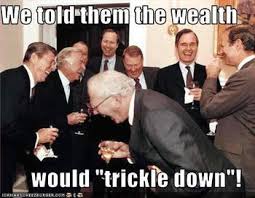
trickle downInequality has grown so dramatically over the past thirty years that our once great egalitarian Australia of the 1960s and ’70s has all but disappeared. And to quote Joseph Stiglitz, “one of the major culprits has been trickle-down economics—the idea that the government can just step back and if the rich get richer and use their talents and resources to create jobs, everyone will benefit. It just doesn’t work; the historical data now proves that.”

If ever world leaders had an opportunity to revolutionise capitalism it was in the aftermath of the Global Financial Crisis (GFC). Just six years on from that incredible opportunity, we can see they have failed and have done so, spectacularly.

Bank bailouts without conditions will be a dark legacy for Barack Obama in an otherwise reasonable presidency and now the opportunity has all but passed. The US stock market has not just recovered but surpassed pre 2008 lows. The rich are richer and the poor are poorer in far greater numbers than before. For the 1%, the plutocrats, it’s business as usual.

The Reagan trickle-down effect is back with a vengeance and is now the hallmark of the present Australian government despite a plethora of information, data, and recent history to demonstrate its failure. They still expect business to lead a national recovery with investment in goods and services. What they don’t get, is that an underutilised workforce cannot afford it. Business knows this. That is why they will not commit.

The government cannot see that a vibrant, active, well-educated workforce is an essential component of a strong, robust economy; a component that creates demand that results in stronger growth, stronger investment and stronger taxes.

Blinded by the advice from bankers, investment houses and those whose fortunes are derived from manipulating stock markets and overvaluing mortgage stocks, Tony Abbott and Joe Hockey are no more than a mouthpiece for the 1%; the plutocrats. They are victims of their own self-serving ideology. While they are in power nothing will change, no improvement for the 99% will ever eventuate.
nick

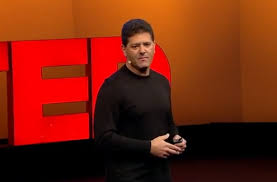
Any realistic observer can see that this trend is unsustainable and its future unpredictable. While the plutocrats continue to build their wealth, billionaire Nick Hanauer thinks they might inherit pitchforks.

While the 1% enjoy their wealth, blind to the signs of desperation around them, a single act of defiance by someone desperate and destitute enough could mobilise thousands in support and roll across the country like a tidal wave. The 1% could be caught like the frog in the saucepan unaware the water has reached boiling point. But by then, it will be too late.

I don’t think anyone in government, least of all Scott Morrison, anticipated riots leading to murder and self-immolation when he embarked upon his ruthless policy of deprivation detention on Manus Island. That crept up without warning. And now, I don’t think either he or his party foresee all the possible outcomes if they embark upon a policy of reducing welfare at a time of fiscal contraction.

He may not even care but he could well be responsible for creating a new underclass that has no respect for law and order. He could well extend existing poverty further into the realm of the middle class, bringing welfare agencies to their knees trying to cope. This is where that one defiant act could likely emerge.

pitchforksHistory is littered with such circumstances and the consequences of doing nothing. The 1% won’t see it coming, but governments should. And they should do something to stop it, or they too will feel the pitchforks. They can plead ignorance but that won’t save them.

They can say their hands were tied but their complicity will be all too obvious. The plutocrats will never change voluntarily. The government is running out of time to do it for them.

Murdoch Press a Truthless Tiger: Arguing with them on Climate Change, Islamaphobia, the ABC, or any other topic is like playing chess with a pigeon

‘I Am Marxist’ Says Dalai Lama

The Dalai Lama identified himself as a Marxist on Tuesday while addressing capitalism, discrimination and violence at a lecture on world peace in Kolkata, India. This is not the first time that the 14th Dalai Lama has spoken about his political leaning – in 2011 he said: “I consider myself a Marxist…but not a Leninist”  when speaking at a conference in Minneapolis.

“We must have a human approach. As far as socioeconomic theory, I am Marxist,”  he said to the audience on Tuesday, at the lecture entitled ‘A Human Approach to World Peace’ which was organized by Presidency University.

The Tibetan spiritual leader partly blamed capitalism for inequality and said he regarded Marxism as the answer: “In capitalist countries, there is an increasing gap between the rich and the poor. In Marxism, there is emphasis on equal distribution,” he said, adding that “many Marxist leaders are now capitalists in their thinking”.

He said that he regarded economic and social inequality in India as the reason for ongoing discrimination against women and low social castes, calling on the world’s youth to take the 21st century from a century of violence to a “century of peace”.


“I will not see this in my lifetime but we must start working on it. Those below thirty are the generation of the 21st century. You have to stop violence with your will, vision and wisdom,” adding that nuclear weapons should be banned.

The Dalai Lama’s sentiments are not shared by the Pope Francis, however, who has repeatedly dismissed suggestions that he is a communist. Earlier this week, the Pope again defended his economic and social ideologies by saying they are rooted in the Christian faith, not Marxism.

“As we can see, this concern for the poor is in the gospel, it is within the tradition of the church, it is not an invention of communism and it must not be turned into some ideology, as has sometimes happened before in the course of history,” he said in an interview taken from This Economy Kills, a book of his teachings set for release in Italian this week.

One critic, American radio host Rush Lambaugh, has referred to the Pope’s views on poverty and growing inequality as “pure Marxism”.

There are currently rumours circulating that the Dalai Lama will be making an appearance at the UK’s Glastonbury Festival in June 2015. Despite an announcement being made on his official site in early January 2015 announcing his attendance, the post was quickly deleted and the organisers have refused to comment.

Free Press

Freedom…well for some of us anyway. Comment: Isn’t Freedom of Speech meant to coexist with Fraternity and Equality in any ideal secular and democratic state? Then again Press and Speech aren’t really equivalent as the Press is about ownership and capital & within whose confines there is no freedom only corporate interest.Strange how the strongest advocates of Freedom of Speech reside where they will never have true freedom.

Freedom-of-Speech-megaphone

“Freedom of speech is not just an academic nicety but the essential pre-condition for any kind of progress. A child learns by trial and error. A society advances when people can discuss what works and what doesn’t. To the extent that alternatives can’t be discussed, people are tethered to the status quo, regardless of its effectiveness.

Thanks to free speech, error can be exposed, corruption revealed, arrogance deflated, mistakes corrected, the right upheld and truth flaunted in the face of power. On issues of value, purpose and meaning, there is no committee, however expert, and no appointee, however eminent, with judgment superior to that of the whole community which is why the best decisions are made with free debate rather than without it.”  – Tony Abbott 2012

George Brandis repeatedly justified his plans to remove the protections of the Racial Discrimination Act by insisting that “our freedom and our democracy fundamentally depend upon the right to free speech”.

How does he reconcile that sentiment with the substantial restrictions the government has placed on efforts by the media and public to access information about asylum seeker arrivals and conditions on Manus Island?

When ten aid workers from Save the Children staff at the Nauru detention centre raised concerns of sexual abuse and self harm of children in detention they were suspended.

“If people want to be political activists, that’s their choice. But they don’t get to do it on the taxpayer’s dollar,” the minister said.

I wonder if getting children on Christmas Island to ring Senator Ricky Muir begging him to release them so he will vote for legislation count as activism?  I can think of a few more appropriate terms.

Yesterday it was reported that thousands of Immigration Department public servants face the sack if they fail to comply with tough new security tests imposed by their new bosses.

Immigration’s 8500 officials have been told they must complete an “organisational suitability assessment” if they want to work at Border Force Australia, the new merged agency combining Immigration and Customs.

There will also be a crackdown on second jobs, social media use and sloppy appearances among the department’s public servants, as the Customs agency hierarchy tightens its grip on Immigration.

Holders of a baseline security clearance must declare any criminal or other legal matters in their past, changes to their personal circumstances and even any shift in political or religious belief or affiliation.

But under the organisational suitability rules, the public servants must disclose “criminal or high risk associations, conflicts of interest, criminal history and/or involvement in criminal or illegal activities, compliance with border-related laws, use of illicit substances [and] compliance with the Australian Public Service values”.

Officers were told that a failure to take part in the process or getting an adverse ruling would result in employees losing their jobs, or at least being transferred to another public service department.

Could you imagine our politicians submitting to similar rules?

In 2012, when addressing the IPA, Tony Abbott said

“There is no case, none, to limit debate about the performance of national leaders. The more powerful people are, the more important the presumption must be that less powerful people should be able to say exactly what they think of them.”

Unless it is critical of him apparently.

In April last year an edict came from the office of PM&C

“PUBLIC servants will be urged to dob in colleagues posting political criticism of the Abbott government on social media, even if the comments are anonymous, under new Department of Prime Minister and Cabinet guidelines.“

Gag clauses preventing organisations who receive government funding from speaking out about legislation are still in force in Queensland and NSW.

“Where the Organisation receives 50 per cent or more of its total funding from Queensland Health and other Queensland Government agencies, the Organisation must not advocate for State or Federal legislative change. The Organisation must also not include links on their website to other organisations’ websites that advocate for State or Federal legislative change.”

There are so many examples of this government withholding information from the public.

The oft-promised cost-benefit-analyses are suddenly “commercial in confidence” as are the secret negotiations for the much touted Free Trade Agreements.

Freedom of Information requests are being denied.  The blue books giving advice to the incoming Coalition Government were unavailable.

Tony Abbott said in that same address in 2012

“Essentially, we are the freedom party. We stand for the freedoms which Australians have a right to expect and which governments have a duty to uphold. We stand for freedom and will be freedom’s bulwark against the encroachments of an unworthy and dishonourable government.”

“From Menzies to Fraser to Howard and to the current government, the Liberal Party has been the party that gives more freedom,” he wrote in October last year on the occasion of the Liberal Party’s 70th anniversary.

Not, however, when it comes to draconian provisions in national security legislation, including jailing journalists for up to 10 years for disclosing information about anything deemed to be a special intelligence operation. Nor when it comes to freedom of information, where the Government is legislating for less freedom.

Appropriately, if coincidentally, it was Scott Morrison – he of the “on water” matters not to be disclosed to the Australian public – who introduced the Freedom of Information Amendment (New Arrangements) Bill in the House of Representatives, representing Attorney-General Senator George Brandis. That was two weeks before Abbott’s October comments.

The new bill abolishes the Office of the Australian Information Commissioner, created as an independent position to foster a culture of open government and to review requests for government information denied by departments and agencies. The Attorney-General’s department, which certainly is not independent, takes over some of its functions. Reviews are sent back to the same government body that rejected the initial request, with the last resort an appeal to the Administrative Appeals Tribunal.

Abolishing the Information Commissioner runs contrary to the trend in most of the Australian states and other countries, which have created similar independent offices.

A Senate inquiry laid bare the government’s other intention: to reduce access to information. Reviews by the Information Commissioner cost nothing, whereas an appeal to the AAT incurs a fee of $861, plus the costs of legal advice and representation, given that government bodies almost always bring their lawyers to tribunal hearings.

Once again the Australian people will have unnecessarily restricted access to government information and a complicated, legalistic, expensive system which defeats many people from even applying for access to information.

In May, Fairfax Media examined the activities of the North Sydney Forum, a campaign fund-raising body run by Mr Hockey’s North Sydney Federal Electoral Conference.  They reported that members were granted meetings with Mr Hockey, including in private boardrooms, in return for annual fees of up to $22,000.

At the time Mr Hockey said he found the stories “offensive and repugnant” and promptly filed defamation proceedings.

And whilst pondering these obvious examples of hypocrisy and different rules for some, remember how whistleblowers are treated.

Stealing Peter Slipper’s diary and then engaging in a concerted attempt to destroy a man in the hope of bringing down a government is fine.  Kathy Jackson is “courageous” in her persecution of Craig Thomson, though any mention of the alleged millions she misappropriated are a ‘witch hunt’.

When a former ASIO operative reveals that our government engaged in commercial espionage under the guise of Foreign Aid his passport is confiscated and his lawyer’s offices are raided and documents seized.

And when Freya Newman reveals that Frances Abbott has been given a $60,000 scholarship that was not available to anyone else she is prosecuted.  The fact that the White House School of Design is a pollie pedal sponsor who benefitted greatly from the Abbott government’s decision to provide funding to private colleges shortly after is no doubt coincidental.

Freedom of speech, transparency and accountability are rights and responsibilities, but apparently only for some.

We’re all supporters of free speech … when it suits us: Surely the notion of Free Speech is an ideal that can only coincide with the ideals of Equality and Fraternity? Otherwise we hand Murdoch even more power on a platter than he has now. JE SUIS Mordecai Bromberg

Attorney-General George Brandis published a proposed revision of the Racial Discrimination Act.

Jonathan Holmes is a Fairfax columnist and former presenter of Media Watch.

For better or for worse, most Australians are not Charlie Hebdo

Some issues aren’t complicated. They are simple black and white. The murder of 17 French innocents, 10 of them simply for being involved in a publication that ridiculed Islam, is an outrage. It should be condemned. Je suis Charlie.

But is it so simple? The Andrew Bolt doesn’t think so. We Australians are NOT , he declares, because we don’t have the guts: “This fearless magazine dared to mock Islam in the way the left routinely mocks Christianity. Unlike much of our ruling class, it refused to sell out our freedom to speak.”

Bolt omits to point out that the murdered editors and cartoonists of were quintessential lefties themselves, who mocked and lampooned the French state and the Roman church with every bit as much gusto as they ridiculed Islam.
Attorney-General George Brandis.

But Bolt is certainly right that most Australians have shown quite recently that they don’t share Charlie Hebdo’s uncompromising views on freedom of speech.

It is unlawful in Australia to do anything in public – including the publishing of articles and cartoons – that is “reasonably likely, in all the circumstances, to offend, insult, humiliate or intimidate another person or group”, if “the act is done because of the race, colour, or national or ethnic origin” of that person or group.

There are exemptions to section 18C of the Racial Discrimination Act for the publication of fair comment on a matter of public interest, published “reasonably and in good faith”. But as Bolt discovered when Justice Mordecai Bromberg found him in breach of the act, whether an article is covered by that exemption depends not just on its accuracy, but on whether “… (in)sufficient care and diligence was taken to minimise the offence, insult, humiliation and intimidation suffered by the people likely to be affected …”

Bolt had not taken enough care, Justice Bromberg found, and not just because he had been inexcusably sloppy with his facts. “The derisive tone, the provocative and inflammatory language and the inclusion of gratuitous asides” in the articles complained of satisfied him that “Mr Bolt’s conduct lacked objective good faith”.

But I was one of those who agreed with Bolt that to make it unlawful merely to offend someone, on any grounds, is an assault on freedom of speech. I found Justice Bromberg’s judgment disturbing, and initially I supported the Abbott government’s determination to revise the act.

When Attorney-General George Brandis published his proposed revision, I changed my mind – it seemed to me that it went absurdly far in the opposite direction. (By contrast, I have no problem with the much simpler bill on the table, sponsored by Senator Bob Day and others.)

But most submissions on the government’s draft bill went further. Any revision to the act was opposed by almost every influential ethnic group; every lawyers’ organisation in the land; the entire human rights and social welfare establishment; and by Jewish, Christian and Muslim organisations. Seldom has a proposed legislative reform met such universal condemnation.

In the face of that chorus of disapprobation, and to Bolt’s disgust, the government backed down, and the act stands.

Now, of course, the federal Racial Discrimination Act does not apply to acts that concern a person’s religion – though the Victorian Racial and Religious Tolerance Act does.

Nevertheless, the very Australians who are most likely to be out on the streets today with their “Je suis Charlie” placards made it clear less than a year ago that in their view, at least so far as race is concerned, publications should not be free to give offence or to insult.

Let’s be clear: Charlie Hebdo set out, every week, with the greatest deliberation, to offend and insult all kinds of people, and especially in recent years the followers of Islam, whether fundamentalist or not.

Look at some of the magazine’s recent covers: An Egyptian Muslim Brotherhood protester in a hail of gunfire crying “The Koran is shit – it doesn’t stop bullets”; a full-on homosexual kiss between a Charlie cartoonist and a Muslim sheik with the ironic headline “Love is stronger than hate”; a naked woman with a niqab thrust up her backside.

Most of those who were so outraged by Bolt’s columns about fair-skinned Aboriginal people, and supported the use of the law against him, would find themselves equally appalled by much of Charlie Hebdo’s output. Even though the late Stephane Charbonnier, the magazine’s editor, inhabited the opposite end of the political spectrum, he shared Bolt’s determination to shock the chattering classes.

But whereas Bolt is an unashamed supporter of the Abbott government, Charlie Hebdo mocks all governments. If it were published in Melbourne rather than Paris, the magazine would be scathing about Australia’s new anti-terrorist laws, under which the government can guard all of its secrets from scrutiny and threaten any who reveal them with five years in prison, but we can keep none of ours from the government.

Yet the new laws have been greeted with tepid acceptance by most Australians. In protesting their over-reach, the media have been largely on their own. In this respect, too, nous ne sommes pas Charlie.

Perhaps that’s not surprising, when so many commentators are prepared to wind up the scary rhetoric. “A de facto world war is under way, and it has everything to do with Islam,” declared Fairfax’s Paul Sheehan on Monday.

That the murder of Charlie Hebdo’s staff was a hideous crime is beyond debate. It should be treated as such. But talk of world war brings with it a grave risk: that it will legitimise the remorseless encroachment by government on our liberties.

The enemy of my enemy is my friend, the saying goes. But the enemies of Islamic fundamentalism are not necessarily the friends of free speech.

For better or for worse, most Australians ne sont pas Charlie. It’s not such a black and white issue, after all.

Here’s Something Your State Can Do to Fight Corporate Money in Politics | The Nation

An activist in New York City.

Here’s Something Your State Can Do to Fight Corporate Money in Politics | The Nation.

The freedom to take offence Who is being forgiven – the prophet, the terrorists or devout Muslims?

Hatem BazianIn the aftermath of the Charlie Hebdo murders, Ahmed Merabet’s brother Malek correctly declared: “My brother was Muslim and he was killed by two terrorists, by two false Muslims … Islam is a religion of peace and love. As far as my brother’s death is concerned it was a waste. He was very proud of the name Ahmed Merabet, proud to represent the police and of defending the values of the republic – liberty, equality, fraternity.”

As the new edition of Charlie Hebdo hits the stands with another cartoon cover depicting a weeping Prophet Muhammad under the heading “All is forgiven”, a critical question must be asked. Whom are we poking fun at? The terrorists or Muslims in general?

How can we use the prophet as the signpost to make fun of the terrorists while Lassana Bathily, a young Muslim immigrant from Mali, saved a whole group in the kosher supermarket and provided police with the key to ending the hostage crisis at the store. Could it be that his inspiration and values are informed by the example of the prophet; did we ask how he feels about the new cartoon and do we care to listen to the answer?

True meaning of religion

Who is being forgiven – the prophet, the terrorists or Muslims who believe in Islam and rightly hold the prophet in high esteem? By framing the response with the prophet cartoon, Charlie Hebdo is echoing CEO Rupert Murdoch’s tweet that all Muslims “must be held responsible” for the Paris attack.

President Francois Hollande in a ceremony honouring the three fallen police officers appropriately expressed the sentiments of many stating, “France is at war against terrorism, jihadism, radicalism. France is not at war against Islam and Muslims”.

However, Charlie Hebdo’s new cover will complicate matters further and in a short period will sideline many Muslims at a critical time in this global struggle against terrorism.

Victims of France attacks laid to rest

Charlie Hebdo and the press have the right to publish what they like but Muslims are free to be offended by what is published and it is their right to be critical of such depictions.

No one should tell Muslims what they should or shouldn’t get offended by as it is up to them to determine it for their community.

By depicting the prophet in a cartoon drawing, Charlie Hebdo chose racism and Islamophobic discourse against all Muslims.

This action transformed the discussion from one focused on terrorism, jihadism and murder into a narrow theological and legal debate concerning what can and can’t be represented in images about the prophet. This is an issue involving all Muslims not only the terrorists.

Another wasted opportunity to build on unity and bring Muslims into the global fold but Charlie Hebdo’s editors chose to stay in the mud of racism and Islamophobia. Some argued that they had no choice and they needed to stay true to who they are by printing such a cartoon; however this would be even more the case that the terrorist forced the subject of the cover rather than the other way around.

Freedom of the press proponents will celebrate the release of the new cover and view it as a triumph over terrorism by insulting all Muslims through another racist cartoon depicting the prophet, as a hooked-nose Arab looking man. Let’s be clear that the overwhelming majority of Muslims will continue to uphold their tradition that it is impermissible to represent the prophet’s likeness in the form of an image, while certainly few had the opinion in the past that it is not prohibited.

Up to the Muslims

This will not change anytime soon and it is none of anyone’s business other than Muslims to decide on this matter. Charlie Hebdo’s cartoon attempted to bring the prophet into the debate around terrorism and Muslim violence, which in my view is a shortsighted strategy to deal with a most serious problem.

By selecting the prophet as the site of contestation, Charlie Hebdo took a page from the clash of civilisation advocates and built a cartoon narrative around it. In doing so they joined the coalition with the global Islamophobic industry and neo-conservative network that have been pushing this framing for almost 30 years and for sure since the collapse of the Soviet Union.

In deciding to print the new cover poking fun of the Prophet’s image, Charlie Hebdo sided with the terrorist framing of Islam and not with the Muslim police officer who lost his life defending them …

We are in agreement that the terrorists claimed to act on behalf of Islam and as Malek Merabet stated his brother likewise is a Muslim and defended the newspaper from an ethical and moral ground that I fully believe are informed and grounded in Islam.

In deciding to print the new cover poking fun of the prophet’s image, Charlie Hebdo sided with the terrorist framing of Islam and not with the Muslim police officer who lost his life defending them and would have been likewise offended by the new publication.

I do believe that if Ahmad Merabet were alive today he would still show up at the newspaper to protect the individuals and their freedom to insult his faith while deeply aggrieved by it.

In this context, every time that we make the connections between terrorism and Islam we are only validating the terrorist’s own epistemic and pushing the 99.99 percent of the Muslims away by insisting to insult the prophet and through it their faith.

Understanding consequences

One can have the freedom to say and do something while understanding the pain that it causes others if it is actually carried out. Today would have been a great day to have a cartoon of Ahmed smiling at the terrorist while defending the newspaper and the cartoonists in the name of his Islam.

This is not giving into the terrorist but standing with Muslims in opposing terrorism and by affirming the pain and suffering they experienced as a result of the heinous crime committed in their name.

Yet on a deeper level, the terrorist purporting to speak for Islam is a crime in itself, which for many Muslims would be akin to accepting the KKK claims to be the authentic voice of Christianity. By framing the response to the terrorist through an explicit link to Islam, we are granting them the credentials they want and directing more attention to their cause.

The proper response should have been to remove their Islamic claims and celebrate and embrace the real Muslim heroes who defended and protected lives at both the Charlie Hebdo offices and the shoppers at the kosher supermarket.

Who are we poking fun at? The Muslims as diverse minorities in France living at the margins of society are the object of the satire; not the powerful or the terrorists.

It is not the powerful but the powerless that is the object of the laughter. Freedom of speech is not absolute and responsibilities are attached to it and more so when those living at the margins are subject to racism and discrimination.

We should defend free speech but doing so while listening to the voice of the voiceless living in our midst and dying for “our” collective right to insult their faith.

Hatem Bazian is coeditor and founder of the Islamophobia Studies Journal and director of the Islamophobia Research and Documentation Project, and a senior lecturer in the Departments of Near Eastern and Ethnic Studies at Berkeley University.

What’s Abbott’s priority?

Australia’s elite troops are sick of the gym and movies while waiting for a green light to help mentor Iraqi forces. This is not what Abbott’s new press office wants us to hear. Is there any wonder the MSM were banned from this trip.

Shame LNP Shame

Filed under:

Falling petrol price good news for consumers but why didn’t experts see it coming?

<i>Illustration: Kerrie Leishman.</i>

Then a sudden oversupply pushed prices south, until the Organisation of the Petroleum Exporting Countries met in November. The US and Canada are not members of OPEC. It could have decided to wind back production to restore prices, as it had done in the past, and many experts expected it to again. But that would have been a gift to the upstarts and also to Russia, which isn’t a member. Instead it decided to destroy their business model. Maintaining production and allowing the oil price to plummet would hurt the US and Canada far more than it would hurt OPEC.

Countries damaged by falling prices are Russia,Venezuela & Nigeria. Is this as Putin says a direct economic attack on the Russian economy?

There Are Two Sorts Of People In The World, Those Who Divide People Into Categories And Those Who Don’t!

murdoch tweet p

Now I seem to remember that one of the reasons that John Howard refused to apologise to the stolen generation was that “we” weren’t personally responsible. Afterl all, none of “us” ever stole children so how could “we” apologise for something we didn’t do. And I seem to remember that the Murdoch Media was fairly supportive of this position.

But now I find that Mr. Murdoch embraces the notion of collective responsibility. If you’re a member of a particular group, then you’re responsible for the actions of all members of that group.

It’s an interesting concept.

Should perhaps all energy companies be fined for the actions of Enron?

Or all newspaper journalists be jailed for the phone hacking in Britain?

Of course, it’s be ridiculous to jail all journalists. I think just the ones who work for Murdoch  would probably be enough.

But now we’ve established the notion of group responsibility. Here is my quick list of people who should apologise on behalf of their group:

  1. All police should apologise for the death in Ferguson.
  2. All bank employees should apologise for the GFC.
  3. All drivers should apologise for the car that cut me off the other day.
  4. All Dutch immigrants should apologise for Andrew Bolt.
  5. All teenagers should apologise for the popularity of “One Direction”.
  6. Alll Australians should apologise for the election of the Abbott government.

Ok, it’s only a quick list, and maybe an apology isn’t enough. Maybe like Rupert says until the people who are part of the group “recognise and destroy”…

Oooh, that sounds a bit nasty and threatening when put in another context. Gee, I certainly don’t want to suggest that any member of that group should “recognise and destroy” someone else in the group.

I mean, people reading this blog might get the wrong idea about what I mean and it would sound like I were inciting hatred and violence.

Lucky Rupert’s made himself a lot clearer about what he means by “recognise and destroy” and that the words won’t encourage such things!

Hate Speech Is Not Free Speech! Cory Bernardi conveniently the preconditions of Fraternite and Egalite that need to accompany any notion of Free Speech. Free Speech in an unequal society only serves the rich and political class

hate sppech

Written by:

After proposing then abandoning a raft of manifestly unpopular changes to section 18c of Australia’s racial vilification laws last year, certain members of the LNP have recently relaunched their attack on 18C, under the rather disingenuous pretext of championing free speech.

In the wake of the Charlie Hedbo attacks Cory Bernardi has been out there again, calling for the LNP’s precious 18c amendments to be put back on the table.

Like pit bulls with lock jaw, a gang radical right wing MP’s including Cory Bernardi, George Brandis, Dean Smith, liberal Democrat David Leyonhjelm, and Family First’s Bob Day have been lobbying hard to ensure we Aussies have the right to engage in hate speech.

cory-bernardi-the-conservative-revolution

Just for clarity, lets take a closer look at what it is they want to change. Specifically they want to have the words “offend, insult and humiliate” removed from the act.

RACIAL DISCRIMINATION ACT 1975 – SECT 18C

Offensive behaviour because of race, colour or national or ethnic origin

(1)  It is unlawful for a person to do an act, otherwise than in private, if:

(a)  the act is reasonably likely, in all the circumstances, to offend, insult, humiliate or intimidate another person or a group of people; and

(b)  the act is done because of the race, colour or national or ethnic origin of the other person or of some or all of the people in the group.

So in effect what they are proposing is that it would just fine to PUBLICLY “offend, insult and humiliate” someone based on their race, colour or national or ethnic origin, so long as you don’t “intimidate” them.

I think it’s fairly safe to say that most people would find public insult and humiliation somewhat intimidating; so we can assume that the interpretation to be given to the word “intimidate” under the proposed amendments would be “to directly physically threaten”, rather than “to emotionally threaten”.

If these changes were ushered in, then it theoretically it would be OK if I were to call Tony Abbott filthy, unwashed, lazy, whinging, snaggle toothed, imperialist, stuck up, limey British scum? And that would be totally OK, because I am all I am doing is using racial stereotypes to abuse him, but I am not actually threatening to do him any harm. Of course the truth is that most British people work hard, wash regularly, visit dentists, aren’t seeking to expand their empire, and complain in relatively appropriate measure..:-), but hey why let the truth get in the way of good story.

wp-egg

Unfortunately what these right wing warriors are failing to understand is that the Racial Discrimination Act is not really about protecting the feelings of “white people”. It was drafted in the knowledge that there are ethnic groups in this country that really suffer as a result of constant racial abuse and the negative stereo types that such abuse fosters.

no racist

To our shame there are many Australians, (most notedly our indigenous brothers and sisters, followed closely by those of African or “middle eastern appearance”) that regularly suffer systemic discrimination in housing and employment on the basis of their race. They are the same Australians that regularly suffer physical abuse in public spaces, and higher rates of detention and incarceration on account of their race. So please let’s not minimise this, these are real consequences, for real people!

Free speech is a noble ideal, but in order for something to be truly free it must come without a cost. Just because hate mongers like Andrew Bolt, Alan Jones and the oh so white fleet of right wing MP’s don’t personally pay the price for their racist tirades doesn’t mean someone isn’t picking up the tab. And too frequently those picking up the tab are the among the poorest and most marginalised members of our Australian family.

andrew-bolt-2

If you happen to belong to one of those oft targeted minorities the Racial Discrimination Act may not offer a lot of protection, but it is the thin end of a very important wedge. It is a line in the sand that says NO, we as Australians do NOT want a society where racial vilification and negative racial stereotypes are permitted to fester and stew in the public sphere. We want an Australia that says racists need to be ashamed, knowing that they are on the wrong side of what is morally decent, and on the wrong side of the law. We want an Australia where vile hate speech does land Andrew Bolt in court and up on charges. Mostly we want an Australia that is for the fair go for everyone regardless of race, colour or creed.

AFL call out

So Mr Bernadi, I say this to you on behalf of all decent, fair minded Australian’s….. GET BACK IN YOUR BOX!!!, we don’t want the hate you are peddling!!!

Then and now: how our response to terror evolved: We experienced attacks like this in the 1970s, but our response has evolved. The shadowy concept of “terrorism” has taken root and become a justification for whole rafts of laws designed to protect us.

The scene of the 1998 bombing in the Northern Ireland town of Omagh.

By Michael Bradley

.

In the aftermath of the Lindt Café siege, local Sydney businesses were sweating on whether the event would be deemed a “terrorism event” by the Federal Government, because of the implications for their lost business insurance coverage.

Outside that legal nicety, the Prime Minister and his supporters in the media were keen to label Man Haron Monis a terrorist.

In Paris, the massacre at Charlie Hebdo and the related siege at a kosher delicatessen were more obviously politically motivated acts of terror, meeting the classical definition of terrorism and appropriately given that label.

There is general agreement that we are entering a period where attacks of this kind will be more frequent, more random and more distributed. They have a general source, a streak of radical Islamic ideology that may not have any legitimacy and that is anyway clearly disavowed by almost all Muslims, but which nevertheless exists and is causing a lot of trouble.

This is a significant shift from the post 9/11 decade, when we expected and defended against large-scale terrorist attacks such as those in Bali, Madrid and London. For those of us who remember, it is strongly reminiscent of a much earlier time, when “terrorism” first entered the consciousness of modern Western society.

This was the 1970s.

For a large part of that decade, well-organised, ideologically driven and utterly ruthless terrorist groups held the West in horrified thrall as they bombed and shot up airports and pubs, kidnapped and murdered politicians, hijacked planes and cruise ships and, most famously, turned the 1972 Olympics into a bloodbath.

They acted in large groups with clear political aims like the PLO, ETA and IRA, and in small terror cells with more anarchic goals such as the Red Brigades and Baader Meinhof Gang. What they had in common was a commitment to using extreme violence as a means to achieving their various ends.

It was a terrifying time. The existential fear was that Western society was coming apart at the seams. However, the moment passed, the terrorist activity quieted and ultimately almost disappeared (for a while), and yet none of the terrorist groups had attained their goals.

So, practically, there’s nothing new about this. We’ve seen wide-scale terrorism before. And it will not succeed, any more than it did at any other time, simply because too few of us want to kill and most of those who do will tire of it or die violently themselves. Shooting people has never been a very effective way of getting them to agree with you.

But something is different this time around. What we now have, which we didn’t in the 1970s, is a structure of executive government built around terrorism that stands outside the criminal law. Its perceived legitimacy is a problem for all of us.

In the 1970s, Western governments treated and responded to the actions of the various terrorist groups as crimes. They did enlist the support of the military at times, and sensibly so, but when a group of men turned up at an airport and started shooting (as happened at Athens and Rome Airports in 1973), they were considered primarily to be the murderers of innocent civilians. In dealing with such events, often extra-judicial and military responses were deemed appropriate (for example, in 1976 when PFLP terrorists hijacked a plane and landed it at Entebbe Airport in Uganda, the Israel Defence Forces carried out the response and killed all the hijackers), which was not inconsistent with an approach grounded in criminal law enforcement. Sometimes hostage takers have to be shot, not as punishment but as the least-worst option.

In some of the most directly affected countries at the time, such as the UK and Italy, the first terrorism-specific laws were enacted, allowing for organisations to be proscribed as illegal and the exercise of extreme powers such as detention without trial. Their justification was expressed to be the same as that for wartime measures – that the IRA, for example, presented an existential threat to society. They were designed to be temporary, as an emergency expedient.

It can be argued that they were unnecessary and that a better approach would have been to extend the criminal law’s reach to give police and the courts sufficient power to attack and degrade the terror groups that were, after all, criminal conspiracies. It may be that the IRA, for example, had a political end goal, but its violent acts within the UK were crimes pure and simple.

The terrorism laws started the shift in focus from the act to the actor. But wanting independence for Northern Ireland could never properly have been a crime.

The temporary laws stayed on the books and languished until 9/11. Since then, “terrorism” has become its own classification. Not just for insurance purposes, but for whole rafts of special laws enacted to protect us from terror. Dozens of terrorism-specific laws were passed after 9/11, and we are in the middle of a new wave of such laws now, with several passed in Australia last year and more on the way. The justification for all of them is that terrorist acts require a response that the criminal law cannot provide.

Since 2001, we have heard much about the “war on terror”, as if you can wage war against a concept (you can’t). The language and usages of war are ill-adapted to terrorism, because war is a battlefield construct. Hence the knots the US and its allies tied themselves into in Afghanistan and Iraq, trying to have it both ways by treating their opponents as soldiers when it suited (while shooting at them) but not when it didn’t (prisoners of war can’t be tortured and have to be sent home when the fighting is over, not held captive in Guantanamo Bay forever).

Somewhere between the bright lines of war and criminal law, the shadowy concept of “terrorism” has now taken root. To combat it, our personal rights and freedoms all become commodities that can be traded for security. The trading calls are to be made not by us but by our governments, empowered mostly by laws we’ve allowed them to pass (but sometimes illegally, for example the US National Security Agency’s unlawful wiretapping of US citizens between 2001 and 2007).

We can be detained without charge, made subject to protection and suppression orders without explanation, prevented from travelling to certain places, arrested on our return, jailed for talking publicly about intelligence operations or saying supportive things about causes deemed to be those of terrorists, and our metadata can be accessed without a warrant. Soon it will all be kept for two years, by law.

All of this only exists because “terrorism” exists. We’re told that this entire monolithic structure of laws, agencies, powers and secrecy is absolutely necessary to protect us from the terrorists. But we’ve been through this before and, in the absence of this engulfing anti-terror structure, we survived. What could have stopped Man Haron Monis? And what difference stems from calling him just what he was: a disturbed man who committed a horrific crime?

Why, in the end, do we need a response to him that differs in any way from that which we level against a man who shoots up a shopping centre over an imagined grievance, or a man who kills his own family because he can’t cope with life?

Where the violence is more organised, the criminal law can respond. The US racketeering laws are an example of how institutional criminality can be attacked in an unconventional way, without resort to calling the concrete acts anything other than what they are: crimes.

The distinction between the act and its motivation can then be maintained. To be clear: desiring that there be an Islamic caliphate in the Middle East is not illegal, nor should it be. Killing people to achieve it is a crime. Adding the word “terror” only confuses the end with the means.

Michael Bradley is the managing partner of Marque Lawyers, a boutique Sydney law firm. View his full profile here.

The climate wars: IPA amateurs inordinately outgunned by Royal Society experts

The climate wars: IPA amateurs inordinately outgunned by Royal Society experts.

Wake up Charlies: Why these world leaders are a threat to you


Wake up Charlies: Why these world leaders are a threat to you.

Watch Bill Gates Drink Water That Was Sewage 5 Minutes Before | IFLScience: Becoming an expensive and scarce resource

Watch Bill Gates Drink Water That Was Sewage 5 Minutes Before | IFLScience.

Policy decisions is not our best skill

His Minders Ad Their Backs Turned

Sri Lanka’s murderous Rajapaksa regime fights and bullies for survival: Abbott’s man is a thug.


Sri Lanka’s murderous Rajapaksa regime fights and bullies for survival.

Cretonia’s Finest On ‘High Alert’ In Wake Of Paris Attacks

idiots3

TALLAHASSEE, CRETONIA (CT&P) – In response to last week’s Paris attacks, Florida governor and ancient Aztec snake god Rick Scott ordered all of Florida’s gazillion law enforcement personnel to assume a “heightened state of readiness” today in a bid to keep the state free of foreign terrorists. In addition, Scott ordered elite units to be prepared and ready to assist police and sheriff’s departments around the state should the threat of Islamic terror rear its ugly toweled head in the Sunshine State.

rednecks-with-guns

SWAT teams, the Florida Highway Patrol, drug enforcement units, and “grouper troopers” now stand ready to cooperate with the FBI, ATF, DEA, and even the IRS should any of Cretonia’s treasures such as Disney World, Busch Gardens, or the Snake-A-Torium in Panama City Beach be threatened.

Scott even scraped the bottom of the barrel of law enforcement by diverting 50% of the state’s 2.6 million probation officers from their regular duties to help in the effort.

idiot-gun-15

Instead of shuffling papers around, infiltrating AA meetings, and watching past offenders urinate, the po’s will be driving around aimlessly looking for suspicious behavior, which is a full-time job in a state literally brimming with meth-crazed rednecks, white supremacists, trigger happy open carry nut jobs, and drunken teenagers from every state in the union.

“We are using all the manpower we can muster to keep those dirty Muslims out of our pristine state,” said Scott.

Of particular concern to the serpent-headed chief executive is the dystopian hellscape known as the Florida panhandle, a place where some of the dumbest primates ever to roam the earth call home.

pigs5

“As you all know, the panhandle acts as a powerful magnet for anyone on earth who has an “L” stamped on his or her forehead,” said the governor, as his scales began to glow and pulsate. “It has the highest rate of idiocy per capita that has ever been measured by researchers. With that in mind, I have personally contacted the sheriffs of all the panhandle counties and emphatically expressed our concerns, and although I had to repeat myself several times and use simple terms a third-grader could understand, I think they got the message.”

In Bay County, Sheriff R.W. Scrotum told WJHG Newschannel 7 in Panama City that “We’ve done prepared for any contingency that might happen out thar. Billy Bob has greased the treads of the tank and I ordered the mechanics to change the oil in our armored personnel carrier and get it ready to roll. We got the “General Lee” (Bay County’s drone) up flyin’ around 24/7 lookin’ for camels, women wearin’ burkas, or any males with towels wrapped around their heads. We’re ready!”

An aide to Governor Scott told reporters on the capital steps that authorities have assured the governor’s office that law enforcement, with the help of FEMA, is ready to handle any unmitigated horror that might befall the state, be it a hurricane, tidal wave, terrorist attack, or even Governor Scott’s reelection to office.

Climate change: Why some of us won’t believe it’s getting hotter

It is staring us in the face but some still will not see.

What is it about the temperature that some of us find so hard to accept?

The year just ended was one of the hottest on record. In NSW it was the absolute hottest, in Victoria the second-hottest, and in Australia the third hottest.

The first step in getting people to at least agree that it’s getting hotter is to stop talking about how to prevent it. Muddying the two, as we do all the time, gets people’s backs up.

The measure is compiled by the Bureau of Meteorology. It dates back to 1910. A separate global reading prepared by the World Meteorological Organisation has 2014 the hottest year since international records began in 1880. Not a single year since 1985 has been below average and every one of the 10 hottest years has been since 1998.

That it’s getting hotter is what economists call an empirical question – a matter of fact not worth arguing about, although it is certainly worth arguing about the reasons for the increase and what we may  do about it.

But that’s not the way many Australians see it. I posted the Bureau of Meteorology’s findings on Twitter on Tuesday and was told: “Not really”. Apparently, “climate-wise we are in pretty good shape”.

If the bureau had been displaying measures of the temperature on a specific day or a cricket commentator had been displaying the cricket score, there would be no quibbling. The discussion would centre about the reasons for the result and its implications.

But when it comes to the slowly rising temperature some of us won’t even accept the readings. And that says something about us, or at least about those of us who won’t accept what’s in front of our faces.

I am not prepared to believe that these people are anti-science. Some of them are engineers, some mining company company executives. Like all of us, they depend on science in their everyday lives.

Nor am I prepared to believe they’ve led sheltered lives, although it’s a popular theory. In the United States a survey of six months of coverage on Rupert Murdoch’s Fox News Channel found that 37 of its 40 mentions of climate change were misleading.

The misleading coverage included “broad dismissals of human-caused climate change, disparaging comments about individual scientists, rejections of climate science as a body of knowledge, and cherry-picking of data”.

Fox News called global warming a “fraud”, a “hoax” and “pseudo science”.

Rupert Murdoch’s Wall Street Journal fared little better. 39 of its 48 references were misleading.

In Australia it’s not as bad. Rupert Murdoch’s The Australian gives more space to climate change than any other newspaper. Its articles are 47 per cent negative, 44 per cent neutral and 9 per cent positive, according to the Australian Centre for Independent Journalism.

It’s impossible to read The Australian‘s articles without feeling at least a bit curious about climate change.

Another theory is that it’s to do with psychology. Some people are more threatened by bad news than others, making them less able to accept that it’s real.

And now a more sophisticated theory suggests that it’s not about the facts at all. It’s really a debate about the implications, disguised as a debate about the facts. Troy Campbell and Aaron Kay, a researcher and associate professor in neuroscience at Duke University in North Carolina find that belief in temperature forecasts is correlated with beliefs about government regulation and what those forecasts would mean for government regulation.

They assembled a panel of at least 40 Republicans and 40 Democrats and asked each whether they believed the consensus forecast about temperature increases. Half were told that climate change could be fought in a market friendly way, the other half that it would need heavy-handed regulation. Of the Republicans, the proportion who accepted the temperature forecast was 55 per cent when they were told climate change could be addressed by the free market and only 22 per cent when they were told it would need regulation.

(Democrats were about 70 per cent likely believe the temperature forecast and weren’t much swayed by how climate change would be fought.)

The finding is important. It means that the first step in getting people to at least agree that it’s getting hotter is to stop talking about how to prevent it. Muddying the two, as we do all the time, gets people’s backs up.

It is getting hotter. Seven of Australia’s 10 hottest years on record have been since the Sydney Olympics. Last year was 0.91C hotter than the long-term average. Last year’s maximums were 1.16C hotter than long-term average maximums.  Warming is a fact. The Bureau of Meteorology accepts it, the government accepts it and it shouldn’t be beyond our abilities to accept it.

Then we can talk about what to do.

Peter Martin is economics editor of The Age.

If we criticize the police it doesn’t mean we’re anti-law enforcement.If we criticize the LNP it doesnt mean were anti-government. Tony Abbott, Rupert Murdoch and his band of commentators seem to think otherwise. I am the ABC

Tom Tomorrow

Filed under:

Total Americans killed by police in 2014: 1100 People. As a comparison, the total number of US troops killed in Afghanistan and Iraq, in 2014 was 58.

Patients face new $20 fee for seeing their GP

The fee change runs the risk of killing off bulk billing, says AMA spokesperson.

Health Editor

Australian patients will be hit by a new $20 fee for seeing their GP when changes to Medicare, introduced by the Abbott government to save billions of dollars, begin to take effect from next week.

Under a little-known “10 minute” rule predicted to blow out GP waiting times from January 19, Medicare will pay $20.10 less for consultations lasting six to 10 minutes.

For years, Medicare has paid $37.05 towards these “Level B” visits made by millions of patients each year requiring a new prescription or blood pressure check, for example. It will now pay $16.95, a move doctors warn will “destroy” free universal healthcare.

<p>

The Australian Medical Association says the change, estimated to cut $500 million from Medicare in 2015, will prompt many doctors to stop bulk-billing shorter consultations because the payment does not meet their costs.

Advertisement

“This change alone will kill off a lot of bulk-billing,” said Dr Michael Levick, a spokesman for the AMA’s Victorian branch. “This is a very sly way of cutting the [health] budget.”

The change means people who currently pay to see their GP will receive $20.10 less back from Medicare for consultations up to 10 minutes, meaning their “out of pocket” cost or “gap fee” (the difference between what their doctor charges and what they receive back from Medicare) will increase.

Chair of the AMA’s council of general practice Brian Morton said although bulk-billing GPs (those who charge their patients nothing) could absorb the pay cut and receive $16.95 for such consultations, they were unlikely to do so because Medicare payments were already failing to keep up with the costs of running a practice.

Instead, he said that as of Monday, many GPs were likely to stop bulk-billing and charge a fee for short consultations, meaning some patients who currently receive free care will have to pay.

Dr Morton said it was also possible that doctors and their patients would stretch consultations out to meet the 10-minute threshold for a rebate of $37.05 – the payment for consultations between 10 and 20 minutes. This would mean GPs would see fewer patients on average a day, making them less accessible to patients trying to book an appointment.

“It may be that patients and doctors extend the consultation unnecessarily to get over that 10-minute threshold and that will impact on access. If you can do an efficient, good-quality consultation for eight minutes that is relevant to the patient’s circumstances and needs, it doesn’t take long before those two minutes add up to block another patient coming in,” he said.

Last financial year, about 35 million GP consultations, or 26 per cent of 134 million billed to Medicare, were under 10 minutes.

In the same year, the Australian Bureau of Statistics said one in five Australians who saw a GP said they waited longer than they felt was acceptable to get an appointment. One in 20 who needed to see a GP said they delayed it or did not go because of cost.

The change comes alongside a $5 cut to all Medicare rebates for GP consultations that will apply to non-concessional patients from July 1. This means people without a concession who see a GP for less than 10 minutes from July, will receive a rebate of $11.95.

Indexation of the Medicare rebate has also been frozen until 2018, infuriating doctors who are planning rallies to protest in all major Australian cities on February 8. They are hoping to pressure the Senate into disallowing the changes, some of which have been introduced through regulation.

A spokesman for Health Minister Sussan Ley said the changes to consultations under 10 minutes were designed to better reflect the time a doctor spends with their patient and to encourage longer GP consultations with patients for better health outcomes.

“Under the current rules, a GP can access Medicare rebates for up to 20 minutes, even if their patient is in and out the door in six minutes,” the spokesman said.

While about 83 per cent of all GP consultations were bulk-billed in 2013-14, Dr Levick, a Brunswick GP on the board of AMA Victoria, said the federal government’s cuts to Medicare were making bulk-billing unviable.

He said the changes meant his clinic would introduce a new fee schedule in February, with bulk-billing reserved for exceptional cases. Under his new fees, people will pay $30 for zero to six minutes and $55 forsix to 10 minutes, meaning their out of pocket cost after a rebate of $16.95 will be $13.05 and $38.05 respectively.

Dr Levick said short consultations were often used to review people with a previously serious illness such as pneumonia or for those with chronic illnesses. He said charging these patients could mean they forego the visits and end up in a hospital emergency department instead.

Here’s How Arab Papers Reacted to the ‘Charlie Hebdo’ Massacre


If you thought the Arab world celebrated the attack on Charlie Hebdo as a blow against blasphemers, some Arab-language newspapers tell a different story.

Many newspapers across the Arab world have published cartoons expressing solidarity and support with the French satirical newspaper, much those published by Western cartoonists just hours after the attack.

But cartoonists find themselves in a difficult position: Despite the alleged wave of democratization that swept the region during the Arab Spring, free expression is still very much in danger across the region.

“Nearly four years later, many people are still watching their step,” Israel’s YNet newspaper writes. “Authoritarian rule has returned to many Arab countries while the rise of Islamic State militants who have seized large areas of Iraq and Syria also poses dangers to anyone who dares to debate religion.”

Below is a collection of cartoons gathered from across the region.

Lebanon

These two cartoons are from the An Nahar newspaper, with the first one reading “But … he called me a terrorist.”

Source: Imgur

The second one reads: “This is how we avenge the cartoonists’ killer.”

Source: Imgur

The Al Akhbar newspaper, which some view as pro-Hezbollah, printed the following with the Arabic reading “freedom up in the air.”

Source: Imgur

A Lebanese cartoonist described the situation “easier but far from ideal,” following the Arab Spring since some saw that as the beginning toward freedom of speech.

“We want to defend the freedom of the press, the freedom of the media and the freedom of opinion. This is our mission,” said Stavro Jabro, who draws for two newspapers and knew some of the victims.

Qatar

English-language newspaper Al-Arabi Al-Jadeed printed a powerful image of a pencil overpowering a bullet.

Source: Imgur

Egypt

Makhlouf, a young cartoonist, drew two cartoons for the privately owned newspaper Al-Masry Al-Youm.

“In support with Charlie Hebdo,” it says on top with the hashtag #JeSuisCharlie.

Source: Imgur

In the other cartoon, Makhlouf drew “himself holding up a pencil in the face of an assailant wearing a balaclava, with almost alien-like eyes, as he points a gun at him,” the outlet writes. The Arabic again says “In support of Charlie Hebdo.”

Adelaide zoo cares for joeys injured in Sampson Flat bushfire

Adelaide Zoo cares for wildlife injured in bushfires

Australian special forces expected to take on greater role in Iraq: Given There has been no role to date any declaration of a role can be seen as greater. Sounds like an Abbott’s new press office release. It’s been rumoured we are to train Iraq’s most brutal brigade one that already has an effective history of dealing in the indiscriminant death of civilians in the same manner as Daesh, beheading included..

http://www.news.com.au/video/id-FreWRycjohJHZ55tZVjfxnfgYlSc3usm/More-Australian-military-involvement-in-Iraq

How Free Is Free Speech in America? Lenny Bruce “Knowledge of syphilis is not instruction to get it. Likewise, knowledge of an opposing point of view is not instruction to eradicate it—nor embrace it.”

Bill Blum

If the terror attacks in Paris have a silver lining, it is that they have sparked an outpouring of support for freedom of speech across the globe and across the ideological spectrum. According to The Associated Press, even Sheikh Hassan Nasrallah, the leader of Hezbollah, has weighed in on the side of enlightenment, saying “that radicals have done more to disparage the Muslim prophet than journalists who published satirical cartoons mocking Islam.”

Here in the U.S., the outrage has been virtually nonstop, expressed by media outlets, satirists and comedians, and in a marked display of solidarity, by Republican and Democratic party leaders.

As a nation, we are rallying around the First Amendment. To quote Chicago Tribune columnist Steve Chapman from an Op-Ed published Friday:

“We in Western societies almost always defer to the wisdom of Supreme Court Justice Oliver Wendell Holmes Jr., who said the basis of the First Amendment is ‘not free thought for those who agree with us but freedom for the thought that we hate.


These are fine and uplifting sentiments, and they clearly distinguish our best political and moral values from the twisted, medieval mindsets of the jihadists who perpetrated the massacres in France. But amid the celebration of our values, a question nags: Just how free is freedom of speech in America?

The uncomfortable truth is that here, as elsewhere around the world, freedom of expression has never come easily and is nearly always threatened in one way or another. From the Salem witch trials of the 1690s to the Red Scares of the mid-20th century and the Pentagon Papers trial of Daniel Ellsberg and Anthony Russo in the early 1970s, we have persecuted and prosecuted those whose ideas we fear. Intolerance and suppression of speech—along with the promotion of views favorable to dominant elites—have been hallmark American traditions.

Today, those traditions continue in at least five critical ways:

1. The Equation of Money and Political Speech: In a series of decisions dating back to the 1976 case of Buckley v. Valeo and continuing through 2010’s ruling in Citizens United and April’s majority opinion in McCutcheon v. FEC, the Supreme Court has held that the expenditure of money on elections is the equivalent of political speech entitled to full First Amendment protections.

The result has been the development of a political system in which candidates from both major parties are increasingly indebted to corporate donors and dare not contest the priorities of their patrons. The messages of third parties are effectively censored.

2. Union Busting: At the same time that the Supreme Court has promoted corporate speech, it has embraced a perverse distortion of the First Amendment when it comes to public employee unions, the last bastion of organized labor in America and a key source of funding for Democratic office seekers.

In two recent cases—Knox v. SEIU and Harris v. Quinn—the court has characterized union dues procedures as coercive, holding that the First Amendment right to freedom of association prohibits the collection of “fair-share” fees from government workers who elect not to join unions that nonetheless negotiate on their behalf. The long-term goal is to neutralize unions as a countervailing political voice.

3. Prosecuting Whistle-Blowers: The prosecution of whistle-blowers did not end with Ellsberg. Indeed, it will continue this month with the trial of former CIA officer Jeffrey Sterling, who is accused under the Espionage Act of leaking information to New York Times reporter James Risen that the CIA provided flawed nuclear weapons data to Iran in 2000. As The Guardian and other publications have noted, “Only ten people in American history have been charged with espionage for leaking classified information, seven of them under Barack Obama.”

Chelsea Manning was convicted under the act in 2013. NSA whistle-blower Edward Snowden awaits a similar fate should he return to the U.S.

4. NSA Spying: The pervasive surveillance apparatus erected by the National Security Agency doesn’t just implicate privacy rights under the Fourth Amendment. Government spying also affects First Amendment rights because of the chilling effect it has on those who wish to join political, social and religious organizations the government deems worthy of monitoring.

First Amendment claims lie at the heart of a federal lawsuit filed against the NSA by the San Francisco-based Electronic Frontier Foundation. The case is one of five major legal challenges to the NSA pending across the country. The events in Paris could deal them all a significant setback, as lawmakers and judges alike yield to arguments that more, not less, surveillance is needed to wage the unending war on terror.

5. Silencing Prisoners: The United States is home to 5 percent of the world’s people, but we have 25 percent of the world’s prison population. Yet we don’t just lock up our convicts; we also try to shut them up. Both the federal government and some 40 states have enacted some form of statute patterned after New York’s “Son of Sam” law, named after the moniker used by 1970s serial killer David Berkowitz, to prevent prisoners from profiting from their violent crimes by writing books or selling the rights to their stories.

Although the original Son of Sam law was invalidated by the Supreme Court in 1985, such laws haven’t gone away. The worst of the current crop is Pennsylvania’s “Revictimization Relief Act,” passed in October specifically to silence former Black Panther and journalist Mumia Abu-Jamal, who is serving a life term on charges of killing a police officer in 1982.

Abu-Jamal enraged state authorities after he delivered a pretaped commencement speech in October to the graduates of Vermont’s Goddard College. Under the new law, in terms that would bring smiles to the faces of any jihadist, victims of violent crime who experience “mental anguish” can sue to enjoin prisoners and released convicts from engaging in any “conduct [including uncompensated speech] which perpetuates the continuing effect of the crime on the victim.” Abu-Jamal is trying to overturn the law in federal court, along with four other inmates and the Prison Radio Network, which distributes his political commentaries.

No doubt there are other items—attacks on academic freedom and curbs on street demonstrations and the Occupy movement, for example—that could be included in my top five.

The important thing is not to construct an exhaustive list, but to underscore the point that freedom of speech is not just under assault in Paris by Muslim fanatics. It rests on a tenuous foundation here as well, in the very home of the First Amendment.

#FoxNewsFacts Trends Worldwide, As Fox ‘Expert’ Calls English City ‘Totally Muslim’ | Crooks and Liars…Murdoch Madness…is this Free Speech when it’s all BS? Fox only 8% fact


#FoxNewsFacts Trends Worldwide, As Fox ‘Expert’ Calls English City ‘Totally Muslim’ | Crooks and Liars.

Uncensored Footage of Paris Terror Attack Raises Serious Questions

(ANTIMEDIA) A censored video of the Charlie Hebdo shootings is raising serious questions about the recent terror attack in Paris. In the shockingly non-graphic video below, which is meant to show French police officer Ahmed Merabet being shot in the head, you’ll notice there is no blood, gore or graphic violence. Pay attention to the sidewalk to the right of the officer’s head.

This has provided many with a legitimate reason to doubt the official narrative taking shape around attack. We also know that a forth suspect linked to the terror attacks left France days before the event and is now in Syria according to French police. It is also important to note that it has only been a few days since the shootings and a senior police commissioner in charge of the investigation into the Charlie Hebdo shootings has already ended up dead.

What we do know is that this footage suggests the officer was likely not shot in the head by an AK-47 (a 7.62×39mm round), as claimed by the corporate media. I’m not here to tell you this is some sort of hoax, or what will be happening next. I am asking you to watch the video below with an open mind:

Jordi Mir, the man who filmed the shooting while sitting alone in his apartment, now says that he regrets filming and subsequently posting the video to his Facebook account. Mir removed the video from his social media account 15 minutes after posting, but not before someone grabbed the footage from his account and posted it to YouTube. The amateur cameraman called the his decision to share the video on Facebook a “stupid reflex”.

In November Israeli PM Benjamin Netanyahu warned it would be a “grave mistake” for France to recognize a Palestinian state. On Monday French President Hollande asked for Western sanctions on Russia to be lifted. Two days later, Paris was attacked.

It appears that the Paris terror attack has bolstered the European right. Massive protests (over 700,000 today) continue to rage across France, while new support for the more militant anti-immigration policies of the National Front rapidly grows. Remember the American government under George W. Bush?

Jordi Mir, the man who filmed the shooting while sitting alone in his apartment, now says that he regrets filming and subsequently posting the video to his Facebook account. Mir removed the video from his social media account 15 minutes after posting, but not before someone grabbed the footage from his account and posted it to YouTube. The amateur cameraman called the his decision to share the video on Facebook a “stupid reflex”.In November Israeli PM Benjamin Netanyahu warned it would be a “grave mistake” for France to recognize a Palestinian state. On Monday French President Hollande asked for Western sanctions on Russia to be lifted. Two days later, Paris was attacked.

It appears that the Paris terror attack has bolstered the European right. Massive protests (over 700,000 today) continue to rage across France, while new support for the more militant anti-immigration policies of the National Front rapidly grows. Remember the American government under George W. Bush?


We’ve been told that these professionally trained terrorists left their identification cards in the getaway car before making an effort to conceal their identity by putting on ski masks. How could they be so careless and so well trained, as the media is reporting, at the same time?

According to Reuters, in 2011 one of the Charlie Hebdo shooting suspects met with al-Qaeda leader Anwar al-Awlaki in Yemen. You probably recognize this name as the first American to ever be killed by a US drone strike. What you likely missed was that in 2012 the FBI admitted it knew in October of 2002 they knew Anwar al-Awlaki was returning to the US before they detained him and abruptly released al-Awlaki from federal custody.

All of this becomes very interesting after reading an article published by Newsweek a few days ago about the role Saudi Arabia plays in terrorism and the 28 classified pages of the 9/11 commission report.


We’ve been told that these professionally trained terrorists left their identification cards in the getaway car before making an effort to conceal their identity by putting on ski masks. How could they be so careless and so well trained, as the media is reporting, at the same time?

According to Reuters, in 2011 one of the Charlie Hebdo shooting suspects met with al-Qaeda leader Anwar al-Awlaki in Yemen. You probably recognize this name as the first American to ever be killed by a US drone strike. What you likely missed was that in 2012 the FBI admitted it knew in October of 2002 they knew Anwar al-Awlaki was returning to the US before they detained him and abruptly released al-Awlaki from federal custody.

All of this becomes very interesting after reading an article published by Newsweek a few days ago about the role Saudi Arabia plays in terrorism and the 28 classified pages of the 9/11 commission report.

Million Dollar Question

Why was Anwar al Awlaki a guest at the Pentagon within months of the 9/11 terror attacks?

Due to the obvious fact that the mainstream media outlets will not be showing this footage, please share this information with as many people as possible.

Paris policeman’s brother: ‘Islam is a religion of love. My brother was killed by terrorists, by false Muslims’

Ahmed Merabet’s death was captured in a graphic video, as he was wounded by one of the two attackers and then shot in cold blood.

Ahmed Merabet was the first police officer at the scene of the Charlie Hebdo attack. He was shot dead in cold blood. Now his brother has appealed for calm

https://embed.theguardian.com/embed/video/world/video/2015/jan/10/charlie-hebdo-victims-family-france-paris-ahmed-merabet-video

Ahmed Merabet, the police officer gunned down in the Charlie Hebdo attack, was killed in an act of barbarity by “false Muslims” his brother said in a moving tribute on Saturday, where he also appealed for unity and tolerance.

Speaking for a group of relatives gathered in Paris, Malek Merabet said the terrorists who ignored his brother’s plea for mercy as he lay wounded on the street may have shared his Algerian roots, but had nothing else in common.

“My brother was Muslim and he was killed by two terrorists, by two false Muslims,” he said. “Islam is a religion of peace and love. As far as my brother’s death is concerned it was a waste. He was very proud of the name Ahmed Merabet, proud to represent the police and of defending the values of the Republic – liberty, equality, fraternity.”

Malek reminded France that the country faced a battle against extremism, not against its Muslim citizens. “I address myself now to all the racists, Islamophobes and antisemites. One must not confuse extremists with Muslims. Mad people have neither colour or religion,” he said.

“I want to make another point: don’t tar everybody with the same brush, don’t burn mosques – or synagogues. You are attacking people. It won’t bring our dead back and it won’t appease the families.”

His brief speech was a moving tribute to the slain officer, loved as a son, brother, companion and uncle, but also a powerful call for harmony.
Ahmed Merabet’s death was captured in a graphic video, as he was wounded by one of the two attackers and then shot in cold blood. Ahmed Merabet’s death was captured in a graphic video, as he was wounded by one of the two attackers and then shot in cold blood. Photograph: Twitter

There has been a rising tide of Islamophobia in France following the Paris killings, including a grenade attack on one mosque, an explosion in a kebab shop beside a mosque and gunfire at a Muslim family in a car, although there have been no casualties.

Merabet’s death was captured in a graphic video, as he was wounded by one of the two attackers and then shot in the head in cold blood. He is shot in the groin, then falls to the pavement groaning in pain and holding up an arm as though to protect himself.

The second gunman moves forward and asks the policeman: “Do you want to kill us?” Merabet replies: “No, it’s OK mate,” but the terrorist then shoots him in the head.

The images were widely shared online and one was published on the front page of a national newspaper.

Malek berated media outlets and websites that showed the graphic content, which he said was extremely painful for the family. “How dare you take this video and broadcast it? I heard his voice, I recognised him, I saw him being killed and I continue to hear him every day.”

Ahmed’s partner, Morgane Ahmad, who said she had watched footage of the shooting without realising it was him, also appealed for calm.

“What the family and I want is for everyone to be united, we want everyone to be able to demonstrate in peace, we want to show respect for all the victims and that the demonstration should be peaceful,” she said.
Advertisement

Ahmed had been a pillar of the family since his father died 20 years earlier, Malek said. The 42-year-old grew up in Livry-Gargan, in the north-eastern suburbs of Paris, and graduated from the local lycée in 1995. He ran a cleaning company before joining the police force eight years ago, and worked hard for a promotion.

“Through his determination, he had just got his judicial police officer [detective] diploma and was shortly due to leave fieldwork. His colleagues describe him as a man of action who was passionate about his job,” Malek said.

Merabet was called to the scene of the attack while on a bicycle patrol and arrived just as the killers were making their escape. They stopped to add him to the long list of victims.

“He was on foot, and came nose to nose with the terrorists. He pulled out his weapon. It was his job, it was his duty,” said Rocco Contento, a colleague who was a union representative at the central police station for Paris’s 11th arrondissement, where Merabet was based. He described him as a quiet and conscientious officer who was always smiling and widely liked.

As news spread that the gunned down policeman was a Muslim, the hashtag #JeSuisAhmed began spreading on Twitter in solidarity. One user, identified as @Aboujahjah, said: “I am not Charlie, I am Ahmed the dead cop. Charlie ridiculed my faith and culture and I died defending his right to do so.”