Progressive Christians oppose Chaplaincy Program.
Is it a coincidence the ABC cuts will pay for the Chaplaincy program? Even Christians find it offensive
Progressive Christians oppose Chaplaincy Program.
Is it a coincidence the ABC cuts will pay for the Chaplaincy program? Even Christians find it offensive
Graft hobbles Iraq’s army in fighting Islamic State.
These are the guys we are meant to train. We couldn’t do it over a 10 year period what on earth makes us believe we can do it now in such a short time particularly when we are really not wanted.The Iraqi army surrendered 2 years supply of US weapons to Isis and some joined them. This is the organization we are there to train. The Shiia Militia and Sunni tribes wont fight along side the army yet these are the men we are meant to train. We just seem to be fighting like Abbott the boxer punching with our eyes closed.

U.S. President Barack Obama’s ambitions to reduce carbon emissions and lead the world toward a treaty on climate change are about to collide with an unyielding Oklahoma “mountain man.”
Republican Sen. James “Mountain Jim” Inhofe, 80, is a self-proclaimed climate change denier – in 2012 he published a book called The Greatest Hoax: How the Global Warming Conspiracy Threatens Your Future – and in January, when Republicans take control of both houses of Congress, will return as chairman of the Senate Environment and Public Works committee.
It’s a powerful job that gives him control of the environmental legislative agenda on Capitol Hill and allows him to hold to account White House emission reduction initiatives. This inevitably will place him at odds with Obama’s legacy goals of guiding the U.S. – and the world – toward a clean energy future.
Equally important is the fact he will become a pivotal player within a Republican Party deeply divided on whether climate change is man-made and, if so, what the role of government should be in dealing with it.
“There is a struggle going on, some even call it a civil war, within the Republican Party over this issue and others,” Prof. Tony Leiserowitz of the Yale Project on Climate Change Communication said.
Inhofe will play an important role in rallying the conservatives, who have proven unassailable adversaries. The question is whether his ideology ultimately will shatter against the hard rock of reality.
“That’s when ideology is forced to confront itself and look itself in the mirror and say OK what’s more accurate, my ideals or the way things look on the ground,” Leiserowitz said. “Eventually, usually, ideology finally gives way. But it doesn’t give way easily.”
If there were any doubt about his determination to unravel Obama’s climate policies, Inhofe last week put them to rest: “The president’s climate change agenda has only siphoned precious taxpayer dollars away from the real problems facing the American people. ” Inhofe, who declined to be interviewed before he is officially elected chairman, has promised to scuttle any possibility of an international treaty coming out the United Nations climate negotiations in Paris next year.
Environmental groups are girding themselves for a fight.
“Sen. Inhofe is an avowed opponent of reducing carbon pollution and moving toward clean energy,” Keith Gaby of the Environmental Defense Fund said. “The fact that he holds this position means that there will be some really high-profile fights.”
The hope is that the moderate faction of the party will prevail. “If Sen. Inhofe interprets this as a mandate to dismantle environmental protections and climate protections I think he’s going to quickly realize that he’s making a very unpopular choice,” Gaby said.
Of that, however, there is indeed little certainty. Americans’ climate change beliefs trend toward the fickle. Polls show belief in climate change reached its peak in 2007. After the 2008 recession – when media coverage of climate change dropped by up to 90 per cent and when the Tea Party gained popularity – that belief dropped 14 percentage points. It has yet to work itself back to 2007 levels.
(Canadians’ belief in manmade climate change, on the other hand, has remained over the past decade relatively steadfast, recently rising to 87 per cent, according
to a Université de Montréal poll. Compare that with 50 per cent of Americans.)
On the international level Inhofe has campaigned against global climate treaties and actively worked to assure that the Senate never passes climate legislation.
Despite the relentless drumbeat of advancing climate change – rising sea levels, intense storms, ocean acidity, wildfires and drought – Inhofe has not wavered.
Yet while his biggest donors come from the fossil fuel sector, his motivation is both ideological and religious.
When debating climate change, he quotes Genesis 8:22: “‘As long as the Earth remains there will be seed time and harvest, cold and heat, winter and summer, day and night.’ My point is, God’s still up there. The arrogance of people to think that we, human beings, would be able to change what He is doing in the climate is to me outrageous.”

CAMP NOU, BARCELONA, CATALONIA, SPAIN (CT&P) – Our Lord and Savior, the goal scoring Messiah Leo Messi scored a hat trick against Sevilla yesterday to set the all time career scoring record in La Liga. The three goals came during a 5-1 trouncing of the unfortunate Sevillistas much to the delight of Barcelona fans at Camp Nou. The former record was set by Telmo Zarra and has stood unbroken since 1955.

The Lamb of God tied the record of 251 goals with an absolutely divine free kick in the 21st minute that rose over the wall of opposing players, dipped like a star falling from the heavens, and sailed into the corner of the net. Sevilla goalkeeper Antonio Alberto Bastos Pimparel was powerless to block the shot delivered from the left foot of Our Lord.
“It was like the heavens opened and a bolt of lighting hit the net,” said a shaken Beto. “There is no fighting the power of the Son of God.”
The Prince of Pitch scored again in the 72nd minute to set the new scoring record at 252 goals. The goal came off a cross from his disciple Prince Neymar of Brazil.
To celebrate, his devoted disciples raised his body toward the heavens in an act of divine ecstasy.

“I’m just delighted to be here to witness these miracles week after week,” said Neymar after the game. “Leo is an all-powerful and all-knowing force out there on the field. He shepherds shot after shot through the heart of the unbeliever’s defenses. I’m just proud to assist him spread the Good News of Barcelona victories in any way I can.”
The King of Kings completed his Trinity of goals only six minutes later with a powerful low strike from the edge of the penalty area.
In an interview after the game, Barcelona captain Cardinal Xavi Hernandez told reporters that the Messiah was “simply the best player ever to grace a pitch.” “He is absolutely without sin on the football field,” said Xavi. “And he’s quite useful during practice as well, turning water into Gatorade on a regular basis. All praise be unto Him.”
Messi, who is only 27 years old, has a chance to top three hundred goals in his career, making it almost impossible to beat unless there is a “Third Coming” sometime in the distant future.
Contents
Introduction: the slow death of democracy.. 2
Australia: A US test market for authoritarian conversion?.. 5
The US is no Longer a “Functioning Democracy”. 8
Hoovers’ legacy: taking the US towards a police state.. 13
The Problem Has Got Worse Not Better. 16
The Banyan Tree: A model of intelligence agency domestic subversion 25
Five-Eyes: Outsourcing domestic surveillance to foreign governments 26
Intelligence agencies: a long history of wilful breaches.. 29
As the world pauses to commemorate the 25th anniversary of the fall of the Berlin Wall on 9 November 1989, it might also reflect that the fall marked the beginning of a slow, slippery slide towards authoritarianism for many western democracies– now a fortress of myriad electronic walls and secret keys. No longer…
View original post 12,321 more words

The G20 summit which just ended revealed, by its actions and omissions, a great deal about the present New World Order (NWO) of neoliberal globalization and, even more significantly, about Russia’s uneven relationship with this criminal Order. Criminal, in a double sense. First, because of its millions of victims, as a result of the military violence used by the Transnational Elite (TE–i.e. the network of elites mainly based in the G7 countries which runs the NWO)[1] in its systematic effort to integrate every corner on the earth into this Order. That is, the victims of the wars it launched in the last quarter of a century or so with this aim (Yugoslavia, Iraq, Afghanistan, Libya) as well as of its proxy wars (Syria and Ukraine). Second, because of the even greater number of victims who have suffered as a result of the economic violence that the NWO of neoliberal globalization had institutionalized all over the world.
This was the direct result of the opening and/or liberalizing of markets for commodities, capital and labor and the consequent destruction of the social welfare systems imposed through the various structural adjustment programs by the international institutions (IMF, World Bank etc.) controlled by this elite, as well as by economic unions like the EU. Such programs were forcing people in the South to try to emigrate en masse to the North, where they had to compete with local workers for badly paid jobs under exhausting working conditions, thanks to the ‘flexibility’ of labor-another basic element of neoliberal globalization–that was bringing down wages generally and attracting consequently the hostility of (uninformed) local workers.
It was through this process of opening and/or liberalizing the markets for commodities, capital and labor that neoliberal globalization, (which was instigated by the Transnational Corporations-TNCs), brought about the economic growth that has been achieved in the last quarter of a century or so. This process has led also to the mass movement of capital to countries like China and India, which were offering cheap and flexible labor, creating the corresponding economic ‘miracles’ in these countries, as well an inevitable de-industrialization in the North. Byproducts of the same process of neoliberal globalization are the ‘zero hours’ contracts, the generalization of part-time/occasional employment and the essential freezing of real incomes in the North and almost slavery conditions in vast zones of the South, particularly in the cases of ‘economic miracles’. No wonder as a result of this kind of growth, resulting in prosperity for the few and desperation for the many, according to the latest statistics, the concentration of income and wealth in fewer and fewer hands has led to the present unbelievable situation when the richest 1 percent in the world (i.e. the population of the two largest cities in the world, Tokyo and Seoul), share almost the same wealth as the rest of the planet![2]
Yet, the G20 Communiqué of 2014 announced on 16 November was a pure celebration of neoliberal globalization with almost every single clause of it extolling the basic principles on which the NWO is based. Just indicatively[3]:
It is important to note that this Communiqué was signed not just by the TE countries and their associate and client regimes but also by the BRICS countries. This is far from inexplicable given that, apart from Russia which under the Putin presidency has taken measures to protect Russia’s industry, (getting Russia into frequent frictions with the WTO in the process) and to control the activities of Transnational Corporations, the other BRICS countries and particularly the economic miracles of India and China have based their entire economic development on the sheer exploitation of local labor by TNCs and local oligarchs. Of course, Russia too suffers the consequences of the terrible legacy of Yeltsin–a period justifiably celebrated by the TE– who presided over the pillage of the country’s social wealth and the complete destruction of a social services system which had indeed managed to meet the basic needs of all its citizens.[4] However, it is well known that although the oligarchs do still exercise significant economic power and (indirectly political power as well, through the ‘globalist ‘ faction of the Russian elite) they have seen their economic power curtailed as a result of social legislation and their direct political power controlled by the Kremlin. In other words, Putin’s presidency restored Russia’s economic and national sovereignty, unlike the other BRICS countries, which never enjoyed for long such periods of sovereignty, apart from China during the Maoist period. That was a crime for the TE, as the NWO is based exactly on the abolition of economic sovereignty of every country integrated into it, and, by implication of its national sovereignty as well. Instead, a transnational sovereignty has been created, which is shared by the elites that constitute the TE.
Yet, although the G20 Communiqué was very wordy in describing the advantages of free trade and open, as well as ‘flexible’, markets it did not have a single word to utter on the greatest violation of these market principles today, i.e. the severe sanctions imposed by the TE not just on the ‘usual suspects’ (Iran, Syria, Cuba etc.) but even on the most important member of the BRICS: Russia itself! All the same, the fellow BRICS countries, with whom Russia is supposed to build an alternative pole according to the liberal “Left”[5] (which does not object to the neoliberal globalization adopted by BRICS but just demands some ‘improvements’) did not dare even to express their objections to them and demand their abolition. This was, of course, far from accidental as the economic ‘miracles’ of these countries was very much the result of the movement of significant TNCs activities to these countries, which could easily move their operations to other ‘paradises’. Every country integrated into the NWO begs them to invest in their own territory in order to create some growth and investment opportunities.[6] Furthermore, it can easily be shown that even if the economic ‘superpower’, China were to decide to dump its huge holdings of foreign reserves to ‘punish’ the U.S, it would be China that would suffer an economic catastrophe whereas the U.S could easily find other buyers, as long as the U.S dollar continues to be generally acceptable as a reserve currency.[7]
However, economic sanctions are a particularly effective form of warfare against a country like Russia, whose advanced technology and size makes a military attack against it inconceivable, if not suicidal, even for the TE and the all-powerful U.S army. No wonder that it was economic warfare which gave ‘victory’ to the West in the Cold War (although there were internal contradictions involved as well) and it is exactly the same success story that the TE attempts to repeat now. Particularly so, when the chances of success of such an economic war against Russia are much higher at present than in the 1980s. This is for two main reasons.
First, because an economic war against Russia is much easier than the similar war against the USSR for a variety of reasons shown elsewhere[8] but mainly, because Russia is much more integrated into the NWO than the USSR (though not as much as the other BRICS countries). Although sanctions against Russia do have an effect on the TE countries, clearly, the benefits that the latter will have in the event it manages to integrate Russia into the NWO as a subordinate member, (so that the pillage of the Yeltsin era could continue unabated) far outweigh any side effects of the present sanctions. Furthermore, as I had shown in another Pravda article, the present dramatic fall (and continuing decline) in the oil price is also part of the same economic war against Russia.[9] The effects of this economic warfare against Russia are clearly to be seen already in terms of the significant fall in the value of the ruble and the consequent domestic inflationary pressures, which might lead to deflationary policies and some recession and so on.
Second, because Russia is much more vulnerable to an economic war–than the USSR– since, as a FT analyst pointed out recently, Russia, unlike the USSR, “does not have an alternative ideology to sell”.[10] However, this claim will not be true if Russia adopts the ideology of the Eurasian Union (EEU) in its original conception, as an economic union of sovereign nations (politically, economically, culturally and so on) which aims at the creation of an alternative pole to the present NWO of neoliberal globalisation. This clearly implies a break with the present international institutions controlled by the TE which impose the rules of neoliberal globalization (WTO, IMF, World Bank etc.). Yet, an alternative pole is at present more imperative than ever. Not only for socioeconomic reasons, as it would allow member states–if it is organized on the basis of the above principles– to impose social controls on markets and create new social welfare institutions and socialized industries controlled by employees and citizens’ bodies. But, also, for geopolitical reasons, as it is obvious that Ukraine is in fact the pretext used by the TE to subordinate Russia.
Alternatively, if Russia continues remaining a member of the NWO, it will have only two options: either full subordination to the TE, or resistance with its hands tied. Particularly so as resistance under conditions of an economic war could easily lead to social unrest, with the decisive help of the TE and its organs within the fifth column, i.e. the globalist faction within the Russian elite. In that case, even resistance will not be possible to take the form of a new Patriotic War and, instead, it may well take the form of a ‘velvet revolution’!
In conclusion, Russia is the only country today that can lead the struggle for the building of a really alternative pole to the NWO, provided however that this pole would consist of countries committed to alternative principles of socio-economic organization, like the ones described above. The sovereign nations that will choose to be its members should therefore discard the principles on which the present NWO is based and be committed instead to self-sufficiency (at the economic union level, something that would imply complementarity within the union). Of course this should not preclude bilateral trade relations with, for instance, BRICS countries, which prefer not to break relations with the NWO.
Russia stands once more at an historic crossroads and not only its own fate but also that of the entire world will be determined by the decisions it takes, i.e. whether a new long period of Dark Ages will emerge, or whether instead the foundations will be set for a real society of self-determination.
The incredible shrinking Malcolm Turnbull and the ABC Sell-out.
How many people need to tell a lie in order for us to believe there was no lie in the first place nor a broken promise. We’ve got your back Tony whether or not we want to.

A “provincial reflex” is getting in the way of Australia’s ability to take full advantage of global leadership position, as the new US-China climate deal just reminded us, writes Tim Mayfield.
Australia is witnessing a rare moment in our history, partly coincidental and partly of our own doing, in which we find ourselves simultaneously hosting the G20 Leader’s Summit in Brisbane and holding the presidency of the United Nations Security Council.
Add in our presence at the just-held APEC Economic Leader’s Conference in Beijing and the East Asian Summit in Myanmar, and it is arguable that Australia has never been more intertwined in the cut and thrust of global affairs than we are right now.
It is ironic then that Fairfax journalist Peter Hartcher has just released a book for the Lowy Institute titled The Adolescent Country in which he refers to our collective “provincial reflex” toward foreign policy.
Indeed, the stultifying effects of this reflex are on full display as China and the United States announce a landmark joint plan to curb carbon emissions in an effort to prompt laggard nations such as ours into action.
While it may seem incongruous to argue that there is, as Nick Bryant puts it, a “pathology of parochialism” in our global outlook at a time when Australia has taken on multiple formal positions of leadership on the world stage, there is nevertheless plenty of evidence to support this thesis.
Beginning with the recent dominance of border security in our regional relations, and continuing with the cuts to foreign aid funding and reluctance to contribute to the effort to contain the Ebola epidemic, there can be little doubt that the Government has sought to narrow the scope of Australia’s interaction with our neighbours and international partners.
Even when we look at two of the standout foreign policy achievements of the Coalition, namely the decisive response to the downing of MH17 and the rapid deployment of military resources in support of the US-led intervention against Islamic State, it is possible to identify clear strands of parochialism.
In the first instance, the response was driven by justified outrage at the murder of the 38 Australian citizens and residents who were on board the doomed flight. In the second, the overwhelming rationale was to head off at source the proliferation of Islamic extremism to our shores.
Of course, this does not mean that either response was incorrect. It is, however, instructive to note the underlying motivations that prompted both actions.
Indeed, Australia’s cautious approach to global leadership has been clearly articulated by Tony Abbott, most notably during his recent address to the UN General Assembly in which he stated that “we are strong enough to be useful but pragmatic enough to know our limits”.
This is hardly the ambitious manifesto of a Prime Minister determined to take on the interminable transnational issues of our times – such as terrorism, health pandemics, environmental catastrophes and the trafficking of people and drugs.
In this sense, I contest Hartcher’s claim that Abbott’s own “provincial reflex” has been replaced by an international inclination. While it is apparent that the Coalition has embraced multilateralism as an effective means of responding to international concerns, this has been in the context of placating its domestic audience.
What is missing in all this is any kind of guiding philosophy articulating with coherence why we do what we do in the international sphere. Instead, we are witnessing a tendency to lurch from one ad hoc response to the next – sometimes the “national interest” is invoked, on other occasions “Australian values” are mentioned, and sometimes there is no explanation at all.
As Tony Abbott gears up for this weekend’s summit in Brisbane, and Julie Bishop prepares to travel to New York to convene the UN Security Council, they have a potentially historic opportunity to not just cement Australia’s place as a “top 20” power but also to entrench our status as a global leader at a time of unprecedented global challenges.
Our right and, indeed, obligation to aspire to such an exalted position is backed up by two important considerations.
The first is that Australia has an enviable track record, both domestically and internationally, to justify any impetuous speaking out on ideas traditionally considered “above our station”. At home, this record includes our successful weathering of multiple financial crises – all the while broadening and deepening our great multicultural experiment. Abroad, there has been Australia’s widely lauded tenure as a non-permanent representative of the UN Security Council, building as it has on past successes including regional interventions in Timor-Leste and the Solomon Islands.
The second consideration is that, as Greg Jericho points out on The Drum (quoting Sharon Begley), “If a rich, technologically advanced nation won’t put its house in order, then developing countries … have a perfect excuse to do nothing.” While this comment was made in the context of climate change, it applies equally across the broad swathe of transnational issues that have been identified above.
If our limitations as a country continue to be delineated along current lines, then we are placing unnecessary restrictions on our ability to act as an agent of change in a world that is increasingly reliant on joint solutions to the many problems that we face.
Sadly, the indications are that we will not witness the abandonment of this “provincial reflex” any time soon.

With all the fuss surrounding the storm in a teacup that was the G20, I’d just like to give a shout out to another notable recent non-event. While our very own treasurer Joe Hockey posed for photo ops with the leaders of the free market, talking up the need to ‘lift people out of poverty’ as the basis for boosting economic growth by 2% above normal growth expectations, the leaders of the world’s 20 poorest countries didn’t meet for multilateral discussions last week, mostly because they weren’t considered important enough get an invite, since they clearly had nothing to bring to the table, and probably could not afford the airfare anyway.
Nonetheless, in the spirit of fairness and equality, let’s take this opportunity to give an enthusiastic hoorah for the undefeated title holder of poorest country in the world, the Democratic Republic of the Congo, whose people Belgium’s King Leopold II is said never to have committed genocide against, killing 10 million.
In a close second place, let’s also raise a glass and a box of used condoms to Zimbabwe, ground zero for the HIV/AIDS epidemic which now affects 20% of its population. Of course this has nothing to do with WHO clinical trials involving human test subjects and a polio vaccine which had been cultured in the kidneys of rhesus monkeys, allowing the Simian Immunodeficiency Virus (SIV) to jump species – so let’s not talk about that.
Followed by a length and a half is Burundi whose economy consists solely of exporting coffee beans but has no sea ports and no direct access to markets so 80% of its population still live in poverty.
In fourth place is Liberia. A nation founded and colonized by freed slaves from America. Is this a dystopian nightmare on steroids? Or a social experiment gone badly, badly wrong? Liberia is still recovering from the civil war which raged through most of the 1980’s killing hundreds of thousands, and is now threatened by the Ebola pandemic.
At the time of writing the world’s fifth poorest country is Eritrea. Gatekeeper of the Suez Canal, in colonial times it was seen as a region of great geopolitical importance by the Italians who ransacked it first, and later the British. Since independence it’s been more or less constantly at war with neighbouring Ethiopia.
Coming up on the inside is the Central African Republic. This is more than likely where those diamonds in your pretty engagement ring come from. 62% of its population live on less than $1 a day.
Next is Niger and then Malawi. 80% of Niger is SAND. Malawi is another landlocked rural economy without access to trade.
In ninth place is Madagascar. If it’s not the exploitation of mineral wealth then it’s tourism which is the cornerstone of most third world economies. Home to some of the most diverse flora you’ll ever see. I should like someday to visit.
Afghanistan is the tenth poorest country in the world. It’s hard to believe that just 30 years ago was a burgeoning socialist economy.
In eleventh place is Mali and in twelfth place Togo, where things are looking slightly up – It’s reported that the average wage in Togo has risen from $1 a day to $1.25 in just under 10 years.
Bringing up the rear are Guinea, Ethiopia, Mozambique, Guinea-Bissau, Comoros, and South Sudan.
Second to last we have Nepal, the world’s 93rd largest country by land mass, with a population of approximately 27 million. Bordered by China and India it is home to the world’s tallest mountain peaks including Mount Everest. It’s also reportedly home to some of the happiest people on earth. Up until 1951 Nepal was an agrarian society, arguably oblivious to its lack of schools, hospitals, roads, telecommunications, electric power, industry or civil service for hundreds of years. Nowadays Nepal is “committed to a program of economic liberalization.” Thank God for progress.
In last place is Haiti, the world’s twentieth poorest country whose citizens are lucky enough to live on $2 a day. All but swept out to sea by a 7.0 Mw earthquake in 2010, despite the billions gifted to NGOs the rebuild infrastructure, there is no indication of economic recovery any time soon.
The global bumblebee fart which was the G20 summit will soon fade away into a cloud of coal dust, remembered most fondly by anyone who happened to catch a glimpse of president Obama, and for the $400m it cost to close down Brisbane for a week, plus whatever Putin’s mini bar bill comes to. Once again our beloved Prime Minister has taken the opportunity to make a complete dick of himself and the rest of us in front of the entire world, playing apologist for big mining in the face of falling iron ore prices and impending climate catastrophe, and whining to his newfound piers how sad it is that the democratic process will not allow him to pass his $7 GP tax or push through his plan to make university degrees less affordable.
Of course none of this should come as any surprise. Maybe we should cut the man some slack? Looking at the P20 it’s pretty clear that mining, agriculture and tourism have been the primary cash cows of some of the most-likely-to-succeed third world economies. I guess you need to see it from the point of view of a sociopathic bottom feeder to understand that old Tones is really doing the best he knows how. It may be another 40 years before Australia gets to play host to such an important event again. Given our current economic trajectory we may be lucky to attend future summits at all. It’s hard to imagine that we will number among the world’s 20 strongest economies for long if we continue on our current path. Still, given the choice between the indignity of poverty and the embarrassment of Abbott’s pointless posturing, this may be for the better.
Abbott has gained a trade deal with China and has guranteed the end of one with Russia that’s his concept of commercial growth.
Leaders from the world’s strongest economies have gathered in the Australian city of Brisbane, commencing the G20 summit, with the crisis in Ukraine expected to take centre-stage.
The two-day summit, which began on Saturday, promises to be a showdown between Western leaders and Russian President Vladimir Putin, amid fresh reports of Russian troops pouring into eastern Ukraine.
At a news conference in Canberra on Friday, British Prime Minister David Cameron blasted Russia’s actions as “unacceptable”, warning they could draw greater sanctions from the United States and the European Union.
| It is a large state bullying a smaller state in Europe, and we have seen the consequences of that in the past. |
“It is a large state bullying a smaller state in Europe, and we have seen the consequences of that in the past,” Cameron said.
Russia denies sending troops and tanks into Ukraine, but increasing violence, truce violations and reports of unmarked armed convoys travelling from the direction of the Russian border have aroused fears that a shaky September 5 truce could collapse.
Security issues
The G20 leaders summit in Brisbane is focused on boosting world growth, fireproofing the global banking system and closing tax loopholes for giant multinationals.
But with much of the economic agenda agreed and a climate-change deal signed last week in Beijing between the United States and China, security concerns are moving to the forefront.
In addition to Ukraine, the crises in the Middle East are threatening to overshadow the economic agenda. British nationals who become foreign fighters abroad could be prevented from returning home under new laws to deal with fighters in conflicts such as Iraq and Syria, Cameron said in an address to the Australian parliament on Friday.
As host, Australia will continue pushing its growth agenda, despite growing security tensions, Prime Minister Tony Abbott said at the joint news conference with Cameron.
Australia is pushing for an increase in global growth targets of 2 percent by 2018 to create millions of jobs, and that goal appears on track. Over 1,000 policy initiatives proposed by G20 nations should add around 2.1 percent, the head of the Paris-based Organisation for Economic Co-operation and Development said.
The G20 is made up of 19 countries – Argentina, Australia, Brazil, Britain, Canada, China, France, Germany, India, Indonesia, Italy, Japan, Republic of Korea, Mexico, Russia, Saudi Arabia, South Africa, Turkey and the United States – and the 28-member European Union.
The group accounts for 80 per cent of world trade and 85 per cent of global economic production.
The ABC spent 40 years broadcasting in the Red Dot region of Covoy Russia. News Corp and the coalition promoted ABC budget cuts and we closed down our exclusive sphere of influence. The Chinese have signed broadcast contracts for the region. Maybe the Russians are there to offer media contracts as well. Pravda English is looking to expand. Abbott me thinks cheered on by Murdoch has left us shirtless
What a strange bunch of headlines today on Murdoch’s Australian tabloid newspapers.
It’s almost as if the last 25 years never happened. In the week that the world is celebrating the fall of the Berlin Wall — the most potent symbol of the end of the Cold War — Murdoch’s crazy liquid modern tabloid editors have raised the spectre of a ‘Red Scare’.
You couldn’t make this stuff up, but Murdoch’s minions apparently can and will.
The Russian boats are not even close to Australia’s territorial waters (see below), but the editors — juiced up on Rupert’s kool-aid — cannot resist a good old RED SCARE front page.
Without a moment’s hesitation the claxon sounds and it’s all hands on deck as the plucky crew of HMAS NutsandBolts rally ’round the flag to repel all boarders and STOP THE BOATS.
Yes, even that classic, elastic, all-purpose, sea-going three-word slogan gets…
View original post 885 more words

http://www.abc.net.au/news/2014-11-12/we-need-to-be-in-step-with-china-and-us-reduction/5886998
China and the USA’s combined climate announcement has been met with a chorus of approval from around the world.
The two largest greenhouse gas emitters have finally agreed to clean up their energy sources and make a symbolic joint announcement, which is just the tonic the stalled international negotiations on climate change need.
For so long, it has been easy for the US and China to duck action on climate, arguing that the other must surely go first.
Australia has joined in this game of ‘apres vous’, often using the excuse that without those heavyweights any climate action is meaningless.
The joint US-China announcement today puts paid to those excuses, nudging Australia towards adopting a stronger emissions reduction target.
Australia’s climate target is officially listed as a 5 per cent cut in carbon emissions by 2020 (compared to 1990 levels), or up to 25 per cent by 2020 if other legally binding cuts are agreed.
Direct Action is the current policy designed to meet these commitments.
As yet, questions have gone unanswered as to whether Direct Action will be an effective strategy to meet the 5 per cent target.
With firmer international commitments now looking more likely by the end of the 2015 UN climate meeting, it is doubtful whether Direct Action will have the ability to meet an expanded target.
Australia’s already tarnished reputation on climate action may only deteriorate further.
PM Tony Abbott is using the centenary of WWI and the spirit of Anzac’ as a cynical propaganda exercise to build support for our latest foreign military adventure, writes
Young Australian men, their heads full of British, Australian and Empire propaganda rushed to the colours, much as young men are swallowing Islamic State propaganda and mistakenly rushing to the black flag. That is the fatal mix for young people — propaganda, emotion, a quest for adventure, dissatisfaction with current circumstances and off they go to meet the demands of cynical power brokers, who rarely fight.
Of the Australians who went overseas 150 in every 1,000 contracted venereal disease . The French averaged 83 cases per 1,000 and the Germans 110. The Australian rate was amongst the highest. Perhaps Abbott can weave that into one of his speeches?
WWI gives the lie to Christianity as a civilising influence.
For those at the front forced to endure days of high explosive shell fire ‒ to the point that they cried with terror, went temporarily or permanently mad, defecated and urinated involuntarily and then crawled out of trenches to face machine gun fire of between 500-700 rounds per minute ‒ it could be said that they were in Dante’s Inferno. Christianity failed to prevent the Armageddon of WWI and some might argue that it contributed to its onset.
The story of war, particularly the First World War should be told as it was and not as part of a propaganda exercise to get the Australian public to accept, yet again, the deployment of Australian forces to war on the sole discretion and authority of a prime minister who has not had the courage to send Australians overseas to fight Ebola in case they return with the disease and threaten his comfort zone.
Tell us about war Tony


There’s no denying that many supporters of The Greens were taken offside by Nick Kenny’s article yesterday. One comment was made that Nick should have been more concerned with attacking the ‘real enemy’ – the Liberal Party. Today Nick does just that as he breaks down another myth about Gough Whitlam.
Myth # 2: “Gough stuffed the economy, blew the budget, and made a mess of the joint” (The Liberals).
The Liberals love this one. Only the last part of it is even remotely true. Gough’s major downfall was trying to achieve too much too soon. After 23 years in opposition, having missed the global tide of left-wing reform in the 1960s, Gough and the ALP had a truckload of ideas they were aching to unleash.
Unfortunately, it doesn’t matter how long you’ve waited, no government is capable of focusing on more than a handful of key policies at once. The ALP learned from this mistake – the Hawke-Keating years were a succession of drastic, much needed economic reforms, spread out over the course of thirteen years. Gough tried to squeeze in the lot in three, and the government collapsed under the confusion and turmoil.
But that’s as far as it goes. Gough did not “stuff the economy” – Nixon and OPEC did. The United States president dismantled the Bretton-Woods monetary system in 1971. Those countries that had used it as the replacement for the previous “gold standard”, including Australia, saw inflation skyrocket. Two years later, the entire global economy was plunged into chaos and disorder after the Arab oil crisis of 1973, bringing an end to almost two decades of unbroken, unprecedented growth. The “Golden Years” had passed us, and the ALP missed the boat by sitting on the opposition benches the entire time.
Much like James Scullin, who came to power two days before the infamous Wall Street Crash of 1929, and was turfed from office two years later as the Depression tore us apart, Gough was a victim of rotten timing. There was bugger-all any Australian could, should, or would have done to properly prepare us for the economic earthquake that would shock the world into a new age.
For his part, Gough stayed staunch, and tried to keep us on our steady new course while the economic winds went out of our sails. In the end, the country jumped shipped ship, blaming him for the miserable weather.
The idea that Gough “blew out the budget” is even more laughable. This myth is passed around in Liberal circles as some testament to the superior economic credentials of the Coalition, particularly under the Howard prime ministership. It is an outright lie. The Whitlam Government delivered a budget surplus every year it was in power.
Moreover, the Fraser Government that defeated Whitlam in 1975 went on to deliver seven consecutive budget deficits. With nothing to show for it. And who was Treasurer overseeing this obscene waste of taxpayer dollars? Who held the key to the nation’s piggy bank, signed the cheques, sent interest rates through the roof? None other than the Liberal grand master himself, John Winston Howard.
The Fraser/Howard duo inherited zero government debt from the Whitlam Government. Zero. By 1983, Howard had blown the budget out to $40 billion. And for all this spending, nothing was achieved – in fact, we went a hundred miles an hour in reverse. Howard and Fraser went on a warpath to undo almost everything achieved during the Whitlam years, and left us with nothing more than double-digit inflation, double-digit interest rates, double-digit unemployment, record numbers of strikes, an “inward-looking, moribund, industrial graveyard”, and a $40 billion dollar debt that refused to die until Howard sold Telstra off decades later to recoup the losses.
Whitlam spent within his government’s means, and he spent it on priceless investments – free tertiary education and universal health care are just a few. While we now shackle our governments’ spending according to the gospel of “fiscal conservatism”, we would do well to remember an age when spending was seen for what it really is – an investment. No different to a mortgage, private school tuition, share portfolio, health insurance, employee training seminars, university degrees, and so on. Consider all these private, personal sacrifices we make in our lives that pay off in the long run. Now consider them on a national scale. Organised, targeted, and accessible to all, elevating this country to its true potential. Such was the Whitlam dream.
once again apologies
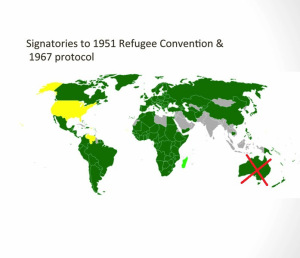 As well as the reintroduction of Temporary Protection Visas, which leave refugees in constant statelessness and fear of being returned to persecution, the Australian Minister for Immigration is proposing changes to the Migration Act which are utterly alarming. The ‘Migration and Maritime Powers Legislation Amendment (Resolving the Asylum Legacy Caseload) Bill 2014’ removes references to the UN Refugee Convention to allow Australia’s domestic law to ignore Australia’s obligations under international law. It also removes the ability of the High Court to challenge refugee and asylum seeker policy and operations.
The bill exempts vessels involved in Operation Sovereign Borders from the appropriate maritime laws. There will be nothing to stop fuel, food, water and safety devices from being removed from intercepted boats. The Government will have the power to send boats or individuals anywhere it chooses. The bill removes the need for Australia to have a Memorandum of Understanding in place…
View original post 750 more words
Labor shouldn’t have waited till Whitlam’s death to defend him. And yes, I am aware that many of the rank and file did. But for too long, the Liberals have been allowed to say “the worst government since Whitlam” without protest from the Labor side of politics.
And I guess this is my biggest criticism of the Labor Party over the past forty years: For too long far too many have been prepared to sacrifice Whitlam to the myths of the time, to say that yes, he was economically irresponsible but we’ve learned our lesson. This has enabled the Liberals to build up the sort of nonsense that Andrew Bolt was peddling in his pathetic attempt to create controversy last week. Even allowing for the fact that Whitlam’s Government was hit with the sort of financial shocks that rocked the rest of the world and sent the US and others into the previously unknown “stagflation”, the fact is that the Fraser /Howard team didn’t solve our inflation or our unemployment problems. When the Fraser/Howard partnership was voted out, the debt relative to GDP was higher than it had ever been. And Howard remains the only Treasurer to hit the 10% inflation, 10% unemployment double.
Gough achieved more in three years than Fraser achieved in seven. In fact, I have trouble thinking of anything enduring that Fraser introduced. The same for Holt and McMahon. Howard? Ah, yes. The GST. And the Private Health Insurance subsidy. Yep, Gough was a leader while Liberal PM’s have been managers.
It wasn’t easy for Mr Whitlam. To achieve, he fight many in his own party as well as the Coalition and the media. I keep thinking of a quote:
“The reasonable man adapts himself to the world; the unreasonable one persists in trying to adapt the world to himself. Therefore all progress depends on the unreasonable man.”
George Bernard Shaw
Let’s hope that another unreasonable man soon emerges for Labor. God knows, the Liberals have enough of them. But unfortunately, while Whitlam wanted to take us into a new era, they’re content with taking us backwards.


Can you name one young white victim of violence who has been publicly humiliated or degraded by tens of thousands of African Americans online or by key African-American journalists or newscasters?
I’m waiting. Still waiting. Stumped? I’ll give you a bonus question.
Can you name one white person, criminal or otherwise, that you’ve heard called a “thug” in the past, let’s say, 50 years?
Even if you came up with an obscure name or two, you have to admit that you’re dealing with a pretty short list.
Yet not only are African-American perpetrators of violence labeled as thugs, but so are victims.
Jeffrey Dahmer killed, raped, and dismembered at least 17 boys and men, but he was never called a thug. He was arrested.
Timothy McVeigh and Terry Nichols killed 168 people when they blew up the federal building in Oklahoma, but they were never called thugs. Both men were arrested.
Jared Loughner, who had a history of drug abuse, shot and killed six people and injured 13 more, including Congresswoman Gabby Giffords, but he was never called a thug. He was arrested.
James Holmes shot and killed 13 people in a movie theater in Aurora, Colorado, but he was never called a thug. He was peacefully arrested.
In a sense, these five men, each notorious mass murderers, were given a level of respect and due process of the law rarely afforded to young black men like Oscar Grant, Trayvon Martin, and Mike Brown, who were all victims of white violence.
Follow below the fold for more.
Throughout the pursuit of justice for all three of these slain young black men, great efforts were made to assassinate their character, devalue their humanity, and, in a sense, make it seem as if justice was an unnecessary luxury for them. The attempted thuggification of their names and reputation is despicable.
Tens of thousands of references can be found throughout social media—and even in the traditional media—making Mike Brown out to be a thug. For weeks, lawsuits were being waged to allege he had a criminal past until it was finally revealed that he had never been arrested a day in his life. Showing every photo he ever posed in on Instagram, every rap lyric he ever suggested he loved, dissecting every tweet he ever wrote, the conclusion that Mike Brown was a thug was pushed and pushed to promote the idea that Darren Wilson did a good thing. Donor after donor to Darren Wilson’s online fundraiser explicitly stated they were glad he did society a favor. When real evidence failed, fake pictures of Mike Brown were floated out to misrepresent him.
Much the same happened with Trayvon Martin. Walking home from a local convenience store with newly purchased snacks in hand, Trayvon was tracked and followed, in spite of the wishes of the police dispatch, and eventually confronted by an armed resident of the neighborhood. He was shot and killed in this confrontation. For a full year, every effort was made to make Trayvon out not to be a typical teenager with a bag of Skittles on his way home to watch the NBA All-Star weekend, but a violent thug who wanted to commit murder on his way home. Trayvon, like Mike Brown, had never been arrested a day in his life. Fake pictures of Trayvon, which were actually of the rapper The Game, nearly 20 years older than Trayvon, were floated out there to make him look like a thug. George Zimmerman, the man who was charged with killing Trayvon, but eventually found not guilty, had been arrested multiple times for violent crimes before killing Trayvon and has been cited for violence multiple times this past year alone. Still, wildly so, the general sentiment still isn’t that he’s a thug.
Oscar Grant, shot and killed by police while handcuffed in Oakland, actually had a criminal past that he fought hard to overcome. He was a diligent father and strived to hold down a local job after his incarceration. His being shot, while handcuffed and sitting on the ground, had absolutely nothing to do with his previous incarceration. The only reason it has ever been brought up, then, is to devalue his life and to dissuade supporters from feeling confident about championing his cause.
The thuggification of Mike Brown, Trayvon Martin, Oscar Grant, and many other young black victims of gun violence very much feels like a modern attempt to three-fifths their value in the world while the refusal to ever ascribe the thug label to white perpetrators of violence suggests that the word is gaining an exclusive racial connotation limited to African Americans.
“Thug” is the new “nigger.”


Exclusive
News Corporation chief Rupert Murdoch directed his editors to “kill Whitlam” some 10 months before the downfall of Gough Whitlam’s Labor government, according to a newly released United States diplomatic report.
The US National Archives has just declassified a secret diplomatic telegram dated January 20, 1975 that sheds new light on Murdoch’s involvement in the tumultuous events of Australia’s 1975 constitutional crisis.
Entitled “Australian publisher privately turns on Prime Minister,” the telegram from US Consul-General in Melbourne, Robert Brand, reported to the State Department that “Rupert Murdoch has issued [a] confidential instruction to editors of newspapers he controls to ‘Kill Whitlam’ “.
Describing Mr Murdoch as “the l’enfant terrible of Australian journalism,” Mr Brand noted that Mr Murdoch had been “the principal publisher supporting the Whitlam election effort in 1972 Labor victory”.
With a publishing empire that included The Australian as well as daily or Sunday newspapers in every Australian capital, Mr Murdoch’s new editorial direction was seen as a critical political development.
“If Murdoch attack directed against Whitlam personally this could presage hard times for Prime Minister; but if against Labor government would be dire news for party,” Mr Brand telegraphed.
The consul-general’s urgent report was prompted by US Labour Attache Edward Labatt who drew upon a range of confidential union and business sources, including people working for News Limited newspapers, to report on industrial relations and political developments.
Mr Brand’s telegram makes it clear the words “kill Whitlam” were a political direction to News Limited newspapers and not a physical threat to the prime minister.
The consul-general’s January, 1975 telegram has only been declassified this week after Fairfax Media applied for access 10 months ago. The identity of Labor Attache Labatt’s confidential source of information has been redacted.
Other diplomatic cables previously released by the US National Archives and published by WikiLeaks in mid-2013 revealed that Mr Murdoch foresaw the downfall of Whitlam’s Labor government a year before its dismissal.
In November, 1974, US Ambassador Marshall Green reported to Washington that Murdoch privately predicted that “Australian elections are likely to take place in about one year, sparked by refusal of appropriations in the Senate”.
One year later, on November 11, 1975 Governor-General Sir John Kerr dismissed Mr Whitlam as the prime minister after the Liberal-Country Party opposition blocked the budget in the Senate.
Although Murdoch believed he played “a substantial role” in Labor’s 1972 election victory, his enthusiasm for Whitlam had quickly waned.
“He expects to support the opposition in the next election,” Ambassador Green reported in November, 1974.
The newly released US cable reveals Mr Murdoch’s political shift was quickly confirmed, at least 10 months before Kerr’s dismissal of the government.
News Limited newspapers savaged Whitlam and strongly backed opposition leader Malcolm Fraser, so much so that journalists at The Australian took industrial action in protest.
The Labor Party was crushed at the polls and did not return to power until 1983.
Mr Fraser acknowledged Murdoch’s support but said the newspaper proprietor’s political role is easily overstated given the collapse in public support for the scandal-ridden Whitlam government.
“Rupert had influential newspapers, certainly, but I don’t think it affected the election outcome,” Mr Fraser said.
John Menadue, News Limited general manager in the early 1970s, expressed surprise that Murdoch might have given an editorial direction as “blatant” as “kill Whitlam”.
Mr Menadue, who was head of the prime minister’s department from 1974-76, said Mr Murdoch’s “modus operandi was more cautious, more subtle in those days, but I wouldn’t dismiss it … he’s certainly more blatant now … more extreme right wing.”
News Corporation did not respond to questions about Mr Murdoch’s role in the political events of 1975. But on Friday Mr Murdoch visited the headquarters of his British newspaper division in London after his protege Rebekah Brooks was cleared of phone hacking at the most high-profile trial and biggest police investigation of recent times.
The 83-year-old US-based media mogul flew in to hold discussions with staff after the trial of former News of the World journalists concluded with a former editor of the tabloid New of the World Andy Coulson being convicted of hacking.
News UK is the parent company of The Sun, The Times, The Sunday Times and the now-defunct News of the World.
Australian-born Murdoch was photographed being driven away from a property in Mayfair in central London on Thursday, reading a copy of The Sun, and then went to the offices in Wapping, east London. He has yet to comment on the outcome of the eight-month hacking trial.

, Australia has the ignominy of being easily bettered by Colombia (ranked 14), Peru (16), Kenya (17), Zambia (24), Ethiopia (26), Rwanda (27) and the Philippines (32).
The previous GGEI released in 2012 showed Australia ranked 10th on performance, out of 27 nations then evaluated. In 2011, for which only the top ten were shown, Australia was outside that elite.
Data available from the four GGEI reports issued so far suggests Australia’s performance peaked in 2012 and has fallen badly since. (There was no report in 2013.)
On global leadership on green energy, Australia in 2012 was ranked equal third with Sweden, behind Germany and South Africa. This year Australia ranked last.
This latest humiliation for Australia follows more than nine earlier embarrassments on the world stage caused by inept decisions, actions or inactions by the Abbott Government on environmental issues.
These include:
Those episodes created the strong impression worldwide that the Abbott Government was failing Australia’s people, their local environment, the global community and the planet. This report shows with rigorous research that this highly negative impression is indeed sound.
This further undermines Australia’s once proud reputation as a good global citizen. The GGEI report has received prominent media coverage worldwide, including in Denmark, the USA, Brazil, Spain and Argentina.


I THOUGHT I DID THE RESEARCH before making the “tree change” decision to move to North Eastern Tassie. The perky Telstra salesperson, desperate to sell me an internet package. “NBN isn’t coming to your area.”
“Uh, no. There are areas where the NBN isn’t yet but will be, but your area isn’t one of them.”
“So, you’re telling me that we can’t ever be connected to the NBN?”
“Yes.” A moment’s pause, then the salesperson perked up. “I can sell you a mobile wireless package though.”
“You mean the wireless card? There’s no mobile phone coverage in this town, won’t I need that for a wireless card thingy?”
“Oh, um….let me just check with my supervisor.”
There was now music in my ear.
After a lengthy pause, she returned. Her voice was distinctly less hopeful. “No, wireless isn’t appropriate. We can offer you dial-up.”
Prime Minister Abbott may think the internet is just a fad and, indeed, he is on record as saying the NBN is “essentially a video entertainment system” and that “25 megs is going to be enough, more than enough, for the average household”. However, whatever his idiosyncratic personal views, the reality is that Australians increasingly rely on high speed access to the internet — not only for leisure, but also for work.
Emails, job search websites like SEEK, distance learning, Centrelink and so on are all online necessities, not luxuries.
To add insult to injury, last week it was revealed that ABC2 may be taken off free-to-air on our National Broadcaster and put on iView. I’m sure my three year old daughter will as delighted to hear that Peppa Pig will now only be available to her by piracy or DVD in the future as I am that I won’t be able to watch excellent satirical programme The Roast anymore.
The Coalition government has consistently and deliberately misled Australian voters and taxpayers in the area of Communications since September 2013, slashing services they vowed personally to preserve.
I will be officially complaining to the Telecommunications Industry Ombudsman about the false advertising by satellite providers who cannot provide the service promised.
I fervently hope there will be a Federal ICAC into the deliberate dismantling of Australia’s Communications systems in a transparent campaign to deliver Rupert Murdoch a monopoly.


Iraqi foreign minister ‘absolutely against’ foreign presence but Tony Abbott remains confident of gaining legal clearance
The “level of engagement” of Australian special forces troops heading to Iraq is still unclear after the new Iraqi foreign minister, Ibrahim al-Jaafari, was quoted as saying he was “absolutely against foreign military bases and the presence of foreign military forces”.
However, the Australian prime minister, Tony Abbott, confirmed the legal clearance contained in a status of forces agreement (Sofa) for the special forces troops was expected within days.
“With the new government of Iraq still forming, it is taking a little longer than we would have liked to have put those legal protections in place but I am confident that the situation will be revolved in the next few days,” Abbott said.
The Australian soldiers remain in the United Arab Emirates awaiting clearance to advise Iraqi military forces in their fight against Islamic State (Isis). The clearance has been in process for weeks.
Al-Jaafari’s comments appear to place a cloud over the status of foreign troops, though small groups of US, British and German troops are already on the ground in Iraq in an advisory role.
He was quoted as telling the RT news channel: “We are absolutely against foreign military bases and the presence of foreign military forces. Yes, we did ask for help, but it concerned air cover.”
“The question of sending troops in was discussed several times and we were very frank and stated clearly that we are completely against the deployment of foreign troops on our territory, as it can cause justifiable fears and concerns among the Iraqi population.”
Abbott rejected suggestions the Iraqi government was wavering about international troop deployments in its country.
Asked whether the new Iraqi prime minister, Haider al-Abadi, had expressed any reluctance about Australian troops entering Iraq, Abbott said: “I made it very clear to [al-Abadi] in New York a couple of weeks ago that we were very keen to help.”
“I made it crystal clear that our special forces are ready to go and there is an enormous amount of good that they can do inside Iraq but we owe it to our special forces only to deploy them with the right legal protections.”

Now I’m not about to don a sandwich board and haunt the cinema district, but it seems to me that we are hurtling towards an apocalypse of our own making.
Whilst I am not a religious person, in the orthodox sense anyway, I have enjoyed studying the bible. There are enough historical references to make it an interesting mystery sorting the fact from the fiction. It also provides endless material for philosophical debate. It suggests a moral and ethical code for a growing society, even if it is a paternalistic view.
I see the bible as metaphorical and allegorical. Working out what the parables are really trying to say is like looking for the moral of the story. What were they trying to warn us about?
Sometimes it can be scarily prophetic.
Revelation 16
The Seven Bowls of God’s Wrath
1Then I heard a loud voice from the temple saying to the seven angels, “Go, pour out the seven bowls of God’s wrath on the earth.”
2The first angel went and poured out his bowl on the land, and ugly, festering sores broke out on the people who had the mark of the beast and worshiped its image.
Ebola, Aids, starvation, diabetes
3The second angel poured out his bowl on the sea, and it turned into blood like that of a dead person, and every living thing in the sea died.
Ocean warming, acidification, whaling, overfishing
4The third angel poured out his bowl on the rivers and springs of water, and they became blood.
Untreated effluent, algal blooms, fertiliser, fracking
5Then I heard the angel in charge of the waters say:
“You are just in these judgments, O Holy One, you who are and who were;
6for they have shed the blood of your holy people and your prophets,
and you have given them blood to drink as they deserve.”
Climate Change Authority, CSIRO, Bureau of Meteorology
7And I heard the altar respond:
“Yes, Lord God Almighty,
true and just are your judgments.”
8The fourth angel poured out his bowl on the sun, and the sun was allowed to scorch people with fire. 9They were seared by the intense heat and they cursed the name of God, who had control over these plagues, but they refused to repent and glorify him.
Global warming, drought, bushfires
10The fifth angel poured out his bowl on the throne of the beast, and its kingdom was plunged into darkness. People gnawed their tongues in agony 11and cursed the God of heaven because of their pains and their sores, but they refused to repent of what they had done.
Unfettered mining, peak resources, energy crisis, poverty
12The sixth angel poured out his bowl on the great river Euphrates, and its water was dried up to prepare the way for the kings from the East. 13Then I saw three impure spirits that looked like frogs; they came out of the mouth of the dragon, out of the mouth of the beast and out of the mouth of the false prophet.
Coalition of the willing
14They are demonic spirits that perform signs, and they go out to the kings of the whole world, to gather them for the battle on the great day of God Almighty.
15“Look, I come like a thief! Blessed is the one who stays awake and remains clothed, so as not to go naked and be shamefully exposed.”
16Then they gathered the kings together to the place that in Hebrew is called Armageddon.
All those gathering on all sides in the Middle East
17The seventh angel poured out his bowl into the air, and out of the temple came a loud voice from the throne, saying, “It is done!” 18Then there came flashes of lightning, rumblings, peals of thunder and a severe earthquake. No earthquake like it has ever occurred since mankind has been on earth, so tremendous was the quake. 19The great city split into three parts, and the cities of the nations collapsed. God remembered Babylon the Great and gave her the cup filled with the wine of the fury of his wrath. 20Every island fled away and the mountains could not be found. 21From the sky huge hailstones, each weighing about a hundred pounds, fell on people. And they cursed God on account of the plague of hail, because the plague was so terrible.
The consequences of poisoning and raping our planet as the bombs rain down on the heads of innocent children
Being a fan of both John Lennon and Star Trek, I look forward to the day when the world will live as one and children may live long and prosper.


Scanning a map of the world must give President Obama a sinking feeling as he contemplates the dismal state of troubled bilateral relationships his administration has sought to turn around. He would be smart to take a hard look at Cuba, where a major policy shift could yield a significant foreign policy success.
For the first time in more than 50 years, shifting politics in the United States and changing policies in Cuba make it politically feasible to re-establish formal diplomatic relations and dismantle the senseless embargo. The Castro regime has long blamed the embargo for its shortcomings, and has kept ordinary Cubans largely cut off from the world. Mr. Obama should seize this opportunity to end a long era of enmity and help a population that has suffered enormously since Washington ended diplomatic relations in 1961, two years after Fidel Castro assumed power.
In recent years, a devastated economy has forced Cuba to make reforms — a process that has gained urgency with the economic crisis in Venezuela, which gives Cuba heavily subsidized oil. Officials in Havana, fearing that Venezuela could cut its aid, have taken significant steps to liberalize and diversify the island’s tightly controlled economy.
They have begun allowing citizens to take private-sector jobs and own property. This spring, Cuba’s National Assembly passed a law to encourage foreign investment in the country. With Brazilian capital, Cuba is building a seaport, a major project that will be economically viable only if American sanctions are lifted. And in April, Cuban diplomats began negotiating a cooperation agreement with the European Union. They have shown up at the initial meetings prepared, eager and mindful that the Europeans will insist on greater reforms and freedoms.
The authoritarian government still harasses and detains dissidents. It has yet to explain the suspicious circumstances surrounding the death of the political activist Oswaldo Payá. But in recent years officials have released political prisoners who had been held for years. Travel restrictions were relaxed last year, enabling prominent dissidents to travel abroad. There is slightly more tolerance for criticism of the leadership, though many fear speaking openly and demanding greater rights.
The pace of reforms has been slow and there has been backsliding. Still, these changes show Cuba is positioning itself for a post-embargo era. The government has said it would welcome renewed diplomatic relations with the United States and would not set preconditions.
As a first step, the Obama administration should remove Cuba from the State Department’s list of nations that sponsor terrorist organizations, which includes Iran, Sudan and Syria. Cuba was put on the list in 1982 for backing terrorist groups in Latin America, which it no longer does. American officials recognize that Havana is playing a constructive role in the conflict in Colombia by hosting peace talks between the government and guerrilla leaders.
Starting in 1961, Washington has imposed sanctions in an effort to oust the Castro regime. Over the decades, it became clear to many American policy makers that the embargo was an utter failure. But any proposal to end the embargo angered Cuban-American voters, a constituency that has had an outsize role in national elections.
The generation that adamantly supports the embargo is dying off. Younger Cuban-Americans hold starkly different views, having come to see the sanctions as more damaging than helpful. A recent poll found that a slight majority of Cuban-Americans in Miami now oppose the embargo. A significant majority of them favor restoring diplomatic ties, mirroring the views of other Americans.
The Obama administration in 2009 took important steps to ease the embargo, a patchwork of laws and policies, making it easier for Cubans in the United States to send remittances to relatives in Cuba and authorizing more Cuban-Americans to travel there. And it has paved the way for initiatives to expand Internet access and cellphone coverage on the island.


(Reuters) – At least nine people were killed and dozens wounded in demonstrations across Turkey on Tuesday, local media reported, as Kurds demanded the government do more to protect the Syrian Kurdish town of Kobani from Islamic State militants.
NATO-member Turkey has taken in more than 180,000 refugees who fled Kobani but has refrained from joining a U.S.-led coalition against the Sunni Muslim militants, saying the campaign should be broadened to target the removal of Syrian President Bashar al-Assad.
Kurdish politicians, part of Turkey’s fragile peace process with the jailed leader of the Kurdistan Workers Party (PKK) to end a three-decade insurgency, have criticized Turkey for inaction.
Ankara rejected the criticism. “It is a massive lie that Turkey is doing nothing on Kobani,” Deputy Prime Minister Yalcin Akdogan said on Twitter. “Turkey is doing whatever can be done in humanitarian aspects.”
He accused Turkey’s pro-Kurdish Peoples’ Democratic Party (HDP) of adopting an “irresponsible way of conducting politics” and called the protests “a big injustice to Turkey’s well-meant efforts”.
The Kurdish party had issued a statement saying: “The situation in Kobani is extremely critical. We call on our people to go out into the streets, or support those that have gone onto the streets, to protest the ISIL (Islamic State) attacks and the … stance of (Turkey’s) AKP government against Kobani.”
The fight in Kobani against Islamist militants has become a rallying point for Turkey’s Kurdish community. They see Ankara as partly responsible for Islamic State gaining power.

The mining industry likes to puff itself up with impressive sounding numbers — but unfortunately many, if not most, of these figures are absolute rubbish, writes Lachlan Barker.


In the USA, the last 30 years has seen a reduction from 70% to 64% of GDP taken by Labour Meanwhile Norway and Sweden, held up as models of “responsible” capitalism, have seen Labour’s share fall from 64% to 55% of GDP and 74% to 65% of GDP respectively since the 1980s.The result is that economic power has shifted in favour of capital, and away from labour.
Bosses, desperate to drive down wages to make bigger profits, turn to cheaper and less regulated labour in the developing world as a method for raking in higher profits and putting pressure on workers in developed countries to accept a lower wage. As Gina warns we beer drinking, cigarette smoking bludgers, Africans are happy to work for $2 a day in the mines. That’s Globalization for you.
The problem is that wages also make up the demand which keeps businesses afloat. With less money in the pockets of wage-earners, fewer commodities can be purchased and so less profit can be made.
The short-sightedness of capitalists trying to make as much money as possible out of each investment with no thought for the future is a fundamental feature of the system. If one business passes up an opportunity to make loads of money through greater exploitation of workers or the environment, another would seize the chance to make the profit and put its competitor out of business. This is the nature of capitalist competition – they cannot afford a long-term perspective.
Coalition governments are advocates of increased privatisation of public services. It’s true that privatisation often brings profit to the new private owners and those rich enough to afford shares in the business, but it is also true that privatisation brings worse wages and conditions for the employees of the newly privatised business. The reason why private ownership of businesses increases profit is because these owners curtail services and force down the wages of all the workers in order to pay the handful of people at the top obscene salaries and bonuses.
Developments in technology and innovation have automated huge numbers of jobs thus cut costs. If businesses were to spend on education and training of highly-skilled workers they would be able to increase productivity, design new products and machinery and boost productive capacity overall. This, after all, is the point of any investment in a business. Instead we see sackings, closures and restructuring as business tries to produce less in order to maintain their profits.
Over 160 years ago, Karl Marx said that the “bourgeoisie is unfit to rule because it is incompetent to assure an existence to its slave within his slavery, because it cannot help letting him sink into such a state, that it has to feed him, instead of being fed by him.“
Capitalism has developed to a point where technology and globalisation, phenomena that have the potential to improve the lives of all people hundreds of times over, are actually making the lives of wage-earners worse. It has reached a stage where we have the capacity to educate and train people, produce and build everything we need, and give everyone a decent standard of living. But we’re not able to realise this potential because of the unrelenting pursuit of profit.
The impoverishment of the masses and the concentration of wealth and capital in the hands of a small minority is a growing problem and as long as the right of private ownership to the means of production exists, and governments move further away from regulation, this process will prevail.
Tony Abbott’s entire approach to governing is textbook Capitalism, from his attack on penalty rates, the minimum wage, and unemployment benefits, his refusal to give industry assistance (unless you are a fossil fuel producer), privatisation of public assets, deregulation and removal of “green tape” (aka environmental protections) – every aspect is a short term grab for cash dictated and ruled by the “market”.
Oh for a government that had the courage to protect its people with a long term plan for general prosperity and well-being instead of a smash and grab raid for your rich friends.

Parliamentary inquiry submission makes case for wider powers to detain without charge and jail people for refusing to answer questions. How does ASIO know the answers are available?
Under the current scheme Asio may detain and question a person without charge for up to seven days, during which time refusing to answer questions may lead to imprisonment. People can essentially be held without contact with the outside world, may lose the right to silence and may be subject to coercive questioning.
Currently the extraordinary powers can be used only as a last resort, if the attorney general believes less intrusive methods of gathering intelligence will not be effective. Now that’s no longer required.
University of Sydney law professor Ben Saul says
“ASIO detention powers should be repealed, not extended. Detaining non-suspects for up to seven days, virtually incommunicado and without effective review at the time, removing the right to silence on penalty of imprisonment, and criminalising any disclosure of detention, is excessive and disproportionate in view of existing powers, the level of terrorist threat, and the absence of any declared public emergency justifying derogation from protected human rights. “
Welcome to facist Australia the land of silent imprisonment. Looking for a missing person ASIO wont tell you.

Holy week in Spain
The current furore over the burqa is nothing new, says contributing editor-at-large Tess Lawrence.
PRIME MINISTER TONY ABBOTT might well find the full veil or burqa “confronting”.
‘Tis true beloved reader, that clothing can enshroud a lethal weapon. No question.
Federal Parliament needs to be protected from any Lambies in wolf’s clothing.
One could easily secrete a Kalashnikov or suicide vest under raiments. Or other deadly weapons. It happens all the time in this turbulent world.
In fact, whenever I see the Honourable Member for Warringah naked save for his red hot Speedos, proudly strutting his half-cocked phallus, somewhat tamed by the sea’s cooling kiss, Mae West seeps into my prolapsed Catholic mind and I wonder if Prime Minister Tony Abbott has a pistol or two in his pocket or if he is just pleased to see me/dia.

It’s good that he’s comfortable in his foreskin and is uninhibited about showing us whether he’s circumcised or not.
Would other world leaders follow suit? (Ras)Putin, yes. Of course.
But would you see Abdullah ibn Abdilazīz AKA King Abdullah of Saudi Arabia be doing the same thing on the sands of Half Moon Bay?
Mish mumkin! [Arabic for impossible, or not on your Nellie!]
Listen up.
When Lebanese born human rights lawyer, Amal Alamuddin wed George Clooney, she wore a version of the burqa.

Like the singer Cher, uber celebrity Kim Kardashian is of Armenian descent. She wore a version of the burqa for her wedding to Kanye West.

When English commoner Kate Middleton wed Prince William, she wore a version of the burqa.

English aristocrat Diana Spencer wore a version of the Burqa when she wed William’s father, Charles.
Like Amal, Kim, Kate and Diana, the nuns that taught me wore a version of the burqa. Many orders of nuns still wear the ‘habit’.
Nuns are, after all, Brides of Christ.
Thousands of Australian women, who wear veils at their weddings, do the same.
Nurses and midwives used to wear a version of the burqa. In some countries they still do.
Women churchgoers used to be compelled to wear scarves and cover their arms. In some countries, they still cover up.
The veil, whether sheer or no, is a sibling of the burqa.
So is the wimple, the al-amira, the chador, the hijab, the khimar, the niqab and the shayla.
The gorget is a version of the burqa. Qui.
It was a head covering used by French and other women in medieval times. Historical and some would say hysterical irony given the burqa ban now in place in France.
In fact, certain ranks in the armed forces – including Australian military, still wear gorget patches on their collars — those red tabs.
Yep, Jacqui Lambie, they are siblings of the burqa. Quel horreur!
The veil in all its incarnations, has been demonised throughout history and, contrary to popular opinion, long been viewed with suspicion and deemed threatening.
Sometimes it is.
There is nothing in the Quran that compels a woman ‒ or young girl for that matter – to wear a veil of any sort.
Just as there is nothing in the Bible that compels females to wear a veil.
But the veil has also been viewed as sexually threatening. Religious and other histories, literature and the arts breathe heavily upon its mystique.
Consider the seductress Salome and her infamous Dance of the Seven Veils.
Neither Herod nor John the Baptist stood a chance. Just like Senator Cory Bernardi.
Seven, it will not have escaped you, is the Devil’s number. And we women are so often ranked amongst his tribe.
Some regard the wearing of the veil as the ultimate sexual tease. Seductive body armour.
Far from presenting women as asexual and anonymous, in fact it arguably incites one to ponder what lays behind it. It is regarded by some as alluring, especially those that reveal the heart’s soul — the eyes.
A great beauty, perhaps ? A terrorist ? Or both ? A man ? Perhaps mounds of cellulite or hairy legs, as some of my giggling Muslim girlfriends attest.
Or perhaps a patriarchal household, where the females are under family and community compulsion to wear a veil of some sort, against their personal wishes.
At the point of the gun, some of our sisters are forced to wear the veil, by the likes of psychopathic genocidal fascists like the Daash (the Arabic word/acronym for Islamic State).
The sweet and usually eagerly awaited ‘now you may kiss the bride’ moment, where the new husband is given permission by the officiating celebrant to lift the Veil from his new wife ‘s face and kiss her, is also a symbol of her virginity and that she is now his for the taking.
No guffaws please.
Whilst our Federal Parliament and our prime minister remain in a tizz over whether to ‘ban or not to ban the Burqa’, I would like to suggest this:
That in an act of solidarity, those parliamentarians of all political dialects who are inclined to do so – men and women alike – should declare a special burqa to work day and wear the burqa to the House.
DISCLAIMER: Despite her awful appearance [Ed: not really] Tess Lawrence was once a fashion editor and constantly featured as number one on the World’s Worst Dressed Fashion Writer List and, despite wearing an abaya and head covering, was still arrested three times in Saudi Arabia by the same religious police. On the other hand, after he had scarpered, some wonderful Saudis came to her aide and, to this day, she remains in contact with them.

Australia has been propagandized.
At the same time, however, Hayden said that a much-publicized White House policy that President Obama announced last year barring U.S. drone strikes unless there is a “near certainty” there will be no civilian casualties — “the highest standard we can meet,” he said at the time — does not cover the current U.S. airstrikes in Syria and Iraq.
The “near certainty” standard was intended to apply “only when we take direct action ‘outside areas of active hostilities,’ as we noted at the time,” Hayden said in an email. “That description — outside areas of active hostilities — simply does not fit what we are seeing on the ground in Iraq and Syria right now.”
There’s a strong whiff of hypocrisy about this new standard for collateral damage.
The Obama administration has been roundly criticized for pursuing an air campaign that cannot possibly destroy the Islamic State. If that is a strategy with limited efficacy, what is the moral argument for continuing to employ it when civilian casualties result? It is one thing when a strategy is well-designed to achieve a specific military objective but quite another when it is not. Obama now is being severely criticized by Isreael. However does anybody even consider that they are all wrong? ISIS hasn’t launched any attacks on American targets (yet), but just the mere potential apparently allows Obama to jettison the same standard he applied to Israel while our ally was under direct and continuous attacks that qualify as war crimes in any sense of the word — from an Islamist terror network not dissimilar at all to ISIS.
The decision not to put a force of ground troops to push ISIS off its ground guarantees that we will create collateral damage like this for months and years to come. If the mission is to “degrade and destroy ISIS” while they remain embedded in these cities and towns, there is no other possible outcome than massive civilian casualties. ISIS will not withdraw under air attack to the desert where they can get bombed and strafed into oblivion, after all, and without ground forces, we won’t have the means to hold any ground we might liberate anyway. Nor will we have the specific intelligence needed to avoid mistakes that happen in any war.
Remember this name Tony Abbott you voted for him I didn’t. He will kill not some “devil cult” but he will kill a lot of families like yours and mine.

After average results at university and an uninspiring football career, with the help of the Jesuit network, Tony headed off to Oxford to take up his Rhodes Scholarship. It only took a couple of games for him to be dropped from the rugby team with suggestions that his prowess had been somewhat exaggerated. Tony was strong on physicality but short on speed or finesse.
Student politics at Sydney University saw Tony, a callow youth straight from a Catholic boys’ school, given a platform to preach loud and long in his opposition to homosexuality and feminism. Further, he denounced contraception, labelling it part of the “me now” mentality. Ironically, whilst eschewing the use of contraception, Tony was an avid partaker of “me now” activities, if not the responsibility that went with them.
Tony Abbott is only one man, but this man’s unwavering belief in his own judgemnt has seen him surround himself with advisers who tell him what he wants to hear. Experts are sacked, independent advisory panels disbanded, oversight and freedom of information curtailed, journalists and the National Broadcaster threatened.
In the space of a year we have gone from world leaders in action on climate change to being called the “Saudi Arabia of the Pacific”.
‘In the year since they took office, Prime Minister Tony Abbott and his Liberal-led coalition have already dismantled the country’s key environmental policies. Now they’ve begun systematically ransacking its natural resources. In the process, they’ve transformed Australia from an international innovator on environmental issues into quite possibly the dirtiest country in the developed world.’
Instead of looking forward to every home being connected to the NBN and school funding bridging the gap of disadvantage and inequity, we have record numbers of new coal mines to enjoy. Instead of universal healthcare and unemployment benefits, we see people on pensions feeling very afraid about their future. Instead of affordable tertiary education and housing, we see places being sold to the highest bidder.
We have moved from bringing our troops home from Afghanistan, to a war in Iraq and Syria that will inevitably lead to civilian casualties and destruction of homes and infrastructure, a move that has seen us specifically named for revenge attacks. The “humanitarian mission” line has been exposed for the lie it always was.
Independent MP Andrew Wilkie, who formerly worked in intelligence, has accused the federal government of exploiting fears about terrorism to rush through new national security laws that push Australia towards a “police state“.
“It is clearly overreach by the security services who have basically been invited to write an open cheque. And the government, which wants to beat its chest and look tough on national security, said, ‘We’ll sign that’.”
The laws include jail terms of up to 10 years for journalists who disclose details of ASIO “special intelligence operations” and provide immunity from criminal prosecution for intelligence officers who commit a crime in the course of their duties.
Tony has great power but no sense of responsibility. He has confidence but no conscience. He has determination but no commitment. He is willing but lacks the skills. He attacks and blames but resents oversight and has never accepted accountability, and this is what scares me most.
The consequences of being wrong could/will be catastrophic and I don’t share Tony’s confidence that he, Maurice Newman and Cardinal Pell have all the answers.
“A body of men holding themselves accountable to nobody ought not to be trusted by anybody.”
― Thomas Paine

” Frankly I find the burqa a fairly confronting form of of attire and I wish it weren’t worn”
That is a very personal statement even regarded by some as bigoted given that there is no record of anybody trying to enter parliament wearing one. George Brandis of all people backed off supporting the leader. Even the AFP did not support the ban. So why is Abbott at cross purposes to his Team? He simply is so used to offending people he can’t help himself. Bronwyn Bishop has requested an independent security assessment.
This government is an act straight out of Monty Python. If a terrorist wanted to enter parliament inconspicuously they’d obviously put on a burqa a garment of first choice. With all the screening devices you need to pass through the burqa had better be the invisible cloak. In fact an invisible cloak wouldn’t really work either. A beard and sunglasses are a bit more dangerous I’d think or even one of those medical masks which obviously the PM doesn’t find confronting. Truly Monty Python and rude to boot


Check out dis Anti-Rape Device. (Mahalo Cindy P.)
Rape has become endemic in South Africa, so a medical technician named Sonette Ehlers developed a product for woman to fight back. Ehlers had never forgotten a rape victim telling her forlornly, “If only I had teeth down there.”
Ehlers created a product she called Rapex. It resembles a tube, with barbs inside. The woman inserts it like a tampon and any man who tries to rape the woman impales himself on the barbs and must go to an emergency room to have the Rapex removed.
Some critics say this is a medieval punishment.
What do you think?


Last night a man was shot by police. A policeman is in hospital with serious wounds. These events are tragic. The man is alleged to have made threats against the Prime Minister (who is currently out of the country). Whether these involved a knife or a chaff bag is unclear at this stage.
It just strikes me as inconsistent that we can dismiss a threat to one prime minister as just being “a figure of speech”, but another will be used by many people as justification for a range of measures. And yes, it has resulted in a violent altercation.
A few days ago, the terrorist threat was raised to high, but we were told that there was no particular threat.
Then we had the raids. Which we were told had been part of an investigation which had been going on for months. And that an attack would have been carried out within days.
We’re told that the PM and Parliament are a potential target for threats. this always been the case? John Howard wore the bullet proof vest when speaking to good, old responsible Aussie gun owners.
Tony Abbott tells us a few days later that all that’s needed for an attack is “a knife, an iPhone and a victim”, but he adds:
“Terrorists want to scare us out of being ourselves and our best response is to insouciantly be fully Australian, to defy the terrorists by going about our normal business,” he told reporters in Sydney.
Abbott went on to tell us that orders to carry out demonstration executions had been sent to the the “small networks” of followers in Australia and other countries.
So, lets make sure that those “small networks” didn’t miss the orders by broadcasting them on the nightly news. Let’s tell everyone that how easy it is to become a terrorist – all you need is “a knife, an iPhone and a victim”
Then say that you need to be “fully Australian” and just say “She’ll be right, mate” and go off to work.
Videos posted by ISIL stays there and nobody takes it down. Some sort of perverse respect for freedom of speech?
Yet the Murdoch media can completely ignore hundreds of thousands (world-wide) marching on climate change, but find it worth writing stories about less than a hundred protesting the building of a mosque.
Updated
A person, who reportedly made threats against the Prime Minister, has been shot dead and two police officers from the joint counter terrorism team have been stabbed in Melbourne’s outer south-east.
The incident occurred near a police station on Heatherton Road in Endeavour Hills about 7:40pm (AEST).
One of the officers who was stabbed is an Australian Federal Police (AFP) officer and the other is a Victoria Police member.
They have both been rushed to hospital and it is understood one is in a critical condition.
The AFP are expected to issue a statement shortly.
Paramedics confirmed they attended the scene but would not comment on the condition of the stabbing victims.
‘Terrifying’ Tony Abbott is using the politics of fear to bully the Australian people into liking him and letting him to take away some of their rights and freedoms, writes Lyn Bender.
With each new threat from ISIL, Prime Minister Tony Abbott is shamelessly fanning the fires of terror in the hope we will forget his shortcomings blunders and buffoonery.
In Abbott Land — security has become insecurity.
But, nevertheless, now a reactive, fearful and fear-manipulating leader is now catapulting us into war. Tony Abbott struts ‒ or more correctly frets ‒ on the world stage: a small frightened man, determined to hold onto his fifteen minutes of fame.
Is western involvement in another war the answer or the problem?
Even Foreign Minister Julie Bishop has said that ISIL is an ideology that cannot be defeated in the battlefield alone.
But things could always be worse. Remember when Abbott’s alpha male posturing to ‘bully’ Putin and his threats to send in armed troops for ‘Operation bring them Home’.
Abbott’s idea of sending an armed defence force to Ukraine was branded as insane in a Fairfax headline:
Abbott is widely acknowledged as a serial liar. And the lies and broken promises continue.
The latest lies relate to what is being dubbed as ‘operation mission creep’.
At first, it was a humanitarian mission to deliver aid to besieged Iraqis. Now it has morphed into a mission to destroy the “death cult” of ISIS and to “respond with extreme force”.
When it comes to understanding and responding to ISL in Iraq, it’s complicated. When it comes to Tony Abbott’s ability to comprehend the global political sphere, it’s simplistic.
“It’s not goodies versus baddies but baddies versus baddies.”
In Abbott’s black and white world there are no shades of grey.
Except when defending baddies as being goodies.
Abbott has excused Sri Lankan President Mahinda Rajapaksa’s appalling human rights record.
Justifying torture, he explained:
“Sometimes in difficult circumstances difficult things happen.”
As Rodney E. Lever points out:
‘It is difficult to believe that Tony Abbott knows what he is doing in committing Australia to a third war in Iraq.’
But there is method in the synchronising of fear announcements and photo shoots.
Abbott’s mentor, former Prime Minister John Howard, has allegedly lied on national television on Sunday about leading us into Iraq on false intelligence and by ignoring expert weapon’s inspector Hans Blix.
There were no weapons of mass destruction and Howard allegedly knew this for two years prior to the invasion.
Tony Abbott ‒ like his father-figure, Howard ‒ is again leading us into dangerous waters and setting Australia up as a terrorist target.
Australia is now named on the hit list in a video believed to be from ISIS. It exhorts the killing of infidels in countries including Australia who have joined the Coalition to attack ISIS. Abbott is seeking greater powers, with limited scrutiny.
The fusion of passion for military adventures, and the political exploitation of fear, is a dangerous mix. Abbott may be creating the terror he is claiming to lessen.
Disturbingly, he is now saying we may need to give up some of our rights and freedoms to lessen the terror threat.
“…for some time to come, Australians will have to endure more security than we’re used to, and more inconvenience than we’d like. Regrettably, for some time to come, the delicate balance between freedom and security may have to shift.”
Even more worrying, Abbott flags discriminating against certain sections of society — presumably Muslims:
“There may be more restrictions on some so that there can be more protections for others.”
He is asking us to let him persecute certain members of our society for the greater good. That is not democracy.
Moreover, he is asking us trust him to act honestly and decently in the national interest.
From
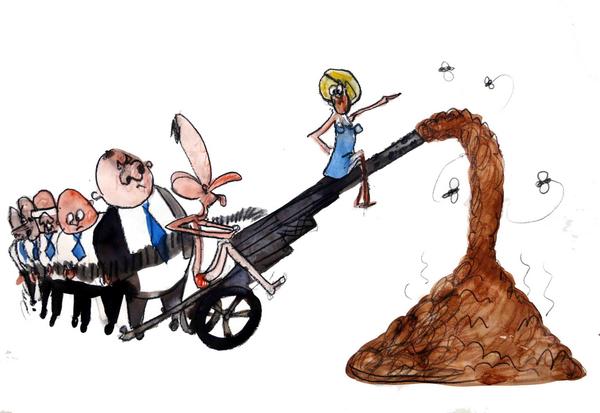
Team Bull you are either against us or with us in the shoot!


 olddogthoughts


You must be logged in to post a comment.