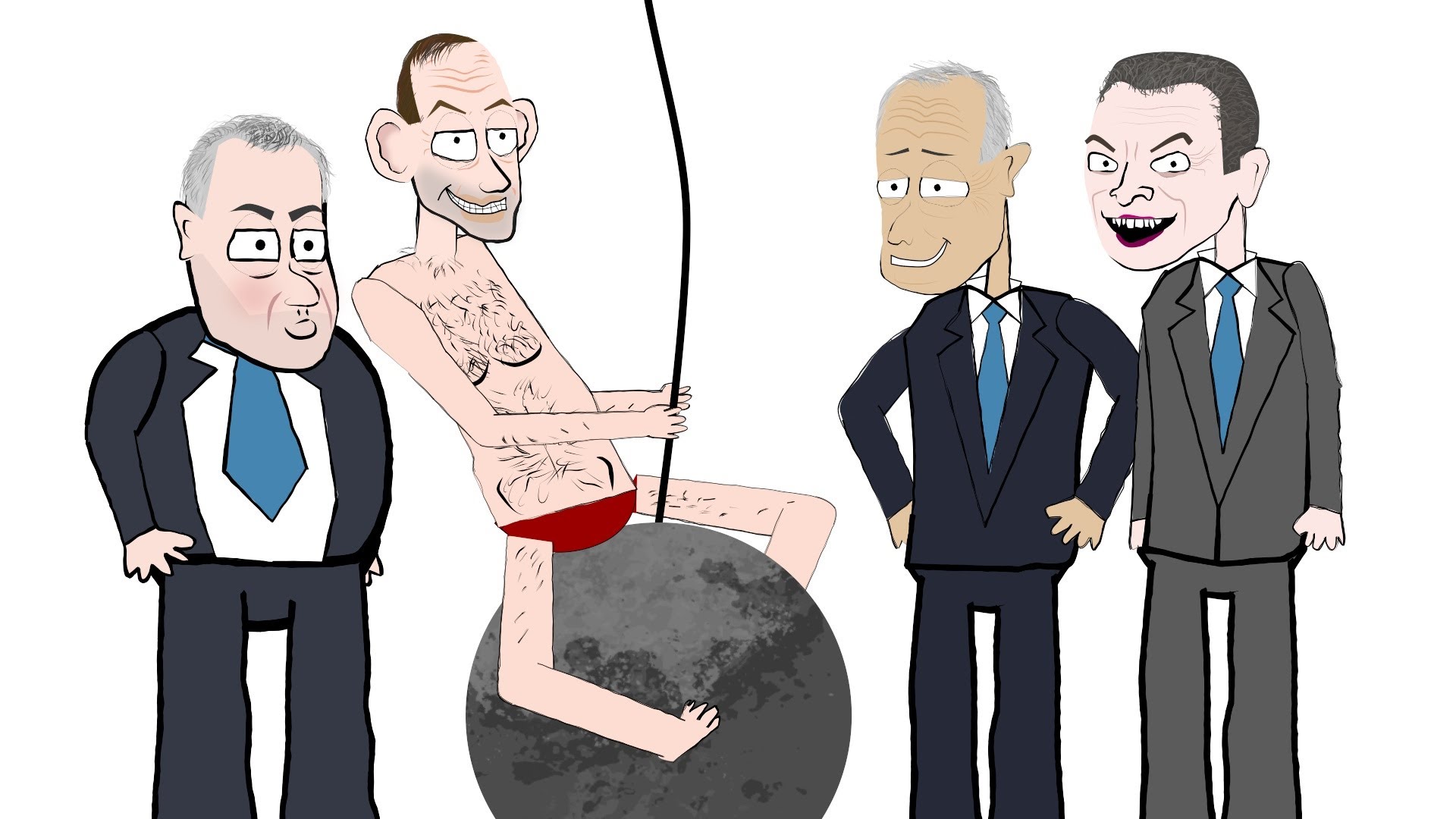
Tag: Abbott

Tony Abbott Fact Check

NSW Overseas workers will be allowed to work for a year without applying for 457 visas: Abbott creating jobs. Who benefiys?

Workers protest about 457 Visas in 2013. The Department of Immigration will now allow overseas workers to stay in Australia for a year without the 457 visa.

Workers protest about 457 Visas in 2013. The Department of Immigration will now allow overseas workers to stay in Australia for a year without the 457 visa.

new temporary-entry permit proposed by the Department of Immigration to allow overseas workers to stay in Australia for a year without a 457 visa would create “open slather” on the Australian labour market at the same time it faces growing unemployment, unions warn.

The Department of Immigration and Border Protection has reviewed skilled migration and in December, it quietly released its recommendations to relax entry requirements for short-term foreign workers. Its proposals include extending the six-month short term mobility visa to 12 months.

The change would mean overseas workers would not have to apply for a 457 working visa, which imposes stricter entry requirements including English language tests. Employers are also required to demonstrate they have looked for local workers before giving jobs to employees from overseas, under a 457 visa.

"Absolute madness": CFMEU national secretary Michael O'Connor criticised visa proposals.“Absolute madness”: CFMEU national secretary Michael O’Connor criticised visa proposals. Photo: Tony McDonough

CFMEU national secretary Michael O’Connor said proposals to abolish the requirement for language and skills tests for temporary overseas workers would worsen unemployment levels in Australia, particularly for young people.

The proposals would mean employers would not be required to demonstrate they had first tried to fill job vacancies with Australian workers before giving them to people from overseas.

“It is absolute madness in the current environment, with unemployment at a 10-year high, to be removing even more opportunities for people to gain access to the workforce,” Mr O’Connor said.

“The impact on young people will be particularly harsh. Youth unemployment is at crisis levels, yet the majority of 457 visa approvals are for people under 30.”

Mr O’Connor said one in five workers on 457 visas already was being paid below-standard wages.

“The 457 visa program needs to have requirements strengthened in the current economic climate, not relaxed,” he said.

Australian Council of Trade Unions president Ged Kearney said the proposed relaxation of requirements for temporary-entry visas would undermine Australian wages and conditions.

She said the proposal to extend short term mobility visas to 12 months would lead to further exploitation of foreign workers.

“We find it absolutely extraordinary that the government’s panel has made a recommendation to just have open slather on the labour market,” she said.

Opposition spokesman for Immigration and Border Protection Richard Marles said the Labor Party was “deeply concerned” about any proposal to remove labour market testing or English language requirements for temporary skilled migrants.

A spokesman for the Assistant Minister for Immigration and Border Protection, Senator Michaelia Cash said the Coalition government fully supported the principle that Australian workers have priority for domestic job opportunities.

“Contrary to union claims, an effectively managed temporary labour migration program will not threaten Australian jobs.  Rather, it will secure the future of businesses and grow employment opportunities to enable businesses to employ more Australians,” he said.

“An effectively managed skilled migration program is essential in supporting employers in industries and regions experiencing skill shortages.  It is essential in restoring growth in the economy.  It is essential in lifting our productivity.”

Submissions to the skilled migration review will close at the end of this month before the federal government responds.

Australian Chamber of Commerce and Industry  director of employment Jenny Lambert said all stakeholders, including unions, needed to recognise that opportunities for Australians are enhanced by a strong economy that is globally competitive.  She said the Department of Immigration proposal referred to highly specialised skills.

“Access to these skills can only benefit the skills development of the Australian workforce as evidence shows that such arrangements allow for the transfer of skills to Australians, ” Ms Lambert said.

“Part of being globally competitive is recognising that the labour force is increasingly global and strong international companies will be attracted here through effective regulatory environments that allow them to operate seamlessly.

“A balanced and reasonable approach to skilled migration policy, preferably with bipartisan support, is good for Australia, and most importantly good for Australian jobs and the economy. Let this be the starting point for a rational discussion.”

Australia accelerates coal mine projects in the face of study that finds it should stay buried

Tony Abbott coal

Research finds more than 80% of reserves should stay in the ground to avoid dangerous climate change, just as Australia expands production

Australia is pressing ahead with huge new coalmining projects, just as a new study has calculated that more than 80% of the world’s current coal reserves must remain in the ground to avoid dangerous climate change.

The research, by the UCL Institute for Sustainable Resources, found that globally a third of all oil reserves, half of all known gas deposits and 82% of coal capacity would have to remain unused by 2050 if the world was to remain within an internationally agreed limit of 2C warming compared with pre-industrial times.

The report found the world needed to stay within a carbon dioxide “budget” of 1,100 gigatonnes emitted between 2011 and 2050 to have at least a 50% chance to avoid more than 2C warming.

That level of warming is considered to have highly damaging consequences for human health, coastal infrastructure, food production and endangered species.

Despite its commitment to the 2C warming limit, Australia is pushing ahead with a massive escalation in its coal output, with prime minister Tony Abbott declaring in October that coal is “good for humanity” while warning against any “demonisation” of the fossil fuel.

Nine new coal projects are earmarked for the Galilee Basin region of central Queensland, producing a combined 330m tonnes a year at capacity.

This coal, destined for export to countries such as China and India, would produce an estimated 705m tonnes of CO2 when burned – substantially more than Australia’s entire annual greenhouse gas emissions of 542m tonnes.

Several international financial institutions have rejected funding the largest of the Galilee Basin mines, Adani’s Carmichael project, but the Queensland government has stepped in to provide taxpayers’ money for construction, citing the jobs the mine would create.
Advertisement

Tim Buckley, the director of energy finance studies at the Institute for Energy Economics and Financial Analysis, said the Australian government’s energy policies “fly in the face” of the need to avoid digging up the vast majority of known coal reserves.

“Rather than acknowledge the problem and transition energy sources over time, Tony Abbott is wedded to an idea of digging up coal as fast as possible before we’re not allowed to do so, which is a globally irresponsible position,” he told Guardian Australia.

“At the current price of thermal coal, the profit margin is zero. It makes no sense to sponsor these projects when the world is awash with coal. Why is Queensland providing millions of dollars to projects that aren’t commerciallly viable? Why does a project funded by a foreign billionaire need taxpayer subsidy?”

Buckley said Abbott’s argument that coal could lift people in developing countries out of poverty was “a highly embarrassing parroting of a coal industry PR campaign”.

Victoria McKenzie-McHarg, climate campaigner at the Australian Conservation Foundation, said Australia was “completely out of kilter” with the required action to avoid dangerous climate change.

“Tony Abbott and [Queensland premier] Campbell Newman have bent over backwards to push through coal projects and side with polluting mining companies over the need to protect Australians from climate change,” she said.

“If we become the greedy polluter, it puts unfair pressure on developing nations to cut their emissions when Australia has been one of the largest polluters for so long. We have a responsibility to clean up our act and take advantage of our real natural resources, such as wind and solar.”

But the Minerals Council of Australia (MCA) disputed the findings of the report, stating that the Intergovernmental Panel on Climate Change made it clear last year that carbon capture and storage technology would ensure that fossil fuels could remain widely used.

“The report’s apparent conclusions are at odds with a series of recent forecasts by a range of respected international bodies, including the International Energy Agency and the Intergovernmental Panel on Climate Change,” said Brendan Pearson, chief executive of the MCA.

“Those reports show that addressing climate change, eradicating energy poverty and a continued strong future for Australia’s energy sector are not mutually exclusive goals.”

Pearson said the International Energy Agency’s 2014 outlook showed that the global coal trade was set to grow by 40% by 2040, with Australia forecast to regain its ranking as the world’s top coal exporter by 2030.

According to the UCL institute’s paper, published in Nature, companies spent $670bn last year searching for and securing new fossil fuel deposits. The research was funded by the UK Energy Research Centre.

Launceston takeaway restaurant owners fined $100,000 for underpaying Chinese chef on 457 visa

Noodle dish

The operators of a Launceston takeaway restaurant have been fined $100,000 for underpaying a Chinese chef and creating false wage records.

The Fair Work Ombudsman found David and Priscilla Lam, who own Dave’s Noodles in Launceston, created false records to pay a staff member for a 38-hour week when he worked 60.

It resulted in the Chinese chef being underpaid $86,000 over a four-year period.

The couple convinced the chef, who they sponsored on a 457 working visa, he had to sign the false time and wage sheets for immigration purposes.

The Federal Court fined the pair $100,000 and ordered them to repay the employee.

The couple are also the franchisors of the Dave’s Noodles restaurants in Hobart, Burnie, Kingston, Moonah and Mowbray.

The chef’s case was investigated by the Fair Work Ombudsman after he lodged a complaint via an interpreter.

The inspectors discovered he was being paid a flat rate based on a 38-hour week while being required to work 60 hours a week.

Judge Norah Hartnett described the couples’ fraudulent paperwork as “particularly disturbing behaviour, worthy of significant reprimand”.

He said the chef was in a vulnerable position, having to rely on the couple’s favour to stay in Australia.

Fair Work Ombudsman Natalie James said the penalties should be a warning against exploiting vulnerable workers.

“The small minority of employers who are inclined to contravene the rights of vulnerable workers should be aware that they can face significant financial consequences for such behaviour,” she said.

“Successful litigations such as this also help to create a level playing field for the majority of employers who are committed to doing the right thing by their employees.”

Anti-bogan Australia

Tony Abbott – Worst PM in Australian History: Medicare

Tony Abbott makes surprise visit to Iraq to discuss fight against Isis: 200 Australian special forces troops will soon enter Iraq to advise and assist local security forces. Any wonder we haven’t heard anything from Abbott who scrambled these forces almost 6 months ago. They are still WAITING

Tony Abbott and Haider al-Abadi

The Australian prime minister, Tony Abbott, made an unannounced visit to Baghdad on Sunday, meeting with top officials to discuss ways in which the country can aid Iraqi forces in their fight against Islamic State (Isis).

Abbott and the Iraqi prime minister, Haider al-Abadi, discussed military cooperation between the two countries, including the training and equipping of Iraqi soldiers, state television reported. The Iraqi army collapsed last summer in the face of a blitz by Isis, which now holds about a third of Iraq and neighbouring Syria in its self-declared caliphate.

During a joint news conference, Abbott said his country was determined to provide all kinds of support to Iraq in its war against terrorism. He vowed to enhance cooperation between the two countries.

Australian fighter jets are bombing Isis targets in northern Iraq as part of a US-led coalition and 200 Australian special forces troops will soon enter Iraq to advise and assist local security forces.

Meanwhile on Sunday, police said mortar shells slammed into several houses in the Shia village of Sabaa al-Bour, about 20 miles (30 kilometres) north of Baghdad, killing four people and wounding seven.

Elsewhere, police said a bomb blast on a commercial street killed two people and wounded six in western Baghdad.

On Sunday night, two bombs exploded in downtown Baghdad, killing three people and wounding 10, police said. A sticky bomb attached to a minibus also exploded, killing two passengers and wounding three, police said.

Medical officials confirmed the casualties. All officials spoke on condition of anonymity because they were not authorised to speak to journalists.

Are we a secular state or a bunch of Pell pleasers?

TheCardinalwithhisAbbottWin

According to Wikipedia, “a true secular state should steadfastly maintain national governance without influence from religious factions.”

Considering Australia is a supposedly secular state, religion plays not only an inordinate role in policies, it costs the taxpayer billions each year.

Charities are eligible for a range of tax concessions, including refunds of imputation credits, income tax exemptions, FBT and GST concessions.

To be a charity, all of your not-for-profit’s purposes must be charitable, except purposes that are ‘incidental or ancillary’ to (further or aid) the charitable purposes.

The law recognises many kinds of purposes as charitable.

The Charities Act 2013 (Cth) lists twelve charitable purposes:

  • advancing health
  • advancing education
  • advancing social or public welfare
  • advancing religion
  • advancing culture
  • promoting reconciliation, mutual respect and tolerance between groups of individuals that are in Australia
  • promoting or protecting human rights
  • advancing the security or safety of Australia or the Australian public
  • preventing or relieving the suffering of animals
  • advancing the natural environment
  • promoting or opposing a change to any matter established by law, policy or practice in the Commonwealth, a state, a territory or another country, (where that change furthers or opposes one or more of the purposes above) and
  • other similar purposes ‘beneficial to the general public’ (a general category).

According to a Herald/Nielsen poll conducted in the lead-up to the 2010 federal election, 84 per cent of people surveyed agreed with the statement ”religion and politics should be separate”.

More recently, a worldwide poll conducted by Win-Gallup International, found that 48 per cent of Australians said they were not religious; 10 per cent declared themselves “convinced atheists”; and 5 per cent did not know or did not respond. Only 37 per cent were religious.  Yet the increasing influence and funding of religion in Australia persists.

Considering the vast array of differing beliefs and the disharmony that religion has caused throughout history, I fail to see how “advancing religion” is, in itself, “beneficial to the general public” when the majority of the public are not religious.

The Howard government outsourced a lot of social welfare to various religious organisations.  By shifting a costly and complex social responsibility to religious providers, the government also exempts them from anti-discrimination laws. This is particularly evident with faith-based aged care providers that are free to discriminate against gays and lesbians on the sole basis that religious ethos overrides the principle of fair and equal treatment of all people.  Faith-based schools can refuse entry to children on the basis of their religion, or lack thereof.

We also spend hundreds of millions on school chaplains for state schools.  This appears in contradiction to the separation of church and state.

Australia is one of only three countries in the world where even the commercial enterprises of religious organisations are granted tax concessions.  They are not required to report the breakdown of their charitable, business or investment activities.

Federally, these apply to income tax, fringe benefits tax, and the goods and services tax. State government exemptions cover land tax, payroll tax, stamp duties and car registration fees. Local governments provide exemptions from municipal rates. Concessions may also be granted for some water and power charges.

In 2008, the Secular Party of Australia made a submission to Treasury where they estimated the government’s financial assistance to religious institutions to be in the order of $31 billion annually.

They suggested that more accurate estimates of this kind could be obtained if the information was available, but it is not. It is standard budgetary procedure that the loss of revenue arising from exemptions, for example those applying to superannuation pensions, are listed in budget papers and can be quantified. It is anomalous that no such requirement exists for religious organisations, even those that may be involved in significant business and investment related activities.

Further anomalies occur in relation to the application of the Fringe Benefits Tax and the Goods and Services Tax. As the FBT is exempt to employees who are religious practitioners, eligible employers can provide remuneration packages that are biased wholly in terms of fringe benefits, thereby avoiding any income tax. This device can also create an unwarranted entitlement to social security benefits.

In relation to the GST, an anomaly occurs in relation to ceremonies for weddings and funerals. If performed by a civil celebrant, GST is payable, whereas if done in a church, it is not. Apart from being grossly inequitable, the situation is of doubtful legality in the light of equal opportunity laws that prohibit discrimination on the grounds of religion.

The SPA made the following recommendations in their 2008 submission.

  1. We submit that the definition of “charitable purpose” be reformed to exclude “advancement of religion”, which would reflect the modern view that religious worship and indoctrination into any sect, cult or religion are not charitable activities in themselves.
  2. We submit that the activities of any charitable organisation, religious or not, should not be exempt from accountability or from taxation.
  3. We submit that the investment and business related activities of any organisation should not be exempt from taxation.
  4. We submit that only the bona fide charitable activities not connected with religious worship or indoctrination should be tax exempt.
  5. We submit that a Charities Commission be established for the purposes of regulating and making accountable the charitable activities of all non-profit organisations. This should include religious organisations, and ensure that tax exemptions are provided only in relation to bona fide charitable activities, and are not used to disguise religious worship or indoctrination.
  6. We submit that all not-for-profit and religious organisations should be required to submit annual reports that are audited, and publicly available in a manner similar to that for public companies.
  7. We submit that if religious organisations receive tax exemptions, these must be provided only to the extent that their activities are bona fide charitable. Where an organisation is involved in religious worship and indoctrination, their business activities, investment income and other taxable activities should be separated, either through an accounting division or through operational separation.

In 2012, the Australian Charities and Not-for-Profits Commission (ACNC) was established largely as a result of a 2010 Productivity Commission report that criticised the existing regulatory regime, in which charities were overseen by a combination of ATO, ASIC, and the states, as cost-inefficient and unnecessarily complex. Moreover, the Productivity Commission deemed the preexisting system as insufficient for ensuring transparency in the allocation of funds by charities.

In 2013, Pro Bono Australia, an independent information agency for the sector, conducted a survey of 1500 non-profits. The survey found that 80% of respondents supported the ACNC.  Despite this, the Coalition will move this year to abolish it and hand its functions over to the ATO.

Why would they ignore the overwhelming support from the NFP sector for the ACNC?

Fairfax Media reported that the Coalition’s plans to abolish the charity regulator, the ACNC, was in part due to “the lobbying power of church conservatives, the Catholic Church in particular, and the office of Sydney Cardinal George Pell, more particularly still.”

Perhaps unsurprisingly, the links to articles in the Age and the SMH about that story no longer work.

However another faith-based Not for Profit, St Vincent de Paul Society National Council has called on the Federal Government to abandon its ideological opposition to the ACNC.

“Rather than abolishing the ACNC, the Government would be well-advised to listen to the voices of the charitable and Not for Profit sector,” Chief Executive Dr John Falzon said. “The ACNC has built excellent relationships with the community sector in an effort to move towards a more supportive and less burdensome regulatory system. We are astonished to see the Government showing such strident opposition to the very sensible role of the ACNC.”

Community Council for Australia Chief Executive Officer David Crosbie said that a very broad range of people, other than some groups in the Catholic community, had shown support for the ACNC.

“For a long time people have been talking about the Not for Profit sector needing to have a voice and I think that yesterday it had a voice,” Crosbie said. “That can only be a benefit to the sector and that level of attention to our issues can only benefit the sector.”

“This is the kind of repeal you have when you don’t know what to do. The focus of this bill is solely to get rid of the ACNC. There’s no real plan, no real narrative or vision for what will happen when the ACNC is disbanded.”

Watch for a reintroduction of gag clauses to stop NFPs speaking out about funding cuts, banned by Federal Labor in 2013  but alive and well in Queensland and NSW.  Talk and we cut your funding.

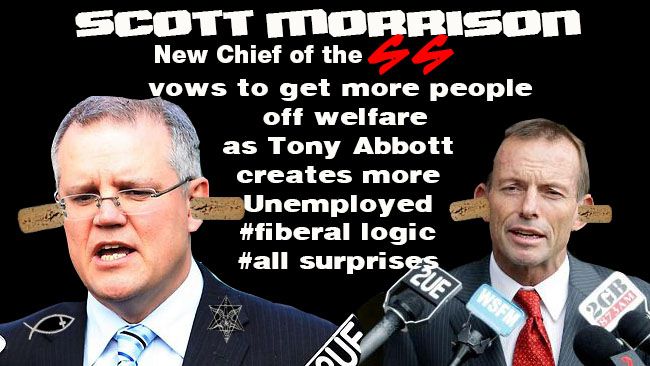
This is now in the hands of SS Commandant Morrison who will no doubt ban all scrutiny, accountability or transparency citing “on-god operations”.

George Pell will be well-pleased.

The sleepyheaded drunkard the work experience person pretending to be a leader. Hewson said that he was the most indolent worker he has ever seen, quite often Hewson would wander into Abbott little cubbyhole of an office, only to find him with his feet up on the desk sound asleep. –

Abbott and his new press team. it works they have shut him up. They won’t let the MSM near him.

Tony Abbott’s media monitoring: we have a message for him

Keeping an eye on social media (Photo: Alex Ellinghausen, image from smh.com.au)

The recent headline in The Sydney Morning Herald  – Abbott government spends up big on media monitoring – went on to tell its readers that:

Federal government departments are spending eye-watering sums to know what the public is thinking and what the media is saying about them . . .

Social media – in particular Facebook – was saturated with the story and subsequent howls of derision over such a costly and questionable exercise.

I disagree.

I want this government to spend as much time and money as it takes to monitor ‘what the public is thinking and what the media is saying about them’. They seriously need to know. They need to take a good look at what’s happening on social media – a long, hard look – where there are refreshingly honest opinions about how utterly incompetent, heartless and disgraceful they are (whereas no such critique exists in the mainstream media). They need to to look, listen, and learn. Thousands of social media users will tell them that this government is considered the closest thing to fascism seen in the free world, while personal attacks on Tony Abbott continue; notably suggestions that the man is a sociopath. While there certainly is no proof, it is understandable that such opinions exist given the behaviour of this government and its leader.

But if they do want to know what people outside the fluffy Murdoch media think, they can always start with this site.

Hundreds of articles have been published on The AIMN echoing what the public think of the worst government in Australia’s history – the Abbott government – and I’d l really appreciate that one or some of their minions take a look at us. Actually, I would implore them to. This site represents the political and social views of a large number of disgruntled Australians. Given the recent opinion polls and the noticeable stench of this woeful government, it would be safe to say we now represent the views of most Australians: ordinary people appalled by this mess, ordinary people appalled at seeing their country – to put it bluntly – go to crap.

However, to save them from rummaging through The AIMN (and similar sites), Facebook and Twitter I have compiled a summary of what I have found of them. I will address it to Tony Abbott personally.

Dear Tony Abbott,

Do you really want to know what the public is thinking of you and your government? After being heavily involved in social media since your election win I’ve come up with the following (based on thousands of comments I have read). This is what people are saying about you (with my own comments in italics):

  • You are a prime minister who displays breathtaking incompetence. The role of prime minister is far beyond you.
  • You are a prime minister who regularly embarrasses both yourself and your country on national and international stages.
  • You are a prime minister who shows more loyalty to the elite few ahead of the wider electorate.
  • You are a prime minister who has no interest in the opportunities of the future.
  • You are a prime minister who is out of touch with the majority of Australians.
  • You are an extreme radical.
  • You are a person who can’t sustain media and public scrutiny without ‘cracking’.
  • You are a habitual liar and back-flipper.
  • You are a  person who is totally out of touch with reality.
  • You lack direction.
  • You are a prime minister who not only ignores that we belong in a global community, but also want to remain isolationist.
  • You are a complete idiot who cannot make a public appearance without being stage managed.
  • You have lied about everything that Australian people value: the ABC, pensions, Medicare, our security etc etc. You have lost the peoples’ trust.
  • The cruelty of your policies know no bounds, and the economic incompetence is breathtaking.
  • I agree with all of the above but I certainly don’t agree with this one: some people would like harm to come to you. I personally wish no harm of you and I deplore seeing such comments. I also deplored the calls from far right-wing radicals to have Julia Gillard shot, dumped out to sea in a chaff bag, or those – including yourself – standing under signs screaming ‘ditch the witch’. In what context does ‘ditch’ mean? Something sinister, I imagine. You didn’t appear too concerned about these particular threats which leads me to believe this is behaviour you tolerate. So it may come as no surprise that daily people are posting comments wishing you the same. They hate you that much, yet they chose to follow your lead in displaying hate. Again, I deplore those behaviors from any political persuasion.
  • For a couple of years now people have questioned the nuances of your relationship with Peta Credlin and the power she may wield as a result. Personally, I really don’t care about your private life, but the power she wields is questioned not only on social media but the mainstream media as well.
  • The question of your apparent non-renouncement of your British citizenship is gaining momentum. Quite a storm has developed. We may never find out the answer, but the consensus among thousands of people is that if you are not legally entitled to hold an office in the Australian Parliament, then you should be disqualified from receiving the parliamentary pension based on your years of service. Come clean!
  • This will surprise you: most Labor voters want you to stay on as prime minister until the election because you are considered Labor’s best weapon. Conversely, many disgruntled Liberal voters want you removed forthwith. No matter what people want, they do not expect you to be in the job by the end of June.

Have you heard enough? I could go on – there is so much more. And I haven’t even started on your ministers yet. But at this stage I won’t: people are saying many of the same things about them too.

Jerry Brown sworn in to record fourth term as California governor : How is it this man got the state pulling together when Abbott cant

California Governor Jerry Brown

Brown says challenge is to ‘build for the future, not steal from it’ after balancing a $26bn deficit and creating a rainy-day fund to gird against future shortfalls

Democrat Jerry Brown, who turned around California’s finances after years of deficits, vowed to keep a tight rein on spending as he was sworn in on Monday for a record fourth term at the helm of the nation’s most populous state.

Brown, currently serving a second stint as governor, first served two terms from 1975 to 1983 and then returned to the governorship in 2011. He easily defeated his Republican challenger, Neel Kashkari, to win re-election in November.

Brown, the 76-year-old son of the late California governor Edmund G “Pat” Brown, has forcefully steered the heavily Democratic state on a centrist path since voters returned him to the governorship.

“We are at a crossroads,” Brown said in his inaugural address. “With big and important new programs now launched and the budget carefully balanced, the challenge is to build for the future, not steal from it, to live within our means and to keep California ever golden and creative, as our forebears have shown and our descendents would expect.”

California faced a budget deficit of $26bn when Brown was elected in 2010, following a national recession that hit the state’s economy hard and came after years of fiscal woes in California. He enters his fourth term with a balanced budget.

In November, California residents voted to enshrine a rainy-day fund in the state’s constitution, a plan backed by Brown that aims to ensure the state’s financial stability after years of boom-and-bust budgets.

This year, California will set aside $2.8bn in the fund, Brown said during his speech, to applause from lawmakers.

Brown also pledged to improve the state’s environment for the next 15 years by cutting petroleum use and increasing electricity derived from renewable sources to 50%.

The Assembly Republican leader, Kristin Olsen, said the governor has failed to present a comprehensive plan for job growth and education, and she expressed doubts about a project to build the nation’s first high-speed rail line in California.

A groundbreaking ceremony is planned for Tuesday, and Republicans have derided the project, which is estimated to eventually cost $68bn.

“While Governor Brown is still off chasing trains, we still have real needs in California,” Olsen said.

Brown sought his party’s presidential nomination in 1992, refusing to take donations larger than $100 and ultimately losing out to Bill Clinton.

Gore Vidal’s criticism of the USA doesn’t mean he’s anti-American. However Murdoch’s Fox News 8% truth and the Koch Bros Americans For Prosperity is a threat to Democracy. This is the model Murdoch, Gina ,the IPA etc and Tony the pawn have adopted. Tony is just a temporary tool who can’t bowl,can’t bat that can only sledge who is taking us into 2015

It’s the Chalice from the Palace that has the pellet with the poison! Who will replace Ceasar, How many knives are there under the togas?

Socrates and Abbot

Wouldn’t you love to be a fly on the wall at the LNP Headquarters at this moment?

As most of Australia swelters in the summer heat, quietly, oh so very quietly, in ‘the smoke filled back-rooms’ of the Liberal Party, tactics are being discussed while promises are made and gifts exchanged.

For the Coalition, the electoral barometer has plummeted from ‘change’ to ‘stormy’ and shows no sign of movement nor is it likely to.

Through his bungling and imperialist bluster demonstrated toward both Indonesia and China during the first two months of his term while at the same time shamelessly toadying to the US and Japan, and followed swiftly by the delivery of a budget hated by the community for its unfairness and blatant bias, Abbott had already set in motion the end of his leadership before it had even begun.

As early as its first quarter, the government’s approval rating began to slide and after May steadily declined to its present rating of 42.5% to the ALP’s 57.5% on a two party preferred basis.

This is not surprising considering the electorate has been a horrified witness to a government which careens from crisis to crisis in the pursuit of God only knows what, while leaving a trail of destruction in its wake.

Arguably, whilst the budget dug the government’s grave, the cuts to the ABC, SBS, and the underhanded implementation of the Medicare co-payment. screwed down the lid on the coffin.

As early as January 2014 the public began to develop selective deafness where Abbott’s statements were concerned about the need for tough budget measures, and by November they had stopped listening – entirely.

Despite the best efforts of the Coalition spin doctors to paint Abbott as a credible leader, nothing has worked.

Not the threat of terrorist attacks, not the deployment of troops to fight terrorist threats – real or imagined, and certainly not ‘shirt-front’ diplomacy.  The gaffes and parochialism of Davos were repeated at the G20, and Abbott side-lined and reduced to insignificance by Obama and Xi’s declaration to combat climate change.

Mid term now looms, and the LNP power brokers are on the verge of panic.

When the electorate loses all faith in the government and treats it with ignore, there can only be one outcome and on the results of polls such as this they know that as far as a second term goes, alles verloren. 

Their only option is to try and limit the damage.

This leaves two courses of action.

Keep Abbott as leader and try to tough it out with the threat of a double dissolution if the government’s bills continued to be blocked in the Senate.

A double dissolution however carries a high risk. With all seats in both houses open to contest, the results are unpredictable and neither Abbott, Palmer, or the independents are likely to relish another round of electioneering so soon.

In Abbott’s case, even if the Coalition were to be returned with a majority in the lower house, it may also mean that the government could face an even more intractable and hostile Senate than it does at present.

For Palmer and PUP, it would be at best a loss of their present power bloc; at worst, obliteration as the electorate tires of both Palmer’s antics and his caprices.

In the minor league, neither Leyonhjelm nor Lambie are likely to be re-elected due to their innate stupidity and the Motoring Enthusiasts Party are also unlikely to drive much further.

A double dissolution is not entirely risk free for the ALP either. Shorten has been able to profit through the strategy of adapting a ‘small target’ stance (and been roundly criticised for it) while standing back and allowing the government’s own ineptitude to seal its fate.

An election campaign however, would require a far more aggressive stance by Labor than demonstrated since its time in opposition, and next few months will also be critical for Shorten to prove beyond doubt to the public that he’s P.M. material.

The other option is to replace Abbott as leader. While pundits argue that this would open the LNP to the same accusations of disunity, disloyalty and disorganisation levelled at the Gillard government, the Coalition’s backers know that the urgency of the necessity to sacrifice the crown in order to save the purse grows by the day.

In less than half a term, the ‘Iron Throne’ of Abbott style Conservative government has become one of porcelain located not in a gleaming bathroom of ‘free markets and workplace reform’ but rather in a political outhouse infested by Red-backed spiders.

But who will ascend it? Truss, Hunt, and Robb are nolo contendere, and Macfarlane would do little more that to cause a rise in  sales of throat lozenges.

Pyne will never lead the party as long as his Gluteus Maximus points to the ground, and while Hockey and Morrison may be palatable to the right wing of the party, as far as the electorate is concerned; both are in the same category as Pyne.

This leaves a choice between either Turnbull or Bishop. Arguably Turnbull is far more likely to be acceptable to the public despite blotting his copy book with the NBN and the defence of Abbott’s cuts to the ABC, but Malcolm is so utterly despised by both the right and centre right of the Coalition, that he is unlikely to be able to garner enough support to mount a successful  challenge.

For the power brokers, Bishop is the only option but it’s not going to be easy to sell a someone who has been described by a Right wing US think tank as; “Australia’s Margret Thatcher and who is as tough as a woodpecker’s lips”.

Australian’s have had more than enough of chest beating, beak whetting Conservative politicians vowing to implement ‘tough measures’ against the most vulnerable in the community in order to drive down a non-existent ‘debt’.

For her own part, Bishop surely knows that to assume leadership is to accept that the chalice from the palace has the pellet with the poison and most of the next eighteen months will be spent in frenzied efforts to reverse the government’s fortunes.

The replacement of Abbott as leader of the LNP is a foregone conclusion. In back-rooms of the party he has been weighed and measured and now stands on the trap-door of the gallows. It’s only a matter of time before the lever is pushed.

Tony Abbott Village Idiot

Our Jobs Our Kids Our Future

Australian Immigration & Refugee Policicy

Tony Abbott – Is he the most corrupt MP Australia ever had?

Our Jobs Our Kids Our Future: Free Trade Agreements are killing manufacturing jobs.

Tony Abbott Village Idiot

All over the world, the challenge to the old order is growing

Eva Bee illustration of a turbulent game of risk


The powers that be will fight back against attempts to change the status quo, economically or globally

A decade and a half into the 21st century, we’re still living through the aftermath of two epoch-making shocks. The first was the demonstration of the limits of US power in the killing fields of Afghanistan and Iraq – the war on terror that broke the spell of invincibility of the world’s first truly global empire. The second was the financial crash of 2008 and the crisis of the western-dominated economic system it unleashed, still playing havoc with economies and lives across the world more than six years later.

That crisis will shape politics in Europe in 2015, from London to Madrid. But the impact will be felt first in Athens. The slump and stagnation that followed the crash has already fuelled the rise of the populist right. Now, after years of self-defeating austerity and falling living standards, the radical left has leapfrogged ahead to challenge for power in the most devastated eurozone economies of Greece and Spain.

It was a backlash waiting to happen. In Greece the leftwing Syriza party, which rejects the austerity enforced across the eurozone by its unelected troika, is favourite to win the snap elections called for the end of January. Syriza may have stepped back from its one-time demand for unilateral debt cancellation, its programme to boost living standards in the wake of a 1930s-style depression may be modest, and mainstream voices across Europe may also be calling for a change of direction. But Europe’s governing elites will have none of it.

Expect a ferocious campaign to terrify Greek voters, who have already been warned by the European commission’s Jean-Claude Juncker not to vote the “wrong” way. If Greeks still insist on making their own democratic choice, everything will be done to force Syriza to retreat. If all else fails, Greece will be punished for fear that others, such as Spain’s new Podemos party, might go down the same route later in the year.

The powers that be in Europe are determined to prop up a failed economic model regardless of the cost – as they will be in Britain if Labour wins the general election in May. The aftershocks of the breakdown of that neoliberal regime are still being felt across the world economy – in falling commodity prices, capital flight, stagnation and recession. But the interests that depend on it won’t let go without a serious challenge.
Advertisement

That’s just as true in terms of global power. The US and its satellites, including Britain, may have suffered a strategic defeat in Iraq and Afghanistan – symbolised by last weekend’s ceremony to mark the end of Nato’s combat mission, held in secret for fear of Taliban attacks. But they’re not letting go either. Some 13,000 troops are staying on as “trainers”, just as thousands of western troops have been returning to Iraq for the war against Isis – the al-Qaida breakaway spawned by their own invasion and occupation – with talk of a major assault in the spring.

In the same spirit, every effort was made at the time of the Arab uprisings of 2011 to hijack, control or crush them. Some of the results can be seen today in the disaster zone across the Middle East, the growing power of the western-backed autocracies of the Gulf, the brutality of Egypt’s new dictatorship and the maelstrom in post-intervention Libya, whose civil war is likely to intensify in the coming months.

Meanwhile, Russia’s challenge to untrammelled US strategic power, which began in Georgia in 2008 and intensified through Syria’s proxy war, has come to a head in the conflict in Ukraine. There has been much western crowing in recent weeks that the combination of collapsing oil prices with US and EU sanctions has plunged Russia into recession, while knocking chunks out of the economies of other independent oil states such as Iran and Venezuela into the bargain. It seems clear enough that the Saudi regime’s decision to boost oil output when prices were already falling was designed not only to protect market share and undercut fracking, but to punish Iran and Russia for their role in the Middle East and Europe to the benefit of Riyadh’s US sponsor.

It is a form of economic warfare – hailed by President Obama this week as the fruit of “strategic patience” – the consequences of which will be felt across the world in the months to come. But along with the global power and economic shocks of the past decade, two other crucial shifts have defined the early 21st century: the economic rise of China, in defiance of market orthodoxy, and the tide of progressive change that has swept Latin America, opening up alternatives to neoliberal capitalism.

Both have continued despite the backwash from the crash, which has taken its toll on the “Brics” countries and the wider global south. Progressive governments have carried on being elected from Bolivia to Brazil, while China’s slowing growth rate is still almost double that delivered by the US recovery. Political and financial pressure on Venezuela, which has been crucial to Latin America’s transformation and already faces serious economic problems, however, looks set to increase in the coming year. The key to riding the storm, as elsewhere, will be who is made to shoulder the burden of falling income and reform.

What seems certain though is that, however much the west tries to recapture lost ground, the global order will not revert to the status quo ante. There may be growing conflict, but there will be no return to unchallenged US diktat or uncontested economic catechisms. Alternative centres of power are forming. Both internationally and domestically, the old order is coming apart. The question will be what replaces it.

Tony Abbott – Worst PM in Australian History: Corporate government citizen control.

The self pride of Tony Abbott I can only sledge

Quote from one-trick Tony today: “I couldn’t bat, I couldn’t bowl, I couldn’t field, but I could sledge, and I think I held my place in the team on this basis”…Can’t lead, won’t follow, doesn’t learn, but good at throwing rocks, and proud of reputation as a wrecker.

Tony Abbott Village Idiot: Transparancy

Tony Abbott’s current polling woes don’t stem from the budget or broken promises, but from the simple fact that he was only elected to get rid of Labor,

Kevin Rudd and Tony Abbott debate during the second people's forum.

 writes Phil Arnold.

Recently there’s been a rush of political analysts to offer explanations for the seemingly inexplicable: polls showing the federal Coalition falling behind the Labor Party opposition in every state but Western Australia, and the man against whom successive Labor prime ministers failed to gain even a modicum of traction when he was opposition leader, demonstrably failing to gain the confidence of the electorate as Prime Minister.

The truth is that the likelihood of Tony Abbott presiding over a one-term federal government increases by the month – a suggestion that has political pundits scratching their heads and holders of marginal conservative seats looking decidedly twitchy.

The most frequent and oft repeated explanations for this political conundrum are the unpopularity of a budget regarded by both sides of the political divide as grossly unfair, and the string of broken promises from a Prime Minister who, when in opposition, made huge political capital out of the broken promises of the Gillard and Rudd led governments.

But, in truth, neither of these explanation stands up under close scrutiny. Other governments have survived unpopular policy decisions: Hawke’s tariff cuts and floating of the dollar, Keating’s interest rate rises and recession we had to have, and Howard’s GST. As for broken promises, the electorate has long ceased to regard the promises of politicians with anything other than well-founded scepticism. Even the most politically naïve could predict the explanations used to justify the abandonment of such hand-on-heart guarantees.

So, if not these, what? The genesis of the Abbott Government’s poor standing can be found in the reason it was elected in the first place. It was not out of any belief that Abbott was the answer to an electorate’s prayers. He didn’t inspire with the physical presence and rhetoric of Whitlam or Menzies, nor was he carried to power on a wave of voter adoration as was Hawke. He didn’t even beguile the electorate with the cheeky, larrikin charm of Keating or the perceived stability of Howard.

No. Abbott gained the prime ministership as a direct result of the electorate’s determination to dispose of a Labor government perceived as incompetent and addicted to suicidal in-fighting. The fact is, that Labor committed political harakiri and Abbott was the proverbial “drover’s dog” waiting to step into the breach.

That, as opposition leader, he played the Labor government for the political suckers they were (and with rare skill and single-minded determination), is undeniable. But so too is the fact that Labor’s fate was sealed well before the election, and a reversal of its fortunes was beyond contemplation.

The truth is, that the Australian electorate is, if not politically astute, certainly more capable of corporate pragmatism than many political commentators give them credit for. In this case, they were perfectly prepared to suffer the short-term agony of an unpopular prime minister in order to rid themselves of a troublesome incumbent, knowing full well that three years is a mere blink of an eye in political terms.

And it’s not too great a stretch of the imagination to further suggest that the same electorate deliberately minimised the potential for long-term damage by depriving Abbott of the senate majority necessary to pursue an unpopular political agenda.

There are precedents that support this proposition. In 1975 and 1977 the electorate elected the unpopular Malcolm Fraser as prime minister in successive landslide victories. They did so not out of any love for Fraser. Like Abbott, he just happened to be the opposition leader at a time when the electorate was determined to rid itself of a government they perceived as incompetent.

Similarly, John Howard, having ousted the Keating Labor government in 1996, in an election that saw the Labor Party reduced to its lowest primary vote in more than 60 years, only just held onto power at the end of his first term when Kim Beasley, as Labor Leader, won the popular vote but not a majority of seats in an electoral anomaly. It was perhaps only the so-called Tampa crisis, when the Norwegian ship entered Australian waters carrying a boatload of rescued asylum seekers, that saved him from defeat three years later.

Now, despite Abbott’s attempts as prime minister to bolster his electoral popularity with a succession of hairy-chested foreign policy responses, the electorate still refuses to see him as anything other than a short-term and expedient way of replacing a Labor government that was beyond redemption. The voters made up their minds about Abbott even before he was opposition leader. They’ve never liked him. They’ve never trusted him. They’ve never wanted him. And, unless the Liberal Party can come up with a popular and credible alternative, it will be consigned to political oblivion as quickly and decisively as its Labor Party predecessors.

Phil Arnold is a freelance writer, composer, teacher and musician living in Sydney. View his full profile here.

Increased policing is the sign of increasing Fascism. The ADF has been recruited as a policing agency, next the churches that’s all it takes. However politicians’ spending is declared non transparent due to national security.

Breaking faith with foreign aid partners is unkindest cut; Abbott is not only giving 23 million Australians a bad name but 2.2billion Catholics. He is truely unrepresentative of any of us.

On top of the $7.6 billion in cuts to aid since it came into office, the Abbott government will take a further $3.7 billion out over the next four years.

How shall we celebrate the New Year? From where I sit, a minute’s silence may be the best response.

I work for an Australian aid and development agency, one that waits to see where the latest round of cuts to the aid budget will fall.

Here is what we know: On top of the $7.6 billion in cuts to aid since it came into office, the Abbott government will take a further $3.7 billion out over the next four years, with 1 billion to be extracted from the coming year’s budget alone. How much will be cut from the part of our aid that is delivered through non-government agencies like mine, remains to be seen. Wherever it falls, the impact will be brutal.

For a time, from 2004, buoyed by the commitments of Labor and Coalition governments to the United Nations Millennium Development Goals (MDGs) and the resulting increasing aid levels, we saw the maturity of the aid and development sector grow. Importantly, we saw improvements in the things that the MDGs measured: more children at school, more babies born safely, more communities with safe water systems.

Australian aid does lots of good things. It enables us to invest in regional and global partnerships with cross-border programs to stop the spread of disease, to harness and share natural resources, and to help displaced people and assist after humanitarian disasters. Working with non-government agencies, our aid contributes powerfully to removing the barriers that stop people from living healthy, productive lives, enabling them to contribute to the wellbeing of their communities and to stable civic environments.

One story illustrates the expertise and effectiveness of our aid sector in Laos. Keo Chan, her husband and three children were only just getting by. With little money, they shared a small house with two other families. There was not enough rice to go around, and Keo and her husband had to travel to another village to work to feed their family. There was no extra income for daily expenses, like school fees or medicine. If emergencies came up, there was no safety net.

An integrated development project, working with the community, sparked changes. A village irrigation system has opened up new farmland, enabling Keo’s family to have their own rice paddy, and improvements to the village’s household water supply mean they can enlarge their vegetable garden, so they’re able to grow enough food. Keo has learned how to read and write. She is part of a savings and loans group and was recently asked to be the group’s bookkeeper. Keo has established her own small coffee plantation, a cash crop that she can sell to make a living. She now has her own home to live in, with space for her three children to grow.

These latest cuts break faith with the many communities like Keo’s which benefit from Australian aid. They break faith with global agencies and those agencies on the ground delivering these impressive results. They had every right to feel that these programs would be resourced for at least a few years. Short-term commitments bedevil the aid area. Most effective development takes years to bear fruit. The recent cuts remove predictability – a goal expressed strongly by Minister Bishop in an address only last February. She said, “But what I have done is stabilise the budget at $5 billion per annum. It will increase in line with inflation, so it will go up by CPI. This will provide certainty, predictability of funding for our partners, for the recipients, and will put the aid budget on sustainable financial footing.”

The massive cuts are also a breach of faith with Australian non-government agencies and will inevitably involve job losses and the cutting back of programs. The loss of expertise and professionalism from the sector will take many years to restore.

The successors to the Millenium Development Goals, the Sustainable Development Goals (SDGs) will be negotiated next year. How can Australia participate in their development while simultaneously drastically cutting back its own aid?

We stand at the cusp of a new year and look ahead with sorrow. Those most affected are the silent ones whose water and food supplies will remain precarious, whose babies will not be vaccinated and whose girls will not go to school. By 2017, Australia will drop from contributing 34¢ for every $100 of our national income, to 22¢. Our aid has never been so low. Other developed countries with higher debt levels than ours, have been holding their aid budgets to promised levels and some, like Britain, have even reached the UN agreed target of 70¢ per $100 of income.

I would like to see a little more faithfulness to communities that benefit from Australian aid and to the Australian people who care about these things.

As the New Year dawns, it seems more than appropriate to spare a minute’s silence for the state of Australian aid.

I have rarely ever used this word but he is a COCONUT

This is Anthony Dillon who claims he is Aboriginal and has and continues to spread his propagandistic lies exclaiming that all Aboriginal people come from a race of barbaric cannibals that were rolling around in the dirt for over 2000 generations here in this country and that white people have come here to these shores to save them from their backward ways..
I have rarely ever used this word but he is a COCONUT ( a black person who is completely assimilated to the point that they are and wish to be white and have absolutely no connection to culture or their roots ) who is trying to bring down our people, but this will never happen as we stand solid with pride in the truth that we are and always have been a beautiful race no matter how much this euro system that we battle against attempts to vilify and victimize us..

So much respect and gratitude for those white brothers and sisters out there who stand with us and join us in this battle for equality and justice for all..

Truth be – One Love..

“All you need in this life is ignorance and confidence – then success is sure.” (Mark Twain). Found. Tony’s source of inspiration.

Financial discrepancies emerge in fundraising body linked to Tony Abbott

Tony Abbott

The Warringah Club may have failed to declare gifts in kind in pre-election audit, finds Australian Electoral Commission

A political fundraising body linked to Tony Abbott was found to have financial discrepancies in the lead-up to the 2013 federal election and may have failed to declare gifts in kind, a critical report by the Australian Electoral Commission has found.

The Warringah Club – now known as the Sydney Small Business Club – is an associated entity linked to the Liberal party and the prime minister’s political fundraising. It has received thousands of dollars from the New South Wales Liberal party, as well as sent thousands to the party.

But the AEC raised concerns about the accounting practices of the entity in a compliance audit in February 2013 for the entity’s accounts year ending 2011, documents obtained by Guardian Australia under freedom of information laws show.

The audit identified problems with its accounting that led to an overstatement of both receipts and payments by $10,909. While clerical error was the reason given, the AEC report said the entity had provided no indication of how the error occurred.

“The discrepancies outlined in the report above are of some concern given the otherwise apparent professional approach to the record keeping undertaken by the financial controller of the Warringah Club,” the report said.

“While unspecified clerical error was quoted as the reason for the discrepancies, the inability of the financial controller to account for the error, particularly as he is a practising accountant, raises concerns about the approach to compiling the return in meeting the requirements of the [Commonwealth Electoral Act].”

Guardian Australia contacted accountant Peter Polgar, who is listed as the financial controller of the entity, but he did not respond to questions.
Advertisement

The audit also raised concerns about the possibility the entity may not have disclosed gifts in kind in the form of unpaid staff work.

The entity told the AEC “no paid staff are employed at all”. The AEC report said the “response implies, therefore, that whilst no paid services were made by the entity’s staff, some unpaid services may have been provided”.

“If this has been the case or is likely to be in the future, the value of the unpaid services provided by staff should be accounted for and reported as a gift.”

The entity was also late in providing key documents relating to gifts in kind, financial statements and loans, and did not provide working papers to support the figures reported in its returns, and the audit recommended the company remedy the discrepancies identified.

The prime minister’s office did not comment on the AEC audit.

The Warringah Club has previously come to public attention through its fundraising activities and political funding disclosures.

In April 2014 the NSW Liberal party also declared late a four-year-old $25,000 donation from the body. The declaration was among a tranche of amendments made declaring previously unreported donations over a span of years from different companies.

In 2010 the NSW electoral authority also found that the Warringah Club had broken NSW disclosure laws by failing to make required declarations.

Greens senator Lee Rhiannon has called for changes to federal electoral funding laws to improve transparency and reporting requirements.

“The inconsistencies and the discrepancies that the AEC has uncovered is a continuation of the problems with Warringah Club,” she said.

“It further underlines why we need uniform consistent electoral laws across the county. When it comes to associated entities they need to be required to have a more rigorous and transparent reporting regime.”

Tony Abbott Village Idiot

Tony Abbott Village Idiot

Tony Abbott Village Idiot

Tony Abbott Village Idiot

457 Visas, Casualise Labour, Increase Unemployment, Put pressure on wages = Work choices

The downing of Malaysia Airlines MH17 – Part 9 – » The Australian Independent Media Network

Tony Abbott and his Malaysian counterpart Prime Minister Najib Razak (image from www.itv.com)

The downing of Malaysia Airlines MH17 – Part 9 – » The Australian Independent Media Network.

JUST DO IT

Tony Abbott Village Idiot

Tony Abbott Village Idiot

Abbott government cuts university support; funds priests’ training

"This raises serious questions about relationship between Church and State": Labor higher education spokesman Kim Carr.

Abbott government cuts university support; funds priests’ training.

Tony Abbott Village Idiot

The downing of Malaysia Airlines MH17 – Part 8

Prime Minister Tony Abbott showing the way.

He can be seen hereafter at  the ‘command station’. He would call it that, would he not?

A very independent and highly acute observer of the provincial theatre – one who can see well through the fog – wrote to the Canberra Times on 9 August 2014:

“That foreign minister Julie Bishop would attempt to threaten Russia with further non-specific sanctions if it fails to accept responsibility for the MH17 disaster says everything about Australia’s eagerness to play cats-paw in America’s geo-political games, designed to enhance the west’s strategy of encirclement and isolation of Russia.

Never mind the fact that no-one, including America, has tabled a skerrick of evidence in support of the hysterical accusations made against Russia. Never mind credible reports suggesting that Ukrainian air force jets may have shot down the hapless airliner. Never mind the hollow pretensions of the Abbott government in claiming that it would pursue ‘truth and justice’ before pointing the finger.

And in mindlessly supporting our government’s criticism of Russia for responding in-kind to our own reckless and provocative behaviour, Opposition Leader Bill Shorten simply confirms how all sides of politics in this country are beholden to American interests and just how weak is our real capability to forge an independent foreign policy geared to support our own national interests.”

Down in thick fog.

Answers to some further questions could clear the air. For instance:

1. Is it correct that:

– on 18 July 2014, in a morning interview with a Melbourne-based radio station, hence given the difference of time only hours after the incident, Prime Minister Abbott declared that it “seems certain” that the plane was brought down by a “Russian-supplied surface-to-air missile”,

– that Mr. Abbott then proceeded to turn the political reality in Ukraine on its head, declaring: “What’s been happening for many months now is an attempt by Russia to bully a neighbour. Now this is just outrageous”,

– that, implicitly calling for massive retaliation, Mr. Abbott declared: “I don’t say there are easy responses when a large and powerful country attempts to bully a smaller and less powerful neighbour.”, and

– that in a speech to Parliament hours later, Mr. Abbott warned that: “the bullying of small countries by big ones, the trampling of justice and decency in the pursuit of national aggrandisement and reckless indifference to human life should have no place in our world”?

2. Is it correct that, following Mr. Abbott accusations of Russian “bullying of small countries”, the Labor leader Bill Shorten declared that: “the missile that brought down MH17 – and the missiles that have claimed numerous other Ukrainian aircraft – could not possibly be made by the people who possibly fired them. These separatist terrorists are obtaining these instruments of murder from elsewhere. This must be investigated – and it must be stopped”?

3. Is it correct that soon thereafter Mr. Shorten issued a blanket guarantee of Labor’s support for any government retaliatory measures against Russia. As he said: ”Labor understands the difficulty and complexity of the decisions [Abbott faces],” and “there will be many understandable calls for all sorts of action.” In particular, he indicated that Labor would support the Abbott government if it refused to allow Russian President Putin to attend the G20 summit in Brisbane this December?

4. Is it correct:

– that on 18 July 2014 the Abbott government summoned Russian ambassador Vladimir Morozov for a dressing down by Foreign Minister Julie Bishop,

– that Ms. Bishop reportedly insisted that Russia support a U.N. Security Council investigation into the crash, and demanded that Mr. Morozov answer whether Russian weapons could have been used to down the plane,

– that in a press conference following the meeting, Mr. Abbott denounced Mr. Morozov’s claim that responsibility for the crash rested with the Ukrainian regime in Kiev, and

– that Mr. Abbott warned that the events were a “test” for Russia and that its: “whole standing in the world is at risk here”?

5. Is it correct that on 19 July 2014 the Labor leader Bill Shorten repeated his call for Russia to be excluded from the G20 talks, saying to journalists: “I put on record again, if the Russian Federation doesn’t co-operate and help us get to the heart of what has really happened in this senseless act of murder, the government should indeed consider not inviting the Russian President Putin to [the G20 Summit to be had on 15 and 16 November 2014 in Brisbane,] Australia”?

6. Is it correct that, by the end of July 2014, a number of Australian policemen were stranded in a war zone with the permission of Ukraine’s president, but without the authorisation of their parliament, while Australia and most certainly its government appeared to have stumbled into a conflict about which they knew nothing and not to care to understand?

7. Is it correct:

– that on 26 July 2014 Foreign Minister Julie Bishop and her Dutch counterpart Frans Timmermans returned to Ukraine to urge the Kiev government to recall Parliament and approve the deployment of armed Australian troops to the MH17 crash site, and

– that fifty unarmed Australian Federal Police officers and forty of their Dutch counterparts had left the Netherlands for Ukraine the day before, but under Ukraine’s constitution no armed forces can enter the country without Parliament’s approval?

8. Is it correct that on 26 July Prime Minister Abbott tried to separate the downing of MH17 from the conflict itself. On that day, when asked at a press conference whether Australia would join the European Union in rumoured new sanctions, he replied: “There are two separate issues here: there’s the issue of the geopolitics of Eastern Europe – and people have their opinions on that and some countries are taking action on that – and there’s the issue of Operation Bring Them Home and my whole and sole focus is on Operation Bring Them Home”?

9. Is it correct that, after Prime Minister Abbott announced a national day of mourning to be held in the near future, and ordered all government flags to be flown at half-mast on 19 July 2014, the choice of venue fell on St Mary’s Catholic Cathedral in Sydney, St Patrick’s Cathedral in Melbourne St Mary’s Cathedral in Perth, as if they were the only places for a ‘national day of mourning’ which should be had at a public place, a non-denominational place, but in the case was insensitively forced in Catholic places of worship, with a sovereign abuse of the memory of those who were not, their families and more specifically of the many 44 Malaysian victims and their families?

10. Is it correct that Australia found itself in the extraordinary situation of having moved Resolution 2166 before the United Nations Security Council, while Ukraine was in breach of the very provision: “that all military activities, including by armed groups, be immediately ceased in the immediate area surrounding the crash site to allow for security and safety of the international investigation”?

And there is more: who, whether on the Australian or Ukrainian side, advised the Foreign Minister that the deployment of unarmed Australian policemen to eastern Ukraine’s war zone would, in fact, be possible?

What advice did the Minister receive about the fragility of the government in Kiev?

Why, during her visit on Friday 25 July, did the Minister not obtain from President Poroshenko a guarantee not to resume the offensive around the crash site?

Did she know, or suspect, that Poroshenko would order the resumption of a campaign that would contravene the very Security Council resolution she had just triumphantly engineered in New York?

Whatever the answer to those questions, the success of two Australian initiatives – the Security Council 2166 and the Australian Federal Police’s grandiosely titled Operation bring them home – now ride on political and geopolitical considerations that go to the heart of the crisis: the mixed cultural and linguistic composition of Ukraine; and the unresolved geopolitical consequences of the Soviet Union’s collapse, above all the eastward expansion of N.A.T.O. and the E.U. at the expense of Russian interests in Eastern Europe.

Operation bring them home has played well in the commercial media. But it is now manifestly putting lives on the line.

It is worth pointing out that this is not, in fact, an Australian-led mission. It is being led by the Netherlands, under the auspices of the Organisation for Security and Cooperation in Europe. But the O.S.C.E. is itself deeply involved in the current crisis. It will in time be a party to crisis talks in Belarus, brokered between Russia’s ambassador to Kiev, Mikhail Zurabov, and former Ukrainian president Leonid Kuchma.

At no point in the current Operation has anyone in the Australian government stopped to explain the relevance of the MH17 crash site to Australia’s broader national interests. Bringing back the bodies of Australian victims is politically attractive for a government which badly needs some positive media coverage. But is it actually in the best interests of Australia? And is it worth risking the lives of Australian police officers?

The Abbott Government is overly fond of the language of the military, as its ‘Boy’s own’ penchant for calling activities ‘Operations’ confirms. The feeling of macho goes with it. Even the sole woman is much of a he man in the mist.

There is still afloat an Operation for MH370 – the Malaysian airplane ‘lost’ on 8 March 2014 and believed to be somewhere in Indian Ocean; a three-star general is in charge of the Operation ‘Stopping the boats’ of asylum seekers and sending them to Australian concentration camps, and a former Air Chief Marshal, Angus Houston is in charge of Operation bring them home.

‘Does Abbott have a military-first instinct ?’ asked a lead column of Murdoch’s The Australian on Sam Roggeveen 13 August 2014.

In the early days of the MH17 crisis Prime Minister Abbott wanted to put 1,000 Australian troops onto the crash site in conjunction with 1,000 Dutch troops. Nothing better testifies to his outrage at the event and his keenness to deploy Australian assets in a cause that affected Australians. This option remained on the table for a few days.

It was never going to be viable. Yet debate around this idea continued before Prime Minister Abbott was talked around and decided it was too dangerous and inappropriate an option. Putting Australian troops into that highly charged situation would have been far too risky.

However, it offers insights into Mr. Abbott’s approach to military issues: he is impatient with limitations relating to logistics and deployment. When Australians are involved Abbott wants to make a difference as soon as possible.

“Abbott’s every instinct – wrote The Australian – is to deploy Australian military and police assets and he needs to be persuaded by his advisers from such options.” He might have added that, on MH370 and Operation Sovereign Borders as well, Mr. Abbott also chose to get the military involved.

More Reading:

The downing of Malaysia Airlines MH17 (as observed from Australia) – Part 1

The downing of Malaysia Airlines MH17 – Part 2: An avalanche of inconvenient questions

The downing of Malaysia Airlines MH17 – Part 3: Who was behind the MH17 downing?

The downing of Malaysia Airlines MH17 – Part 4: Cui prodest? Huh . . . it is the oil, men!

The downing of Malaysia Airlines MH17 – Part 5: (continuing) Cui prodest? Huh . . . it is the oil, men!

The downing of Malaysia Airlines MH17 – Part 6: (continuing) Cui prodest? Huh . . . it is the oil, men!

The downing of

Ditch the Rupert Rags forever!

Tony Abbott: A man most Australian women would like to pat on the back…iron in hand.

OhTony. Why do you insist on putting your foot so regularly in your mouth? Perhaps if you wore a high heel it would prevent you from jamming it in there every five minutes. Plus I’m sure many Australian women would like to see you in a pair of stilettos while ironing and sorting the household bills. Apparently, though, that’s our job. #notfittogovern #LNPSociopaths
“Women are particularly focused on the household budget,” said Abbott when claiming his biggest achievement for women was repealing carbon tax. Apparently it will reduce the cost of electricity used when ironing. I’m sure women across Australia want to give him a pat on the back for that, hot iron in hand.

To be fair, Julia Gillard did try to warn us. She endured his eye rolling and sexist jibes during their campaign battle, leading her to slam Abbott as representing “the definition of misogyny in modern Australia”. The fact that he told us to vote for him because he had two “not bad looking daughters” should have raised a red flag too. But, alas, he won the 2013 election (perhaps we women were too busy ironing to vote?) and now we are subjected to sexist slip-up after slip-up.

I’m sure Aussie women have your sympathy, though. After all, British women have to put up with David “calm down dear” Cameron. At least the UKIP days of jokes about “crumpet”, “sluts” and “women don’t clean behind the fridge enough” are over after Godfrey Bloom stepped down from the party. Although, just like the fridge, I am sure we are yet to see the back of it.

I appreciate that women are not the only victims of Abbott’s foot-in-mouth disease. He caused controversy with his “shit happens” remark when he was told that the death of Lance Corporal Jared MacKinney’s death in Afghanistan was not down to any single factor, and he even roped Jesus in to back up his immigration stance, stating that, “Jesus knew that there was a place for everything, and it’s not necessarily everyone’s place to come to Australia”.

Alas, I don’t think Abbott will be removing his foot from his mouth any time soon. I guess I’ve just got to hope he uses his free foot to give himself a kick up the arse.
http://www.independent.co.uk/voices/comment/

Tories sell the farm labour buys it back. Social responsibility only if theirs a profit

Small Government and Cheap Labour #notfittogovern
“Small Government” is the central defining right-wing slogan. And yes, it’s all about “Cheap Labour”. Using this ideology, the Cheap-Labour ideologue paints himself as a defender of “freedom” against “Big Government Tyranny”.
But the Cheap-Labour Conservative isn’t really interested in “freedom”. What he wants is the “Privatised Tyranny” of industrial serfdom, the main characteristic of which is – you guessed it – “Cheap-Labour”.
Is the pattern becoming clearer? These Cheap-Labour Liberals have no problem at all opening the public purse for corporate interests. It’s “Social Spending” on people who actually need assistance that they just “can’t tolerate”.
And now you know why. Destitute people work Cheaper, while a harsh police state keeps them suitably terrorised.
Included within the slogan “Small Government” is the whole Conservative set of assumptions about the nature of the “Free Market” and government’s role in that market. In fact, the whole “Public sector/Private sector” distinction is an invention of the Cheap-Labour Liberals. They say that the Private sector exists outside and independently of the Public sector. The Public sector, according to Cheap-Labour ideology, can only interfere with the Private sector, and that such interference is inefficient and unprincipled.
In fact, the whole idea that the Private sector is independent of the Public sector is totally bogus. In fact, “the market” is created by public laws, public institutions and public infrastructure.
For proof, you need only look at exactly what constitutes “Big Government Tyranny” and what doesn’t. It turns out that Cheap-Labour Liberals are BIG supporters of the most oppressive and heavy handed actions the government takes.
Sounds to me like the Cheap-Labour Liberals have a peculiar definition of “Freedom”.
What do these guys consider to be “tyranny”? That’s easy. Take a look:

• Cheap-Labour Liberals must always have a “Surplus” – Sell off every “Public” owned asset until they achieve their “Surplus” – or until there is NOTHING left to sell.

• “Social Spending”, otherwise known as Redistribution, is classed as “Age of Entitlement”. While they don’t mind tax dollars being used for killing people in wars for oil, using their taxes to feed people is “stealing”.

• Cheap-Labour Liberals have fought against every piece of legislation ever proposed to improve working conditions, including the eight hour day, annual leave, sick leave, OHS regulations, and even Child Labour laws.

• Cheap-Labour Liberals are hell bent on destroying Labour Unions, who “extort” employers by collectively bargaining.

• Cheap-Labour Liberals cut Federal support and diminish Federal standards for public education.

• Cheap-Labour Liberals completely ignore or bypass Environmental regulations and the EPA.

• Cheap-Labour Liberals mock Civil rights legislation. There are still Cheap-Labour Liberals today, who are staunch defenders of the “White Australia Policy”. Apparently, Federal laws ending Segregation and Racial Discrimination were “tyranny”, but segregation itself was not.

• Cheap-Labour Liberals are petrified of the Truth – Unlike Commercial Broadcasting, Public Broadcasting deals in the truth– The ABC and SBS, which are virtually the only source for Real News, High class Documentaries, Music and Theatre, are a threat to their Propaganda. This from the people constantly braying about the decay of “The Culture”.

• Cheap-Labour Liberals support every Right-Wing Authoritarian Hoodlum in the third world.

• Cheap-Labour Liberals support foreign assassinations, covert intervention in foreign countries, and every other “Black Bag” and “False Flag” operation they can dream up, even against constitutional governments, elected by the people of those countries.

• Cheap-Labour Liberals want all the military force we can stand to pay for and never saw a weapons system they didn’t like.

• Cheap-Labour Liberals – you know, the ones who believe in “Freedom” – say our crime problem is because – get this – we’re too “Permissive”. How exactly do you set up a “Free” society that isn’t “Permissive”?

• Cheap-Labour Liberals complain about the “handcuffing the police” and giving “rights to criminals”. It never occurs to them, that our criminal justice system is set up to protect innocent citizens from abuses or just plain mistakes by government officials – you know, the ones who can’t do anything right

• Cheap-Labour Liberals support the “get tough” and “lock ’em up” approach to virtually every social problem in the spectrum. In fact, it’s the only approach they support. As for the ever increasing gaol population – they say our justice system is “too lenient”.

• Cheap-Labour Liberals support “domestic surveillance” against “subversives” – where “subversive” means “everybody but them”.

• Cheap-Labour Liberals, the big believers in “freedom”, think it’s the government’s business if you smoke a joint or sleep with somebody of your own gender.

• Cheap-Labour Liberals support our new offshore “Concentration Camps”. They also support these “secret tribunals” and “secret evidence” and draft new inhumane legislation to inflict even more pain and suffering on human beings fleeing persecution from their governments. Then label Labor and The Greens as “Stalinists” for demanding the release of children from these hell holes.

• And let’s not forget this perennial item on the agenda. Cheap-Labour Liberals want to “Protect our National Symbol” from “Desecration”. Of course, it is they who desecrate the flag every time they wave it to support their Cheap-Labour Liberals. [Ouch! That was one of those “hits” you can hear up in the “nosebleed” seats

See the pattern? Cheap-Labour Liberals support every coercive and oppressive function of government, but call it “tyranny” if government does something for you – using their money, for Christ sake.
Australia, don’t become America.

Three not so wise men

wise men

Written by:

Firstly, Tony Abbott. As if he had not embarrassed himself enough during this year, the latest but not necessarily the last effort was his astonishing suggestion that removing the carbon tax was his greatest achievement in 2014.

“Well, you know, it is very important to do the right thing by families and households,” Abbott said. “As many of us know, women are particularly focused on the household budget and the repeal of the carbon tax means a $550 a year benefit for the average family.”

What a comment bereft of inspiration!

Then, when questioned about the number of women in cabinet he said, “The challenge for all of us is to get more women into public life, more women into the parliament, once we have got more women in the parliament we will have more women in the ministry and more women in the cabinet.”

abbottWhy is it a challenge? Does he mean that there is no one of sufficient competence or that the challenge is for him to overcome his own difficulties relating to women? One would think that there are plenty to pick from already; many of whom would clearly outshine some of the male deadwood he has there now. So, do we conclude that he is the problem, not the women?  Or should we just let Anthony Albanese have the last word? “There is no issue too big for Tony Abbott to show how small he is as a thinker,” Mr Albanese told Fairfax Media.

Now let’s look at Joe Hockey. If ever we needed proof that his budget measures and his actions since were creating a defence line for his elite, excessively wealthy neo liberal support base, we have it with what we read on page 117 of his MYEFO statement.

In short, his broken promise to impose new tax avoidance rules to stop multinational companies from loading debt on their Australian subsidiaries, says it all.

It was the Gillard government that planned legislation to abolish section 25/90 of the Income Tax Assessment Act 1997 that enabled tax minimisation deductions for global corporations.

hockeyIn November 2013, Joe Hockey announced that the government would not proceed with the package but instead would introduce a targeted anti-avoidance option after consultation with the participants involved.

In this month’s MYEFO statement we find hidden way back on page 117 the following announcement: “The government will not proceed with a targeted anti-avoidance provision to address certain conduit arrangements involving foreign multinational enterprises, first announced in the 2013-14 MYEFO.”

The reason? That it would cause, “unreasonable compliance costs on Australian companies” with subsidiaries offshore. “That means more revenue flowing out the door to multinationals, which means worse services and higher taxes for Australians,” according to Andrew Leigh, Shadow Assistant Treasurer.

What a pathetic cop-out by Hockey. How hard would it be to exempt Australian owned companies from the legislation?

On his Facebook page, Wayne Swan says, “This decision leaves open a huge loophole that will bleed our tax revenue for years and is yet another example of how this Government is reneging on essential structural reforms required to make our budget sustainable.”

Swan concludes by saying, “Joe Hockey’s deceptive rhetoric about all Australians needing to pay their fair share is yet again exposed by this decision to give further tax breaks to large multinational corporations.”

Then there is Scott Morrison whose actions as Minister for Immigration and Border Protection betray his self-professed Christian principles of standing up for the truth, standing up for justice, standing on the side of the poor and the hungry, the homeless and the naked.

Contrast this with the circumstances on Manus Island that led to the death of Reza Berati, with the recent transfer of Sri Lankans at sea, with blackmailing the Senate cross benches promising to release children in detention on Christmas Island in return for the reintroduction of Temporary Protection Visas.

morrisonMany politicians cloak themselves with so-called Christian principles when describing themselves publicly, so in that sense Morrison is not alone. And it is easy to recall such obvious contradictions in one’s words with one’s actions as we can with most of them. So we should not be surprised when so-called Christian principles employed to win votes are quickly dispensed with in favour of pragmatism.

Now he had been given the Social Services Ministry as a reward for stopping the boats, as if stopping the boats was an achievement; as if engaging a nation’s Navy to stop a handful of desperate people trying to find a safe haven was considered clever.

However, he may well find treating Australian citizens similarly is a different kettle of fish. We shall see if his belief in standing up for the truth, standing up for justice, standing on the side of the poor and the hungry, the homeless and the naked continue to conflict with pragmatism. If it does, he might well find himself and his government in a different kind of struggle.

So, what is left to say about 2014 that hasn’t been said? The ongoing incompetence and absurdity of the Abbott government has provided a rich canvas for political commentators. We can only hope they keep providing us with similar material in 2015. I certainly expect they will.

liarsThis constant harping on about removal of the carbon tax, the mining tax and stopping the boats only serves to highlight the absence of any vision for the future. They represent an ideas vacuum; a government that won by default, that was never prepared for what lay ahead and doesn’t know how to move forward.

Meanwhile the world will face some pretty ominous challenges in 2015 and there’s not a lot of confidence that those who lead us will manage those challenges well.

The Ship of Fools SS commandant will increase forced labour while Uberfurrher Abbott will increase unemployment. Forcing down the cost of labour. WorkChoices willbe back.

Image from mewscorpes.com

If you think the government was taking us towards social and economic disasters prior to the recent Cabinet reshuffle, well you ain’t seen nothin’ yet, writes Ricky Pann.

The new threat to Australia is not the boat people nor the terrorists, it’s now the unemployed and those on welfare.

Scott Morrison is ferociously ambitious and a Liberal insider told me just after his rather dirty campaign for pre-selection in Cook that he has aspirations for the top job. Like Abbott, he is combatant and will say or do anything to win. This they have in common.

Tony Abbott has been scraping the bottom of the boat over the weekend and Scott Morrison has managed to land himself as the head of Social Security (ironically the SS).

So now Scott “where the bloody hell are ya” can treat the unemployed and disadvantaged with the same ‘take no prisoners’ contempt with which he treated refugees. In a recent presser he gloated that he intends to get as many people “off welfare” as he can and in light of the Abbott Government’s policies driving unemployment up; that should be an extraordinarily heinous feat that may have dire social consequences.

Kevin “onward Christian soldiers” Andrews, neanwhile, moves to defence as he is obviously not hard enough for ideologies dirty job. I am no longer surprised at all by Abbott so I predict a series of undisclosed ideological agendas will be “tried on” with Morrison at the helm.

These may include:

  • The Green Army as a dumping ground for people that cannot find suitable employment (work 4 the dole).
  • Food stamps and income management.
  • Tightening of the qualification for the Disability Support Pension and government health checks.
  • Drug and Alcohol testing.
  • Privatisation of services provided by Centrelink.
  • Tightening of provisions and mandatory obligatory requirements for Welfare recipients.
  • Demonisation of welfare as a social disease.

Expect a wide backlash against the idea of these measures as Morrison, like Abbott, is about as popular in electorate polling as root canal therapy. The fight will be fought in the Senate.

There is an elitist belief deeply entrenched in this government’s socially disconnected ideology, that people on welfare should work in menial jobs as part of their social contract. Ironically this government has abandoned any sense of social responsibility to the point of disenfranchising the very people they courted before the election. The list of lies and dishonesty is becoming quite ridiculous as the gloss of “I’m a changed man” washes off in a shower of insincerity to reveal two ironically sobering points:

  1. The electorate was sold a PUP (literally) as the hollow promise of “not dealing with minor parties” becomes the only filter to sanity ironically making people like Jaquie Lambie (with .09% of the vote) powerful players in the last line of social equality’s defence.
  2. The facile promise of Abbott stating he “would not say one thing and do another” is prevalent in the tsunami of undisclosed agendas and broken promises directly contradicting what was sold during the election campaign.

Quite simply, Tony Abbott personifies everything he said he would not be before the election. Abbott went into the election with no plan other than to say anything to win with a range of undisclosed agendas and social engineering masquerading as prudent conservative fiscal stewardship. Some fourteen months in, the runs are not on the board nor is the plan working. People are starting to use the “R” word and public confidence in Hockey’s ability is scathing across the political divide:

  • Commodities are tanking (coal, ore, gas and oil).
  • Expenditure is up.
  • Tax receipts are down.
  • The Australian dollar is weakening.
  • Unemployment is up.
  • Spending and consumer confidence is down.
  • The big ticket items like the repeal of the carbon tax or the MRT have done nothing.
  • The planned surplus promises were a lie and not attainable.
  • Inflation is steady, but easing up.

This government is arrogant and is simply not listening to the electorate. It will do so at its own peril. Abbott has always been doggedly combatant and non-conciliatory. He prefers to tough it out to grim death and apologise insincerely as a last resort on every point. He feels he has to win no matter what with no compromise. That may be fine in opposition but in government its politically suicidal. Strong leadership comes from governing for the whole electorate which is something that Abbott has not learned. Tony Abbott unscripted is awkward and stilted which is reflected in his popularly approval rating. People just don’t like him, especially the Liberal voters he has abandoned in a wave of tea party fervour.

The problem with socially disconnected elitism is you become delusionary, preferring to live in your own version of truth. This government has been extremely divisive, preferring to have a “for or against” mentality. They honestly believe that government is a mandate to do whatever they like, disclosed or not, wanted or not, necessary or not. They have waged an ideological battle with no logical outcome other than proving a point irrespective of the social cost.

It is core to their thinking that they are above criticism, which is a sign of radicalisation. They have hijacked and shifted the middle ground of centrist conservatism to the extreme right polarising the bipartisan middle ground. Moving the gold posts of where conservative starts so it is indistinguishable from radicalism. Of course this is another illusionary lie. Abbott’s front bench team is made up of mostly people who have always been radical ideologues pretending to be conservative.

Character assassination is prevalent in their tactic. Anyone that disagrees in the fiercely partisan ideology wars is a “Lefty” – the new “Commo”. This too has seeped into the mainstream where the term “Lefty” or “leftist” seems to be a common insult for anyone that questions the simplicity of complex issues reduced to sloganism in the Abbot meme so popularised by the far-right opinion writers of the Murdoch press.

Meanwhile, Hockey still thinks his budget is fair and he is doing a great job. Or at least he has been fearlessly trying to sell it that way. The numbers don’t add up; just like the social fall out. The hastily shallow government waste justification process epitomised by the productivity commission wreaks of a government that talks up empathy but does not understand its meaning. Ironically they castigated the last government for wastage then hold a commission into waste while wasting money themselves. Every aspects of policy direction for this government is rhetorically heavy and substance light. No wonder Hockey can’t find any money!

Lobbyists run the modern Liberal Party and as donors they have shopping lists with an expected a dividend.

Instead of looking at taxation equality, minimalisation, and corporate welfare and a multitude of corporate lurks they prefer to privatise and cut the services of working, tax-paying voters rather than alienate the money of corporate interest that helped them get elected. A neoconservative religious factional block controls the modern Liberal Party which has also arrogantly stopped listening to its own members – much like the divide in modern Labor. The modern Liberal Party has abandoned the ethos of conservative liberalism in favour of radicalism of the neoconservative religious tea party movement of the USA. Factional and special interest cronyism is a modern condition that is a big problem for both major Australian parties. This culture is detaching the major parties from the relevance of core constituency in favour of corporate interest run by socially disconnected elitists who have the numbers circumventing local rank and file into irrelevance.

The Abbott Government has lost its way. It’s lazy, divisive, vindictive, lacks vision and is devoid of ideas. It’s simply out of touch. It’s all the things it said it would not be, ironically. They choose to blame everyone but themselves and one must ask, “who is left to blame?”

When Tony Abbott was asked this week what was his greatest achievement as Minister for Woman’s he gleefully stated “repealing the carbon tax”. This in itself is a glaringly obvious indication that Tony Abbott just doesn’t get it, and he does not listen.

The Revelation is nigh, comrades.

Travelling backwards… Abbott’s year of “achievement” 4102

maxresdefault

 December 23, 2014

Dismantling medicare, cutting foreign aid, reducing real wages, slashing funding to the ABC and SBS, destroying the NBN, raising the retirement age, gutting the CSIRO, cutting child care staff subsidies, axing secular social workers in public schools in favor of chaplains, trashing the renewable energy sector, spending billions breaching international law with our treatment of refugees, stripping away our right to privacy, granting immunity from prosecution to ASIO officers, unwinding the same sex marriage laws in the ACT, ushering in ISDR clauses in the South Korean, Chinese and Japanese free trade agreements, blowing holes in the budget with the repeal of the carbon and mining taxes, investing in a shiny new war and handing an unsolicited multi-billion dollar gift to the reserve bank… it’s just been go go go for the Abbott government.

Given the cracking pace of their legislative achievements it’s quite amazing they have had the time to (among other things):

Axe the Climate Commission, cull the sharks, fast track the destruction of the Great Barrier Reef, open up the Galilee Basin, scrap the Australian Animals Welfare Advisory Committee, scrap the Commonwealth Firearms Advisory Council, scrap the International Legal Services Advisory Council, scrap the High Speed Rail Advisory Group, scrap the Maritime Workforce Development Forum, scrap the Advisory Panel on Positive Ageing, scrap the Insurance Reform Advisory Group, scrap the National Housing Supply Council, and as a special last minute present for Christmas, scrap the funding to homeless and housing groups!

Admittedly the government will need a bit more time to “sell” the obvious merits of some of their policies to the ignorant cross-benchers and whiny leaners in the broader electorate, but never fear, with a few more tax payer funded “public education” campaigns we will all no doubt be clamoring for Hobbitt (yes, that is a Hockey Abbott couple contraction) to dish out their lavish Paid Parental Leave to high earning mums to be, ensure our universities are properly reserved for those with a fiscal pedigree, and to finally pull the trigger on those pesky unemployed youth who are currently cowering in their cross-hairs.

But it hasn’t all gone Abbott’s way! And while we may lament that some of the government’s noblest ambitions, (such as their push to de-list Tasmania’s world heritage forests or secure our right to engage in hate speech), have been thwarted by forces beyond their control, at least the coalition government have had the guts to stand up to those lefty green nutters and try!

None the less I think we can feel relieved that the government hasn’t made any significant move to stem corporate tax evasion, (in fact they have pro-actively stood in the way of international co-operation on that issue).  Nor has Abbot been swayed by all that hysterical feminist white noise, managing to keep the number of women in cabinet down below 10% in his Christmas reshuffle. (Golly gee, if I had known it would be this fabulous under the Coalition I would have voted for them!)

comedy tragedy

As the first full year of the Abbott government draws to a close, comedy and tragedy stroll hand in hand through our political landscape into 2015, a future as yet unknown. If all goes according to the play book Abbott and his team have two more years to weave their special magic over the nation, but who knows? Maybe we can look forward to some PLEASANT surprises in the New Year!

Happy Holidays :-)

Abbott is employing an ABC correspondent to head his press office. Andrew Bolt must be screaming.

 Departing ABC political correspondent Mark Simkin

Departing ABC chief political correspondent Mark Simkin to head PM Tony Abbott’s press team

The ABC’s departing chief political correspondent Mark Simkin will lead Tony Abbott’s media team in a behind-the-scenes shake-up announced by the Prime Minister late today.

A statement from the Prime Minister’s office said Simkin would take up the role of head of the Prime Minister’s press office in the new year.

Simkin’s departure from the ABC was announced earlier today.

A former foreign correspondent, he has been the ABC’s Canberra-based chief political correspondent for the past five years.

As part of the shake-up in the PM’s press office, deputy chief of staff Andrew Hirst will take on a new role that will combine “strategic communications with overall responsibility for the Prime Minister’s Press Office,” the statement from the PM’s office said.

The appointments will take effect in January.

Own goals: He has a history poor management and smoozing the moneyed and political classes.

Tony Abbott isn’t the first political leader to be accused of breaking promises made before an election. “By 1990 no Australian child will be living in poverty,” said Bob Hawke during the 1987 election campaign. It was a goal rather than a promise, but it would have been less damaging for him had he chosen the year 2000: politically, the best goal is one to which the leader can’t possibly be held accountable.

Before the 1993 election, which was John Hewson’s Liberals’ to lose, Paul Keating promised two rounds of income tax cuts. He even legislated them to demonstrate his bona fides. When he unexpectedly won and subsequently repealed the legislation so as to redirect that money into superannuation – no doubt a better idea – his opponents never let him forget his “L-A-W tax cuts” pledge.

In an effort to quell fears that the Liberals would simply revive Hewson’s election-losing Fightback! if elected the following year, in 1995 John Howard told a journalist who asked if he’d left the door open for a GST: “Never ever. It’s dead. It was killed by voters at the last election.” In his first term he revived the GST. That was less a broken promise than a confirmation that Howard had technically lied in 1995 – he always intended to introduce a broad-based consumption tax – but at least he took the GST to the 1998 election, which he won.

And during the 2010 election campaign, Julia Gillard repeatedly ruled out a “carbon tax”. She also told Paul Kelly on election eve: “I don’t rule out the possibility of legislating a carbon pollution reduction scheme, a market-based mechanism.” In order to form government, Gillard then negotiated with the Greens a market-based CPRS with, fatally, an initial three-year fixed-price period. The fixed price was (probably accurately) described as a “tax”, and the rest was history.

Then came Tony Abbott. Before the 2013 election he made the following statements:

“We will repeal section 18C of the Racial Discrimination Act, at least in its current form.” (5 April 2013, address to the Institute of Public Affairs.) On 5 August 2014 he announced a “leadership call” to back down on his promised repeal of section 18C.

“We want to end the uncertainty, by guaranteeing that no school will be worse off over the forward estimates period. So we will honour the agreements that Labor has entered into. We will match the offers that Labor has made. We will make sure that no school is worse off. We think that money is important. It’s very important to educational outcomes that schools are properly funded . . . The essential difference between Labor and Coalition going into the coming election is not over funding. It’s over the amount of control that the Commonwealth government should have. Under the Coalition, you’ll get the funding, but you won’t get the strings attached. So what I want to say today is that as far as school funding is concerned, Kevin Rudd and I are on a unity ticket. There is no difference between Kevin Rudd and myself when it comes to school funding. The differences, if any, is over how schools should be run, how that funding should be utilised . . .” (2 August 2013, press conference.) By the end of November 2013, Christopher Pyne had announced changes to the pledged funding model that would see some schools worse off. On 1 December 2013, Abbott told Andrew Bolt: “Well, I think Christopher said schools would get the same amount of money and schools – plural – will get the same amount of money. The quantum will be the same.” Abbott eventually saw the errors of his ways and retracted the revised policy.

“So my pledge, should I become prime minister, is that I will not neglect – I will not neglect – spending a week a year in an Indigenous place, so that I can sit down with people and talk to them in their country, not simply in my office building in Parliament House. So that I can learn from my own experience what it is like to live in a remote Aboriginal place. So that I can sense something of the heart and soul of the people who still live in places like this, and who still have the beating heart of tradition, who still have everything that makes up the living cultures, the oldest living cultures in our world, in our universe. That’s what I want to do. That’s what I want to do.” (10 August 2013, Garma Festival.) Abbott set up a temporary office in Arnhem Land in September 2014 – just a little after a year since he won the election – but had to cut the trip short to deal with a fast-changing situation in Iraq.

“Why shouldn’t I, if you will permit me, spend my first week as prime minister, should that happen, on this – on your country? Now I know there’ll be people who say ‘you’re prime minister, you can’t do that. You’re goofing off. You’re not doing your job.’ But the fact is, if these places are homes to the first Australians, why shouldn’t they be home, even if only for a few days, to the prime minister of our country?” (10 August 2013, Garma Festival.) Abbott directed the first sentence – the promise – directly at Galarrwuy Yunupingu. The promise was acknowledged as such by a nod from Yunupingu and applause from those present. Abbott did not spend his first week as prime minister on Yolngu country.

“I want to say that as far as I am concerned, one of the most important things that any new government could achieve, would be the final recognition of Indigenous people in the Australian constitution. Our duty, our responsibility is to remedy the failures of the past according to the best standards of these times, which we like to believe are better standards than those times. As far as I am concerned, Indigenous recognition would not be changing our constitution, but completing our constitution, and until this is done our country will not be whole. Should there be a change in government, there will be a lot to do. There will be border protection issues to address. There will be budget issues to address. There will be all sorts of questions that need, as a matter of urgency, to be addressed. But within 12 months, we will publish a proposal for constitutional recognition, and we will establish a bipartisan process to try to bring that about as soon as possible.” (10 August 2013, Garma Festival.) On 18 September 2014, the first year of the government had passed without a draft amendment. There is still no draft amendment.

“We’ll trim the Commonwealth public sector payroll by 12,000 through natural attrition, because we don’t need 20,000 more public servants now than in 2007.” (25 August 2013, campaign launch.) In June 2014, Martin Parkinson announced that 30 Treasury staff would be made forcibly redundant to meet cost-cutting targets.

“I trust everyone actually listened to what Joe Hockey has said, last week and again this week: no cuts to education; no cuts to health; no change to pensions; no change to the GST; and no cuts to the ABC or SBS.” (6 September 2013, SBS TV.)

On 25 November, the Alcohol and Other Drugs Council was defunded, effective immediately, having operated since 1966.
On 17 December, Hockey announced that Labor’s Trade Training Centres program would be axed entirely, saving $987 million, which would be redirected into school funding.
On 18 December, NSW learnt that it would lose more than $150 million in federal funding for vital health services, including $100 million cut from Westmead Hospital in Sydney’s west.
On 14 May 2014, the budget included $43.5 million of cuts to the public broadcasters over the following four years.
The budget also forecast a reduction in the rate of indexation for the aged pension to commence in 2017, and an increase in the pension age to 70.
The budget also ended Labor’s hospital funding agreement with the states, which translated to cuts worth about $1 billion within three years; reduced the Medicare benefit for optometry services; axed Charles Sturt University’s dental and oral health clinics; and abolished Medicare Locals.
In November 2014, Malcolm Turnbull confirmed that an additional $280 million would be withdrawn from the ABC and SBS budgets.

On the issue of taxes, of which the “carbon tax” was the big kahuna, Abbott had made repeated statements over the three years of the Gillard government that together created the impression that not only would taxes always be lower under a Coalition government, but also that a Coalition government would not impose any new taxes without first taking them to an election:

“A very clear message is going out from the Australian people to this government: there can be no tax collection without an election. If this government had any honesty, any decency, that is what we would have: an election now.” (16 August 2011, House of Representatives.)
“There is one fundamental message that we want to go out from this place to every nook and cranny of our country: there should be no new tax collection without an election.” (16 August 2011, address to the “No Carbon Tax” rally outside Parliament House.)
“I say this to the prime minister: there should be no new tax collection without an election.” (14 September 2011, House of Representatives.)
“What you’ll get under us are tax cuts without new taxes.” (14 March 2012, doorstop interview.)
“The only party which is going to increase taxes after the election is the Labor Party.” (9 August 2013, press conference.)
“I am determined not to increase the overall tax burden. I am absolutely determined not to increase the overall tax burden on anyone.” (15 August 2013, press conference.)

Then, after the election:

The government announced in May 2014 that a new “deficit levy” would be imposed on high-income earners (those earning over $180,000 a year) between July 2014 and mid 2017.
The government also announced in May 2014 that it would seek to reintroduce the twice-yearly increase in petrol excise indexation.

All of these specific promises – clearly made by Abbott himself – have since been broken. Other promises, made by shadow ministers or in election documents, have also been broken, and there are more broken promises on the way (see both Sally McManus’s website and the ABC’s “Promise Checker”).

* * *

It’s not just the broken promises that are causing problems for Abbott and his government. For three years before the election, Abbott campaigned on trust. He presented himself as a man of integrity, accountability and unimpeachable honesty. He saw how Julia Gillard’s prime ministership had been destroyed by the perception of a broken promise on the carbon tax, and he traded mercilessly on that destruction himself:

“Let me just say of this government that it’s broken promises. That’s bad.” (28 May 2010, doorstop interview, Sydney.)

“I think what we want are governments and prime ministers who tell the truth and this prime minister just has not told the truth.” (31 May 2010, doorstop interview, Parliament House.)

“I am very happy to put my credibility on the line against Julia Gillard.” (25 June 2010, 7.30, ABC TV.)

“What we’re seeing from this prime minister, as from her predecessor, is incompetence, deception and ideology.” (9 July 2010, doorstop interview.)

“It’s my job between now and polling day to remind the Australian people just what a hopeless, unreliable, untrustworthy, dishonest, deceptive government this has been. It just doesn’t get democracy.” (21 July 2010, interviewed by Alan Jones, Radio 2GB.)

“It’s the government that is faking things, fudging things and ultimately trying to deceive people.” (23 July 2010, doorstop interview, Perth.)

“The last thing we’d ever get from a Labor government is a charter of political honesty, because these guys would be in breach of it every day.” (11 August 2010, interviewed by Alan Jones, Radio 2GB.)

“I think that the Labor Party has trouble with the truth.” (17 September 2010, doorstop interview, Adelaide.)

“This government is built on a lie. This is a thoroughly dishonourable and deceitful government and it deserves to be exposed as such.” (29 September 2010, House of Representatives.)

“Any carbon tax that is legislated by this parliament would be the L-I-E ‘lie’ tax. I would like to think that deep within the heart of this prime minister is the desire not to live a lie.” (2 March 2011, House of Representatives.)

“This is a government which suffers from TDD – truth deficit disorder.” (8 August 2012, doorstop interview, Darwin.)

“It is never a good thing for a government to break fundamental promises and this government has broken its two covenants with the Australian people: no carbon tax and a budget surplus. They’ve broken both of them. You just can’t trust this mob.” (21 December 2012, interviewed by David Koch, Sunrise.)

“We need a government that you the people can trust.” (5 August 2013, press conference, JBS Australia.)

“There is going to be a lie a day from the Labor Party.” (8 August 2013, doorstop interview, Tasmania.)

“We’ve seen scare after scare, lie after lie, from the Labor Party, and look, sometimes it takes people a little while to sift the truth from the lies that have been heaped upon it by the Labor Party.” (24 August 2013, press conference, Adelaide.)

By contrast, Abbott presented himself and his party as unimpeachably honest:

“We are the party of political honesty.” (19 March 2009, Q&A.)

“The great thing about the Coalition is you know exactly what you will get from the Coalition.” (8 July 2013, 7.30, ABC TV.)

“We will be a consultative, collegial government. No surprises. No excuses.” (8 July 2013, 7.30, ABC TV.)

There were, of course, lots of surprises. Neither Abbott nor any member of his government said anything before the election about a GP co-payment, making young people wait six months before receiving an unemployment benefit, raising HECS fees or lowering the pension indexation. Much of the budget was a huge surprise.

Abbott also was very explicit about wanting to be held to account in the same way that he considered he was holding the Labor government to account:

“Look, if I tell the kind of massive fibs that this government has told, I would deserve the most condign electoral punishment.” (25 February 2011, Triple M radio, Sydney.)

And he didn’t just make promises. He made promises about promises:

REPORTER: “All your promises that you’re announcing during this election campaign, they will be implemented in full. That is a rock-solid commitment?”
TONY ABBOTT: “I will do what I say we will do. I want to be known as someone who under-promises and over-delivers.” (13 August 2013, press conference.)
REPORTER: “The condition of the budget will not be an excuse for breaking promises?”
TONY ABBOTT: “Exactly right. We will keep the commitments that we make. All of the commitments that we make will be commitments that are carefully costed.” (13 August 2013, press conference.)

“I want to be known as a prime minister who keeps commitments.” (13 August 2013, press conference.)

“I’ve seen the disaster that this government has done for itself by saying one thing and doing another, Jon. I don’t want to be like that. I really don’t. If we do win the election and we immediately say, oh, we got it all wrong, we’ve now got to do all these different things, we will instantly be just as bad as the current government has been and I just refuse to be like that . . . Before polling day you’ll know exactly what we’re going to spend, exactly what we’re going to save, and exactly how much better the budget bottom line will be under the Coalition.” (30 August 2013, ABC Radio 774, Melbourne.)

And Abbott was so desperate to appear water-tight on promises that he even denied himself any wiggle-room on the question of not getting his legislation through the Senate…

“The government knew going into the election that we didn’t support any spending associated with the mining tax. So, she knew that we were going to be opposing this because we said we were going to oppose it. Now, she shouldn’t have made a promise that she couldn’t keep.” (4 March 2013, doorstop interview, Auburn.)

. . . and on changing one’s mind with changing circumstances:

TONY ABBOTT: “This is a government which has been spending like a drunken sailor. It is not that revenue is too low, it’s that spending is too high.”
DAVID KOCH: “OK, but as a percentage of the size of the economy, they are spending less than the Howard government did under the Howard government’s reign.”
TONY ABBOTT: “Well, we can argue that toss . . . You cannot spend your way to prosperity. You cannot tax your way to prosperity. But this is a government which is always spending too much and taxing too much.”
DAVID KOCH: Look, there is a time for surplus during boom times, there are times for deficits when governments should be spending more to keep the economy going, otherwise more jobs will be lost and more businesses will go broke. Isn’t this the time for governments to be stimulating the economy?
TONY ABBOTT: “Kochie, the Labor Party always thinks it is time to be stimulating the economy.”
DAVID KOCH: “But isn’t right now the time, really?”
TONY ABBOTT: “Well, our terms of trade are still at historic highs. The terms of trade are still considerably higher today than at any time in the life of the Howard government.”
DAVID KOCH: “Yeah, you didn’t have the Global Financial Crisis.”
TONY ABBOTT: “The global financial crisis was four years ago, Kochie. They can’t keep using this excuse.”
DAVID KOCH: “No, but you are comparing it to the Howard government’s reign which was an incredible purple patch.”
TONY ABBOTT: “Well, let me give you this statistic. In 2004/2005, when unemployment was about 5 per cent, the Howard Government delivered a surplus of 1.5 per cent of GDP despite terms of trade 40 per cent lower than last year when this government gave us a three per cent of GDP deficit.”
DAVID KOCH: “OK, but America was booming, China was booming, Europe was booming. Let me put this to you, though. The Australian Chamber of Commerce and Industry says it was a good thing to drop the surplus promise and go into deficit. So does the Business Council of Australia, the OECD, the International Monetary Fund praising our economic management in this country. We are an economic miracle. We haven’t had a recession since 1991.”
TONY ABBOTT: “Kochie, it is never a good thing for a government to break fundamental promises and this government has broken its two covenants with the Australian people: no carbon tax and a budget surplus. They’ve broken both of them. You just can’t trust this mob.”
DAVID KOCH: “But it is a promise that needed to be broken in the circumstances.”
TONY ABBOTT: “It is a promise that should have been delivered upon.” (21 December 2012, Sunrise, 7 Network.)

The standard that Abbott had set for himself was this: all of his promises would be implemented in full; no “surprises” would be sprung on the Australian public after the election without first taking them to a subsequent election; and there were no excuses – not the budget, not changed circumstances – that would justify breaking a pre-election promise. This was the standard to which he held the Rudd/Gillard government, and he made it clear that it was the standard to which he also expected to be held.

* * *

What a mess it all seems now. After each promise is broken, Abbott moves through a sequence of stages – first he denies that a promise has been broken at all, then he downplays the initial promise, and finally he seeks to excuse the broken promise. This month he appeared on the ABC’s 7.30 still in denial: “I think there have been a lot of unjustified cries of broken promise.” For good measure, he repeated it: “I think there really have been a lot of unjustified cries of broken promise.”

Host Leigh Sales directed him to an analysis in the Australian Financial Review that concluded that the government had already broken 14 of its 38 pre-election commitments. “I would doubt very much whether I would end up agreeing,” Abbott replied, and then moved onto the excuse. “On the ABC, for instance, plainly I did say the night before the election that there would be no cuts to the ABC, but again I say that was when the expectation was of an $18 billion deficit or a close to $18 billion deficit turned out to be a $48 billion deficit.” But he’d already played himself out of using the budget as a justification.

He also regaled the ABC audience with his current line: “I would say that we have kept faith with the Australian people because we have fundamentally honoured the core commitments, which were to stop the boats, to repeal the carbon tax, to build the roads and to begin the task of budget repair.”

Putting aside for the moment the mistake Abbott is making by equating an electoral campaign slogan with major policy commitments, the word “core” evokes John Howard’s post-election distinction between “core” and “non-core” promises after discovering – as he put it – that Paul Keating’s government had lied about the true state of the budget. Indeed, Abbott has been keen to remind us all that Howard’s first administration went through some rocky times early before becoming, in his view, the best post-war government. But if the “core”/“non-core” distinction works more than once, it doesn’t work now because Abbott specifically ruled it out before the election.

But why did he so dramatically over-promise? He didn’t need to. Had he said very little at all by way of specific commitments, he would still have been elected: the baseball bats were well and truly out for Rudd/Gillard/Rudd Labor.

* * *

Tony Abbott’s “trouble with the truth” in fact began well before the election. He’d spent most of his four years as opposition leader talking down Australia’s economy by telling everyone how badly it was doing. But his rhetoric never stacked up. Australia’s had been one of only four OECD economies to escape the global financial crisis without entering into a recession. In April 2013, public debt was about 27 per cent, compared with an average of about 90 per cent for developed countries. Australia was well down the list of effective tax rates among OECD nations. The national interest rate was 3 per cent, compared with an average of 6 per cent under the Howard government (which claimed that interest rates would always be lower under a Coalition government). And five years after the GFC, Australians were living with an unemployment rate of 5.6 per cent, compared with well over 7 per cent in Canada, the US and Britain.

On most standard economic measures, Australia wasn’t just performing better than the rest of the world – it was performing better in early 2013 than it had been when Labor took office in 2007. Since then, GDP per capita had climbed 13 per cent. Real wages had increased by 27 per cent. Household savings had more than doubled. Labour productivity was at an all-time high. On pension levels, superannuation savings, international credit ratings, the value of the Australian dollar, industrial production growth, foreign exchange reserves, the balance of trade, the current account as a percentage of GDP, the government’s ten-year bond rate – on all those measures, Australia had improved its economic situation since 2007, while the rest of the world had moved in the opposite direction.

Abbott’s task as he saw it was to generate the perception of chaos – which he did, very effectively. It just wasn’t very honest. And a year after he assumed office, the picture had hardly improved. Australia’s public debt had climbed from 27 to 30 per cent. After Abbott claimed the 3 per cent interest rate under Labor was at an “emergency low”, it’s now 2.5 per cent. Unemployment has increased to 6.3 per cent. Yet far from the “crisis” of the Labor years, the last year has been one of “substantial achievement”.

The backflips also began early. In 2009 Abbott published Battlelines, a kind of manifesto of his own political thought. The most controversial policy position he articulated in the book was a comparatively generous paid parental leave scheme that would define parental leave as a workplace entitlement, thus ensuring that high-income parents would benefit the most. His party didn’t like it from the beginning, for both sexist and economic reasons. But the central idea in Battlelines was that Australia’s federation needed a radical overhaul. He meant to centralise the power of government in Canberra, thus furthering a process that had begun in the early years of the Commonwealth. Battlelines contained substantive chapters on this idea, and even included a draft referendum proposal as an appendix. The radical approach to federalism was repeated when a second edition of Battlelines was published in 2013. But within months of taking office, Abbott announced his new position on federalism: decentralisation. In other words, the direct opposite of what he’d articulated in Battlelines. He now expected the states to take full responsibility for areas such as health and education, which had been left to the states by the framers of the Constitution in the 1890s. In line with this expectation, he cut $80 billion from projected future spending by the Commonwealth in those areas.

Abbott has now backflipped on contributing to the Green Climate Fund, repealing section 18C of the Racial Discrimination Act, his opposition to an increase in the GST, the means-testing of his paid parental leave scheme, the GP co-payment, the Gonski school funding reforms and defence force entitlements. Perhaps we shouldn’t have been surprised. Before becoming opposition leader in 2009, Abbott had gone on record with so many different positions on climate change and how to respond to it, if at all, that he’d earnt the nickname “weathervane” even in his own party.

* * *

Can anything Tony Abbott ever says be taken seriously? That sounds like a mundane, partisan-political question, but it’s one that in his case seriously needs to be asked. Famously, Abbott created a minor storm of incredulity when in May 2010 he told Kerry O’Brien: “Sometimes, in the heat of discussion, you go a little bit further than you would if it was an absolutely calm, considered, prepared, scripted remark, which is one of the reasons why the statements that need to be taken absolutely as gospel truth is those carefully prepared scripted remarks.” O’Brien had asked Abbott about the incongruity of promising one month to “fund our promises without new taxes and without increased taxes”, and the next month to fund his PPL scheme by imposing a new tax on companies. So Abbott set his “carefully scripted” standard, but then he failed to meet it when he backflipped on federalism. There is no more “carefully scripted” remark than one contained in a published manifesto.

There’s a growing perception that Abbott is simply not a very serious man. By that I mean that he rarely seems to intend that his public statements should carry as much weight as people seem inclined to lend them. He says things, perhaps, because they need to be said at the time, or perhaps because they just pop out. My guess is that he lacks a well-enough worked-out political philosophy that would provide him with an intuitive and rational position on very much outside his traditional areas of passion: the so-called “moral” politics of BA Santamaria’s National Civic Council on abortion and homosexuality.

On most other political issues – economics, climate change, federalism – Abbott could genuinely go either way. His positions on issues like these aren’t the product of decades of thinking about and debating them, as they were for Gough Whitlam or John Howard. Rather, his positions are formed out of political necessity (as with his PPL scheme, formed in a bid to appeal to women) or after being “convinced” by those with the loudest voices (as with his first budget, whose economic “dryness” owes much more to Joe Hockey and the Institute of Public Affairs than it does to Abbott, whose earlier economic positions bordered on protectionist).

Thinking about Abbott as unserious in this sense explains his lack of conviction on most issues. He arrives at a position, plays the committed politician for a while, and then arrives at another position. The problem is not his changing of mind per se – “when the facts change, I change my mind,” said John Maynard Keynes. “What do you do, sir?” Rather, the problem is the half-baked nature of Abbott’s ideas about any particular issue at any particular time.

Rhodes Scholarships aren’t easy things to get, even for the son of an orthodontist raised in Sydney’s eastern suburbs and North Shore. While the Rhodes committee doesn’t require evidence of genius, Abbott’s receipt of the scholarship reflects more than just the right connections. The PPE course at Oxford is by all accounts demanding, and to finish even in the “second class” suggests an aptitude that is uncommon. A pity, then, that Abbott has spent much of the time since apparently reading not very widely outside magazines like The Spectator and Quadrant and News Weekly and newspapers like The Australian. Somehow, he managed to let himself be convinced that Andrew Bolt represents a kind of middle ground in Australian political thought. For a Rhodes Scholar, all this suggests a kind of intellectual laziness.

Combined with this laziness is Abbott’s almost pathological desire to goad what he sees as the Left into outraged frenzy. Abbott learned the pleasures of doing this early, at Sydney University in the wake of the dismissal of the Whitlam government. Like generations of campus Liberals after him, Abbott took obvious delight in being as provocatively macho, sexist and homophobic as he could get away with being. I saw evidence of his love of this kind of politics of reaction as I sat in the audience in Adelaide University’s Union Hall to see him deliver a now-famous speech in 2004 on the “ethical responsibilities of a Christian politician”, during which he made a number of claims and statements about abortion that continued to haunt him for years afterward.

I don’t really doubt that his incredulous claim last week – that his colleagues’ recent criticism of his chief of staff, Peta Credlin, was driven by sexism – was less a salvo at his colleagues than yet another provocation of his “Left”, which of course exploded with accusations of hypocrisy and pointed to Abbott’s own thirty-year record of sexist comment and his preparedness to ride a wave of anti-Gillard misogyny into power. The problem was that Abbott’s colleagues are now so pissed off at him that they failed to see the “joke”.

Abbott seems driven to ensure that his own criticisms of the Rudd/Gillard administration can be applied with even greater accuracy to his own. This is perhaps the oddest thing about the process by which Abbott’s administration has become so terribly unstuck in just fifteen months. All his accusations of lies and hypocrisy can be applied equally, if not more effectively, to his government. His assessment that Kevin Rudd’s government was too centrally controlled through his office is almost as true of Abbott’s. His constant criticism of “Kevin 747” – parochially lampooning Rudd’s overseas travel both as PM and then Foreign Minister – turned into hypocrisy when he made just as many trips as Rudd during his first year in office. He regularly accused Rudd in particular of meddling in affairs beyond his brief, and then this month overrode his own literary awards panel to ensure that Richard Flanagan shared in an $80,000 fiction prize. “I won’t be doing deals with Independents and minor parties,” he promised a month before the election; since the election he’s done regular deals with the Palmer United Party and Independent Senators to get budget legislation through Parliament. He regularly promised from opposition to lead a “grown-up, adult government” – as a counterpoint to what he presented as a Labor administration split by factional bickering and one that wasn’t really ready for the big league. By “grown-up” and “adult”, it’s doubtful Abbott meant “hypocritical”, “dishonest” and “squabbling”.

And after constantly criticising his predecessors for keeping government information secret, Abbott has led a government determined to keep as much information as possible from public scrutiny. Abbott is currently refusing to release information about how often his Cabinet colleagues have travelled overseas and how much that travel has cost. Legislation is before Parliament to abolish the Office of the Information Commissioner and to make Freedom of Information requests much easier to refuse and much more expensive to make. Abbott and Scott Morrison quickly made official secrecy a central plank of Operation Sovereign Borders. New national security legislation makes reporting on secret “special intelligence operations” a major crime, and allows even the secrecy status of any intelligence operation to be kept a secret. “The last thing we want to do is to hide anything from the Australian people,” Abbott said in August 2013.

Observers assumed that Abbott would simply replicate John Howard’s successful model of Cabinet government. In hindsight, all we needed to do to predict Abbott’s governing style was to listen to his critiques of his predecessors. In Freud, this denial of aspects of himself and attributing them to others is called “projection”.

Another Freudian concept is the “death drive”, the urge to self-destruction that conflicts with our instinctual desire to live. In his later work, Freud suggested that often, the destructive death drive finds expression in an “instinct of destruction directed against the external world”. Abbott is known to attack the institutions that would foster his success, beginning with St Patrick’s Seminary in Sydney, which he did his best to white-ant in public after he discovered that it wasn’t governed according to Santamaria’s interpretation of Catholic doctrine. Beginning with St Patrick’s, and ending with Parliament, which he all but threatened to blow up when he didn’t secure the prime ministership after the 2010 election. As powerful as is Abbott’s drive to succeed, it’s possible that his death drive is even stronger.

During his first year, Abbott has gotten most major interest groups off-side – students, scientists, teachers, Indigenous people, doctors, environmentalists, women, defence force personnel, pensioners, workers, unemployed people, academics, media, lawyers, business, the foreign aid community, manufacturers, writers, the states, crossbench Senators, even many of his own colleagues. Indeed, the only groups with whom he has truly kept faith are the fossil fuel lobby and intelligence organisations. What, apart from a powerful, unconscious drive to fail as a prime minister, would explain all this?
About the author