Arguments over whether Israelis or Palestinians count as “really indigenous” are beside the point. No one’s human rights should depend on their ethnicity or religion or where their ancestors come from.
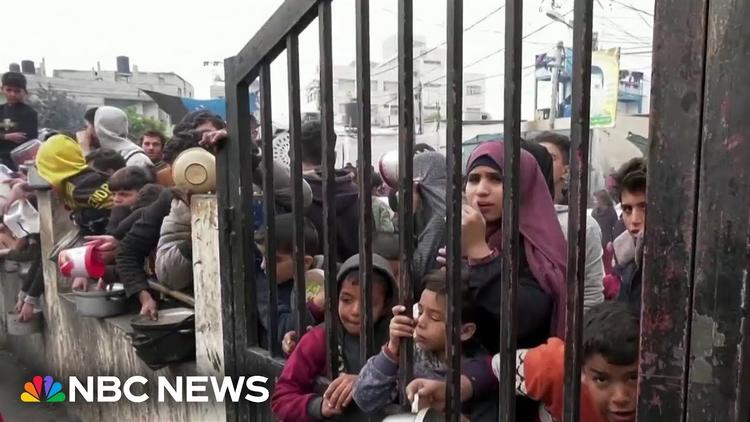
There are many things wrong with Hochul’s remark. First, Gaza is recognized by the UN and most countries in the world as an occupied territory over which Israel is the occupying power. It isn’t an independent country. It has no port, airport, or heavy armaments. It is almost completely surrounded by Israel, including from the sea and the skies, and even the Egyptian checkpoint of Gaza is de facto controlled by Israeli policy. Israel has the basic right of self-defense, as do all United Nations member states under its charter. But it doesn’t have the right to wage a total war, to wipe out 30,000 people in Gaza, the bulk of them innocent non-combatants, or to ethnically cleanse 1.9 million people. It has a right to defend itself from the Hamas organization, but not to destroy Gaza. As an occupying power it has a special responsibility to ensure the welfare of the Palestinian non-combatants of Gaza, a responsibility it has abandoned with glee.
Perhaps the most powerful objection against Israel’s demand on others to recognise its “right to exist” are claims it had made about itself during the country’s founding. Israel’s declaration of independence was based on the Balfour Declaration, the Mandate of the League of Nations and the General Assembly’s Partition Resolution. Every one of those claims have been challenged on legal grounds since 1948. The Balfour Declaration of 1917 for example did not recognise the right of the Jewish people to a state in Palestine. It simply stated that the British government viewed “with favour the establishment in Palestine of a home for the Jewish people” but that this was to be without prejudice to the “civil and religious rights of existing non-Jewish communities in Palestine.” The clear and obvious goal of the declaration was to create a “home” for the Jewish people “In Palestine“, not erase Palestine as Israel has done to supplant a new state on top of it.
The Constitutional Expert Group, appointed to advise on the proposed Voice to Parliament referendum, has concluded that the “draft amendment is constitutionally sound” and does not amount to a “veto” power or provide anyone with “special rights”.
Across Australia, Labor and Liberal governments are cracking down on the right to protest. Their motivation is clear: both parties care more about the fossil-fuel industry than the environment.
Right-wing media celebrated the Supreme Court’s decision to overturn Roe v. Wade on Friday, ending the constitutional right to abortion almost 50 years after it had been recognized. The ruling was the culmination of a decadeslong project on the right and was celebrated across conservative media outlets and on Twitter.
Amy Coney Barrett, the token Aunt Lydia of the 6 conservative judges, kept circling around the argument that women don’t need abortion rights, because “in all 50 states, you can terminate parental rights” after giving birth. It was a question that only makes sense if one assumes women are merely ambulatory uteruses, with no feelings or internal lives at all. In the real world, however, pregnancy is a difficult process, not just physically, but emotionally. Pregnancy isn’t a houseplant you stick in the corner of your house and ignore until someone comes to pick it up. You carry it with your body. People ask you about it — indeed, as anyone who has been pregnant can tell you, it’s basically all people can talk to you about when you’re showing. It causes all sorts of hormonal and emotional reactions, and giving up a baby your body has created is notoriously wrenching, even for those who are ready to do it.
Menulog won plaudits for its promise to trial an “employment model”, yet in the wake of the Senate inquiry the battle to find consensus over what constitutes fair work in the gig economy remains in full swing. Workers – or “partners” as Uber calls them – still earn less than the minimum wage for employees not covered by an award or registered agreement and they receive no benefits or legal protections. Luke Stacey reports.
Since the Coalition won government in 2013, everything remaining that was good and worthwhile in this country has been trashed by the idiots who are theoretically in charge of running the country. All they are actually achieving is running us and our standards down to the level of the convicts and their keepers who first invaded this land. I am no Labor supporter, either, but I do want a government which shows a capacity to understand and cater for people’s needs. And, most importantly, recognises that equality of opportunity is a universal right! Instead we have a national government which has dragged a country, which once had enormous potential, into a ramshackle mess.
Adalah, a legal center for Palestinians in Israel, stated that Yechieli’s words and actions “are motivated by racism.”
Preventing Palestinian citizens of Israel “from purchasing homes due strictly to their national identity is an illegitimate act,” Adalah added.
“In a climate in which the Israeli Knesset continues to promote racist legislation targeting Arab citizens, Kfar Vradim’s council leader feels emboldened to promote racist policies and to trample the most basic of democratic principles,” the group stated.
Jamal Zahalka, a Palestinian lawmaker in Israel’s parliament, called on the attorney general to investigate Yechieli’s “racist” decision.
Oliphant pleaded for the right to protest and argued for change in the treatment of the black community in the wake of the fatal police shooting of an African-American man in Charlotte, N.C.
Following Australian border force’s announcement about conducting visa checks in Melbourne, here are six crucial facts about police and immigration officer powers
In the vast wilderness that is “the media”, it never ceases to amaze me just how much Indigenous opinion gets moulded and curtailed in order to promote a mainstream agenda. As a writer who was initially “discovered” because I took to social media to create alternate spaces for Indigenous viewpoints like a number of other Indigenous people, I am still, three years later, surprised that I manage to break through this wall. I consider myself lucky. Yet I am a single voice and for the vast amount of discussion and debate we see non-Indigenous men able to have in the media, the same principle rarely seems to apply to voices marginalised within society.
Earlier this week, community social media channel IndigenousX released their findings from a community-driven survey into constitutional recognition. This survey was launched after the Recognise campaign issued a media release stating 87% of Indigenous people would vote yes in the planned 2017 Recognition referendum following a survey of 750 people.
The reason for IndigenousX creating its own survey was simple: the Indigenous sentiment conveyed on social media channels and broader didn’t correlate with such an incredibly high approval rate particularly considering the model has not been determined.
Do you think Aboriginal and Torres Strait Islander people will be better off if we are ‘recognised’ in the Australian constitution? Illustration: Luke Pearson/IndigenousX
By the time the IndigenousX survey results were released, 827 Indigenous people had participated. The results were striking. It was found that only 25% of respondents supported Recognise. It was additionally found that nearly 50% of respondents would vote against constitutional recognition even if the removal of racist provisions was included in the referendum questions.
The figure voting against jumped to nearly 70% when the removal of racist provisions was taken off the table as an option and to 75% opposed if the model was purely symbolic. Finally, a majority of respondents stated that they did not feel that Aboriginal and Torres Strait Islander people’s lives would improve if we are recognised in the constitution.
Yet consistently, we are told that recognition of Indigenous people in the constitution will lead to equality; that it is “the right thing to do”. We have also been told we want this and need to convince the rest of Australia.
Why is it then that so many people who answered the IndigenousX survey disagree with this view? Granted, this was a self-nominating survey where people chose to take part and therefore the results may be skewed toward those who hold strong opinions on the topic, for or against. But the idea that 87% of Indigenous people would agree on anything is even more skewed. We are a diverse group of people and our opinions reflect this.
Do you support the idea of an Indigenous parliamentary body being included in the constitutional referendum? Illustration: Luke Pearson/IndigenousX
Only one question came back with a majority support from the respondents: support for an Indigenous parliamentary body. Noel Pearson has recently championed such an idea. Some sort of permanent political representation has long been sought after by the community, whether it’s a proper body to advise on proposed policy, or it’s designated seats, or it’s the simple push toward achieving parity rates of representation. In 2015, it’s shameful that we only had three Indigenous senators and one Indigenous MP ever elected to federal parliament since federation.
This has meant that for nearly the entire history of parliament, we have rarely had anyone at the table during discussions of policies that affect our lives, nor has there been an imperative on the government to consult us. It is not surprising that Indigenous people want to be at the table because history shows that it is a rare occasion that governments actually act in our interests with our consent.
If nothing else, the results from the IndigenousX survey on constitutional recognition should tell the Australian public that the discussion on this topic is far from over from an Indigenous perspective. There is a responsibility of the public, if they are indeed going to go to the polls and vote on this matter, to engage with this discussion. At the moment, it seems to be happening the other way around and the media, in general, has been neglectful when it comes to giving a platform for this diverse discussion.
When it comes to Indigenous rights, our voices should always be front and centre.





 Menulog won plaudits for its promise to trial an “employment model”, yet in the wake of the Senate inquiry the battle to find consensus over what constitutes fair work in the gig economy remains in full swing. Workers – or “partners” as Uber calls them – still earn less than the minimum wage for employees not covered by an award or registered agreement and they receive no benefits or legal protections. Luke Stacey reports.




 olddogthoughts
You must be logged in to post a comment.