Tag: Abbott

The News Corp Right are telling him to change. If he does it wont be natural or believable

There is no Left: However there is in the mind of the conservative right.

In July, incoming senator James McGrath became the latest Liberal Party politician to accuse the ABC of bias. “While it continues to represent only inner-city leftist views, and funded by our taxes, it is in danger of losing its social licence to operate.” His most senior colleague, Tony Abbott, told the Australian Financial Review while he was opposition leader that “there is still this left-of-centre ethos in the ABC”. Last year, Cory Bernardi launched an impassioned attack on the national broadcaster in a party-room meeting, reportedly calling it “a taxpayer-funded behemoth that is cannibalising commercial media while spreading a message that ignores the majority views of Australians”.

A belief that the ABC is biased toward the “left” is an article of faith among the right that emerged during and after the Vietnam War and the cultural revolution. Bias is now assumed by a small army of media commentators, including Andrew Bolt, Miranda Devine, Janet Albrechtsen, Peter Reith, Gerard Henderson, Alan Jones, Piers Akerman, Greg Sheridan, Sharri Markson, Judith Sloan, Tom Switzer, Paul Kelly, Niki Savva, Nick Cater, etc, etc.

The main problem with the theory that the ABC has a left-wing bias is that it’s not true. None of the neverending stream of independent reviews commissioned by both the ABC and governments from time to time has ever found bias.

And yet, the Right continues to allege bias – and not just in the ABC. News Corp’s flagship tabloid columnist Andrew Bolt, for instance, also finds left-wing bias in the Fairfax press, the universities, the courts, not to mention the Labor Party and the Greens. During the period of the last government he also dismissed as left-wing Tony Windsor and Rob Oakeshott. His list of “leftist columnists in Murdoch’s Australian newspapers” includes Graham Richardson, Laurie Oakes and Malcolm Farr.

To qualify as a “leftist” for Bolt, one must believe at least one of the following heresies: that climate change is happening and man-made; that the Stolen Generations exist; that minorities should be protected from bigotry; that companies should be restricted from selling harmful food products to consumers on the free market; that governments should go into debt during downturns or times of slow growth; that experiences of Indigenous people should be incorporated into the narratives of Australian history; that education should promote critical thought; that governments should support education, health care and public broadcasting out of general revenue; that social security is a vitally important safety net; that taxes should be progressive and redistributive; that prison should be used only rarely; that employees should be entitled to minimum wages and conditions, and penalty rates for long or irregular hours; that drug use should be decriminalised; that fossil fuel-based energy should be replaced by renewable energy sources; that the powers and activities of police, security and intelligence organisations should be kept in check and subject to scrutiny; that most government information should be freely available; that same-sex couples should be allowed to marry; that the power of governments and corporations should be limited and subject to scrutiny; that the rights of people seeking asylum should be protected; that Australia should be a multicultural community. Together, this is broadly the policy platform of the Australian Greens – a political party the right describes as “extreme”.

“Extreme” – or just evidence-based and respectful? Most of the positions in the above paragraph are standard positions based on the best available evidence in respective fields – climate science, history, nutrition science, economics, pedagogy, criminology. Even the idea that governments should invest in preventive health and public education is an uncontroversial conclusion based on economic evidence that governments get a substantial return from investment in these areas – unlike defence, which is often a sunk cost. The above positions on same-sex marriage and asylum seekers and multiculturalism are based on a philosophy of respecting and empathising with people who have come from backgrounds and had experiences different to one’s own.

Labelling these positions “left-wing” is akin to labelling scientific and sociological research as a leftist activity, and compassion and empathy as leftist impulses. This side of the Enlightenment, that’s patently ridiculous.

Not that the ABC or the universities, for instance, can be said to preach these views, or even hold them to the exclusion of all others. What the ABC does, uncommonly among broadcasters in Australia, is allow the space for the discussion of secular and humanist ideas in rational ways. It also allows space for the discussion of non-secular, conservative and dogmatic views, including occasionally socialism and capitalism, though nearly always in a pluralistic framework. The universities do largely the same thing. The Right curiously marginalises itself by calling this kind of pluralism left-wing. Are we to assume the Right wants dogma instead?

The Right in the inappropriately named Liberal Party and its media cheer-squad, however, often take strong positions against the evidence base, and in favour of so-called “conservative” ideas that in practice stigmatise and marginalise people who aren’t causing anybody any harm. Global warming isn’t happening and, if it is, it’s a natural event. The carbon “tax” wasn’t working and it was costing jobs. No Indigenous child was ever stolen for “purely racist” reasons. The responsibility for healthy eating choices rests with individuals, and for children’s choices, with parents. Government budgets should always be in surplus, so downturns should be met with austerity – and Australia’s current budget deficit represents a crisis. We’re spending too much on health and education. Schools should teach children about the achievements of western civilisation, “Judeo-Christian culture”, British settlers and the Australian nation. Welfare recipients are probably bludgers, or “leaners”. Taxes should be regressive and should “reward hard work”. More criminals should go to jail to keep the community safer. Coal should continue to power Australia’s energy needs and its exports. Nobody who has nothing to hide should be worried about more powers for ASIO. Marriage is between a man and a woman.

Many of these positions, when they inform policy, actively cause harm, socially or to the environment. Many ignore lessons of history and research. They’re based on a set of values that are clearly out of step with our best knowledge about human behaviour and the world around us.

* * *

Our values inform our theories of human behaviour and social relations, and our theories in turn become the “frames of reference” we use to understand and analyse other people’s statements or behaviour. If we’re not careful, we can misinterpret another person’s motivations entirely, by applying to them our own frame of reference. Psychologists call this “projection”.

The “Left” that the right complains about – a small, self-interested, influential but out-of-touch and loopy elite that’s engaged in a fierce battle of ideas in the pursuit of weird policy outcomes – doesn’t actually exist. If there’s a group of people that could be described in that way, it’s not “leftists”. It’s the Right.

Those of the Right assume that people who disagree with them are engaged in a similar, explicitly ideological project. Very often, they’re not. Very often, “leftists” are climate scientists, nutritionists, historians, researchers, social workers, teachers, lawyers, humanists. When they intervene in a public debate on the side of the evidence, they often disagree with the Right’s project – and are attacked and/or dismissed as “leftists”.

When Joe Hockey, Gerard Henderson and Judith Sloan establish themselves as unswervingly “pro-business”, they often align themselves with the private interests of corporations – and often against the private interests of employees (in industrial relations disputes), or the public interest in environmental protection, nutritious food and relative social equality. When they establish the maximisation of shareholder returns as the highest value, they see people with different, pro-social values – people for whom the maximisation of shareholder returns has nasty consequences in terms of health and job security – and dismiss them as “left-wing”.

When Andrew Bolt and George Brandis establish themselves as unambiguously in favour of the free expression of bigotry, they align themselves with the private interests of racists, against the private interests of their victims and the public interest in multicultural harmony. When they establish the freedom of bigoted speech as the highest value, they see people with different values and dismiss them as “left-wing”.

The frame of reference the Right uses is self-interest, based on rational choice theory, the theory of human nature that informs economic rationalism. So when the Right sees unions pushing for better pay and conditions for their workers, it sees their activities through the frame of self-interest – and assumes rent-seeking. (The right remains oblivious to, or approving of, the far more prevalent rent-seeking behaviour among corporations.) When the Right is confronted by scientists and governments urging reductions in carbon dioxide emissions, it assumes rent-seeking and goes looking for possible motives. Do the scientists benefit through career advancement? In grant applications?

I’m not suggesting there’s no rent-seeking in unions, that there’s no self-interest in ABC journalists protesting against budget cuts. But the modern Right sees only self-interest through its myopic frame of reference, and dismisses any evidence of alternative values as either deceptive or “extreme”.

* * *

There are senses in which the “Left” can be said to exist, of course. The theory of communist socialism after 1848 and especially 1917 dominated an explicitly left-wing agenda for much of the 20th century, with terrible consequences wherever its proponents took the power of the state. When the modern right complains about “leftists”, it’s as if it’s still fighting the Cold War. But for practical purposes this communist Left doesn’t exist anymore in Australia, and hasn’t for at least 40 years.

There’s an even older Left. The democratic ideas the French commoners propagated in 1789 were “left-wing”, if only because they sat on the left of the Estates General and demanded a National Assembly. “Left” politics came to be associated with the challenge to illegitimate power and privilege.

If this challenge is what the Right objects to when it dismisses scientists, researchers and humanists as “leftists”, then surely that exposes its own project as illegitimate. Surely we’re all democrats now? Even if a pro-democracy, pro-equality attitude could have been described in 1789 (or 1989) as “left-wing”, it’s now being demonstrated – through the work of social epidemiologist Richard Wilkinson, among others – that policies that encourage greater levels of equality within societies actually do generate both material and intangible benefits for everyone.

If a Left exists in Australia at all, now, it’s simply as a shorthand description of those who don’t agree with the prescriptions of the modern Right, which seems primarily interested in reversing many of the intellectual and democratic gains of recent decades and centuries and restoring and confining power and privilege to the few rather than the many. To be labelled “left-wing” by the modern Right is probably an endorsement that one’s ideas are sound.

In the end, the Left exists largely in the Right’s own mind – as a straw man onto which to project its delusional and self-interested chatter.

When the PM normalises lying

government lying to you

“It is an absolute principle of democracy that governments should not and must not say one thing before an election and do the opposite afterwards. Nothing could be more calculated to bring our democracy into disrepute and alienate the citizenry of Australia from their government than if governments were to establish by precedent that they could say one thing before an election and do the opposite afterwards.” Tony Abbott, August 22, 2011

Every time Abbott lies to the citizens of this country we become increasingly disaffected, and not only from our Prime Minister, but from the institution he represents. Abbott has normalised the discourse of lies. He has taken the dishonesty of politicians to a whole new level. We barely expect anything else from him, and from his fellow politicians. Under the leadership of our mendacious Prime Minister, we have increasingly abandoned hope of fairness, straightforwardness, belief and trust. Our Prime Minister doesn’t think we are worthy of the truth.

One of the many unpleasant effects of being lied to is that the liar insults and patronises me by creating a false reality that I have to inhabit, until I discover I’m the victim of deception.The liar denies me the right to know the truth, a serious offence against me, because truth is something no one has the right to deny me.

Whether it’s on a personal or a political level, lying to me signifies the liar doesn’t consider me as entitled to the truth as is he or she. This infantilises me, is disrespectful to me, and denies me the knowledge I need to make informed decisions about my life. There’s little more insulting than being lied to, kept in the dark with lies of omission, and intentionally misled because the liar doesn’t consider you capable of handling the truth, or is acting entirely in their own self-interest because you knowing the truth will in some way threaten them.

The Prime Minister of our country, Tony Abbott, has never made any secret of his ambivalent relationship with truth. There is his notorious assertion that nothing he says is “gospel” truth unless it’s written down.

There’s his prescriptive declaration that “It is better to seek forgiveness than ask permission.” While this isn’t necessarily an endorsement of lying, it is a ruthless and callous prescription for relationship with one’s fellow humans. It recommends that one do that which one desires and if it backfires apologise, but it isn’t necessary under the terms of Abbott’s prescriptive to negotiate with or communicate intention to others, prior to taking an action. This has a similar effect to lying, in that it assumes an inferiority of some kind on the part of another that doesn’t require Abbott to enter into an equal, respectful relationship in which another’s opinions and wishes count for the same as his own.

We have a liar for a leader. When the lies start at the top, there’s little hope truth will ever see the light of day. Abbott is leading us into an abyss of normalised deception that will damage every one of us, because when dedicated liars are in power, the country will inevitably lose its way. If you don’t think this country is losing its way, you’re dreaming.

First published on Jennifer’s blog No Place for Sheep

Victoria election 2014: Tony Abbott says state will not receive billion-dollar funding if Labor scraps East West Link. Blackmail in action

East West Link tunnel entrance

Abbott will punish Victorians if they give Labour the mandate. He is the Bouvver Boy an extortionist. Tell the man where he can go

The Prime Minister has warned Victoria’s Labor leader the state will not get $3 billion in federal funding for Melbourne’s East West Link if he keeps an election pledge to scrap the road project.

Tony Abbott wrote an open letter to Daniel Andrews and Premier Denis Napthine to say the money would only go to Victoria if the road was built.

“I want to make it absolutely clear to the people of Victoria that the $3 billion the Commonwealth Government has committed to this project is for one purpose and one purpose only – and that is to build the East West Link,” Mr Abbott wrote.

“Let me repeat: the $3 billion the Commonwealth Government has committed for the East West Link is only available to build the East West Link.

“If a future government is not prepared to spend the money on East West Link, then that money will not be forthcoming from the Commonwealth.”

The Federal Government committed $1.5 billion for the $6.8 billion first stage of the road, and $1.5 billion for the second stage western section.

But Mr Andrews said he would seek to work with Mr Abbott to convince him to fund Labor’s infrastructure priorities.

“I look forward to sitting down with the best of intentions, in a respectful way, having a discussion with the Prime Minister about how we might all work together to help him deliver on his commitment to be the infrastructure Prime Minister,” he said.

Federal Government ‘building 21st Century roads’: Treasurer

Treasurer Michael O’Brien said the Prime Minister had made his funding intention clear.

“The money was only provided to Victoria for East West Link,” he said.

“It wasn’t provided as a no strings attached grant.

“It’s not available for other projects, and we’re already seeing other states including New South Wales sniffing around trying to get that money.”

Mr O’Brien said Mr Andrews would not be able to convince Mr Abbott to spend the money on public transport.

“The Federal Government has made it quite clear that it is interested in building the roads of the 21st century,” he said.

(Tony Abbott) is trying to help his best mate in Victoria, Denis Napthine.

Daniel Andrews, Opposition Leader

“Daniel Andrews cannot expect the national government to change its policies because he has a reckless threat to rip up East West Link contracts.”

The Coalition said Victorian taxpayers would be liable for $1.1 billion in compensation if Labor kept its promise to abandon the East West Link.

But Labor was adamant the consortium building the road would not get a payout because the contract was invalid.

Mr Andrews said he was not surprised Mr Abbott had reaffirmed his position so close to the election.

“No-one would expect him to say anything different,” he said.

“He’s trying to help his best mate in Victoria, Denis Napthine. This is an election campaign, it’s the colour and movement of an election campaign.”

Meanwhile, former prime minister John Howard joined Dr Napthine on the campaign trail in Ringwood in Melbourne’s east.

He conceded the Coalition faced a tough battle to stay in government, but was confident voters would back Dr Napthine.

“I’ve seen polls on the eve of an election before turn out to be completely wrong, and it’s pointless and a waste of time to speculate about outcomes when the election has not been resolved,” he said.

UK SAS quad bike squads kill up to 8 jihadis each day: We remain ignorant of what Abbott’s SAS are doing?

IS PICKED OFF IN GUERILLA-STYLE RAIDS: Using precision sniper rifles, machine guns and surprise tactics, the SAS take out their IS targets before disappearing back into the desert

 British SAS quad bike squads kill up to 8 jihadis each day… as allies prepare to wipe IS off the map: Daring raids by UK Special Forces leave 200 enemy dead in just four weeks

  • Targets are identified by drones operated by SAS soldiers
  • Who are then dropped into IS territory by helicopter to stage attacks
  • The surprise ambushes are said to be ‘putting the fear of God into IS’
  • The raids are attacking IS’s main supply routes across western Iraq 

Abbott: David Johnston has my full confidence: Submarine Corp bagged to the world “they couldn’t build a canoe” Way to go to fold an industry Abbott

Defence minister David Johnston with France's President Francois Hollande (centre) inspecting a model of the Royal Australian Navy's Collins Class submarine.

Abbott under pressure to drop the defence minister, David Johnston, after the PM was forced to defend the Australian Submarine Company, while Jacqui Lambie expects a deal on defence pay. Follow it live…

Labor censure motion of David Johnston

The Labor motion in the senate is thus:

I move that the Senate censures the Minister for Defence (Senator Johnston) for:

1) Insulting the men and women of ASC by stating he “wouldn’t trust them to build a canoe”;

2) Undermining confidence in Australia’s defence capability;

3) Threatening the integrity of the Future Submarine Project, Australia’s largest defence procurement, by demonstrating bias and failing to conduct a competitive tender;

4) Breaking his promise made on 8 May 2013 to build 12 new submarines at ASC in South Australia; and

5) Cutting the real pay, Christmas and recreation leave for Australian Defence Force personnel.

Penny Wong says with his comments, Johnston has compromised the procurement process for future submarine contracts. Billions of dollars and thousands of jobs are involved.

He is Such a Lying Bastard. John Lord

Abbott promise

The subject of political lying, since the election of Tony Abbott, has almost become a permanent point of discussion on main stream media, social media and the blogosphere.

Why is this so? It’s because the Prime Minister has set a record of lying both past and present that is unprecedented in Australian political history. If you think I am exaggerating read “Remembering Abbott’s past”.

Lying is so engrained in his political persona that he knows not the difference between fact and fabrication.

More recently his lie about funding the ABC (and all the others) has drawn immense criticism. On Monday 24 November he denied in Parliament that he had broken a pledge not to cut funding to the ABC and SBS, telling Parliament his government had “fundamentally kept faith with the Australian people”.

In saying this he used another lie to justify telling the original one. This is not just wrong but appallingly immoral. To suggest the first lie was not one is to suggest we are no longer communicating in English.

And Malcolm Turnbull’s attempt to do the same thing only served to devalue his own integrity.

More recent examples are the PMs Letter of advice on changes to the pension. What a deceitful document it was. Really his lying knows no bounds. He fails to mention the way the pension is calculated is to be changed (If he can get it passed) resulting in a substantial loss of income. Does he really think we are fools?

Another deceitful lie is the cuts to power bills with the elimination of the Carbon tax. The resulting drops in charges varied across the country and nowhere near the $550 he indicated everyone would receive.

Yet another example was when asked about the Green Fund at a joint press conference with President Hollande the PM said that we already had a Direct Action fund of 2.5 Billion and a Clean Energy Finance Corp 10 Billion fund. The only thing wrong with the answer was that the first won’t work and it is a tax not a fund. And its Government policy to abolish the second.

Unfortunately less informed voters outnumber the more politically aware. Therefore, conservatives feed them all the bullshit they need. And the menu generally contains a fair portion of untruths.

People like Bolt and Jones write and comment outrageously on the basis of payment for lying controversy. Freedom of the press may entitle them to do so but it is unjustifiable for the Prime Minister to follow suit on the grounds of a collective desire for honesty in government. It is however, highly unlikely that this Prime Minister has the decency to do so.

“Political Lies and Who Tells Them Revisited”.

November 2013

The issue of truth featured largely in the last election. We the voters were often left to decide who was and who wasn’t telling the truth. Or who was telling more or less of it. So what is a lie? This election was different in so much as we saw the emergence of various “Truth Finder” sites and both sides of the political spectrum were found out telling full-on porkies, or at least using different shades of hue.

This week lying has again been highlighted with the Government’s decision to axe the Gonski Education reforms. The troubling aspect of this decision is that during the campaign Tony Abbot gave a number of commitments. For example:

“This will be a no surprises, no excuses government, because you are sick of nasty surprises and lame excuses from people that you have trusted with your future”.

He also promised a ”unity ticket” with Labor on Gonski funding:

“You can vote Liberal or Labor and you’ll get exactly the same amount of funding for your school”.

“There will be no change to school funding under the government I lead”.

These commitments were totally unambiguous. Unequivocally intentional. So much so that the average voter on hearing them could logically assume that they were being told the absolute truth.

We now know that the Prime Minister and his Education Minister Christopher Pyne were telling blatant lies about this and many other policies. Policy decisions since the election (as listed in other posts on this blog) demonstrably attest to this. Their actions have been universally condemned by all media outlets except those of Murdoch who has a vested interest in protecting Abbott from criticism.

This all gives rise to the question of the value of the words politicians use. I for one wouldn’t believe a word Abbott says. There is ample evidence that he is a liar and he has declared so himself.

But let’s take a look at the broader picture and ask ourselves what is a lie in general and what constitutes political lying.

We know that a lie has three essential ingredients; it communicates some information, the liar intends to deceive or mislead and the liar believes that what they are ‘saying’ is not true. And we call people who use these three principles blatant liars.

When the leader of the then opposition said in July 2012: “The tragedy of this toxic tax is that it will not actually reduce emissions” and six months later they fall by 8.6%. Did he actually tell a lie? One could well argue that he had no facts on which to base his assumptive statement, so it could not be construed as a lie. It might be just an opinion. The same could be said about his statements about towns being wiped of the map and many others. However, if in politics we believe that lies or statements are made either to deceive or manipulate (and has the three principles mentioned previously), then you would conclude that he was telling porkies.

“When it comes to controlling human beings there is no better instrument than lies. Because, you see, humans live by beliefs. And beliefs can be manipulated. The power to manipulate beliefs is the only thing that counts”.

– Michael Ende, The Never-ending Story

“If you tell a big enough lie and tell it frequently enough, it will be believed”.

– Adolf Hitler.

Conversely, when the former Prime Minister said “I don’t rule out the possibility of legislating a Carbon Pollution Reduction Scheme, a market-based mechanism”, “I rule out a carbon tax”, did she actually tell a lie? Clearly she showed an intent to keep her options open. As it turns out we have a market based scheme. She was not trying to deceive. She was being honest within the uncertainty of the circumstances. And the MSM never gave her the benefit of the doubt.

I have always felt that when politicians have in their possession certain knowledge and facts and fail to disclose it then they are guilty of lying by omission. When you withhold information you are denying the other person’s right to the truth. An example of this was when John Howard found out that the children overboard incident was false and withheld the information for two days prior to the 2001 election. It was in fact lying by omission. And of course there is the weapons of mass destruction lie. Did John Howard ever check the facts? If not he perpetuated one of the greatest lies in history.

“When you tell a lie you deny the other person’s right to the truth”.

– John Lord.

On a more personal level there are what we call white lies where we deliberately colour what we say in shades of hue to protect the feelings of others or ourselves, or to avoid argument.

“Clinton lied. A man might forget where he parks or where he lives, but he never forgets oral sex, no matter how bad it is”.

– Barbara Bush.

Consider the case where telling a lie would mean that 10 other lies would not be told. If 10 lies are worse than one lie then it would seem to be a good thing to tell the first lie, but if lying is always wrong then it’s wrong to tell the first lie.

When politicians lie over a long period of time, it only serves to denigrate the liar and show contempt for the voter’s intelligence. Especially if the lies are chronic and systemic. The current use of the term “no direct knowledge” is a lie within a lie pretending to absolve a person who is fully conversant with the facts.

“Oh, what a tangled web we weave . . . when first we practice to deceive”.
– Walter Scott, Marmion.

Lying is probably one of the most common wrong acts that we carry out (one researcher has said ‘lying is an unavoidable part of human nature’), so it’s worth spending time thinking about it.

Why is lying wrong?

There are many reasons why people think lying is wrong; which ones resonate best with you will depend on the way you think about ethics.

Lying is bad because a generally truthful world is a good thing: lying diminishes trust between human beings; if people generally didn’t tell the truth, life would become very difficult, as nobody could be trusted and nothing you heard or read could be trusted – you would have to find everything out for yourself and an untrusting world is also bad for liars – lying isn’t much use if everyone is doing it.

Who are the biggest liars? The left or the Right of Politics.

Last year on Facebook I shared a post of an interview with Laurie Oakes and Tony Abbott (you can see it on YouTube). It is from 2005 and Tony Abbott is obviously telling lies about the Medicare safety net. At the time I made the following comment to accompany it:

“People who constantly portray the prime minister as someone who constantly tells lies should take the time to read this”.

It was then picked up by former National Times journalist Alan Austin and we had a chat about broken promises, telling lies and the current standard of journalism. He had this to say:

Remember, it was a Senator from his own side who called John Howard ‘the lying rodent’.

And have we forgotten the articles about Malcolm Fraser’s ‘Top 40 broken promises’?

Lies, about-faces and broken promises are as follows:

Gough Whitlam: 7
Malcolm Fraser: 52
Bob Hawke: 4
Paul Keating: 3
John Howard: 41
Tony Abbott (as minister): 17
Kevin Rudd: 4
Julia Gillard: 6

Tony Abbott (as Opposition Leader): 15 and counting. As PM ?

I found this to be particularly revealing so I inquired as to the authenticity of the figures and he replied with the following:

Before your time, John, I wrote a piece for The National Times in 1977 about what were then Malcolm Fraser’s top 25 blatant lies and broken promises. The then editor Trevor Kennedy – later to become one of Rupert’s henchmen – headed it “Malcolm’s battle with the time machine” which I thought at the time was unduly generous towards Mr Fraser.

Later, in 1980, I wrote a piece for Nation Review on Fraser’s top 40 lies and broken promises which then editor, Geoffrey Gold, headed ‘Promises, promises.’ Neither are online, unfortunately, but I have them in my clip file. Since then, I have kept tabs on all Prime Ministers and would love to write about it.

If I get a publisher, I will let you know. (I am tentatively titling the piece ‘Lies, damned lies and I support the elected leader of the party’). Point being that there is simply no comparison whatsoever between the falsehoods and about-faces of the Conservatives and Progressives. The ratio is about 8 to 1. Which is why the current perception that Ms Gillard is ‘Juliar’ is so bizarre from this vantage point. (I am in France. Which means I read other media than just Rupert Murdoch’s).

I replied:

Well I do hope you get to do it, Alan. I have been following politics for around 50 years and it is time we had more honesty and the standard of reporting is deplorable. However, do you think there is at times a fine line between a broken promise and a change of mind? And of course changed circumstances can necessitate a change of mind. I would also be interested in what you think of the standard of political journalism in Australia today.

Again, quoting Alan Austin:

Excellent questions, John.
Re standard of journalism in Australia:

http://www.eurekastreet.com.au/article.aspx?aeid=27274

Regarding categories of deception, there are at least seven.
Staring down the camera bare-faced lies are Class A falsehoods, like this one satirised here:

This is Tony Abbott lying about a meeting with George Pell.
Promises broken for political expediency with no external factors forcing their abandonment are Class B Examples are Ms Gillard duding Mr Wilkie recently. And Mr Howard’s no-GST-never-ever which he abandoned before the 1998 election.

A Class B broken promise may, of course, be ratified by an election. If this succeeds, as indeed happened with Mr Howard’s GST, then it becomes less offensive. Say Class C.

Commitments made in good faith but prevented from being implemented despite the government’s genuine best efforts – by a hostile Senate or the High Court or a hung Parliament – are Class D.

Promises prevented from being implemented by changed economic conditions – such as Paul Keating’s L-A-W-law tax cuts – are Class E.

Promises deferred by changed economic or political conditions – such as Labor’s no carbon tax – are Class F. (Keating’s L-A-W tax cuts also turned out to be F eventually.)
Assurances of loyalty to the leader by putative challengers deserve a special category. Say Class I. (I for inevitable? Unavoidable?)

‘Telling the truth should not be delayed simply because we are not sure how people might react to it’.

John Lord

In the US election Republicans Romney and Ryan took lying to an unprecedented level. Fact finders alerted the public to 2019 lies by Romney alone. It is my contention that

President Obama lost the first debate not because he was off his game, or that he was under prepared, but rather he was taken by surprise by the willful lies that Romney was telling. The same fascination for untruth by conservatives has been exported to Australia.

In my view Australians faced the most important election in living memory. Liberalism no longer existed so what we were faced with was a political decision between a very sharp turn to the scary right. Or a party (in spite of its faults) that had the common good at the centre of its ideology. In our ignorance, or perhaps our naivety we elected a cohort – an all-male club who insisted they were adults but instead turned out to be juvenile liars.

“Do you shape the truth for the sake of good impression? On the other hand, do you tell the truth even if it may tear down the view people may have of you? Alternatively, do you simply use the contrivance of omission and create another lie. I can only conclude that there might often be pain in truth but there is no harm in it”.
John Lord.

Promises, promises… By Mungo MacCallum Tuesday, 25th November 2014

So Tony Abbott has broken another election promise. Well, golly gee – who would have thought it?

Actually, just about everyone. It isn’t the first pre-poll lie and it won’t be the last. And of course Abbott is not the only offender – election promises are, as Sam Goldwyn once almost said, just verbal commitments not worth the paper they’re written on.

But Abbott’s confection is particularly egregious because he had made such protestations of rectitude. There would be no ambushes, no surprises; what he said is what he would do. He would restore trust and honesty to the system. And naturally there would be no broken promises like Julia Gillard’s pledge of no carbon tax, a turpitude that could only be compared to the original sin of Eve.

Thus Abbott can, rightly, be blamed for shameless and cynical hypocrisy. But more than that: his reneging on the election eve “no cuts” declaration was made without prompting and without reservation or qualification. The voters heard an unequivocal undertaking: no cuts. What they got instead was cuts, and plenty of them.

But instead of a frank admission that, yes, he had made the promise, and now it was broken, Abbott and his colleagues have spent weeks attempting to weasel their way out of it. First there was the predictable appeal to hindsight: Labor’s debt and deficit disaster was worse than they had ever imagined or feared, so all bets were off. Even if this was true (which it wasn’t) this was no excuse. There were other ways of fixing things without welshing on the voters.

But the denialists persevered: the real promise was to repair the budget, and everything else was a secondary consideration – or a non-core promise, as John Howard famously popularised the line. And in any case he had only said it on the SBS network, which no one listened to, so it didn’t matter.

His not entirely loyal follower Malcolm Turnbull said, yes, Abbott said it, but it was a matter of context: after all, Turnbull and Joe Hockey had said there would be cuts – well, a bit of tightening up, anyway – across the board, so the public should have listened to them, not to their leader. Or health, or education, or pensions, for that matter, but that was not quite the context he meant.

Matthias Cormann went further: they weren’t cuts at all, they were efficiency dividends – a fine example of the spinmeister’s art – so Abbott had not actually broken a promise after all. And Abbott himself went back, as is his wont, on obfuscation and bluster: Team Australia had a job to do, so there were no exemptions, not even (perhaps especially not) the ABC.

As the polls had already showed, this just doesn’t wash. Abbott simply reinforced the perception that he is untrustworthy and dishonest. He would have done better to have come clean: okay, I said it, and it’s a fair cop. I was reckless and stupid: it was a promise I could not and should not fulfil and I’m sorry. Now let’s move on.

By trying – unsuccessfully – to pretend it never happened our prime minister has revealed himself not only as mean and sneaky but a wimp and a wuss. Perhaps Andrew Bolt is right: time to bring back the biff. Nothing else seems to work.

Now, If I Say It, It must Be True, Because Liberals Never Lie. And You Can Trust Me On That Because I Said It!

IMG_1039.JPG

BARRIE CASSIDY: Sure, but do you accept climate change potentially is one of the biggest impediments to growth?

JOE HOCKEY: No. No, I don’t. Absolutely not .

Well, I guess we can just accept that Joe Hockey could be right on this one. After all, climate change could lead to a lot of floods, fires and other devastation. This should be a real pick-me-up for the building industry, shouldn’t it? Impediment to economic growth? I don’t think so.

It’s just a shame that it’s still unclear that the climate even exists, let alone that man could have any effect on it. After all, we’ve been dumping stuff in the ocean for years and, in spite of what that upstart President from the USA has to say, the Barrier Reef is doing just fine, thank you.

As for those ABC cuts, well I think they’ve been well and truly dealt with. As Mr Turnbull implied, while Mr Abbott may have said no cuts to the ABC, the SBS and no changes to pensions, there was no reason to think that he was speaking on behalf of the Liberal Party. Or, indeed, was there any reason to think that he had the authority to deviate from the policies that had been so clearly spelt out by IPA prior to the election.

Of course, all these critics who are complaining (wrongly, of course) that Abbott changed his mind on the ABC, had no problem when he went against his election commitment on pensions. He clearly said they’re be “NO CHANGES TO PENSIONS”  in the same interview. Yet, in spite of the fact that the intention was to eliminate all future rises, the government is still allowing some indexation, albeit at a lower rate. We didn’t hear a whimper out of the left on that one!

Now, to quote Scott Morrison from last week:

“And as former president Yudhoyono said, in advice to Australia, you’ve got to take the sugar off the table, and that’s what we’re doing.”

He pointed out that they were “taking the sugar off the table” so many times in that interview that I decided it must be some sort of metaphor and not simply a way off helping Joe to keep his weight down to somewhere near his IQ. A friend helpfully suggested that the metaphor was about making the table less attractive to ants.

“So, the asylum seekers are being compared to ants. What’s the table?”

“The table is Australia.”

“I see. I guess that means that the sugar is what makes Australia appealing. Affordable healthcare, a living wage and the Great Barrier Reef.”

So, I see it all now. Julie Bishop and Andrew Robb are right. The Liberals know what they’re doing with their Reef management. They’re taking the sugar off the table.

Silly old Obama. As if we want foreigners coming over here, telling us what to do. (And don’t say that Tony and Matthias are foreigners – that’s just racist – they’re as Australian as Anzac Biscuits with Vegemite!)

     *                   *                    *

Peter Reith just wrote that he found it hard to believe that Labor would win this week’s Victorian election, in spite of the polls having them “slightly ahead” (on average, at 54-46%). It defied “common sense” according to Mr Reith.

This morning, Victoria’s Treasurer announced that – a few weeks ago – the Liberals signed a contract for the East-West Link which would entitle the consortium to over a billion dollars, even if Labor kept their election promise and didn’t build it OR the councils opposing it blocked it in Court.

Why did they sign a contract with such a big penalty clause so close to an election?

I guess it was just common sense!

After the spin

tony comp

After a week which saw Tony Abbott’s government berated by both Alan Jones and Andrew Bolt, The Australian has joined the chorus of discontent saying

“Limply, the Prime Minister is losing the battle to define core issues and to explain to voters what he is doing and why.”

What did they expect from a man who counts off his policies on his fingers as he presents three word slogans that Mark Textor wrote for him?

What did they expect from a man who said “I have never been as excited about economics as some of my colleagues; you know, I find economics is not for nothing known as the dismal science”?

What did they expect from a man who said “I’m no tech head” as he explained to us why we didn’t need a National Broadband Network?

What did they expect from a man who thinks that “climate change is crap” and that Ebola is due to the carbon tax?

Ok… he may not have directly said that last one but if it wasn’t the carbon tax then it was the mining tax, or the debt and deficit disaster, or something Labor did, as Abbott was at pains to point out to the assembled leaders of the world at the G20.

The truth of the matter is that Tony Abbott has no idea of why they are doing what they are doing other than to reward their friends, to wipe any Labor reforms off the books, and to do what lobby and focus groups tell him to.

Let’s take “stop the boats” as an example.

We were told that we must stop the boats to stop deaths at sea, to break the people smuggler’s business model, and to stop supposed queue jumping.

Having achieved success in this at huge cost (reputational, financial and humanitarian), we are now stopping refugees registered with the UNHCR from coming – you know, the ones that are in the queue.  We have also closed our doors to anyone coming from West Africa because they might have germs (fingers crossed no return).

In his campaign launch, Tony Abbott said “we won’t increase the humanitarian migrant intake until such time as it’s no longer being filled by people smugglers.”

Far from increasing the intake now that the people smugglers are apparently out of business, he cut it from 20,000 to 13,750 and ‘resettled’ 29 unaccompanied minors on Nauru.  Unfortunately, the locals are beating them up.

And who could forget the high fives when they “axed the taxes”.

Tony warned the carbon and mining taxes would cripple industry and wipe out investment.  In fact, as reported in The Australian Financial Review, corporate Australia paid out a record $53 billion to shareholders in 2013, despite the carbon and mining taxes, with fund manager Perpetual calculating dividend payments rose 6.1% in 2013 from 2012.

AMP chief economist Dr Shane Oliver said “ the [2013] results have been impressive”.

“So far 55% of companies have exceeded expectations (compared to a norm of 43%); 73% of companies have seen their profits rise from a year ago (compared to a norm of 66%); a whopping 78% of companies have increased their dividends from a year ago (compared to an average of around 62% in the last two years)… Key themes are a massive turnaround for the resources stocks (notably Rio), banks doing very well (with great results from CBA and ANZ), help coming through from the lower $A, ongoing cost control, improved outlook comments from cyclicals (like Boral) and soaring dividends.”

In February Tony Abbott said ‘‘We are all mourning the closedown of the Alcoa plant at Point Henry near Geelong but I regret to say that’s the carbon tax doing its job’’.

What he failed to mention was that, in the first year of the carbon price, the industry was eligible for maximum compensation. This meant 94.5 per cent of the industry’s average emissions were paid for by the government, reducing by 1.3% each year.

Alcoa Inc recorded a $53 million gain in its annual report. That document, which dealt with the year to December 2013, contained the following declaration: “… a favorable [sic] change of $53 [million] in prepaid expenses and other current assets, mostly caused by the sale of excess carbon credits in Australia”.  Ironically, removing the carbon tax not only cost the government revenue, it also cost the aluminium industry.

But what can we expect from a Prime Minister who admitted he didn’t read the company reports that stated the taxing regime in Australia had nothing to do with their decisions to close mines or smelters?

How can we believe Abbott wants to “cut the waste” when he spends hundreds of millions on new planes big enough for his press contingent, or fleets of bomb proof cars, or who decides to live in Kirribilli House rather than Canberra, or who keeps caucus waiting while he has a photo shoot to justify claiming overnight accommodation and flights to a private function, or who spends millions on his ‘‘Strategic Communications Branch’’ to monitor social media?

And I would suggest that Hockey’s upcoming MYEFO will put pay to any talk of debt and deficit repair.  After all, he has a war to pay for and all the toys that go with it.

The Australian went on to say “Voters are left with the impression that Mr Hockey’s May budget was a litany of broken promises, designed to inflict severe pain on low-income workers and the poor, and that the deficit crisis was not as acute as the Coalition presented it.”

I would suggest that is an accurate appraisal backed up by the figures rather than an impression.

The Australian further suggests that “The Abbott government is doomed without narrative”, but sooner or later, spin with no substance gets found out.

The political stupidity of the ABC cuts

We hardly need to be reminded of it, but the ABC funding cut demonstrates the utter political ineptitude of the Abbott government.

It’s not just that it’s an obvious broken promise (one that Coalition members compound foolishly by denying).

Nor is it merely that the government is picking a fight with the most wide-reaching and respected media organisation in the country. Or that Coalition partners the Nationals will bleed votes as a result of cuts made to regional coverage.

It highlights the extent to which the government is out of touch with ordinary Australians, preferring the counsel of a small group of right-wing ideologues to the clear-cut research that the ABC is still the most trusted news source in the country. But this isn’t the worst of it, not by far.

Even the ABC critics have angrily made the point that the government has barely attempted to build a case that the cuts could be sustained. It’s an open secret that there are some areas of the ABC that could use some trimming – like any major organisation. But this isn’t an excuse for such major cuts, nor was it used as one; it provided an opportunity for the government to hold a mature debate about spending and debt, about public broadcasting’s role and the virtue of keeping a responsible eye on all government-funded institutions. But as is becoming common, the chance was missed by Abbott et al, and any political capital that might have been gained was squandered. If you listen closely, you can still hear echoes of Coalition politicians fighting the wrong battle.

It’s not even that the government is doing all this at a time when it needs all the support it can get, as even its few remaining boosters – Alan Jones, Andrew Bolt, the Australian – turn on it. The cuts have almost no support on the rest of the political spectrum, apart from two libertarian senators, who feel the same way about all government spending. Christopher Pyne, wily fox that he is, knows the score: recognising the unpopularity of his own cabinet’s decision, he’s campaigning against it. Hopefully he kicks his own arse while he’s at it.

So what’s to gain? The support of a handful of angry old men who would never vote for anyone else anyway.

The point’s been made over and over that the ABC is essential – in regional areas, in order to prevent the total domination of the likes of News Corp, in order to cover the sorts of community service broadcasting that commercial stations could never afford, and so on and so on. What’s the argument in favour of cuts? No idea, except to shore up a broad, almost ideological point that there’s “too much waste” in government. It comes in the context of a much wider conversation about the budget that the government has already lost. Did Hockey and Abbott think this would help?

If the point was that the ABC is wasting taxpayers’ money, the Coalition has never actually bothered to make it. (If it was that the ABC is an ideological threats to the government, as it prefers News Corp’s support, it would be honourable to say this.) As usual, Abbott has gone silent rather than front up and explain the reasoning behind his government’s stance. Like the recent bluster about shirt-fronting Putin, he’s less than brave when push comes to shove. In this case he’s handed the steaming pile to his good friend and supporter Malcolm Turnbull.

Four hundred jobs will be lost in the ABC alone, five regional radio stations, the TV studio in Adelaide, all non-news TV production outside Melbourne and Sydney and numerous programs and presenters.

But the most humiliating thing about the campaign to cut public broadcasting, for all of us, is that all of the pain caused, all this traumatic upheaval, all this stupidity and lost political capital is the result of an ineptitude that could be exposed in a single short message on Twitter (@mmccwill): “Politics, apparently, should be understood in context: $254million cut from ABC. Extra $245million found in May budget for school chaplains.”

The Abbott government deserves the kicking it’s going to get over this.

PUP SPLITS, SENATE STUFFED. Coalition now need 6 out of 7 crossbenchers if Lambie stays true to her word

Senator Jacqui Lambie has at last formally quit the Palmer United Party. She will remain in the Senate as an independent. It was hardly a surprise. Last week her party leader, Clive Palmer, publicly accused her of lying to Parliament. Over the weekend he suggested she’d been deliberately “sent in [to the PUP] by someone to disrupt” it, and raised the possibility that Lambie had rorted the Disability Support Pension while she was campaigning before last year’s election. None of this was said under parliamentary privilege, but it’s unlikely Lambie will want to engage the deep-pocketed Palmer in a legal dispute.

Lambie’s chief of staff, Rob Messenger, said yesterday that Liberal Party members had been urging Lambie to stay with the PUP, and it’s easy to understand why. The Abbott government’s task of finding six of the eight cross-benchers to vote with it just got even more difficult – especially as Lambie has now given a “100 per cent guarantee” that she won’t vote in favour of university fee deregulation or the $7 GP “co-payment”. The co-payment seems to be on ice, though Education Minister Christopher Pyne and the Go8 universities are hoping to get the legislation through in the next fortnight – the last of the sittings before Christmas.

The government now faces the real prospect of returning next year with its legislative program in tatters. The Mid-Year Economic & Fiscal Outlook (MYEFO) is due out in December and will confirm a worsening budget position. The government’s low polls are unprecedented so soon into a first term. And the government’s media cheer squad is becoming increasingly frustrated, with Alan Jones, Andrew Bolt and the Australian‘s editorial laying the boot in during the last week.

Russell Marks
Politicoz Editor

Abbott’s problems go deeper than Bolt realises: The man punches with his eyes closed.

Political parties are no longer able to command the authority they once did.

A reshuffle and a better media strategy will only get the Abbott Government so far. What it needs is power and authority, both of which are in short supply in this globalised world, writes Tim Dunlop.

Andrew Bolt is worried. The Abbott Government has, he says, “a serious problem“. They are lagging in the polls and unless they do something drastic, they are going to stay that way.

His is one of those tough-love columns those on the Right like to write occasionally in order to gird the loins of those on their side of politics.

Such articles are like an intervention for a friend with a drug problem, or a who’ll-tell-you-if-I-don’t moment where a loved one softly informs you that your pits smell.

To be fair, Bolt is certainly read and respected by the Coalition, so he is within his rights to think his little truth bomb will have some effect.

Indeed, some of what he says is fair enough. But what I want to highlight here is the fact that he misses the wider significance of his own assessment.

Most interestingly, the solutions he offers betray a fundamental misreading of the underlying problems faced by not just the Abbott Government, but Australian political parties in general.

Bolt makes a long list of the things that are undermining the Government:

  • They are doing OK on foreign policy, but voters don’t care about that
  • Their broken promises continue to “kill” them
  • The budget is in “blowout” and the economy is struggling, and that undermines their “entire argument for being”
  • They are suffering an “onslaught” from the media which makes it impossible for them to sell their agenda
  • They have a lousy media strategy which is “too often defensive and reactive”
  • Tony Abbott is just too nice, which means “The Government is getting killed in bare-knuckle politics”
  • Joe Hockey is a dud “who can’t dominate the agenda”
  • They lack an effective head kicker, and so look weak
  • Scott Morrison (who Bolt, like many on the right, sees as heroic) is underutilised
  • Julie Bishop is great, but again, no-one cares about foreign affairs
  • Malcolm Turnbull’s ability to coddle “the Left-wing media” is being wasted
  • They have no “inspiring cause” they can evangelise about
  • They don’t have enough spruikers outside government, including within business circles, who will help them push their plans
  • They lack “inspiring reforms” that will “energise [their] base”
  • They need to dump fights they can’t win like Medicare co-payment and the parental leave scheme
  • They are ignoring new talent, especially women, within the parliamentary party
  • They have no senior Victorian ministers, as they have had in the past
  • They keep getting caught out in interviews on the ABC. Ministers “sit there passively while the interviewer asks the gotcha questions”

The first thing that strikes you is how much of this could have been applied to the last three Labor governments (Rudd, Gillard, Rudd).

In particular, the idea that the Government lacks an inspiring “big picture” message; that they face a hostile media and have no coherent media strategy; that their Treasurer can’t dominate the agenda; that they lack spruikers outside government; that they are lumbered with unpopular policies; and that broken promises are killing them – all of this sounds eerily familiar.

And that’s exactly the point.

The fact that governments of different political stripes end up suffering from the same shortfalls speaks not to something unique to a given party, but an underlying weakness in the political substrate.

Remember, both Rudd 1 and Abbott himself came to power with fairly decent majorities, were ostensibly swept into office on the back of electoral dissatisfaction with their predecessors, and yet both very quickly fell into a heap, shedding internal coherence and public confidence in equal measure.

This is hardly a coincidence. In fact, it is part of a wider trend in Western democracies, where political parties, long the basis of democratic governance, are no longer able to command the authority they once did.

As political scientist Peter Mair puts it in his book Ruling the Void:

The age of party democracy has passed. Although the parties themselves remain, they have become so disconnected from the wider society, and pursue a form of competition that is so lacking in meaning, that they no longer seem capable of sustaining democracy in its present form.

Memberships are down, voting is in decline, and much of the serious work of economic management now happens at the pan-national level via organisations like the G20 or the European Union. So-called free-trade agreements and other international contracts zap control from sovereign nations and hand it to these rootless instrumentalities, further undermining the role of parties and the governments they form.

What’s more, corporations distribute profits globally and thus avoid tax on a massive scale, depriving governments of the resources they need in order to function. The fiscal hole is then filled by governments destroying services which ultimately leads to the rising inequality that is plaguing the developed world.

Citizens naturally become disenchanted. They come to expect to be disappointed.

Tony Abbott’s many broken promises are thus symptomatic of a system where politicians anticipate that disappointment, feel the need to tell people what they want to hear, but then lack the authority to even remotely address the issues people want addressed.

That he even gave all these cast-iron commitments – despite the fact that it was as obvious as it could be that he would comfortably win the 2013 election – is indicative of the underlying weakness that animates so much political behaviour.

So what happens when political authority evaporates in this way?

The void is filled with tales of budget emergencies, a rhetoric of entitlement and of leaners and lifters to justify cuts, a scapegoating of the truly vulnerable such as asylum seekers and the unemployed, and the whipping up of national security concerns: anything that can make it look like the government still has some relevance.

But people see through it, which is why the polls are as they are.

Bolt’s “solutions” to the Abbott Government malaise, then, are just about pointless because he misses this bigger picture. He says the government must execute a reshuffle and then: “Get sharp. Get tough. Get assertive. Get confident. Offer inspiration. And fight.”

But these all presume that governments, or parties more generally, have some underlying authority, some power to really make a difference in people’s lives. Increasingly, though, that power and authority is absent – dissipated into the gossamer connections of a globalised world – and without it, no amount of sharpness, toughness, assertiveness, confidence, inspiration or fight is going to make any difference, especially in the long-term.

Bolt is right. The Abbott Government is in big trouble. But the nature of the problem goes way deeper than anything a reshuffle and a better media strategy is able to address.

Tim Dunlop is the author of The New Front Page: New Media and the Rise of the Audience. He writes regularly for a number of publications. You can follow him on Twitter. View his full profile here.

A word from a world pariah nation. Abbott has brought us to this image.

Andrew Robb: Obama misinformed in ‘unnecessary’ Great Barrier Reef speech

Andrew Robb

Work for Abbott and your face changes. Politics the Anti-Science

Trade minister Andrew Robb has slammed US president Barack Obama’s call for Australia to do more to save the Great Barrier Reef, saying the speech was unnecessary and Obama was misinformed.

Robb is the latest high-profile minister to criticise the climate change speech, which Obama made on the sidelines of last weekend’s G20 meeting in Brisbane.

On Friday, foreign minister Julie Bishop publically rebuked Obama for the address, saying that she had a briefing with the US secretary of the interior Sally Jewell before the G20 in which she’d outlined the action Australia was taking to protect the reef.

The trade minister took up the fight on Sunday, saying the content of the speech was wrong.

“It was misinformed, and I think it also was unnecessary,” Robb told Sky News.

“I felt that the president was not informed about Australia’s achievements, which have been bipartisan achievements. You know, we get a lot of people lecturing us from around the world about meeting targets. We – Australia – have met the Kyoto targets … Most of the countries lecturing us did not meet their targets.”

“I don’t think others should be coming and lecturing us on climate change,” he said. “[The speech] gave no sense of the first world, high-class efforts that Australia is making successfully on that issue.”

Robb said the speech unfairly highlighted the issue of climate change, which wasn’t the focus of the G20 meeting.

“There had been 12 months of work gone into shifting the focus of the G20 to greater growth, sustainable growth.”

But he wouldn’t be drawn on whether he thought Obama had shown a deliberate disregard for the Abbott government, saying that the two governments had worked well together on a number of key issues over the last year.

Australia’s attempts to keep climate change off the G20 agenda were hijacked by the announcement of a climate deal between the US and China in the lead up to the high-profile leaders’ meeting.

A final communique by the leaders included a call for all countries to contribute to the international green climate fund, a call previously rejected by Australian prime minister Tony Abbott.

A tale of two Tonys

Illustration: Jim Pavlidis

It was the best of times, it was the worst of times, it was the age of wisdom, it was the age of foolishness, it was the epoch of belief, it was the epoch of incredulity … it was the spring of hope, it was the winter of despair. Charles Dickens

From one vantage point, these have been the best of times for the Abbott government: the Prime Minister delivering exactly what was promised at the G20 summit; signing a landmark trade deal with China; and elevating the relationship with India to a new trajectory of boundless promise.

It was Vladimir Putin who reflected the views of visiting heads of government when he lauded Abbott’s collaborative style, discipline and chairmanship of the Brisbane summit. And it was India’s Narendra Modi who simply dubbed him the “perfect host”.

In the Parliament, Abbott revealed a side of him we rarely see when introducing Modi. Reflecting on his three months as a student backpacking around India, and without so much a glance at his prepared text, he recited lines from a Gujarati poet about the father of the Indian nation, Gandhi.

To those who saw the concentration on foreign policy as a distraction from the main game, the Abbott message was one of reassurance: “The objective of all our international engagements is, yes, a better world, but particularly, a better Australia.”

So why, then, are the polls so dire? Why is the usual cheer squad so angst-ridden? Why do Victorian Coalition MPs, especially those holding marginal seats, fear an Abbott backlash will consign them to being part of the state’s first one-term government since 1955?

The answers were as much on show this week as the official banquets, signing ceremonies and cuddly koala photo opportunities for foreign leaders. The first was Abbott’s failure to anticipate the importance and urgency his guests placed on the issue of climate change and other concerns.

It showed in the discordantly parochial opening statement to the leaders’ retreat on Saturday when, after Barack Obama’s rallying cry to young Australians to make their voices heard, Abbott “kicked off” proceedings by reporting how he had axed the carbon tax.

It showed when, in the same sentence,  he told G20 leaders how his government had “stopped the boats”. Only the previous day, Turkey’s Prime Minister had explained to a Brisbane audience why his country had opened its borders to some 1.8 million refugees from Syria and Iraq. “We cannot close our borders because they are our relatives, our neighbours, but before everything they are human beings,” remarked Ahmet Davutoglu.

While some commentators branded Obama’s focus on climate change impolite, and others an act of bastardry, Abbott finally seemed to get the tone right on the issue  after one-on-one talks with his French counterpart on Wednesday.

Abbott’s commitment to a “strong and effective” agreement in Paris next year on carbon emissions cuts vied for attention with Communication Minister Malcolm Turnbull’s announcement that funding to the ABC and SBS would be cut by more than $300 million over five years. It fell to Turnbull and Finance Minister Mathias Cormann to explain how this sat with Abbott’s election-eve promise of “no cuts to education, no cuts to health, no change to pensions, no change to the GST and no cuts to the ABC or SBS”.

Turnbull’s argument was essentially the same as Labor’s explanation for Julia Gillard’s “no carbon tax” edict on the eve of the 2010  election – that the words had to be seen in the context of previous statements that were more equivocal and qualified. Both he and Treasurer Joe Hockey had indicated on several occasions that, if circumstances necessitated across-the-board cuts, then the ABC and SBS could not be exempt, Turnbull explained.

But this was just like Labor spinners arguing that Gillard’s “no carbon tax” pledge had to be heard in the context of Labor’s consistent support for pricing carbon to tackle climate change. Both arguments fail what Sydney broadcaster Alan Jones this week dubbed the “pub test”.

The main focus of Jones’ rage was what he considered a one-sided China trade deal, but he summed up the concern of listeners in broader terms: “We don’t believe the people who are elected to represent us are speaking our language”.

On the ABC cuts, Cormann was even less convincing than Turnbull. Asked by the ABC’s Chris Uhlmann what judgments he thought the Australian people would make, “when the night before the election the Prime Minister says there’ll be no cuts to the ABC and SBS and then there are cuts afterwards”, Cormann said flatly: “Well, they’re not cuts.”

Cormann was being interviewed in response to the third sign of a government in trouble: the coup that saw a breakaway Senate group (branding itself the Coalition of Common Sense) demolish the Government’s changes to Labor’s financial advice laws. The changes were adopted with the support of Palmer United Party senators in July, but two senators who backed the deal, Jackie Lambie and Ricky Muir, are now convinced the changes are grossly inadequate to protect consumers. Once again, the government found itself on the wrong side of an argument about fairness.

Finally, there was Immigration Minister Scott Morrison’s announcement that asylum seekers who registered in Indonesia after July 1 will no longer be eligible for resettlement in Australia, and that the few refugees who will be taken (who registered before the cut-off) face a “much longer wait”.

Much can be said about the unfairness of the decision, particularly to the 1000 unaccompanied children in Indonesia, whose prospects of reunion with family members in Australia or resettlement elsewhere have been drastically diminished. But just as troubling is the way it was announced, with Morrison saying the Indonesian government had been “briefed” on the decision which was “designed to reduce the burden, created by people smugglers, of asylum seekers entering Indonesia”. Here, once again, was Australia deciding what was best for Indonesia and setting back any prospect of a genuine regional framework to deal with asylum issues.  The contrast with the focus on collaboration in Brisbane could hardly have been more stark.

With the exception of boats, where the hard-line approach is still a vote winner, the common denominator is a government that has failed to take the people with it or be seen as acting in their interests. No wonder some federal Coalition MPs are worried that they, too, could be out of office after just one term.

Michael Gordon is political editor of The Age

Abbott the chump cut ABC’s 40 year broadcasting tie with the Pacific Island Nations. We had a serious sphere of influence. Abbott handed it to China on a platter.

Xi Jinping shakes hands with Fijian Prime Minister Josaia Voreqe Bainimarama

Chinese president Xi Jinping signs five agreements with Fiji as part of China’s Pacific engagement strategy

Chinese president Xi Jinping has signed five agreements with Fiji’s prime minister Frank Bainimarama, with the aim of strengthening economic and strategic ties with Pacific island nations.

Five memorandums of understanding (MOU) were signed following a meeting between Mr Xi and Mr Bainimarama.

They cover increased economic and defence cooperation, the “provision of goods to address climate change”, and visa exemptions for Fijians travelling to China.

One of the MOUs includes the establishment of a Chinese cultural centre in Fiji.

Mr Xi is also hosting bilateral meetings with leaders from Samoa, Vanuatu, Niue, Tonga, Papua New Guinea and the Federated States of Micronesia, and a round-table discussion with all the Pacific leaders.

Pacific a diplomatic focus for China and India

His visit comes after Indian prime minister Narendra Modi stopped over in Fiji also to court regional leaders, who form one of the largest voting blocs at the United Nations.

Both leaders targeted the Pacific as a vital stop on their way home from the recent G20 summit in Australia.

During a traditional welcoming ceremony in the tourist town of Nadi last night, Mr Bainimarama said Fiji wanted China to be fully engaged in the Pacific.

In a thinly veiled swipe at Australia and New Zealand, he said China had been “a true friend of Fiji” and had never interfered in Fiji’s internal politics.

Australia and New Zealand loudly criticised Mr Bainimarama and imposed sanctions on Fiji after he seized power in a military coup in 2006.

Mr Xi said that Fiji is the first Pacific island country to establish diplomatic relations with China and the two countries have witnessed ever-deepening political mutual trust and fruitful practical cooperation over the past 39 years.

“China views Fiji as a cordial friend and an important partner'” Mr Xi said.

“China supports the people of Fiji in choosing their own development path and improving livelihoods.”

Before his arrival in Fiji, Mr Xi released a statement saying he would meet the leaders of all Pacific island countries that have diplomatic ties with China to draw what he called a blueprint for future mutually beneficial cooperation.

“The friendly exchanges between the people of China and Pacific Island countries date back to a long time ago,” he said.

“We feel a natural kinship with each other.”

It took only two days for Abbott’s ‘conversion’ to climate change to be exposed

Denial: Australians burying their heads in the sands of Bondi Beach to send a message to Prime Minister Tony Abbott about the dangers of climate change.

Denial: Australians burying their heads in the sands of Bondi Beach to send a message to Prime Minister Tony Abbott about the dangers of climate change.

Prime Minister Tony Abbott’s apparent, if modest, conversion to the idea that climate change was an “important subject”  following talks with French president Francois Hollande on Wednesday was greeted with no small measure of cynicism.

This was, after all, a politician who had built a political career on climate scepticism, with his famous remark in 2010 that it was “absolute crap” to assert the science was settled.

It took only two days, but the doubters can claim vindication after revelations that the government sent a briefing note to Barack Obama to dissuade him that the Great Barrier Reef was under threat by climate change.

In an interview with Fairfax Media’s Latika Bourke in New York, Minister for Foreign Affairs Julie Bishop said the Reef was “not under threat from climate change because its biggest threat is the nutrient runoffs agricultural land, the second biggest threat is natural disasters, but this has been for 200 years”

This is disingenuous, and factually wrong.

To be sure, the government believes the world is warming, and that human factors play a part.

But when it comes to acknowledging the urgency of the problem, how climate change will impact on the world, and what must be done to avert a catastrophic four-degree rise in global temperature, the Abbott government offers obfuscation and excuses.

So it was with the response to Obama’s speech in Brisbane last week, when the US leader called on Australia’s youth to rise up and demand more action to combat climate change, remarking that “incredible natural glory of the Great Barrier Reef is threatened”.

The US leader’s speech might have been undiplomatic and rude to his hosts – but his analysis of the impact of climate change on the Reef was spot on.

Just ask the federal government agencies charged with monitoring and protecting the Reef.

The Great Barrier Reef Marine Park Authority said in its 2014: “Climate change remains the most serious threat to the Great Barrier Reef. It is already affecting the reef and is likely to have far-reaching consequences in the decades to come.”

Averting further degradation of the Reef can “only be successful if climatic conditions are stabilised” reported the Australian Institute of Marine Science (AIMS), another government body.

The size of the Reef has halved in the past 30 years. Outbreaks of crown of thorn starfish which consume soft corals –  along with cyclones –  have contributed to about 90 per cent of that decline, says AIMS.

Coral bleaching is responsible for the remaining 10 per cent.

Coral bleaching is the direct result of rising sea temperatures caused by global warming. The acceleration of crown of thorn starfish infestations – which spawn in warmer months – is also driven, at least in part, by hotter weather.

And, warns the government’s marine scientists, cyclone activity will only increase as the planet heats up.

Bishop’s personal political stocks have soared in recent months due to some forceful international diplomacy on the MH17 disaster and the rise of the Islamic State terrorist group.

Her intervention on the Reef is unlikely to faze Obama, or harm relations. But some of the gloss has come of Bishop’s credentials as a moderate alternative to Abbott.

And, the government’s climate change credentials, once again, have been battered

Cringing

Tom Switzer, former editor of Spectator Australia magazine, yesterday urged his readers on the Guardian’s website to look deeper at Prime Minister Tony Abbott’s performance over the G20 weekend. What might have seemed to many observers “defensive, embarrassing, insular, cringeworthy” was for Switzer evidence of Abbott’s “down-to-earth quality”, of his charming and unpolished bluntness.

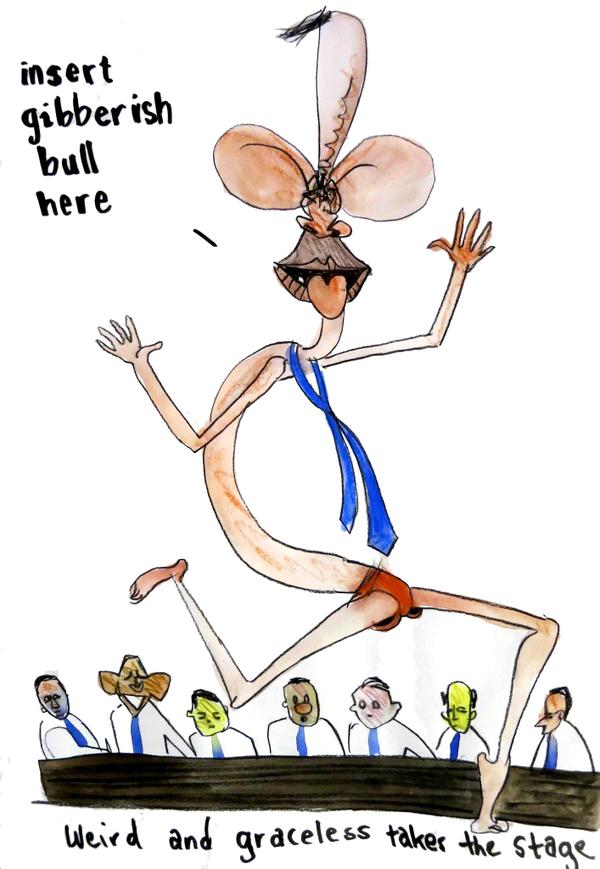
The focus of the “cringe critique” to which Switzer takes exception was an eight-minute talk Abbott delivered, without notes, to open a discussion at a G20 “leaders’ retreat”. Bill Shorten described it afterwards as “weird and graceless”, though he didn’t elaborate. Does Switzer have a point? It was a significant speech, delivered when the world was watching, so it is worth examining in depth.

“We are meeting in the Legislative Council chamber of the Queensland state Parliament,” Abbott began, “and back in the 1920s, the Queensland government abolished the Legislative Council because it was too much of a restriction on the power of the then premier, who was in the Legislative Assembly. So, this room symbolises the limitations on our power.”

The logic doesn’t follow. More plausibly, the room symbolises what Abbott would like to do to the current Senate, which is creating enormous difficulties for his policy program. Abbott’s frustration spilled over into his address to the G20 leaders:

“If I could kick off very briefly by saying that when I was elected – my government was elected – 14 months ago, I made four promises to the Australian people. First, that I would repeal the carbon tax, and that’s gone. Second, that I would stop the illegal boats that were coming to our country, and they have, thank God, stopped. Third, that we would start building roads in particular which had been long neglected in this country. Fourth, I said I would get the budget under control.”

This paragraph is the main focus of the “cringe critique”. It was a strange thing to say to a group of international leaders – especially when many of them agree with carbon pricing and see Australia as shirking its responsibilities under the Refugees Convention. Surely few could be expected to care about specific electoral promises Abbott had made from opposition.

But Abbott, as always, even in the midst of the political leaders of 20 of the most economically powerful states, was talking solely to his domestic audience. The speech was filmed, distributed publicly, and transcribed on his website. All this suggests that the speech was meant for wide public consumption.

The alternative explanation – that Abbott genuinely expected that the other 19 leaders present would respond positively to his presentation of himself as a kind of conviction politician, determined to deliver what he’d promised – doesn’t really bear thinking about. If true, it suggests powerful delusion on Abbott’s part.

“Now, I have to say this has proven massively difficult – massively difficult,” Abbott continued, referring to his efforts to get the budget under control, “because it doesn’t matter what spending program you look at, it doesn’t matter how wasteful that spending program might appear, there are always some people in the community who vote, who love that program very much.”

Ostensibly, Abbott wanted a 100-minute discussion about the problems of getting “important economic reforms” through the Senate. If he wanted tips, it’s unlikely he would have got anything useful from Vladimir Putin, an autocrat, or from Xi Jinping, the president of a one-party state.

No. What Abbott wanted was for his domestic audience to see him discussing deeply unpopular domestic policies at the world’s premier economic forum. He spoke of two issues in particular – his government’s planned deregulation of the university sector, which would mean “less central government spending and effectively more fees that students will have to pay”, and the $7 GP co-payment. For Abbott, the policies are good and right. What’s wrong is the way they’re being perceived. As with any problem of perception, what’s needed is a good rhetorical play.

The rhetorical trick of the speech was all about framing. Since the May budget, Abbott has always justified these and other policies in economic and fiscal terms. What better opportunity to drive home that message than at the G20, when presumably only serious economic issues of world importance would be discussed? And by mentioning those policies without seeking to justify them on first principles, Abbott hoped to create the illusion that their economic credentials, at least for “the most powerful and influential people in the world” (as he described them), were self-evident and uncontroversial. “In most countries this is not unusual,” Abbott said about the need to inject a “price signal” into primary health care, making eye contact with others in the room as if gathering global support for a so-called “reform” that would obliterate the central tenets – bulk-billing and universality – of Medicare, in Abbott’s mind a thoroughly Labor policy.

“I don’t have any magic answers to the problems we face,” Abbott went on. “But the more gatherings like this can affirm the importance of good policy.” Having all but exhausted his domestic options short of a double dissolution, which on current poll numbers he would lose, the global play is a last-ditch effort to win domestic support for policies that the public rejects not because they’re “harsh but necessary”, but because they’re harsh and unnecessary.

For a man whose worldview is not all that dissimilar to the DLP’s half a century ago, Abbott made a very grave error when he allowed his economic policies to be outsourced to the right-wing think tanks (like the Institute of Public Affairs, with which Switzer is associated). It’s meant that on both social and economic issues, Abbott is for middle Australia a kind of extremist, albeit one who seems pleasant and blokey enough in person.

Tom Switzer is just one of an army of right-wing commentators whose function is to protect Abbott and his government from too much negative interpretation, to insulate him from it by building around him a fortress of bullshit. Most of them are at News Corp, an entity whose writers go to extraordinary lengths to present Abbott as “statesmanlike” in his international dealings.

There’s an irony to their efforts. A statesman – according to dictionaries a “disinterested promoter of the public good”, a political leader who “exhibits great wisdom and ability” – is precisely the opposite of what Abbott is: yet another insular, domestically focused political leader who sees foreign policy and international engagement as a way to earn cheap domestic points. He’s the type of leader Peter Hartcher laments in his book The Adolescent Country. If we weren’t so deeply in the thrall of the free market, one might be forgiven for seeing something of the old Soviet spin in Team Abbott’s methods.

But in the end, Abbott’s attempt to co-opt the G20 for domestic ends didn’t work. His delivery, all Midnight Oil hands and missed beats, was truly cringeworthy. And it came among too many gaffes. His incorrigible Anglophilia (his words) had displaced his domestic radar during David Cameron’s visit on the Friday, and he fell again into the trap of lauding the achievements of the British in Australia without acknowledging the destruction and devastation it wrought on those who were already here in 1788 – and generations of their descendants. His bizarre threat to shirt-front Putin – a mixture of playing for domestic points and genuine brain-snap – overshadowed the whole G20 preparation period in the tabloid media, and made him look full of piss and wind when he couldn’t follow it through. His stubborn insistence that his Direct Action policy – conceived as a purely political counterpoint to the Gillard government’s carbon price – is more effective than the market-based schemes elsewhere, and that environmental issues should be kept separate from economic ones, looks stupider and stupider as the world grinds forwards, if far too slowly, on climate change. By the end of the weekend he’d managed to confuse China with Tasmania.

No, Tom Switzer and the “Kelly gang” at News Corp: statesmen don’t behave like this.

Tony Abbott, Andrew Bolt think they are original thinkers. The Uni Failure and the Rhodes Scholar belong to the Church of Ayn Rand welcome to the Tea Party

Series: Katharine Murphy: Dispatches Previous | Index ABC, climate change: the Coalition is drowning us in nonsense

Australian Broadcasting Corporation ABC

This morning, on the wireless, I heard the finance minister, Mathias Cormann, say the government wasn’t making cuts to the ABC.

The day before, I heard the communications minister, Malcolm Turnbull, say Tony Abbott hadn’t actually promised before last September’s election not to cut the budgets of the ABC and SBS. If Abbott had said something like that, then he didn’t mean it; and more likely, we’d all just misunderstood what the prime minister had said.

Also on Wednesday, I heard the prime minister tell the French president, Francois Hollande, that part of the Australian government’s policy arsenal to combat the risks associated with climate change involved funding an agency called the Clean Energy Finance Corporation.

What he didn’t tell the French president was the government intends to abolish the CEFC.

In politics at the present time, we are drowning in nonsense. The nonsense waves are not only lapping, elegantly, at our ankles, they are picking us all up and dumping us head first into the sand.

The Abbott government is performing so many contortions, and running so rhetorically ragged, it’s hard to see if anything coherent is actually going on.

The maximum self-harm you can inflict on yourself in politics is to obscure your substance with abject nonsense, and yet federal politics has been seemingly locked in this cycle for the past couple of terms. Labor deadweighted itself with kindergarten intrigues and dysfunctional personality conflicts.

This government is seemingly intent on deadweighting itself with evasions and too-clever-by-half constructions that can be ripped apart comprehensively in about a minute-and-a-half.

You cannot, as Tony Abbott did in opposition, make a virtue of authenticity and truth-telling in politics then break promises and spout nonsense from the moment you take the prime ministership. By Abbott’s own measure, this behaviour is immoral; and if politics is too flawed a business to apply morality, then from a self-interest perspective, it’s a recipe for self-destruction.

It is death by a thousand cuts.

Let’s be clear on the examples flagged at the start of this dispatch. The government is cutting the budgets of the ABC and SBS. It doesn’t matter whether you call the cut an efficiency dividend because it sounds kinder, or if you call it an interpretative dance – it’s a cut.

Abbott made an unequivocal promise before the last election not to cut the budgets of the public broadcasters. There were no underpants on what he said – it was black and white. So no, Malcolm, we did not misunderstand what the prime minister said, and you really insult our collective intelligence (and your own) by suggesting otherwise.

As for the CEFC construction – well, that kind of takes the cake. Abbott is sounding increasingly defensive and sensitive on climate change, which he should.

The government has taken a carbon pricing scheme that was rational and functional and replaced it with a scheme that most sensible analysts think is an absolute dog. To dress up clear policy regression as action is an absurdity – absurd enough to be seen for what it is in far away capitals of the world.

On Wednesday in the Senate, two newcomers to Australian politics did a very simple thing. Jacqui Lambie and Ricky Muir got to their feet and said, effectively: we screwed up, we are sorry. We made the compromises and engaged in the sheep-like behaviour that institutional politics seems to demand. It delivered a poor result, and we are going to try very hard not to do that again.

Rather than sneering at the newbies, some of the old timers in Parliament House could stop for a minute and have a good, hard think about that gesture of atonement.

Truth-telling and humility are powerful things.

And as bankrupt as things currently are in Canberra, it is not too late for politics to learn that basic lesson.

When broken promises become tests of character

Tony Abbott visits Arnhem Land as opposition leader.

Beyond the convenient promises of campaigning lie the deeper moral obligations of the state. How will Tony Abbott respond as Indigenous Australians face the prospect of being driven once more from their traditional lands? Jonathan Green writes.

The routine political promise is like a piece of Mary Poppins pastry: easily made, easily broken.

And do we care? Probably not so much. Trust has been worn down by the constant repetition of brazen insincerity. We are resigned.

“No cuts to education, no cuts to health, no change to pensions, no change to the GST and no cuts to the ABC or SBS.”

No change either to the post-truth framing of modern politics, a place where a promise is simply a piece of positioning to sway popularity whose impact is immediate and not dependent on execution.

If we wanted truth, we’d probably vote for it. As it is, we seem to prefer a more gestural approach: a sense of plausible coherence rather than too much specific commitment. We want a sense that things will be better, that things will be managed. That we all might quietly prosper and get on.

Truth is as far from the point as conviction.

It certainly wasn’t our issue with the last administration. To take the “Juliar” campaign as a pointed pursuit of honest politics is to mistake the rhetorical veneer for the character assassination it concealed. The carbon promise was a crack in credibility that subsequent consistency and unified confidence could have papered over, the same sense of confident denial the Abbott Government is using now to insist bluntly that black is almost certainly white if you consider the full ramifications of the changing context.

And to be fair, we’re flexible enough to admit that circumstances change and that campaign promises are largely rhetorical gestures that shouldn’t stand in the way of greater responsibilities.

That’s a practical as well as moral convenience, one that saves us from the awkward prospect of holding the simultaneous notions that truth matters while admitting that politics is inherently mendacious. We need that grace of flexibility.

And yet there is another level of political truth on which honesty matters very much indeed. Beyond the convenient promises of campaigning lie the deeper moral obligations of the state … to fairness, justice, equity, opportunity.

These are the sort of issues that draw broad declarations of noble intent, the sort of statements that truly go to something deeper than political character.

This kind of thing:

I want a new engagement with Aboriginal people to be one of the hallmarks of an incoming Coalition government … I hope to be a prime minister for Aboriginal Affairs.

This is more than Tony Abbott the politician, this is Tony Abbott the man dealing with an issue that is at the core of the most fundamental moral obligations of any Australian Government: to attempt some honest betterment of the state of Aboriginal Australians.

As much as any current politician he has put words to the profound necessity of a just settlement between Australia’s first and colonising peoples. As he told the Parliament in February 2013:

Australia is a blessed country. Our climate, our land, our people, our institutions rightly make us the envy of the earth; except for one thing – we have never fully made peace with the first Australians. This is the stain on our soul that Prime Minister Keating so movingly evoked at Redfern 21 years ago.

We have to acknowledge that pre-1788, this land was as Aboriginal then as it is Australian now and until we have acknowledged that, we will be an incomplete nation and a torn people.

Clearly we are far from achieving that healing. The Productivity Commission report released this week, Overcoming Indigenous Disadvantage, details a people in a state of psychological crisis. A people amongst whom suicide, self-harm and mental injury are rife.

There are slow improvements in things like infant mortality, but it seems that when many young and adult Indigenous Australians confront their life circumstances, they see little grounds for hope or evidence of opportunity.

And despite the Prime Minister’s declared intention to be “a Prime Minister for Aboriginal Affairs”, a Prime Minister who might move to heal this “torn people”, they also see a leader who fits, perhaps unwittingly, into the assimilationist orthodoxies of hyper-conservative Australia, of that body of bizarre opinion that sees any gesture toward Indigenous autonomy, self-determination or recognition as some queer inverted racism visited upon long suffering white Australia.

The sort of view promoted with endless vigour by the likes of Andrew Bolt:

I am an indigenous Australian, like millions of other people here, black or white. Take note, Tony Abbott. Think again, you new dividers, before we are on the path to apartheid with your change to our Constitution.

I was born here, I live here and I call no other country home. I am therefore indigenous to this land and have as much right as anyone to it.

It’s a lunatic fringe, but its impact is borne out in documents like the Productivity Commission report, a report that was preceded by news from Western Australia that the State Government intends to close over a hundred remote Indigenous communities, communities now defunded by the Commonwealth and thrust upon the slim resources of a state that sees little future in supporting them.

Their people will be driven, once more, from their traditional lands, by a Government that fully comprehends the consequences. As WA premier Colin Barnett put it:

It will cause great distress to Aboriginal people who will move, it will cause issues in regional towns as Aboriginal people move into them.

And here is a test for the PM, to stand by those principles he presents as deep conviction, as the fundamental tenets of his moral self.

This is as far from a dumb promise shaken out in the excitement of 11th hour campaigning as you can get, and something that might stand as a serious test of character for Tony Abbott, something, that if he is not careful, might yet make a Juliar of him.

Jonathan Green hosts Sunday Extra on Radio National and is the former editor of The Drum. View his full profile here.

Tony Abbott seeks closer security ties with Superpower

pope

EXCLUSIVE:  The AIMN has learned that Tony Abbott is seeking closer security ties with another superpower.

No, it’s not India, though they did sign a Framework for Security Cooperation to guide closer bilateral collaboration across “defence, counter-terrorism, cyber policy, disarmament and non-proliferation and maritime security”.

“They agreed to hold regular meetings at the level of the Defence Minister, conduct regular maritime exercises and convene regular navy to navy, air force to air force and army to army staff talks,” said the joint statement.

And it’s not China, though China and Australia will hold a series of high-level defence exchanges this year under an agreement sealed in April between Tony Abbott and Chinese Premier Li Keqiang on the first day of the PM’s visit to China.

Defence Minister David Johnston has hailed the forging of closer defence relations between Australia and China and strongly endorsed the agreement to conduct joint military exercises involving China, Australia and the United States.

“Exercise Kowari, in Australia, is a firm demonstration of all three countries’ intent to work together towards enhancing mutual trust and regional stability,” the Defence Minister said.

Nor is it Japan, though Prime Minister Abbott and Japanese Prime Minister Abe held a summit meeting on 7 April 2014, at which the two leaders decided to elevate the security and defence relationship to a new level.

In their first trilateral meeting since 2007 at the recent G20 meeting, Australia, the US and Japan agreed to stronger defence ties and to boost joint military exercises.

It’s not South Korea, though Tony Abbott has tightened defence ties with South Korea by laying out plans to conduct more joint exercises and share more military technology, helping to mend a bruising row two years ago over a cancelled weapons deal.

“I wanted to assure President Park that we were interested in defence cooperation beyond the long-established security cooperation including defence procurement, and I think she was very happy to have that assurance.”

Not Indonesia either, though the signing of a Defence Cooperation Agreement with Indonesia on 5 September 2012 shows a strong intent to deepen bilateral defence ties between Indonesia and Australia. There’s been a substantial increase in ministerial-level exchanges and the establishment of a regular Defence Minister’s meeting and a ‘two plus two’ dialogue between Defence and Foreign Ministers. And the next Defence White Paper will aim to set out a path to even closer and more comprehensive military cooperation.

The US you say?  Nope, though Australia, the G-20 host, has played an important role in Obama’s efforts to bolster the U.S. military presence in the region in order to be a counterweight to China. During a trip to Australia in 2011, Obama announced a plan to rotate 2,500 U.S. Marines through a military base in Darwin.  By the end of this decade, the US is set to deploy most of its navy and airforce to the region.

So who is it?

An insider has revealed to the AIMN that representatives of Tony Abbott are in negotiations with representatives of God at the Vatican regarding enhanced counter-terrorism surveillance.

It is understood that Cardinal Pell is arguing for an ISDS (Individual Sin Disclosure Statute) to be included which would see all confessions taped and the information held for two years.

A spokesman for Cardinal Pell said “Not only will this lead to more arrests of people who have had bad thoughts, it will free up the courts because it is so much easier to prosecute someone if you have a confession.”

He assured us that the information would not be used to prosecute pedophile rings in the clergy.

One point of contention appears to be George Brandis’ insistence on tapping the Telephone to Jesus.

“We are concerned that Jesus may have been radicalised during his time in the Middle East.  He has been receiving prayers asking for help from a lot of very suspect people.”

It is said that Tony Abbott has also had a “robust conversation” with God about his failure to smite their common enemy, the scientists, expressing his concern about recent statements made by Pope Francis about climate change, and his anti-business rhetoric about poverty and weak stance on border security.

Under the proposed agreement, radical scientists who encourage others to engage in scientific research could have up to fifty years added to their time in Purgatory, while it will also be a mortal sin for anyone to advocate an evidence-based approach.

Tony Abbott is said to be keen to sign off on the deal, suggesting a Christmas Day announcement from St Peter’s Basilica would make a great photo.

God was contacted for comment but, as at time of publishing, had not responded.

We will keep you informed as further news comes in.

It’s Time for Abbott to Step Down

jones

Surely when Alan Jones, one of Prime Minister Tony Abbott’s most fervent supporters, gives him a grilling on radio, it is time to say enough is enough. For whatever reason the talkback radio host found it necessary to take Abbott to task on the issue of the free trade agreement with China, it was enough to ask: if his friends are unhappy, isn’t it time someone tapped him on the shoulder?

On Insiders Sunday November 15th, Malcolm Farr summed up his thoughts: “Tony Abbott is a man who should not be left alone with his own mouth.” The comment was made in reference to Abbott’s opening remarks to the leaders of the G20 on the weekend about the $7 GP co-payment, the carbon tax and stopping the boats.

It was that, and Abbott’s attempts to exclude climate change from the G20 agenda that made him look foolish. Laura Tingle said it well enough in the Australian Financial Review. “Unfortunately for our Prime Minister, however, Barack Obama has delivered a rather humiliating exercise in power politics over the weekend: showing how leadership and power lies in setting and controlling an agenda.”

blew it

If Abbott ever had a golden moment to look every inch the statesman, it was the G20. He blew it in breathtaking fashion. Surely there must be a point where the collective mental health of the nation takes precedence over the choice of a national leader. How much more are we expected to endure?

If ever a supportive media had the chance to make him look worldly, it was at the G20, but even they could not do it. We saw him, warts and all, make an idiot of all those who voted for him and have the rest of us reaching for the Prozac. Then, on Monday night at a dinner to host the Chinese president, he confused China with Tasmania.

The thought of having to endure another two years watching this man stumble from one gaffe to another while continuing to lead our country, is asking too much. We deserve better. Whatever misgivings people may have had about Kevin Rudd or Julia Gillard, surely those misgivings must pale into insignificance when placed alongside the recurring examples of ineptitude displayed by this man.

For a moment, let us look beyond the sheer dishonesty that is the trail of broken promises. As unfair as they are, as economically unsound and unlikely to work as they are, his government would not be the first to play that card. Let us look beyond the appalling treatment of asylum seekers, a policy decision based solely on the belief that it gave his party an electoral advantage.

Let us look beyond his extraordinary approach to the issue of climate change. Let us put some of his utterly stupid remarks about coal to one side for the time being. Let us look beyond the possibility that he is, and has been, ineligible to stand for parliament in the first place, because of Section 44 of the Constitution which prohibits those holding dual citizenship from being candidates.

These are all issues we can debate but which are overshadowed by another. The question all LNP members of parliament should be asking is: does this man demonstrate the qualities and mental capacity necessary to lead the nation, or is he simply a figurehead, a puppet attached to, and dangled by, other more powerful interests who take advantage of his inability to articulate a coherent narrative?

bizarreWhen one addresses that question and places all his bizarre comments, his misguided sense of equality, his inability to express an original thought, surely they must scratch their heads and wonder: is he the best they have to offer?

If they cannot nominate an alternative, then they too must all be seen as incompetent and tarred with the same brush.

That then leaves the only alternative: to demand of the Governor General that he be replaced.

It’s not as if he would be the first. As unlikely as that is to happen, however, it is as clear as it is appropriate. If the man himself was willing to put the country ahead of his own personal ambitions, he would step down.

The latest Newspoll would suggest the majority of voters agree.

Polls it’s what politicians all concern themselves with 55:45 after the G20 does not look good.

Tony Abbott down in polls after G20

Tony Abbott down in polls after G20

Tony Abbott down in polls after G20

TONY Abbott is being savagely marked down by voters unimpressed with the Prime Minister’s season of overseas summits and his lavish hosting of global leaders at home.

Labor is rubbing in the opinion poll pain with one senator referring to Mr Abbott as “a village idiot” on the world stage.

Opposition Leader Bill Shorten has jumped five points to again be preferred Prime Minister — 43 per cent to 37 per cent — according to a Newspoll published in The Australian today.

The survey also found Labor had strengthened its electoral leadership 55 per cent to 45 per cent on a two-party preferred basis.

These are almost exactly the same figures recorded six months ago after the May Budget — now considered one of the most unpopular economic statements in recent decades.

Polling by Morgan also has found there was no lift for Mr Abbott from the $400 million G20 summit in Brisbane at the weekend.

Labor senator Sam Dastyari said the polls were a disaster for the Government and were linked to the Budget’s unpopularity.

Opposition leader Bill Shorten is preferred Prime Minister after the G20. Picture: Anthon

Opposition leader Bill Shorten is preferred Prime Minister after the G20. Picture: Anthony Weate Source: News Corp Australia

“World leaders must be wondering why Australia sent the village idiot to the G20. What an embarrassing performance for the PM,” said Senator Dastyari.

“To have the entire leaders of the world together and use that as an opportunity to talk about your GP tax and the fact you can’t anything through your Senate, Prime Minister you can’t get anything through the Senate because they’re bad policies.

“No one wants them and it’s just embarrassing that Tony Abbott is out there on the world stage acting like the village idiot.”

There is significantly increased respect for Foreign Minister Julie Bishop and Trade Minister Andrew Robb but the Prime Minister is not sharing the foreign policy glow.

The dissatisfaction rating of his performance rose from 52 per cent to 55 per cent in Newspoll. Mr Shorten’s fell from 45 per cent to 41 per cent.

The Government had benefited from Mr Abbott’s applauded role in the international search for the lost Malaysian Airlines MH370 and the jet downed over the Ukraine MH17.

However, domestic issues including the controversial remaining elements of the May Budget appear to have outweighed those global appearances.

And at the weekend there was significant criticism of his address to the G20 leaders in Brisbane and of the perception Australia was being left behind by the US, China and Europe on dealing with climate change.

Grin and bear it. Joe Hockey and Tony Abbott have had a hard time since the Budget was de

Grin and bear it. Joe Hockey and Tony Abbott have had a hard time since the Budget was delivered in May. Picture: Gary

It’s all about the jobs, bout the jobs, no trouble

jobs

Tony Abbott and Joe Hockey have been at pains to tell us it’s all about “jobs and growth”.  Now that we have “a number” the economies of the world will be saved.  But how do we intend to reach this magical figure of “2% growth above what is expected”?

The government’s action plan has listed five “key commitments” to underpin its pledge.

The first key commitment to expanding economic activity is infrastructure spending, including its “asset recycling initiative” – encouraging state governments to privatise assets and then plough the proceeds into new projects.

Considering we are selling the profitable Medibank Private to invest in railways for dubious Indian coal mining ventures, this seems an avenue to privatising profits and socialising losses.  No doubt some Liberal Party donors will do well out of it.

“Employment welfare reforms” is ranked as the No 2 commitment, and notes that the changes will “strengthen participation and activation strategies”.

By cutting payments entirely to some unemployed and requiring jobseekers to search for more jobs to qualify for payments, the government argues it will spur the unemployed to look for work rather than live on welfare, thereby boosting economic activity.

But that boost can only come if there are jobs for the unemployed to get and there seems little in the way of a plan to create jobs beyond “axe the tax” and “build some roads”.

Anglicare Australia commissioned a report called “Beyond Supply and Demand” which rubbished the Abbott government’s treatment of the long-term unemployed, calling for a “life first” rather than a “work first” approach to end joblessness.

Anglicare executive director Roland Manderson said

“It’s a problem if the public debate hinges on an assumption that people can just try harder and get work, that’s not true.  What is true is that people can get work and develop really great work but you need to put that investment in at the front end.  The problem with the ‘earn or learn’ (budget measure) is it makes the assumption that any training will do the trick. It’s disempowering to train people who might find work for a short time, but then are out of work again because they haven’t worked through their life barriers.”

Labor assistant treasury spokesman Andrew Leigh said cuts to welfare payments such as   the unemployment benefit, family tax benefits and the pension would act to suppress economic growth.

“If you produce a budget that reduces the income of the poor, it has an impact on consumer demand because they spend everything they’ve got,” he said.  “That will detract from economic growth.”

The other key commitments are “cutting red tape”, “contributing to global trade liberalisation” and “creating self-reliant industries”.

If one thing came out of the many millions spent on inquiries into the Home Insulation Program, it was to underline the dangers of “cutting red tape” and oversight.

The most obvious result of this commitment is to fast track development and mining approvals without regard to environmental impacts, and to remove rights of appeal.

The detail of the China Free Trade Agreement, or Memorandum of Understanding to be more accurate, is yet to be released so it is difficult to assess its impact but one concession we made was to allow Chinese companies to bring in their own workers.  I’m not sure how selling our assets to foreign companies who send their profits back home and who employ foreign workers will actually boost our economy.

Andrew Robb also admitted that Treasury has not done modelling on the overall impact of this agreement and he does not know how it will affect our balance of trade.

The commitment to “create self-reliant industries” seems to fly in the face of Abbott’s staunch resistance to reducing fossil fuel subsidies.  And how does Newman’s Galilee railway and Hunt’s Emissions Reduction Fund fit into that plan?

As was forcibly pointed out over the weekend, renewable energy is an industry of the future, but rather than taking advantage of the billions available for investment in this area, Abbott seems determined to kill off this industry and the tens of thousands of jobs that go with it, presumably because it offers competition to those humanitarian coal producers and users.

Which seems strange as the Coalition’s plan for more jobs is based on improving productivity and competitiveness.

Across the globe, mining productivity has declined by 20 per cent over the past seven years, despite the push for increased output, and declining market conditions.

Efficiency in the Australian mining industry has received a stern rebuke from PricewaterhouseCoopers (PwC), rated as one of the least productive regions in the world.

The damning report ‘Mining for Efficiency’ states that Australia is the second least productive mining region in the world, with Africa taking the wooden spoon, and North America beating Australia on all classes of equipment.

The report claims there is an inherent conflict between the productivity plans of the mining boom which were based on increased volumes, and plans based on cost reduction which are now coming to the fore of business strategy.

Despite claims by industry lobby groups that high wages in Australia will impact on our competitiveness, results actually show “significant divergences” between mines in close proximity chasing the same minerals under the same industrial relations conditions.

Equipment and the way it is used is a key focus of the report, which shows that productivity differences between the best and worst performing mines are stark, with some of the best practice outputs coming in at more than 100 per cent greater than the median performers.

“The popular tagline of the mining sector is that the miners are serious about productivity,” PwC states.

“We suggest that most are reducing costs and increasing volumes but there are precious few with legitimate claims to improving core productivity in their open cut operations.”

Comments in the report echoed the new fashion for cost reduction employed by the major miners who continue to sell off ‘non-core’ assets, such as BHP Billiton had done earlier this year with Nickelwest operations.

“Miners are banking the first available dividend, selling or segregating mines deemed too hard to fix and tempering expectations of further productivity gains by citing a combination of labour laws, high costs, regulatory hold ups and mine configuration constraints,” Lumley said.

And then this morning, we are hit with the news that the axe has fallen again at Australia’s research agency, the CSIRO, with another 75 researchers retrenched across the organisation’s future manufacturing, agriculture and digital productivity programs.

All three affected areas belong to the CSIRO’s flagship “impact science” division, set up in 2003, which aims to partner with universities and the private sector to bring “large scale and mission directed science” to bear on major national priorities.

Future manufacturing research will be hardest hit, losing up to 45 full-time positions, including in advanced fibres, biomedical manufacturing and high-performance metals.

Among the work to which future manufacturing research scientists have contributed is state-of-the-art ceramic body armour for Australian soldiers, the southern hemisphere’s first Arcam additive manufacturing facility, which enables 3D printing of metals, and a spray-on topcoat for aircraft.

But this shouldn’t surprise us from a government who thinks coal is the industry of the future and a Treasurer who thinks that climate change is “absolutely not” an impediment to economic growth

When the Russian czar goes fishing, Europe can wait. When the Koala didn’t piss on Abbott but Putin did.

When the Russian czar goes fishing, Europe can wait. 53969.jpeg

Today, one can draw conclusions from Vladimir Putin’s interview to German TV channel ARD and his visit to Brisbane for the G20 summit. The president clearly indicated his intention to support the People’s Republics of Donetsk and Luhansk, substantiated Russia’s strong economic position and made it clear that the West could accuse and threaten as much as it wanted to, but the “Russian czar will go fishing” amid all of this.

Putin gave the interview to the German TV channel a few days before his departure to Australia. The interview was published after the Russian president returned on Sunday. The President noted that the Minsk agreement became possible only because “Russia became actively involved in this effort; we worked with the Donbass militias, that is the fighters from southeast Ukraine, and we convinced them that they should settle for certain agreements. If we had not done that, it would simply not have happened. There are some problems with the implementation of these agreements, it is true,” he said.

However, according to Putin, Russia does not have the “special levers” of influence on the leaders of Donbass. It is difficult to find arguments, when loved ones are being killed. “These are our villages, we come from there. Our families and our loved ones live there. If we leave, nationalist battalions will come and kill everyone. We will not leave, you can kill us yourselves,” the president said, expressing the views of the militia forces.

“When Putin speaks about the limited possibilities of showing influence on leaders of Donetsk and Luhansk republics, it goes primarily about the fact that Russia is not responsible for their statements, for example, when they say that the Donetsk and Luhansk People’s Republics must exist within the administrative boundaries of the Donetsk and Luhansk regions, – Konstantin Kalachev, a political scientist, the head of Political Expert Group told Pravda.Ru. – Russia is not responsible for their statements about the wish to go on crusade to take Mariupol. Russia sees them as a full-fledged, independent entity. The country in any case is responsible for the fate of the population living on the territory.

“Russia will have to take responsibility for the fate of the Donetsk and Luhansk People’s Republics in terms of economic and practical assistance – in questions of  the organization of peaceful life, in terms of advice, counseling and everything that will help these territories go through this difficult period. This winter for them is actually a test for survival,” Konstantin Kalachev told Pravda.Ru.


Putin laid responsibility for the situation in Ukraine on the Kiev government. “Today there is fighting in eastern Ukraine. The Ukrainian central authorities have sent the armed forces there and they even use ballistic missiles. Does anybody speak about it? Not a single word. And what does it mean? What does it tell us? This points to the fact, that you want the Ukrainian central authorities to annihilate everyone there, all of their political foes and opponents. Is that what you want? We certainly don’t. And we won’t let it happen,” said the Russian president.

Thus, it is now obvious that Putin will not tolerate the destruction of the People’s Republics of Donetsk and Luhansk. This is the main conclusion from Sunday’s interview. Russia does not need NATO bases in Ukraine, nor does it need the neo-Nazi Ukraine. “Frankly speaking, we are very concerned about any possible ethnic cleansings and Ukraine ending up as a neo-Nazi state,” he said.

Speaking of the influence on “separatists,” Putin said: “There is just one thing that I always pay attention to. We are told again and again: pro-Russian separatists must do this and this, you must influence them in this way, you must act in that way. I have always asked them: “What have you done to influence your clients in Kiev? What have you done? Or do you only support Russophobic sentiments?” he said. “However, the following day, despite all the guarantees provided by our partners from the West, a coup happened and both the Presidential Administration and the Government headquarters were occupied,” he then continued.

Next came the question of support for the Donetsk and Luhansk republics with servicemen, weapons and equipment. Where did they get the armoured vehicles and the artillery systems? Nowadays people who wage a fight and consider it righteous will always get weapons,” said the president.

At the G20 summit in Brisbane, Putin told Canadian Prime Minister that “we will not leave Ukraine because we are not there.” Some like to draw parallels with Crimean events, where Putin first denied, but then acknowledged the presence of Russian troops to “block Ukrainian military bases.” Well, politics is the art of the possible.

Russia, according to the president, does not fight against Ukraine, but saves its economy. Russian banks, for the time being, have credited Ukrainian economy in the amount of $25 billion, Putin said. Yet, Russia is not going to seek early repayment of the public debt of the 3-billion-dollar loan in payment for natural gas.

“When we extended a $3 billion loan a year ago, there was a condition that if Ukraine’s total debt exceeded 60 percent of GDP, we, the Russian Ministry of Finance, would be entitled to demand an early repayment. Again, if we do it, the whole financial system will collapse. We have already decided that we will not do it. We do not want to aggravate the situation. We want Ukraine to get on its feet at last,” Putin said.

Why does the West restrict Russian banks in their access to credit resources, Putin asked, because such restrictions harm Ukraine. Gazprombank is another creditor, a private bank. When under sanctions, it may demand early repayment of the amount of 3.2 billion dollars.

“For Putin, it is important Donetsk and Luhansk republics should gain political subjectivity, and this is where respect to the elections that took place there comes from. For Russia, it is important the Ukrainian authorities should see these territories as a partner for negotiations. For war, one party is enough, for peace one needs two. The problem is that not all people in the Donetsk and Luhansk republics want peace. Not all people in Ukraine want peace either. For some, this war is business, for others, war can end only with victory,” said Konstantin Kalachev.

“This is the idea that Putin announced back in March, when he offered to confirm and guarantee the neutrality of Ukraine, when he tried to push the Ukrainian leadership towards federalization of the country for the protection of human rights, protection of the Russian-speaking population, the introduction two-language system and so on,” Rostislav Ishchenko, President of the Center for Analysis and Forecasting (Kiev) told Pravda.Ru. The plan was rejected then, and, as I understand it, it was finally rejected at the G20 in Brisbane. Putin’s early departure suggests that he failed to come to a consensus with the United States. In Ukraine, it is the USA that forms the reaction of the Western world to all proposals in this regard. This means that this idea of shared responsibility should be buried.”
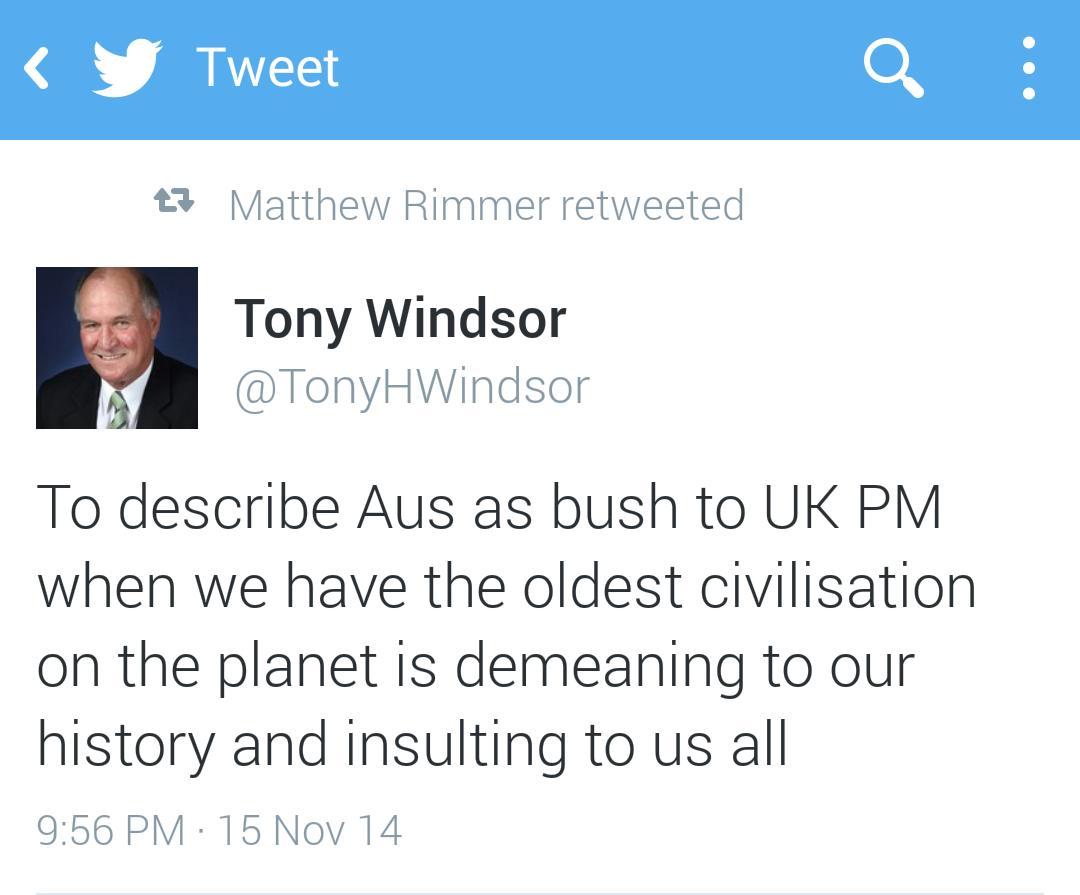
“Putin is trying to show that putting pressure on him is useless, – said Konstantin Kalachev. – That is, in this case, we can recall the phrase of Alexander III – “when the Russian czar goes fishing, Europe can wait.” Now the two sides will start waiting. In the West, no one is going to die for Ukraine. Now it is very important to start a dialogue between Donbass and Ukraine, and this dialogue will contribute to mitigating the relations between Russia and the West.”

Tony Abbott tries to ease fears over China trade deal after Alan Jones tirade

Tony Abbott and Alan Jones at Randwick racecourse in Sydney in April.

Prime minister defends agreement, saying it means a better deal for Australian agriculture, in combative interview with radio host

Tony Abbott has moved to allay concerns about Australia “selling off the farm” to China as the countries prepare to sign a trade deal in Canberra on Monday.

The prime minister defended the benefits of the agreement to the Australian agricultural sector during a combative radio interview conducted hours before he announced he had finished negotiations with the Chinese president, Xi Jinping.

Abbott met with Xi on Monday morning and said the trade minister, Andrew Robb, and the Chinese commerce minister, Gao Hucheng, would sign a “declaration of intent” undertaking to prepare the legal texts in both languages for signature.

Xi is scheduled to address the federal parliament on Monday afternoon.

The conservative 2GB broadcaster Alan Jones told Abbott he did not have a mandate for the new trade deal and repeatedly raised concerns over the sale of Australian dairy farms to Chinese entities. A Tasmanian investor, Troy Harper, said last month Chinese interests would be among investors in 50 dairy farms in Victoria as part of a deal reported to be worth $400m.

After listing other prospective sales involving China, Jones told Abbott: “By this time next week who’s going to own little Tasmania? The public are very, very angry about this prime minister, I can tell you.”

Abbott said he understood people were “always anxious at what’s often referred to as selling off the farm” but “no one can buy land unless the person who currently owns the land wants to sell”.

“Presumably you only want to sell to an overseas buyer because the overseas buyer is offering you a better price than any Australian. That’s the first point,” Abbott said.

Jones replied: “Of course … but can Tony Abbott go and buy a farm in China? The answer’s no, prime minister … nor can he buy a coal mine, nor can he buy a steel mill.”

Abbott said: “Well, Alan, I’m no expert on land ownership arrangements in China but China is still run by the Communist party. I’m not sure that anyone is that able to own land in China on an individual basis.”

Jones also objected to the proposal to increase the threshold for Foreign Investment Review Board (FIRB) scrutiny of Chinese investments to those worth more than $1.087bn.

This change, allowing a greater level of investment to proceed without FIRB screening, is similar to provisions in Australia’s recently signed deals with South Korea and Japan. In those agreements, the Australian government retained the right to screen proposals for foreign investment in agricultural land worth more than $15m and agribusinesses worth more than $53m.

Abbott said the new high threshold for FIRB screening would not apply to agricultural land in the deal with China. He also reaffirmed his yet-to-be-implemented promise to introduce a public register of farmland ownership.

The prime minister said Australia’s efforts to strike the trade agreement with China had started 10 years ago. Asked why the full text of the deal was not yet public, Abbott said this was because it was “being negotiated”.

“It’s going to be signed but it won’t actually come into force until first of all it’s gone to the parliamentary committee on treaties, been tabled in the parliament, and almost certainly legislation for some aspects of it will have to be passed,” Abbott said.

“There’s a whole lot of due process that will now take place, but I promise you this Alan: This is better for Australian agriculture, it’s at least as good for our agriculture, as New Zealand got about six or seven years ago and their dairy exports to China have gone up from under a half a billion [dollars] to over $3bn.”

The trade minister, Andrew Robb, has said Australia’s agricultural, resources, energy and service industries would benefit from the deal.

The Australian reported the dairy industry would gain similar tariff reductions as contained in the New Zealand agreement, but it will not deliver benefits for sugar, rice, wheat and cotton sectors before a review in three years. That review is also expected to consider changes to Australia’s existing requirement that all investment proposals by Chinese state-owned entities be subject to FIRB scrutiny.

Labor’s trade spokeswoman, Penny Wong, said the government had used “weeks of choreographed leaks” about the contents of the free trade agreement (FTA) and it was time for Abbott to release the full text so Australians could judge the benefits.

“Labor is deeply concerned that key export sectors like sugar have been told to expect nothing from the deal,” she said.

“Mr Abbott has talked about a two-step FTA , the fact is, Australia can’t afford a second-rate FTA with China.”

Wong nominated Labor’s criteria for a good deal, including market access outcomes for Australian farmers and other exporters that were at least as good as the New Zealand deal.

Chinese companies operating in Australia should not be granted superior legal rights to those enjoyed by Australian companies, Wong said, while calling for the retention of migration safeguards to ensure Australians gained the first opportunities for jobs.

Canada has don a turn around on Tony so much for BBF and brotherhood. Harper saw the light.

Stephen Harper and Tony Abbott

Stephen Harper changes mind, saying he is prepared to contribute to UN fund to help poor countries adapt to climate change Last year Tony Abbott and Stephen Harper had jointly dissented from support for the Green Climate

Canada – one of the few countries previously in line with Australia’s opposition to the international Green Climate Fund – now appears to have changed its mind, with Tony Abbott’s close friend prime minister Stephen Harper saying he is preparing to make a contribution.

Abbott has defied global pressure to commit to the fund, designed to help poor countries adapt to climate change, because Australia is already spending $2.5bn on its domestic Direct Action fund and providing $10bn in capital to a so-called “green bank” – which he is trying to abolish.

World leaders forced Australia to include stronger language about the Green Climate Fund in the G20 communique – and during the summit Barack Obama pledged the US would contribute $3bn to it and the Japanese prime minister, Shinzo Abe, offered $1.5bn. But soon after the conference was over Abbott indicated it would make no immediate difference to Australia’s position.

On Sunday Harper said Canada was preparing to make a contribution to the UN fund, the Globe and Mail and other Canadian media outlets reported. He did not nominate an amount.

Last November, Abbott and Harper “made history” by jointly dissenting from support for the Green Climate Fund in a communique from the Commonwealth Heads of Government meeting.

Speaking after a meeting on Sunday night with the German chancellor, Angela Merkel, Abbott said Direct Action – which funds Australia’s domestic emissions reduction, not international efforts – was already “quite a substantial fund”. He also cited the Clean Energy Finance Corporation, which he is committed to abolish.

“We also have a Clean Energy Finance Corporation which was established by the former government and there is $10bn in capital which has been allocated to this,” he said. “In addition to those two funds a proportion of our overseas aid, particularly in the Pacific, is allocated for various environmental schemes including schemes to deal with climate change. So, we are doing a very great deal and I suppose given what we are doing we don’t intend, at this time, to do more.”

Environment minister Greg Hunt tried to compare Obama’s $3bn commitment to the international fund to be spent in poor countries with Australia’s $2.5bn spending on its own domestic policy, saying that if the Direct Action fund was implemented in the US “on a like for like basis it would be the equivalent of a $25bn fund”.

Neither Abbott nor Hunt ruled out making a contribution to the fund at some time in the future and it is understood the Department of Foreign Affairs, which leads Australia’s international climate negotiations, has been considering a donation. The fund is seen as a critical part of a successful outcome at the United Nations Paris conference next year, which will discuss a global emissions pact to take effect after 2020.

But Abbott’s trenchant opposition to the fund is seen as an impediment to any contribution. He has publicly disparaged it as an international “Bob Brown bank” – another reference to the CEFC, which he wants to abolish but he also cites as evidence of Australia’s climate action.

As revealed by Guardian Australia, Abbott told world leaders at the Brisbane summit that as the leader of a major coal producer he would be “standing up for coal”.

The communique references demanded by other leaders, including Obama, were reluctantly accepted by Australia at the last minute. They included a call for contributions to the fund and for the “phasing out of inefficient fossil fuel subsidies”.

An EU spokesman reportedly described the climate negotiations with Australia as being like “trench warfare”. Other officials said it had been “very difficult” and protracted.

Speaking to the media after the summit, Abbott downplayed the importance of the fund. He took a similar line on the greenhouse reduction pledges unveiled by Obama and the Chinese president, Xi Jinping, immediately before the summit.

He said all nations “support strong action … to address climate change”, but added: “We are all going to approach this in our own way and there are a range of [climate] funds which are there.”

Obama and the UN secretary general, Ban Ki-moon, both urged G20 countries to contribute to the Green Climate Fund. In the end, at Australia’s insistence, the communique called for contributions to financing funds “such as the Green Climate Fund”.

Hunt suggested a regional rainforest fund, to which Australia recently pledged $6m, could substitute for contributions to the Green Climate Fund.

Punching with your eyes shut…………………. Ross Jones 17 November 2014,

View image on Twitter

Australia’s likely dual citizen prime minister is leading Australia down a path of destruction and ruin, says Sydney bureau chief Ross Jones — who desperately hopes the Liberals have a plan B.

IT IS TIME, ladies and gentlemen, to resist. We have a traitorous government hell-bent on destroying us. This is not a drill.

Australia’s car making industry is closing down. Worse, we can no longer refine fuel. We need to import it.

Australia has only a few weeks supply of diesel. Our sea lanes’ security is so important we are going to buy Japanese submarines, which might be okay if they are WRX STIs, but not so if they are 120Ys.

Should the sea lanes be cut, we are stuffed. No diesel, no trucks, no food. Anarchy, breakdown.

If the images of a Soviet battlefleet hanging off the coast did not send shivers up your spine then you have not been paying attention.

Vladimir Putin is without doubt the most powerful man in the world, Obama and Warren Buffett pale into a Banksy background. The guy runs a fascist state armed to the teeth and ready to go.

We’ve helped the English out in a few wars before but, to paraphrase Noel Pearson and Monty Python, what have the English ever done for us?

So when Englishmen Abbott and Cameron decide to re-live the glory days of Balaclava, you can bet your bottom dollar there’s nothing in it for Australians.

China, in all its long history, has ‒ arguably ‒ never invaded another state. At least by force. It has a weird idea of cultural hegemony and shoots dissidents and resisters, but it’s never sallied forth with an imperial fleet and invaded, let’s say, Japan.

We are already subsumed in China, part of its sphere. Touch any object within reach, odds are it was made in China. Look at your socks.

So, our foreign policy under Harpers Bazaar chick of the year, Julie Bishop, is to prod Putin with sticks and cold-shoulder China in favour of Japan, a country simmering with militarism under Abe.

As the Italians say, Via Figure.

In his days fighting for Oxford, Abbott knew how to hit but had no idea how to finesse. There are shots of him throwing punches with his eyes shut.

Andy McClintock wrote about Abbott’s boxing style in The Guardian last year:

But as an Oxford boxing Blue, Abbott was an entirely different kind of fighter. “He was crude, with very little technique,” said Nicholas Stafford-Deitsch, Abbott’s sparring partner.

Stafford-Deitsch claimed that Abbott wasn’t a huge puncher, but his knockout ratio suggests otherwise. A bigger area of concern is his footwork. In the above photo you can see that Abbott has switched out of the southpaw stance and is leading with his left foot while throwing a right hand, which goes against a boxer’s most basic training. Don’t even get me started on the position of his left hand, which should be up at his jaw “holding the phone”.

This is not the description of a man you’d follow into a fight. This is the description of a man who would make entertaining ringside viewing, but not, by any stretch, a contender.

There is photographic proof the guy punches with his eyes shut, which his former Oxford sparring partner Nicholas Stafford-Deitsch said,

“… meant he was scared.”

And right now, on our behalf, he is squaring up to Vlad, who has a much nicer dressing gown and probably better trainers.

Over what? The allegation a Soviet BUK bought down MH17. He saw it as his Howard/Bali/unify the country moment, but he blew it. Unlike Bali, there has never been any hard evidence — fog of war.

Supposed photographs from a low orbit satellite, which might themselves be photo-shopped, purport to show a Ukrainian MIG firing on and bringing down the jetliner. (daily mail)

The images of the Cameron Abbott love-fest at G20 are enough to make Cecil Rhodes orgasm in his grave. Mad dogs and Englishmen.

In none of the media reports of the Russian nuclear fleet pacing menacingly off the coast was there any mention of a U.S. or British seaborne force.

So let’s hope the LNP have Plan B.

Punching with your eyes shut is no way to fight.

Tony Abbott: The Loaded Dog of Australian politics

It is certain Abbott will not survive, politically, his Brisbane weekend among the world’s leaders.

It is not certain when he will be overthrown. But there is no other probability, any more.

His whinge about his domestic troubles in his opening statement; his attempt, for months, to keep climate change off the agenda; his physical threat to Putin and his demand, in Beijing, that Putin give him blood money; his genial handshake with the Evil One, at last, in Brisbane; his weird joke that he was on a “unity ticket” with him; and his rallying cry on behalf of coal: these mistakes ‒ plus Hockey’s bizarre assertion that climate change and the economy were “not connected” ‒ have made him seem an innumerate and a diplomatic disaster, like Borat or Billy McMahon, and an embarrassment for us, his people.

Nothing much will happen to him before November 29.

But if, then, that night, Daniel Andrews’ victory is considerable, and Palmer gains control of the Upper House, it is possible he will fall in the following fortnight, and Bishop, Turnbull, Dutton, Robb or Hunt replace him.

It is no longer acceptable that he represent us, or speak for us, in the counsels of the world. He seems a whack-head, a sort of Loaded Dog, and too big a risk to our economy, and our security, in every direction.

On his watch, the deficit has doubled. Our military have been insulted. Our old people betrayed. Our young people threatened with a $¼ of a million bill for their degree, and a $2 million dollar bill for their dwelling.

He and Morrison have threatened children with a 100 years’ imprisonment on Nauru, covered up a murder, and collaborated in the kidnap and torment of some innocents, and the sending back of some others to torture, squalor and death. He has proposed some children go to Cambodia, where they may become child whores to sustain their families.

He has proposed young people seasonally sacked from fast food cafes get no money for six months while seeking other, similar work in shrinking country towns.

He has committed us to a 20 year war we will not win against crucifying terrorists now occupying oil-rich land the size of Britain. He is spending billions on a twilight war with ‘dickheads’, who still seem able to get to Syria and fight there.

He is ethnic cleansing 100 Aboriginal communities from the map of Western Australia.

Embedded image permalink

By these and other means, he has made ten million Australians ashamed of their nationality.

He may survive a few more months, but the weight of his accumulated dunderheadedness has ensured he will topple and fall, unpleasantly, before the end of 2015.

And so it goes.

Abbott declares war on Putin. Vigilante Diplomacy excercised by Abbott and Harper bears a similar approach to Saddam and weapons of mass destruction. Guilty because we say so.

Putin walks out of G20 summit early

Russian president says he left to get some sleep but move may be seen as snub after he was pressured over Ukraine.

Russian President Vladimir Putin has left the G20 summit in Australia early, live footage showed, after he came under intense pressure from the West over Moscow’s alleged support for separatist fights in eastern Ukraine.

Putin told reporters he was leaving before the release of the G20’s communique because of the long flight to Russia and he wanted to get some sleep, Reuters news agency reported.

In unusually frank language between two leaders, Stephen Harper, the Canadian prime minister, was reported to have told Putin as they shook hands to “get out of Ukraine”.

According to Jason MacDonald, Harper’s spokesman, the prime minister told the Russian leader: “I guess I will shake your hand but I have only one thing to say to you: You need to get out of Ukraine.”

British Prime Minister David Cameron was among other leaders who publicly criticised Russia, accusing it of “bullying a smaller state in Europe” and warning that Moscow would face further sanctions if it continues “destabilising Ukraine”.

Putin left on Sunday before the final communique from the weekend talks was issued, but attended the annual forum’s wrap-up lunch and praised the “constructive discussions”.

Speaking at a press conference broadcast on Russian television earlier, he said “some of our views do not coincide, but the discussions were complete, constructive and very helpful”.

Putin also thanked Australian Prime Minister Tony Abbott for hosting the event.

Tony Abbott achieves the impossible: unity among economists

Prime minister Tony Abbott during a press conference.

Economists are refuting the three big picture claims made by the government: 1) We have a budget emergency 2) We have a debt crisis and 3) The carbon tax was ruining the economy

There’s a joke about economists: if you ask five economists the same question you’ll get six different answers. Granted, it’s not a very good joke, but it’s a fair call. Ours is a complex field, and a growing number of economists are acknowledging that the theory sitting behind mainstream economics is mostly rubbish. As a result, it’s very difficult to find consensus on real world events.

But that’s where Abbott and Hockey have achieved what many thought impossible: a true consensus. Unfortunately for the coalition government, the consensus is entirely against them. The Abbott government’s agenda has been driven by three major claims, all of them economic in nature. Let’s see how economists view these three themes:

1) There is a budget emergency

Number of economists who agree: zero

2) The federal government has a debt crisis

Number of economists who agree: zero

3) Carbon pricing is an economic wrecking ball

Number of economists who agree: zero

The above represents a very slight exaggeration. You can find people with some economics qualifications who agree with the government but, without exception, they either work for the Coalition or for some entity with ideological motives (like the IPA or News Corp).

While most would agree that there are serious structural problems with the budget, none would call it an emergency. Chris Richardson, economist and partner at Deloitte Access Economics, said:

We don’t need a surplus tomorrow, we don’t even necessarily need it in five years’ time. I’m more than happy with us getting back to sustainable fiscal finances over the long term. The politics would tend to suggest moving earlier rather than later but on the economics there’s no rush.

Saul Eslake, chief economist at Bank of America Merrill Lynch, said that to call the Australian debt situation a crisis was “to abuse the English language.”

Similarly, Nobel prize winning US economist Joseph Stiglitz used terms such as “absurd”, “crazy” and “a crime” to describe some of Hockey’s budget measures, and dismissed the perceived debt and deficit problems, noting that any Australian who worries about debt “must be out of their mind.” Richard Holden, professor of economics at the Australian School of Business, put it this way: “First, Australia does not have a debt crisis. Or, to put it another way, Australia does not have a debt crisis.”

It doesn’t stop here. The Age recently conducted its annual economics survey of 25 prominent economists. They select economists from a broad range of backgrounds across the spectrum of economics and their views vary widely on almost all issues. None of them agreed with the government on any of the above three topics.

This unique consensus among economists makes it clear that the entire government agenda is based on false premises. How has this exposure affected the Coalition’s agenda or their messaging? Not at all. Not one bit. Not one iota. Let’s be clear about this. We know they’re not being honest about their real motives for policy. They know we know, too. They don’t care.

As I’ve explained previously, the Abbott and Hockey budget, if fully implemented, would have taken us a long way towards the free market social and economic model of the US, and away from the social democracy model of much of Europe. But the question remains as to why they would do this. Who benefits from a US style free market system where government minimises its involvement?

The answer of course is the wealthy and those who already wield power. The greatest beneficiaries of Abbott and Hockey’s policies are their largest financial backers, including the financial industry, the mining and energy industries, gambling interests and real estate companies.

For all the talk about this being the most ideologically driven government in living memory, the reality is something much simpler and more familiar. This government is simply delivering to big money what big money wants.

One of the clearest examples of this is the winding back of the Labor government’s Future of Financial Advice (FoFA) reforms. We know that many financial advisors have been preying on their clients. They make use of clients’ lack of understanding of complex investing and other financial options to direct them to financial products that are not in their interest, but rather in the interests of the advisor. This has been costing consumers huge sums of money, which primarily flow into the hands of the banks.

Labor’s reforms were aimed at making such conflicts of interest for advisors illegal in order to address this complex problem. The Coalition have wound back Labor’s changes and have provided not one defensible reason for doing so. Compliance costs and red tape have actually increased, so that cannot be used as the excuse. Meanwhile, we allow the banks to continue to profit from ripping off their customers.

The same is at play when you examine climate policy. You can’t find an independent economist who thinks the government’s “direct action” plan for tackling climate change is more efficient or effective than a carbon tax or trading scheme. Who likes direct action? The polluters of course. Instead of paying to pollute, they get paid not to pollute. Here’s the real con: one argument we are given is that the carbon tax was too big a burden on consumers. Who’s going to pay the polluters to reduce pollution? The government. Where do they get the money? From all of us. Consumers pay anyway.

The clarity of these examples reveals the sad reality of this government. They are not ideologues, they are just puppets dancing to the tune of those pulling their strings.

We know Abbott’s budget emergency is fake. So where are his real enemies?

shorten and abbott

Tony Abbott’s fair-weather allies got their wishes because they encountered little real opposition from social movements over the past six years. That has to change

Tony Abbott’s Australia could be an updated incarnation of the film Pleasantville. Instead of 1950s America, Abbottville is a sanitised, stable suburban and rural world based upon existing forms and levels of consumption and production. It is free of climate change concerns, “boat people”, political dissidents and unassimilated Indigenous Australians. Yet, unlike Pleasantville, Abbottville can’t always be pleasant. Sacrifices must be made by society, especially by workers and welfare recipients if the loyal business defenders of the realm are not to be undermined.

Abbottville is the logical conclusion of a disastrous policy framework first inaugurated in 1983 by Hawke and Keating. For thirty years, this policy framework has led to the marketisation and pricing of nearly all social activities. Abbott’s agenda is merely a sharp extension of policies pursued to a lesser or greater degree by both Coalition and ALP governments. There has never been a truly universal social welfare, health and education system that Abbott can tear apart.

From Fraser to Rudd and Gillard, a two-class health, education, housing, aged care and income retirement system has prevailed. Joe Hockey maintains the long established Australian policy of collecting 7% to 8% less revenue to GDP than average rates in OECD countries. This translates into a loss of approximately $105 to $120 billion additional revenue per annum that could comfortably fund a raft of urgently needed social policies while making our cities environmentally sustainable.

Looming over the Abbott government and Australian society is a genuine budget emergency rather than Hockey’s phoney “budget emergency”. The highly ideological 2014 budget completely ignores that carbon emissions are already so high that the global carbon budget for burning fossil fuels has almost run out and with it the possibility of preventing a dangerous two-degree-Celsius rise in the earth’s temperature. Unfortunately, our blinkered major political parties, business lobbies and media refuse to see the global carbon budget emergency because they are preoccupied with the self-interest of parochial budget figures.

As for Abbott’s “enemies”, they still adhere to obsolete organisational practices and policy agendas that are “one society or historical stage behind our current lived experiences”. For too long the peak environment, social welfare, labour movement, development aid and human rights bodies have got used to politely courting Labor governments and sympathetic Coalition politicians.

Apart from the occasional street march, many conduct their political lobbying as if they were in a university seminar. Dozens of detailed reports are regularly prepared by NGOs on endless social welfare, environmental and other topics. Government ministers consign most to these reports to the rubbish bin.

Crucially, Abbott’s “enemies” have failed to come to terms with the characteristics of the new global phase of capitalism: that capitalism and democracy are becoming increasingly incompatible and business wants to completely free itself from democratic regulation.

International investors in bonds and currencies, or those industries primarily geared to exports rather than domestic consumption (like the resources sector), have little vested interest in maintaining decent social welfare, education, health and public services.

In those domestic sectors of the market where competitive pressures are greatest, an increasing percentage of profits and market viability depends on favourable government policies such as reduced taxation, reduced regulation over labour costs, minimal consumer protection and fewer restrictions over services and the marketing of new financial products.

In contrast to weak resistance in Anglo-American countries, European and Latin American countries have witnessed an escalation of desperate forms of public resistance to austerity measures (riots, occupations, torching of luxury cars and homes of the rich, smashing expensive shops and hijacking food trucks), thus placing governments on notice that there is a limit to their toleration of austerity. Is this the future that awaits Australia?

The rise of the anti-big business, populist rightwing parties also simultaneously weakens both the mainstream leftwing and the corporate sector’s ability to shape policies.

Despite knowing from 2010-11 that Abbott was going to win, social movements succumbed to the same old ineffective politics. The Abbott government now privately derides and disparages them, thus leaving them with no plan B to fight back against the Coalition or to prepare strategic policies regardless of an Abbott or future alternative government.

Abbott’s contempt for climate science particularly renders existing practices of the Australian Conservation Foundation and other peak environment groups irrelevant. They are now belatedly turning to grass roots community activism but still have a long way to go. The same is even truer of the Australian Council of Social Services (Acoss). How they can maintain their alliance with the Business Council of Australia –formed in 2012 by Acoss CEO Cassandra Goldie and Tony Shepherd of the recent infamous National Audit – is beyond belief, after Acoss’s welfare constituents were savaged by Hockey and Shepherd.

How also to understand well-intentioned people like Tim Costello, Paris Aristotle or Robert Manne, who undermine their long moral commitment to the poor or asylum seekers by now advocating naïve and immoral policies? Does Costello think a broadened GST will restore foreign aid cuts and that a regressive tax is OK because, as he stated, poor people don’t eat much fresh food? What of Paris Aristotle and Robert Manne, who legitimised the offshore hellholes on Manus Island and Nauru, even though they oppose Scott Morrison’s harsh methods?

Certainly the labour movement has belatedly organised protests to combat Abbott. However, the real danger for the ACTU and ALP is that they will do a Beazley and think that they will be re-elected on Abbott’s unpopularity. A timid opposition front bench will have to be dragged kicking and screaming to any proposed increase in tax revenues, or to the abandonment of conservative climate change and social welfare policies.

Abbott’s “enemies” will have to formulate clear alternative revenue raising measures, not just by closing privileged entitlements, but by using a creative set of massive capital raisings (a minimum of $50bn per annum or less than 3% from the $1.9tn superannuation system) in the form of compulsory levies, social infrastructure bonds and the like, in return for continued favourable tax treatment.

There are numerous imaginative ideas of how to simultaneously fund and organise urban and regional community housing, social services and environmentally sustainable infrastructure without falling back on the old bureaucratic state and federal department processes. Building community alliances through the promise to deliver community designed social agendas is potentially the basis for a successful political strategy as well as a political necessity to combat climate change and dilapidated public services.

Abbott’s fair-weather allies put in their ambit claims precisely because there was little opposition from labour and social movements over the past six years. A new message of consistent public opposition and campaigning in strategic marginal parliamentary seats as well as outside prominent corporate and industry lobby headquarters is required.

New disruptive campaigns must be organised – such as ending the dominance of the IPA and rightwing commentators on the ABC and combatting their commercial media outlets. Regular protests could occur whenever Abbott and his ministers attend public functions. Abbott has taught his opposition a powerful lesson: quiescent, nice people come last. However, strong opposition is only half the answer, unless popular resistance has a set of socio-economic and environmental goals. This will require a major rethink of strategies and policies. The age of comfortableness is over.

Oh no, there was nothing here… Except a civilisation with its own intricate and sophisticated culture… That Abbotts ancestors destroyed so we could have skyscrapers and prostitutes in sydney.

If you voted liberal Shame Shame Shame

Sir-Joel McAlear shared Terror Australis‘s photo to the group: 1,000,000 Aussies Against Racism.

Full of it ……….By Michaela McGuire Friday, 14th November 2014

Let’s talk about shit. Our leaders talk it, our prime minister is full of it, and for one of the G20 leaders, it’s a key piece of policy.

Indian Prime Minister Narendra Modi is coming to Brisbane for the G20 after a quick victory lap of the world, during which he sold his vision of the new India. Modi’s dream is of a young, rising nation that safeguards the future of an ageing globe. Part of realising this is expanding sanitation and bringing to an end the Indian tradition of defecating outside. The soundbite is “toilets before temples”, and it’s part of a greater philosophy of a clean India. At one end of the rhetoric this means a toilet in every home. At the other, the abolition of “the enemy within”, a euphemism for the Indian Muslim minority.

It’s testament to Modi’s oratorical skills that he is better known internationally for his fiscally progressive yoga-loving political incarnation, than as the Hindu nationalist firebrand who many scholars argue was complicit in the 2002 Gujarat riots in which 790 Muslims were murdered and many more wounded and raped.

These days the genocide perpetrated on his watch as Gujarat Chief Minister is less well remembered than his prudent fiscal stewardship of the state, a legacy he trades on as the leader of a rapidly growing India. He has turned the focus away from his own feculent past to literally cleaning up the streets.

Like water off a duck’s back, the shit doesn’t stick to Modi. Perhaps our own prime minister could learn a thing or two about managing his image from his Indian counterpart.

The two men have some things in common. Both head governments in which policy is led by right-wing think tanks. Neither lets reality get in the way of a good soundbite. Both lead parties that have benefited from playing up the threat of extremist Muslims. Both shuffled their cabinets in line with their own values: while Australia lost its Ministry of Science in favour of a Minister for Anzac Day, Modi just appointed a Minister for Yoga.

Each man wears his religion on at least one of his sleeves. The other sleeve is for economic credentials, although Modi is rather more convincing in this role – the Gujarat State did enjoy rapid economic development under his rule, while Abbott made Joe Hockey his treasurer.

Modi sells his brand much better than Abbott. While they both use foreign policy to score domestic points, Modi’s domestic policy is also designed to score points internationally. When he addressed a rapturous crowd of expats in New York’s Madison Square Gardens, he spoke of India’s future as a global power. The message was intended for the voters at home, and for the Obama administration. When Modi addresses an Indian crowd, he is also talking to the world.

Contrast this with Abbott’s use of international platforms, in his first months in office, to broadcast criticisms of the previous Labor administration. In opposition, his relentless hostility to the ALP made him seem ruthless. In leadership, it makes him look petty.

Modi has played to his strengths. The Modi he has sold to the world is a reformed one. He plays up his humble origins as a tea merchant, his unimposing physicality, his practical measures to improve his country. It all belies the divisive way in which he wields power. There will be toilets before temples, but right about now the Muslim minority in much of India will be shitting themselves.

For his part, Abbott has remained studiously pig-headed, either unwilling or unable to adapt his rhetoric as the world moves on. Blindsided by this week’s agreement between China and America to reduce global emissions, he had a chance to soften his stance on climate change and make it part of the agenda at the upcoming G20 summit. Abbott appears to have failed before the summit begins, by reaffirming that jobs, not the climate, would be his focus.

This puts Tony “Coal is good for humanity” Abbott at odds with the world’s primary superpowers, as well as its rising ones. Modi has signalled his concern over climate change, and has called for the developed world to act on it. He recognises that he must talk the talk, even if he can’t yet walk it.

Abbott, who in the past has said that he takes direction from God, now finds himself out of step with his God’s main representative on earth. Pope Francis recently wrote to the Catholic Australian PM urging him to reconsider the poor and disenfranchised who will be most affected by climate change.

Meanwhile Abbott continues to be mocked for his stance by international observers, by his electorate, by other world leaders.

The boost in the polls Abbott enjoyed when he shifted public attention away from his fumbling domestic policy and bumbling cabinet to an international focus is levelling off. While voters appreciated the appearance of strong leadership in the wake of the MH17 tragedy, his promise to ‘shirt-front’ the Russian leader and his attempts to hold Putin to account are not playing particularly well. Compared to proper villains like Putin and Modi, Abbott comes across not as threatening, but just incompetent.

When Modi was in Australia in September he gave Abbott a book on yoga. Perhaps he would have done better with the perennial Western spiritual text How to Win Friends and Influence People or even, given the paucity of women in the Abbott cabinet, The Game. Or maybe just a bumper sticker.

After all, shit does happen.

Abbott’s View of history and progress with the arrival of the first fleet

Brisbane: Can we please concentrate on the issues?

Brisbane: Can we please concentrate on the issues?. 53953.jpeg

There are those who would like to use the G20 Summit in Brisbane, Australia, to perpetuate a hackneyed West versus East approach, at a time when the world needs to pull together. This begins with a responsible media and competent political leaders, focusing on the issues at hand instead of chasing ghosts and sowing the seeds of conflict.

Predictably, David Cameron has used Brisbane as a stage to launch a set of snide remarks about Russia, just as the host, Australian Prime Minister Tony Abbott, did recently with puerile remarks about wishing to “shirtfront” Russian President Vladimir Putin over the MH17 air disaster over Ukraine. In fact the entire Western leadership has adopted a hypocritical, dishonest and groundless campaign against Russia, its partner in two world wars, over a question which was prepared, cooked and served in the west: Ukraine. Why doesn’t Abbott confront the Ukrainian President, Poroshenko? Why doesn’t he ask why the Ukrainians do not reveal the content of the ATC tapes seized by the authorities, why doesn’t he ask the Ukrainian President about the alleged sighting of fighter jets trailing flight MH 17?

They tried it before in 2008, in Georgia, when Georgian troops murdered South Ossetian citizens, massed their troops on the border with Abkhazia and then ran screaming along with their magnificent NATO advisors as Russia taught them a lesson or four in soldiery.

They tried again in 2014, in Ukraine, when an illegal Putsch was launched in Kiev to topple the democratically elected President, Yanukovich. The West, of course, applauded at this travesty of democracy and then had the audacity to claim the moral high ground and start blaming Russia, accusing Moscow of undemocratic behavior when President Putin has been elected multiple times with whacking majorities and approval ratings several times higher than those of Cameron, Obama and Abbott combined.

Nothing did they say about the shots fired from the sixth floor of Hotel Ukraine in Independence Square against the pro-rebellion demonstrators, to create a cause and blame Yanukovich. Nothing did they say about the Fascist massacres in which burning bodies of Russian-speaking Ukrainians were tossed out of windows by Fascists as the crowds below looked on, applauded and cheered, as was the case at Mariupol. And this is the side backed by Abbott, his master Cameron, and their master, Obama?


They are quick to blame Russia for the instability in Eastern Ukraine, and to point the finger without a shred of evidence that Russia is interfering. Google these days can practically pick up a matchbox. Where are the photographs of tanks rolling across the border? There aren’t any. Maybe the BBC would like to do a copy paste job again using pics from two decades earlier and another continent?

And now we are on to the blame game perhaps Mr. Cameron and Mr. Abbott would like to comment on their own countries’ recent history of war crimes in Iraq, the country which was invaded without any justified or justifiable casus belli, the sovereign nation which was totally destabilized, whose civilian infrastructures were strafed with military hardware, whose civilians were murdered. The entire Iraq campaign culminated in the most horrific war crimes – deploying cluster bombs in civilian areas, targeting civilian homes and leaving swathes of the country dangerous through the deployment of Depleted Uranium.

The direct result of the criminal interference of the United States of America, its chief poodle, the UK, in turn its ex-colony crawling around its legs, Australia and new willing bedboy, Poland, was thousands of cases of cancer and birth defects among Iraqi children in 300 known contamination sites. The USA, the UK, Australia and Poland, in participating in the illegal invasion of Iraq, have left a radioactive legacy for decades to come.

And here they are, the West, supporting terrorists in Syria against President Assad, interfering in Ukraine, overthrowing a democratically elected Government, then supporting the side that committed massacres.

So instead of using Brisbane to launch unfounded and insolent quips against Russia, suppose the West, for once, acted with responsibility in addressing the real issues facing humankind, and not perpetuating their lies to cover up their own criminal misconduct?

The issues at Brisbane’s G20 Summit on November 15-16 are the following:

Fostering the conditions to stimulate world trade, instead of stifling it through the illegal imposition of sanctions, job creation, stimulating the global economy by 2 per cent over five years and measures to combat tax evasion, now that climate change is not on the agenda. And who was responsible for keeping it off? Three guesses.

Let us hope Brisbane is about coming together, not driving a wedge between the G8 and its diminishing sphere of influence and the BRICS, the prototype of the new model which carries the hearts and minds of humankind.

Timothy Bancroft-Hinchey

Tony Abbott: The mad Englishman ruining Australia. No evidence to say he is not a dual citizen

Tony Abbott: The mad Englishman ruining Australia. 53793.jpeg

Section 44 of Australian constitution precludes members of parliament from being a dual national. MPs must sign declarations for the Australian Electoral Commission stating that they are eligible under our constitution to stand for election to parliament.  I last wrote as a response to being labelled a birther which was a bit of a laugh for me. When I played rugby union many centuries ago, I was nicknamed Big Bertha because of my short stature, my weight, 115kg of muscle, and hippy hair half way down my back. Playing as a prop didn’t help but encouraged those with wit to call me the Big Bertha.

Since last writing I have been chasing the fabled documents which prove Tony Abbott has or has not renounced his British citizenship. The latest fiasco was a public servant working in Mr Abbotts Parliament House office promising to email details to me by yesterday evening.  I had been talking to her about the information for the last ten days or so and she assured me approval would be granted and the information released to the world. Nothing.  Peta Credlin had stopped the media staffer talking to me.  At one stage during my talks with the PMs office my home and mobile phone numbers were automatically put on hold and the only way to get through to anyone was to use Skype and not give my name. Such is modern politics and the right of people to know.

The United Kingdom had quite a large shuffle of ministers recently, I don’t know if my complaint about Mr Hague, who was then in the Foreign Office, blocking my FOI request to the Home Office had anything to do with it, but a lot of seats have changed.  The new Attorney General in the UK is the Right Honourable Jeremy Wright MP.  I have written to him to examine the documents in the Home Office which indicate if and when Mr Abbott renounced his British citizenship. I asked him to release the documents because it would be a shame for the UK to be tied up in a scandal of cover up and possible fraud.  I mentioned the last illegal Commonwealth of Nations leader would have been Idi Amin, a few Pakistan generals and maybe the Fijian military leaders of recent times.   There doesn’t seem to be a precedent for someone not eligible for parliament being elected.  Even Mussolini and Hitler were elected legally in their respective countries

Mr Wright a lot of Australian wrongs are in your hands and I do apologise for such a terrible word play.


Others to have received details of the possible problems with Mr Abbotts election are the Governor General, the Attorney General, the Australian Federal Police and the Australian Electoral Commission.   The only one to reply has been the AEC who have reiterated they can not ask people to prove their citizenship and must rely on the prospective MPs telling the truth when they sign the AEC declaration.  The AEC can not see beyond the citizenship question and notice that the prospective MP may have lied and signed a false declarations and thereby committed fraud.  The Hon Peter Heerey AM QC is the head of the actual Australian Electoral Commission and has been asked to ascertain if a fraud may have been committed.  As a QC it is his duty to follow up any allegations of fraud and ascertain if a crime has been committed. I believe staff at eh AEC have kept my communications from him, so I wrote directly to him and to his barrister chambers. Unfortunately he is on leave until the end of the month so any response form him will be a while coming.

I can only assume the Governor General is more intent on keeping his knighthood than he is on protecting the integrity of our constitution. No response from him or his office to any queries I have made.

The AFP. By far the cleverest political decision I have seen Tony Abbott make is to house himself in the AFP academy dormitory instead of any official residence. I was drinking mates for many years with a lot of AFP from and in that academy and I know they are at best reluctant in questioning anyone living there. If a murder has happened they will jump and police actively and normally but signing a false declaration would be the least of their considerations. Believe me every cop I have ever met is brilliant in their job, but sleep with them and things become a little blurred. Things do look blurred especially from the eyes of an outsider trying to question the activities of a person sleeping in the dormitory. My complaints to the AFP were lodged via their online complaints process for reporting possible Commonwealth crimes. Since there has been no response via that method  I have emailed the new Commissioner of the AFP Andrew Colvin, but again have not had a reply. I mentioned earlier my drinking mates, their email addresses are set out in a specific format, using that format to contact Commissioner Colvin was simplicity itself.

And now we come to the Attorney General, the Hon Senator George Brandis.  George Brandis was at Oxford with Tony Abbott and as some of the few Aussies there became very close friends. Being a part of the same political party and from the same rather extreme right wing of that party, means their friendship and political ties continue unfettered.  I contacted Senator Brandis in May, July and August before my email account was hacked and all emails removed and deleted and impossible to recover.  Thankfully the Parliament House computer system will have a copy of my emails to my Queensland senator and will also show no reply at all from him or anyone in his office.  I re-contacted the senator in September after he was on ABC television proclaiming he would uphold the integrity of law in this country.  I reminded him that the constitution was part of our law and there was a possibility of a member of parliament getting into parliament after fraudulently signing a statutory declaration for the AEC. Again no reply. Totally ignored.

I have lodged a complaint with the Queensland Legal Service Commission about the good senator possibly breaching the codes of conduct and moral requirements of a Queens Council in the state of Queensland.  That matter will be examined by the Law Services Commission and they will decide in due course.

There we have it. After 12 months of looking at the dual national born in the same year as I was and a few hundred kilometres south of where I was born, I am no closer to finding out the truth about the most important man in the country. The saddest thing may be that if he is in the job illegally the war with ISIS could be a case of treason. Anyone who causes a foreign state to wage war with the Commonwealth of Australia could be guilty of treason. Those poor service personnel sent into action may be fighting for all the wrong reasons.  Air Chief Marshal Binskin has been advised of the possible conflict and asked to do all he can to legally protect his troops.

Tony Magrathea

British bulldog Tony: Australia’s white supremacist Prime Minister

Australia’s possible dual British citizen PM Tony Abbott today described Australia as “nothing but bush” before the arrival of the First Fleet. First Nations’ representative Natalie Cromb responds.

Australia is a focus point in international politics this week as it plays host to the 2014 G20 summit in Brisbane. International diplomats, representatives, staff, security and media have descended amidst a climate of tension and drama pertaining to Prime Minister Tony Abbott’s threats to “shirt-front” Russian President Vladamir Putin.

In this context of heightened international interest, speaking at the International Infrastructure Business Breakfast in Sydney this morning, Prime Minister Tony Abbott, in front of British Prime Minister David Cameron, took the opportunity to perpetuate the lie of terra nullius by describing Australia prior to colonisation as [IA emphasis]:

“… nothing but bush … the Marines, and the convicts and the sailors … must have thought they’d come almost to the Moon…. Everything would have seemed so extraordinarily basic and raw…”

Granted, these comments come as little surprise to the Indigenous population of this nation given he has previously credited British people with the first

“… foreign investment … [in] the then unsettled or, um, scarcely settled, Great South Land…

and stated that

“… the First Fleet was the defining moment in the history of this continent.”

While not surprised by his comments, I am outraged.

I am outraged that a man of this unashamed racial intolerance holds the leadership position of this nation.

I am outraged that he uses this platform to manifestly attempt to rewrite history and decimate any progress made historically towards closing the gap, self-determination and reconciliation.

I am outraged that his entire platform of economic policy was based on scaremongering without any substance.

I am outraged that he so grossly underestimates the intelligence of the Australian people and that such underestimation, for a large portion of people, is well founded. How else can the fact he was elected be otherwise explained?

I realise it is facetious of me to expect the self-proclaimed “Prime Minister for Indigenous Affairs” to consider the gravity of his words as they may be received by his alleged constituents — after all, a man holding the highest position in this land cannot possibly be expected to speak in a measured an accurate manner. Can he?

Of course not! He has proven time and time again that he is a simple man ‒ albeit an avid liar ‒ who has absolutely no sense of social justice. He has used his platform of leadership to decimate Australia in every capacity — socially, culturally, educationally, economically and environmentally.

Let me be clear, I do not hold Tony Abbott in high regard intellectually. I am not outraged at the views of a simple bigot.

I am outraged that we live in a country that has such an affinity with his views that he was elected into power to perpetuate his racist ideals with real policies that we, as Australians, are required to live with. These policies have real consequences and will reverberate for many years to come.

Australia is a racist country (cue gasps of horror and indignation). Are all Australians racist? No.

Let me explain.

This nation is one built on the lie that is terra nullius and the fact that there has been no meaningful attempt at reparation for the theft of an entire continent from the original inhabitants (“owners” for those of you who require capitalist terminology) demonstrates that we remain a racist nation.

At times, covert — but still racist.

Not only was an entire race of people dispossessed from their land, but they were subject to brutal massacres, slavery, disease, political policies of genocidal proportions and to deny this history and continue to benefit from it is the crux of the issue.

There is a wilful ignorance of many non-Indigenous Australians to the perspective of Indigenous Australians when it comes to discussing this history. There is a glazed look when this topic of discussion gets raised because there is no means in to empathise and there is a common misconception that Indigenous people want them to give up their homes and make claims that would directly impact them. This is not the case.

All too often you will hear discussions of this very issue and there are always comments of varying degrees of the same message:

“It was in the past…. I didn’t personally do it, it was my ancestors …. get over it …. it’s not my problem …. I can’t be held responsible for events of the past …. haven’t we moved on?”

A large part of the destruction of Indigenous culture did occur in the past, however, the destruction continues today. The current generation Australians benefit from the actions of previous generations of Australians (and British) and continued denial of this fact perpetuates the myth that the damage was done and remains in the past.

This denial of history and the effects rippling through modern Australia is the accepted perspective of a large portion of the Australian community. A portion of the community that elected a leader so blatantly racist that he uses his leadership platform to dispense with covert methods and go straight to telling anyone who will listen about British superiority and our obligation to give thanks for “creating” Australia — all the while denying the truth of the Indigenous history of this nation.

I am aware that being so blunt as to label Australia as a racist country is tantamount to setting the cat amongst the pigeons, but spare me the outrage; having lived and experienced this racism first hand, this is just plain honesty.

So while Adam Goodes (who happens to be Australian of the Year) gets lambasted for speaking the truth in relation to Australia’s sordid history, I will undoubtedly get my share of  vitriol, Tony Abbott is free to send a clear message to the world that Australia is, was and always has been a British colony (truth is irrelevant).

You can follow Natalie on Twitter @NatalieCromb.

needs an education, for starters ‘The Biggest Estate on Earth How Aboroigines

Print Email Facebook Twitter More Prime Minister Tony Abbott describes Sydney as ‘nothing but bush’ before First Fleet arrived in 1788

Tony Abbott addresses the Sydney Institute

Prime Minister Tony Abbott has been accused of effectively declaring Australia “terra nullius” before British settlement, after remarking that Sydney was “nothing but bush” prior to the arrival of the First Fleet.

During a breakfast for British prime minister David Cameron in Sydney this morning, Mr Abbott made a speech about infrastructure and noted the “extraordinary partnership” between the two countries since the arrival of the First Fleet in 1788.

“As we look around this glorious city, as we see the extraordinary development, it’s hard to think that back in 1788 it was nothing but bush,” Mr Abbott said.

“The marines and the convicts and the sailors that straggled off those 12 ships, just a few hundred yards from where we are now, must have thought they had come almost to the moon.

“Everything would have been so strange. Everything would have seemed so extraordinarily basic and raw, and now a city which is one of the most spectacular cities on our globe.”

Kirstie Parker from the National Congress of Australia’s First Peoples said the comments do tremendous damage to the relationship between the Prime Minister and Aboriginal people.

“I’d say they were a blunder except this is becoming a habit for the Prime Minister,” she said.

“On several occasions just in the last couple of months, he has made comments that have erased Aboriginal and Torres Strait Islander people from the landscape.”

Ms Parker said it was not a case of reading too much into the remarks, or taking them out of context.

“For the Prime Minister to say there was nothing here but bush is incorrect; there were people here with sophisticated systems and societies and rules,” she said.

“We were here.”

Labor’s Indigenous affairs spokesman Shayne Neumann said Aboriginal people have a right to feel that the Prime Minister “owes them an apology and he should express regret at the form of words he used today when he was honouring his own heritage but denying theirs”.

“It’s a denial of their culture, their language, their heritage and their custom and basically it shows the Prime Minister has a sort of terra nullius type approach to the continent,” he said.

“Language counts. Words have meaning, words can be like bullets, words are symbolic.

“They drive people’s thoughts and can influence people.”

Greens Indigenous affairs spokeswoman Rachel Siewert said Mr Abbott’s comments were “another example of the Prime Minister ignoring the reality of colonisation and the peoples, flourishing culture and languages that were here at the time of European settlement”.

Mr Abbott made a point of acknowledging Indigenous history in his speech to the Parliament today as he welcomed Mr Cameron to Canberra.

“Modern Australia has an Aboriginal heritage, a British foundation and a multicultural character,” he said.

Mr Abbott also attracted criticism in August when he described the arrival of the First Fleet as the “defining moment” in Australian history.

Subsequently Mr Abbott conducted an interview with British newspaper The Telegraph during his trip to a remote Aboriginal community in Arnhem Land.

According to the report he said the arrival of British settlers on the First Fleet proved devastating for Aboriginal people.

“Initially the impact [of British settlement] was all bad, disease, dispossession, discrimination, at times wanton murder,” he said.

This man is our Minister for the Indigenous people of Australia. He hasn’t learnt a thing.

Mr Abbott this moon your talking about  was a home to the First People. It wasn’t a barren waste land to them ever. It was their land filled with their history their stories their culture. It merely was a wasteland in your racist mind’s eye. Stop making the First People of this country irrelevant.

DISGUSTING, DISRESPECTFUL, HAVE YOU RENOUNCED YOUR BRITISH CITIZENSHIP?

The forgotten poor – until we need a few bucks.

Poverty-History1

Tony Abbott has vowed to lift the poor of India and China from their poverty by selling them coal.  But what about poor people in Australia?

Various ministers tell us that education, health and welfare are no longer affordable.  Others tell us that we have been too greedy and that the “wage explosion” and “toxic taxes” are the root of our problems.  Joe Hockey assures that “a rising tide will lift all boats” while the girlinator tells us we must “live within our means” to fix “Laboor’s debt and deficit disaster”.

All of this is crap of course as can easily be shown by reference to the facts.

As a percentage of GDP, Australian government spending on health is the tenth lowest of the 33 countries in the OECD database and the lowest among wealthy countries.

The 8.3% of GDP spent by the US government, for instance, is higher than the 6.4% spent by the Commonwealth and state governments in Australia.

Nor is it true that total health expenditure – government plus private spending – are unsustainable. Australia spends about 9.5% of GDP on health services; the United States spends 17.7%.

As discussed on The Conversation, the real reason for co-payments appears to be ideological – a dislike of communal sharing even when it is to alleviate the financial burden of those already disadvantaged by illness.

Australia spends 19.5% of our GDP on social welfare, whereas some European countries like France and Belgium spend upwards of 30% of their GDP on the welfare system.

Australia ranks 25th of 30 countries in the Organisation for Economic Co-operation and Development with data available in terms of expenditure for unemployment.

The largest slice of our welfare payments goes towards the age pension. According to OECD Pensions at a Glance 2013, Australia’s public spending on the age pension is much lower than pension spending in Europe.

Australia spends 3.5% of GDP on the age pension, while Italy spends 15%, France spends 14% and the United Kingdom spends 6%.

A recent OECD report stated that Australia spends slightly less on education as a percentage of GDP (5.8 per cent) than the OECD average of 6.1 per cent. Although it also found that Australia’s total spend has increased relative to GDP over recent years, up from 5.2 per cent in 2000.

And as for a wage explosion, official figures show wage growth remaining at a historic low in the September quarter.  The Bureau of Statistics data shows the annual pace of wage growth remained at 2.6 per cent for the second straight quarter, as expected.

The index peaked over 4 per cent shortly before the financial crisis and has been on a downhill trajectory ever since, now running at its lowest level since the records started in 1997.

Abbott and Hockey also emphasise the need to increase productivity.  What they fail to mention is that, between 2003-04 and 2012-13, capital productivity shrank 23 per cent while labour productivity increased 14 per cent.  It would appear that the workers are doing the lifting while the owners of capital are very much leaning on them.

Meanwhile, the Australian Council of Social Service released a new report revealing that poverty is growing in Australia with an estimated 2.5 million people or 13.9% of all people living below the internationally accepted poverty line with 603,000 or 17.7% of all children living in poverty in Australia.  Over a third (36.8%) of children in sole parent families are living in poverty.

“Most of the poverty we found is concentrated among the groups of people facing the most disadvantage and barriers to fully participating in our community. Those most likely to be in poverty are people who are unemployed (61.2%) and those in a household that relies on social security as its main source of income (40.1%), particularly on the Newstart Allowance (55.1%) or Youth Allowance (50.6%).

This finding brings into focus the sheer inadequacy of these allowance payments which fall well below the poverty line. The poverty line for a single adult is $400 per week yet the maximum rate of payment for a single person on Newstart – when Rent Assistance and other supplementary payments is added – is only $303 per week. This is $97 per week below the 50% of median income poverty line.”

Since 1996, payments for the single unemployed have fallen from 23.5% of the average wage for males to 19.5%. Furthermore, the level of Newstart for a single person has fallen from around 54% to 45% of the after-tax minimum wage. Newstart has fallen from 46% of median family income in 1996 to 36% in 2009-10 – or, from a little way below a standard relative income poverty line, to a long way below.

Before the last election, the Greens had the Parliamentary Budget Office cost an increase of $50 a week to the Newstart payment.  It would cost about $1.8 billion a year.  Not only would this help lift about 1 million people from poverty, it would provide stimulus to the economy as every cent would be recycled, spent on survival.  It would lead to better health and education outcomes and facilitate more people finding employment.  It’s much easier to look for a job if you have an address and enough to eat and a little left over to buy an outfit and get public transport there should you get an interview.

Give low income earners more money, demand increases, creating more jobs and more profit – an upward spiral instead of the depths to which Hockey would like to send us (aside from a few polaris missiles like Gina and Twiggy).

$1.8 billion is how much we gave up by repealing the changes to the FBT requiring people to justify the business usage of their cars by keeping a logbook for three months once every five years.  Abbott and Hockey would much rather protect tax avoiders than help the poor.  Instead, they want the poor to carry the burden of finding the money to pay for their war games whilst delivering a surplus.

Let’s not forget, in April Tony Abbott decided to spend $12.4 billion ordering 58 more Joint Strike Fighters in addition to the 14 already on order.  The first Joint Strike Fighters will arrive in Australia in 2018 and enter service in 2020.

As part of the announcement, more than $1.6 billion will be spent on new facilities at air bases in Williamtown in New South Wales and Tindal in the Northern Territory.

But a specialist in US defence strategy has questioned whether Australia’s purchase is good value for money.

If Australia wants to be able to have aircraft that can go up against what China might deploy – in way of not only its own fighters but advanced air defences in years and decades [to come] – then I think you want something… like the F-35.

[But] if you think more about your military needs being the Afghanistan-style operations, the troubled waters of the South China Sea, counter-piracy, peace operations, keeping some degree of regional calm with some turbulence in the ASEAN region but not necessarily China, then frankly it’s a debatable proposition whether the F-35 is the best bang for your buck.

“If you think that that kind of high-end threat is not realistically where you’re headed with your military requirements, then it’s more of a debatable proposition.

In August, defence minister David Johnstone announced

HUNDREDS of millions of dollars will be spent bolstering the RAAF’s fleet — and the prime minister is in line for a new long-range jet, promising uninterrupted global travel.

The government plan — scheduled to be delivered as part of next year’s Defence White Paper — includes the purchase of up to four new aircraft: an additional two Airbus tanker-transport planes and one or two Boeing C-17 heavy lift aircraft.

One of the Airbus KC-30A multi-role tanker transports would be converted to a VIP configuration and would service the prime minister’s international travel needs.

It would carry the PM’s entourage and the travelling media pack, who are currently forced on to commercial planes as the government’s existing Boeing 737 BBJs are too small.

Since handing down its budget in May, the Government has given national security agencies an extra $630 million over four years.

The Government has also estimated that the military deployment to the Middle East will cost about $500 million per year.

Then we have submarines and unmanned drones and patrol boats and more – a seemingly endless display of military hardware – but we ask our defence personnel to take a pay cut.

I await Joe Hockey’s MYEFO with a sense of anticipation and trepidation.  Will the poor be asked to shoulder more of the burden or will Joe admit where the big bucks are to be found and have the guts to go after them?

Tony Abbott and the Age of Stupid.

View image on Twitter

The death of Gough Whitlam reminds us that the great man was everything our new prime minister is not, writes Lyn Bender.

A GIANT EXITS AND A PYGMY ENTERS. Let the booing go on.

The results are in. Tony Abbott is a colossal non-hero and Gough Whitlam’s evil twin.

He is a master promoter of folly and disaster. Now languishing on the sidelines, as China and the United States do a deal on big emissions cuts, he is left with only his feeble impotent direct action as his climate plan.

Meanwhile, the Russians are ship-fronting Australia as he postures ineffectually on the bridge. Abbott is exposed as the inept captain of a floundering vessel.

Tony Abbott is our modern Les Patterson abroad; he is as excruciating as any Barry Humphries caricature. Abbott is our own you bet, Putin defying shirt fronting, suppository of wisdom. He is very good at being deeply and undisguisedly bad.

He is our salutary lesson; he shows us where we must not go.

Abbott attacks science, supports the rich elites, and increases the hardships of the young, elderly, and the most vulnerable. He is as vividly explicit as the portrait of Dorian Gray in the attic, except his gruesome moral failings are on display for all to see.

In just a little over a year in power, Tony Abbott has

  • turned a blind eye to human rights abuses, in Sri Lanka;
  • returned refugees to potential danger in defiance of the Refugees Convention;
  • repealed the price on carbon, and other effective measures, when other nations like China and the US, are ramping up climate action;
  • put in place a worse than useless climate program called ‘Direct Action’, that pays polluters ‒ with taxpayer’s money ‒ to please pollute less, but only if they feel like it;
  • doubled the deficit;
  • increased Australia’s terror threat, arguably, by hastily ‒ without parliamentary debate ‒ sending Australian forces to another war in the Middle East;
  • made cuts to the CSIRO and science funding, including crucial climate science.
  • All this is terrible for Australians and the planet, but at least it is unequivocal.

    Abbott tells us many lies, but it is his superficial selfies that truly demonstrate his narcissism.

    Here is a sample:

    • Lifesaving Tony in red speedos — showing us he is physically fit to rule.
    • Lycra Tony on his bike —don’t look at my policies, look at my pins!
    • G.I. Tony, working out with the troops — but don’t expect good pay and benefits, veterans!
    • Fireman Tony, doing his bit to help fight fires — but not to fight climate change and reduce their risk.
    • Fighter Pilot Tony in a Striker Jet cockpit — can’t wait to use those on a “humanitarian” bombing mission.
    • Coal miner Tony, opening a “good for humanity” coal mine while stifling renewables — no worries, Gina!

    When it comes to talk about increased fire prevalence and intensity being induced by climate change, Tony will have none of it.  UN Climate negotiator Christiana Figueres, was ‘talking through her hat’, he declared.

  • Abbott has almost entirely dismantled or reduced investment confidence in climate change action and renewables. This is a disaster but he has never pretended to care about climate change. His position has wafted from pronouncing it to be ‘crap,’ to a grudging acknowledgement of climate change being ‘real’. But Tony has stuck by his position of supporting fossil fuels, recently declaring that coal is good for humanity.

    With Tony Abbott we should no longer be under any illusion. He is in the pocket of his fossil fuel backers and has no interest in the well being of Australians or future generations. In psychiatric terms, his actions would be analysed as psychopathic.

    Writes clinical psychologist Lisa Johnson:

    ‘If the Abbott government was an individual, he would be a psychopath.’

    In the opinion of this psychologist, if the Abbott government were your boyfriend it would be time to dump him and take out an apprehended violence order.

  • The Institute of Public Affairs ‒ IPA‒ has even anointed Tony Abbott to be Gough Whitlam’s [evil twin] successor, instructing Tony Abbott to emulate Whitlam’s transformation of Australia; but in the opposite direction. It delineates Whitlam’s ‘most left wing’ reforms in education, health, social justice, welfare, women’s and indigenous rights, proposing that Tony reverse them — and fast. It lists 75 radical ideas to transform Australia — Tony has already embarked upon these.

    Bob Ellis writes of Gough’s memorial

    Farewell to a giant’.

    But we could add:

    Moral pygmy enters stage right.

    Or even:

    As the pygmy arrived, the crowd booed.

    Paul Keating has said, Whitlam changed the country’s idea of itself and changed its destiny.

    Now Abbott wants to create an Australia with a new mean spirited self-destructive idea of itself and a new and terrible destiny — its own extinction.

    His goal is to transform Australia into a country that is mean, inequitable, and an irresponsible global citizen.

    None of us can claim that we don’t know. Unlike the German citizens in denial, who were marched past the corpses in the concentration camps by the conquering allies — we know.

    Tony Abbott is destroying our children’s inheritance.

    David Suzuki regards climate change denial as extremely dangerous. He has accused Abbott of willful blindness and criminal negligence.

  • https://www.youtube.com/watch?feature=player_embedded&v=oC5BZ7zlfkA
  • Coal is not the future. Coal is not ‘good for humanity’. Coal is not ‘the foundation of prosperity for the foreseeable future’

    Abbott is brutally and methodically dismantling much that has made this nation progress towards equity prosperity and fairness.

    When he said that he is a PM of no surprises, he was declaring his gotcha moment. He will consistently lie and cheat, whenever it suits him. He will implement the agenda of big coal. He will keep his promises to his backers and friends – including Gina Rinehart and Rupert Murdoch – and the right wing think tank – The Institute of Public Affairs.

    That is why Abbott was heartily and deservedly booed at the Gough Whitlam Memorial service. We all know what Tony Abbott is on about, now.

    He is no role model for the future. He is no hero. He is part of what has been dubbed The age of stupid’ — the age that jeopardizes its own survival. In this paradoxical way Tony Abbott reminds us to:

    Remember Gough. Maintain the protest. Maintain the scorn. Maintain the rage.

    Maintain the booing!

  • https://www.youtube.com/watch?feature=player_embedded&v=6nmSHQknks8
  • https://www.youtube.com/watch?feature=player_embedded&v=uCKKYcHIcJI

Tony Abbott discusses MH17 with Vladimir Putin at APEC; Kremlin says Russian president was not ‘shirtfronted’

http://www.abc.net.au/news/2014-11-11/abbott-and-putin-meet-to-discuss-mh17-at-apec-summit/5883592?WT.mc_id=Corp_News-Nov2014|News-Nov2014_FBP|abcnews

A gem or a dual? Tony Abbott’s Lying-ingate. Isn’t there a legal requirement of truth here?

View image on Twitter

As Tony Abbott’s wimps out on his threat to shirtfront Vladamir Putin, more evidence emerges to suggest he has never renounced his British citizenship. Sydney bureau chief Ross Jones reports.

ON 28 OCTOBER 2014, a woman stood in the public gallery of Parliament House and shouted something at Tony Abbott that saw her summarily ejected by security.

It is still unclear what actually happened.

The only report of the event was made by AAP and the only outing that report received was in a couple of News Ltd websites.

AAP have the woman shouting at Abbott:

“… and we’re coming after you!”

That’s not much to shout before security gets you.

If it was indeed all she shouted, she must have been standing directly next to a security guard who managed to muzzle her outburst while dragging her from the gallery. While there is heightened security in Parliament House since the Coalition gained control and started poking ISIS and the former Soviets with pointy sticks, a response time like that would still be greased lightning.

So, the woman probably had time to mention some other stuff as well — stuff not mentioned by AAP, possibly continuing to shout even as her heels dragged across the floor towards the exit. I’m pretty sure it would be against OH&S for an un-gloved meaty security paw to be placed over an uncovered shouting mouth.

If a person goes to the public gallery with the intention of screaming at Tony Abbott they don’t give up that easily. She probably screamed the scandal that, for fear of ridicule, dare not speak its name.

AAP reported:

She told AAP her threat was centred on Tony Abbott and related to documents she was denied under Freedom of Information about his birth certificate and legitimacy as prime minister.

AAP has misreported the birth certificate detail. IA has received information from Jan Olson and none of it related to Abbott’s birth certificate — for the simple reason that there is no controversy about that at all. Tony Abbott’s circumstance and place of birth ‒ London ‒ is a matter of public record and not contested by anyone, as far as we are aware.

You can see the full birth certificate application below:

The event that precipitated Jan Olson’s outburst was, in fact, receiving a letter a few weeks earlier (dated 8 October 2014) from Robert McMahon, Assistant Secretary, Parliamentary and Government Branch of the Department of Prime Minister and Cabinet.

In it, McMahon confirmed the subject of his letter was a response to an application by Ms Olson under the FOI Act for an official copy of the Official confirmation of Abbott’s renunciation of British citizenship.

So, nothing to do with a birth certificate, but rather a request to see evidence Abbott had given up his British citizenship — something required by the Australian Constitution because the founding fathers did not want representatives with loyalties to foreign powers. The 1999 High Court decision in Sue vs Hill confirms dual UK / Australian citizens are ineligible to sit in Federal Parliament.

Ironically, Abbott, only became an Australian citizen in his 20s so he could accept a Rhodes Scholarship to study at Oxford University, back in England.

Back to the FOI request response to Jan Olson’s request for evidence of Tony Abbott’s renunciation of British citizenship:

Robert McMahon confirmed he was an ‘authorised decision-maker’ under the FOI Act.

He then went on to say the Department had searched its file management system, its current and former ministerial correspondence database, the computer drives of its relevant departments and the email accounts of current officers in relevant branches and [IA emphasis]:

‘As a result of these searches, no relevant documents were found in the Department.’

It was the fact the Department had confirmed that Abbott had never provided proof of his renunciation (the Form RN for British citizens, not a birth certificate) that had so angered Jan and convinced her of Abbott’s likely deception.

If Abbott had, in fact, renounced his citizenship — surely this documentation would have been provided to Abbott’s own Department?

And Jan is not alone. Now Putin is getting in on the act as well.

The frostbite between Vlad the shirt-fronted and Our Tony at APEC is palpable. They won’t look at each other. They won’t even shake hands for the camera.

But he’s cunning bastard, Putin. Not for nothing did he run the KGB.

He is also, from the old days, quite good friends with the chaps at Pravda. Which is probably why Pravda is going to run a little piece on Tony’s credentials in its English website; a sort of follow-up to the popular one it did in October after Abbott’s infamous shirtfronting statement.

It will be running it at 22.42 Moscow time on 14 November 2014. That is, 5.42am Brisbane time, on 15 November 2014 — or in other words, Day 1 of the G20.

Russia no longer has the KGB — now it has the SVR (in English, the Foreign Intelligence Service), who are also quite good at finding stuff out. The Pravda article might just be boring stuff and not tell us anything new, but then again, you never know.

Postscript

While remaining steadfastly light on detail, the AAP/News Limited story managed to get in the following sly dig:

US president Barack Obama faced the same birth conspiracies with rumours circulating during his presidency campaign that he was not a US citizen.

Theories allege that Obama’s published birth certificate is a forgery and that his actual birthplace is not Hawaii but Kenya according to Wikipedia. Other theories allege that Obama became a citizen of Indonesia in childhood, thereby losing his US citizenship. Others allege that Obama is not a natural-born U.S. citizen because he was born a dual citizen (British and American).

However many have called these theories racist and Obama has never succumbed to pressure to show his birth certificate.

This is obfuscation writ large and has absolutely nothing to do with the issue. It’s the equivalent of rounding out a story on Peta Credlin with a reference to Margaret Aitken’s kindergarten years (Mrs Abbott to you).

The Australian media are, for some reason, desperate to protect Australia’s split loyalty PM — even to the extent of conflating completely unrelated issues and bizarrely introducing the topic of “racism”.

Clearly, the issue needs a new gate.

As Anthony John Abbott was born in 1957 at the ‘Lying-In’ hospice in Lambeth, Lying-Ingate has a certain ring to it.

If he wants kill this issue, all he needs to do is prove he has renounced his British citizenship. Or maybe big bad Vlad will come up with the proof ‒ one way or the other ‒ in Pravda on Friday.

Nyet nyet, y’all.

China and US agree on ambitious greenhouse gas emissions targets

China US Emissions Agreement.jpg

http://www.abc.net.au/news/2014-11-12/we-need-to-be-in-step-with-china-and-us-reduction/5886998

China and the United States have agreed on a set of ambitious greenhouse gas emission targets, with Beijing setting a goal for its emissions to peak “around 2030”.

It is the first time China, the world’s biggest polluter, has set a date for its emissions to stop increasing, and the White House said China would “try to peak early”.

At the same time the US set a goal to cut its own emissions of the gases blamed for climate change by 26-28 per cent from 2005 levels by 2025.

The declaration came as president Barack Obama met his Chinese counterpart Xi Jinping for talks in Beijing.

China will look to “increase the non-fossil fuel share of all energy to around 20 per cent by 2030”, the White House said.

Scientists argue that drastic measures must be taken if the world is to limit global warming to the UN’s target of two degrees Celsius over pre-industrial levels, and failing to do so could have disastrous results.

China and the US, which together produce around 45 per cent of the world’s carbon dioxide, will be key to ensuring that a global deal on reducing emissions after 2020 is reached in Paris next year.

Mr Obama said the deal showed that when China and the US worked together, it was good for the world.

“I believe that president Xi and I have a common understanding about how the relationship between our nations can move forward,” he said.

“We agree that we can expand our cooperation where interests overlap or align.

“When we have disagreements we will be candid about our intentions and we will work to narrow those difference where possible.”

Latest agreement fraught with challenges

China and the US have long been at loggerheads over global targets, with each saying the other should bear more responsibility for cutting emissions of gases blamed for heating up the atmosphere.

While the US, which never ratified the Kyoto Protocol on climate change, pledged to cut emissions in the past, goals have shifted or been missed altogether.

Announcement a nudge to Australia

By ABC environment online editor Sara Phillips

China and the USA’s combined climate announcement has been met with a chorus of approval from around the world.

The two largest greenhouse gas emitters have finally agreed to clean up their energy sources and make a symbolic joint announcement, which is just the tonic the stalled international negotiations on climate change need.

For so long, it has been easy for the US and China to duck action on climate, arguing that the other must surely go first.

Australia has joined in this game of ‘apres vous’, often using the excuse that without those heavyweights any climate action is meaningless.

The joint US-China announcement today puts paid to those excuses, nudging Australia towards adopting a stronger emissions reduction target.

Australia’s climate target is officially listed as a 5 per cent cut in carbon emissions by 2020 (compared to 1990 levels), or up to 25 per cent by 2020 if other legally binding cuts are agreed.

Direct Action is the current policy designed to meet these commitments.

As yet, questions have gone unanswered as to whether Direct Action will be an effective strategy to meet the 5 per cent target.

With firmer international commitments now looking more likely by the end of the 2015 UN climate meeting, it is doubtful whether Direct Action will have the ability to meet an expanded target.

Australia’s already tarnished reputation on climate action may only deteriorate further.

Its greenhouse gas emissions increased last year, despite Washington setting emissions reduction goals during a climate summit in 2009.

The deadline for Mr Obama’s new pledge is in more than a decade’s time, but he only has two years left in his presidency and faces a Congress controlled by Republicans in both houses, which will make passing crucial environmental legislation more difficult.

Much of his action on climate change so far has been done with executive orders rather than cooperation from an often confrontational legislature.

While it was the first time China agreed to a target date for emissions to peak, the commitment was qualified, leaving considerable room for manoeuvre.

China has trumpeted its efforts to reduce dependence on coal and oil in the past, and is the world’s largest hydropower producer, with a growing nuclear sector.

But economic growth remains a vitally important priority and has seen demand for energy soar.

The European Union pledged last month to reduce emissions by at least 40 per cent by 2030 compared with 1990 levels.

But efforts to make meaningful progress on climate change will by stymied unless the US sets “a concrete and ambitious” goal to reduce its greenhouse gas emissions, Connie Hedegaard, the EU climate commissioner, said in October.

The EU accounts for 11 per cent of the world’s greenhouse gas emissions, compared to 16 per cent for the United States and 29 per cent for China.

US Republican leader criticises ‘unrealistic plan’

The US Senate’s Republican leader slammed Mr Obama’s proposed greenhouse gas reductions as an “unrealistic plan”.

“This unrealistic plan, that the president would dump on his successor, would ensure higher utility rates and far fewer jobs,” Mitch McConnell said of Mr Obama’s proposal.

Mr McConnell, who is set to lead a Senate which Obama’s Democrats lost control of in mid-term elections, said the country had had enough of Mr Obama’s strategies.

“Our economy can’t take the president’s ideological war on coal that will increase the squeeze on middle-class families and struggling miners,” Mr McConnell said.

“The president said his policies were on the ballot, and the American people spoke up against them.

“It’s time for more listening, and less job-destroying red tape.

“Easing the burden already created by EPA [Environmental Protection Agency] regulations will continue to be a priority for me in the new Congress.”

Calls strengthen for Australia to act

Environment Minister Greg Hunt welcomed the deal between the US and China, but Labor warned Australia was at risk of international embarrassment.

Mr Hunt said Australia was already delivering on its own commitment to reduce emissions by 5 per cent by 2020 and will take into account actions by other major nations when setting future targets.

But Opposition Leader Bill Shorten said the Abbott Government’s views were out of step with world leaders.

“We are now irrelevant to the great economic debates of our age,” he said in a statement.

“While the United States and China show global leadership, Tony Abbott is sticking his head in the sand.

“At the G20 this week, Australia will hold the embarrassing title of being the only nation going backwards on climate change.

“Any argument for inaction, because the rest of the world isn’t acting, is clearly false.”

Greens leader Christine Milne welcomed the US-China agreement and urged Mr Abbott to tackle climate change.

“This should be a massive wake-up call to Tony Abbott. His continued climate denial and his destruction of the environment is reckless,” she said.

“Tony Abbott is so busy unwinding Australia’s climate policies that he failed to notice the global economy is changing around him.”

Mining boss lauds US-China climate deal

Rio Tinto chief executive Sam Walsh said the agreement was “exciting” and Australia needed to keep in step with what was going on elsewhere in the world.

 Video: Rio Tinto CEO Sam Walsh speaks to 7.30 about the ambitious US-China targets (7.30)

Mr Walsh is currently in Brisbane for a meeting of top business leaders, the B20, ahead of the G20 leaders’ summit later this week.

The mining boss said China and the US were setting the pace in terms of technology development around carbon emission reduction.

“Obviously, they have a vision of what they can achieve over the next 10 years and it’s important that Australia play its part in this,” he told the ABC’s 7.30 program.

Mr Walsh pointed to the CSIRO’s work on carbon reduction as an important Australian initiative.

Asked about recent comments by Mr Abbott that coal was “good for humanity”, Mr Walsh agreed that coal would continue to be important but said that Australia also needed to focus on other renewable avenues, such as wind and solar.

If this was the case you just know the monk is not listening but thinking about his next rehearsed slogan

The Shirtfront Chronicles Bob Ellis 12 November 2014, 10:00am 6

It is worth noting how big a fool Abbott has made of himself with his ‘shirtfront’ threats and the harm he has done to his country.

He has accused a world leader of complicity in a mass murder and asked him for money in recompense for it. Though it is unlikely Putin knew of the incident before it happened, he has asked him to take responsibility for it, and, in effect, pay a fine – if he is a good fellow – though he has not spoken of any consequences if he does not.

This was after he threatened to ‘shirtfront him’; then, backing off a bit, ‘have a robust conversation with him’, and then sat beside him for an hour avoiding his eyes and not saying a word to him, showing palpable fear of one who is, after all, the most powerful man in the world.

If the ‘compensation’ he has asked for each dead Australian, or Australian resident, was, say, $450,000 the money that Putin would be then said to owe the 298 victims’ families is $134,100,000. This is greatly in excess of the $800 Australia pays for a wrongly killed child in Afghanistan, but let us imagine this is the total owed.

But is it Putin that owes it?

He supplied weapons to an insurgent force, as America did to the Contras in Nicaragua, who killed, inadvertently, some innocent people in the path of their advance, just as they supplied weapons to the secret force that killed Che Guevara, but they have not yet paid a fine for this wrongdoing to anybody

And Abbott wants not only money but an apology.

He asks no apology from the Malaysian airline official, and the EU official, who guided the plane into a war zone, but he wants an apology from Putin, who had nothing to do with the accident that followed.

And if he doesn’t get the apology, he will do … nothing.

‘Laughing stock’ does not come near the way he is thought of by the wide, wide world this morning. He has accused a powerful man of being an accomplice in mass murder and asked $17,100,000 for it, and an apology, and threatened him, if he does not comply, with … nothing.

This, after showing palpable cowardice in his presence.

It is likely, though not certain, that Putin will have a press conference, or issue a statement. He will say he has evidence the Ukrainians did it. He may cut off trade with Australia. He may forbid Qantas to fly over Russia. He may ask Abbott to apologise for so accusing him. It certain he will not ask him to pay a fine.

How serious a blunder is this?

Well, it has shown that, after the acclaimed majestic tact of Bob Carr, our foreign policy has been executed by boofheads. Bishop railed, on camera, at the Chinese. Morrison dumped refugees on Indonesia, invading their territory. Abbott said the Scots were unworthy of the freedom Australians have. Dutton refused qualified doctors, who wanted to go there, to the Ebola stricken countries of Africa.

And now this. It gets worse, of course.

Putin, next week, will be in Brisbane, imperfectly protected and journalists will come after him. And he will, at some point, say something. He will accuse Abbott, humorously perhaps, of being ‘not the full quid’.

And the wide, wide world will agree.

And so it will go.

View image on Twitter

Real Media, Alt News, Politics, Critical Thought, War, Global events, Australia, Headlines,