Category: Budget

From Back in Black to a Trillion in Debt – » The Australian Independent Media Network


Last night we saw an out of touch and desperate Federal Government trying to buy your votes just before an election – an election which the polls suggest the Morrison Government will be heavily defeated in – by delivering a terrible budget which has no long-term plans for this country’s future. The only plan regarding this budget is an attempt to re-elect Mr Morrison as Prime Minister, a man whom in the words of Senator Fierravanti-Wells is an “autocrat and bully who has no moral compass” (Pauline Hanson is also alleging today she too has experienced Mr Morrison’s bullying). We deserve better than this, Australia.

Source: From Back in Black to a Trillion in Debt – » The Australian Independent Media Network

Budget 2022: government’s emergency is political not economic

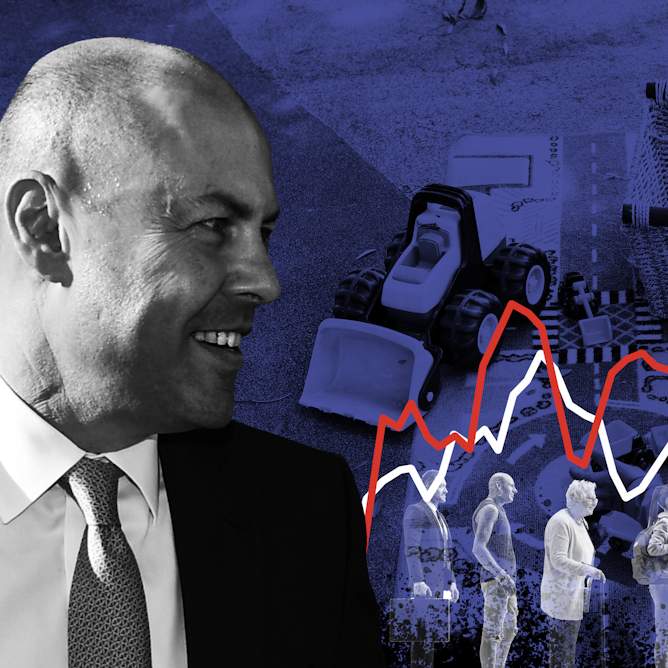
Josh Frydenberg and Scott Morrison are preparing to hand down another budget.

Watch out for the bandaids attached to this Norman Gunston budget, The one-offs, Cost of Living Help of $4-$9, the fuel excise cut etc. Like the one off emergency payout of $800 promised flood victims that’s been so slow its “coming” but not arrived. The red tape put in place even more costly. But then promises pad the “appearance” of this government that has continuously failed to deliver anything but promises. They’re a government where style is more important than meaning, where  hi-viz uniforms that are meant to make Morrison and his MPs appear to know what he’s doing. Where inexperience and politics dominate decision making over expertise and studied  experience.  One-off gifts promised in the short term to allay but do nothing for the nation. This has been a short-term knee-jerk government since 2013. Imagine a one-off $250 bonus for pensioners $0.70cents a day to be ripped ioff them after a year WOW that’s a bonus!! But does that promise really drown out the “Nope Nope Nope” the anthem we’ve heard for the past decade? Or the false promises “No Cuts” to the ABC , Health, Education, Aged-Care, Wages, Public Service, etc etc etc?

Australians are used to being told the federal budget will give them billions of dollars in urgent cash to help them through a crisis, but Josh Frydenberg will have to adjust that message on Tuesday night.

Source: Budget 2022: government’s emergency is political not economic

Seven ways the Coalition’s 2021 budget is blue — not pink

Lastly, while this Budget makes extra-legal assistance available for victims of domestic violence, they will need it, since, in a move condemned by judges and legal experts, the Family Court was abolished earlier this year. This Budget, unlike previous ones, recognises that women exist and appears to target them for special small relief measures that may be afforded other minority groups. Except, as Helen Dally Fisher from the Equality Rights Alliance points out, “…Women aren’t a special interest group, we are more than half the population”. This type of fiscal approach, then, intended to address the systemic inequality long-endured by the majority sex, is tokenism at best.

Source: Seven ways the Coalition’s 2021 budget is blue — not pink

Cuts, spends, debt: what you need to know about the budget at a glance

After twenty years of rhetoric from both sides of politics focusing on getting back to surplus, this year’s budget continues pandemic spending in the hope of getting the economy back on track as the pandemic starts to settle. The projected deficit is $161 billion for 2021-22, but rather than tackling this in the next four years, the government’s focus is instead on payments and long-term serviceable debt.

Source: Cuts, spends, debt: what you need to know about the budget at a glance

Filed under:

Josh Frydenberg’s first MYEFO will be declared a triumph, but why did it take so long to fix the books? – Politics – ABC News (Australian Broadcasting Corporation)

Australian coins

Treasurers have always relied upon population growth and bracket creep to help ramp up the revenue. A bigger population means more workers. And if wages are kicking along at a decent clip, more of those workers are bumped up into higher tax brackets.

Bracket creep is a Treasurer’s secret weapon. It delivers windfall gains for very little effort and in an election year, offers a wonderful opportunity to give the electorate exactly what they need; tax relief.

via Josh Frydenberg’s first MYEFO will be declared a triumph, but why did it take so long to fix the books? – Politics – ABC News (Australian Broadcasting Corporation)

Tax cuts, higher wages: Budget ‘raining revenue’, says top forecaster

World is doing Australia 'plenty of favours', says Deloitte

This year would be the first year since 2012 that the budget’s revenue forecast had improved since the previous budget.

It was happening because of “the best and most synchronised global backdrop in quite some time” and because of improved Chinese demand for Australian resources.

The upswing was coming at “exactly the right time”, when Australia’s house price boom had come off the boil.

via Tax cuts, higher wages: Budget ‘raining revenue’, says top forecaster

Draw it yourself: how well has the economy performed under the Coalition?

See how closely you’ve been paying attention with our Draw It Yourself tool.

Source: Draw it yourself: how well has the economy performed under the Coalition?

R&D CSIRO and Science Budget Cut in Australia

India recently launched a “mini space shuttle” for just $14 million. Many people commented, expressing their unhappiness at India investing in space travel while so many of their people live in poverty. The space industry is worth more than a hundred billion dollars worldwide. Most of this is dominated by just a few countries. If India can break into this industry at a lower cost, it could provide a massive stimulus to their economy.

And let’s take a look at a few of the things that were more expensive than their latest launch, shall we?


Budget papers show steep decline of Australian economy under Coalition

The Budget papers reveal an Australian economy in much worse shape than it was under Labor. Alan Austin unpicks the data.

Source: Budget papers show steep decline of Australian economy under Coalition

Filed under:

Budget predictions pointing us towards world of rainbows

Instead of dumping leaders as duds when we’re disappointed by reality, we should start looking at the real reasons for our underperformance.

Source: Budget predictions pointing us towards world of rainbows

Federal budget 2016: The more you look at it, the better it gets

This type of federal budget is rare. The Turnbull government sought and adopted best practice. You can’t argue with that.

Source: Federal budget 2016: The more you look at it, the better it gets

Budget 2016: Tony Abbott’s ‘zombies’ add billions to Malcolm Turnbull’s first budget

The first Turnbull budget will be propped up by around $13 billion of so-called “zombie measures”, which are still on the books from the first and second Abbott budgets but not yet passed by the Senate.

Source: Budget 2016: Tony Abbott’s ‘zombies’ add billions to Malcolm Turnbull’s first budget

Budget 2016: Tim Pallas rides high while Scott Morrison dithers

Victorian treasurer Tim Pallas luxuriates in surpluses, but he’s also protecting his revenue base, unlike another treasurer in Canberra.

Source: Budget 2016: Tim Pallas rides high while Scott Morrison dithers

Has the time come to criminalise tax avoidance?

Has the time come to consider criminalising tax avoidance and making boards and senior officers liable for prison sentences, asks former ATO Assistant Commissioner John Passant.

Source: Has the time come to criminalise tax avoidance?

Thank God For Malcolm Turnbull’s Defence Of People Like Me!! – » The Australian Independent Media Network

Mum and dad trucking companies… Mum and dad investors… Dum and mad people using negative gearing as a way of reducing their tax… Well, these people are just awe-fucking-some! Yep, I guess that I’m a little prejudiced and that I have a conflict of interest… To explain: Every now and then, I’m accused of being…

Source: Thank God For Malcolm Turnbull’s Defence Of People Like Me!! – » The Australian Independent Media Network

Want a radical counter-terrorism strategy? Let’s strengthen trust Despite significant budgetary constraints, the government announced in Tuesday’s budget that a further A$450 million in counter-terrorism strategies. But something significant is lacking in its approach.

Governments need to focus their counter-terrorism strategies on strengthening community relations and trust. . ..

Despite significant budgetary constraints, the Australian government announced in Tuesday’s budget that it will invest a further A$450 million in counter-terrorism strategies.

The arrest of several young Australians, who were allegedly planning attacks on Anzac Day and Mothers’ Day, seems to have convinced most Australians that these expensive counter-terrorism measures are essential for national security.

A public expenditure of around A$1.2 billion a year, we are told, is justified in order to prevent the sorts of terror attacks that have been perpetrated in Boston, Sydney, Paris and Copenhagen.

In order to thwart domestic terror attacks, therefore, the vast majority of this money will will be devoted to military deployment in Iraq, and funding for intelligence, surveillance, policing systems and information programs at home.

Various aspects of these counter-terrorism strategies and programs have been questioned by civil rights lawyers and activists, particularly in terms of data retention and journalistic freedom.

Questions have also been raised about the actual cost-benefit and effectiveness of many security measures, particularly around airport and aviation security. According to Professor Mark Stewart, full passenger body scans are expensive, time-consuming and of marginal security value, while hardened cockpit doors are of optimal cost-benefit.

There’s a reason for the “catch-all” approach of such measures. The cost of close surveillance of a single individual who may be at risk of committing a terrorist act is estimated at around A$8 million per year.

If security agencies were to conduct close scrutiny of the 200 individuals most likely to commit a terror act in Australia, the bill would be well over A$1.5 billion.

If the net were to widen far enough to include people such as Man Monis, a middle-aged Iranian refugee, who was not regarded as a high security risk ahead of perpetrating Sydney’s Martin Place siege earlier this year, then the cost would incalculable.

For that reason, if nothing else, western governments are investing in early intervention counter-radicalisation programs. The Australian government, specifically, is investing in programs that will generate and distribute “counter-narratives” which will be designed to halt the allure and propaganda of ISIS, al-Qa’ida in the Arabian Peninsula (AQAP) and other Islamist terror groups.

While there are few details about these programs, it is most likely that they will be structured around advertising and social marketing models which target youth audiences.

The problem here, of course, is that the individuals who may be susceptible to the influence of radical and militant Islam are an extremely diverse group. The terrorist profiling which has been produced by security psychologists bears little resemblance to a group which includes Man Monis, Jake Bilardi (a bright but disturbed adolescent convert to Islam), the Chechen Tsarnaev brothers who attacked the Boston marathon, and the Kouachi brothers – second-generation Algerian migrants who attacked Charlie Hebdo.

This diversity is further confounded by the sorry story of young Australian women – such as Amira Karroum – who become radicalised as much through love and desire, as through religious devotion.

In fact, we cannot even say that these radicalised individuals are unquestionably devout, uneducated or poor, making any kind of conventional mass-media program unlikely to connect with a given target audience.

A focus on social media might have greater traction, particularly if designers are able to tag their counter-narratives to militant groups’ websites and Twitter feeds. Unfortunately, and as overseas experience has demonstrated, these sites and feeds are chameleon-like, changing their character, title and URLs as they are constantly closed down by site managers and security agencies.

Moreover, users and followers are themselves extremely adept at moving with the messages and creating their own support networks which continually escape scrutiny. The western adolescents, who have become increasingly wooed by the ISIS imagery and ideas, have appeared to enjoy the cat-and-mouse game as they explore and exploit the limits of public and government authority.

Thus, while security agencies and social marketers may lumber around the internet in search of susceptible adolescents, their target audiences have already moved on.

The greater problem, in fact, is the very nature of the radical Islamist appeal to young western Muslims. ISIS, in particular, has conjured a heroic and ultra-masculinist imagining. This imagining shapes their attack on western global domination into a dark and erotic politics of the body.

The potency of their appeal to receptive adolescents is extremely difficult for state authorities to understand, let alone counter. Paradoxically, this is partly because ISIS has enlisted much of the violent erotica which is a feature of western media culture – a fact the west simply won’t acknowledge.

Rather, western governments deny the parallel, invoking the rationalism and authority which they claim to be their point of difference and enmity.

This denial also affects the ways in which the Australian government is approaching the problem of radicalisation. While paying lip service to the idea of community engagement, there has been far less serious investment in this approach as a primary counter-terrorism strategy.

In particular, there has been far too little attention paid to the nature of adolescence and the ways in which ISIS and others conjure themselves in the imaginary of young people.

This is particularly important as these adolescents seek to consolidate themselves and their identity through their emerging adulthood. These growing pains are especially potent in a modern western world that fetishises freedom and choice as markers of adulthood and sexual maturity.

The internet opens those choices to even broader scales of possibility, including the possibility of self-realisation in radical ideas and an erotic violence which is inscribed by mortal risk.

ISIS provides adolescents and young adults with an identity that heroises this mortal risk. Like drug use, drag-racing or street violence, this heroic aggression proves an irresistible choice for some.

To this end, parents and family remain the critical factor for managing adolescents and their choices. If community engagement means anything, it is surely that there needs to be strong interaction and trust between families, religious bodies, education institutions and government agencies.

It seems essential that parents create a family culture in which young people feel safe enough to discuss their perturbations, politics, ideas and feelings. Where parents sense the radical or militant disaffection of their adolescents, there needs to be a safe space in which they can trust public authorities and systems to provide genuine support and assistance.

This needs to take place before the disaffection becomes amplified as criminal action.

Sadly, this trust is continually strained as security agencies seem to prefer arrest to negotiated family engagement and crime prevention. This is despite the quite simple fact that many adolescents drift away from radicalisation far more often than it evolves as militant action.

In short, governments need to focus their counter-terrorism strategies on strengthening community relations and trust. This is far more than simply controlling the hate speech of rogue Imams.

It’s about addressing the complexities of culture and encouraging a whole-of-society approach to managing our tensions and uncertainties.
Federal budget 2015: Joe Hockey takes his budget tips from Wayne Swan

Peter Martin

Federal budget 2015: Joe Hockey takes his budget tips from Wayne Swan.

Joe Hockey’s piggy ‘trickle down’ Budget

Joe Hockey’s piggy ‘trickle down’ Budget.

Waste of space: Joe Hockey’s budget megafail all Abbott’s fault

Waste of space: Joe Hockey’s budget megafail all Abbott’s fault.

Team Abbott: Why Oh Why???

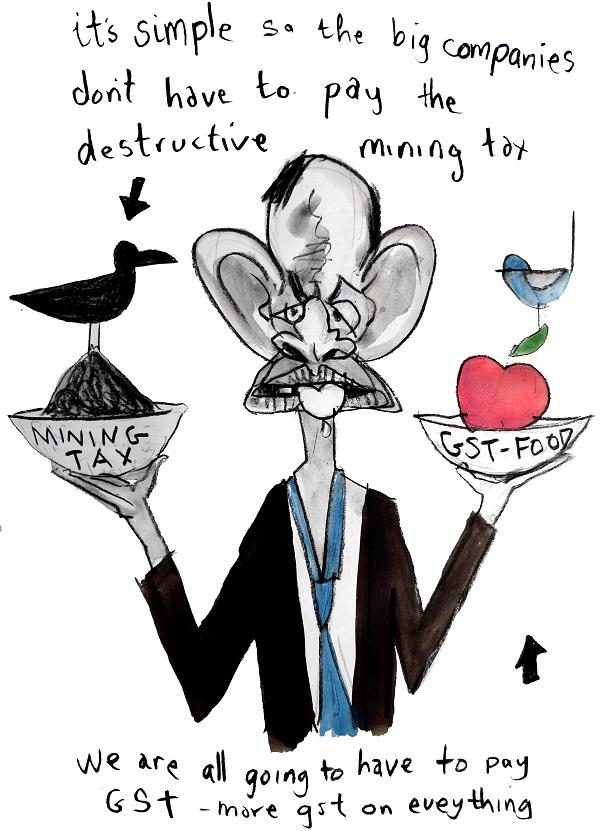
Raising and extending the GST: Another brilliant Coalition plan for families

View image on Twitter

Raising and extending the GST: Another brilliant Coalition plan for families.

Filed under:

Tony Abbott – Is he the most corrupt MP Australia ever had?

Tony Abbott Village Idiot

Economists are refuting the three big picture claims made by the government:

Tony Abbott achieves the impossible: unity among economists<br />
Economists are refuting the three big picture claims made by the government: 1) We have a budget emergency 2) We have a debt crisis and 3) The carbon tax was ruining the economy #notfittogovern #LNPSociopaths #greenlabor #auspol #votebairdlast<br />
There’s a joke about economists: if you ask five economists the same question you’ll get six different answers. Granted, it's not a very good joke, but it’s a fair call. Ours is a complex field, and a growing number of economists are acknowledging that the theory sitting behind mainstream economics is mostly rubbish. As a result, it’s very difficult to find consensus on real world events.</p>
<p>But that's where Abbott and Hockey have achieved what many thought impossible: a true consensus. Unfortunately for the coalition government, the consensus is entirely against them. The Abbott government’s agenda has been driven by three major claims, all of them economic in nature. Let’s see how economists view these three themes:</p>
<p>1) There is a budget emergency<br />
Number of economists who agree: zero</p>
<p>2) The federal government has a debt crisis<br />
Number of economists who agree: zero</p>
<p>3) Carbon pricing is an economic wrecking ball<br />
Number of economists who agree: zero</p>
<p>The above represents a very slight exaggeration. You can find people with some economics qualifications who agree with the government but, without exception, they either work for the Coalition or for some entity with ideological motives (like the IPA or News Corp).</p>
<p>While most would agree that there are serious structural problems with the budget, none would call it an emergency. Chris Richardson, economist and partner at Deloitte Access Economics, said:</p>
<p>We don’t need a surplus tomorrow, we don’t even necessarily need it in five years’ time. I’m more than happy with us getting back to sustainable fiscal finances over the long term. The politics would tend to suggest moving earlier rather than later but on the economics there’s no rush.</p>
<p>Saul Eslake, chief economist at Bank of America Merrill Lynch, said that to call the Australian debt situation a crisis was “to abuse the English language.”</p>
<p>Similarly, Nobel prize winning US economist Joseph Stiglitz used terms such as “absurd”, “crazy” and “a crime” to describe some of Hockey’s budget measures, and dismissed the perceived debt and deficit problems, noting that any Australian who worries about debt “must be out of their mind.” Richard Holden, professor of economics at the Australian School of Business, put it this way: “First, Australia does not have a debt crisis. Or, to put it another way, Australia does not have a debt crisis.”</p>
<p>It doesn't stop here. The Age recently conducted its annual economics survey of 25 prominent economists. They select economists from a broad range of backgrounds across the spectrum of economics and their views vary widely on almost all issues. None of them agreed with the government on any of the above three topics.</p>
<p>This unique consensus among economists makes it clear that the entire government agenda is based on false premises. How has this exposure affected the Coalition's agenda or their messaging? Not at all. Not one bit. Not one iota. Let’s be clear about this. We know they’re not being honest about their real motives for policy. They know we know, too. They don’t care.</p>
<p>As I’ve explained previously, the Abbott and Hockey budget, if fully implemented, would have taken us a long way towards the free market social and economic model of the US, and away from the social democracy model of much of Europe. But the question remains as to why they would do this. Who benefits from a US style free market system where government minimises its involvement?</p>
<p>The answer of course is the wealthy and those who already wield power. The greatest beneficiaries of Abbott and Hockey’s policies are their largest financial backers, including the financial industry, the mining and energy industries, gambling interests and real estate companies.</p>
<p>For all the talk about this being the most ideologically driven government in living memory, the reality is something much simpler and more familiar. This government is simply delivering to big money what big money wants.</p>
<p>One of the clearest examples of this is the winding back of the Labor government’s Future of Financial Advice (FoFA) reforms. We know that many financial advisors have been preying on their clients. They make use of clients’ lack of understanding of complex investing and other financial options to direct them to financial products that are not in their interest, but rather in the interests of the advisor. This has been costing consumers huge sums of money, which primarily flow into the hands of the banks.</p>
<p>Labor’s reforms were aimed at making such conflicts of interest for advisors illegal in order to address this complex problem. The Coalition have wound back Labor’s changes and have provided not one defensible reason for doing so. Compliance costs and red tape have actually increased, so that cannot be used as the excuse. Meanwhile, we allow the banks to continue to profit from ripping off their customers.</p>
<p>The same is at play when you examine climate policy. You can't find an independent economist who thinks the government’s "direct action" plan for tackling climate change is more efficient or effective than a carbon tax or trading scheme. Who likes direct action? The polluters of course. Instead of paying to pollute, they get paid not to pollute. Here's the real con: one argument we are given is that the carbon tax was too big a burden on consumers. Who's going to pay the polluters to reduce pollution? The government. Where do they get the money? From all of us. Consumers pay anyway.</p>
<p>The clarity of these examples reveals the sad reality of this government. They are not ideologues, they are just puppets dancing to the tune of those pulling their strings.<br />
http://www.theguardian.com/commentisfree/2014/jul/23/tony-abbott-achieves-the-impossible-unity-among-economists<br />
The Real News Channel Australian Labor Party NSW Labor The Australian Greens  The ANTI- Antibogan wordpress The real "Team Australia" Independent Australia GetUp! Destroy the Joint https://www.facebook.com/TheAustraliaInstitute

Tony Abbott achieves the impossible: unity among economists
Economists are refuting the three big picture claims made by the government: 1) We have a budget emergency 2) We have a debt crisis and 3) The carbon tax was ruining the economy ‪#‎notfittogovern‬ ‪#‎LNPSociopaths‬ ‪#‎greenlabor‬ ‪#‎auspol‬ ‪#‎votebairdlast‬
There’s a joke about economists: if you ask five economists the same question you’ll get six different answers. Granted, it’s not a very good joke, but it’s a fair call. Ours is a complex field, and a growing number of economists are acknowledging that the theory sitting behind mainstream economics is mostly rubbish. As a result, it’s very difficult to find consensus on real world events.

But that’s where Abbott and Hockey have achieved what many thought impossible: a true consensus. Unfortunately for the coalition government, the consensus is entirely against them. The Abbott government’s agenda has been driven by three major claims, all of them economic in nature. Let’s see how economists view these three themes:

1) There is a budget emergency
Number of economists who agree: zero

2) The federal government has a debt crisis
Number of economists who agree: zero

3) Carbon pricing is an economic wrecking ball
Number of economists who agree: zero

The above represents a very slight exaggeration. You can find people with some economics qualifications who agree with the government but, without exception, they either work for the Coalition or for some entity with ideological motives (like the IPA or News Corp).

While most would agree that there are serious structural problems with the budget, none would call it an emergency. Chris Richardson, economist and partner at Deloitte Access Economics, said:

We don’t need a surplus tomorrow, we don’t even necessarily need it in five years’ time. I’m more than happy with us getting back to sustainable fiscal finances over the long term. The politics would tend to suggest moving earlier rather than later but on the economics there’s no rush.

Saul Eslake, chief economist at Bank of America Merrill Lynch, said that to call the Australian debt situation a crisis was “to abuse the English language.”

Similarly, Nobel prize winning US economist Joseph Stiglitz used terms such as “absurd”, “crazy” and “a crime” to describe some of Hockey’s budget measures, and dismissed the perceived debt and deficit problems, noting that any Australian who worries about debt “must be out of their mind.” Richard Holden, professor of economics at the Australian School of Business, put it this way: “First, Australia does not have a debt crisis. Or, to put it another way, Australia does not have a debt crisis.”

It doesn’t stop here. The Age recently conducted its annual economics survey of 25 prominent economists. They select economists from a broad range of backgrounds across the spectrum of economics and their views vary widely on almost all issues. None of them agreed with the government on any of the above three topics.

This unique consensus among economists makes it clear that the entire government agenda is based on false premises. How has this exposure affected the Coalition’s agenda or their messaging? Not at all. Not one bit. Not one iota. Let’s be clear about this. We know they’re not being honest about their real motives for policy. They know we know, too. They don’t care.

As I’ve explained previously, the Abbott and Hockey budget, if fully implemented, would have taken us a long way towards the free market social and economic model of the US, and away from the social democracy model of much of Europe. But the question remains as to why they would do this. Who benefits from a US style free market system where government minimises its involvement?

The answer of course is the wealthy and those who already wield power. The greatest beneficiaries of Abbott and Hockey’s policies are their largest financial backers, including the financial industry, the mining and energy industries, gambling interests and real estate companies.

For all the talk about this being the most ideologically driven government in living memory, the reality is something much simpler and more familiar. This government is simply delivering to big money what big money wants.

One of the clearest examples of this is the winding back of the Labor government’s Future of Financial Advice (FoFA) reforms. We know that many financial advisors have been preying on their clients. They make use of clients’ lack of understanding of complex investing and other financial options to direct them to financial products that are not in their interest, but rather in the interests of the advisor. This has been costing consumers huge sums of money, which primarily flow into the hands of the banks.

Labor’s reforms were aimed at making such conflicts of interest for advisors illegal in order to address this complex problem. The Coalition have wound back Labor’s changes and have provided not one defensible reason for doing so. Compliance costs and red tape have actually increased, so that cannot be used as the excuse. Meanwhile, we allow the banks to continue to profit from ripping off their customers.

The same is at play when you examine climate policy. You can’t find an independent economist who thinks the government’s “direct action” plan for tackling climate change is more efficient or effective than a carbon tax or trading scheme. Who likes direct action? The polluters of course. Instead of paying to pollute, they get paid not to pollute. Here’s the real con: one argument we are given is that the carbon tax was too big a burden on consumers. Who’s going to pay the polluters to reduce pollution? The government. Where do they get the money? From all of us. Consumers pay anyway.

The clarity of these examples reveals the sad reality of this government. They are not ideologues, they are just puppets dancing to the tune of those pulling their strings.
http://www.theguardian.com/…/tony-abbott-achieves-the-impos…
The Real News Channel Australian Labor Party NSW Labor The Australian Greens The ANTI- Antibogan wordpress The real “Team Australia” Independent Australia GetUp! Destroy the Joint https://www.facebook.com/TheAustraliaInstitute

Tony Abbott Village Idiot

Tony Abbott Village Idiot

How Long can Hockey Survive? As long as the poison chalice is not transferred to Turnbull

hockey

For someone whose popularity was the envy of everyone in the new Coalition government earlier this year, Joe Hockey must be wondering what the hell happened. His pre-budget popularity among all voters was 21 points on the positive side (51% for and 30% against). Then came his first and possibly last budget. That budget is best described as a fart bomb, the aroma of which just won’t go away.

From that point on Joe has suffered from a lingering case of foot-in-mouth disease. Some of his revealing comments following on from his earlier, ‘end of the age of entitlement’ rant, and his dancing to the ‘best day of my life’ music, on budget night, include ‘old people don’t drive cars,’ and just the other day a mind boggling, ‘we will find any way we can to take money out of universities,’ as said to Phil Coorey at the Australian Financial Review.

So, it’s pretty clear his star has hit a brick wall not just with the electorate generally, but with LNP voters as well. The odd thing is that Joe himself is genuinely surprised at how badly his budget has been received. So one has to ask, did he not think that being unfair to the disadvantaged would rebound on him? What was he thinking? Were the unpopular budget measures his idea, or was he encouraged to go down that path by others? Was he set up?

debtOne thing is for sure. The Treasurer owns the budget no matter who else contributed and Joe will own this one for years to come just like John Howard owned the 1982 budget that preceded Malcolm Fraser’s defeat in 1983. The full impact of Joe Hockey’s budget is yet to be realised because the economy is in much better shape than it was in 1982. That’s the good news.

The government, however, campaigned furiously on fixing the ‘debt and deficit disaster’ and that is the bad news. They did so not realising the nature of the problem which was, and is, falling revenues and excessive tax expenditures. They still don’t seem to realise it, or do they? They still want to curb spending but in fact are doing the opposite. Debt is steadily increasing. Perhaps that is why Tony Abbott wants a more mature discussion about the GST. They know they have to find some new money from somewhere.

Sooner or later the numbers will show them up as utter failures. They have already left it too late. And someone will have to accept responsibility for it. It almost feels like poetic justice that while Peter Costello benefitted hugely from a barrel load of money coming in from China and making him look so good, Joe Hockey’s barrel has shrunk to a tea pot and he is looking so bad.

musicWhen the money flows the music plays. When it stops the music fades.

Costello was never put to the test. Hockey is being tested severely right now and is not looking good at all. The analogy being, that when things are good the music is playing. When things go pear-shaped, the music begins to fade.

If the budget is ever to return to surplus, revenues must rise. That is fundamental. The only way that can happen, short of a revival in China, is to raise taxes and cut tax expenditures; the exact opposite of Abbott’s mantra about lower taxes. They won’t do it. What a delicious opportunity for Labor to exploit. If Bill Shorten and Chris Bowen can climb out of their lethargic slumber and show the Coalition up for the failures they are, Abbott will have to respond.

budget1The likely response is to blame the Treasurer. That’s the way of politics. How long has he got left? Probably one more budget and if it does include tax increases of some description, Joe is screwed. If it doesn’t, by 2016 the Coalition’s economic credentials will be screwed and they will have to go.

The Coalition could have avoided all this last year by campaigning on Labor’s leadership failures and little else, but they had to engage in chest beating about the economy, pointing to their so called success while Costello was Treasurer. They chose to highlight, what seemed to be Labor’s economic failures. In reality, they shot themselves in the foot.

They didn’t hear the music fading. In 12 to 18 months’ time the music will stop.

Upside down downunder

downunder

We sure do things upside down downunder.

Tony Abbott’s chief business adviser first tells us we are unprepared for global cooling, followed by lashing out at the UN response to the Ebola outbreak and labelling the world body a “refuge of anti-western authoritarians bent on achieving one-world government”.

Newman wrote an opinion piece for the Australian newspaper in which he said the UN’s “leanings are predominantly socialist and antipathetical to the future security and prosperity of the west”.

“The philosophy of the UN is basically anti-capitalist,” he writes. “Countries that pay the most dues, mostly rich Anglo countries, are those to which the world body shows the greatest disdain.”

Is he suggesting that we should receive foreign aid in thanks for using up all of the world’s resources while killing the planet?

Aside from Maurice Newman’s bizarre ravings, our inaction on climate change, our inadequate response to the Ebola crisis, the chief executive of Whitehaven Coal telling us that coal “may well be the only energy source” that can address man-made climate change, and the sheer bastardry of cutting real wages and entitlements to defence personnel as we send them off to war…..we are also ignoring the call from the rest of the world to take action to address income inequality.

Despite being one of the richest nations on earth, one in seven Australians are living in poverty.  Thirty per cent of Australians who receive social security payments live below the poverty line, including 55 per cent of those on unemployment benefits. Fifteen per cent of aged pensioners live in poverty.

So it seems unfathomable as to why these people would be targeted when the government is looking for savings.

Since 1980, the richest 1 percent increased their share of income in 24 out of 26 countries for which the IMF have data.

In the US, the share of income taken home by the top one percent more than doubled since the 1980s, returning to where it was on the eve of the Great Depression. In the UK, France, and Germany, the share of private capital in national income is now back to levels last seen almost a century ago.

The 85 richest people in the world, who could fit into a single London double-decker, control as much wealth as the poorest half of the global population– that is 3.5 billion people.

With facts like these, it is no wonder that rising inequality has risen to the top of the agenda—not only among groups normally focused on social justice, but also increasingly among politicians, central bankers, and business leaders.

Our politicians are telling us that they want to provide the opportunity for each person to be their best selves but the reality is that we do not have equal opportunity. Money will always buy better-quality education and health care, for example. But due to current levels of inequality, too many people in too many countries have only the most basic access to these services, if at all. Fundamentally, excessive inequality makes capitalism less inclusive. It hinders people from participating fully and developing their potential.

Disparity also brings division. The principles of solidarity and reciprocity that bind societies together are more likely to erode in excessively unequal societies. History also teaches us that democracy begins to fray at the edges once political battles separate the haves against the have-nots.

A greater concentration of wealth could—if unchecked—even undermine the principles of meritocracy and democracy. It could undermine the principle of equal rights proclaimed in the 1948 Universal Declaration of Human Rights.

Redistributive policies always produce winners and losers. Yet if we want capitalism to do its job—enabling as many people as possible to participate and benefit from the economy—then it needs to be more inclusive. That means addressing extreme income disparity.

One way to address this is through a progressive tax system but instead, our government is looking at regressive measures like increasing the fuel excise and the GST. These will impact far more greatly on low income earners.

Another avenue is to expand access to education and health but instead, our government is cutting needs-based education funding, making the cost of tertiary education prohibitive, and introducing a co-payment to discourage people from seeing the doctor.

Abbott, Hockey and Cormann assure us that if we make the rich richer we will all benefit. Everyone from the Pope to Rupert Murdoch knows this is rubbish.

Two weeks ago In Washington, in a speech to the world’s most powerful finance ministers and central bankers, Rupert Murdoch accused them of making policies to benefit the super rich.

In it, he blamed the leaders for increasing inequality, said the ladder of generational progress was now at risk, and warned that a moment of great global reckoning had arrived.

I note that his criticism of poor policy does not stop him from taking advantage of said policies. “I’ll only be as good as you make me be” seems to be the prevailing principle.

Hockey’s response to Murdoch’s barrage was interesting.

“Certainly, as he says, loose monetary policy has helped people who own a lot of assets to become richer, and that’s why loose monetary policy needs to be reversed over time, and we’ll get back to normal levels of monetary policy, normal levels of interest rates,” Mr Hockey told AM’s presenter Chris Uhlmann.

“Governments, on the other hand, have also run out of money and can’t keep spending money – particularly on the credit card – to try and stimulate growth.

“So, if loose monetary policy is not available and actually makes the rich get richer, and governments have run out of money, how are we going to get growth going in the world economy over the next few years? And the only way to do it is through structural changes that make us better at what we do.”

The structural changes suggested by Mr Hockey will increase inequality and send more people into poverty which is indeed what Coalition governments are good at doing.

Pope Francis recently tweeted “Inequality is the root of social evil.”

In last autumn’s essay, Evangelii Gaudium, Francis wrote that: “Just as the commandment ‘Thou shalt not kill’ sets a clear limit in order to safeguard the value of human life, today we also have to say ‘Thou shalt not’ to an economy of exclusion and inequality. Such an economy kills … Today everything comes under the laws of competition and the survival of the fittest, where the powerful feed upon the powerless. As a consequence, masses of people find themselves excluded and marginalised: without work, without possibilities, without any means of escape. Human beings are themselves considered consumer goods to be used and then discarded.”

The claim that human beings have an intrinsic value in themselves, irrespective of their usefulness to other people, is one that unites Christianity and socialism. But if you think the market is the real world, it makes no sense at all, since in the market, value is simply the outcome of supply and demand.

A recent article by Lissa Johnson discusses decades of research into political psychology.

“Another ubiquitous finding is that conservatism is inversely related to the pursuit of social and economic equality. Conservatism correlates strongly with a preference for fixed social hierarchies entailing inequality between social groups, along with punitive attitudes towards marginalised and/or non-conforming members of society, who are seen as destabilising elements that threaten social cohesion.”

Australia is indeed a wondrous place where coal will save us from climate change, where helping the rich to get richer will make us all happier, and where the poor will be asked to pay off the nation’s debt.

Abbott’s planning to squeeze the states….GST

Australia was noted in the 60’s for it’s equality. A classless society one proud of the “fair go” offered to each of us. That’s changed and this government is determined to widen the gap.

14 October 2014, 6.19am AEDT

Do Australians still believe in the fair go? Views on pay suggest not

 Which country favours the biggest pay gap?

The United States was not the country in which people saw the largest gap between CEO and worker as ideal. The identity of that country might come as a surprise.

It was not Germany or Japan or France. It was Australia. We thought the ideal ratio of CEO pay to worker pay would be 8.3.

Not only did Australians approve of the largest gap between CEO and worker, we did so by a fair margin. Here, in order, are the countries seeing the largest pay gaps as ideal:

Kiatpongsan and Norton/Harvard Business School, Chulalongkorn University

The “gap” between Australia at 8.3 and the second place-getter – the US – is 1.6. This is more than twice the “gap” (0.7) between the US and fifth-placed Japan.

By a significant margin Australians are, it seems, most accepting of a large pay gap between those at the top and those at the bottom. This is certainly very different from the image of Australia as a highly egalitarian country.

In The Lucky Country (published in 1964), Donald Horne described Australia as “the most egalitarian of countries” where “most people earn within a few pounds of the average”. Although Horne acknowledged there were still some forms of inequality, he expressed the belief these would fade with time. For Horne, Australia was above all a place that valued egalitarianism.

What’s become of our fabled egalitarianism?

Now, 50 years later, we are the country (at least of those surveyed) most accepting of big differences in pay between those at the bottom and those at the top. What has happened? Is it possible that in the last half-century we have in our values gone from being “the most egalitarian of countries” to the least, or one of the least, egalitarian?A few possible answers to these questions might be considered

So it remains unclear why Australians are accepting of such large pay differences between those at the top and the rest. Is it possible we just no longer believe in the fair go? Let alone know the reality of those differences and how incorrect those beliefs are.

Another Nobel Prize winner is challenging Abbott/Hockey Economics. Has the Nobel board gone a little crazy it’s Tony/Joe not Gillard /Swan

An inconvenient truth countered by a blatant liar: Hockey denies Australia is dirtiest greenhouse gas emitter in OECD

Nobel Prize for economics challenges Hockeynomics

The newly awarded Nobel Prize for economics challenges Joe Hockey’s voodoo economics prescription for Australian economic growth, writes Alan Austin.

THE NOBEL PRIZE FOR ECONOMICS announced yesterday bolsters the campaign for better industry regulation in Australia.

The prestigious award – officially, the Sveriges Riksbank Prize in Economic Sciences – went to Professor Jean Tirole of the Toulouse School of Economics in France. It recognises his work on how poorly regulated corporations operate to the community’s detriment. And how the problems can be fixed.

Drawing attention to industry regulation is timely for Australia as the Abbott Government strives to wind back regulation brought in by previous administrations, but with little success.

Tirole’s analysis of corporate market power has shown how big companies damage the communities in which they operate. And also how they may be regulated to everyone’s advantage. He believes different industries require quite different regulation.

The Academy noted that Tirole’s work not only described the negative outcomes of regulation failure, but recommended specific responses:

‘The best regulation or competition policy should therefore be carefully adapted to every industry’s specific conditions. In a series of articles and books, Jean Tirole has presented a general framework for designing such policies and applied it to a number of industries, ranging from telecommunications to banking. Drawing on these new insights, governments can better encourage powerful firms to become more productive and, at the same time, prevent them from harming competitors and customers.’

The French Government, however, is delighted.

Spokesman Stéphane Le Foll said:

‘The Nobel Academy making this award is also a reflection of the absolute necessity in today’s crisis that we have regulation and mechanisms for stability. We must not just leave management of the economy to the free market.’

Will the global discussion this award is generating engage hapless Treasurer Joe Hockey and the Abbott Government?

Clearly, the mindless mantras he mouthed before the 2013 election have not materialised into benefits for Australia’s businesses or people.

Hockey promised this:

‘Reducing the burden of taxes and regulation, ensuring fair and competitive markets, and reducing the size of government will boost business investment and spending. And from investment and spending will come growth and jobs.’

The Abbott Government then undertook a highly visible exercise in deregulation with its Autumn Repeal Day last March — the first of two promised every year. The Government boasted that 10,000 regulations and acts would be removed from the statute books.

So what has been the result? How much better is the economy now performing?

It is, in fact, performing much worse. In the 13 months since Hockey became treasurer, business confidence has slumped, the value of the all ordinaries on the Australian Stock Exchange has fallen, consumer confidence has collapsed, the Aussie dollar is at the lowest level since 2010, inflation is up from 2.4% to 3.0% and rising, unemployment is at the highest level in a decade and government debt has blown out by $39 billion – up 22%.

The failure to regulate appropriately, Tirole shows, risks not just weaker company profits and a poorer community, but another financial crisis:

‘The gradual lowering of regulatory standards predated the recent crisis. To be sure, other developments such as “irrational exuberance,” loose monetary policy, and global macroeconomic imbalances also contributed to the crisis. But underregulation or ineffective regulation is rightly blamed for playing a central role in the crisis.’

Much of the world is now listening to Jean Tirole. Which is just as well.

But is Joe Hockey?


ABC television channels may be axed if budget cuts too savage, says Mark Scott

Mark Scott, ABC

Savage budget cuts to the ABC would mean not only axing some television and radio programs but potentially reducing the number of ABC television channels, managing director Mark Scott said on Tuesday.

Scott told ABC radio in Melbourne that the impact on programs depended on how big the cuts were and, just as critically, when the cuts came into effect. He said coverage of local sport was under scrutiny and he confirmed that local versions of 7.30 were also being looked at.

“If the government cuts money this financial year or next financial year we would have to cut some commissioning of some of our television services [and] radio, and if the cuts were too dramatic we’d have to look at how many channels we’re offering,” he said.

The ABC currently runs five channels: ABC, ABC2, ABC3, ABC News24 and iView. It is believed ABC2, an edgier channel launched in 2005, would be most vulnerable.

Scott’s remarks follow a defiant speech on Monday night, in which he expressed frustration that five months after the May budget, the national broadcaster still did not know what cuts it was facing.

The ABC’s funding was cut by 1% in the budget – or about $120m over four years – which was described as a “down payment” for more savings yet to be announced.

The government’s expenditure review committee is expected to decide on ABC cuts in mid-November. During last year’s election campaign, the Coalition ruled out any cuts to the ABC.

Scott made clear that the ABC would continue to invest heavily in new online and digital services, even if the government made deep cuts and despite organisations such as News Corp arguing it should limits its online expansion because it harmed for-profit providers.

Scott said that in the past, the ABC had found efficiencies which were used to fund innovations such as the catch-up service iView. But if the government essentially pocketed any further savings, the ABC would cut TV and radio programs to continue to invest in digital offerings, because that’s what modern audiences demanded.

Scott was cautious about which programs were vulnerable, saying the ABC was looking at “where we may overservice or we spend a lot of money and the audience is tiny”. Programs mooted include Lateline, local editions of 7.30 and radio programs such as the World Today.

Asked whether the ABC should be covering live women’s soccer, for example, he said local sport “would be hard for us to do” with significant budget cuts.

He also made clear that state-based editions of 7.30. which run on Friday nights, are also likely to change.

“I can’t rule anything in or out, we do have to have everything on the table,” he said.

“Whether it [local television current affairs] can only be delivered in that program or there are other ways we can deliver that, that’s something we are looking at now.”

Answering questions from the audience on Monday night, Scott said there was no guarantee that existing media organisations would manage the dramatic transition underway, and new players often had little concern with public interest beyond their “narrow commercial interests”. This made maintaining funding to the ABC vital.

“That’s a very conservative, sensible thing to do. Why would you weaken the ABC at a time when the rest of the media is in turmoil?”

Low-income families in Sydney’s west, Melbourne’s north to suffer most under Coalition budget: NATSEM

Low-income families in Western Sydney and Melbourne’s northern suburbs will suffer the most under new Federal Government budget measures, a study has found.

Low-to-middle income families could be worse off by more than $3,500 a year, the National Centre for Social and Economic Modelling (NATSEM) study found, while low income families with children could lose more than 6.5 per cent of their disposable income.

A couple with children in the lowest income quintile will, on average, lose 6.6 per cent of their disposable income by 2017-2018 while a top quintile family will actually gain 0.3 per cent.

The study modelled 19 separate budget measures and also included some additional elements outside the Coalition’s 2014-2015 budget.

These measures differentiate the trajectory of the previous Labor government and that of the Abbott Government’s first budget.

The study identified Broadmeadows, Campbellfield and Coolaroo in Melbourne and Mt Druitt and Whalan in Sydney as the areas hardest hit by the federal budget.

The report said families in Elizabeth and The Parks in Adelaide will also suffer.

Some of the suburbs least affected include Wahroonga in Sydney, Cottesloe in Perth, Nhulunbuy in the Northern Territory and Forrest in the national capital.

The research was funded by the Australian Workplace Innovation and Social Research Centre at the
University of Adelaide.

Opposition Leader Bill Shorten, responding to the study, said the budget burden was falling on those least able to afford it.

“It’s all right for senior members [of the Government] to make sure their electorates are paying only a small increase and experiencing small cuts, whereas the rest of Australia has been left to its own devices by the Abbott Government,” he said.

Addressing the Tasmanian Liberal conference in Launceston, Prime Minister Tony Abbott said the budget contained tough but necessary measures.

“We said before the election that we would bring the budget back under control,” he said.

Mr Abbott also told the gathering that while the campaign to get the budget through the Senate had its “ups and downs”, the Government would persevere.

“Inch by painful inch, step by difficult step, compromise by hard-negotiated compromise, that’s exactly what we’re doing,” he said.

“So we are getting there. It’s not easy. Every single step has to be negotiated through a Senate dominated by our political opponents, but we will never ever give up.”

Commentators this week said that while domestic activity is showing signs of improvement, the federal budget is coming under increased pressure from slower global growth and falling commodity prices.

Our Budget their Budget. For The Homeless Featuring Gym, Library, And Art Studio. California taxed the wealthy they didn’t leave.

The Star Apartments on Los Angeles' Skid Row, seen here during construction in 2013, will provide permanent housing to 102 homeless people and the county agency that works to end homelessness

Jerry Brown took California from a real finacial basket case to profit in 3 years.The coalition invented one  that didn’t exist and now are facing a self-fulfilling disaster and trying to blame Labour.

Los Angeles’ Skid Row has been home to thousands of homeless Angelenos for decades, but downtown development has started to squeeze the area one longtime resident described as “a giant outside insane asylum.” The city is hoping that a new 102-unit housing complex for the homeless that opened Wednesday can help alleviate the resulting tension between the area’s destitute outsiders and the new-money lofts and restaurants popping up nearby

At ground level, the Star Apartments building holds the new headquarters of the Los Angeles County Department of Health Services agency that works on homelessness issues, called the Housing for Health division. The building also holds a gym with a track, a library, a garden, and art studios for residents, according to the Los Angeles Times. Residents pay 30 percent of their income — meaning they pay nothing if they have no income — with city housing funds subsidizing the remainder of the rent cost.

102 prefabricated apartment units are stacked atop the Housing for Health headquarters like children’s blocks. The final product is a modern, eye-catching structure. Seen from the street, the apartments jut out at improbable-looking angles from the ground floor facilities. The interior facing views from the apartments look over a concrete valley strung with cable-edged staircases.

More important than the aesthetics is the good the facility will do for its residents and for Skid Row as a whole. It is three times more expensive to leave homeless people on the street than it is to simply give them housing. The stability that a home provides makes it far easier for homeless people to regain their footing socially, economically, and often medically or psychologically.

This approach to ameliorating homelessness is known among advocates as “permanent supportive housing.” The federal government has begun emphasizing permanent supportive housing in the formulas it uses to divvy up funding for state and local housing authorities, signalling that the largest financial player in the fight against homelessness is putting its weight behind the idea. But despite the evidence that permanent housing with supportive services is not only effective but a cost saver, many cities around the country continue to criminalize homelessness, raise ordinances that make it harder to help the homeless, and experiment with policies that simultaneously raise money for the homeless and push panhandlers out of downtown areas.

In Los Angeles, officials hope to further smooth the Star Apartments’ residents’ reintegration into society by locating key wraparound services directly below the beds where they will sleep and kitchens where they will cook for themselves.

With an estimated 5,000 people living on the streets in Skid Row, the Star Apartments have had to be selective over the past year since the building was ready for occupants. “We want to target the people who are costing the taxpayer the most by not being in housing,” Skid Row Housing Trust executive director Mike Alvidrez told Marketplace last year. That means people who are most prone to ending up in emergency rooms and jails.

The Times interviewed one Star Apartments tenant named Bill Fisher who ended up homeless thanks to health problems and “the death of his life partner” at the age when people with mailing addresses start to get flyers from the AARP. “If somebody had told me 10 years ago I’d lose everything and end up homeless, I’d have said you’re nuts,” Fisher told the paper. He has “decorated his studio apartment with art projects, including antique sheet music, his guitar collection and an orchid suspended from a palm frond.”

The promise the building holds for people like Fisher is not invulnerable, however. Even successful permanent supportive housing programs can be undermined by bureaucratic disputes over funding and jurisdictional lines, as a community of formerly homeless families at the border between Atlanta and Fulton County learned recently when they were forced to relocate by County officials.

If as Abbott says this war is affordable what happened to the emergency budget?

Treasurer Joe Hockey pressures Labor to pass stalled budget measures to pay for Iraq war . PM pressures him to shut up

Treasurer Joe Hockey in Washington: "We will spend what we need to spend to defend the nation."

Prime Minister Tony Abbott is being urged to “correct” his Treasurer Joe Hockey, who has said the Labor opposition should pass stalled budget measures if it is “honest” about supporting the Iraq mission and its associated costs.

Mr Abbott on Thursday was asked several times whether he backed Mr Hockey’s comments, but he declined and instead praised Labor’s leader Bill Shorten for his bipartisan approach to the military action against Islamic State extremists.

Mr Shorten said he was “extremely disappointed” Mr Hockey had “chosen to make the Iraq intervention a source of political point-scoring”.

Speaking earlier in Washington, Mr Hockey said the Australian government would reveal how it would fund the Iraq mission, which is estimated to be roughly $500 million a year, in the December budget update.

However, the Treasurer said if Mr Shorten was “honest” about his promise of bi-partisan support for Australia’s mission in Iraq, he would pass budget measures currently stalled in Parliament.

“We will spend what we need to spend to defend the nation,” Mr Hockey said.

“Given that we spend tens of billions of dollars each year on defence we have the capacity to deliver what we say we are going to deliver and it’s another good reason for Mr Shorten to immediately pass the remaining measures in the budget.

“Everything comes at a cost and if Bill Shorten truly is honest about his commitment to deliver bipartisan support in relation to our defence efforts in the Middle East he’ll provide bi-partisan support to pay for it,” he said.

While Mr Abbott on Thursday declined to back his Treasurer’s call, the opposition’s treasury spokesman Chris Bowen attacked the tactic as “disgraceful” and “blackmail”.

“Just when you think Joe Hockey can’t stoop any lower, there he is. Australians won’t be blackmailed into supporting this unfair budget,” Mr Bowen said.

“It is simply disgraceful that Joe Hockey is trying to link his failed budget with national security. Under no circumstances should our international obligations be used to justify the cuts or taxes in this budget,” he said.

Mr Shorten said Australians would “see through this political game”.

“Under no circumstances should our intervention be used as a source to justify hurting Australian people through this unfair budget and the cuts and raised taxes which flow through it,” he said.

Labor’s foreign affairs spokeswoman Tanya Plibersek also said it was “incredibly poor taste” that the Treasurer had attempted to politicise the bipartisan mission.

Speaking a short time after Mr Hockey’s media conference, Mr Abbott thrice declined to back his Treasurer’s call and said Labor should devise its own budget strategy if it wanted to continue rejecting the government’s.

“To his great credit Opposition Leader Bill Shorten has been very, very bipartisan on this,” he said on 3AW.

“I’ve had numerous conversations with Bill about this and he is an Australian patriot.

“I want our budget measures to be passed by the Parliament, I accept that the opposition is absolutely entitled to come to its own position on our budget measures…if the Labor party doesn’t want to support our budget measures I think they should come up with their own alternative measures.”

He also failed to endorse the Treasurer’s call during a later press conference in Sydney.

Mr Abbott earlier this week ruled out introducing a tax to pay for the Iraq mission.


Hockey died and we don’t know where we buried him. Yet he’s been caught out again by John Howard

Treasurer Joe Hockey has been caught out – by John Howard no less.

In 1998 the Howard Government passed the Charter of Budget Honesty Act. It required the Department of Finance to publish a “Final Budget Outcome” by September 30 each year.

In any event, the 2013-14 Final Budget Outcome has just been published. Of course, treasurers can put whatever spin they want on the document. In Hockey’s opinion the document is “a report card on the previous Government’s irresponsible fiscal and economic management”.

Well, Hockey is entitled to his own opinions, but he is not entitled to his own facts. The facts are different. So different, indeed, that the aura that conservative governments are better economic managers is now exposed as myth.

In Opposition, the Liberals carried on mercilessly about Labor’s spending blowouts and rising government debt. But what about the facts? The last report under Labor in August 2013 showed projected year-end debt of $178.1 billion. It remained the same for the next four months – the first four months of Coalition Government.

Then, in December 2013, it rose to $191.52 billion and stayed at that till rising in May 2014 to $197.85 billion. And now in September it is $202.5 billion – up 14 per cent on Labor’s debt level.

So now you have it, the Coalition is as bad at running up debt as Labor.

Yet this government abolished the mining and carbon taxes. It is absurd that we allow mainly foreign-owned mining companies to dig up and take our minerals paying virtually no company tax and very little royalties.

Smart countries like Norway taxed their main resource – North Sea oil – at 78 per cent and built up a vast sovereign fund. The tax did not deter the miners.

. Moreover, spending on the military and security has ballooned. But the problem is not government spending, it is the failure to gather the revenue to match it.

$8.4 billion a year is lost in company tax through evasion and minimisation, mainly by saddling up Australian arms of multinational companies with large interest payments on loans that are used worldwide. These companies should pay full Australian tax on their Australian revenue.

One of the most effective ways of making big companies and high-wealth individuals pay at least some tax is the GST. If you want to buy a fur coat from DJs, you pay the GST.

Australian workers and consumers must stop fearing an increase in the GST, because an increased GST could give income tax relief. Australians on quite modest incomes are now facing significant tax increases as inflation pushes them into higher tax brackets.

We should at least index the brackets. A far better solution – as a reader of this column has suggested – would be not to have the four big steps of tax brackets at $18,200, $37,000, $80,000 and $180,000.

It is manifestly unfair that the $1 earned after $37,000 (a very modest income) is taxed at 32.5 cents – the same rate as the $1 earned after $79,999 (a very comfortable income).

In these days of computerisation why not have a Cartesian scale? We could have the tax rate at zero for the marginal dollar after $18,200 gliding incrementally up to, say, 60 per cent on the marginal dollar after, say, $1 million. And then plateauing. That would be better than having these vicious steps.

And please ignore Hockey’s rubbish about the top 10 per cent of earners paying 46 per cent of total income taxes and the top 2 per cent of earners paying 26 per cent, whereas the bottom 20 per cent pay just 2.5 per cent.

The trouble with this is the definition of “earners”. These are ATO figures. The level of “earning” is based on DECLARED income. As the corporate figures suggest there must be a lot of individuals pulling in very, very large incomes but whose “declared” income is very modest indeed

It is indefensible that someone on just $37,000 will pay almost a third of the next dollar they earn in tax. So, let’s forget the hysteria about government spending and have a rational overhaul of revenue.

Matt Corman says “Old News Move On” Let’s screw the new Oldies. He’s Belgian says it without smiling or his face would crack

scam-financial-advisor

Chris Bowen said the government’s changes to the FoFA regulations had scored a ”daily double” by reducing consumer protections from unscrupulous financial planners and increasing red tape.

”They’ve emasculated the requirement to work in the best interests of the client,” he said.

Now, independent Senators Nick Xenophon and John Madigan have introduced two amendments to tackle the worst and arguably most potentially dangerous aspects of the Coalition’s reforms – namely general advice and changes to the best-interests duty.

Considering the banks and AMP own or control up to 80 per cent of the financial planning industry, as Nick Xenophon put it,

“The financial services industry is big enough and ugly enough to look after itself and … consumers are the ones government should be providing with certainty and adequate protections.”

But hey…we’re open for business.  Caveat emptor.

How can this government be serious about corporate revenue collection if 3000 senior ATO wereforced to take redundancy packages

Illustration: John Spooner.
Date
September 30, 2014 – 12:15AM

After the G20 Corporations will go on their merry way transfer-pricing and their big-swinging tax lawyers and accountants will keep ripping out huge fees for the most slippery advice on how to skive out of paying tax (while sanctimoniously preaching to government about tax reform and the finer points of budget management).

“Morale is down and 3000 of our most senior ATO staff have recently taken redundancy package,” said one former officer. “There was also an absurd clear out of senior transfer pricing staff about two years ago, so there is very little likelihood of the ATO ‘manning-up’ on multinationals any time soon. Corporate lobbyists smuggly tell us is such a minimal issue amongst the top 200 companies.

“The big firms can afford to attract the best brains while the ATO has to get by on a few well-meaning but outgunned do-gooders,”

The sources grumbles that the focus in the ATO is now to to “facilitate business”.

“The general impression among senior ATO officers is that we are supposed to give the big firms what they want and to usher the revenue out the door. The News decision is symptomatic of that and a lot of staff were pissed we caved on that case.”

The source was referring to the decision by the ATO not to appeal a case against Rupert Murdoch’s News Corporation. News, an infamous tax minimiser, won an $880 million rebate last year for a transaction which harked back to 1989.

If it had the political will, the government could enact laws right away to remove the secrecy around tax.

“Lack of transparency of settled disputes with multinationals can, in my opinion, promote questionable back-room tax deals, if not corruption … where litigation is discouraged, settlement encouraged, a ‘light touch’ approach promulgated and where the appointment of senior executive staff (SES) to positions in a handful of large, multinational-specialist, tax advisory firms, and vice versa, has increasingly become a revolving door,” the source said.

This secrecy plays directly into the hands of the corporations dodging tax, not to mention their advisers at the big four accounting firms and their tax lawyers.

The government could move to make the tax laws and regulation more transparent tomorrow and the corporate regulator could insist on companies publishing general purpose financial statements. The tools are there to bring in billions in tax, all that is needed is some fair dinkum government.


The usual culprits top the list again this year: Rupert Murdoch’s Fox, Frank Lowy’s Westfield and the host of real estate trusts listed on the Australian Securities Exchange.

ATO needs to ‘man up’ on tax dodges

Date
September 29, 2014 – 7:12AM

The Age

The usual culprits top the list again this year: Rupert Murdoch’s Fox, Frank Lowy’s Westfield and the host of real estate trusts listed on the Australian Securities Exchange.

These are our thoroughbreds of tax avoidance; the nation’s chief “leaners”, as opposed to its “lifters”, the ordinary tax-paying Australians, small businesses and big retailers who fork out their fair share.

Those singled out in for special mention in the latest report from the Tax Justice Network will scream blue murder that they obey the law, that they have a duty to their shareholders to minimise tax. This much may be true. The one simple thing about corporate tax though, despite its impenetrable complexity, is that every year in a company’s financial statements there is a number showing exactly how much has been paid.
The two biggest miners, BHP and Rio Tinto, were nominated for failing to disclose all but a fraction of their tax haven subsidiaries.

The two biggest miners, BHP and Rio Tinto, were nominated for failing to disclose all but a fraction of their tax haven subsidiaries.

Or in the case of Rupert Murdoch’s media empire, how much it got back. This group has historically “leaked” very little in tax but last year it even won an $880 million rebate from the Australian Tax Office for a company restructure – where no money changed hands – back in 1989. It has now split into two entities, News Corp and Twenty-First Century Fox.

Fox, which led the pack for sheer numbers of tax haven subsidiaries, was also cited for the dubious honour of having the greatest negative impact on Australia’s tax base. With its effective tax rate of just one per cent – even before last year’s rebate – the Tax Justice Network estimates $1.6 billion in tax forgone.

Elsewhere, the word “aggressive” was used a number of times in respect of the tax practices of the world’s biggest shopping mall operator Westfield. Toll-road operator Transurban, Sydney Airport and many stapled trust structures spawned from the loins of the Macquarie Group were also among the nation’s top leaners.

They will argue it is up to their unit-holders, members in the trust that is, to pay income tax not them. Yet many of these are offshore or are trusts themselves which enjoy special tax relief.

The two biggest miners, BHP and Rio Tinto, were nominated for failing to disclose all but a fraction of their tax haven subsidiaries. These pay good deal more tax though than the third biggest miner, Glencore, whose coal holding company enjoyed an $8 million rebate last year.

The point is that while tax avoidance is rife among companies in the ASX Top 200, which are covered by the analysis, it is far worse among multinational companies who have their headquarters elsewhere.


The courage and the political will are not there yet. Public concern is on the rise, though. The result of concerted action is evident in the case of Macquarie, whose tricky tax structures once had it paying less than 10 per cent (the corporate tax rate is 30 per cent). Recently it has been paying 40 per cent, bringing in extra tax revenue of hundreds of millions of dollars – all thanks to the ATO manning up and having a crack.

Read more: http://www.smh.com.au/business/ato-needs-to-man-up-on-tax-dodges-20140928-10n7f7.html#ixzz3EeR7bSB9

30% of our largest companies pay less than.10c in the dollar corporate tax. We have a revenue problem not a spending problem

Global crackdown on tax havens fails to sway Australian companies

There would be no deficit Mr Hockey. If you collected what Mr Murdoch and others have been allowed to forego: Murdoch alone $1.5billion.

How is it that I paid 35% income tax and 30% company tax throughout my working life and the largest companies pay less than 10% and you call them lifters.?????

forgohttps://public.tableausoftware.com/shared/58T5R89KM?:display_count=no


<i></i></p>

https://public.tableausoftware.com/shared/58T5R89KM?:display_count=no

Seems like a defeat to me

Destroy ISIS is a late addition to this collection. Battle Creep is nothing for this creep who has never been comfortable with peace.

Don’t Stop Believing They Are Out There They Exist. We have no specific intel yet but they are there They Just Take a Bit of Finding. They Age Money

Sounds like Abbott’s  home grown terrorists are easier to spot than good financial planners. When we had sold our business and were in transition to retirement our CBA business manager turned up with a lady who was a CBA financial planner. She assured us she had our best interests at heart and would turn a profit with our newly liquidated assets. We asked for her qualifications and she said she was an  agricultural scientist. I nodded  and said that was good as it indicated she could do math and at least use a computer. Obviously my next question was why she thought she had our best interests at heart and could manage our money better than us.

” Because I love making a profit and love making my clients happy”

That was the best she could do.My response was that we  could trump her on all counts as it had taken us 30 years of hard work to make the savings  30 years of continuous profit and that we were eager not to make a loss. Hadn’t she noticed we were too old for  risky ventures and that our happiness was of far more value to us than her. We never really moved on from that point. Given the recent revelations of the CBA and it’s financial planners now  I’m now quite relieved we didn’t take up her offer to be serviced.

FPA has lifted it’s professional standards we are told by Corman. The Finance Minister is telling us to forget the past and move on. Sounds awfully what a ponzi schemer would say and if bold enough would ask to start again. Why weren’t standards lifted 30 years ago the goals  of financial planning have remained the same haven’t they. It’s as if the fox owns the hen house and is making lots of promises after being caught out with the umpire on side.

The coalition wants savings built on labour to be given back to Capital to manage we aren’t even invited to the board. Capital already made profit on those savings once if they lose tough luck. Capital just moves on with an oops and Corman saying that’s life. There are no manslaughter charges handed down on the suicides that have resulted in the past

Just launched is the ‘Most Trusted Register’. Planners who clients say are giving them exceptional service and performance. Planners pay nothing to be listed it’s not funded by any body or financial services firm or any association. mosttrustedadvisers.com there is also a free apple app. It all sound like betting to me. The Abbott government just wants it made easier for capital to get at our money. It still all seems like betting to me it’s about risk management. It would be far better to offer self management courses to seniors before being told to swim in a pool with a history of sharks that have in fact caused far more deaths than the real


“Tell The Leaners My Cigars and Whiskey Are Good For The Economy” Jolly Joe


Hockey in his eagerness to do something right for a change tripped  and found himself licking Palmer arse. He’s delayed the increase in compulsory super   from 9.5% to 12% for another 7 years. Of course Joe magnanimously said the workers will see that extra money in their pay packets. A straight out lie because employers are not obligated to pass it on.

Tell me an employer that will pass on a 2.5% wage increase when they are not obliged to. His man will go down in history as little more than a waste of space. Please explain Mr Treasurer

If it stays with employers the best way to grow superannuation

“Tell The Leaners My Cigars and Whiskey Are Good For The Economy” Jolly Joe


Hockey in his eagerness to do something right for a change tripped  and found himself licking Palmer arse. He’s delayed the increase in compulsory super   from 9.5% to 12% for another 7 years. Of course Joe magnanimously said the workers will see that extra money in their pay packets. A straight out lie because employers are not obligated to pass it on.

Tell me an employer that will pass on a 2.5% wage increase when they are not obliged to. His man will go down in history as little more than a waste of space. Please explain Mr Treasurer

If it stays with employers the best way to grow superannuation in Australia is to have a stronger economy because ultimately because superannuation is invested back into the economy’

If the employer keeps the money Joe it’s not my super Joe it’s his new Merc or his overseas trip. It’s the Christmas present my wife or kid just might miss out on. Maybe the school excursion. What utter horse shit is the man saying the improvement in my employer’s life style is good for the economy. That’s as Liberal as you can get and Abbott is running the same line on this.


CUT CUT CUT OOPS SORRY

Kevin Andrews Oh f**k they say he’s even further right than Abbott. He has $20 mill and can’t give it away. 100,000 marriage counseling vouchers for de facto couples in the hope they might get married. $200 a pop and he has off loaded only 4000. How Catholic of him he and his wife get done as R&R every now and then. My partner and I have been in a de facto relationship for 43 years. I wonder what the counselor would have to say to us. The majority of our friends have been serially married maybe he should find takers amongst them. But know it’s only for de factos. He apparently has been trying the wedding fairs and nobody stops. Because their in love Kevin. Sounds as if he  will get rid of them in 2016 in the LNP election showbag

In December 2013, as Social Services Minister, Andrews introduced to the House of Representatives a bill repealing almost all of the gambling harm-minimisation measures passed by the Gillard Labor government in November 2012. a straight capitulation to the power of the pokies lobby,”.

Australian Hotels Association are on of the top donars to the liberal party.

We currently hear from our Social Services minister:Mr Andrews has already revealed the government is looking at changes that would see more people under the age of 40 on the DSP checked to see whether they could work and temporary payments for potentially impermanent conditions to prevent the number of those in the system from ballooning to one million.Under Mr Andrews’ mooted change, disability pensioners who were assessed by their family doctors – before Labor tightened the system in 2011 – would be re-examined by medical experts at the Department of Human Services.

 ” nation’s welfare system is “unsustainable” and large, urgent changes must be made to the disability pension and the general unemployment benefit.”

Andrews is pushing the idea that pensioners suffering “episodic” illnesses such as depression should be given monthly or quarterly medical certificates rather than getting two-year “set and forget” pensions. This idea, he said, was particularly important given there were now more disability pensioners suffering from psychological conditions. However Mr Andrews was able to find $20 million for marriage guidance counseling vouchers. This of course has nothing to do with the fact that he and his wife are/were involved in the marriage counseling business.

On August 4th, Minister for Social Services Kevin Andrews launched 2014 Homeless Persons Week

 “We have made a good start with all states and territories signing the National Partnership Agreement on Homelessness, which will allow us to start working collaboratively to achieve a lasting legacy of helping all Australians find appropriate housing.”

What Mr Andrews fails to point out is that the states and territories already had a signed deal with the previous government and he had to be dragged kicking and screaming to renew that commitment, but in so doing, he cut $44 million that was to be spent on capital works or 10,000 houses.

Kevin Andrew’s media release:

“In the year ahead we will review housing and homelessness policies and programmes to examine ways to improve housing supply and affordability.  This review will feed into the Government’s White Papers on Reform of the Federation and on taxation.”

Urgent has been yet again replaced by investigative committees and exhaustive consultaion to look into the matter.

When talking about the importance of education in breaking the cycle of homelessness, Tony Abbott made much of his decision to spend $30 million on truancy officers to keep aboriginal kids in school.  He did not mention that his government cut $1.6 million in funding in November for a school bus service that transported students from town camps to five schools in Alice Springs. The plan is to punish the parents for their children’s inability to get to school.

Add to this the cuts to legal aid and family violence programs, the closure of many refuges, and the withdrawal of any support for young people for half the year, and it is clear that this government has no concern about a growing problem and are instead exacerbating the situation of our most vulnerable citizens.It appears Andrews is reflecting on how to abrogate any federal responsibility by passing the buck to the states.

With the crisis in youth unemployment, and the government’s focus on “earn or learn”, they also made the inexplicable decision to cut funding to the Youth Connections program which provides funding to local youth services to support young people at risk of disengaging from education and work. This has been regarded as an extremely successful program. Youth Connections fills a critical gap in services and with youth unemployment at crisis levels in some areas, it’s just not the time to be cutting a program like this.”The average cost of putting a young person through a Youth Connections program is just over $2000.  Youth Connections works, it’s cost effective and it makes absolutely no sense when the Government’s talking about reducing unemployment to cut the very programs that help unemployed young people into the training they need or into the jobs that they can stick to.

I believe he  thinks  he is doing extremely well as the Minister for Homelessness as  those figures are showing a marked rise. I can picture Kevin and Eric doing high fives in the corridors of parliament celebrating the rises in their respective graphs

WHY HAVEN"T WE BEEN TOLD

Hockey tells Kiwis there is no economic crisis in Australia


 Lisa Owen began by asking him how much trouble the Australian economy was in given his drastic measures in the recent Budget. 
Joe Hockey:  The Australian economy is not in trouble. We’ve had 23 years of consecutive economic growth. We want another 23 years of economic growth, and as a result, the reforms you undertake today will build the growth tomorrow. So we need to undertake these reforms.
But there’s no crisis at all in the Australian economy. The fact is you need to move on the budget to fix it now, and you need to undertake structural reform to structure the economy in the years ahead.
Lisa Owen: So if there is no crisis, and a number of economists in your country have said that there isn’t one, is this budget about ideological changes, trying to push through some things that might have been highly unpalatable unless you told people there was a real need to do this?
Well, no, I don’t accept the premise of your question because the fact is if you make decisions now, you’ll get the prosperity in the future. And that’s one of the ways we’ve been able to deliver low unemployment, high economic growth, a diversified economy that has built, unquestionable, advantages for everyday Australian families into our daily living.
Now, if you undertake the reforms, and this is a good lesson out of New Zealand, if you undertake the structural reforms, the benefits flow.
But I’m just wondering, you’re our second biggest trading partner; should we be concerned about the status of that relationship, given you feel that there is a need for quite significant changes in your economy?
Well, our economy is undergoing change. We’ve had a massive mining boom, and the mining boom has involved a huge amount of resources for construction of new mines and gas projects, and so on. Now we are into the production phase so we’re exporting our socks off in coal, in gas, in iron ore, so that requires, obviously, far less labour.
Mining and resources represents 10% of our economy, but just 2% of employment. And agriculture is around 2% and 2 ½%  of our economy, so how do we stimulate the other 88% of the economy to pick up the slack? And that is exactly what we are focusing on. We’re shifting resources from mining and gas into new areas of the economy that help to grow the pie. And, frankly, it is a transition, but that means we will have sustainable growth into the future, and like New Zealand, we’ll capture the huge trading opportunities in the Asian region that lie before us.
So we don’t have anything to worry about in terms of our trading partnership with you?
No. No, not at all. You’re highly competitive. We’re like brothers and sisters. There might be a little competitive tension in the family, but there’s no doubt in my mind that, you know, we’re shared blood.
I want to look at some of the changes that you have made and are making – you’ve raised taxes. Your top tax rate is now 45 cents in the dollar. Ours is just 33 cents. How worried are you that some of your best and brightest might think that New Zealand is the better place for them now?
Well, they may well do, and this is one of the challenges that we have because other jurisdictions, not just New Zealand, but company tax in the United Kingdom is 21%, and far less than that in Hong Kong and Singapore. There are lots of competitive advantages that other countries have, that’s why we need to live within our means. When we start running surpluses instead of massive deficits, we have the capacity to further cut taxes. But the only way we can cut taxes is if we start to generate more income and start to live within our means. And that’s why we’ve had a hard budget.
So do you accept, then, while you are rebalancing like that, there is prospect,… you accept that some people could jump across to New Zealand because they see it as a better option.
Of course. Yeah, yeah.
Does that worry you? Your best and your brightest.
We’ve just got to manage. We’ve got to manage the challenge. Never take it for granted. There are other advantages that we have. I’m rolling out, in partnership with state governments, around $125 billion of new additional infrastructure over the next six years. That is a massive, a massive stimulant to the Australian economy, and that will obviously attract businesses to Australia.
We’re undertaking significant reforms in health and welfare and education. That will act as an incentive for people to come to Australia. So there’s twists and turns.
Super. That’s another change to the age of 70. Isn’t it inevitable that New Zealand will have to match that, do you think, over time?
Well, it might be a priority for the people in New Zealand to keep a lower pension age. That’s up to the people of New Zealand. But in Australia, when the aged pension was introduced in the early 1900s for men and women aged 65, life expectancy was 56. Life expectancy now is heading towards 100,, so, obviously, in our case, we had to make the change.
If we stick with 65, do you think older Australians might jump the ditch to get an extra five years of pension out of us?
Well, no, because there’s other things that might cause them to jump the ditch or perhaps stay on the other side. There are many factors…
But what would stop them doing that, because we treat them exactly the same as our own citizens?
Well, there might be the argument that we may have a better health-care system and a better age-care system for people over 65. I’m not saying that is the case, but there might be an argument about it. So there are many reasons why people might not suddenly flood the New Zealand marketplace to get an extra five years of aged pension.
You’ve had a really strong housing market, has your capital gains tax kept those housing prices lower than you would otherwise expect them to have been?
Uh, well, no. There are many factors that play in the Australian housing market. There is arguably an under-supply, and we’ve got a big immigration programme, so our population does grow significantly every year. So there are many other factors at play in Australia.
Our housing market is robust. There is a big…
So capital gains hasn’t done a lot?
Capital gains tax is, you know, … it varies. You’ve got to have a competitive capital gains tax regime, but if you’re fishing for with a comparison to New Zealand, I’m not familiar with the New Zealand regime at this moment.
Well, for the first time since 1991, we’ve got migration figures that show New Zealand migrants to Oz have levelled off. Are you relieved by that?
Well, we welcome New Zealanders coming to Australia, and they make a massive contribution in many areas. The fact that they’re choosing to come home is a lot about the strength of the New Zealand economy, and if New Zealanders are coming home, it means that they’re voting with their feet for a strong New Zealand economy and strong future for New Zealand. You should be proud of that.
But the ones who do choose to stay, since 2001, New Zealanders can’t collect welfare in Australia. Most of them can’t access student loans. They can’t vote. I’m wondering, does the Anzac spirit mean anything any more?
Oh, it means a lot. It means a lot. It’s just…. We’re…
So why not treat them the same way?
Because they are not Australian citizens. And the fact is there are a lot of countries that would find it attractive to access all the entitlements that are afforded to the Australian people, but, ultimately, we’ve got to strike a balance when we’re running out of money, and at the moment we are running big deficits. We’ve got to live within our means.
But you said we’re like family. We’re like brothers and sisters, and we treat Australians like brothers and sisters in terms of welfare and benefits and what have you.
Well, that’s right. We are. But if my brother and sister were in very desperate financial trouble, I wouldn’t be asking them for money, and similarly, given that New Zealand’s doing very well, and Australia is not in desperate financial trouble, but we’re short of a quid at the moment because we are running deficits, I think it’s not unreasonable that we both live within our means.
So do you see a time then, if it’s a problem at the moment, do you see a time in the future when that could change?
Yeah. Look, the Prime Minister raised with me… Prime Minister Key raised with me a number of issues. I think we can move on some, but let me go back and speak to my colleagues…
Could you share with us what are the ‘some’ things?
There were a couple of initiatives in welfare that I think the Prime Minister put forward a pretty convincing case…
What are they, Treasurer?
Let me speak to my colleagues first. I want to know what the cost if, but in deference to John Key, I will go back and have a good look at it.
So, maybe unemployment benefit?
I said I would have a look. I’m not going to go through the shopping list.
OK, so do you have any concerns that perhaps there might be an underclass of New Zealand citizens in Australia?
No, not at all because New Zealanders know how to stand on their own two feet. They don’t need to rely on Australian welfare to get ahead.
Then that leaves me to the thought. Is this policy actually not about blocking New Zealanders coming into Australia, but is it a means of stopping citizens from other places, like Pacific Island migrants, coming to Australia through New Zealand?
Well, it’s about placing limitations on the amount of money that the Australian government, the Australian taxpayers, pay out, and the first priority is to Australian citizens. It’s pretty understandable.
But is part of that stopping people from the Pacific Islands coming into Australia?
Well, no, because we’re a very welcoming nation for people from the Pacific Islands, and New Zealand is a great leader in the region. So… Look, it’s a balancing act, and you can afford to be more generous when you have more money, and in Australia, gee, I wish our budget was in the position of the New Zealand government. They’ve done the hard yards. They’re getting to surplus. At the moment, we are a long way from surplus.
There was one thing in your budget which suggested that your government was actually going further than previous governments in terms of excluding New Zealanders. It was this work commitment bonus. The 2500 if you stay in employment for a year. You have specifically excluded New Zealanders from picking up that bonus, haven’t you?
Look, I’m not familiar with any specific exclusion of New Zealanders. I’m going to follow that up. I didn’t know there was… I would be surprised if it was specific to New Zealand, but let me have a look at that.
OK, so, overall,  would you be happy if we treated Australians, coming into our country, the same way New Zealanders are treated when they move to Australia?
Well, look, the relationship is much more sophisticated than any one area of activity, and, look, Australia has a deep and enduring relationship with New Zealand, and will continue to do so. How New Zealanders treat Australians I would hope is to your benefit, and I don’t want to get into it tit-for-tat sort of arrangement…
But as part of that enduring relationship, it sounds like you’re going to give it a nudge for us when you go home, are you?
Well, I’ll tell you what. If you send Richie McCaw over to play for the Wallabies, then I’m prepared to do a deal in other areas.
Oooooh. We’ll have to weigh that one up. Thank you so much for your time today. Very appreciated.
Thank you. Thank you.
Tags
Real Media, Alt News, Politics, Critical Thought, War, Global events, Australia, Headlines,