Month: January 2015

Charlie Hebdo shootings: Woman wanted over Paris attacks thought to be in Syria, says Turkish source

Veiled woman kneeling and aiming crossbow

Hayat Boumeddiene, the wanted partner of one of the gunmen shot dead by police after three days of high drama in France, arrived in Turkey before the killings and may now be in Syria, a Turkish security source says.

“On January 2, a woman corresponding to her profile and presenting a piece of identity took a flight from Madrid to Instanbul,” the source said.

The source said she was accompanied by a man and had a return ticket for January 9, but never took the flight and was believed to have moved on to the south-eastern Turkish city of Sanliurfa and then to Syria, but there was “no concrete data” to prove this.

The unnamed source said Turkey did not arrest her because of a lack of timely intelligence from France.

“We do not have the luxury to prevent everyone entering without intelligence sharing,” said the source. “If the intelligence sharing had been timely then she could have been extradited.”

But the source added that the intelligence sharing between the two sides has since intensified and was now “better than normal”.

French police had initially suspected the 26-year-old Boumeddiene may have acted with partner Amedy Coulibaly when he shot dead a policewoman and took people hostage in a kosher grocery store.

But French police sources said she was likely already in Turkey at the time of the attacks.

French police issued a public appeal to locate her following the bloody events of Friday and provided a mugshot from 2010 when she was questioned about Coulibaly.

“All our services are focused on looking for this person,” national police chief Jean-Marc Falcone told BFM-TV television.

“We call on her to put herself in the hands of justice.”

Local media have released photos purporting to be of a fully-veiled Boumeddiene posing with a crossbow, in what they said was a 2010 training session in the mountainous Cantal region.

Boumeddiene is described by local media as one of seven children whose mother died when she was young and whose delivery-man father struggled to keep working while looking after the family.

As an adult, she lost her job as a cashier when she converted to Islam and started wearing the niqab.

French newspaper Le Monde said Boumeddiene married Amedy Coulibaly in 2009 in a religious ceremony not recognised by French civil authorities.

Individuals are policed News Corp isn’t it’s too difficult and might open a can of worms.

The Sydney Morning Herald Comment Letters Editorials Column 8 Obituaries View from the Street Blunt Instrument You are here: Home Comment Search smh: Search in: Comment Tony Abbott must stop baffling the voters

<i>Illustration: Simon Letch</i>

Latika Bourke

Tony Abbott won the Liberal leadership on his own good instincts, it’s time to remind himself of that.

By the end of his first year in government Tony Abbott had conceded the need for a political reset. The new year,  he declared, would be about “jobs and families”. We were told he planned to travel less and get back to domestic issues. Major end of year personnel changes were not just confined to the government’s public face – the ministry. Another significant adjustment occurred behind the scenes.

After months of conservative columnists calling for a shake-up in media strategy, the Prime Minister replaced his communications chief of one year and announced a successor – the ABC’s political correspondent Mark Simkin.

They need a better communications strategy latched on to a better governing strategy, says Lachlan Harris

Affable, respected and clear-eyed, the well-liked press gallery veteran has the badly needed skills required to mend some of the PMO’s broken relationships with parts of the media. But his task is herculean and will only be surmountable if the Prime Minister is capable of fundamentally recasting himself by rediscovering the political instincts that served him well in opposition but ditching the tactical approach that is crippling him in government.

The test for Abbott is if he can show he is capable of drawing a line under the last year and learning the lessons of what one Liberal describes as the “horror stretch” of 2014.  Simkin is yet to begin but the immediate signs don’t look promising.  Tony Abbott has begun the New Year much like he ended the last.  More overseas travel and sending new confusing signals about what he stands for – crucially – throwing open the prospect of a Great Big New Tax.

His newly minted Assistant Treasurer Josh Frydenberg is talking of imposing the GST on goods bought from overseas which are currently exempt if they are worth below $1000. This is in spite of Tony Abbott’s promise that there would be no changes to the GST.  A trio of backbenchers, led by the Victorian country Liberal Dan Tehan who was overlooked for promotion in the recent reshuffle, has begun lobbying for a debate about extending the GST to fresh food.  This has now been backed by at least one minister.  Their political courage is admirable.

“Did he let them off the hook or are they just off the hook,” asks one Liberal. Abbott is giving the impression that he is (belatedly) happy for his backbench to publicly debate politically sensitive topics. But he only needs to dust off his own scare campaign to recognise how politically vulnerable he is, not least because it violates all his pledges with the electorate that is against new taxes.

His opening salvos in 2015 have prompted fresh dismay and fear that the year might not yield the PM’s promised and badly needed reset.  “I think our media strategy needs a bit of rethinking when we decide to start the new year by mooting tax rises for Aussie families,” says Cory Bernardi, a Liberal instrumental in promoting Abbott to the leadership.  Few want the Prime Minister to succeed as much as the conservative South Australian Senator.

Scare campaign aside, the greater cost of opening debate on new taxes is that once again, the Prime Minister is baffling voters about what he is and what he will do. He pledges no surprises then wastes political capital astonishing the public by restoring Knighthoods and Dameships.  He promises no new taxes but unveils a deficit levy and agrees to float the prospect of a 10 per cent slug on fresh food, health and education.  On one hand, he is the leader happy to rid families of the cost of living pressures associated with the carbon and mining taxes.  But on the other he is the big-spending Liberal PM who will cheerfully levy big businesses to pay for an expensive paid parental leave scheme that few want.

As one MP puts it, it’s very hard to explain to pensioners that they should cop the budget’s “tough choices” with paid parental leave  lurking in the background.  Of all the demographics, older voters accept and understand the need to pay down the debt and deficit, says one MP, but their response is always ‘well why are you having the PPL?’  ‘That’s what cuts across fundamentally,’ says the MP.

Tony Abbott told his partyroom in 2011 that faced with “policy purity and pragmatic political pragmatism, I’ll take pragmatism every time”.    The Prime Minister doesn’t need “policy purity” but could trade a little of the “political pragmatism” for some consistency on defining values.  The vast majority of voters don’t follow policy debates closely.  Instead they navigate their leaders by their values.

John Howard was successful because he gave voters a compass, a framework, which they could use to navigate him.  Says one Liberal, even a reasonably disengaged voter knew that on any given day, John Howard stood for reducing income taxes, controlled migration and aiding families through huge middle-class welfare handouts.

In contrast, Tony Abbott has spent his time in office constantly confusing and perplexing voters. By the end of 2014, he was left with no shortage of friends giving him no end of free advice.  He might legitimately complain that when Julia Gillard was in similar trouble the left rallied behind her while the right has appeared to pile in.  But unlike Gillard, Abbott is seen so far, as a great disappointment to his base.

But Abbott can turn a new leaf in the New Year.  First, says one insider who has known Abbott for more than a decade, he needs to remind himself of who he is.  With his regimented blue ties, new side part and strained way of talking, Prime Minister Abbott is straight-jacketed and unrecognisable to those who’ve know him in his previous iterations as the former health minister, Member for Warringah, surfer, volunteer firie and so on.

Abbott won the Liberal leadership on his own good instincts and without his formidable chief of staff, Peta Credlin, who in 2009 was working for Malcolm Turnbull at the time. He could do with reminding himself of that, says one of his friends.

But the instincts that served him victory in opposition also need recalibrating.  Lachlan Harris, former Communications director to Kevin Rudd recognises all too well the familiar problems that are disabling the Coalition after its first year.  Opposition is tactical.  The strategy, if continued into government eventually becomes counter productive.  “They need a better communications strategy latched on to a better governing strategy,” says Harris. Another Liberal insider agrees.  Good governance in the Howard years was never about waking up to win the media cycle – “You need to get your policy ducks in a row first”.

But Harris says the problem is larger than the media or governing strategy. Abbott simply needs some big ideas. Fortunately, a raft of white papers, a new budget, inter-generational report and new climate targets will give the Prime Minister ample opportunity to re-cast himself with voters.  But it will be need to brought together with a focus on the outcomes of reform and not the mechanics, as is currently taking place with the GST.  What are the long-term benefits being proposed and why should the pain be felt now? The Prime Minister has made the right noises that he is willing to reset. Now he must show he is capable

Charlie Hebdo: Understanding is the least we owe the dead | Hari Kunzru | Comment is free | The Guardian

Muslims Praying on Paris idewalk

Charlie Hebdo: Understanding is the least we owe the dead | Hari Kunzru | Comment is free | The Guardian.

Democracy down the drain handed to foreign corporations on a platter with the TPPA

Je Suis Larry? Quelle est la différence?

freedom g

It’s rather strange that in a week, where free speech is such a hot topic that we’ve had the “I’m with Stupid” t-shirt incident, people arguing that the anti-vaccination campaigner, Sherri Tenpenny shouldn’t be allowed into the country, and Rupert Murdoch’s tweet.

Personally, I’m all for Rupert tweeting. Generally, he shows himself to be the ignorant, old fool that he is. (Apologies to anyone ignorant, old or foolish reading this but you really need to distance yourself from Murdoch or I’ll consider you responsible for everything he does!) When he asserts that “Egyptians are white” or when he tweets “Enemies many different agendas, but worst old toffs and right wingers who still want last century’s status quo with their monoplies.” (sic), it shows exactly how out of touch with reality the man really is – not to mention spelling – as well as going a long way towards explaining Fox News.

And, of course, his idea that even if “Most Moslems are peaceful” but still accountable for the actions of the others strikes me as absurd when you apply it to any other group. I can’t imagine anyone writing “Maybe most Americans are peaceful, but until they recognise and destroy their growing number of gun criminals, they must all be held responsible…” And should all Christians be held responsible for the Westboro Baptist Church? Or does Father Rod Bower cancel them out? Am I responsible for other Collingwood supporters?

Now, we’ll undoubtedly have people arguing that to protect our free speech we need to ban certain people from saying certain things and to give our government greater powers. And I’m sure we’ll have many articles telling us that Islam is the problem. Not violence, or vigilante actions. We’ll have many articles telling us that political correctness is the problem. And without reading him, I suspect Andrew Bolt has probably already complained again that he’s prevented from writing about Islamic immigration, while writing about Islamic immigration. (Paul Sheehan complained that Islam has made certain places in the Middle East unsafe to travel. Afghanistan, for example. And Iraq. Mm, I’m wondering when Afghanistan was a safe place to travel given it was invaded by the Soviets in 1979 leading to a war which lasted nine years! Iraq, on the other hand, used to be very safe while the Americans were in charge. Certainly, inside the green zone anyway.) 

Most people have some sort of belief in the concept of human rights; the only point of disagreement is what are they and who has them. The dilemma of free speech, of course, is how we deal with competing rights. Few reading this would say that I don’t have a right to express my views in this piece of writing, but may object if I  express my views through a loudhailer on the street (or outside their window at 6a.m. on a Sunday morning). Yes, there are laws against noise, as well as libel and fraud. But when my views are “merely” offensive to you, at what point do you have the right to object to me expressing them at all?

Voltaire’s famous: “I disagree with what you say, but I’ll defend to the death your right to say it” sounds all very nice and politically correct, but the fact is I’m not always comfortable with it. I won’t defend a racist’s right to incite hatred, nor a liar’s right to spread misinformation to give two examples that have nothing to do with any high profile case in Australia’s recent past.

Neither will I endorse Larry Pickering’s views.

Yes, there are views and statements which I don’t think that people should be allowed to make because they trample on other people’s rights.

But is this hypocrital of me? Is free speech a matter of open slather and allowing people to judge for themselves with offensive views being drowned out by the chorus of disapproval? If I say, “Je suis Charlie” must I also say “Je suis Rupert” or “Je suis Larry”?

These are the hard questions. The easy question is do people have a right to use violence as a solution to being offended?  And I suspect the quote attributed to Ghandi is probably most appropriate.

“An eye for an eye will leave everyone blind.”

Audit report targets the minimum wage

Joe Hockey And Andrew Robb Release Liberal-National Party Costings

By Mark PhillipsEditor of Working Life

UPDATED: The minimum wage in Australia is facing a major shake-up following today’s release of the much-anticipated report from the National Commission of Audit.

In a surprise recommendation, the commission has suggested that the way minimum wages are set through an annual review overseen by the Fair Work Commission should be scrapped.

Instead, it is proposing a “minimum wage benchmark”, which would fix minimum wages well below what they are now at 44% of average weekly earnings. If implemented tomorrow, it would mean slashing the minimum wage by almost $140 a week.

The recommendation, which has provoked a strong response from the union movement and fuel further criticism that the Commission of Audit – dubbed the ‘Commission of Cuts’ – has delivered on a business wish list, was one of 86 in the 428-page report that was publicly released today.

The report is the product of a five-person Commission of Audit, chaired by Tony Shepherd, a former President of the Business Council of Australia.

They were commissioned by Treasurer Joe Hockey to audit  all Commonwealth Government expenditure and identify cost savings to allow the Abbott Government to achieve its fiscal strategy of a surplus of 1% of gross domestic product by 2023-24.

Controversial measures

The 86 recommendations released today would generate savings of $60-70 billion a year by 2023-24, the report claims.

But it will do so through controversial measures such as slugging all patients with a $15 fee every time they visited a doctor, slashing the age pension and family payments, and selling government assets like Australia Post.

An estimated 15,000 public sector jobs would be slashed – 5% of the Commonwealth workforce – and the states would also be encouraged to collect their own taxes, while Medicare and Centrelink could be merged into Australia Post outlets.

The recommendations, which take aim at the 15 largest and fastest growing areas of government expenditure, also cast doubt over the future of the National Disability Insurance Scheme and the ‘Gonski’ reforms to school funding.

Mr Hockey was tight-lipped during a short visit to the media lock-up this afternoon, saying that the government’s position on the recommendations would be announced in the Federal Budget in two weeks’ time.

“This is not the Budget,” he said. “This is a report to the Government, not of the Government.

“We have carefully and methodically gone through the recommendations. There are a number of recommendations that would be described as courageous to use a term familiar to some in Canberra. There are some recommendations that represent common sense.”

The report claims that the Australian Government is living beyond its means, spending is wasteful and poorly justified, and business as usual is no longer viable.


Hockey’s audit report – key recommendations

• Cutting the real value and tightening eligibility to the age pension, disability support pension, carers’ allowance and other payments.
• Extending the retirement age to 70 by 2054.
• Privatising nine government agencies, including Australia Post, abolishing another seven and merging 35.
• Charging $15 for every visit to the doctor, while forcing more people to take out private health insurance.
• Establishing a ‘minimum wage benchmark’ of 44% of average earnings.
• Winding back redundancy payments under the Fair Entitlements Guarantee.
• Altering the Gonski reforms to primary and secondary education funding by reverting to a system that allows the states more control over schools policy and funding.
• Delaying the full introduction of the National Disability Insurance Scheme.
• Scrapping or reducing funding to a range of industry and trade promotion assistance programs, including those for the auto and steel industries, and the Clean Energy Finance Corporation.
• Slashing at least 15,000 public sector jobs, or 5% of the Commonwealth workforce.
• Requiring young job seekers to move to different parts of the country, even interstate, or lose their allowance.
• Expecting the elderly to pay more of their aged care costs themselves.
• Abandoning Tony Abbott’s paid parental leave scheme for a more modest one, and putting the savings into childcare, including for at-home nannies.


Mr Shepherd argued that an incremental and phased approach to many of the cuts in the report would avoid pain for ordinary Australians.

“We must bring future expenditure and future expenditure commitments in line with our means,” he said. “It’s no good signing up for stuff we can’t afford, and that will increase national debt.

“If we kick the can down the road and leave it too late to make this correction, then the correction will be sudden, it will be difficult and it will be painful.

“And that has been the European and the UK experience . . . So what we are suggesting is let’s take a longer term view of this. Let’s do this over time, let’s do it incrementally and let’s do it fairly.”

But the Australian Council of Social Service said most of the recommendations failed the test of fairness, and had squibbed on the opportunity to look at the real problem of falling government revenue.

ACOSS CEO Cassandra Goldie said if the report was adopted, the community would lose many essential social protections and services.

“A  balanced review, which looked at the revenue side as well as spending, would review superannuation tax concessions, one third of which goes the top 10% of wage earners,” she said. “These cost the public purse around $40 billion each per year. They are growing more quickly than the age pension and they are unfair and grossly inefficient, yet they remain untouched.”

And the Community and Public Sector Union warned that the real number of jobs at risk from the recommendations was up to 25,000 given the scope of work the Commission of Audit wants to cut or outsource.

“The Abbott Government and their big business backers need to be reminded that public sector workers are real people not just figures on a spread-sheet,” said CPSU National Secretary Nadine Flood. “They have families and mortgages just like other Australians. Why should their livelihoods be held hostage to this radical ideological agenda?”

The recommendation to scrap the national minimum wage in favour of a new minimum wage benchmark, and to allow the states to set their own minimum wages, will open the Commission of Audit to new criticism that it is implementing a big business agenda – particularly as last year, the BCA, of which Mr Shepherd was then President called for something similar in a pre-election policy manifesto.

The commission’s terms of reference did not ask it to consider Australia’s wage fixing system, as this does not have any direct relevance to government spending – and Mr Shepherd used the limited terms of reference to defend the commission for not investigating new methods of revenue raising.

Widening the wage gap

But recommendation 28 argues that “an excessively high minimum wage is … likely to act as an impediment to government programs to get people back to work.

“Australia’s minimum wage is high by international standards. Containing growth in the minimum wage would improve job opportunities and the effectiveness of the government’s employment policy programs.”

Under its proposal, growth of the minimum wage would be slowed by raising it by the rate of inflation, minus 1%, each year for the next decade until it had reached 44% of national Average Weekly Earnings.

Under a model similar to that of the US, states and territories would then be free to set their own different minimum wage each year, in line with the growth of average earnings in the state.

Australia’s minimum wage is currently $622.20 a week, or 56.3% of average weekly earnings are $1105. At 44% of average weekly earnings, it would be $486.20, or $12.79 an hour. The ACTU is seeking to increase it by $27 a week to $17.08 an hour or $649.20 a week.

In recent years, the ACTU has been warning that the gap between the minimum wage and average earnings is already too wide.

The Commission of Audit report says that having a single national minimum wage disadvantages workers attempting to gain a job in states like Tasmania and South Australia, where the costs of living are generally lower.

It says the national minimum wage is about 45% of average earnings in the ACT, but 65% of those in Tasmania.

But opponents of the move will argue that adopting this recommendation would entrench pockets of working poor in some states, and encourage a race to the bottom over wages.

Adopting the audit commission’s approach would cut the national minimum wage by as much as $209 a week in Tasmania, and $136 a week across the national average.

ACTU President Ged Kearney said the recommended cut to the minimum wage was an attack on the very foundations of Australia’s wages system.

“This is a recipe straight out of the United States – pushing down the minimum wage, getting rid of decent health services and privatising core Government services,” she said.

“Will Mr Abbott continue to be the puppet of Tony Shepherd and the Business Council of Australia and drive down wages and conditions for big business?”

Chuck Todd Taken To Task By Muslim Guests For Painting Islam With Broad Brush.( Why is it we support the center of radical Islam Wahhabism?)

Readers of Australian Doctor magazine have ranked Peter Dutton as the worst health minister in 35 years, with one doctor saying he “will be remembered as the dullest, least innovative and most gullible for swallowing the reforms from his thinktank”.

The former minister for health Peter Dutton – not popular among doctors, according to a poll by Australian Doctor magazine. Photograph: Stefan Postles/AAP

Australian Doctor magazine says 1,100 readers took part in survey and quoted one GP as saying Dutton ‘will be remembered as the dullest, least innovative and most gullible’

Doctors have overwhelmingly voted Peter Dutton the worst health minister in living memory, according to a poll conducted by Australian Doctor magazine.

Forty-six per cent of the nearly 1,100 survey respondents voted Dutton the worst health minister in the last 35 years.

The magazine has a readership of around 20,000, mostly general practitioners and specialists.

Dutton took on the health portfolio after the Coalition won the 2013 federal election, but was moved to immigration and border protection in December’s ministerial reshuffle.

Medical groups have been vociferous in their opposition to the introduction of a Medicare copayment.

The government was forced to back down from its original $7 copayment plan, instead pursuing a $5 cut to rebates for doctors treating non-concession holder adult patients and a range of other reductions that doctors say would result in a cumulative cost to patients.

Head of the Australian Medical Association, Dr Brian Owler, said the changes had prompted “some of the angriest emails from doctors” that the organisation had received in a long time.

The Australian Doctor article quotes Tasmanian GP Dr Donald Rose as saying: “Dutton will be remembered as the dullest, least innovative and most gullible for swallowing the reforms from his thinktank … Although I am glad he has been demoted, it would have been good if he was still around to take responsibility for the current chaos he has caused.”

Former Gillard government health minister Nicola Roxon, who held the portfolio from 2009 to 2011, came in second after Dutton, securing 17% of the vote.

Current prime minister Tony Abbott, who was health minister from 2003 until the Howard government lost the 2007 election, rounded out the top three with 13% of the vote.

Guardian Australia has contacted Dutton’s office for comment.

Australian PM says he’ll now use Daesh instead of Isil for ‘death cult’ – but why? Because it’s derogative term applied to them in the Middle East and has always been so. How long has it taken Abbott to acknowledge that the Middle East disregards this terrorist group being representative of Islam. If the world took on this reality we might be able to separate religion from political thuggery. However I doubt if Rupert Murdoch would allow his transnational media group to do the same even thought his largest funder is Muslim. Why hasn’t Abbott or his advisers acknowledged this from the start because it was an expedient political agenda to marginalize Australian Muslims to fulfill Scott Morrison’s sovereign borders policy & increase national security to divide the nation. Purely political when your doing so badly in the polls.

Islamic State fighters parade through Raqqa in Syria. One militant holds a US M16 assault rifle

Tony Abbott says the new name deprives the group of legitimacy, but why do its members hate it and what makes naming them so complicated?

Fred McConnell

Monday 12 January 2015 17.56 AEST

Tony Abbott has announced that from now he will refer to the Islamic State group as “Daesh”, on the grounds that the terminology deprives the group of legitimacy among Muslims.

“Daesh hates being referred to by this term, and what they don’t like has an instinctive ­appeal to me,’’ the Australian prime minister told the Herald Sun.

“I absolutely refuse to refer to it by the title that it claims for itself [Islamic State], because I think this is a perversion of religion and a travesty of governance.”

Western leaders and media have struggled for a consistent terminology to identify the group, which was initially known in English as the Islamic State of Iraq and the Levant (Isil), then the Islamic State of Iraq and al-Sham (Isis) and subsequently often simply as Islamic State (IS). Al-Sham is often translated as Syria but can also refer specifically to Damascus or even the entire Levant region.

“Islamic State” is near enough a literal translation from the group’s name in Arabic, Al Dawla al-Islamyia, yet the original is more of a religious concept than a political one. Our translation is misleading because it implies a western conception of bureaucratic statehood.

The Arabic equivalent relates to the Qur’anic ideal of a universal Islamic community or umma, united by faith and spirituality, and bound in religious terms by sharia. No matter what term the media use, English cannot adequately capture that meaning.

In that light, Abbott’s insistence on “Daesh” seems like a canny workaround. He, like the French president, François Hollande, is essentially saying: you don’t get to name yourselves. It solves the problem both of legitimacy and of semantically flawed translations.

Daesh is also an acronym, but of the Arabic words that mean the same as Isis: Al Dawla al-Islamyia fil Iraq wa’al Sham.

As such, it loses all meaning in non-Arabic contexts. With Daesh – or Da’ish, with the emphasis on a long “e” – the Islamic association is nowhere to be found. Abbott manages to further neuter the term by mispronouncing it “Dash”. Perhaps this itself is a subtle power move.

It is not just the lack of the word “Islamic” in the new term that frustrates Isis. In adopting the term Abbott joins many Arabic speakers who also use Daesh.

In Arabic, the word lends itself to being snarled with aggression. As Simon Collis, the British ambassador to Iraq told the Guardian’s Ian Black: “Arabic speakers spit out the name Da’ish with different mixtures of contempt, ridicule and hostility. Da’ish is always negative.”

And if that wasn’t infuriating enough for the militants, Black reports that the acronym has already become an Arabic word in its own right, with a plural – daw’aish – meaning “bigots who impose their views on others”.

Internet speeds: Australia ranks 44th, study cites direction of NBN as part of problem

Hands hold an optic fibre wire during installation of Tasmania's National Broadband Network

A US study has delivered an unwelcome finding about Australian internet speeds, finding that they are well behind the international pack.

One engineering expert said the nation would continue to tumble down in world rankings if the rollout of the National Broadband Network (NBN) continues in its current form.

The State of the Internet Report from cloud service provider Akamai ranks Australia 44th for average connection speed.

The US-based company produces the quarterly report looking at connection speeds and broadband adoption around the world.

Dr Mark Gregory, a network engineering expert from RMIT University, said the Akamai report was a reputable review.

“In the latest report, Australia has dropped a couple of places down to the 44th position, which is a pretty big drop really over such a short period of time,” he said.

Media player: “Space” to play, “M” to mute, “left” and “right” to seek.

Audio: Internet speed rankings see Australia drop to 44 in world (The World Today)

Dr Gregory said Australia’s relative decline was because many other countries were moving forward apace with new and upgraded networks.

“The drop is happening because a lot of other countries over this period are moving towards fiber-based access networks, or they’ve already completed rollouts of what we would call the multi-technology mixing/mixed networks,” he said.

“Whatever way you look at it, what it means is that the average speeds that Australians are enjoying are slowly becoming less than most of our competitors around the world.”

Copper-based network slowing Australia down: expert

Dr Gregory said the Federal Government’s decision to switch from fibre-to-the-home to a mixed fibre/copper network was part of the reason for the decline.

“One of the reasons is that we’re falling down the list [is] that we’re moving towards utilising a copper-based access network,” he said.

“Whereas previously, under the Labor government, we were moving towards an all cyber-based network, which is what most of our competitors are now doing.

Average connection speed by country

1. South Korea

2. Hong Kong

3. Japan

4. Switzerland

5. Sweden

6. Netherlands

7. Ireland

8. Latvia

9. Czech Republic

10. Singapore

44. Australia

Source: Akamai’s State of the Internet Report

“And we’re also seeing this drop because, as we keep changing direction with the NBN, we’re putting in large delays before the rollout is actually occurring.”

New Zealand is one of the nations now ranked ahead of Australia, with faster average internet speeds.

Dr Gregory said that was largely because it has stuck with a fibre-to-the-home network.

“The key difference between New Zealand and Australia is that New Zealand made the decision to do fibre-to-the-premise, they’ve stuck with that decision,” he said.

Even though Australia is much larger geographically, Dr Gregory said fibre-to-the-home should be financially viable for a network to cover the vast bulk of the population.

“Fibre-to-the-premise is viable in Australia, mainly because most Australians are clustered around the coast,” he said.

“If you look at the density of Australians, then really we don’t differ very much from most other countries in the world, we’re just a large country, but with the technologies that we’ve got today to actually roll out fibre systems, the cost is not that different from most other countries in the world.”

Quality of streamed video ‘much lower’ than overseas

Dr Gregory said many households will notice the deficiencies in Australia’s internet when they try to watch television over the internet, such as through the Netflix service coming to Australia this year, or its local rivals.

“Even though the suppliers say they are giving us high definition of 4K steaming, to actually be able to stream over Australia’s connection and our connections will be a lot slower than the rest of the world,” he said.

“What they will do is that they will increase the compression ratio on the video.

“Even though they are saying that we are getting high definition, or 4K TV, the actual compression will be far more in other countries and therefore the quality of the video that we are viewing at home will be much lower.”

Dr Gregory added that another development may push Australia even further down the rankings for internet speed.

“The most important change is occurring in the United States where the FCC chairman – and that’s their body that looks after telecommunications – has decided to redefine broadband to 25 megabits per second download speed,” he said.

“So what that means is that, in Australia, the Government has been saying that they’re going to provide every Australian with high-speed broadband.

“In the future they’ll be able to say that they’re providing Australians the bare minimum broadband under the new FCC determination on what broadband will be called.

“For many other countries around the world of course, they’re moving towards gigabit broadband now and that is super-fast broadband under the new definitions.”

Document
Pages
Text

20 Quotes From Tony Abbott to Remind You Why He Shouldn’t Be Prime Minister

20 Quotes From Tony Abbott to Remind You Why He Shouldn’t Be Prime MinisterPosted on August 23, 2012 by Liam Carswell

via 20 Quotes From Tony Abbott to Remind You Why He Shouldn’t Be Prime Minister.

The reaction to the Charlie Hebdo attack – Listening Post – Al Jazeera English

Image result for charlie Hebdo images

The reaction to the Charlie Hebdo attack – Listening Post – Al Jazeera English.

Chris Hedges: A Message From the Dispossessed – Chris Hedges – Truthdig

Chris Hedges: A Message From the Dispossessed – Chris Hedges – Truthdig.

Authoritarianism, Class Warfare and the Advance of Neoliberal Austerity Policies – Truthdig

Authoritarianism, Class Warfare and the Advance of Neoliberal Austerity Policies – Truthdig.

Why We Must Resist Simple Explanations of the ‘Charlie Hebdo’ Massacre | The Nation


Why We Must Resist Simple Explanations of the ‘Charlie Hebdo’ Massacre | The Nation.

Why depicting Mohammed angers many Muslims

A person reads the latest issue of Charlie Hebdo in Paris on January 7, 2015

Banner Icon Religion Depictions of Prophet Mohammed such as the cartoons published by the French satirical magazine reeling from a deadly attack are banned in Islam and mocking him angers many Muslims.

Although images poking fun at the prophet have repeatedly infuriated the Islamic world, Arab and Muslim leaders and clerics were quick to condemn the attack. Sunni Islam’s most prestigious centre of learning Al-Azhar said “Islam denounces any violence”.

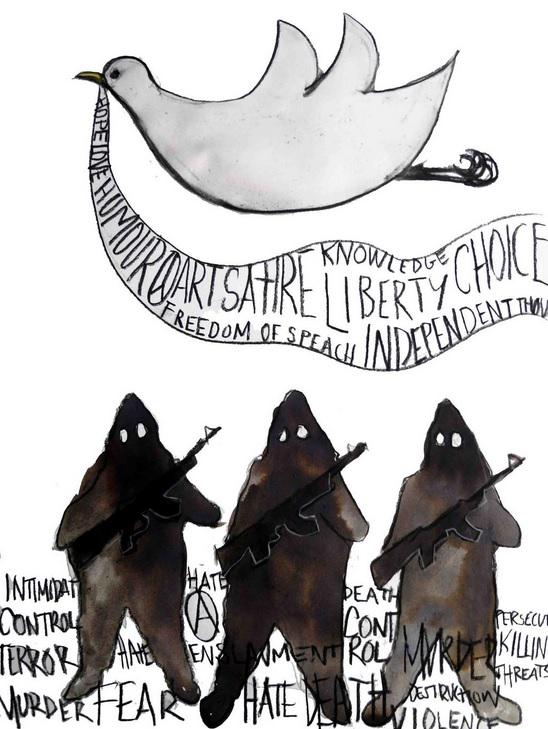
The two masked gunmen who killed 12 people at the Charlie Hebdo weekly on Wednesday claimed to be on a mission to “avenge” its cartoons of Mohammed.

It follows years of controversy over such caricatures.

“This is a prophet that is revered by some two billion people… Is it moral to mock him?,” prominent Iraqi preacher Ahmed al-Kubaisi told AFP, explaining the violent reaction of Muslims to cartoons of Mohammed.

“France is the mother of all freedoms, yet no one said this (depiction) is shameful,” he said.

Outspoken former Malaysian prime minister Mahathir Mohamad said Charlie Hebdo had shown disrespect towards Islam on numerous occasions.

“Is there a need for them to ridicule Prophet Mohammed knowing that they are offending Muslims?” state news agency Bernama quoted him as saying.

“We respect their religion and they must respect our religion,” he added.

Violent protests broke out in the Muslim world after Denmark’s Jyllands-Posten newspaper published 12 caricatures of Mohammed in 2005.

Charlie Hebdo and other European publications reproduced the cartoons the following year, including one which showed Mohammed wearing a turban shaped like a bomb, making them a target of Islamist fury.

The French magazine’s offices were fire-bombed in November 2011 following the publication of an edition renamed “Charia Hebdo”, (Sharia Hebdo), with a caricature of Mohammed on the front page.

‘NO RESPECT FOR FREEDOM’

At the core of the problem is the “lack of respect for others’ right to freedom of expression” in Arab and Muslim countries, according to Hassan Barari, professor of international relations at Qatar University.

Some people “do not understand the Western context of free speech, where you can easily make a movie that is critical of Jesus.”

Mathieu Guidere, who teaches Islamic studies at France’s University of Toulouse, said that the “culture of tolerance, and acceptance of different opinion is almost non-existent in the Arab and Islamic world.”

He attributed violence to a feeling harboured by “almost every Muslim who believes that he is the defender of the prophet and of Islam.”

Barari pointed to a history of “animosity between the West and Muslims”.

“We cannot deny that anti-Western feeling in the region is related to the West’s policies. This is related to past colonialism, policy on Israel, and support to dictatorships,” he said.

EVEN POSITIVE DEPICTION BANNED

The majority of Islamic scholars ban drawings of all prophets revered by Islam, and reject the depiction of the companions of Mohammed, even when it shows them in a positive light.

“We should not open the door to people to draw the prophet in different forms that could affect his status in the hearts of his people,” said Kubaisi, the Iraqi preacher who is based in Dubai.

There is no text from the Quran or the tradition of the prophet that clearly forbids such depictions, and the ban is “out of homage and respect” to the prophets, he added.

The ban also applies to depictions of prophets and companions of Mohammed in movies and television programmes.

When a trailer for anti-Muslim movie “Innocence of Muslims” appeared on YouTube in 2012, protesters took to the streets in several countries.

Four people, including US Ambassador Chris Stevens, were killed in Libya when extremists used protests against the film to attack US interests on September 11, 2012.

In recent weeks, a number of Muslim countries banned Ridley Scott’s “Exodus: Gods and Kings” for its depiction of Moses.

Even the 1970s epic “The Message”, which chronicled the life of Mohammed and starred Anthony Quinn, did not impersonate the prophet.

“Depicting the prophets of Allah would cast doubts about their status and might include lies, because actors could never match the characters of the prophets,” said a fatwa, or edict, by the Mecca-based Islamic Fiqh Coun


Free Speech or Licenced Hate? – » The Australian Independent Media Network

free speech2

Free Speech or Licenced Hate? – » The Australian Independent Media Network.

The secrets and lies of the Lindt Cafe

The secrets and lies of the Lindt Cafe.

NSW Overseas workers will be allowed to work for a year without applying for 457 visas: Abbott creating jobs. Who benefiys?

Workers protest about 457 Visas in 2013. The Department of Immigration will now allow overseas workers to stay in Australia for a year without the 457 visa.

Workers protest about 457 Visas in 2013. The Department of Immigration will now allow overseas workers to stay in Australia for a year without the 457 visa.

new temporary-entry permit proposed by the Department of Immigration to allow overseas workers to stay in Australia for a year without a 457 visa would create “open slather” on the Australian labour market at the same time it faces growing unemployment, unions warn.

The Department of Immigration and Border Protection has reviewed skilled migration and in December, it quietly released its recommendations to relax entry requirements for short-term foreign workers. Its proposals include extending the six-month short term mobility visa to 12 months.

The change would mean overseas workers would not have to apply for a 457 working visa, which imposes stricter entry requirements including English language tests. Employers are also required to demonstrate they have looked for local workers before giving jobs to employees from overseas, under a 457 visa.

"Absolute madness": CFMEU national secretary Michael O'Connor criticised visa proposals.“Absolute madness”: CFMEU national secretary Michael O’Connor criticised visa proposals. Photo: Tony McDonough

CFMEU national secretary Michael O’Connor said proposals to abolish the requirement for language and skills tests for temporary overseas workers would worsen unemployment levels in Australia, particularly for young people.

The proposals would mean employers would not be required to demonstrate they had first tried to fill job vacancies with Australian workers before giving them to people from overseas.

“It is absolute madness in the current environment, with unemployment at a 10-year high, to be removing even more opportunities for people to gain access to the workforce,” Mr O’Connor said.

“The impact on young people will be particularly harsh. Youth unemployment is at crisis levels, yet the majority of 457 visa approvals are for people under 30.”

Mr O’Connor said one in five workers on 457 visas already was being paid below-standard wages.

“The 457 visa program needs to have requirements strengthened in the current economic climate, not relaxed,” he said.

Australian Council of Trade Unions president Ged Kearney said the proposed relaxation of requirements for temporary-entry visas would undermine Australian wages and conditions.

She said the proposal to extend short term mobility visas to 12 months would lead to further exploitation of foreign workers.

“We find it absolutely extraordinary that the government’s panel has made a recommendation to just have open slather on the labour market,” she said.

Opposition spokesman for Immigration and Border Protection Richard Marles said the Labor Party was “deeply concerned” about any proposal to remove labour market testing or English language requirements for temporary skilled migrants.

A spokesman for the Assistant Minister for Immigration and Border Protection, Senator Michaelia Cash said the Coalition government fully supported the principle that Australian workers have priority for domestic job opportunities.

“Contrary to union claims, an effectively managed temporary labour migration program will not threaten Australian jobs.  Rather, it will secure the future of businesses and grow employment opportunities to enable businesses to employ more Australians,” he said.

“An effectively managed skilled migration program is essential in supporting employers in industries and regions experiencing skill shortages.  It is essential in restoring growth in the economy.  It is essential in lifting our productivity.”

Submissions to the skilled migration review will close at the end of this month before the federal government responds.

Australian Chamber of Commerce and Industry  director of employment Jenny Lambert said all stakeholders, including unions, needed to recognise that opportunities for Australians are enhanced by a strong economy that is globally competitive.  She said the Department of Immigration proposal referred to highly specialised skills.

“Access to these skills can only benefit the skills development of the Australian workforce as evidence shows that such arrangements allow for the transfer of skills to Australians, ” Ms Lambert said.

“Part of being globally competitive is recognising that the labour force is increasingly global and strong international companies will be attracted here through effective regulatory environments that allow them to operate seamlessly.

“A balanced and reasonable approach to skilled migration policy, preferably with bipartisan support, is good for Australia, and most importantly good for Australian jobs and the economy. Let this be the starting point for a rational discussion.”

“Unburnable”: To avoid catastrophic climate change, most of the world’s fossil fuels must remain in the ground

"Unburnable": To avoid catastrophic climate change, most of the world's fossil fuels must remain in the ground

The world must abandon most of its coal reserves, half of its gas and a third of its oil if we’re to have any hope of preventing catastrophic climate change, a major new study finds.

The analysis, published in the journal Nature, breaks down just how “unburnable” the world’s remaining fossil fuels are in terms of keeping warming below the agreed-upon limit of 2 degrees Celsius (3.6 degrees Fahrenheit). And the implications, as many are pointing out, are profound. The Middle East would have to walk away from 260 thousand million barrels of oil. The U.S., Russia and China would collectively turn their backs on coal. The fossil fuel industry would have to face huge parts of their reserves becoming absolutely worthless — and investors might reconsider investing in those companies.

According to the study, which examines our reserves down by region, the U.S. would actually be able to burn most of its remaining gas and oil. But forget Keystone XL — if you weren’t convinced already, the study contributes to the argument that the proposed pipeline would definitely have a harmful impact on climate change.

Canada’s Globe and Mail broke down what its findings mean for Alberta’s tar sands, which the pipeline would tap, and the numbers are harsh


Domestic estimates of Alberta’s oil reserves tend to come in around 168 billion barrels, with hundreds of billions more available for extraction if future oil prices make the resource more attractive. The study uses a more conservative estimate of 48 billion barrels as the current reserve and then finds that only 7.5 billion barrels of that, or about 15 per cent, can be produced by 2050. The figures assume that new technologies will make possible a reduction in the carbon intensity of oil sands production. If this does not happen, the authors say, then even less of the oil sand reserve should be extracted.

Oil sands productions levels are currently running at 722 million barrels per year and climbing, which suggests that the amount produced in the next 10 years will easily exceed Alberta’s share of the two-degree limit. Once that happens, only more drastic reductions in fossil fuel extraction elsewhere in the world would keep international climate goals on track.

Advocates of Keystone XL point out that the oil sands are not as large a contributor to climate change as other fuel reserves, particularly coal. The study does not disagree with this assessment but makes clear that a concerted global effort that includes Canada will be needed to achieve the two degree goal. Development of the oil sands at the pace currently projected by producers and the federal government would contradict this aim.

Of course, tar sands oil is only a small portion of the fossil fuel reserves the study calls for us to abandon, including 100 percent of the oil and gas in the Arctic. And the study doesn’t account for fossil fuel sources that have yet to be discovered. “Companies spent over $670 billion last year searching for and developing new fossil fuel resources,” noted Professor Paul Ekins, Director of the UCL Institute for Sustainable Resources and a study co-author, pointed out. “They will need to rethink such substantial budgets if policies are implemented to support the 2 degree C limit, especially as new discoveries cannot lead to increased aggregate production.”

But that’s a big if — and the main question now will be whether the world steps up to that challenge.


Lindsay Abrams Lindsay Abrams is a staff writer at Salon, reporting on all things sustainable. Follow her on Twitter @readingirl, email labrams@salon.com.

Australia accelerates coal mine projects in the face of study that finds it should stay buried

Tony Abbott coal

Research finds more than 80% of reserves should stay in the ground to avoid dangerous climate change, just as Australia expands production

Australia is pressing ahead with huge new coalmining projects, just as a new study has calculated that more than 80% of the world’s current coal reserves must remain in the ground to avoid dangerous climate change.

The research, by the UCL Institute for Sustainable Resources, found that globally a third of all oil reserves, half of all known gas deposits and 82% of coal capacity would have to remain unused by 2050 if the world was to remain within an internationally agreed limit of 2C warming compared with pre-industrial times.

The report found the world needed to stay within a carbon dioxide “budget” of 1,100 gigatonnes emitted between 2011 and 2050 to have at least a 50% chance to avoid more than 2C warming.

That level of warming is considered to have highly damaging consequences for human health, coastal infrastructure, food production and endangered species.

Despite its commitment to the 2C warming limit, Australia is pushing ahead with a massive escalation in its coal output, with prime minister Tony Abbott declaring in October that coal is “good for humanity” while warning against any “demonisation” of the fossil fuel.

Nine new coal projects are earmarked for the Galilee Basin region of central Queensland, producing a combined 330m tonnes a year at capacity.

This coal, destined for export to countries such as China and India, would produce an estimated 705m tonnes of CO2 when burned – substantially more than Australia’s entire annual greenhouse gas emissions of 542m tonnes.

Several international financial institutions have rejected funding the largest of the Galilee Basin mines, Adani’s Carmichael project, but the Queensland government has stepped in to provide taxpayers’ money for construction, citing the jobs the mine would create.
Advertisement

Tim Buckley, the director of energy finance studies at the Institute for Energy Economics and Financial Analysis, said the Australian government’s energy policies “fly in the face” of the need to avoid digging up the vast majority of known coal reserves.

“Rather than acknowledge the problem and transition energy sources over time, Tony Abbott is wedded to an idea of digging up coal as fast as possible before we’re not allowed to do so, which is a globally irresponsible position,” he told Guardian Australia.

“At the current price of thermal coal, the profit margin is zero. It makes no sense to sponsor these projects when the world is awash with coal. Why is Queensland providing millions of dollars to projects that aren’t commerciallly viable? Why does a project funded by a foreign billionaire need taxpayer subsidy?”

Buckley said Abbott’s argument that coal could lift people in developing countries out of poverty was “a highly embarrassing parroting of a coal industry PR campaign”.

Victoria McKenzie-McHarg, climate campaigner at the Australian Conservation Foundation, said Australia was “completely out of kilter” with the required action to avoid dangerous climate change.

“Tony Abbott and [Queensland premier] Campbell Newman have bent over backwards to push through coal projects and side with polluting mining companies over the need to protect Australians from climate change,” she said.

“If we become the greedy polluter, it puts unfair pressure on developing nations to cut their emissions when Australia has been one of the largest polluters for so long. We have a responsibility to clean up our act and take advantage of our real natural resources, such as wind and solar.”

But the Minerals Council of Australia (MCA) disputed the findings of the report, stating that the Intergovernmental Panel on Climate Change made it clear last year that carbon capture and storage technology would ensure that fossil fuels could remain widely used.

“The report’s apparent conclusions are at odds with a series of recent forecasts by a range of respected international bodies, including the International Energy Agency and the Intergovernmental Panel on Climate Change,” said Brendan Pearson, chief executive of the MCA.

“Those reports show that addressing climate change, eradicating energy poverty and a continued strong future for Australia’s energy sector are not mutually exclusive goals.”

Pearson said the International Energy Agency’s 2014 outlook showed that the global coal trade was set to grow by 40% by 2040, with Australia forecast to regain its ranking as the world’s top coal exporter by 2030.

According to the UCL institute’s paper, published in Nature, companies spent $670bn last year searching for and securing new fossil fuel deposits. The research was funded by the UK Energy Research Centre.

Climate changes amid the blaming game

Launceston takeaway restaurant owners fined $100,000 for underpaying Chinese chef on 457 visa

Noodle dish

The operators of a Launceston takeaway restaurant have been fined $100,000 for underpaying a Chinese chef and creating false wage records.

The Fair Work Ombudsman found David and Priscilla Lam, who own Dave’s Noodles in Launceston, created false records to pay a staff member for a 38-hour week when he worked 60.

It resulted in the Chinese chef being underpaid $86,000 over a four-year period.

The couple convinced the chef, who they sponsored on a 457 working visa, he had to sign the false time and wage sheets for immigration purposes.

The Federal Court fined the pair $100,000 and ordered them to repay the employee.

The couple are also the franchisors of the Dave’s Noodles restaurants in Hobart, Burnie, Kingston, Moonah and Mowbray.

The chef’s case was investigated by the Fair Work Ombudsman after he lodged a complaint via an interpreter.

The inspectors discovered he was being paid a flat rate based on a 38-hour week while being required to work 60 hours a week.

Judge Norah Hartnett described the couples’ fraudulent paperwork as “particularly disturbing behaviour, worthy of significant reprimand”.

He said the chef was in a vulnerable position, having to rely on the couple’s favour to stay in Australia.

Fair Work Ombudsman Natalie James said the penalties should be a warning against exploiting vulnerable workers.

“The small minority of employers who are inclined to contravene the rights of vulnerable workers should be aware that they can face significant financial consequences for such behaviour,” she said.

“Successful litigations such as this also help to create a level playing field for the majority of employers who are committed to doing the right thing by their employees.”

Tony Abbott – Worst PM in Australian History: Medicare

Sydney siege: Investigation finds Katrina Dawson killed by police during shootout at Martin Place, sources claim

Tragic loss ... Katrina Dawson is pictured with her husband Paul Smith. Picture: Supplied

Sydney siege: Investigation finds Katrina Dawson killed by police during shootout at Martin Place, sources claim.

In Solidarity With a Free Press: Some More Blasphemous Cartoons – The Intercept


Featured photo - In Solidarity With a Free Press: Some More Blasphemous Cartoons

In Solidarity With a Free Press: Some More Blasphemous Cartoons – The Intercept.

Defending Free Speech Doesn’t Require Solidarity With the Speech Itself

| Sat Jan. 10, 2015 1:28 PM EST

A couple of days ago, I had in mind a follow-up post about the point that defense of free speech doesn’t necessarily demand “solidarity” with the speech itself. This is obvious. If an extremist gay rights lunatic murdered a dozen members of the Westboro Baptist Church, would we all start showily plastering “God Hates Fags” on our websites? The question answers itself. There might a few photos showing WBC members sporting the phrase because there’s some news value in making it clear what sparked the attacks, but that would be it.

Anyway, I didn’t do it. The only way to make the point was to choose something deliberately and revoltingly offensive, so I backed off. But Glenn Greenwald didn’t:

This week’s defense of free speech rights was so spirited that it gave rise to a brand new principle: to defend free speech, one not only defends the right to disseminate the speech, but embraces the content of the speech itself. Numerous writers thus demanded: to show “solidarity” with the murdered cartoonists, one should not merely condemn the attacks and defend the right of the cartoonists to publish, but should publish and even celebrate those cartoons. “The best response to Charlie Hebdo attack,” announced Slate’s editor Jacob Weisberg, “is to escalate blasphemous satire.”

Some of the cartoons published by Charlie Hebdo were not just offensive but bigoted, such as the one mocking the African sex slaves of Boko Haram as welfare queens….But no matter. Their cartoons were noble and should be celebrated — not just on free speech grounds but for their content. In a column entitled “The Blasphemy We Need,” The New York Times’ Ross Douthat argued that “the right to blaspheme (and otherwise give offense) is essential to the liberal order” and “that kind of blasphemy [that provokes violence] is precisely the kind that needs to be defended, because it’s the kind that clearly serves a free society’s greater good.” New York Magazine’s Jonathan Chait actually proclaimed that “one cannot defend the right [to blaspheme] without defending the practice.”

….It is self-evident that if a writer who specialized in overtly anti-black or anti-Semitic screeds had been murdered for their ideas, there would be no widespread calls to republish their trash in “solidarity” with their free speech rights….When we originally discussed publishing this article to make these points, our intention was to commission two or three cartoonists to create cartoons that mock Judaism and malign sacred figures to Jews the way Charlie Hebdo did to Muslims. But that idea was thwarted by the fact that no mainstream western cartoonist would dare put their name on an anti-Jewish cartoon, even if done for satire purposes, because doing so would instantly and permanently destroy their career, at least. Anti-Islam and anti-Muslim commentary (and cartoons) are a dime a dozen in western media outlets.

I don’t agree with everything Greenwald says in his post. In particular, I think he really does downplay the disparity in both the number and virulence of terrorist attacks by radical Islamic groups compared to other groups. Like it or not, that makes a difference. He also would have been well-served by reprinting more than just anti-Semitic cartoons. Nonetheless, he makes his point vigorously, as usual, including a refresher of the evidence that terrorist violence is hardly limited to radical Islamists.

I am, I confess, conflicted about this. There is value in solidarity in the face of such a hideous attack. Still, although refusing to publish out of fear is plainly wrong—this is hardly a controversial point—letting a terrorist attack provoke an overreaction is a dubious response as well. For this reason, Greenwald’s piece is worth reading in full even if, in the end, you think he’s wrong. Maybe even especially if you think he’s wrong.

Al Qaeda Source: AQAP Directed Paris Attack – The Intercept


Featured photo - Al Qaeda Source: AQAP Directed Paris Attack

Al Qaeda Source: AQAP Directed Paris Attack – The Intercept.

Murdoch says Muslims must be held responsible for France terror attacks. Are Right wing Christians that promote hatred and violence the personal responsibility of all Christians? All Jews responsible for Likud? Are all Catholics responsible for the IRA. Hitler made all Jews responsible for some Jews actions living was one.. All Gypsys responsiblefor the actions of some.

Rupert Murdoch used Twitter to convey his thoughts on the ongoing terror alert in France.

Murdoch says Muslims must be held responsible for France terror attacks | World news | The Guardian.

Good Cop, Bad Cop: A Tale of Two Police Chiefs

Chief Cameron Mclay

Justin King
January 7, 2015

(ANTIMEDIA) Two cops, not alike in dignity is where we lay our scene. One police chief wrote a 750-word essay filled with pro-cop propaganda, which is aimed at lessening criticism of police for killing unarmed citizens. The other indicated he would work to end racism. Guess which one is being attacked by their fellow officers.

The first cop comes from Horry Police Department in South Carolina. Chief Saundra Rhodes wrote an essay defending cops and saying that criticism is unwarranted. The whole essay is without substance or merit.

“I have sat by quietly for weeks now and listened to or read posts of people that I genuinely consider friends, speak so ill of my fellow law enforcement officers.

I told myself repeatedly that it is simply because they do not have a true understanding and that all of their opinions are based upon the negative incidents that are portrayed by the national media.”

It should be noted that the national media wouldn’t have been able to talk about those “negative incidents” if they hadn’t happened. Let’s be clear about what we’re talking about, a “negative incident” sounds like something a that Kindergarten teacher would say. The “negative incidents” she is referring to have names, they had families, they had lives, and the one thing they didn’t have were weapons. They had all of those things until the police officers she is attempting to defend killed them.

“I acknowledge that there are some officers who should not be police officers and that our criminal justice system does not always get it right.”

Well, isn’t that the understatement of the year?

“I think that it’s time that I give my friends my perspective.

I am a police officer, it’s not just a job; I am just as much a police officer as I am a mother, I am just as much a police officer as I am a daughter, a sister, a cousin and a friend.

It is not just a job to me and it’s not just a job to most of my fellow brothers and sisters who wear the badge with pride.”

No, it is just a job. Wearing a badge does not make you special. You go to work, go home, and collect a paycheck. It’s a job. You aren’t superheroes. You aren’t “brothers and sisters” in some special fraternity. It’s a job, and the people to whom you are condescendingly addressing are your bosses. This sense of superiority you are reinforcing is what leads those that share your noble profession to believe they can rape and kill without consequence.

“It was not a job that caused Officer Bo Sauls to buy the baby formula that his suspect was trying to steal to feed her baby, instead of taking her to jail. That selfless act was due to him being just as much a police officer as he is a son and a father.

It was not the job that caused Officer Richard Ernest to go home and take an air conditioner from his garage and go back to a ladies house and install it for her after he had responded there for something else but noticed she had no air.


It was not a job that caused my officers to go out and find furniture for a family that had none so that they would no longer have to sleep on the floor; they did this because they are police officers.

It was not the job that caused Cpl. Brad Thompson to not stop until he found the suspect that stole an elderly ladies appliances and made the suspect load them back up on his pick up truck and return them to the victim before he took him to jail, he did this because he is just as much a police officer as he is a grandson.

It was not a job that caused Detective Heather Brummett’s life to be changed forever as she was forced to shoot and kill a suspect that was trying to kill another officer; it was her devotion to the life that she chose and that choice of being there to arrest a suspect has caused her to never be the same person that she was before.

Finally, it was not a job that made all of my officers leave their families on Christmas Day to search for a missing 4 year old autistic boy who had wandered away from his family’s vacation home.

It was not the job that made them willingly walk through mud, woods and water searching every nook and cranny for young Jayden.

It was not the job that caused me to watch as this baby was pulled from the water, nor was it the job that caused me to hold his father’s hand as he kissed his baby goodbye for the last time and to hold that mother and not be able to offer an explanation of why bad things happen to good people.

No it was not a job that caused me to hold in my emotions and to be strong for people that I had never met before, knowing that young Jayden reminded me so much of my own “grand baby” Zaevion and that all I wanted to do was to get home to him and hear him yell out for his mema.”

Yes, that is the job. It’s the profession you chose. More importantly, it doesn’t matter what other things a person may have done in their life, if they support, excuse, or try to downplay the murder of unarmed and sometimes completely innocent people, that person is a horrible human being. This whole letter is designed to draw attention away from the murders of unarmed people. Understand that no matter what PR technique you attempt to employ, we will not let the story deviate from the fact that way too many unarmed people are being killed by your “brothers and sisters.” Shame on you for trying to excuse murder.

“It was not a job that caused me to be strong for this family although I wanted to fall apart and cry with them.

We are police officers, we are willing to head towards the gunfire when everyone else is running away.

We are police officers, we are the ones who tell parents that their child is dead and then hold them as long as necessary as they cry out in sorrow.”


What about the parents of all of the dead who were killed by your “brothers and sisters” all across the country. Are you willing to hold them as long as necessary? Obviously not. You sit there and make snide remarks about the glory of the badge while militarizing your own department with vehicles straight from the battlefield in Iraq. When you attempt to defend murder, you will have to do better than a few anecdotal stories about your officers.

“We are police officers, we are the ones who respond when a husband is beating his wife and then take the hits from her as she tries to prevent us from taking him to jail.”

Are we talking about the case involving Detective Gonska’s girlfriend? He allegedly beat her because she took his beer away. When the other officers arrived there was blood on her face and clothes and she told the story of Gonska beating her. Is that one of your honorable “brothers?” Whatever happened to that case? Was it inexplicably dropped? I notice he wasn’t one of the officers you chose to highlight above.

In fact, according to the National Center for Women and Policing, multiple studies show that at least 40% of police officer families experience domestic violence, in contrast to 10% of families in the general population.

“We are police officers, we are the ones who will listen to you call us pigs, pieces of crap and murderers; yet will head your direction with lights and siren the minute that you need us, because ……… We are police officers.”

If you don’t want to be called murderers, the solution is simple and it isn’t writing poetic little tributes to law enforcement. If you don’t want to be called murderers, stop killing unarmed people. It’s that simple. You will not change the topic of this national debate.

In a further display of utter arrogance, this department just acquired an MRAP, the local media avoided using the dreaded term and instead chose to call it a Caiman. Caiman is the brand name of the vehicle the department obtained from the Department of Defense after it was used on battlefields overseas. The Chief says the vehicle will be used in rescues, hostage negotiations, and active shooter scenarios.

This further shows that the Chief is in a position above her skill level. During a hostage or barricade situation the idea is defuse to the situation. Typically, rolling out a 60,000lb armored vehicle increases tensions a tad. If it was intended for dynamic entry, it’s too loud and you’re going to get your officers killed because you lost the element of surprise. If you ever attended a course on hostage rescues you should remember the three things needed to achieve victory: speed, surprise, and violence of action. A 60,000lb vehicle will cost you speed and surprise.

Active shooter scenarios typically occur within buildings. Does the department plan on crashing the MRAP through the wall Waco-style? Otherwise it just delivers them to the scene and then is left behind. If it was driven up to make the assault the same rules above apply and the officers are in greater danger having lost speed and surprise.

This letter fooled no one. It was a very transparent attempt at distracting people from the increasing number of citizens who have died at the hands of your “brothers and sisters.”

Pittsburgh’s new police chief, Cameron McLay held a sign saying that he was fighting to end racism at work and end white silence. Seems like a pretty simple statement. Who wouldn’t want to end racism in a police department? Apparently, the Fraternal Order of Police in Pittsburgh isn’t too fond of the idea. Howard McQuillan said:

“by Mayor Peduto labeling us ‘corrupt and mediocre’ and now our current Chief insinuating that we are now racist, merely by the color of our skin and the nature of our profession, I say enough is enough!”

Maybe McQuillan is unaware that the last chief of police went to jail for corruption. Homicide and rape incidents are on the rise, and there is racism resulting in violence inside the department. So, corrupt, mediocre, and racist seems a pretty fair generalization. As head of the Fraternal Order of Police, there’s something McQuillan can do to change it: stop defending corrupt, mediocre, and racist officers. Cameron McLay held a sign saying he wanted to end racism in his department. If there were more chiefs like him, maybe officers wouldn’t be getting killed while they sat in their patrol cars and cities wouldn’t be burning to the ground.

This country needs more like McLay.

Filed under:

Good Cop Blew Whistle on Corrupt Superior, She Was Fired for It. He got Worse, Was Just Arrested

good cop bad cop

Former cop says she wasn’t surprised when she found out that her prior superior was just arrested for sexual assault, while on duty.

Dallas, TX– Officer David Kattner, a 26 year veteran of the Dallas Police Department was arrested in late December for sexually assaulting a woman on three separate occasions while in uniform and in his police vehicle.

The evening of his arrest, the officer had called the woman and told her where to meet him. The affidavit states that he had her perform a sex act on him while one of his hands was on his weapon and the other hand was down her pants, after showing her outstanding warrants and telling her he knew where her daughter lives.  The woman believed this to be a threat to her and her daughter’s safety and complied.

The detectives were already on the scene and were aware the assault was taking place as it happened.  Instead of stopping the attack, they waited until it was over and questioned the woman, who they describe as “a known prostitute,” as she went to leave the scene.

The 44 year old officer is currently on paid leave and out on bond as the investigation into his second degree felony continues.  Oddly, the department refused to release any photo of the officer or his mugshot, stating they will not release it during the “on-going investigation” despite it already having been published in D Magazine in 2007.

The department is asking for any additional victims to come forward, and unfortunately it is likely there are many, due to the department’s own negligence.

Back in 2006, a then rookie officer named Shanna Lopez was terminated after she came forward and told one of her trainers that Kattner and three other Central police officers had systematically mistreated prostitutes, WFAA reports.

http://bcove.me/ml6p35t9

“Those are real people,” Lopez said. “Each and every one of those people were not only degraded and humiliated and targeted and hunted on a nightly basis for years.”

Rookie officers go through several months of field training, and Lopez’ first trainer was Kattner.  She alleges that she witnessed him filling out blank citations on prostitutes for minor violations like jaywalking before even leaving the station each evening.

Lopez explains that he was “seeding the field” with class C citations that would later become warrants.  Kattner kept a notepad in his shirt pocket with the names of prostitutes and street-level criminals he regularly saw, as he needed to keep information such as their addresses and date of birth handy to complete the illegal citations.

From February 2006 through July 2006 over a quarter of the citations written by Kattner and three of his buddies were issued “at large” or “refused to sign.”

She describes Kattner and the two others as being obsessed with prostitutes, who were easy targets for them.

She explained to D Magazine in June of 2007 an evening where she was out with Kattner and an officer Nelson who had just taken a prostitute into the back of his police vehicle for a game he called “64 questions,” meant to demean the women.

“Give me the four reasons why you hate to f— niggers.” “Give me the four reasons you hate to f— spics.” “What are the three things you like to do every day?” he would ask.

After releasing the woman, Nelson told Lopez, “They know the routine. They do what we tell them. You break them down like that, and they’ll do anything you want. They’ll come when you snap your fingers.”


Eventually she brought what was happening up to a subsequent trainer, who explained that they cannot do that, and that it is illegal to write citations for people you never stopped or detained.

“He was like, why would he use that to write tickets, because usually you have someone in your custody and you write a ticket and there they go. I was like, ‘I don’t know; he’d write four or five tickets a night before we’d ever leave the station and then write a few more when we would be at Lew Sterrett while I’d be typing up my jail report, turn them in at the end of the night .’ He said he was the number one ticket writer at Central.”

The trainer told a sergeant what Lopez told him, and that’s when she claims everything changed and she began to be treated as though she was incompetent. She was called into a meeting with her current trainer and Sergeant Deborah Ann Branton where she was intensely scolded and told she has done nothing right.  It was boggling, as she had received praise previously.

“I’ve heard you’ve been going around talking about illegal arrests and other activities by other officers,” Lopez recalls Sergeant Deborah Ann Branton saying.

Branton then proceeded to ask her if  she ever tape-recorded any of the conversations.  Unfortunately, Lopez had not.  After she left the meeting she overheard Branton saying “This should be easy. Gayle did a good job of documenting it.”

Shortly before being terminated, Lopez was confronted by Kattner outside of Central Patrol.

“He said he had heard that I was going around saying he was writing tickets to people that don’t exist,” Lopez told WFAA. “He was like, ‘I will hunt you down and hurt you.’”

Lopez was terminated without proper explanation in October of 2006, despite having a glowing record and even receiving a commendation two days before her demotion in August.

After Lopez came forward another whistleblower came forward and two of Kattner’s buddies were fired, a third suspended, over their ticket writing scheme.  Kattner faced zero repercussions.

According to WFAA, Lopez also was allowed to reapply to the department after signing a 10-page settlement agreeing not to sue the department over her earlier termination. She was rejected for rehire after background investigators wrote a detailing memo claiming — among other things — that she associated with gang members and street criminals and had dated a neighbor who was a gang member.

The December 17, 2007 memo stated that gang unit officers had obtained sworn affidavits attesting to those facts. But those affidavits were dated January 9, 2008 — more than three weeks after the date of that memo. Police officials told News 8 that they are looking into the date discrepancy.

Lopez denies the allegations detailed in the memo. She believes the department never had any intention of rehiring her.

It is truly unfortunate that honesty and being a decent human within the ranks is such dangerous business.  The thin blue line makes calling out corruption something that can be done by only the truly brave and heroic, which many departments seem to be lacking.  It is also unfortunate that the officers who are protected by their peers face no consequences and thus have no reason to modify their behavior.

Last month we reported on a heroic officer in Buffalo, NY who was punched in the face and fired after she stopped a fellow cop from choking a handcuffed man. The officer who assaulted her and the handcuffed man kept his job.  He went on to later assault two other officers and was indicted for civil rights violations against four black teenagers.

Its time to start placing the discipline where it is deserved.

Filed under:

As Investment Advisers, The Liberals Make Alan Bond Look Good! LNP Investment Advice C Pyne

money fire

Late last year, I wrote about the Liberals’ criticism of the ANU’s decision to divest itself of shares in fossil fuel companies. As I pointed out, while this was considered “outrageous” by various senior Liberals, the shares being sold had actually been losing value, and apart from anything ethical considerations, it was possibly sound financial sense to sell.

When I’m wrong, I’m happy to admit it. Unfortunately, for those Liberals who I intend to mock mercilessly, this isn’t one of those times. Santos shares have continued to dive and I just noticed this little gem:

Santos shares “worthless” say Credit Suisse.

Now, just last October, Christopher Pyne labelled the ANU’s decision to sell “bizarre” and Jamie Briggs says that he wrote to the Vice-Chancellor  demanding an explanation. Well, I can give Mr Briggs an explanation – the shares are now almost half what they were when they were sold.

Perhaps, that should be one of the Labor Party’s questions in Parliament. Are the Government ministers still critical of the move, or do they now concede that sometimes people in universities might actually know something, even if Andrew Bolt is better placed to lecture us all on climate change. Yes, I know that Bronwyn Bishop would rule it out of order, but it’d be fun to watch.

Just like it was fun to listen to Jamie Briggs tell an ABC interviewer this morning that her question was out of line because, of course Tony Abbott was concerned about the SA bushfires, why he’d commented in response to a question just yesterday, and Mr Briggs believed that he had spoken to the Premier offering whatever help they needed. The Premier’s Office seemed unaware of any such call – perhaps Mr Abbott should have told them who he was.

Here we have the question and response:

Question: And just finally, on the SA bushfires, will there be any assistance package for the people affected?

Abbott:

The standard national disaster relief and recovery arrangements are already in place. We will shortly have a little bit more to say on the Centrelink payments which are often made in circumstances like these. I have been talking regularly to the relevant minister, Michael Keenan, to Minister Jamie Briggs who has the electorate which has been most impacted by these fires.Obviously, Australian summers are prone to fire and flood. It is tragic that we’ve seen, yet again, the ferocity of Mother Nature, but the thing about Australians is that the worst in nature tends to bring out the best in us and that’s what we always see when our emergency services rush to help people in trouble and when communities rally around those people who have lost a very great deal.

Mm, can’t see why people who’ve lost their homes would feel that Tony’s response lacked empathy!

Filed under:

Tony Abbott makes surprise visit to Iraq to discuss fight against Isis: 200 Australian special forces troops will soon enter Iraq to advise and assist local security forces. Any wonder we haven’t heard anything from Abbott who scrambled these forces almost 6 months ago. They are still WAITING

Tony Abbott and Haider al-Abadi

The Australian prime minister, Tony Abbott, made an unannounced visit to Baghdad on Sunday, meeting with top officials to discuss ways in which the country can aid Iraqi forces in their fight against Islamic State (Isis).

Abbott and the Iraqi prime minister, Haider al-Abadi, discussed military cooperation between the two countries, including the training and equipping of Iraqi soldiers, state television reported. The Iraqi army collapsed last summer in the face of a blitz by Isis, which now holds about a third of Iraq and neighbouring Syria in its self-declared caliphate.

During a joint news conference, Abbott said his country was determined to provide all kinds of support to Iraq in its war against terrorism. He vowed to enhance cooperation between the two countries.

Australian fighter jets are bombing Isis targets in northern Iraq as part of a US-led coalition and 200 Australian special forces troops will soon enter Iraq to advise and assist local security forces.

Meanwhile on Sunday, police said mortar shells slammed into several houses in the Shia village of Sabaa al-Bour, about 20 miles (30 kilometres) north of Baghdad, killing four people and wounding seven.

Elsewhere, police said a bomb blast on a commercial street killed two people and wounded six in western Baghdad.

On Sunday night, two bombs exploded in downtown Baghdad, killing three people and wounding 10, police said. A sticky bomb attached to a minibus also exploded, killing two passengers and wounding three, police said.

Medical officials confirmed the casualties. All officials spoke on condition of anonymity because they were not authorised to speak to journalists.

Middle East Iraq’s Sunnis may seek Iran help against ISIL Desperate for arms and military training to fight ISIL, Sunni tribes were considering Iranian assistance as an option.

Iraq’s Sunnis want a bigger role in the battle against ISIL [Al Jazeera]

Iraqi Sunni tribal sheikhs threatened to resort to the United States’ rival in the region, the Islamic Republic of Iran, to get the needed military support in their fight against the Islamic State of Iraq and the Levant (ISIL), if the US did not respond to their demands, warned Iraqi lawmakers and tribal sheikhs.

The warning came during a meeting with US Senator, John McCain, who embarked on a short visit to Baghdad on Friday.

McCain met with several Iraqi lawmakers and tribal sheikhs representing the Sunni-dominated provinces of Anbar, Saladin, Diyala as well as the towns constituting the belt of Baghdad, to discuss proposed plans to confront ISIL.

Three Iraqi Sunni figures who attended the meeting told Al Jazeera that a list of demands was submitted to McCain asking for US ground troops, weapons and funds to accelerate the liberation of areas seized by ISIL and grant them (Sunni tribes) a bigger role in the battle against ISIL.


RELATED: Iraqi army to raid ISIL fighters’ ‘hub’


The disgruntled tribal leaders, according to Sunni figures, made it clear that they were considering alternative options to get the much needed military support to drive away ISIL fighters, and that Iran was on top of the list of alternatives.

“[McCain] was told clearly that if the Americans kept watching the situation [in Anbar, Saladin and Diyala provinces] and did not intervene, we will ask another regional power to fill the gap,” a senior Iraqi lawmaker who attended the meeting, told Al Jazeera on condition of anonymity.

“We have already opened many channels with Iran and they have offered unconditional support including weapons, funds and even fighters if required,” he said.

The attendees have expressed their anger and dissatisfaction at the US and the [US-led] international coalition that does not support them in its war against Daesh [ISIL] while they rose up when Daesh got close to the Kurdish region and quickly, intervened.

– Salah al-Joubori, senior Sunni lawmaker

ISIL fighters overran the second largest city in Iraq, Mosul, in June, with hardly any resistance from the Iraqi army. A few days later, ISIL fighters seized the neighbouring province of Salahuddin and vast parts of southern Kirkuk.

They now have control over most of the cities and towns of the Sunni-dominated province of Anbar.

Iran was the first regional country that responded to the Iraqi government’s calls for assistance to stop ISIL advances towards the capital.

Iranian military commanders, accompanying Iraqi forces and Shia militias, have played a vital role in gaining control over the border towns of Jalawla and Saadia, in Diyala province, a few weeks ago and driving ISIL fighters from Jurf al-Sakhar, one of the main supply routes for ISIL in southern Baghdad.

Iran, according to analysts, was also quick to cover the large shortage of weapons and ammunition for the Iraqi troops and Kurdish forces.

On Sunday, official Iranian media reported that an Iranian Revolutionary Guards commander, who was training Iraqi troops and  militia fighting ISIL, was killed in the Iraqi city of Samarra.

McCain, who was mostly just listening during the meeting, according to the lawmaker, asked for clarification relating to that point.

“McCain stopped us a lot when it came to that point, he looked very interested and was asking questions like who, when, where, why and how,” the lawmaker said.

The meeting which lasted 90 minutes was held at the house of the Iraqi speaker, Saleem al-Joubori, in the Green Zone, the most fortified area in Baghdad that contains governmental buildings and many foreign embassies including the US and British embassies.

The tribal leaders and lawmakers had also expressed their dismay at the lack of a serious US policy to liberate their lands and “the US’ double standards” in dealing with the Sunni tribes in these provinces compared to the Kurds.

“The attendees have expressed their anger and dissatisfaction at the US and the [US-led] international coalition that does not support them in their war against Daesh [ISIL] while they rose up when Daesh got close to the Kurdish region and quickly intervened,” Salah al-Joubori, a senior Sunni lawmaker who also attended the meeting, told Al Jazeera.


RELATED: Deadly bombing hits anti-ISIL force in Iraq


Salah al-Joubori, who confirmed that Sunni tribes have threatened to get assistance from Iran, added that McCain did not make any promises or offer any plans to explain how the US will address their demands although the meeting was “frank and realistic”.

“The man is a senator and he has nothing to do with the decision-making [related to arming and funding the Sunni tribes]. He will transfer all what he heard, in addition to the written list of demands, to Congress,” Joubori said.

 US to help Iraq train and arm tribesmen as part of a future National Guard [EPA]

Iraqi Sunni leaders who met McCain, as several senior officials who are familiar with the talks confirmed, were hoping to convince the US administration to put pressure on the Iraqi government to form the long-awaited National Guard troops, arm the Sunni tribes and keep the Kurdish forces and Shia militias away from the Sunni areas.

“US is able to put great pressure on the Iraqi government and force it to form the National Guard, support the [Sunni] tribes and prevent the Peshmerga and Shia militias from entering the Sunni areas,” a senior Sunni figure told Al Jazeera on condition of anonymity.

“We believe that the Iraqi government is deliberately holding up the formation of the National Guard and does not support the [Sunni] tribes.”

In a briefing held on Saturday at the US embassy in Baghdad, McCain told reporters that the US will train and arm Sunni tribal fighters who will be part of the planned National Guard troops in Anbar.

“The Iraqi government will arm 4,000 tribesmen, in Anbar, within the National Guard troops which will be formed [later], and their training and arming will be through the Iraqi government,” he said.


Shi’ite militias expand influence, redraw map in central Iraq

Fighters from the Shi'ite Kata'ib Imam Ali (Imam Ali Brigades) militia search a house after taking control of a village from Islamist State militants, on the outskirts of Dhuluiya, north of Baghdad December 29, 2014.  REUTERS/Stringer

Fighters from the Shi’ite Kata’ib Imam Ali (Imam Ali Brigades) militia search a house after taking control of a village from Islamist State militants, on the outskirts of Dhuluiya, north of Baghdad December 29, 2014.

(Reuters) – Behind black gates and high walls, Iraqi national security agents watch 200 women and children.

Boys and girls play in the yard and then dart inside their trailers, located in a former U.S. military camp and onetime headquarters for Saddam Hussein’s officials in Babel province’s capital Hilla.

The women and children are unwilling guests, rounded up as they fled with their male relatives in October from Jurf al-Sakhr, a bastion of Islamic State, during a Shi’ite militia and military operation to clear the farming community.

Once they were arrested, security forces separated out the men, accusing them of being Islamic State fighters. They have not been heard from since.

Security forces say the women and children are being investigated, but have not been brought to court.

Their status shows how central Iraq’s mixed Shi’ite and Sunni regions are being altered.

As Shi’ite forces push into territories held by Islamic State, many Sunnis have fled for fear of both the Shi’ite-led government and the Sunni jihadists.

Shi’ite leaders insist Islamic State must never be allowed to strike them again, nor return to areas now abandoned.

Shi’ite groups now decide who can stay in a community and who should leave; whose houses should be destroyed and whose can stand.

In one case, a powerful Shi’ite paramilitary organization has started redrawing the geography of central Iraq, building a road between Shi’ite parts of Diyala province and Samarra, a Sunni city that is home to a Shi’ite shrine.

“The ideas of what Shi’itestan’s limits are is changing,” said Ali Allawi a historian and former Iraqi minister.

“Some of these towns and villages, which were neutral or partial to ISIS, have been retaken. I don’t think the people living there will go back. We are talking about depopulated areas that may be resettled by different groups.”

More than 130,000 people, mostly Sunnis, fled central Iraq in 2014, counting just Baghdad’s agricultural belt and northeastern Diyala province, the International Rescue Committee told Reuters.

The exodus has left villages empty as Shi’ite paramilitaries, tribes and security forces fill the void.

Iraqi government officials including Prime Minister Haider Abadi stress the importance of helping people return home.

But in the current chaos it is questionable whether officials can help, or that the displaced will want to return.

“I AM TRAPPED”

Already dramatic changes are happening on the ground. For the 200 women and children from Jurf al-Sakhr, it has meant an undefined period of detention.

When they ran from their homes in October raising white surrender flags, security forces and militias separated the women from their male relatives.

Now the women, jailed in Hilla, worry about their fate.

“I’m trapped here living on charity without understanding why all this happened to us”, said Um Mohamed, sobbing during a visit Reuters made to the heavily secured compound last week.

“All that I wish is to have my husband back and to return to our small farm.”

Security officials say the women and children have not been brought before a court, and will not be freed soon.

“These families were joining or harboring Islamic State,” said Falah al-Rahdi, head of the Babel provincial council’s security committee. “The judicial system will decide their fate.”

Privately, officials in Babel province vow never to welcome back its Sunni residents.

CONFISCATE LAND

As Shi’ite militia leaders and tribal allies surround Sunni villages in central Iraq, they insist they have strong intelligence from inside those communities.

“Our orders come from the government: whoever is with Islamic State, we will confiscate their land. Those who aren’t Islamic State will be allowed back,” a national commander from Asaib Ahl al-Haq told Reuters.

He said he contacted sources in Islamic State-held areas and waited until all civilians had escaped before liberating a community.

However, those who have lost their homes say the militias make little distinction between jihadists and civilians when they storm areas.

Akram Shahab, 32, a Shi’ite in Diyala’s Saadiya district, fled with his family last June when Islamic State were about to overrun the town.

He heard from a Sunni neighbor that a jihadist family had moved in. For Shahab it was a relief his house was not blown up.

But after Iraqi militias and security forces kicked Islamic State out of Saadiya in November, Shahab was stunned to learn that the militias had burned his house assuming it was a terrorist’s.

The next day, Shahab went with Shi’ite militiamen to inspect the ruins.

“I blamed the militia members at the scene for burning my house and they defended themselves, saying how could they tell a Sunni house from a Shi’ite house.”

Shahab, who comes from a family with both Shi’ite and Sunni relatives, said he managed to save his Sunni aunt’s house by telling the militia she belonged to their sect.

“They spray-painted (Shi’ite) on the gate to alert the other militia groups,” he said.

“They told me,‘We need to clean your town from those germs who supported Islamic State. You might have lost your house but as a Shi’ite you will live with your head high from now on’.”

SCENIC HIGHWAY

Not only are homes being demolished, but new infrastructure is being built.

A Shi’ite paramilitary organization is constructing a road to strengthen its positions across the mixed areas of Diyala and neighboring Salahuddin province.

The Badr Organization, a leading political party and militia with ties to Iran, is supervising the new road, which leads to Samarra.

It means Badr can resupply troops guarding Samarra, currently surrounded by Islamic State.

The 35 km road will also allow Shi’ite pilgrims from Iran to visit Samarra, one of Shi’ite Islam’s most sacred shrines.

On a recent day, in olive green sweater and commander’s cap, Badr Organization chief Hadi al-Amri toured the 35 km road.

Arguably the most popular Shi’ite politician in Iraq for defending Diyala, Amri placed orange work cones on the ground and directed bulldozers.

“The road is of strategic importance to finish off Islamic State in the outskirts of Diyala and to put pressure on them in Salahuddin,” said Badr lawmaker Mohammed Naji.

“Hadi Amri suggested this road and he supervises it daily in spite of the dangers.”

Senior Iraqi politicians say Amri is the commander closest to Iran on the battlefield.

Amri’s new project — the Samarra road — passes through one trouble spot: an area called Hawi, which Badr considers to be filled with Islamic State cells.

“We have started neutralizing the villages, putting guards on the road,” Naji said. “We have not displaced the people there. We put forces there to make sure Islamic State cannot enter the villages.”

Egypt warned Amal Clooney she risked arrest

Amal Clooney

Egyptian officials warned human rights barrister Amal Clooney that she risked arrest after identifying the same serious flaws in its judicial system that subsequently contributed to the conviction of three al-Jazeera journalists now jailed in Cairo.

In an interview with the Guardian after their appeal hearing this week, Clooney, a lawyer for one of the trio, said they were victims of the same flaws that she earmarked in a February 2014 report about Egyptian courts.

Written before Clooney became involved in the al-Jazeera case, officials deemed the report so controversial that they threatened her team with arrest should they have tried to present its findings inside Egypt.

“When I went to launch the report, first of all they stopped us from doing it in Cairo,” Clooney told the Guardian. “They said: ‘Does the report criticise the army, the judiciary, or the government?’ We said: ‘Well, yes.’ They said: ‘Well then, you’re risking arrest.’”

The report, compiled on behalf of the International Bar Association, said Egypt’s judicial system was not as independent as it could be. It pointed out that officials in the ministry of justice have wide powers over nominally independent judges, and highlighted the control the government can exert over state prosecutors.

Among other recommendations, Clooney and her co-authors suggested ending the practice that allows Egyptian officials to handpick judges for certain politicised cases. “That recommendation wasn’t followed, and we’ve seen the results of that in this particular case where you had a handpicked panel led by a judge who is known for dispensing brutal verdicts,” Clooney. said “And this one was no different.”

The three journalists – Peter Greste, Baher Mohamed, and Mohamed Fahmy, whom Clooney represents – were initially sentenced to between seven and 10 years in jail last June by the controversial Egyptian judge Mohamed Nagy Shehata.
Baher Mohamed, Mohamed Fahmy and Peter Greste in court in Cairo
Facebook
Twitter
Pinterest
Baher Mohamed, Mohamed Fahmy and Peter Greste in court in Cairo in March. Photograph: Heba Elkholy/AP

Shehata became notorious during the trial for rarely taking off his aviator sunglasses, mocking Fahmy’s fiancee, and for cracking a joke about World Press Freedom day. A few months later, he also sentenced to death 188 people, Clooney said, “in one mass trial which didn’t distinguish between each defendant’s criminal responsibility”. Shehata failed to respond to several requests for interview.
Advertisement

At the trio’s appeal on New Year’s Day, a new judge refused to throw out the case, but agreed to a retrial, after recognising problems with the initial process. But Clooney fears those flaws – which included the presentation of a Gotye song, footage of a trotting horse, and pictures of Greste’s parents as evidence of the trio’s guilt – are so serious that they will compromise the integrity of any second hearing.

“If the idea is: well, there were errors and now there’s going to be a retrial, but then the retrial operates on the same basis as the original one, that doesn’t really mean much,” Clooney said. She has waived most of her usual fees, and is paid directly by Fahmy without the support of al-Jazeera. “I don’t see how the prosecution can proceed again in a trial process even if the judges were to be constituted properly this time around. I don’t see how they could fix the lack of evidence.”

As a result, Clooney has concluded “that we have to continue and double our efforts to achieve his release in other ways. Unfortunately we have to conclude that we can’t rely on these Egyptian court processes to achieve a fair or swift result.”

For Baher Mohamed, the third detainee who holds only an Egyptian passport, his fate largely depends on those court processes, with the prospect of a presidential pardon dwindling. But Clooney’s client, Fahmy, a Canadian citizen, and his Australian colleague Greste, have another option: deportation to their home countries.

Fahmy and Greste have applied to Egypt’s chief prosecutor to demand they be sent to Canada and Australia respectively under the terms of a new presidential decree that provides foreign detainees with such a route, and which seems to have been tailored for their case.

The vague and unprecedented nature of the decree has led to doubts about how it would be used in practice. But based on her communication with relevant officials in Egypt and Canada, and on her experience of international law, Clooney is hopeful that deportation is a real option. “There are many different ways in which the transfer from Egypt to Canada can occur, and as long as there is a genuine commitment on both sides, I see no reason why a transfer can’t happen in fairly quick terms.”

Inside Egypt, Fahmy’s appeals team was led by an Egyptian lawyer, Negad Boraie, with contributions from Clooney that related to international law. But outside Egypt, it is Clooney who is spearheading attempts to secure Fahmy’s deportation, and hopes next week to meet the Canadian foreign minister, John Baird, to try to convince him to expedite the process.

“We are very much hoping that the Canadian and Egyptian officials we have contacted will engage with us fully to ensure that Mohamed is involved – through his counsel – in the discussions and that a fair outcome can be achieved as soon as possible.”

Labor and the Unions introduced all of the following. If you Brainwashed Union Bashers had any self respect, you would refuse to accept these conditions. But that ain’t gonna happen, eh Comrades. The mob you have been fooled into believing are about to strip our conditions away from us. But the bestest thing is, they gonna strip you too. Silly Liberal Lovers!

Filed under:

Catholic League Defends Murders at Charlie Hebdo

Justin King
January 9, 2015

(ANTIMEDIA) The specifics and motives of the attack in Paris are being hotly debated, but the Catholic League’s Bill Donohue has in essence attempted to justify the killings by saying that the attack was provoked.

In a rambling statement he says that he has never encouraged violence, but that

“neither should we tolerate the kind of intolerance that provoked this violent reaction.”

The editor-in chief targeted in the attack, was Stephane Charbonnier. Donohue states that

“Had he not been so narcissistic, he may still be alive.”

He doubles down on the statements in an interview with Newsmax. He talked about protesting against art and then called the victims of the attack “thugs.” Not the alleged shooters; the victims. He cites the abuse of liberty in the United States as well. Apparently, he is unaware that the same Amendment to the Constitution that protects free speech also protects his religious rights and his right to protest art that offends him.

“The abuse of liberty, in this country and . . . by these smart alecks who want to take their middle finger and put it in the face of people of faith, that has to stop too.”

He also stated:

“I also condemn the lack of restraint of people perverting their freedom by choosing the most pornographic, obscene, vulgar depictions of Muhammad for the juvenile intent of insulting them. You know, when you keep doing that, you’re going to get a response.”


The “response” in this case was the apparent attack on a satirical newspaper that killed 12 people. He asked people that wished to condemn Islam to do it with civility and decency.

Donohue was not the only public figure to put his foot in his mouth by attempting to gain political capital out of the deaths.

Nigel Farage, a Member of the European Parliament, blamed immigrants for the attacks and said that it could be blamed on a

“really rather gross policy of multiculturalism.”

This was said without poetic intent. Farage is apparently unaware that having one culture is exactly what the shooters thought was best as well.

The two talking points made by these men complement each other nicely. Don’t criticize religion and there needs to be only one culture. It sounds alarmingly like the probable talking points of the shooters.  The solution to the threat of domination by one culture and one religion cannot be the domination of another culture and religion.

Before his death, Stephane Charbonnier said:

“Extremists don’t need any excuses.”

That may be true, but it seems that extremists will excuse each other when the times demand it.

Editors note: It should also be noted that the Catholic Church has sued Charlie Hebdo fourteen times.

Proud to Offend, Charlie Hebdo Carries Torch of Political Provocation

PARIS — In 2012, when Charlie Hebdo editors defied the government’s advice and published crude caricatures of the Prophet Muhammad naked and in sexual poses, the French authorities shut down embassies, cultural centers and schools in about 20 countries.

“Is it really sensible or intelligent to pour oil on the fire?” asked Laurent Fabius, the foreign minister at the time.

But Charlie Hebdo’s editor, Stéphane Charbonnier, who died in the attack on the paper’s offices Wednesday, was not deterred.

Week after week, the small, struggling paper amused and horrified, taking pride in offending one and all and carrying on a venerable European tradition dating to the days of the French Revolution, when satire was used to pillory Marie Antoinette, and later to challenge politicians, the police, bankers and religions of all kinds.

This week’s issue was no exception. It featured a mock debate about whether Jesus exists and a black-and-white New Year’s greeting card from the leader of the Islamic State, Abu Bakr al-Baghdadi, with the caption, “To your health.”

Photo

An October 2014 cover depicted immigration critics.

No subject was off limits. The paper offered pages of colorful cartoons depicting France’s top politicians and intellectuals as wine-swilling slackers indulging in sexual acts, or suggesting the pope was stepping aside to be with his girlfriend.

It is a brand of humor the French and other Europeans are attached to, but it has prompted fury among both Muslim extremists and less radical Muslims who see the denigration of their religion as provocation, not food for thought.

“The French like their satire,” said Jean-Marie Charon, a sociologist who studies the news media. “The idea is to be irreverent, that irony and criticism are good things. But it is true that this is perhaps not part of everybody’s culture.”

Photo

A December 2013 issue featured President François Hollande.

In recent years, the editors and cartoonists at Charlie Hebdo had weathered a firebombing, computer hacking and death threats. Mr. Charbonnier was included on a list published by Al Qaeda’s magazine, Inspire, of those “most wanted” for crimes against Islam. But Charlie Hebdo’s staff continued to take on Islam with the same irreverence as it did other religions, a stand that gave it stature among French journalists.

In 2006, for instance, the paper republished the controversial cartoon caricatures of a weeping Prophet Muhammad that had appeared first in a Danish newspaper.

“Charlie Hebdo has always kept its insolence, and since the caricatures crisis, it has become a symbol of press independence,” said Bruno Patino, director of the journalism school at the Institut d’Études Politiques de Paris, known as Sciences Po. “The debate about caricatures overlapped others in France about freedom of speech and religion. It became the most visible.”

Photo

People held placards reading, “I Am Charlie” in Clermont-Ferrand, France, during a rally on Wednesday to honor the victims of the attack on Charlie Hebdo. Credit Thierry Zoccolan/Agence France-Presse — Getty Images

The newspaper was born in controversy in 1970, after a publication called Hara-Kiri was banned for mocking the death of former President Charles de Gaulle. That prompted its journalists to set up a new paper, Charlie Hebdo, named for its reprint of Charlie Brown cartoons from the United States and a French shorthand for weekly publication.

According to some reports in the French news media, the attackers knew the names of their victims. Among the dead were Mr. Charbonnier, editor since 2009, and the veteran artists Jean Cabut, 76, and Georges Wolinski, 80, who had been involved with the publication since its inception.

While the paper first drew the anger of Muslims by reprinting the Danish cartoons from the newspaper Jyllands-Posten, it went further in 2011, when it temporarily renamed its weekly “Charia Hebdo,” a play on Shariah, Islamic law, and appointed the Prophet Muhammad as its “editor in chief.”

Continue reading the main story Video

Play Video|1:16

In Paris, Solidarity Against Terrorism


In Paris, Solidarity Against Terrorism

Hours after the deadly attacks on Charlie Hebdo in Paris, thousands gathered in the Place de la République to show support for free speech.

Video by Pierre Kattar on Publish Date January 7, 2015. Photo by Ian Langsdon/European Pressphoto Agency.


In 2012, the French authorities increased the police presence outside the Charlie Hebdo office out of concern about another attack. At the time, one of its journalists, Laurent Léger, said that “in France, we always have the right to write and draw.”

He continued: “And if some people are not happy with this, they can sue us, and we can defend ourselves. That’s democracy. You don’t throw bombs, you discuss, you debate. But you don’t act violently. We have to stand and resist pressure from extremism.”

Mr. Charon said the paper was often sued, including 14 times in recent years by the Roman Catholic Church. The New York Times has chosen not to reprint examples of the magazine’s most controversial work because of its intentionally offensive content.

Continue reading the main story Photographs

Photographs|11 Photos

Deadly Attack in Paris


Deadly Attack in Paris

CreditVia Reuters


Mr. Charbonnier, like the other Charlie Hebdo journalists, published under his pen name, Charb. His last published cartoon appeared in Wednesday’s issue, a haunting image of an armed and cross-eyed militant with the words, “Still no attacks in France,” and the retort: “Wait! We have until the end of January to offer our wishes.”

Since 2012, Mr. Charbonnier had a police bodyguard, who also died in the attack. “The threats were constant,” the publication’s lawyer, Richard Malka, said. “It’s frightening.”

But Charlie Hebdo thrived on breaking taboos. In the past, Mr. Charbonnier vowed that his cartoonists would keep poking fun “until Islam is just as banal as Catholicism,” but in the process it struggled not only with death threats, but also with its own financial survival.

Its circulation is about 30,000, and like other frail journals in the French newspaper industry, it has turned to its own form of crowdfunding, publishing a coupon on Wednesday for readers to fill out and mail in with checks.

Its chief rival is Le Canard Enchaîné, founded in 1915, which specializes in scoops and leaked secrets, whereas Charlie Hebdo is known for its cruder and more vicious wit. On Wednesday, an editor at Le Canard Enchaîné declined to speak about the shooting. Journalists there were instructed during an emotional afternoon meeting not to discuss the attack.

“It’s too early and too difficult to talk about this right now,” said a journalist there who knew some of the victims at Charlie Hebdo.

Radio France, Le Monde and France Télévisions issued statements late in the day saying they intended to offer staffing and other support to help Charlie Hebdo “live on.”

The Sydney gunman and Charlie Hebdo – Al Jazeera Blogs


The Sydney gunman and Charlie Hebdo – Al Jazeera Blogs.

Calls for unity and understanding as world mourns Charlie Hebdo

View image on Twitter

Calls for unity and understanding as world mourns Charlie Hebdo.

Mr. Fish and Juan Cole on the Charlie Hebdo Massacre – Truthdig Radio – Truthdig

Mr. Fish and Juan Cole on the Charlie Hebdo Massacre

Mr. Fish and Juan Cole on the Charlie Hebdo Massacre – Truthdig Radio – Truthdig.

Juan Cole: Why al-Qaida Attacked Charlie Hebdo Satirists in Paris – Juan Cole – Truthdig


Juan Cole: Why al-Qaida Attacked Charlie Hebdo Satirists in Paris – Juan Cole – Truthdig.

Are we a secular state or a bunch of Pell pleasers?

TheCardinalwithhisAbbottWin

According to Wikipedia, “a true secular state should steadfastly maintain national governance without influence from religious factions.”

Considering Australia is a supposedly secular state, religion plays not only an inordinate role in policies, it costs the taxpayer billions each year.

Charities are eligible for a range of tax concessions, including refunds of imputation credits, income tax exemptions, FBT and GST concessions.

To be a charity, all of your not-for-profit’s purposes must be charitable, except purposes that are ‘incidental or ancillary’ to (further or aid) the charitable purposes.

The law recognises many kinds of purposes as charitable.

The Charities Act 2013 (Cth) lists twelve charitable purposes:

  • advancing health
  • advancing education
  • advancing social or public welfare
  • advancing religion
  • advancing culture
  • promoting reconciliation, mutual respect and tolerance between groups of individuals that are in Australia
  • promoting or protecting human rights
  • advancing the security or safety of Australia or the Australian public
  • preventing or relieving the suffering of animals
  • advancing the natural environment
  • promoting or opposing a change to any matter established by law, policy or practice in the Commonwealth, a state, a territory or another country, (where that change furthers or opposes one or more of the purposes above) and
  • other similar purposes ‘beneficial to the general public’ (a general category).

According to a Herald/Nielsen poll conducted in the lead-up to the 2010 federal election, 84 per cent of people surveyed agreed with the statement ”religion and politics should be separate”.

More recently, a worldwide poll conducted by Win-Gallup International, found that 48 per cent of Australians said they were not religious; 10 per cent declared themselves “convinced atheists”; and 5 per cent did not know or did not respond. Only 37 per cent were religious.  Yet the increasing influence and funding of religion in Australia persists.

Considering the vast array of differing beliefs and the disharmony that religion has caused throughout history, I fail to see how “advancing religion” is, in itself, “beneficial to the general public” when the majority of the public are not religious.

The Howard government outsourced a lot of social welfare to various religious organisations.  By shifting a costly and complex social responsibility to religious providers, the government also exempts them from anti-discrimination laws. This is particularly evident with faith-based aged care providers that are free to discriminate against gays and lesbians on the sole basis that religious ethos overrides the principle of fair and equal treatment of all people.  Faith-based schools can refuse entry to children on the basis of their religion, or lack thereof.

We also spend hundreds of millions on school chaplains for state schools.  This appears in contradiction to the separation of church and state.

Australia is one of only three countries in the world where even the commercial enterprises of religious organisations are granted tax concessions.  They are not required to report the breakdown of their charitable, business or investment activities.

Federally, these apply to income tax, fringe benefits tax, and the goods and services tax. State government exemptions cover land tax, payroll tax, stamp duties and car registration fees. Local governments provide exemptions from municipal rates. Concessions may also be granted for some water and power charges.

In 2008, the Secular Party of Australia made a submission to Treasury where they estimated the government’s financial assistance to religious institutions to be in the order of $31 billion annually.

They suggested that more accurate estimates of this kind could be obtained if the information was available, but it is not. It is standard budgetary procedure that the loss of revenue arising from exemptions, for example those applying to superannuation pensions, are listed in budget papers and can be quantified. It is anomalous that no such requirement exists for religious organisations, even those that may be involved in significant business and investment related activities.

Further anomalies occur in relation to the application of the Fringe Benefits Tax and the Goods and Services Tax. As the FBT is exempt to employees who are religious practitioners, eligible employers can provide remuneration packages that are biased wholly in terms of fringe benefits, thereby avoiding any income tax. This device can also create an unwarranted entitlement to social security benefits.

In relation to the GST, an anomaly occurs in relation to ceremonies for weddings and funerals. If performed by a civil celebrant, GST is payable, whereas if done in a church, it is not. Apart from being grossly inequitable, the situation is of doubtful legality in the light of equal opportunity laws that prohibit discrimination on the grounds of religion.

The SPA made the following recommendations in their 2008 submission.

  1. We submit that the definition of “charitable purpose” be reformed to exclude “advancement of religion”, which would reflect the modern view that religious worship and indoctrination into any sect, cult or religion are not charitable activities in themselves.
  2. We submit that the activities of any charitable organisation, religious or not, should not be exempt from accountability or from taxation.
  3. We submit that the investment and business related activities of any organisation should not be exempt from taxation.
  4. We submit that only the bona fide charitable activities not connected with religious worship or indoctrination should be tax exempt.
  5. We submit that a Charities Commission be established for the purposes of regulating and making accountable the charitable activities of all non-profit organisations. This should include religious organisations, and ensure that tax exemptions are provided only in relation to bona fide charitable activities, and are not used to disguise religious worship or indoctrination.
  6. We submit that all not-for-profit and religious organisations should be required to submit annual reports that are audited, and publicly available in a manner similar to that for public companies.
  7. We submit that if religious organisations receive tax exemptions, these must be provided only to the extent that their activities are bona fide charitable. Where an organisation is involved in religious worship and indoctrination, their business activities, investment income and other taxable activities should be separated, either through an accounting division or through operational separation.

In 2012, the Australian Charities and Not-for-Profits Commission (ACNC) was established largely as a result of a 2010 Productivity Commission report that criticised the existing regulatory regime, in which charities were overseen by a combination of ATO, ASIC, and the states, as cost-inefficient and unnecessarily complex. Moreover, the Productivity Commission deemed the preexisting system as insufficient for ensuring transparency in the allocation of funds by charities.

In 2013, Pro Bono Australia, an independent information agency for the sector, conducted a survey of 1500 non-profits. The survey found that 80% of respondents supported the ACNC.  Despite this, the Coalition will move this year to abolish it and hand its functions over to the ATO.

Why would they ignore the overwhelming support from the NFP sector for the ACNC?

Fairfax Media reported that the Coalition’s plans to abolish the charity regulator, the ACNC, was in part due to “the lobbying power of church conservatives, the Catholic Church in particular, and the office of Sydney Cardinal George Pell, more particularly still.”

Perhaps unsurprisingly, the links to articles in the Age and the SMH about that story no longer work.

However another faith-based Not for Profit, St Vincent de Paul Society National Council has called on the Federal Government to abandon its ideological opposition to the ACNC.

“Rather than abolishing the ACNC, the Government would be well-advised to listen to the voices of the charitable and Not for Profit sector,” Chief Executive Dr John Falzon said. “The ACNC has built excellent relationships with the community sector in an effort to move towards a more supportive and less burdensome regulatory system. We are astonished to see the Government showing such strident opposition to the very sensible role of the ACNC.”

Community Council for Australia Chief Executive Officer David Crosbie said that a very broad range of people, other than some groups in the Catholic community, had shown support for the ACNC.

“For a long time people have been talking about the Not for Profit sector needing to have a voice and I think that yesterday it had a voice,” Crosbie said. “That can only be a benefit to the sector and that level of attention to our issues can only benefit the sector.”

“This is the kind of repeal you have when you don’t know what to do. The focus of this bill is solely to get rid of the ACNC. There’s no real plan, no real narrative or vision for what will happen when the ACNC is disbanded.”

Watch for a reintroduction of gag clauses to stop NFPs speaking out about funding cuts, banned by Federal Labor in 2013  but alive and well in Queensland and NSW.  Talk and we cut your funding.

This is now in the hands of SS Commandant Morrison who will no doubt ban all scrutiny, accountability or transparency citing “on-god operations”.

George Pell will be well-pleased.

When cartoons upset the ‘wrong people’ – Opinion – Al Jazeera English

When cartoons upset the ‘wrong people’ – Opinion – Al Jazeera English.

Charlie Hebdo terrorist crisis comes to dramatic climax as special forces kill gunmen in Dammartin and Porte de Vincennes

Hayat Boumeddiene (left) and Amedy Coulibaly (right) were suspected to have taken hostages at a kosher grocery store in east Paris. Coulibaly is still at large, according to reports.

Charlie Hebdo terrorist crisis comes to dramatic climax as special forces kill gunmen in Dammartin and Porte de Vincennes.

Cronulla Riots: The Day That Shocked the Nation | Programs

When The Sledgers Took Control

ACronulla Riots: The Day That Shocked the Nation | Programs.