Tag: SAS

Imperfect Releases: Andrew Hastie, War Crimes Reports and Australia in Afghanistan – » The Australian Independent Media Network

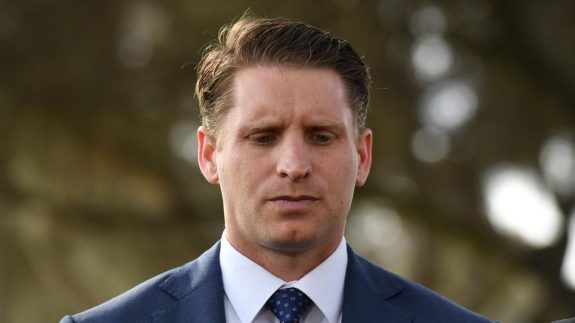
If one were to get into the head of Australian government MP Andrew Hastie, a security tangle of woe would no doubt await. Having been a captain with the Special Air Services and having also served in Afghanistan, he has been none too thrilled by the publicity soldiers he served with have received. The report by New South Wales Court of Appeal Justice Paul Brereton has now been mandatory reading (or skimming) for political and military watchers. Known rather dully as the Inspector-General of the Australian Defence Force Afghanistan Inquiry Report, it makes the claim that 39 alleged murders were inflicted on non-combatants by Australian special service units when operating in Afghanistan.

Hastie’s speech has a throbbing subtext: containment. Despite professing a belief in the rule of law and transparency, the overwhelming sense from the politician who chairs the Parliamentary Joint Committee on Intelligence and Security is that the Inquiry should have been kept indoors. Such bloodied laundry should never have been aired. That, at the very least, would have avoided public discussions about the egregious methods of Australia’s elite warriors, and the decisions behind deploying them in the first place.

Imperfect Releases: Andrew Hastie, War Crimes Reports and Australia in Afghanistan – » The Australian Independent Media Network

Old Dog thought- Are all Aus PMs so redfaced the LNP make the ALP look good. Howard ,Abbott,Morrison

Fighting Fake News with REAL 23/11/20; Australia internationally redfaced by Abbott and Morrison, SAS Afghanistan, Trump’s seemingly incompetant coup

Old Dog Thought- Toxic Subcultures in our Institutions driven by ‘Might is Right’

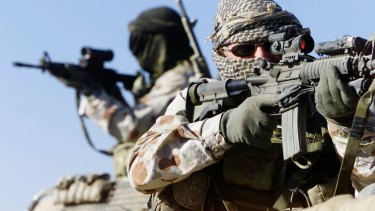
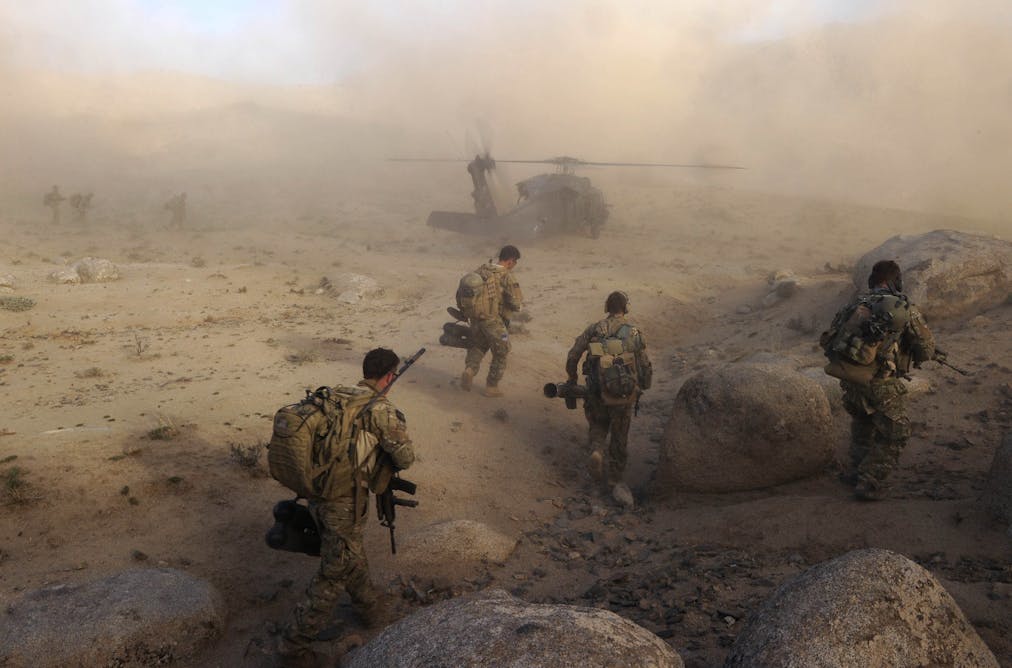
From intelligence gatherers to an effective commando unit ... Australian SAS soldiers in Afghanistan.

Fighting Fake News with REAL; 22/11/20; Like The ADF there’s a toxic subculture within the LNP; Australia’s leaders love the SAS; The business of War Memorials;

The reputation of Australia’s special forces is beyond repair — it’s time for them to be disbanded

Four years into a constant stream of misconduct allegations, it’s hard to know how to process the latest revelations about the actions of Australia’s special forces in Afghanistan.

The reputation of Australia’s special forces is beyond repair — it’s time for them to be disbanded

US marine says Australian special forces soldiers made ‘deliberate decision to break the rules of war’ – ABC News

A man in uniform leans up against a helicopter.
So difficult to arrive at what should be so easy

A US marine says Australians were known to leave “fire and bodies” in their wake in Afghanistan Australian soldiers from 2nd Commando Regiment told the ABC the US Drug Enforcement Administration refused to work with the November platoon in Afghanistan It is unclear if the alleged killing is covered in the Inspector-General of the Australian Defense Force’s inquiry US marine says Australian special forces soldiers made ‘deliberate decision to break the rules of war’ – ABC News

Old Dog Thoughts- Non compulsory voting booty call;

Fighting Fake News with REAL26/9/20 Lincoln Project Video; Australian SAS; 55 Charges over Education scam;Trump’s SCOTUS pick and contraversy;

Abdul’s brother went out to buy flour. He never came home

Behind closed doors, the words “war crimes” are being used. Not only specific incidents, but the entire culture and command structure of Australia’s most renowned and trusted fighting force is now under scrutiny in a manner unprecedented in Australian military history.

via Abdul’s brother went out to buy flour. He never came home

Tony Abbott in Iraq: How Australian media were left out: Abbott merely sloganises this war and has offered no indication of what we are doing there. How is he preventing it coming to Australia?


Abbott spoke with FA18 pilots on their return from an operational mission over Iraq. Pict

Tony Abbott in Iraq: How Australian media were left out.

Our SAS are training ghosts why are we there? Humpty Dumpty fell off the wall back in 2004: Abbott’s been silent for weeks talks as if we have done the job though.

Isis fighters parade through Mosul in an Iraqi army vehicle. The city was supposed to have 25,000 de

Isis fighters parade through Mosul in an Iraqi army vehicle. The city was supposed to have 25,000 defenders but 15,000 were ‘ghost soldiers’.

Iraqi government investigation finds 50,000 ‘ghost soldiers’ on army payroll

Missing soldiers explains rout of Iraqi forces in Mosul by Isis and city’s collapse in face of jihadis’ advance in June, say officials

Iraq’s new government has found 50,000 “ghost soldiers” who received army pay without showing up for work, a practice that accelerated the military’s collapse in the face of Islamic State (Isis) fighters six months ago.

The names were uncovered in an investigation inquiry launched by the prime minister, Haidar al-Abadi, who took office in September, his spokesman, Rafid Jaburi, said.

“Ghost soldiers” were are men on the army payroll who pay their officers a portion of their salaries and in return do not show up for duty, enriching their commanders and hollowing out the military force.

“Those 50,000 soldiers were revealed after an intense search through military documents and there will be a field search in order to put an end to this phenomenon and any other form of corruption,” Jaburi said.

Local officials in Mosul said the city should have been defended from an Isis attack in June by 25,000 soldiers and police, but in reality the number was at best 10,000. Islamic State militants took over the city with barely a fight.

The United States, which has spent billions of dollars trying to build up Iraq’s armed forces before it pulled out in 2011, has sent military advisers back to Iraq to train them to take on the Isis fighters who now control much of the north and west of the country.

Since taking over as premier from Nouri al-Maliki, Abadi has sacked dozens of military officials appointed during Maliki’s eight-year rule and pledged to root out corruption.

On Monday Abadi’s office announced that he had retired 24 senior interior ministry officials and replaced them with new officers under a reform plan to make the security forces “more effective in confronting terrorism”. The finance minister, Hoshiyar Zebari, told Reuters last week there was a need for deep-rooted reform of the security forces to fight corruption and mismanagement. “The military has to be cleaned of all these numbers, figures of ghost soldiers and other mismanagement,” he said.

UK SAS quad bike squads kill up to 8 jihadis each day: We remain ignorant of what Abbott’s SAS are doing?

IS PICKED OFF IN GUERILLA-STYLE RAIDS: Using precision sniper rifles, machine guns and surprise tactics, the SAS take out their IS targets before disappearing back into the desert

 British SAS quad bike squads kill up to 8 jihadis each day… as allies prepare to wipe IS off the map: Daring raids by UK Special Forces leave 200 enemy dead in just four weeks

  • Targets are identified by drones operated by SAS soldiers
  • Who are then dropped into IS territory by helicopter to stage attacks
  • The surprise ambushes are said to be ‘putting the fear of God into IS’
  • The raids are attacking IS’s main supply routes across western Iraq 

Graft hobbles Iraq’s army in fighting Islamic State

Graft hobbles Iraq’s army in fighting Islamic State.

These are the guys we are meant to train. We couldn’t do it over a 10 year period what on earth makes us believe we can do it now in such a short time particularly when we are really not wanted.The Iraqi army surrendered  2 years supply of  US weapons to Isis and some joined them. This is the organization we are there to train. The Shiia Militia and Sunni tribes wont fight along side the army yet these are the men we are meant to train. We just seem to be fighting like Abbott the boxer punching with our eyes closed.


USA 3000 AUS 200 the Devils Number 6.66% of our troops in Iraq. Only Baghdad

Australian troops ‘moving into locations’ in Iraq to assist with fight against Islamic State

Updated about an hour agoTue 11 Nov 2014, 10:56am

The Federal Government has left open the possibility of sending more troops to fight Islamic State (IS) militants, a day after confirming that special forces soldiers have begun moving into Iraq.

Australia sent a contingent of about 200 special forces to the defence base in the UAE in September, but they have been waiting there for a formal direction from the Iraqi government.

The troops have begun moving into the strife-torn country in the past week and will initially be placed in Baghdad in an “advise and assist” role.

US president Barack Obama said yesterday he is in talks with Australia and other coalition partners about how they can “supplement” their commitments.

Assistant Defence Minister Stuart Robert said no decision has been made about sending more troops and would not be made until the success of the current commitment could be gauged.

“The Prime Minister has not announced that and the Prime Minister has not made any statements to that effect – nor should we make any commitments further until we’ve actually bedded down what we’re putting into theatre right now,” he told NewsRadio.

“Our forces have now spent a number of days moving into locations. It will take more days to actually become effective in the advising and assisting.

“It will take weeks if not months for that training force to really come into effect.

“So let’s see what effect we can have on our ground before we jump further.”

Prime Minister Tony Abbott, who is in Beijing for the APEC summit, said yesterday that Australia continues to talk with its partners about fighting the terrorist group.

Tony Abbott, Iraq and the Anzac myth: The Anzacs sailed arrived and fought Abbot’s SAS are waiting waiting and even he has stopped sabre rattling out of embarassment.

View image on Twitter

PM Tony Abbott is using the centenary of WWI and the spirit of Anzac’ as a cynical propaganda exercise to build support for our latest foreign military adventure, writes

Young Australian men, their heads full of British, Australian and Empire propaganda rushed to the colours, much as young men are swallowing Islamic State propaganda and mistakenly rushing to the black flag. That is the fatal mix for young people — propaganda, emotion, a quest for adventure, dissatisfaction with current circumstances and off they go to meet the demands of cynical power brokers, who rarely fight.

Of the Australians who went overseas 150 in every 1,000 contracted venereal disease . The French averaged 83 cases per 1,000 and the Germans 110. The Australian rate was amongst the highest. Perhaps Abbott can weave that into one of his speeches?

WWI gives the lie to Christianity as a civilising influence.

For those at the front forced to endure days of high explosive shell fire ‒ to the point that they cried with terror, went temporarily or permanently mad, defecated and urinated involuntarily and then crawled out of trenches to face machine gun fire of between 500-700 rounds per minute ‒ it could be said that they were in Dante’s Inferno. Christianity failed to prevent the Armageddon of WWI and some might argue that it contributed to its onset.

The story of war, particularly the First World War should be told as it was and not as part of a propaganda exercise to get the Australian public to accept, yet again, the deployment of Australian forces to war on the sole discretion and authority of a prime minister who has not had the courage to send Australians overseas to fight Ebola in case they return with the disease and threaten his comfort zone.

Tell us about war Tony

Islamic State militants murder 322 Iraqi tribe members in Anbar province. According to Bolt these are the guys we are fighting NOW not waiting to fight.

Haider al-Abadi

Tribe leader Sheikh Naeem al-Ga’oud says he was not provided with any arms by the central government and army. Aren’t we supplying weapons anymore?

Islamic State militants have killed 322 members of an Iraqi tribe in western Anbar province, including dozens of women and children whose bodies were dumped in a well, the government said in the first official confirmation of the scale of the massacre.

The systematic killings, which one tribal leader said were continuing on Sunday, marked some of the worst bloodshed in Iraq since the Sunni militants swept through the north in June with the aim of establishing medieval caliphate there and in Syria.

The Albu Nimr, also Sunni, had put up fierce resistance against Islamic State for weeks but finally ran low on ammunition, food and fuel last week as Islamic State fighters closed in on their village Zauiyat Albu Nimr.

“The number of people killed by Islamic State from Albu Nimr tribe is 322. The bodies of 50 women and children have also been discovered dumped in a well,” the country’s Human Rights Ministry said on Sunday.

One of the leaders of the tribe, Sheikh Naeem al-Ga’oud, told Reuters that he had repeatedly asked the central government and army to provide his men with arms but no action was taken.

State television said on Sunday that prime minister Haider al-Abadi had ordered air strikes on Islamic State targets around the town of Hit in response to the killings.

Officials at a government security operations command centre in Anbar and civilians reached by Reuters said they had not heard of or witnessed air strikes.

The fall of the village dampened the Shia-led national government’s hopes the Sunni tribesmen of Anbar – who once helped US Marines defeat al-Qaida – would become a formidable force again and help the army take on Iraq’s new, far more effective enemy.

US air strikes have helped Kurdish peshmerga fighters retake territory in the north that Islamic State had captured in its drive for an Islamic empire that redraws the map of the Middle East. But the picture in Anbar is more precarious.

Islamic State already controls most of the vast desert province which includes towns in the Euphrates River valley dominated by Sunni tribes, running from the Syrian border to the western outskirts of Baghdad.

If the province falls, it could give Islamic State a better chance to make good on its threat to march on the capital.

Ga’aud said 75 more members of his tribe were killed on Sunday under the same scenario – they were hunted down while trying to escape from Islamic State, shot dead execution-style and dumped near the town of Haditha.

The Albu Nimr leader also said Islamic State killed 15 high school and college students in Zauiyat Albu Nimr and that, apart from an air drop, there had been no help from the US-led air campaign.

Security and government officials could not be immediately reached to confirm the latest killings.

In Anbar, the militants are now encircling a large air base and the vital Haditha dam on the Euphrates. Fighters control towns from the Syrian border to parts of provincial capital Ramadi and into the lush irrigated areas near Baghdad.

Will Australia fight Islamic State alongside Iraq’s army, or militias sponsored by Tehran? What Abbott doesn’t tell us

Iraq army recruits march during their training at Baghdad Combat School, Camp Taji, in Taji, Iraq.

SAS according to Abbott were waiting for the lawyers to start our war. Further we were to train the Iraqi army to fight not the Sunni tribes or the Iran backed Shiia militias who don’t even want us there. Now it seems we are there to train the most unreliable , corrupt rag bag army from the top down one could imagine. How long will that take? They are so unreliable the Sunni tribes and the Iran backed militias want nothing to do with them either as they can’t be trusted

It appears of the 300,000 only half can be found of those 11,000 were missing in action and 10.000 were known to have been killed. Even the country’s most vaunted Special Ops have 35% unaccounted for. So are we there to aid the Iran backed army or are we there just for Abbotts political ride.

When the northern city of Mosul fell to so-called Islamic State forces in June, the world wondered what had happened to the billions invested by the West in Iraq’s army. But it was what happened a few days later at a place called Camp Speicher that showed the true scale of the problem.

When hundreds of Iraqi officers fled Speicher to save their skins, thousands of terrified recruits left behind decided their best option was to open the gates and then to set out on foot for Baghdad, 180 kilometres to the south.

Leaderless and naive, they walked into the arms of IS forces who trucked them off to their death squads. IS boasted that it had massacred as many as 1700 of the young men, releasing gruesome video of some weeping and others begging to be spared before being gunned down in shallow desert trenches.

Yet in a cruel irony, when IS finally attacked the former US base at Speicher, the handful of officers and men who stayed on – including commanding officer Lieutenant-General Ali Furaji, 44 – fended off their attack.

The collapse of its military leaves Iraq at a crossroads.

Just as the democratic framework left by the US and its coalition partners, including Australia, is driven more by the imperatives of Shiite Islamist political parties, the defence of the country could now fall into the hands of the militias of those same parties, who take guidance and arms from neighbouring Iran and are already comfortable issuing orders at joint command meetings, according to a senior Iraqi intelligence source.

These militias are impatient with the Iraqi Army and with the air strikes by a new US-led coalition, again with Australia along for the ride. They complain the strikes are too casual and infrequent, and seemingly are more about surveillance than about dropping munitions that might repel IS.

Some of Iraq’s Sunni tribes have declared war on IS, but they hesitate to line up with the Iraqi authorities in Baghdad. When Mosul fell, Sunni tribal chief Sheikh Ali Hatem al-Suleiman al-Dulaimi told local reporters the tribes in western Anbar province “consider [former prime minister Nouri al-] Maliki more dangerous than IS”.

If the real battle against IS is to be waged by Shiite militias, how do Washington and other Western capitals finesse the reality that in fighting alongside those militias, they become de facto allies of Tehran, with which they are in bitter conflict on almost every key issue in the region? Is the Australian Defence Force going to war with a disciplined, professional military loyal to its government, or with an unruly, self-willed band of militias more aligned with the near-pariah state next door?

An army for the highest bidder

Analysts in Baghdad and other informed sources, including a recently retired army general who cannot be named for reasons of security, confirm that for many in the officer corps and the ranks, the army is a milch cow, not a fighting force.

During and after the collapse at Mosul, the army lost five of its 15 divisions and ceded huge stores of US-supplied weapons and equipment to IS. By the reckoning of analyst Hisham al-Hashimi, only half of the army’s 300,000 establishment can ever be counted as genuine “boots on the ground”.

“About 11,000 are missing in action, 10,000 were killed in action and most of the rest are simply absent without leave,” Dr Hashimi said. Even the country’s vaunted Special Operations forces were depleted by 35 per cent, he said.

Another source who had observed the Iraqi Army at close quarters for some years explained the concept of the military “alien”, a soldier who, even in the midst of a national security crisis such as that now facing Iraq, cuts a deal with his senior officers to split his salary in return for not having to front for duty.

In Anbar, the vast western province that IS is on the verge of capturing, the “alien” problem means the official strength of the army divisions in the fight is 60,000 – but only 20,000 men are actually on the ground.

Soldiers also buy days off duty, paying the equivalent of $US20-$US30 a day to their officers for permission to absent themselves.

Most senior officers pay $US1 million or more to buy their rank – and the opportunities for patronage and corruption that go with it. The retired general told me: “It’s like a market – supply and demand. You have something that hundreds want, so of course they’ll pay.”

Citing well-heeled areas of Baghdad like Mansour and Karrada, another source explained: “Competition for officer positions in wealthy areas is especially fierce. That’s where there are liquor stores, parking lots and many shops – they extort money from all. The operator of a parking lot could pay $US2000-$US5000 a month to have the military direct all vehicles into his lot; and the liquor seller pays just so that he won’t be harassed.”

These commanders-turned-entrepreneurs regularly set revenue targets that had to be met by their subordinates, which resulted in many in the ranks having to buy their own food. In the 50-degree heat of summer some soldiers got only two to four 500ml bottles of drinking water a day.

And the US had a hand in this state of affairs, too. In the early days of the occupation in 2003, the decision was made by US officials that all division commanders would have their own budget to acquire food and other necessities from local private enterprise. The officers soon worked out that highway checkpoints were readymade “toll stations”, at which truckers were forced to pay a levy to pass.

All this explains a litany of local reports of army bases around the country surrendering while besieged by IS, and troops complaining later that their pleas for food, water and ammunition went unanswered. “When’s the last time you heard of IS being surrounded by Iraqi forces and running out of ammunition?” one source quipped.

Retired US general Jim Dubik, who led the US effort to train Iraqi forces in 2007-08 and who is now with a Washington think tank, told Reuters in June: “Their leadership has eroded. If you’re a fighter and you think your side’s going to lose, you don’t fight until the last man. You save yourself.”

But Anthony Cordesman, with the Washington-based Centre for Strategic and International Studies, takes General Dubik’s training program to task: “The US tried to impose too many of its own approaches to military development on an Iraqi structure, and Iraq lacked the internal incentives, and checks and balances, necessary to make them function once US advisers were gone.

“As in Vietnam and Afghanistan, the US accomplished a great deal. But it tried to do far too much, too quickly with more emphasis on numbers than quality, and it grossly exaggerated unit quality in many cases … Successful force-building takes far longer than the US military was generally willing to admit, and US efforts to transform, rather than improve, existing military cultures and systems have often proved to be counterproductive and a waste of effort.”

The two generals who openly abandoned their troops in Mosul with hardly a shot fired were retired without charge and within days. One of them, Abboud Qanbar, shamelessly toasted the Baghdad establishment as he presided over a lavish wedding for his son at the Hunting Club in suburban Mansour. There are vocal calls for punishment, but none of the derelict officers has been formally charged, though many of Mr Maliki’s hundreds of personal appointments to the officer corps could be sidelined in a review of the military leadership promised by Iraq’s new Prime Minister, Haider al-Abadi.

The 2003 decision by Paul Bremer, Washington’s envoy to Iraq, to completely disband the military required that it be rebuilt from the ground up – a “reckless decision that had huge negative impact”, one militia leader told me.

Again and again I was told the training by US and other coalition countries for the new force was inadequate – “it was all too brief, it was not reinforced and the army was deployed for too long doing what essentially was police work – manning checkpoints and the like weakened their morale”.

On the prospects of rebuilding the force, the retired general ruefully asked: “Do you think you can rebuild in two years what previously took 80 years to build? An army has to rise above religion and party policy, but the government wants to work with the militias that agree with its ministers.”

The confidence men

At the Defence Ministry headquarters on the banks of the Tigris River, a visitor is struck more by indolence than a sense of urgency. But chief spokesman Brigadier-General Mohammad al-Askari speaks with confidence – he acknowledged much of the fight was being taken to IS by the militias and tribal fighters, but he insisted too that reports that the capital might soon fall to IS were wildly exaggerated.

“IS does have sleeper cells in Baghdad, but what is their size? If they have tens of people in a city of millions, it’s not the same as the city being surrounded. Baghdad is secure and we have more troops here than we need.”

General Askari argued Iraqi Army units were mounting a serious challenge to the IS rampage across Anbar, a vast desert expanse stretching west from Baghdad to the Jordanian and Syrian borders.

“We control three major bases and we’re slowly expanding our area of operations,” he claimed, despite reports of a more tenuous ebb and flow in the Anbar fight. “We still need more troops and a lot of international cooperation – logistics and air cover.

“But we’re better off than we were – we are on the offensive and things will start to improve.”

At the same time, he acknowledged that “Iraq was saved” in June when leading Shiite cleric Ayatollah Ali al-Sistani issued a fatwa urging Iraqis to volunteer to fight, thereby swelling the ranks of the militias more than those of the Iraqi Army.

“Everyone was abandoning the army, morale was in freefall, but the fatwa brought balance, nationalism and a sense of patriotism for the Shiites and Sunnis – our blood is mixed on the battlefield.”

Some battlefield success may bring a glimmer of hope. But in iconic contests, like the defeat in September of the IS siege of Amerli, 180 kilometres north of Baghdad, it was the banners of four militias, not that of the Iraqi Army, that were cheered by locals, and little was made of the US air cover that sealed the town’s relief.

Sheikh Abdul Hamid al-Juburi, described as being in control of all the Sunni tribes in central Salaheddin province, still has reservations. Over a grand tribal lunch, he told me: “The government troops are not up to this fight, they’re standard military fighting gangsters and because they don’t have sufficient numbers they disperse when they feel the heat.”

The sheikh, who has hundreds of his tribesmen fighting in wild clashes with IS across the province, likened the force of IS to water behind a dam, adding hopefully: “When we collapse the dam, there’s a huge gush of water, but then it becomes a small, manageable stream.”

The country has a new prime minister who is promising change and reform. But some Iraqi observers are not holding their breath. “The same players are there as he reshuffles the seats – and IS just carries on, like a professional boxer attacking a bunch of kids,” one said.
Our Prime Minister thinks the war back home is the easiest but we don’t have enough POW camps

Photo

Null

Real Media, Alt News, Politics, Critical Thought, War, Global events, Australia, Headlines,