BAGHDAD – (CT&P) – Islamic State militants have curtailed the amount of water flowing to government-held areas in Iraq’s western Anbar province, an official said Thursday, the latest in the vicious war as Iraqi forces struggle to claw back ground held by the extremists in the Sunni heartland.
It’s not the first time that water has been used as a weapon of war in Mideast conflicts and in Iraq in particular. Earlier this year, the Islamic State group reduced the flow through another lock outside the militant-held town of Fallujah, also in Anbar province. But the extremists soon reopened it after criticism from the media and threats of boycotts on the Islamic State from more progressive terrorists and business leaders in surrounding provinces.
The reduced flow of water through the militant-held dam on the Euphrates River will threaten irrigation systems and water treatment plants in nearby areas controlled by troops and tribes opposed to the extremist group, provincial council member Taha Abdul-Ghani told the Associated Press.
Abdul-Ghani said there would be no immediate effect on Shiite areas in central and southern Iraq, saying water is being diverted to those areas from the Tigris River.
The United Nations had said on Wednesday that it was looking into reports that ISIS had reduced the flow of water through the al-Warar dam.
ISIS CEO Abu Bakr al-Butthollah told reporters from Al Jazeera that the actions were perfectly justified under the Islamic State’s new “Religious Freedom Restoration Act, enacted last December.
“We got the idea from Indiana and other misguided, backwards-ass states located in the Great Satan,” said Butthollah. “We have to protect our employees’ deeply held religious beliefs. Our supreme court already upheld the law with its landmark decision in Unexploded Ordnance Lobby v Omar last month.
“There’s just no way that we’re going to force any of our employees to serve water to infidels with alternative lifestyles, and I think Allah would be proud of the stand we’re taking for bigoted assholes all over the globe.”
United Nations officials have reacted with dismay to the policy, as it has to the ridiculous attempts to make homosexuals second-class citizens within the U.S.
“The use of water as a tool of war is to be condemned in no uncertain terms,” the spokesman for the UN secretary-general, Stephane Dujarric, told reporters. “It is just a damn shame that these throwbacks from the Middle Ages still exist in state governments around America and in the Middle East as well. These kinds of reports are disturbing, to say the least.”
On Tuesday, the international community was shocked to learn of the barbaric murder of Jordanian Air Force Pilot Lt. Muath Al Kassasbeh. Jordanians lost a brother and a son, and passionate emotions of grief and anger spread across the entire country.
While our heartbreak and anger may push us towards seeking revenge, let us hone in on our emotions to unite in our humanity instead. Beyond any military war, it is the love and compassion encouraged by Islam and all religions that is our greatest weapon.
I grew up in Jordan, but any visitor and guest of the country will tell you of the great qualities of hospitality and generosity its people transmit. It is no coincidence that it is such a country that has overcome a range of political, economic, and social challenges, consistently opening itself up to aid refugees and fellow Arab populations in times of need despite significant resource constraints.
As we continue to mourn the death of the brave martyr, let me explicitly note that ISIS is not an extremist version of Islam. Their followers in no way, shape, or form, abide by any version of Islam, let alone any other religion. Let us in our reaction and remembrance of Muaath expose ISIS for what they truly are, nothing more than a collection of monsters. Let us delegitimize them by exercising the true meaning of Islam, a religion that was built on love and compassion to overcome an era of ignorance (Jahl) that ISIS embodies today.
With Islamic State militants just kilometres from the country’s western border, and increasingly radical anti-Shia militants to the east in Pakistan, Gareth Smyth examines Iran’s Sunni problem
Nearly ten years ago, a story circulating in Tehran had Mohammad Khatami say of Mahmoud Ahmadinejad, his successor as president, “No matter how extreme you are, you will always be in a queue behind Ousama [bin Laden].”
This may well have been an urban folk tale, but it highlighted a fear that Ahmadinejad’s assertive Shi’ism was not in Iran’s best interests. Rather than spread Iranian influence, unleash a revolution of the world’s dispossessed, or liberate Jerusalem from the Israelis, Iranian radicalism carried the danger of a backlash from Sunnis Muslims, who are around 80% of the world’s 1.6 billion Muslims, while Shia are 10-15% and a majority in only Iran, Iraq, Azerbaijan and Bahrain.
Is that nightmare now becoming real? Today the Islamic State (Isis), which regards Shia as infidels and has killed thousands, is barely kilometres from the Iranian border in Iraq’s Diyala province. But if the rapid rise of Isis to the west has alarmed the Iranian public, there are also developments to its east.
Several Pakistan Taliban commanders have declared their loyalty to Isis, including former spokesman Shahidullah Shahid. There are reports of Isis establishing an affiliate, Ansar-ul Daulat-e Islamia fil Pakistan, and luring recruits from two Sunni militant groups, Lashkar-e Jhangvi and Ahl-e Sunnat Wai Jamat.
For 30 years, Pakistan has been a centre of a brand of Sunni extremism, related to Saudi Wahhabism, that considers Shia apostates. Violence against Shia has killed thousands in recent years. In Baluchistan, neighbouring Iran, eight Shia were taken from a bus in October and gunned down in Quetta, the provincial capital.
A Human Rights Watch report in June highlighted a litany of atrocities against Shia, especially against ethnic Hazara in Baluchistan province, that have killed many hundreds in recent years, including two bombings in Quetta in 2013 in which at least 180 died.
Pakistani Baluch army recruits take part in a training exercise in Quetta in 2010.
Facebook
Twitter
Pinterest
Pakistani Baluch army recruits take part in a training exercise in Quetta in 2010. Photograph: Aamir Qureshi/AFP/Getty Images
It is not easy for Iran to isolate its own territory. Around 10 million Baluchis straddle Iran’s Sistan-Baluchistan and Pakistan’s Baluchistan, both poor provinces with widespread drug smuggling.
Advertisement
Last year Iran executed 16 members of Jundallah, which had carried attacks on Iranian security forces, mixing Baluchi nationalism with al-Qaeda style practices including beheadings, and declared its insurrection over.
But a new group, Jaish al-Adl, appeared and in February captured five border guards, provoking a drawn-out crisis that provoked major social media activity among alarmed Iranians before mediation by the main Sunni leader in Sistan-Baluchistan, Abdul-Hamid Esmaeel-Zehi, secured the release of four.
Iran fears both that the United States and Saudi Arabia have encouraged Jundallah, alleging when it captured and hanged its 27-year-old leader Abdul-Malik Rigi in 2010 that he had visited the US air base in Bagram, Afghanistan, shortly before his capture. The New York Times has recently offered new evidence of US intelligence involvement with the group.
Iran is also aware of collusion between sections of Pakistani security – especially Inter-Services Intelligence (ISI) – with militant Sunni groups, which goes back at least to both Saudi and Pakistani intelligence fuelling jihad against Russia in Afghanistan in the 1980s.
Hence the limits of last year’s bilateral agreement with Pakistan to co-operate against crime and security threats were exposed by several weeks of recent border tensions. In October, Tehran warned Pakistan after militants killed at least four Iranian soldiers or border guards, and then reportedly crossed the border (17 October) and, according to Pakistan, killed one and wounded three border guards. This culminated, a few days later, with the two sides’ armed forces exchanging mortar fire and the dispatch of a deputy Iranian foreign minister for urgent talks.
Pakistani officials have denied Iran’s claims that insurgents use Pakistan as a base, with some arguing unrest has its origins in legitimate Baluchi resentment. With support growing for Isis, this is no time to be “soft” on Shia Iran.
But for Iran, the Baluchi make a Sunni-Shia conflict domestic. Inside Iran, Sunnis are around 10% of the country’s 78 million people and are mainly ethnic Baluchi or Kurds. Extreme Sunni militancy has made far less headway among the Kurds than among the Baluchi, partly due to the influence of Sufism and the strength of pre-Islamic Kurdish culture, but a growth in Kurdish nationalism caused by both Syrian and Iraqi Kurds fighting Isis has its own implications for Iran’s 8 million Kurds.
But in any case, all Iran’s Sunnis allege discrimination in government employment and investment, and begrudge the absence of a Sunni mosque in Tehran and the common naming of buildings and streets in Sunni provinces after Shia leaders.
President Hassan Rouhani has promised to address the grievances of both ethnic and religious minorities. In last year’s presidential election, he did better in Kordistan province (which is not all of the mainly Kurdish region) with 71% and Sistan-Baluchestan (of which Sistan is mainly Shia) with 73% compared to 51% nationally. But delivery is far from easy, as Mohammad Khatami found when he made similar promises.
While there is political opposition to reform both among Shia clerics and the political class, Iranian security favours “strategic depth”, whereby border provinces are heavily militarised to create a buffer, an approach that can fuel resentment as much as improve security.
In terms of politics, Iranian leaders have been at pains to deny there is a regional battle between Shia and Sunnis and to argue that Sunni militants should be distinguished from the wider Sunni community. Ayatollah Ali Khamenei, the supreme leader, has called several times in recent months for Muslim unity. He told Iranian hajj officials in late October that the “ummah shouldn’t practise hostility towards each other, but should support each other over important global issues”.
But does at least some hostility towards Shia – and therefore rise of militant Sunni groups – stem from the behaviour of Iran and its allies?
An Iranian Revolutionary Guard covers his chest with a portrait of Lebanon’s Hezbollah leader Hassan Nasrallah.
Facebook
Twitter
Pinterest
An Iranian Revolutionary Guard covers his chest with a portrait of Lebanon’s Hezbollah leader Hassan Nasrallah. Photograph: Behrouz Mehri/AFP/Getty Images
The 2003 US-led invasion of Iraq unnerved the Sunni-led states, especially Saudi Arabia, by creating a new, Shia-led order in Baghdad that Iran welcomed. In 2008, Hezbollah’s military assertion in west Beirut, in response to a Sunni-led government challenging its security role at the airport, alienated “moderate Sunnis”. Above all, by 2012 the Syrian war appeared clearly sectarian as an Iranian-backed, Allawi-led regime confronted mainly Sunni rebels.
Since Isis took Mosul in June, Iran’s approach in Iraq has been rooted in Shia solidarity. Nouri al-Maliki, Iraqi vice-president and as former prime minister widely blamed for alienating Iraq’s Sunnis, was recently in Iran to improve what he called “mutual co-operation” against “Takfiri terrorists”. Shia militia leaders in Iraq have been quoted extolling the role of Qassem Soleimani, the head of the al-Quds section of Iran’s Revolutionary Guards, to the extent of leading a front-line operation in the recapture of Jurf al-Sakher from Isis, shunning a flak jacket in the process.
Human Rights Watch has documented abuses both by mainly Iraqi Shia government forces and by Shia militias (it has described the two as “indistinguishable”). After the killing of 34 civilians in a mosque in Diyala province in August, Joe Stork, HRW regional director noted: “Iraqi authorities and Iraq’s allies alike have ignored this horrific attack and then they wonder why the militant group Islamic State has had such appeal among Sunni communities.”
KHANKE, Iraq — The 15-year-old girl, crying and terrified, refused to release her grip on her sister’s hand. Days earlier, Islamic State fighters had torn the girls from their family, and now were trying to split them up and distribute them as spoils of war.
The jihadist who had selected the 15-year-old as his prize pressed a pistol to her head, promising to pull the trigger. But it was only when the man put a knife to her 19-year-old sister’s neck that she finally relented, taking her next step in a dark odyssey of abduction and abuse at the hands of the Islamic State.
The sisters were among several thousand girls and young women from the minority Yazidi religion who were seized by the Islamic State in northern Iraq in early August.
The 15-year-old is also among a small number of kidnapping victims who have managed to escape, bringing with them stories of a coldly systemized industry of slavery.
Their accounts tell of girls and young women separated from their families, divvied up or traded among the Islamic State’s men, ordered to convert to Islam, subjected to forced marriages and repeatedly raped.
While many of the victims are still living in areas of northern or western Iraq under the control of the Islamic State, also known as ISIS or ISIL, many others have been sent to Syria or other countries, according to victims and their advocates.
Five girls and women who recently escaped agreed to be interviewed at the end of October. Four of them were in Khanke, a predominantly Yazidi town in the far north of Iraq, and a fifth in the nearby city of Dohuk. Tens of thousands of Yazidi refugees have sought refuge in this region, in vast tent camps and in relatives’ homes, after fleeing their villages around the Sinjar mountains.
The five victims consented to speak publicly only on the condition that their names not be revealed for fear that the Islamic State would punish their relatives.
At first, though, the 15-year-old felt differently. “I want my name used because when the Islamic State reads it, it will be like a revenge for me,” she declared at the outset of her interview, though she soon demurred on the advice of a Yazidi advocate with her, only permitting the use of her initials, D. A. The militants, she said, were still holding most of her immediate family.
The Islamic State itself has openly acknowledged its slavery industry. In an article last month in Dabiq, the group’s online English-language magazine, the Islamic State said it was reviving a custom justified under Shariah.
“One fifth of the slaves were transferred to the Islamic State’s authority to be divided as khums,” a tax on war spoils, and the rest were divided among the fighters who participated in the Sinjar operation, the article said.
Yazidis follow a religion influenced by a medley of faiths, including Zoroastrianism, Judaism and Islam. But the Islamic State regards them as devil-worshiping pagans deserving of enslavement or death. By forcing Yazidi women and girls to marry Islamic State members and become their “concubines,” the article said, the group is helping to protect its fighters against committing adultery.
In a video posted last month on YouTube, men purported to be Islamic State fighters sit in a room and banter about buying and selling Yazidi girls on “slave market day.” One says he will check the girls’ teeth. Another says he will trade a girl for a Glock handgun. They discuss the relative value of girls with blue eyes.
“Today is the day of (female) slaves and we should have our share,” a fighter declares.
The Islamic State has kidnapped more than 5,000 Yazidis, and possibly as many as 7,000, most of them women and girls, according to Matthew Barber, a member of the Sinjar Crisis Management Team, an advocacy group that has conducted an extensive survey of displaced Yazidi families.
Human Rights Watch, in a report released last month, said the systematic abduction, abuse and killing of Yazidis might amount to crimes against humanity.
“We’ve all been living these cases,” said Amena Saeed, a former member of the Iraqi Parliament and a Yazidi who has been advocating on behalf of the kidnapped.
The Yazidis’ communal ordeal began on Aug. 3 when the Islamic State launched an attack on their villages in the Sinjar region, driving thousands to flee into the nearby mountains.
D. A. was part of that exodus, traveling in a car with her parents, five of her sisters and a niece. But their path was cut off by militant fighters who rounded them up, along with other families, and took them to a building in the town of Sinjar. There, the militants separated the female Yazidis and young children from the men and boys, then later in the day picked out the unmarried women and older girls, D. A. said.
“I was crying and grabbing my mother’s hand,” she said during an interview at a relative’s house in Khanke, a Yazidi village near Mosul Dam Lake. “One of the Islamic State members came and beat me and put a pistol to my head. My mother said I should go so I wouldn’t be killed.”
Along with dozens of other girls, D. A. and two of her sisters — one 19, the other 12 — were loaded onto a convoy of three buses and driven to the Islamic State stronghold of Mosul.
D. A. and her two sisters were held in a house there for nine days along with women and girls from other villages in the region, then they were taken to a three-story building crowded with hundreds of captives.
The building functioned as a kind of clearinghouse. Islamic State fighters would stop by and take their pick of the girls and young women. Some, perhaps in a reflection of their lower rank, would take only one girl, while others took more, D. A. and other escapees said.
The man who chose D. A. “was wearing a beard, though not a long one, and not very long hair,” she recalled. She refused to go at first, holding on to her older sister. But the sight of a dagger at her older sister’s throat convinced her to submit. Her 12-year-old sister looked on in stunned silence.
Over the next several weeks she was moved at least eight more times, among increasingly smaller groups of girls.
She was taken across the border into Syria. She remembers spending a day in a white house, next to a lake, near Raqqa, Syria, where Islamic State fighters engaged in another round of commerce involving the girls. She saw men haggling, money trading hands. “It was like an auction,” she recalled.
At that house, the girls were forced to shed their clothes, bathe and change into conservative Islamic garb. Some of the girls were as young as 11.
At one point, while she was being held in another house near Raqqa, D. A. tried to escape along with five other girls. But their attempt failed, and D. A., accused of being the ringleader, was severely beaten and imprisoned.
She was released into the custody of yet another jihadist who locked her in a house with several other girls.
The jihadist told them he was going to force them to marry him at the end of the week. They could hear another group of girls living in a different section of the house being taken away from time to time for sex.
None of the five escapees interviewed said they had been raped while in captivity. But one said she had fought off a sexual assault, and most said they had met other girls who had been raped, sometimes by several men.
Several advocates said that even if the girls had been sexually assaulted, they might never admit it, particularly not to a stranger. Some advocates said they were concerned that the shame surrounding rape might drive victims to suicide, though Ms. Saeed and other community leaders insisted that there had been no suicide attempts among the estimated 150 Yazidi escapees.
The threat of forced marriage led D. A. to consider killing herself, but instead she decided to try another escape. Late one night, she and another girl squeezed through a small window, and the two ran into the darkness, eventually coming to a house in a rural area. They took their chances, knocked on the door and a sympathetic-seeming young Arab man answered.
He took them to the house of a Kurdish family who then contacted D. A.’s brother, arranged a meeting in a Kurdish area of Syria and agreed that the girls’ families would pay $3,700 each to the Arab man for his help. (They withheld details of the transaction, including the route D. A. took out of territory controlled by the Islamic State, to protect the identities of those involved.)
Asked why the Arab took the extraordinary risk of helping the two girls, D. A. said, “I think he needed the money.”
That meshes with other accounts suggesting that a cottage industry of for-profit rescuers has sprung up in response to the Yazidi girls’ abductions. One 19-year-old woman, the daughter of a Yazidi police officer, said her family had paid a smuggler $15,000 to help her escape captors in Aleppo, Syria.
D. A.’s parents are still in captivity — if they are still alive — as are five sisters and her niece, relatives said.
Their absence, D. A. said, has left her feeling bereft. During the day, relatives, relief workers and television provide distractions. But at night, she said, when the house goes quiet and she is left alone with her thoughts, that is when it hurts the most.
Last week, the Guardian reported, “The United Nations has warned that foreign jihadists are swarming into the twin conflicts in Iraq and Syria on ‘an unprecedented scale’ and from countries that had not previously contributed combatants to global terrorism.”
“A report by the U.N. Security Council, obtained by the Guardian,” the story continued, “finds that 15,000 people have travelled to Syria and Iraq to fight alongside the Islamic State (ISIS) and similar extremist groups.”
Multiple news organizations picked up the Guardian’s scoop but added little. It seems that none had gotten the report, which the United Nations has not released.
But this is a huge story demanding lots more difficult reporting. Have 15,000 terrorist wannabes really trooped in to Iraq and Syria from what the Guardian reports the United Nations says is “more than 80 countries” to join a group whose major calling card is beheading Westerners for show and otherwise slaughtering nonbelievers?
That’s a huge number, dwarfing anything we have previously been told about the number of fanatics recruited from around the globe to join Islamic State’s fight.
What information is the United Nation basing its estimate on? Are the numbers real? Are they growing as fast as the Guardian’s story implies? Who carried out this “report” for the U.N. Security Council? If the recruits are able to be counted and even have their countries of origin identified, as the report implies, why can’t they be tracked and stopped?
Or, on closer look, is the report a vague estimate published to highlight the threat so that the world will pay attention?
Assuming the report’s findings look real, what is motivating recruits from as far afield as the Maldives, Chile, Russia and Northern Ireland? Who are these people?
Has Islamic State’s use of social media and other digital propaganda, including videos of the beheadings, worked so well that the group has been able to convene a convention of all the world’s crazies, arm them and send them out to battle? We need to read and see as many different case histories as reporters can gather.
That, of course, is easier said than done. Trying to get that story from any of those 15,000 recruits could, by definition, be a suicide mission. But reporters should at least try to track down the families of the recruits. The world needs to understand what is going on here.
Then there’s the question of how long the recruits are typically staying and what their leaders’ priority is. Are they being encouraged to come and get trained and then go home to fight? Or are they being encouraged to fight in Syria or Iraq as long as possible and only urged to continue the battle elsewhere once they decide to return home?
Which leads to all the unprecedented security issues — for the United States and every other civilized country — raised by the apparent burgeoning of an indoctrinated and trained army like this.
For starters, should this change the way we think about all the privacy issues raised by the Edward Snowden leaks that revealed the National Security Agency’s seemingly unbounded effort to track people? Should knowing that there are 15,000 trained fanatics roaming the world targeting Western democracies make us more willing to let agencies like the NSA sift through everything and everyone’s lives?
If we know that these recruits are getting into Iraq and Syria mostly through the border of one country, maybe Turkey, should a Western alliance execute a kind of reverse border-control strategy and line up all the forces necessary to block people from leaving Turkey for Syria or Iraq? Could we get the Iranians and Saudis to do the same thing from the east and south?
Are we already trying to do this?
Is there any way we can and should change our passport system — perhaps even by embedding chips in passports — so that we can actually know when people returning home have been in Syria or Iraq? Or other hot spots as they arise?
Finally, what are we trying to do, and what more can we do, to counter what appears to be an increasingly successful image campaign by the world’s worst villains?
In that regard, I’d like to see what my former colleague — former Time Managing Editor Richard Stengel — now under secretary of state for public diplomacy and public affairs — is up to. I’ve read lots of stories, like this one, extolling Islamic State’s social media savvy and referring vaguely to how Stengel and others are trying to counter it.
But these reports have not pinned down what Stengel has been trying to do and whether and why it has worked or failed.
Have bureaucratic or other constraints (the constraints of political correctness, perhaps) limited Stengel? What other, more creative or aggressive measures do private-sector messaging experts suggest we try?
An army of 15,000 (and growing) violent, crazy people — with many carrying U.S. passports or passports from countries where they don’t need visas to come to the United States — should start everyone thinking outside the box. And an army of journalists should be tracking all that.
You get three choices, pay the Islamic State tax, convert or die.Then the first choice is taken off the table. That makes it quite simple. Convert or die. On my first day here in Jordan I came face to face with Iraqi Christians who had less than an hour to flee the advancing Islamic State. Standing in the bustling refugee processing centre in Amman, an Iraqi family tell me their story.
It was June in Mosul and many thought the Peshmerga forces would stop the murderous militants from swamping their city. They were wrong.
While the Iraqi families consider their resettlement options, Jordan is being faced with it’s own Islamic State ultimatum. The rise of the brutal jihadis has forced countries like Jordan to choose between security and humanity.As we walk through hundreds of refugees at the UNHCR’s Amman processing centre, the organisation’s head Andrew Harper tells me that fear of Islamic State militants crossing the border has been a game changer here in Jordan and other neighbouring countries.
“The humanitarian focus has now been surpassed by the security focus,” Andrew Harper goes on to explain that in the last month very few refugees have been allowed to cross the Syrian border in Jordan. October was the lowest intake in two years.That’s created a nightmare situation where vulnerable Syrian refugees fleeing the Islamic State are starting to pile up at the border.
Andrew Harper tells me there are 5000 asylum seekers piled up at Jordan’s eastern border crossing with Syria.
“Anyone who is stuck at a border and is not allowed in is a massive concern because it’s my job to make sure that people fleeing violence have access to safety.”It’s obviously a tricky balance. While Jordan has been incredibly generous in accepting over 600,000 refugees they are now part of the US led coalition at war with the Islamic State.
If security concerns means thousands of refugees stuck at the border become sitting ducks for Islamic State militants it will take this three year long catastrophe to another level.
JIHADISTS are encouraging attacks on Australian teachers working abroad, the Department of Foreign Affairs and Trade has advised expatriates.
DFAT on Friday night updated its terror threat advice in light of an online forum post, which urged attacks against teachers at international schools around the world.
However, DFAT says it’s not aware of any specific information to suggest an attack is being planned.
“A recent posting on a jihadist forum website encouraged attacks against teachers, including Australian teachers, at international schools around the world,” the advice said.
“The post does not represent planning for an attack, nor are we aware of any specific information to suggest an attack is being planned.
“We encourage Australians involved with international schools, who may have concerns, to engage with the school to ensure it is aware of the threat and that appropriate security arrangements are in place.”
The jihadist post notes the presence of international schools in Saudi Arabia, United Arab Emirates, Qatar, Egypt, Jordan, Turkey, Bahrain, Oman, Kuwait, Sudan, Tunisia, Nigeria, Morocco, Malaysia, India, Bangladesh and Indonesia.
It makes specific mention of two schools — in Jeddah, Saudi Arabia and the suburb of Ma’adi, in Cairo, Egypt — where numbers of teachers at international schools reside, DFAT says.
The new advice follows the federal government last month raising the domestic terror alert level to high.
DFAT reminded Australians that even where attacks may not specifically target Australian interests, Australians could be harmed.
“In the past decade, Australians have been killed and injured in terrorist attacks in Nairobi, Mumbai, Jakarta, London and Bali.”
Travel advisories for Australians are available on the smartraveller.gov.au website and are reviewed and reissued regularly.
UN report suggests decline of al-Qaida has yielded an explosion of jihadist enthusiasm for its even mightier successor organisations, chiefly Isis
The United Nations has warned that foreign jihadists are swarming into the twin conflicts in Iraq and Syria on “an unprecedented scale” and from countries that had not previously contributed combatants to global terrorism.
A report by the UN security council, obtained by the Guardian, finds that 15,000 people have travelled to Syria and Iraq to fight alongside the Islamic State (Isis) and similar extremist groups. They come from more than 80 countries, the report states, “including a tail of countries that have not previously faced challenges relating to al-Qaida”.
The UN said it was uncertain whether al-Qaida would benefit from the surge. Ayman al-Zawahiri, the leader of al-Qaida who booted Isis out of his organisation, “appears to be maneuvering for relevance”, the report says.
The UN’s numbers bolster recent estimates from US intelligence about the scope of the foreign fighter problem, which the UN report finds to have spread despite the Obama administration’s aggressive counter-terrorism strikes and global surveillance dragnets.
“Numbers since 2010 are now many times the size of the cumulative numbers of foreign terrorist fighters between 1990 and 2010 – and are growing,” says the report, produced by a security council committee that monitors al-Qaida.
The UN report did not list the 80-plus countries that it said were the source of fighters flowing fighters into Iraq and Syria. But in recent months, Isis supporters have appeared in places as unlikely as the Maldives, and its videos proudly display jihadists with Chilean-Norwegian and other diverse backgrounds.
“There are instances of foreign terrorist fighters from France, the Russian Federation and and the United Kingdom of Great Britain and Northern Ireland operating together,” it states. More than 500 British citizens are believed to have travelled to the region since 2011.
The UN report, an update on the spread of transnational terrorism and efforts to staunch it, validates the Obama administration’s claim that “core al-Qaida remains weak”. But it suggests that the decline of al-Qaida has yielded an explosion of jihadist enthusiasm for its even mightier successor organizations, chiefly Isis.
Those organisations are less interested in assaults outside their frontiers: “Truly cross-border attacks – or attacks against international targets – remain a minority,” the report assesses. But the report indicates that more nations than ever will face the challenge of experienced fighters returning home from the Syria-Iraq conflict.
Wading into a debate with legal implications for Barack Obama’s new war against Isis, the UN considers Isis “a splinter group” from al-Qaida. It considers an ideological congruence between the two groups sufficient to categorise them as part a broader movement, notwithstanding al-Qaida’s formal excommunication of Isis last February.
“Al-Qaida core and Isil pursue similar strategic goals, albeit with tactical differences regarding sequencing and substantive differences about personal leadership,” the UN writes, using a different acronym for Isis.
Leadership disputes between the organisations are reflected in the shape of their propaganda, the UN finds. A “cosmopolitan” embrace of social media platforms andinternet culture by Isis (“as when extremists post kitten photographs”) has displaced the “long and turgid messaging” from al-Qaida. Zawahiri’s most recent video lasted 55 minutes, while Isis members incessantly use Twitter, Snapchat, Kik, Ask.fm, a communications apparatus “unhindered by organisational structures”.
A “lack of social media message discipline” in Isis points to a leadership “that recognizes the terror and recruitment value of multichannel, multi-language social and other media messaging,” reflecting a younger and “more international” membership than al-Qaida’s various affiliates.
With revenues just from its oil smuggling operations now estimated at $1m daily, Isis controls territory in Iraq and Syria home to between five and six million people, a population the size of Finland’s. Bolstering Isis’s treasury is up to $45m in money from kidnapping for ransom, the UN report finds. Family members of Isis victim James Foley, an American journalist, have questioned the policy of refusing to pay ransoms, which US officials argue would encourage more kidnappings.
Two months of outright US-led war against Isis has suffered from a lack of proxy ground forces to take territory from Isis, as Obama has formally ruled out direct US ground combat. On Thursday at the Pentagon, General Martin Dempsey, the chairman of the Joint Chiefs of Staff, said that the US has yet to even begin vetting Syrian rebels for potential inclusion in an anti-Isis army it seeks to muster in Syria. Dempsey encouraged the Iraqi government to directly arm Sunni tribes to withstand Isis’s advances through the western Anbar Province.
Islamic State (IS) militants have released 25 Kurdish schoolchildren who were kidnapped by fighters in northern Syria in May, a rights group says.
IS militants abducted more than 150 children, aged 13 and 14, as they were returning to their hometown of Kobane after sitting exams in Aleppo, the British-based Syrian Observatory for Human Rights (SOHR) said.
The 25 were the last of the children to be freed by the jihadists.
Five others were allowed to leave earlier this week before the final group were released on Wednesday, the SOHR said.
“It is true. They were released from (the Syrian town of) Minbij. This is the last part of the releases,” Idris Nassan, deputy foreign minister of Kobane district, said.
He said he did not know why the children had been released, but suggested it could be part of a “propaganda” campaign.
Fifteen children were released in June as a hostage swap to free three IS militants held by Kurdish forces, according to the New York-based Human Rights Watch.
Two boys who escaped captivity told local media the IS group was forcing the children to undergo lessons in jihadist ideology, the rights group said.
The children’s release comes on the same day IS fighters executed more than 40 members of a tribe that fought against them in Iraq’s Anbar province, officials said.
The men from the Albu Nimr tribe were killed in Hit, northwest of the capital Baghdad.
A police colonel and a leader from the anti-jihadist Sahwa forces confirmed the killings.
IS has overrun large areas of Anbar, and the killings are likely aimed at discouraging resistance from powerful local tribes, who will be key to any successful bid to retake the province.
Pro-government forces have suffered a string of setbacks in Anbar in recent weeks. That has prompted warnings the province, which stretches from the borders with Jordan and Saudi Arabia to the western approach to Baghdad, could fall entirely.
IS militants have spearheaded an offensive that has overrun much of the country’s Sunni Arab heartland since June.
“Many antique collectors unwillingly support terrorists like Islamic State, ” Michel van Rijn, one of the most successful smugglers of antique artifacts in the past century, told German broadcaster Das Erste this month.
And smuggling is booming in Iraq and Syria right now. In Iraq, 4,500 archaeological sites, some of them UNESCO World Heritage sites, are reportedly controlled by Islamic State and are exposed to looting. Iraqi intelligence claim that Islamic State alone has collected as much as $36 million from the sales of artifacts, some of them thousands of years old. The accounts data have not been released for verification but, whatever the exact number is, the sale of conflict antiquities to fund military and paramilitary activity is real and systematic.
Grainy video from soldiers fighting for President Bashar al-Assad’s regime at Palmyra, an ancient capital in what is now Syria, shows delicate grave reliefs of the dead, ripped out, gathered up and loaded into the back of their truck. The soldiers present the heads of decapitated statues to the camera. Other stolen Palmyrene treasures were exposed by an undercover reporter for The Sunday Times.Sculptures, pillar carvings and glass vessels were found to be on sale for knock-down prices in Beirut, Lebanon. Roman vases had been robbed from graves and were being sold by the box.
How much — and even what — has been bought and sold isn’t known for sure, but entire sites are being lost.
The International Council of Museums’ Emergency Red Lists, which document cultural objects at risk of looting in Iraq and Syria, include clay tablets that preserve some of the earliest writing in the world, intricate stone carvings and coins, in addition to the other items mentioned above.
Penn Cultural Heritage Center’s Brian Daniels revealed to the New Yorker that he had seen such items for sale in border town markets in Turkey.
Of course, it is hard to prove how many of the looted antiquities have made it to the West. And Kate Fitz Gibbon, a lawyer who advises antiquities collectors, argues that there is “no credible evidence that looted art is coming from Syria to [the] U.S.” and that, rather, it is flowing “unchecked to Turkey, the Gulf States and other nearby nations.”
Still, experts have shown a 145 percent increase in American imports of Syrian cultural property and a 61 percent increase in American imports of Iraqi cultural property between 2011 and 2013, which suggests that the illicit trade is reaching American consumers by ‘piggybacking’ on the legal trade. Furthermore, archaeologists Jesse Casana, Mitra Panahipour and Michael Danti have found evidence that looters are specifically targeting Classical antiquities in order to supply what is mostly a Western demand for Greek and Roman art.
An investigative report by the German broadcaster NDR documented evidence that antiquities looted by terrorist groups were being sold through German auction houses. The report revealed how Syrian conflict antiquities were smuggled as handicrafts, laundered with obscuring or outright false documentation, and then sold on the open market. It also exposed the transfer of antiquities to Gulf States, where they were laundered for resale in Western markets.
We must not be misled by antiquities collecting lobbyists’ insinuation that Syria or Iraq’s antiquities are better smuggled than burned by the various groups of militants – the smuggling pays for the burning. Paramilitary profits from looting and smuggling underwrite the cost of war, ethnic cleansing and genocide.
There’s real urgency here. These glimpses into our past are disappearing before we can learn from them or they can be shared with their creators’ descendants. They will end up as art divorced from its culture – some in unscrupulous museums that hope they have been laundered just enough to appear clean, many more displayed as talking pieces in the homes of the wealthy or secreted away in private collections.
The UN Security Council unanimously, which is a rare occasion during the recent years, adopted a resolution on the fight against terrorism. Pravda.Ru interviewed executive secretary of the Presidium of the Academy of Geopolitical Problems, Araik Stepanyan, about old and new threats in the Middle East and in the whole world.
“Why did Russia support the United States? Not that long ago, there was heated debate on the USA’s interference in the internal affairs of Syria and Ukraine. In fact, the United States wants to destroy Russia by the hands of Ukrainian fascists. Yet, Russia supported the States. Why so?”
“Russia has its list of terrorist organizations. Some of them, included on our list, are not included on the list of the United States. They consider them fighters for freedom and democracy and support some of them. Russia calls for the coordination of databases of terrorist organizations, so that they are clearly considered as terrorist organizations for the whole world. In this case, it would be possible to catch members of such organizations and bring them to trial, rather than simply bomb sovereign states. Russia voted for coordinated legal international action.”
“Do we have a certain interest at this point?”
“Of course. The USA and Turkey did not consider ISIS a terrorist organization. Russia does not consider the Kurdistan Workers’ Party a terrorist organization, but the Americans consider them as such. Russia considers the Muslim Brotherhood a terrorist organization, but the Americans do not. We have different opinions. Even Egypt found Muslim Brotherhood a terrorist organization. So we do have our own interests here. Moreover, Russia may even restrict the Americans in their actions to a certain extent. It is very hard to convince the Americans to give up their positions. They are stubborn, even if they are wrong. This is their view and their policy.”
“Russian Foreign Minister Lavrov diplomatically did not name those who are directly responsible for the growing threat of the Islamic State. He said that the bombing of Libya and the Syrian conflict led to the fact that ISIS now poses a huge threat to the world. He does not call Western countries responsible for that. Is it a part of covert struggle to change the Americans’ position on Ukraine, support the USA in the fight against ISIS and obtain their neutrality in Novorossiya?”
“The rhetoric of the Russian foreign minister represents Russian diplomatic school. His remarks are indeed diplomatic. He is absolutely correct not to name responsible sides specifically, because it includes the entire intelligence network of the United States represented by Al-Qaeda and Al-Nusra, from which ISIS broke away. These are the structures that the Americans created.
“They invested from three to nine billion in Bin Laden. Where did Al-Qaeda go? Each of those organizations performs a specific function. Al-Qaeda let the Americans invade the Middle East, Afghanistan and farther – they have bases on the territory of the former Soviet Union already. Al-Qaeda quietly disappeared. But first, the American leadership was using Al-Qaeda to intimidate the world and the American society. Records of Bin Laden’s threats would appear regularly. Today, instead of audio recordings, the world watches video, in which terrorists behead hostages. And once again, the United States starts shaking the international community, convincing all and everyone that one has to bomb them and so on and so forth.”
“Do you think all of this is staged?”
“All of this is a game of the USA. They punish the forces that do not want to obey the Americans. Those who do, receive support and help from the USA. American schizophrenic McCain always speaks cynically and impudently. This is the style of American diplomacy – hypocritical and cynical diplomacy. McCain says that he is constantly in touch with American partners, that the United States considers them fighters against the regime of dictator Assad. They put Assad on a par with these ISIS thugs. If everything goes according to the American scenario, they support them. If someone goes against the US line, the Americans punish them.”
“What is the ultimate goal of this scenario?”
“Of course, the goal of the American foreign policy is to destroy Russia. Another goal of theirs is China. All of these processes that take place in the Middle East were launched in the United States targeting Russia and China.”
“Is the current bombing of ISIS in Syria a start of the operation that will then proceed to the destruction of Bashar Assad?”
“Of course. The Americans supply weapons to the so-called Liberation Army, but it is very weak. An-Nusra, ISIS and other groups captured warehouses of that army. There are no Syrians in those organizations, because the Syrians do not want to destroy their country. There are mercenaries from all over the Islamic world, from the former Soviet Union.
“By bombing, the Americans want to strengthen the organization that they control, so that this organization defeats Syria afterwards. There is a version that the head of the Islamic State, al-Baghdadi, is a citizen of Israel, who was put into that organization. He had been in American prisons, but then the Americans freed him and made him a leader. The Americans were trying to do the same with al-Nusra, but failed. Those guys were more ruthless, more cunning, more daring. ISIS crushed the Syrian opposition and an-Nusra because they had a universal ideology. Now they have territory, caliphate, leader, money, army.
“ISIS has something from everything. It has something from Jehovah’s Witnesses, from archaic Judaism, from the criminal world … That is, they built a fine, universal and simple ideology. The main idea of it is the false understanding of the end of the world. To be saved, one needs to unite and go to the end of the world together. In another world, they will have beautiful women, etc.”
“If this is a script for the destruction of Russia and China, why is the Russian government being so inactive in its responses? Why doesn’t Russia ship arms to Assad? Why doesn’t Russia protest against the bombing of Syria? Where did this protest go?”
“For many years, our country was running the foreign policy of total retreat and defeat. During this time, a part of the liberal elite has penetrated into the structures of power, there is a very powerful force in oligarchic circles that do not support Russia’s national interests. They support Western policies. Our leadership is fragmented, so it can not be more confident, more rigid in its actions.”
“Probably, it could also be due to the fact that Russia is economically weak compared to America. Have sanctions put pressure on us?”
“They did, but Russia is a self-sufficient country. It has all resources that one needs. The main thing is how to organize them. If it wasn’t for those saboteurs, who had been investing in Western banks for 25 years, rather than the Russian economy, science and education, we would be the most prosperous country in the world. We have so many opportunities. Despite the brain drain during the 1990s, Russia still has a scientific and technical potential. Yet, those, who sympathize with the West, do not want that to happen. It is convenient for them to make money here and then invest it in the West. Their children study in the West. Money is invested there.
“The West accuses Russia of corruption. Where do Russian corrupt officials go? Has any of them escaped to India or China, for example? No. All of them escaped to the West. Westerners take what they want. They declared Muammar Gaddafi’s money the money of a dictator and put a trillion dollars into their pockets. They can do just the same to the money of Russian oligarchs. Just as easily, they can arrest accounts and confiscate all money. The Americans clearly gave a signal to Russian oligarchs: kill Putin or remove him by any means, and we will continue welcoming you.”
“Why doesn’t Putin respond to that?”
“We have neither NKVD, nor Gestapo. One needs to have it done in a civilized way, not to shock the society. Vladimir Putin gave a clear signal that Russia won’t let down Syria, South Ossetia, Abkhazia and the Crimea. The Americans understand that Russia is becoming stronger.”
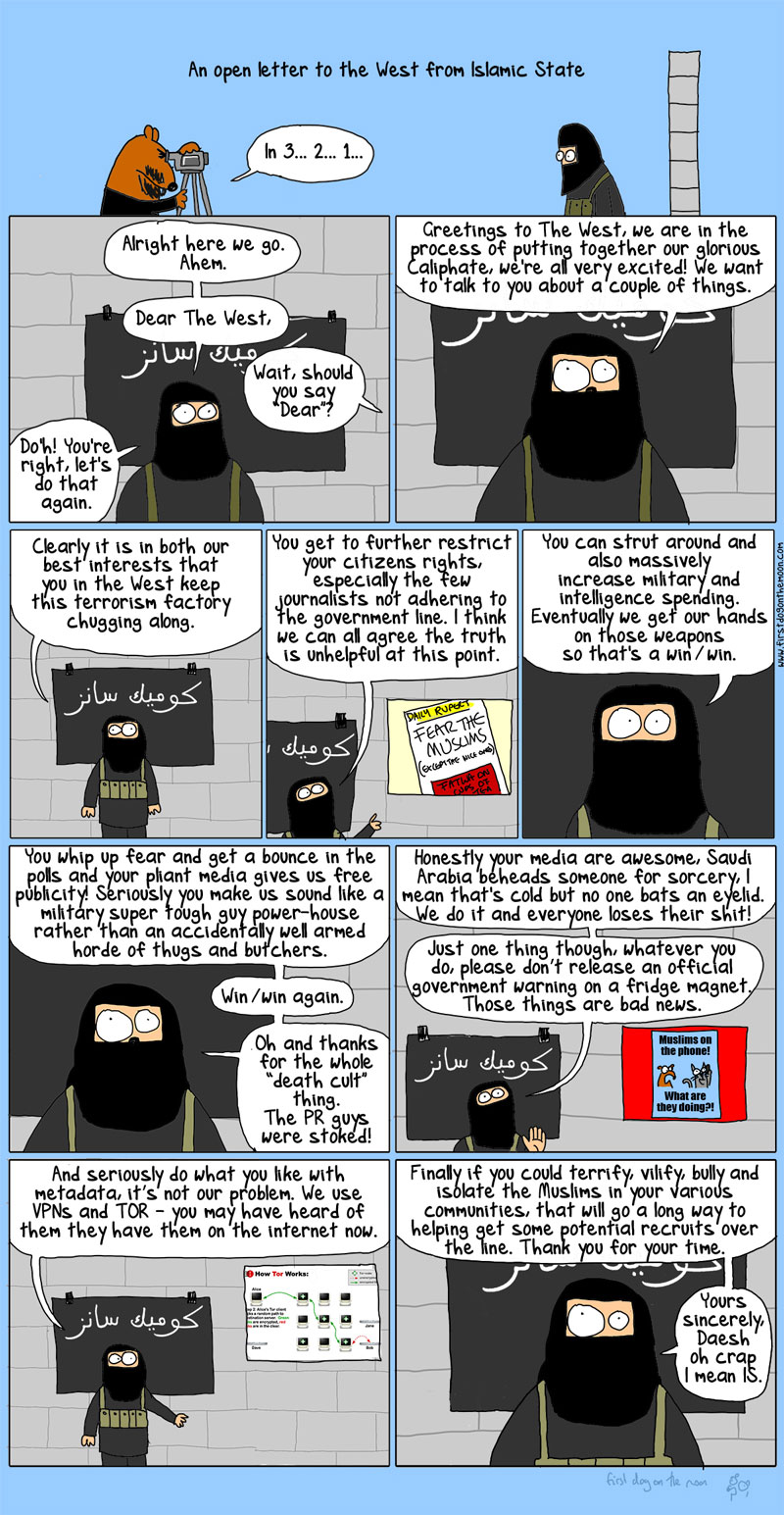
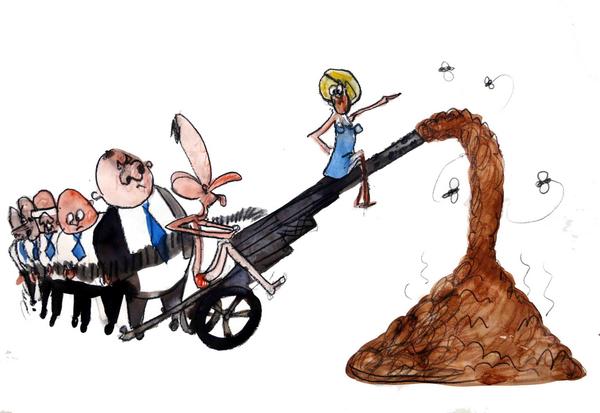
‘Terrifying’ Tony Abbott is using the politics of fear to bully the Australian people into liking him and letting him to take away some of their rights and freedoms, writes Lyn Bender.
With each new threat from ISIL, Prime Minister Tony Abbott is shamelessly fanning the fires of terror in the hope we will forget his shortcomings blunders and buffoonery.
In Abbott Land — security has become insecurity.
Fear is the weapon of choice, of those seeking to gain and maintain power. Frightened people can be manipulated and subjugated.
But, nevertheless, now a reactive, fearful and fear-manipulating leader is now catapulting us into war. Tony Abbott struts ‒ or more correctly frets ‒ on the world stage: a small frightened man, determined to hold onto his fifteen minutes of fame.
Is western involvement in another war the answer or the problem?
Even Foreign Minister Julie Bishop has said that ISIL is an ideology that cannot be defeated in the battlefield alone.
But things could always be worse. Remember when Abbott’s alpha male posturing to ‘bully’ Putin and his threats to send in armed troops for ‘Operation bring them Home’.
Abbott’s idea of sending an armed defence force to Ukraine was branded as insane in a Fairfax headline:
He has now moved on to the more fertile field of homegrown Muslim terror.
Abbott is widely acknowledged as a serial liar. And the lies and broken promises continue.
At first, it was a humanitarian mission to deliver aid to besieged Iraqis. Now it has morphed into a mission to destroy the “death cult” of ISIS and to “respond with extreme force”.
When it comes to understanding and responding to ISL in Iraq, it’s complicated. When it comes to Tony Abbott’s ability to comprehend the global political sphere, it’s simplistic.
Remember his description of the situation in Syria just prior to the last Federal election:
“It’s notgoodies versus baddies but baddies versus baddies.”
In Abbott’s black and white world there are no shades of grey.
Except when defending baddies as being goodies.
Abbott has excused Sri Lankan President Mahinda Rajapaksa’s appalling human rights record.
Abbott tells the media that any random person could have been seized. All that is needed is an iPhone and knife. A statement the media reports repeatedly. and uncritically
Man is removed from plane and questioned by police for doodling satirical notes on terror.
Abbott dismisses Muslim protests at anti-terror raids, saying “have a good, long, hard look at yourselves”
Operation Sovereign Borders ‒ hitherto secret on water matters ‒ are announced to convey an image of strong tough mean leadership-keeping those Muslim-refugees out
New anti terrorism laws to be tabled to Parliament, that could place journalists under threat of 10 years imprisonment, for publishing details about national security operations.
Under pressure from crossbencher David Leyonhjelm “torture is explicitly forbidden”, but not defined.
Abbott shifts focus in Question Time in Parliament from scrutiny of the Budget to elaborating on the terror threat to all Australians.
Abbott’s mentor, former Prime Minister John Howard, has allegedly lied on national television on Sunday about leading us into Iraq on false intelligence and by ignoring expert weapon’s inspector Hans Blix.
Tony Abbott ‒ like his father-figure, Howard ‒ is again leading us into dangerous waters and setting Australia up as a terrorist target.
Australia is now named on the hit list in a video believed to be from ISIS. It exhorts the killing of infidels in countries including Australia who have joined the Coalition to attack ISIS. Abbott is seeking greater powers, with limited scrutiny.
The fusion of passion for military adventures, and the political exploitation of fear, is a dangerous mix. Abbott may be creating the terror he is claiming to lessen.
Disturbingly, he is now saying we may need to give up some of our rights and freedoms to lessen the terror threat.
“…for some time to come, Australians will have to endure more security than we’re used to, and more inconvenience than we’d like. Regrettably, for some time to come, the delicate balance between freedom and security may have to shift.”
Even more worrying, Abbott flags discriminating against certain sections of society — presumably Muslims:
“There may be more restrictions on some so that there can be more protections for others.”
He is asking us to let him persecute certain members of our society for the greater good. That is not democracy.
Moreover, he is asking us trust him to act honestly and decently in the national interest.
From
Team Bull you are either against us or with us in the shoot!
Given deep commitment that many fighters have to their idea of martyrdom and the Caliphate, then the few who chose to leave and return home will mostly be the disillusioned and the unfaithful. These individuals will have to escape in secret to avoid execution on charges of spying or desertion. It is these that will be of most use to Western intelligence and deradicalization programs. ASIO must have considered this and informed Abbott who however insists they are the most dangerous. Ones that haven’t left remain a closed book and it’s up to us as a community that will or wont determine their radicalisation. Abbott’s public war announcement is not going to help our security. Abbott’s continual TV appearances can only exacerbate things.
The bottom line is that the Islamic State group has learned the importance of operational security and the dangers of allowing western intelligence contact with its members. That is not to say that there will be no Islamic State-backed attack plots targeting the West and that western governments need not worry. But the selection of suitable operatives to carry out attacks will be highly problematic for the group, leaving only a tiny pool of possible options. Its commanders will have to choose individuals with a proven track record of competence, loyalty, independence and determination.Gauging those characteristics without exposing the individuals concerned to operational information will be very difficult. The Islamic State group is unlikely to take a risk in most cases and will probably only attempt to release a few trusted individuals for uncomplicated suicide missions.
The challenges of making and deploying suitable bombs without detection back in their home countries will probably be beyond most of these few. So, while the threat is real and must be taken seriously it must also be seen in context; one that is not as numerically great as the assessments of officials and experts have so far indicated.Failure to put the threat into context has dangers of its own. Firstly, the Islamic State group monitors the media and will be encouraged by the fear-mongering aspect of the debate. It might be tempted to amplify its terror impact by encouraging attacks in the West, having so far been regionally focused. So what the logic of Abbott’s public alarm is he making a public invitation to for ISIL to do more?
Abbott has achieved more headlines announcing a threat that, even if it materialises, will have a transient impact on the country compared with the Budget, Health ,Education and Pensions. Abbott and his cabinet aren’t stupid they know this and realise how problematic these issues are for them. It appears preferential for Abbott to avoid the serious internal issues and go down the path of raising a terror alarm despite the probability of radicalising more locals and inviting the further interest of ISIL.
Responding to Syrian objections over the Administration’s plans to fly combat missions against ISIS in Syrian territory, President Obama told journalists at the White House that as far as he was concerned, Bashar Assad could “Fuck off and die.”
In a speech to the nation last night, Mr. Obama said the United States was recruiting a global coalition to “degrade and ultimately destroy” the militants, known as the Islamic State in Iraq and Syria. He warned that “eradicating a cancer” like ISIS was a long-term challenge that would put some American troops at risk.
“We will hunt down terrorists who threaten our country, wherever they are,” Mr. Obama declared in a 14-minute address. “That means I will not hesitate to take action against ISIL in Syria, as well as Iraq,” he added, using an alternative name for ISIS. “This is a core principle of my presidency: If you threaten America, you will find no safe haven.”
Mr. Obama specifically stated that he would not place U.S. “boots on the ground” in Iraq or Syria, which most intelligent pundits interpreted as meaning that we will have no large ground units in the Middle East like we did in the recent Iraq and Afghanistan wars, but did not preclude the use of special forces units and forward air observers.
Although Mr. Obama has received political support from both parties on his policy statement, some pundits on the far right, particularly those who depend on Fox News for their income, have criticized the President for not going far enough. In addition, several members of the wing nut radio talk show crowd, along with former members of the Bush Administration, continue to blame Obama for the whole situation.
“The Bush Administration and its cheerleaders caused this clusterfuck by invading Iraq in the first place,” said White House Press Secretary Josh Earnest. “Anyone who listens to Dick Cheney, Rush Limbaugh, or Sean Hannity on this subject needs his head examined anyway. They’re best bet is to shut the fuck up, that way they won’t sound so ignorant.”
There seems to be a general assumption that the Islamic State is motivated by a Medieval Ideology which is far from the truth. Firstly it’s young there’s generational break from their fathers. This applies to the Western and Middle Eastern Jihadis alike. We call it “medieval” only because we see it as being radically different. Abbott just does not realize that the older generation of Muslims their parents are just as confused as he is. They to ask the question why has this happened? We are at one on this.
The ISIS claim is that one can only be a Muslim in an Islamic State sounds less from the Koran than from the French Revolution which in itself was the secularization of an idea that had its origins in European Christianity. “There is no salvation outside the church” This idea became transformed with the birth of the modern European states into ‘outside the state there is no legal person-hood” This idea demonstrates its power today. Look at the way we treat refugees, gypsies or persons without documentation. Morrison regards them in such a way the UNHRC has drawn world attention to it
Still today French government agencies are prevented by law from collecting data about ethnicity, considered a potential intermediary community between state and citizen. Islamists present themselves as true to their religion, while their parents, so they argue, are mired in tradition or “culture” . It’s why so many diverse individuals have come together to fight. Nobody seems to try to address this question of how it’s possible. Andrew Bolt believes race, ethnicity, and the cultures that accompany them get in the way and constantly tries to prove the same. A few steps further to the right Bolt could well be ISIS
If Islamic State is profoundly modern, so too is its violence. IS fighters do not simply kill. They seek to humiliate as we saw last week as they herded Syrian reservists wearing only their underpants to their death. They seek to dishonour the bodies of their victims, have we forgotten Abu Ghraib and the total humiliation of prisoners by the American coalition forces.
ISIS has consolidated it’s position across Syria and Iraq even eliminating opposition groups with the same goals such as the FSA in Syria. With the fog of confusion lifted the reality remains whether any rapprochement is possible with Assad and the new Iraq Government. ISIS is now calling for professionals to help consolidate their Sunni caliphate. Unlike previous rebel groups ISIS has the hallmarks of Saddam’s military invasion with it’s specific goals,targets and logistics & bringing together a growing coalition of support.
“It really is all guesswork at this stage,” said Sakhr al-Makhadhi, a British-Arab journalist and Syria analyst. “The Islamic State recently called for professionals – doctors, engineers and such – to move to its territory, so it’s clear that they view this as a long-term state building project. What this shows is that they’re lacking certain skills. They may have the manpower to fight, but not to build a state.”
It is Muslims in the Middle East who have most to worry about from the Islamic State. The decapitation of the journalist James Foley doesn’t change anything – the number of Iraqis executed by Islamic State fighters is far, far more. In a very short time the Islamic State has become the most compelling and attractive organisation for Muslim fighters around the world, more so than AL-Qaeda ever was.
For countries where Muslims are a minority like Australia paranoia has developed. The impact of this phenomenon on community relations – in Australia, Canada, India, the US, and Europe – could be devastating. Abbott for his own political advantage is calling for National Unity in the hope of restoring flagging polls. Once again, suspicions will easily be raised by Islamophobes like Andrew Bolt about Islamic State sympathisers in the west and whether they pose a threat. The news media will undoubtedly report on Australian, American or European Muslims joining the group or calling for violence in videos, further raising tensions and besmirch the Muslim faith. These very actions help recruit sympathizers amongst Australians being disparaged.
The group has prompted bomb blasts and fighting in Lebanon, and in Jordan and Kuwait the governments are worried that sleeper cells may attack at any moment. But it is Saudi Arabia that is on high alert, worried that the Islamic State group will come after them with force. In a recent interview, a senior Islamic State defector said their next stop would be Saudi Arabia, which includes Mecca and Medina. Its rulers are now in full panic, sending money to the Lebanese army, funding UN counter-terrorism efforts, and even getting senior Muftis to condemn the group. And there is reason for this panic. However for the moment their focus is firmly on the Middle East states.
The Islamic State is a direct descendant of AL-Qaeda, but there is one key difference: Its leaders believe fighting “apostates” is more important than fighting non-Muslims for now. They want to unite the Middle East under their banner before truly turning their sights on the US and Europe. In the eyes of many jihadis, the Islamic State has established the most successful and feared caliphate in recent history.
President Obama calls the Islamic State in Iraq and the Levant a “cancer.” Hassan Nasrallah, leader of Lebanon’s Hezbollah, describes ISIL as a “monster.” Sheikh Abdul Aziz al-Sheikh, Grand Mufti of Saudi Arabia, ranks al-Qaeda and ISIL, also known as ISIS, as “Enemy No. 1″ of Islam. And President Hassan Rouhani of Iran warns Muslim states to beware of “these savage terrorists,” for “tomorrow you will be targeted,” too, by ISIL.
The unanimity of hatred and fear toward the ISIL militants rampaging through Syria and Iraq is testament both to the threat they pose and to an unusual opportunity. Not since Saddam Hussein invaded Kuwait 24 years ago have the region’s most powerful players expressed such animus toward a common enemy. That’s because ISIL’s goal of replacing national boundaries in the Middle East with a Sunni Muslim caliphate threatens not just the usual “infidels”—Christians, Jews, Shiites, and other non-Sunni Muslim minorities—but the nation-states themselves.
But make no mistake: The real threat from the Islamic State is to other Muslims in the Middle East. Sooner or later people across the Middle East will have to face up to this threat.
“These signs from a Sydney protest suggest beheading is indeed considered by many Muslims to have religious sanction. These protesters haven’t just independently dreamed up some punishment of their own”………….In short they are here!!
“The fact that Foley’s killer has an English accent is actually one of the most significant details about this horrible murder.” ……….They have Australian accents as well!!
235 Journalists have been killed in Syria & Iraq according to Committee to Protect Journalists 111 murdered with impunity
CPJ is extremely concerned for all journalists, most of them Syrians, held captive by Islamic State, which murdered U.S. freelancer James Foley. Islamic State kidnaps, kills, and threatens journalists in the territories over which it holds sway. Syria has been the most dangerous country in the world for journalists for more than two years, with at least 70 killed covering the conflict. At least one journalist is killed, another arrested, and several injured amid intensifying clashes between the Iraqi government and its allies, and the insurgency spearheaded by the Al-Qaeda splinter group Islamic State.
“Local and foreign journalists already knew that Syria was the world’s most dangerous place to be a reporter before the beheading of James Foley brought that knowledge to the general public,” said CPJ Deputy Director Robert Mahoney.
Despite that, Syrian and foreign reporters like Jim Foley are prepared to put their lives at risk, in an attempt, in the words of another U.S. journalist killed in Syria, Marie Colvin, to ‘bear witness.'”
James Foley accepted the risks involved and had experienced captivity in Libya for 55 days once before. Death is a part of war. Mai Lai was a brutal and illegal event committed by US troops in Vietnam. Illegal acts are done by all sides in a wars. Sarin gas was used by Assad in Syria. MH17 is a recent case in which 38 Australians perished.
I think one has to be extremely carefull as to who we are blaming here. The use of Sarin was a condemnation of the Assad government and not the Syrian people or Islam. MH17 wasn’t shot down by the Russians. Abbott backed off after his knee jerk reaction pointing a finger at Putin and the Russians.
Bolt and his Newscorp mates however blame Islam. For them this public eventis yet another opportunity to give Islam a verbal shalacking rather than ISIS it’s leadership and propaganda arm. Isis wants the USA to escalate they want them in on this war and what better way to goad Obama than a public beheading. Retaliation by the USA is as good as any recruitment drive. Take Gaza the collateral damage Israel does in their effort to destroy Hamas simply increases Hamas’s ranks and results in another generation of youth filled with hate for Israel.
Murdoch’s global news machine always responds in unison – to some divine wind – it pursues a relentless campaign in favour of current Murdoch objectives – particularly his political ones it’s not reporting. Every journalist in Australia knows that.” Along with Fox News Murdoch uses his media empire as a standard-bearer for the radical-conservative front that’s undermining social democratic parties and progressive politics throughout the English-speaking world. For god sake he doesn’t need to ring his editors or producers to let them what he wants. They know what he thinks he Tweets the world daily and tells us what he thinks. He hates Obama and loves the neocons. He hates the ALP and supports Abbott at the moment. His global media once supported Bush & the invasion of Iraq. Weapons of Mass Destruction never found but were used as a necessity for US intervention then. Now it’s Isam because it’s good for Abbott, Cameron, the Tea Party and conservative front.
The more fear,the more alarm about an enemy that lurks within Australia, the more ground Abbott and the coalition will regain. James Foley died as a war correspondant as others have before him. He knew the risks and didn’t quiver when his time came. But Newscorp Bolt, Blair, Devine, McCrann & others will use James Foley to tell us know Tony Abbott is the ‘Man’ “the Oxonian Rhodes scholar”, “the volunteer fire-fighter and surf club member”, “the hugely intelligent, hugely decent, down-to-earth bloke”, equally at home downing “beers” and “writing books about political philosophy” – these commentators will practise their character beatification and take us to war or at least ensure that this government stays in power. This government that will guarantee an increase in youth suicide, the mental breakdown of asylum seekers and further alienation of the poor and minorities in this country


 “Many antique collectors unwillingly support terrorists like Islamic State, ” Michel van Rijn, one of the most successful smugglers of antique artifacts in the past century,
  Across the disintegrating border,




 olddogthoughts
You must be logged in to post a comment.