
They’re only 5 years late.
Source: Mainstream Media Finally Admits Syrian Conflict is US-Russia Proxy War
They’re only 5 years late.
Source: Mainstream Media Finally Admits Syrian Conflict is US-Russia Proxy War

Russia will need to be a part of a long-term solution in Syria, whether the West wants it to be or not, says international political expert, Professor Damien Kingsbury.

A White House-coordinated campaign on Kickstarter has raised $800k on premise that governments alone can’t do enough
Source: US Launches Crowdfunding Effort for Syria Refugees | Al Jazeera America

The current crisis can be traced back to events following the arbitrary partition of the Ottoman Empire.

President Obama’s own substantial failures in the Middle East notwithstanding, he might still be right about Vladimir Putin’s Syrian intervention. Eventually, Russia will have to accept that the brutal rule of Bashar al-Assad is the cause of the Syrian civil war, not the solution it.

Russia’s direct military intervention into Syria has dramatically changed the dynamics of a war that has raged since 2011. #antiwar #imperialism #syria
Source: Russia enters Syria war, exposing hypocrisy and contradictions of U.S. policy – Liberation News

The refugee crisis now confronting Europe, with hundreds of thousands of desperate migrants pouring across multiple borders, has opened up deep fissures in the European Union.

Russia’s decision to carry out air strikes in Syria has caused concern. What is Moscow trying to achieve?
Hundreds of Iranian troops have arrived in Syria to join a major ground offensive in support of President Bashar al-Assad’s government, Lebanese sources said on Thursday, a sign the civil war is turning still more regional and global in scope.
Source: Iran troops to join Syria war, Russia bombs group trained by CIA | Reuters

Russian president Putin and his US counterpart spar over the crisis in Syria in duelling UN speeches.

Because why not?
Source: Michele Bachmann Introduces Lie About Drowned Syrian Boy | Crooks and Liars
 As Western countries scramble to seek a deal to end the violence in war-torn Syria, some fear what may happen if embattled leader Bashar al-Assad retains power.

Report: 30,000 Foreign ISIS Recruits in Syria | Border crackdowns not keeping recruits from getting to caliphate
Source: Report: 30,000 Foreign ISIS Recruits in Syria — News from Antiwar.com

It comes as welcome news that Australia is set to abandon its opposition to Bashar al-Assad as part of a durable peace settlement in Syria. The recent military escalation by Russia and reported sightings of Chinese war ships in the Mediterranean in the last week must come as something of an embarrassment to the war…
Source: Julie Bishop’s Epiphany on the Road to Damascus – » The Australian Independent Media Network
 Last week satellite images revealed Russia’s military expansion in Syria, with deployments of troops, tanks and warplanes. Now western governments are scrambling to respond to the shift in power in the Middle East
Source: Vladimir Putin bids for major world role as his forces move into Syria | World news | The Guardian

More than two weeks have passed since the lifeless body of 3-year-old Aylan Kurdi washed ashore on a Turkish beach, forcing the world to confront the tide of Syrian asylum seekers massing at Europe’s borders.
Source: Long Before the Refugee Crisis, the World’s Powers Had Failed the People of Syria | The Nation

Al Qaeda’s Syria affiliate and its Islamist allies execute at least 56 regime troops at a military airport they recently seized in the north-west, a monitoring group says.

In all, Australia is engaged in a shameful, degrading and illegitimate method of determining the fates of asylum seekers. It cannot hold its head high in regards to one intake of refugees while many others languish in prisons of the government’s making.
Australia remains the only country sending Security personnel to vet choices made by the UN on who are the most in need. Will there any transparency in this process or will it become another secretive operational matter?

The Australian government has just announced that it will take in 12,000 Syrian and Iraqi refugees, giving priority to Christians and Yazidis who they say are the most persecuted, but not everyone agrees.
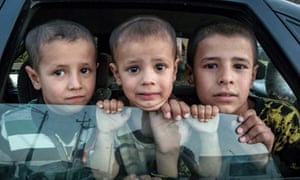
Social services minister joins Eric Abetz in urging religious focus as Muslim and Christian leaders raise concerns that it would foster discrimination

The government should be ashamed that it has detained on Manus Island the few Syrians who have reached here.
Source: Australia has power to save tens of thousands of Syrian refugees

The Abbott government was expected to approve Australian bombing runs against Islamic State targets and supply lines in Syria on Tuesday night, while the question of how many refugees could be absorbed by Australia has exposed ugly divisions in the government party room.
Source: Australia looks set to start bombing Syria as Libs warn against too much refugee compassion

What you need to know to understand Syria’s civil war — and the refugee crisis it created.
Source: Why people are fleeing Syria: a brief, simple explanation – Vox

There’s a part of the story you might not have known.
Source: Trying to follow what is going on in Syria and why? This comic will get you there in 5 minutes.

There won’t be any political solution to the migrant crisis in the UK and the EU in general, until the European public pushes governments to act in a moral way and calls for more reforms, Raza Nadim, MPACUK member told RT.
Source: ‘Cameron’s shift on rhetoric on migrants – result of public pressure, not morals’ — RT Op-Edge

the 8 countries that sent the most weapons to Syria since 2011 only accepted 2 percent of the refugees Germany has taken in.
Source: Nations that sent the most arms to Syria have accepted the fewest refugees

Two of them were British nationals. It happened in Raqqah in Syria more than two weeks ago.Emma Hayward reports.
Source: Uk Used Drone to Kill Three Members of ISIL | Al Jazeera America
 The former head of the ADF signs an open letter to the Prime Minister, opposing bombing raids in Syria.
Kevin Andrew is all for them

Michael Cornish
Should Australia bomb Syria? The legal, practical and moral arguments are manifestly weak.


The Defence Intelligence Agency provides military intelligence to the United States Department of Defense and intelligence community. A conservative American organisation called Judicial Watch filed a Freedom of Information lawsuit in May 2014, and in response received a very important and very revealing report from the DIA about the conflict in Syria.
The report dates from August 12, 2012, and, despite being written by an American intelligence organisation, is actually intelligent and prescient, and deeply revealing about the conflict in Syria and its foreign sponsors. It can be read here.
It begins with a summary of “The General Situation”:
A. Internally, events are taking a clear sectarian direction
B. The Salafist, the Muslim Brotherhood, and AQI [Al Qaeda – Iraq] are the major forces driving the insurgency in Syria.
C. The West, Gulf Countries, and Turkey support the opposition, while Russia, China and Iran support the regime.
The report has a section on AQI, which it notes “is familiar with Syria. AQI trained in Syria, and then infiltrated into Iraq”. It notes that AQI “supported the Syrian opposition from the beginning, both ideologically and through the media. AQI declared its opposition of Assad’s government because it considered it a sectarian regime targeting Sunnis.” It observes that AQI acted as Jaish al Nusra in Syria. “One of its affiliates… AQI, through the spokesman of the Islamic State of Iraq (ISI), Abu Muhammad al Adnani”, declared the Assad government the “spearhead” of the Shi’ite enemy. Adnani later became the chief spokesperson for ISIS.
The report then outlines “The Future Assumptions of the Crisis”.
The first is that “The regime will survive and have control over Syrian territory”. I will return to this point, but consider what it means already. The West, along with its allies in the Middle East, is supporting sectarian jihadis in fighting in Syria even though they assume that the insurgents they support will not be successful in overthrowing Assad, let alone in achieving a more humane and liberal system of government. This casual admission about Western policy and its cynicism deserves a moment’s pause and reflection.
The second assumption is “Development of the current events into proxy war”. It explained that Syria would control the coastal areas, in the West, whilst the insurgents would try to control eastern areas, adjacent to Turkey and Iraq.

Then the report discusses “The Effects on Iraq”. It explains “opposition forces will try to use the Iraqi territory as a safe haven for its forces”, whilst trying to recruit and train fighters in Iraq.
Point C in the “Effects on Iraq” section are particularly fascinating. It says:
If the situation unravels there is the possibility of establishing a declared or undeclared Salafist principality in Eastern Syria (Hasaka and Der Zor), and this is exactly what the supporting powers to the opposition want, in order to isolate the Syrian regime, which is considered the strategic depth of the Shia expansion (Iraq and Iran).
That’s right. The DIA predicted the establishment of a Salafist state in Eastern Syria, as this would serve the interests of the states that support the rebels in weakening the Assad regime. Remember – the supporting states are listed as the “West, Gulf Countries and Turkey”. One can dispute whether the West was equally welcoming of this outcome as the other states, and whether they realised that ISIS would turn out differently to the House of Saud, but I must stress that this report was written by the DIA.
The report then explains that “The deterioration of the situation has dire consequences on the Iraqi situation and are as follows”. A list the follows, which features a point 1 and 3 only: the rest of the report appears to be redacted.
Point 1 explains:
This creates the ideal atmosphere for AQI to return to its old pockets in Mosul and Ramadi, and will provide a renewed momentum under the presumption of unifying the jihad among Sunni Iraqi and Syria, and the rest of the Sunnis in the Arab world against what it considers one enemy, the dissenters. ISI could also declare an Islamic state throughout its union with other terrorist organisations in Iraq and Syria, which will create grave danger in regards to unifying the Iraq and the protection of its territory.
Point 3 of ‘predicted consequences’ is: “The renewing facilitation of terrorist elements from all over the Arab world entering into Iraqi arena”.
Finally, the report’s classification appears to be secret.
There is also another set of documents released to Judicial Watch. They show that after the fall of Qaddafi, weapons were shipped from Libya to Syria. It doesn’t explicitly explain precisely who sent and received these weapons. However, one can assume that after the fall of Qaddafi, it would have been his successful military opponents who would send the weapons.
And given their always readily observable Islamist complexion, one can reasonably conclude that this is official confirmation of US knowledge of former Libyan rebels aiding Syrian rebels.
This is consistent with a story Seymour Hersh wrote in the London Review of Books in April 2014. Hersh wrote that the US had a role in creating a “rat line”: “authorised in early 2012, [it] was used to funnel weapons and ammunition from Libya via southern Turkey and across the Syrian border to the opposition. Many of those in Syria who ultimately received the weapons were jihadists, some of them affiliated with al-Qaida.”
As’ad AbuKhalil notes that the documents show “that the US knew all along that the Syrian rebels are made of Islamists (this is from 2012): that is when the US government publicly talked about the dominance of “moderate Syrian rebels”. The US seems to have approved arms shipments from Libyan Islamist terrorists to the Syrian Islamist terrorists, and even of the likely rise of Islamist Jihadi threat in Iraq.”
The US knew all along that the conflict was driven by a clash between jihadis, supported by the West, Gulf States and Turkey, and was “taking a clear sectarian direction”, though they assumed that Assad would “survive and have control over Syrian territory”, and they continued to support the jihadis anyway.
This may remind some of other conflicts. For example, the Iran-Iraq war of the 1980s, where the US offered some support to both sides of the war, prolonging it and contributing to its final gruesome toll of perhaps over a million dead. In that case, the US preferred a weaker Saddam Hussein and Islamic Republic of Iran. The death and suffering in both countries did not trouble US leadership.

Another similar case is Western, Saudi and Pakistani support for the mujahideen in Afghanistan. In his history of the CIA, Tim Weiner observes that “the mission was not to liberate Afghanistan”. As CIA chief in Pakistan Howard Hart observes, the “wonderful order” was “Go kill Soviet soldiers… Imagine! I loved it.” Weiner describes this as a “noble goal”. Afghans and others might be less impressed at massive Western support for the jihadis whose members later became warlords, the Taliban and al Qaeda.
As prescient as the DIA report seems, it did not require any unique genius to observe where the trends in Syria were headed. Writing in July 2012, I quoted Haytham Manna, a courageous leftist Syrian activist, who warned that the militarisation of the conflict undermined “the broad popular support necessary to transform the uprising into a democratic revolution”.
He observed the same trends as the DIA:
“The pumping of arms to Syria, supported by Saudi Arabia and Qatar, the phenomenon of the Free Syrian Army, and the entry of more than 200 jihadi foreigners into Syria in the past six months have all led to a decline in the mobilisation of large segments of the population, especially amongst minorities and those living in the big cities, and in the activists’ peaceful civil movement. The political discourse has become sectarian; there has been a Salafisation of religiously conservative sectors.”
It didn’t take any particular brilliance to doubt the sudden outpouring of compassion for Syria, which, as is usual with Western “concern” for the Middle East, was expressed in discussion over whether Syria should be bombed, or whether more arms should be sent to the rebels instead.
Just as Western support for Islamist fanatics in Afghanistan in the ‘80s was a disastrous policy with long-term catastrophic effects, particularly in Afghanistan, so it appears Western support for Islamist fanatics in Syria has been a disastrous policy with long-term catastrophic effects, particularly in Syria, but also in Iraq, and perhaps other places soon.
It is terrible to say, but Syria’s uprising appears to have been defeated, both by its enemies, and by its ostensible friends. In June 2012, Manna wrote in the Guardian that the struggle began in March 2011, and in the second week, he launched the three nos: No to violence, no to sectarianism, and no to external intervention.
However:
“Powerful players tried to recruit the tens of thousands of young people who went out in public for the first time to their own regional or international causes. Within the first three months many players had intervened in the conflict, which was seen by many, inside and outside Syria, as an opportunity to change some basic geopolitical facts about the Middle East.
The aims of those intervening from outside Syria were at odds with the revolutions’s songs of dignity and freedom.”
He concluded by asking: “Has the arming of the insurgents already seriously weakened any chance of a political solution and a democratic transition in Syria?” At this point, it is hard to avoid the conclusion that the answer is yes. A brutal and murderous tyrant has been legitimised by the fanatical jihadis the West funded (and is now turning on), whilst the country has been devastated.
And yet, one day soon, the record of the tragedy will be forgotten. And then Western pundits will solemnly debate the next humanitarian intervention to rescue an oppressed people from a foreign dictator
– See more at: https://newmatilda.com/2015/05/25/how-west-was-one-syrian-catastrophe#sthash.DIUxfDBm.dpuf

A Florida native told RT that he followed ‘God’s call’ when he joined Kurdish fighters in the north of Syria to battle the Islamic State (formerly ISIS). He is one of dozens of westerners who have come to the region to fight against the terror group.
Dean Parker, 49, was a surfing instructor in Costa Rica with no prior combat experience when he saw the harrowing images of Yazidi refugees fleeing to Mount Sinjar before the IS onslaught last fall. “Overwhelmed with emotions” upon seeing a refugee child “with a look of sheer terror in his eyes,” he decided to enlist with the Kurdish militia fighting the IS in northern Syria.
Parker ended up joining the Lions of Rojava, a unit of foreign volunteers attached to the Kurdish People’s Protection Unit (YPG). Famously independent, the YPG began recruiting on social media in October 2014, when the Lions of Rojava Facebook page was created.
Read moreInt’l anti-ISIS brigade: Westerners flock to fight for Kurds
“Send terrorists to hell and save humanity” proclaims the page, asking for donations to a Germany-based Kurdish charity and volunteers for the fight against IS. The Lions of Rojava have been attracting a steady stream of Western volunteers.
The Kurds are “fighting hard and fighting strong,” but “they are fighting this war against Da’ash in Syria all alone,” Parker told RT, using the Arabic name for the Islamic State. Parker explained he came back to campaign for aid to the Kurds in weapons and supplies.
Even though the Kurdish fighters lack heavy weapons, boots and even elementary medical supplies, they have successfully defended the city of Kobani from IS attack and are holding the line. “They are doing all this great fighting… with so little,” Parker said. “They need help across the board.”
Parker recalled a particularly harrowing experience of observing the Islamic State fighters abusing and killing a prisoner. He described “fair-skinned” IS fighters parading a captive before the Kurdish positions, beating him bloody, and then executing him. “After a few minutes of throwing him around like a ragdoll, one of them grabbed the guy by the back of his shirt, pulled him away from the group, and cut his throat.” After that, “they were all high-fiving each other and waving at us.”
Parker invested everything he had to go to Syria, and come back – but rather than returning to his home in Colorado, he decided to travel to Washington and seek help for his new-found Kurdish friends. “I owe them that,” he said.
“Dozens” of foreign fighters from Europe and America have joined the Kurdish militia in the fight against the IS. Meanwhile, the State Department has estimated that some 20,000 foreigners have flocked to the ranks of the terror group, including at least 3,000 Westerners.
Read more20,000 foreigners have joined ISIS in Iraq, Syria – reports
However, Sean McFate, professor of Foreign Service at Georgetown University and author of “The Modern Mercenary: private armies and what they mean to world order,” told RT that it isn’t just people like Parker who are staving off the terrorists, it’s also America’s heavy reliance on private contractors or “hired guns.”
Describing military contractors as “cheaper and more efficient” than actual US military forces, McFate pointed out they provide the government with plausible deniability, don’t count as “boots on the ground,” and can be used on risky missions in order to avoid the politically problematic issue of US soldiers coming home in body bags. “The American public doesn’t seem to care that much about dead contractors,” he added.

Syrian state TV claims Israel has bombed two installations, one near Damascus and one near the Lebanese border
Syria accused Israeli jets of bombing two installations inside the country on Sunday, one near the capital, Damascus, and the second in a town near the Lebanese border.
The report by Syrian state television described the attack as “an aggression”. It said the air raids occurred near Damascus’s international airport and in the town of Dimas.
The state news agency Sana said: “The Israeli enemy attacked Syria by targeting two safe areas in Damascus province, namely the Dimas area and the area of Damascus international airport.” It said no casualties were reported.
There was no immediate comment from Israeli officials.
Speculation in the immediate aftermath suggested that the target of the strikes might have been advanced Russian-made S300 surface-to-air missiles.
The Syrian Observatory for Human Rights, a UK-based group that monitors the country’s civil war through a network of activists on the ground, said the strike near the Damascus airport hit a warehouse, and it was unclear what was in the building.
The Observatory said around 10 explosions could be heard outside a military area near Dimas. It had no word on casualties in either strike.
Israel has carried out several air strikes in Syria since the revolt against Bashar al-Assad began in March 2011. Binyamin Netanyahu has repeatedly threatened to take military action to prevent Syria from transferring sophisticated weapons to its ally Hezbollah.
In June, Israel struck targets inside Syria, including a military installation, following a cross-border attack that killed an Israeli teenager. Israel said at the time that it had struck nine military targets inside its northern neighbour and had confirmed “direct hits”.

Commentary condemns western countries for arming anti-government movements fighting against Syrian government
Western countries are stoking extremism in the Middle East with their support for anti-government opposition movements, China’s top newspaper has said, repeating a call for non-interference in the region’s turmoil.
China has expressed concern about the rise of Islamic State (Isis) in countries such as Syria and Iraq, nervous about the effect the jihadi group could have on its far-west region of Xinjiang, where Beijing says it faces a threat from Islamist extremists.
But it has also condemned efforts by western countries to arm certain groups fighting against the Syrian government, and has shown no sign of wanting to join US efforts to use military force against Isis.
The People’s Daily, the official paper of China’s ruling Communist party, said moves by the west to support anti-government movements in the Middle East were having the opposite effect.
“The facts prove that by letting jihadists pass unchecked into Syria to join battle has caused the expansion of the extremist group Islamic State,” it said in a commentary.
“This is a classic case of how rearing a tiger will court calamity. The entry of major powers must avoid by all means adding to the chaos.”
The US needed to understand that the enemy of your enemy was still your enemy, the newspaper added.
The article was published under the pen name Zhong Sheng, meaning Voice of China, often used to give views on foreign policy.
But the international community could not just sit by and watch as Isis grew, the commentary said. It needed to play a constructive role and follow the rules of the UN charter. That meant respecting countries’ sovereignty, independence and territorial integrity.

A WOMAN has donned a burqa and travelled thousands of kilometres to Syria in an undercover mission to rescue her daughter from Islamic State terrorists.
The Dutch woman had been warned by police that the journey to find the teenager — who had recently converted to Islam and was married to a Dutch jihadi — would be too dangerous, The Telegraph reports.
But a mother’s love proved too strong and she decided to take matters into her own hands.
“Sometimes you gotta do what you gotta do. This is what I think is right,” she told family and friends.

Secret mission … the pair managed to escape across the Syrian border. Source: News Limited
The woman, known only as Monique, contacted her daughter Aicha through Facebook to arrange a meeting in the Syrian town of Raqqa, the so-called capital of the Islamic State.
The young woman had fallen in love with IS militant Omar Yilmaz and his lifestyle after seeing him interviewed on television, according to media reports.
But as time passed, Aicha felt she had made a huge mistake.

Islamic fighter … the woman’s teenage daughter wanted to escape her husband. Source: No Source
“She wanted to go home, but could not leave Raqqa without help,” Monique said.
Determined to bring her daughter home, the mother disguised herself in a burqa to make the risky journey to Raqqa from Turkey, The Telegraphsays.
She and her daughter then managed to escape across the Syrian border back to Turkey where Aicha is being held as she does not have a passport.
Dutch officials are now involved and will bring the pair back before the end of the week.
 A fighter for the moderate Free Syrian Army sits in a shooting position behind sandbags during clashes with loyalist forces in Aleppo, Syria, on Nov. 2. Moderate rebels elsewhere in northern Syria were pushed back by Islamists over the weekend. (Hosam Katan/Reuters)
BEIRUT — The Obama administration’s Syria strategy suffered a major setback Sunday after fighters linked to al-Qaeda routed U.S.-backed rebels from their main northern strongholds, capturing significant quantities of weaponry, triggering widespread defections and ending hopes that Washington will readily find Syrian partners in its war against the Islamic State.
Moderate rebels who had been armed and trained by the United States either surrendered or defected to the extremists as the Jabhat al-Nusra group, affiliated with al-Qaeda, swept through the towns and villages the moderates controlled in the northern province of Idlib, in what appeared to be a concerted push to vanquish the moderate Free Syrian Army, according to rebel commanders, activists and analysts.
Other moderate fighters were on the run, headed for the Turkish border as the extremists closed in, heralding a significant defeat for the rebel forces Washington had been counting on as a bulwark against the Islamic State.
Moderates still retain a strong presence in southern Syria, but the Islamic State has not been a major factor there.
A senior Defense Department official said the Pentagon “is monitoring developments as closely as possible” but could “not independently verify” reports from the ground. The official was not authorized to comment publicly and spoke on the condition of anonymity.
Jabhat al-Nusra has long been regarded by Syrians as less radical than the breakaway Islamic State faction, and it had participated alongside moderate rebels in battles against the Islamic State earlier this year. But it is also on the U.S. list of terrorist organizations and is the only group in Syria that has formally declared its allegiance to the mainstream al-Qaeda leadership.
A Jabhat al-Nusra base was one of the first targets hit when the United States launched its air war in Syria in September, and activists said the tensions fueled by that attack had contributed to the success of the group’s push against the moderate rebels.
“When American airstrikes targeted al-Nusra, people felt solidarity with them because Nusra are fighting the regime, and the strikes are helping the regime,” said Raed al-Fares, an activist leader in Kafr Nabel, in Idlib.
“Now people think that whoever in the Free Syrian Army gets support from the U.S.A. is an agent of the regime,” he said.
Fleeing rebel fighters said they feared the defeat would spell the end of the Free Syrian Army, the umbrella name used by the moderate rebel groups that the United States has somewhat erratically sought to promote as an alternative both to the Assad regime and the extremist Islamic State.
Among the groups whose bases were overrun in the assault was Harakat Hazm, the biggest recipient of U.S. assistance offered under a small-scale, covert CIA program launched this year, including the first deliveries of U.S.-made TOW antitank missiles. The group’s headquarters outside the village of Khan Subbul was seized by Jabhat al-Nusra overnight Saturday, after rebel fighters there surrendered their weapons and fled without a fight, according to residents in the area.
Hussam Omar, a spokesman for Harakat Hazm, refused to confirm whether American weaponry had been captured by the al-Qaeda affiliate because, he said, negotiations with Jabhat al-Nusra are underway.
Harakat Hazm, whose name means “Steadfastness Movement,” had also received small arms and ammunition alongside non-lethal aid in the form of vehicles, food and uniforms from the United States and its European and Persian Gulf Arab allies grouped as the Friends of Syria alliance. Scores of its fighters had received U.S. training in Qatar under the covert program, but it was also not possible to confirm whether any of those fighters had defected to the al-Qaeda affiliate.
Another Western-backed group, the Syrian Revolutionary Front, on Saturday gave up its bases in Jabal al-Zawiya, a collection of mountain villages that had been under the control of the pro-American warlord Jamal Maarouf since 2012. A video posted on YouTube showed Jabhat al-Nusra fighters unearthing stockpiles of weaponry at Maarouf’s headquarters in his home town of Deir Sunbul.
In a separate video, Maarouf, addressing the Jabhat al-Nusra leadership, said he fled along with those of his men who had not defected, “to preserve the blood of civilians, because you behead people and slaughter them if they do not obey you.”
The loss of northern Idlib province could prove a crippling blow to the moderate rebels, whose fight against Assad’s regime began in 2012 and has since been complicated by the rise of rival Islamist groups with goals very different from those of the original revolutionaries.
Idlib was the last of the northern Syrian provinces where the Free Syrian Army maintained a significant presence, and groups there had banded together in January to eject the Islamic State in the first instance in which Syrians had turned against the extremist radicals.
Most of the rest of northern Syria is controlled by the Islamic State, apart from a small strip of territory around the city of Aleppo. There the rebels are fighting to hold at bay both the Islamic State and the forces of the Assad government, and the defeat in Idlib will further isolate those fighters.
Perhaps most significant, it will complicate the task of finding Syrian allies willing to join the fight against the Islamic State, said Charles Lister of the Qatar-based Brookings Doha Center.
“The United States and its allies are depending very strongly on having armed organizations on the ground to call upon to fight the Islamic State, and now those groups have taken a very significant defeat,” he said.
Although some groups have already been receiving U.S. support, it was never sufficient to tilt the balance of power on the ground, Lister said. “This sends a message that Western support doesn’t equal success,” he added.
The limited assistance program already underway is expected to be supplemented by a bigger, overt, $500 million program to train and equip moderate rebels that was first announced by President Obama in June and that has become a central component of the U.S. strategy to confront the Islamic State.
But U.S. officials have said it could be months before the program starts, and longer before it takes effect, thereby giving an incentive to the moderates’ foes to challenge them before any significant help arrives.
Although the administration has long voiced its support for the rebel fighters, direct U.S. aid to them has been slow and scant, with weapons shipments and a CIA training program limited by the need to vet the fighters for any ties to militants.
More extensive aid to the rebels has also been withheld in the interest of promoting a negotiated political solution that would remove Assad from power while leaving Syrian institutions, including the military, intact.
In public remarks last week, national security adviser Susan E. Rice acknowledged that the U.S.-backed rebels “are fighting a multifront conflict, which is obviously taking a real toll on them.” The expanded military train-and-equip mission, Rice said, “is, in the first instance, going to enable them to fend off ISIL, but it is also designed and originated with the concept of trying to help create conditions on the ground that are conducive to negotiations. And that means helping them in their conflict against Assad as well.”
Meanwhile, the extension of the air war to Syria in September has drawn widespread complaints from moderate rebels that their goal of ousting the Assad regime is being shunted aside in the effort to fight the Islamic State, which is also known as ISIL. Anecdotal evidence that the airstrikes have indirectly aided the Assad government in its efforts to crush the rebellion has further fueled resentment.
Besides southern Syria, where the Islamic State has not established a significant foothold, moderate groups are also still fighting in scattered pockets around Damascus. But the U.S. campaign against the Islamic State is focused on the northern part of the country, where the group has entrenched itself across vast areas of territory for more than a year.

Women and girls living in Syria and Iraq have been subject to gross sexual violence, economic strife and the psychological trauma of a war that, to them, seems endless. But women in these countries are not just victims of violence, they are also great agents for change. These women should be our best allies in the fight against Islamic State.
We have seen reporting on female Kurdish fighters; women who were university students, mothers and grandmothers. But women are not just taking up arms. Though missing from the news, women in Syria and Iraq are also working towards peace. For example, in the suburbs of Damascus, a women’s group negotiated a 40-day ceasefire between regime and opposition forces to allow the passage of essential supplies.
The US-led international coalition needs to go beyond seeing women as passive victims of this war. Instead, it needs to connect with these women, whose work is central to long-term stabilisation and peace in Syria and Iraq.
Nearly eight in ten of the 6.8 million people who have been displaced by the conflict in Syria are women and children. The United Nations has appealed for more than US$2.2 billion to meet critical humanitarian needs of displaced people, but the international community has committed only one-third of what is needed.
Gender concerns are being integrated into humanitarian planning and programming, but women and girls still face huge challenges.
The International Rescue Committee recently completed a large survey of Syrian women and girls. When asked “what are the biggest challenges you are facing?”, the most common responses related to the daily reality of sexual exploitation and harassment:
Constantly fearful, women and girls told us about extreme levels of harassment.
Islamic State is using sexual violence as a weapon of war. The United Nations in Iraq has said that:
… some 1500 Yazidi and Christian persons may have been forced into sexual slavery.
When sexual violence is used as a weapon of war, the social fabric needed to recover from conflict is threatened. Even the UN Security Council has stated in the past that sexual violence:
… can significantly exacerbate situations of armed conflict and may impede the restoration of international peace and security.
There is increasing acknowledgement that victory against Islamic State will take more than just dropping bombs. We know from recent experiences in Afghanistan that violent extremism thrives in places where governance and the rule of law are virtually non-existent. There, military analysts knew that coalition forces were being out-governed by the Taliban.
Local community leaders in Syria now fear that people will become radicalised in places where there is no employment, education or other opportunities. But there can be no stability if we do not address the security concerns of half the population.
October 31 marks the 14th anniversary of the landmark UN Security Council Resolution 1325 that formalised women’s participation and protection as a priority of international peace and security. It was the first in a suite of seven resolutions to acknowledge the disproportionate impact of conflict on women and girls.

That resolution obliges member states not just to protect women from sexual violence, but also to increase their participation in prevention, mitigation and resolution of conflict.
In Iraq, women like Shatha Naji Hussein work to secure the right for women to build a safer future. It’s a two-way process between civil society and government to empower women to bring about positive change in their communities. It’s women like this that the international community need to support in the fight against Islamic State.

We need to support women like Honey Al Sayed, who is promoting leadership and tolerance in Syria by communicating positive messages at the grassroots level, particularly to youth groups. She co-founded the online radio station Radio SouriaLi, which promotes civic engagement, community development and responsible citizenship, under the motto “Unity in Diversity”.
Only with local leadership can there be effective conflict resolution and transition. Women like Afra Jalabi, who started The Day After Project, have developed plans for a post-conflict, democratic Syria.
The Syrian Women’s League has conducted a comparative assessment of constitutions in the region to establish a set of guiding principles for a new Syrian constitution.
At the Annual Civil Society Dialogue on Women, Peace and Security on September 23, Australia’s Minister Assisting the Prime Minister for Women, Senator Michaelia Cash, said:
… there are countless other women who have the skills and capabilities to participate in peace-building and peacekeeping. But they are denied the opportunity. This must be remedied.
Having made military commitments to the conflict with Islamic State, the Australian government now needs to prioritise the commitments made in the Australian National Action Plan on Women, Peace and Security 2012-2018. It is a whole-of-government policy, which has bipartisan support.
One of the strategies of the National Action Plan is to “take a co-ordinated and holistic approach” to women, peace and security.
Of course, Australia and our allies need to invest in the protection of women and girls affected by the conflict in Syria and northern Iraq. But as Cash rightly pointed out, women are not merely victims in this conflict: they also have vital skills and local knowledge.
To defeat Islamic State in the long run, the world needs to support Iraqi and Syrian women to be more actively involved in conflict mitigation, resolution and peace processes. Australia could be doing more – and we need to be pushing our allies to do the same.

Islamic State (IS) militants have released 25 Kurdish schoolchildren who were kidnapped by fighters in northern Syria in May, a rights group says.
IS militants abducted more than 150 children, aged 13 and 14, as they were returning to their hometown of Kobane after sitting exams in Aleppo, the British-based Syrian Observatory for Human Rights (SOHR) said.
The 25 were the last of the children to be freed by the jihadists.
Five others were allowed to leave earlier this week before the final group were released on Wednesday, the SOHR said.
“It is true. They were released from (the Syrian town of) Minbij. This is the last part of the releases,” Idris Nassan, deputy foreign minister of Kobane district, said.
He said he did not know why the children had been released, but suggested it could be part of a “propaganda” campaign.
Fifteen children were released in June as a hostage swap to free three IS militants held by Kurdish forces, according to the New York-based Human Rights Watch.
Two boys who escaped captivity told local media the IS group was forcing the children to undergo lessons in jihadist ideology, the rights group said.
The children’s release comes on the same day IS fighters executed more than 40 members of a tribe that fought against them in Iraq’s Anbar province, officials said.
The men from the Albu Nimr tribe were killed in Hit, northwest of the capital Baghdad.
A police colonel and a leader from the anti-jihadist Sahwa forces confirmed the killings.
IS has overrun large areas of Anbar, and the killings are likely aimed at discouraging resistance from powerful local tribes, who will be key to any successful bid to retake the province.
Pro-government forces have suffered a string of setbacks in Anbar in recent weeks. That has prompted warnings the province, which stretches from the borders with Jordan and Saudi Arabia to the western approach to Baghdad, could fall entirely.
IS militants have spearheaded an offensive that has overrun much of the country’s Sunni Arab heartland since June.
(Reuters) – A convoy of peshmerga fighters from northern Iraq headed across southeastern Turkey on Wednesday towards the Syrian town of Kobani to try to help fellow Kurds break an Islamic State siege which has defied U.S.-led air strikes.
Kobani, on the border with Turkey, has been under assault for more than a month and its fate has become a test of the U.S.-led coalition’s ability to combat the Sunni Muslim insurgents.
Weeks of air strikes on Islamic State positions around Kobani and the deaths of hundreds of their fighters have failed to break the siege. The Kurds and their international allies hope the arrival of the peshmerga, along with heavier weapons, can turn the tide.
The Kurdish fighters were given a heroes’ welcome as their convoy of jeeps and flatbed trucks, some bearing heavy machineguns, snaked its way for around 400 km (250 miles) through Turkey’s mostly Kurdish southeast after crossing the border from northern Iraq.
The presence of Kurdish forces passing with government permission through a part of Turkey which has seen a three-decade insurgency by local Kurdish PKK militants was an extraordinary sight for many residents.
Villagers set bonfires, let off fireworks and chanted by the side of the road as the convoy passed. Thousands took to the streets of the border town of Suruc, descending on its tree-lined main square and spilling into side streets, some with faces painted in the colors of the Kurdish flag.
“All the Kurds are together. We want them to go and fight in Kobani and liberate it,” said Issa Ahamd, an 18-year-old high school student among the almost 200,000 Syrian Kurds who have fled to Turkey since the assault on Kobani began.
An initial group of between 90 and 100 peshmerga fighters arrived by plane amid tight security in the nearby city of Sanliurfa early on Wednesday, according to Adham Basho, a member of the Syrian Kurdish National Council from Kobani.
Saleh Moslem, co-chair of the Syrian Kurdish Democratic Union Party (PYD), said the peshmerga were expected to bring heavy arms to Kobani – known as Ayn al-Arab in Arabic.
“It’s mainly artillery, or anti-armor, anti-tank weapons,” he said. The lightly armed Syrian Kurds have said such weaponry is crucial to driving back Islamic State insurgents, who have used armored vehicles and tanks in their assault.
Kurdistan’s Minister of Peshmerga, Mustafa Sayyid Qader, told local media on Tuesday that no limits had been set to how long the forces would remain in Kobani. The Kurdistan Regional Government has said the fighters would not engage in direct combat in Kobani but rather provide artillery support.
RADICAL ISLAM
Islamic State has caused international alarm by capturing large expanses of Iraq and Syria, declaring an Islamic “caliphate” that erases borders between the two. Its fighters have slaughtered or driven away Shi’ite Muslims, Christians and other communities who do not share their ultra-radical brand of Sunni Islam.
Fighters from the Nusra Front, al Qaeda’s official affiliate in the Syrian civil war, have meanwhile seized territory from moderate rebels in recent days, expanding their control into one of the few areas of northern Syria not already held by hardline Islamists.
Nearly 10 million people have been displaced by Syria’s war and close to 200,000 killed, according to the United Nations. A Syrian army helicopter dropped two barrel bombs on a displaced persons camp in the northern province of Idlib on Wednesday, killing many, camp residents said.
In Iraq, security forces said they had advanced to within 2 km (1.2 miles) of the city of Baiji on Wednesday in a new offensive to retake the country’s biggest oil refinery that has been besieged since June by Islamic State.
Islamic State has threatened to massacre Kobani’s defenders, triggering a call to arms from Kurds across the region.
The U.S. military conducted 14 air strikes on Tuesday and Wednesday against Islamic State in Syria and Iraq, according to a statement from U.S. Central Command. Eight of the raids destroyed Islamic State targets near Kobani, it said.
At least a dozen shells fired by Islamic State fighters fell on the town overnight as clashes with the main Syrian Kurdish armed group, the YPG, continued, according to the British-based Syrian Observatory for Human Rights.
It said preparations were being made at a border gate which Islamic State fighters have repeatedly tried to capture before the arrival of the peshmerga, while YPG and Islamic State forces exchanged fire in gun battles on the southern edge of the town.
The Observatory also said 50 Syrian fighters had entered Kobani from Turkey with their weapons, though it was unclear which group they belonged to. Turkey has pushed for moderate Syrian rebels fighting President Bashar al-Assad to join the battle against Islamic State in Kobani.
Rebel commander Abdul Jabbar al-Oqaidi said he had led 200 Free Syrian Army fighters into Kobani but there was no independent confirmation of this. The FSA describes dozens of armed groups fighting Assad but with little or no central command. It is widely outgunned by Islamist insurgents.
DELICATE PARTNERSHIP
The Iraqi Kurdish region’s parliament voted last week to deploy some peshmerga forces to Syria and, under pressure from Western allies, Turkey agreed to let then cross its territory.
The United States and its allies in the coalition have made clear they do not plan to send troops to fight Islamic State in Syria or Iraq, but they need fighters on the ground to capitalize on their air strikes.
Syrian Kurds have called for the international community to provide them with heavier weapons and munitions and they have received an air drop from the United States.
But Turkey accuses Kurdish groups in Kobani of links to the militant PKK (Kurdistan Workers’ Party), which has fought the insurgency against the Turkish state and is regarded as a terrorist group by Ankara, Washington and the European Union.
That has complicated efforts to provide aid.
A Syrian Kurdish official said in Paris on Wednesday that France, which has taken part in air strikes in Iraq and given Iraqi peshmerga fighters weapons and training, had yet to fulfill a promise to give support to Kurds in Syria.
“France has said it was ready to help the Kurds, but we haven’t been received by the French authorities. There has been no direct or indirect contact,” Khaled Eissa, representative in France of the Syrian Kurdish Democratic Union Party (PYD), said.
French officials confirmed there had been no meetings in large part due to concern about historic links to the PKK.
Ankara fears Syria’s Kurds will exploit the chaos by following their brethren in Iraq and seeking to carve out an independent state in northern Syria, emboldening PKK militants in Turkey and derailing a fragile peace process.
The stance has enraged Turkey’s own Kurdish minority, about a fifth of the population and half of all Kurds across the region. Kurds suspect Ankara, which has refused to send in its forces to relieve Kobani, would rather see Islamic State jihadists extend their territorial gains than allow Kurdish insurgents to consolidate local power.

The UN Security Council unanimously, which is a rare occasion during the recent years, adopted a resolution on the fight against terrorism. Pravda.Ru interviewed executive secretary of the Presidium of the Academy of Geopolitical Problems, Araik Stepanyan, about old and new threats in the Middle East and in the whole world.
“Why did Russia support the United States? Not that long ago, there was heated debate on the USA’s interference in the internal affairs of Syria and Ukraine. In fact, the United States wants to destroy Russia by the hands of Ukrainian fascists. Yet, Russia supported the States. Why so?”
“Russia has its list of terrorist organizations. Some of them, included on our list, are not included on the list of the United States. They consider them fighters for freedom and democracy and support some of them. Russia calls for the coordination of databases of terrorist organizations, so that they are clearly considered as terrorist organizations for the whole world. In this case, it would be possible to catch members of such organizations and bring them to trial, rather than simply bomb sovereign states. Russia voted for coordinated legal international action.”
“Do we have a certain interest at this point?”
“Of course. The USA and Turkey did not consider ISIS a terrorist organization. Russia does not consider the Kurdistan Workers’ Party a terrorist organization, but the Americans consider them as such. Russia considers the Muslim Brotherhood a terrorist organization, but the Americans do not. We have different opinions. Even Egypt found Muslim Brotherhood a terrorist organization. So we do have our own interests here. Moreover, Russia may even restrict the Americans in their actions to a certain extent. It is very hard to convince the Americans to give up their positions. They are stubborn, even if they are wrong. This is their view and their policy.”
“Russian Foreign Minister Lavrov diplomatically did not name those who are directly responsible for the growing threat of the Islamic State. He said that the bombing of Libya and the Syrian conflict led to the fact that ISIS now poses a huge threat to the world. He does not call Western countries responsible for that. Is it a part of covert struggle to change the Americans’ position on Ukraine, support the USA in the fight against ISIS and obtain their neutrality in Novorossiya?”
“The rhetoric of the Russian foreign minister represents Russian diplomatic school. His remarks are indeed diplomatic. He is absolutely correct not to name responsible sides specifically, because it includes the entire intelligence network of the United States represented by Al-Qaeda and Al-Nusra, from which ISIS broke away. These are the structures that the Americans created.
“They invested from three to nine billion in Bin Laden. Where did Al-Qaeda go? Each of those organizations performs a specific function. Al-Qaeda let the Americans invade the Middle East, Afghanistan and farther – they have bases on the territory of the former Soviet Union already. Al-Qaeda quietly disappeared. But first, the American leadership was using Al-Qaeda to intimidate the world and the American society. Records of Bin Laden’s threats would appear regularly. Today, instead of audio recordings, the world watches video, in which terrorists behead hostages. And once again, the United States starts shaking the international community, convincing all and everyone that one has to bomb them and so on and so forth.”
“Do you think all of this is staged?”
“All of this is a game of the USA. They punish the forces that do not want to obey the Americans. Those who do, receive support and help from the USA. American schizophrenic McCain always speaks cynically and impudently. This is the style of American diplomacy – hypocritical and cynical diplomacy. McCain says that he is constantly in touch with American partners, that the United States considers them fighters against the regime of dictator Assad. They put Assad on a par with these ISIS thugs. If everything goes according to the American scenario, they support them. If someone goes against the US line, the Americans punish them.”
“What is the ultimate goal of this scenario?”
“Of course, the goal of the American foreign policy is to destroy Russia. Another goal of theirs is China. All of these processes that take place in the Middle East were launched in the United States targeting Russia and China.”
“Is the current bombing of ISIS in Syria a start of the operation that will then proceed to the destruction of Bashar Assad?”
“Of course. The Americans supply weapons to the so-called Liberation Army, but it is very weak. An-Nusra, ISIS and other groups captured warehouses of that army. There are no Syrians in those organizations, because the Syrians do not want to destroy their country. There are mercenaries from all over the Islamic world, from the former Soviet Union.
“By bombing, the Americans want to strengthen the organization that they control, so that this organization defeats Syria afterwards. There is a version that the head of the Islamic State, al-Baghdadi, is a citizen of Israel, who was put into that organization. He had been in American prisons, but then the Americans freed him and made him a leader. The Americans were trying to do the same with al-Nusra, but failed. Those guys were more ruthless, more cunning, more daring. ISIS crushed the Syrian opposition and an-Nusra because they had a universal ideology. Now they have territory, caliphate, leader, money, army.
“ISIS has something from everything. It has something from Jehovah’s Witnesses, from archaic Judaism, from the criminal world … That is, they built a fine, universal and simple ideology. The main idea of it is the false understanding of the end of the world. To be saved, one needs to unite and go to the end of the world together. In another world, they will have beautiful women, etc.”
“If this is a script for the destruction of Russia and China, why is the Russian government being so inactive in its responses? Why doesn’t Russia ship arms to Assad? Why doesn’t Russia protest against the bombing of Syria? Where did this protest go?”
“For many years, our country was running the foreign policy of total retreat and defeat. During this time, a part of the liberal elite has penetrated into the structures of power, there is a very powerful force in oligarchic circles that do not support Russia’s national interests. They support Western policies. Our leadership is fragmented, so it can not be more confident, more rigid in its actions.”
“Probably, it could also be due to the fact that Russia is economically weak compared to America. Have sanctions put pressure on us?”
“They did, but Russia is a self-sufficient country. It has all resources that one needs. The main thing is how to organize them. If it wasn’t for those saboteurs, who had been investing in Western banks for 25 years, rather than the Russian economy, science and education, we would be the most prosperous country in the world. We have so many opportunities. Despite the brain drain during the 1990s, Russia still has a scientific and technical potential. Yet, those, who sympathize with the West, do not want that to happen. It is convenient for them to make money here and then invest it in the West. Their children study in the West. Money is invested there.
“The West accuses Russia of corruption. Where do Russian corrupt officials go? Has any of them escaped to India or China, for example? No. All of them escaped to the West. Westerners take what they want. They declared Muammar Gaddafi’s money the money of a dictator and put a trillion dollars into their pockets. They can do just the same to the money of Russian oligarchs. Just as easily, they can arrest accounts and confiscate all money. The Americans clearly gave a signal to Russian oligarchs: kill Putin or remove him by any means, and we will continue welcoming you.”
“Why doesn’t Putin respond to that?”
“We have neither NKVD, nor Gestapo. One needs to have it done in a civilized way, not to shock the society. Vladimir Putin gave a clear signal that Russia won’t let down Syria, South Ossetia, Abkhazia and the Crimea. The Americans understand that Russia is becoming stronger.”


 olddogthoughts