Category: LNP

Barrage against Triggs is contemptible

In its cheap attacks on the president of the Human Rights Commission, Gillian Triggs, the Abbott government has shown it has a very prominent glass jaw. When Professor Triggs criticises the government, out comes a minister with a string of damnations, the most recent alleging that she has politicised her role. Say it often enough, and people will come to believe it. That is the way this government works. It seeds falsehoods and plays with words and meanings. It rethreads stories so that details get lost in translation.

What exactly has Professor Triggs done to deserve the thundering denunciations of this government? She has criticised its policies on human rights. She has denounced its treatment of asylum seekers. She has warned of executive overreach, of the dangers of investing ministers with more powers but without proper checks and balances and without the explicit authority of the people. And she has queried if the policy of unilaterally turning back boats carrying asylum seekers may be a reason why Indonesia and other neighbouring countries “will not engage with us on other issues that we care about, like the death penalty”.

To be clear, in those latter comments Professor Triggs did not specifically mention the execution of drug traffickers Andrew Chan and Myuran Sukumaran, as Immigration Minister Peter Dutton suggested. She did allude to the death penalty in pressing her point that if Australia wanted common ground on some matters with regional neighbours, it needed to consider how its own policies affected other countries.

The link was there, but these are hardly controversial comments and to make such a link is not a “complete disgrace” or an “outrageous slur”, as Mr Dutton contends. They are contributions to the debate about the efficacy of government policies and the management of diplomatic ties

Professor Triggs says the kinds of things governments don’t like to hear. That is the essence of her role. The commission is required to be alert to potential abuses of power, to criticise when it detects human rights intrusions, to call out the danger and act as monitor. Professor Triggs and her fellow commissioners are fundamentally not there to support the government of the day. They are there to act on our behalf and for the rights of all people within Australian territory.

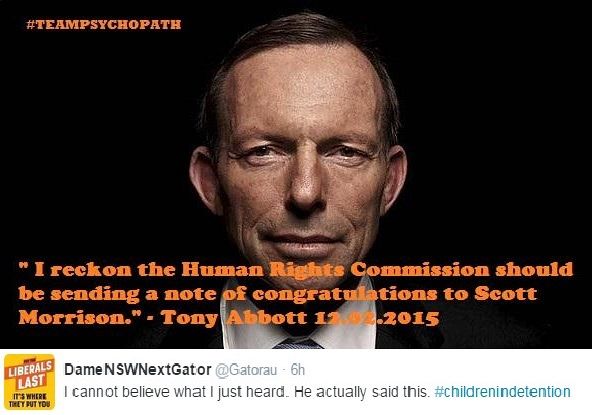
Professor Triggs, though, has been the target of a despicable, orchestrated campaign by the Abbott government. It was led by Prime Minister Tony Abbott, who accused her of acting in a “blatantly partisan” manner for investigating the conditions of children held in immigration detention. He declared the government had lost confidence in Professor Triggs. Then it was Attorney-General George Brandis, who tried to force her resignation by sending a bureaucrat to offer her another role.

The latest unwarranted and high-handed volley was from Mr Dutton. He needs to have a hard look at himself. Remember he brought to cabinet (with Mr Abbott) the unheralded and preposterously un-researched proposal to cancel, on the say-so of a minister, the citizenships of Australians suspected of terrorism activities.

As Immigration Minister, Mr Dutton has charge of one of the most important and sensitive government portfolios. His brief requires focus on matters of national security as well as national cohesion. To enhance national security requires more than extra defence and police powers or border protection services or, indeed, stripping citizenship rights from individuals. As Immigration Minister, he should be building tolerance and inclusion, not demonising and ostracising.

The efforts of all these senior ministers to blunt the independent advocate for human rights underscores how desperate the government is to deflect criticism of other matters, and how haughtily some ministers seem to view the power of the executive. On that last point, authoritarian is a word that springs to mind.

Maurice Newman: mad, bad or sad?

AAP/Julian Smith

Having a platform, albeit a modest one, from which to try and catch the world’s attention is a great privilege. The number of competing voices in the blogosphere means that the size of the audience is often far smaller than one might like. In this regard, newspapers are still in the ascendant and writing for them has a good deal more impact. No-one demonstrates this possibility more vividly, perhaps, than Maurice Newman.

One thing Newman is not short of is opinions, and very consistent ones at that. But as I never tire of telling students, having an opinion is one thing; having a decent argument that is actually supported by some relevant evidence is quite another. Clearly there’s a case for speculative and provocative op-eds that don’t necessarily pass the fact-check test, but that doesn’t mean that such facts should be wilfully ignored.

What makes Newman’s views so noteworthy is not just their predictability and consistency, but that they are so dramatically and wilfully at odds with the prevailing scientific consensus in the area about which he claims to speak with authority. This is not the place to rehearse the well-known debates about climate change, but to point out that this is grist to the mill for the conspiracy theorists on the other side of the debate.

The fact is, as Robert Manne among others has pointed out, that the Murdoch press generally and The Australian in particular really do give a lot of space to climate contrarians, sceptics and outright denialists, such as Newman.

I don’t have any problem with a range of opinions being offered on contentious subjects, but it is hard not to conclude that Newman’s highly contentious, regularly repeated views are received sympathetically at The Australian because they are ideologically compatible with that paper’s pro-business, pro-development agenda, and its owner’s own sceptical views.

What gives Newman’s views additional weight and credibility for some is that he is chairman of the Prime Minister’s Business Advisory Council – something he never fails to include on his byline. Even if Newman’s views were simply confined to his relentless criticisms of the science of climate change, one might have thought this would have made him a rather embarrassing advisor for Tony Abbott. Now that Newman has embraced some of the more paranoid and/or laughable conspiracy theories about the United Nations, it is surely time for Abbott to disown him.

Newman’s latest in a long line of op-eds for The Australian claimed that Christina Figueres, a senior UN climate change official, is part of an authoritarian conspiracy to shut down the fossil fuel industry:

… the real agenda is concentrated political authority. Global warming is the hook … This is not about facts or logic. It’s about a new world order under the control of the UN. It is opposed to capitalism and freedom and has made environmental catastrophism a household topic to achieve its objective … In her authoritarian world there will be no room for debate or disagreement. Make no mistake, climate change is a must-win battlefield for authoritarians and fellow travelers.

This might be amusing if we read this on one of the many anti-UN, anti-climate change mitigation websites that proliferate and peddle delusional nonsense about powerful figures conspiring to impose a new world order. But when we read this in our only “serious” national newspaper then it rather ironically becomes easier to sympathise with Newman’s conspiracy theories – although not quite as he imagines them.

In Newman’s reading of the new world order it is the environmentalists who are in the ascendancy, of course, ably assisted by “compliant academics and an obedient and gullible mainstream media”. If only. Even the most cursory survey of the contemporary world serves as a reminder of the difficulty of achieving any kind of national, let alone international collective action on climate mitigation and much else besides.

In reality, chaos and disorder, not centralised authoritarian rule, are becoming more common. Sadly, the UN is most noteworthy for its inability to influence anything of importance. Capitalism remains the ascendant, unchallenged economic system, despite very real doubts about its compatibility – as currently configured, at least – with anything like a sustainable environment.

Maurice, your side is winning – more’s the pity.

It begs the question of what motivates Maurice? Does he have children, grandchildren? Just on the off-chance that the overwhelming majority of the world’s climate scientists, the UN, and all of those limp-wristed liberals and greenies aren’t involved in an elaborate conspiracy to shut down capitalism, wouldn’t it be a good idea to at least consider the possibility that there actually might be something in all this climate change stuff?

You may not be around for much longer Maurice, but your offspring will. Being confident about your opinions doesn’t inevitably make them right. It is just possible that people who have dedicated their lives to understanding the climate rather than making money might know a bit more about it than you do.

Given the unprecedentedly difficult nature of understanding much less addressing the problem of a changing environment, a little intellectual humility all round might not be a bad thing.

EXCLUSIVE: Turkey returns Gallipoli tickets as Hockey capitulates on Armenia: All’s not well as one would believe

EXCLUSIVE: Turkey returns Gallipoli tickets as Hockey capitulates on Armenia.

Liberal Party leaks, lack of cohesion damaging Abbott Government and economy: Roger Corbett – ABC News (Australian Broadcasting Corporation)

Federal Minister for Communications Malcolm Turnbull

Liberal Party leaks, lack of cohesion damaging Abbott Government and economy: Roger Corbett – ABC News (Australian Broadcasting Corporation).

Mr Colgate: The other side of Mike Baird

Mr Colgate: The other side of Mike Baird.

Australia’s complicity with brutal regime exposed

Australia’s complicity with brutal regime exposed.

The inevitable is almost upon us – » The Australian Independent Media Network

knives


The inevitable is almost upon us – » The Australian Independent Media Network.

EXCLUSIVE: Tim Wilson already promised Gillian Triggs’ job. A Captain’s Call and bag full of promises but shush

EXCLUSIVE: Tim Wilson already promised Gillian Triggs’ job.

So much for a more ‘consultative’ PM – The Drum (Australian Broadcasting Corporation)

Tony Abbott

So much for a more ‘consultative’ PM – The Drum (Australian Broadcasting Corporation).

Seven ministers put Tony Abbott on notice


Prime Minister Tony Abbott during question time.

Seven ministers put Tony Abbott on notice.

Westerners Join Iraqi Christian Militia To Fight ISIS/ Abbott want’s them arrested or the right rescind their passports. Do they have good reason to be there?


DWEKH

Westerners Join Iraqi Christian Militia To Fight ISIS.

Robert Manne. Human Rights Commission and Gillian Triggs. | Pearls and Irritations Hopes of our totally unrespected national leader


Robert Manne. Human Rights Commission and Gillian Triggs. | Pearls and Irritations.

Children in detention: A government without compassion: Andrew Bolt’s truism right wing governments show compassion.

Joshua Dale

Prime Minister Tony Abbott dismisses a damning Human Rights Commission report into children in refugee detention, saying he feels no guilt about their plight whatsoever. Human rights lawyer Joshua Dale says there needs to be complete overhaul of attitudes amongst Australia’s politicians and their constituents.

IT IS with sadness, that one must now accept that the rights of children in Australia, particularly so far as it concerns Australia’s immigration policies, have fallen by the wayside.

There is now a common theme amongst Australian governments to dismiss human rights issues when it concerns Australia’s detention facilities and the treatment of their occupants.

Recently, the Australian Human Rights Commission under the guidance of its president, Gillian Triggs, has engaged in a national inquiry into children in immigration detention. The report has now been released, making 16 recommendations, including that all children should be released from detention in the next four weeks and that a Royal Commission into the treatment and detention of children should be convened.

This report has been met with strong opposition by the Abbott Government.

The Federal Government’s current approach to ensuring Australia’s international obligations are upheld is by delegating authority to the Australian Human Rights Commission to investigate and advise.

Outside of the Human Rights Commission’s recent findings, there remains the question of how children or minors accused of people smuggling are affected by current Government policies.

You may recall reports in 2012 and also 2013 where young Indonesian children, accused with people smuggling crimes, were detained in Silverwater Prison.

Many of these children came from impoverished backgrounds, in which they were forced into operating vessels on the high seas where they risked death, all for the purpose of being able to return what can only be described as a dismal income to their families. Evidence submitted to a Senate Inquiry suggested that many of these individuals had very little knowledge as to whether or not they were, in fact, committing a crime.

When detained in Australia, many of these minors did not have any identification or birth documents in their possession. In the absence of identification data, their age was determined by the performance of a wrist X-ray, which would then be examined for certain levels of deterioration in the wrist, which could then estimate age of the minor.

Various studies had been in existence prior to the implementation of law that allowed for age testing with the use of X-ray. These anthropological studies concluded that there existed a significant variation in findings and concluded that unreliable results concerning bone ages had arisen. The conclusions generally were that the testing methods did not accurately represent multi ethnic child populations.

For example, a study conducted in 2001 [Mora Et Al, “Skeletal Age Determinations in Children of European and African Decent; Applicability of the Greulich and Pyle Standards”, Paediatric Research (2001) 50, pp624-628] indicated that African American children had a greater bone age than those of European decent. The testing standards made no allowances for differences in genetic make up in so far as it affected bone age. As a result, the study rejected the adequacy of the testing method and determined that new standards were thus required.

Despite this, the Australian Government continued to apply this testing. Indeed, from September 2008 to January 2012, 208 people detained as members of smuggling crews who claimed to be minors had been detained. After the result of X-ray testing, 86 of these persons were determined to be adults, despite truly being minors. This means, in effect, that  Australia’s Government was advocating and allowing the detention of children in adult prisons based on testing that, anthropologically speaking, had been rejected almost a decade prior.

A Senate inquiry ensued and a number of recommendations were made. Whilst the Government generally accepted the recommendations arising out of the majority report, it disagreed with all further recommendations made by the Senate Committee, except for the funding of Government funded legal agencies, such as Legal Aid, to assist Indonesian minors detained and accused of people smuggling to return to Indonesia in order to substantiate their age.

Of most concern regarding the outcome is that it took until 2013 before any amendments to crime regulations were made removing the use of x-ray testing for age. Furthermore, the Human Rights Commission was not consulted prior to implementing x-ray testing for age despite this avenue being available to them.

There have remained ongoing issues arising from these events and this inquiry.

For example, there remains a significant issue for children detained in circumstances where their age is not known, so far as legal representation is concerned, particularly in relation to any criminal proceedings arising from minors being detained on people smuggling charges. Depending on how they plead to criminal offences, this can also affect other recovery actions against the Government should there be untoward treatment, such as detaining a minor in an adult prison and any subsequent injury.

Furthermore, there is an ongoing fear that anyone pleading guilty to such offences are doing so without adequate advice, legal representation, or proper knowledge and understanding of the crimes in which they are charged.  Without ensuring this advice and access to a proper defence it is clear that Australia will continue to advocate for laws that allow for breaches of international treaties and procedural fairness.

The point here is that there should be no excuse for delaying the implementation of comprehensive rights based laws that advocate for the rights of children. Nor should there be any politically motivated attack on a commission charged with protecting Human Rights in Australia.

What history confirms is that the current political landscape looks to solve immigration and people smuggling policies with short term fixes without implementing a longstanding agenda that creates a system whereby Australia maintains its Human Rights obligations, yet maintains a tough stance on people smuggling and national security issues.

Despite what the current government would have you think with their mantra and partisan stance of “stop the boats”, this can be achieved by ongoing consultation with Human Rights based groups, including the Human Rights Commission.

From an international perspective, policies need to be shifted to create a more collaborative approach internationally to shut down illegal people smuggling operations. And more importantly, greater education needs to be provided to the regions where the operators of the boats that come to Australia are recruited.

Domestically, it seems that Australia is crying out for human rights based legislation to be enacted to ensure that breaches of international human rights are recognised at their earliest stage, not only by our government when making laws, but also so that they are actionable should they be breached.

It is clear there needs to be a complete overhaul of attitudes amongst not only our members of Parliament but also their constituents. There needs to be current and ongoing checks and balances and there needs to be an underlying concern and motivation to ensure change not only to minors held in detention centres but any minor that finds themselves at the mercy of Australia’s current immigration policies.

Tax collection. Now there’s a moral crusade for the Tories . An Urgent advice for Abbott and Hockey which they won’t take. Aiding and abetting crime,

The star chamber is in session. Any foot-draggers in the cabinet are due to be hauled before it if they fail to offer up 25% or even 40% cuts in time for the mass slaughter of the public sector next month. A wail of pleas for mercy has gone up to at least stop shortsighted purging that will end up costing the state more.

The recent cut in teenage pregnancy prevention programmes will add to future spending. Cuts in early mental health treatment will lead to more florid cases arriving in hospital. Cutting home care for the frail will send more into costly care homes. The arts can prove how every £1 the Arts Council spends generates another £2. Everywhere you turn, there are compelling arguments for upfront investment to save money later. But the Treasury is implacable, fingers in ears, sceptical about future savings that have a habit of vanishing into their departments. Myopia is part of Treasury DNA, pessimism about putative paybacks hardwired into its circuit board – now, more than ever.

But the Treasury should heed the voice in its own backyard, Revenue & Customs, which brings in the money, cash in hand, here and now: it could bring in enough to deal with the deficit. The World Bank estimates £70bn a year goes missing in Britain’s shadow economy – and its last report found tax evasion rising.

On average a senior tax inspector on £50,000 brings in about £1.5m, while lower-level inspectors on £25,000 bring in £300,000 each – in all 10 times more than is recouped by Department for Work and Pensions fraud-chasers. Yet Revenue staff have already been cut by a third to 68,000. How can they now lose another 25%? Top brass is fighting hard to resist it, suggesting a state-financed “investment plan” to recover lost funds.

Revenue has been accused of going soft on using the law: the Association of Revenue and Customs union reports HMRC brought 200 cases last year, while the DWP brought 9,000 for considerably less lucrative benefit fraud. Three huge firms recently settled out of court, but critics said all three would have paid more if these cases had proceeded. Each handed over at least £1.25bn in unpaid tax: one had set aside nearly twice as much as a contingency. HMRC settled these cases at the door of the court as they had each already drained £12m from its diminished resources. Now they say only high-risk big businesses are targeted. Overt organised crime such as VAT carousel fraud and carbon-trading fraud have “hoovered up our resources”, so most big evaders are under-scrutinised.
Advertisement

“There is a tipping point where without enough investigation, more of the fiddlers think they can fiddle more,” senior officials warn Osborne. A culture of honesty soon evaporates without the constant threat of arrest. HMRC tells how a recent crackdown on doctors spread the word fast: 10% came forward and confessed to cheating. Now the HMRC says bluntly: “We need to send more people to jail so people recognise that it is not worth cheating.” The honesty tipping-point comes when too many people know someone who is getting away with cheating: why pay if no one else does? Research shows the deterrent effect: every £1 detected deters another £1 in potential fraud.

HMRC says it needs resources for urgent scrutiny of the wealthy who are converting their income into capital to avoid the 50% income tax rate: City law partners are among the many awaiting investigation. The big four accountancy and consulting firms are still devising avoidance schemes, although they are required to register each new loophole. An honest rich man called a top tax inspector last month to report an approach by a big four firm offering a complex new capital gains tax wheeze involving “rescindable contracts”.

A brisk official call sent the firm into a “flat spin”; it subsequently withdrew it. But the dangerous impression is that the taxman is always a plod behind, short of resources, depending on tip-offs and settling out of court to save money. The National Audit Office’s report says “lack of funding” is preventing efficient debt recovery, with a 17m backlog of PAYE cases. Some £26.1bn is owed in back PAYE, according to tax expert Richard Murphy: “They haven’t enough people to get on the phone and knock on the door to get the money in.”

The Guardian’s Tax Gap report showed the vast scale of corporation tax avoidance. Meanwhile, a meagre 100 HMRC inspectors do their best to police the entire country’s employers for compliance with the minimum wage.

Britain is historically a nation of relatively compliant taxpayers, but that is changing. Lord Oakshott, the Lib Dem Treasury spokesman, told the Lords: “Tax-dodging in Britain is a deep-seated, pervasive, pernicious disease … Highly organised, aggressive, abusive tax avoidance which used to be a marginal and rather spivvy operation, that was frowned on by the main banks and shunned by top accountants and lawyers who were mainly concerned with reputational risk, has now mushroomed out of all recognition.”

He questions why the government is willing to give the big four and City law firms state contracts while they earn fortunes helping to deplete the Treasury. Until its last year Labour turned a blind eye to tax havens and other dodges; can the coalition do better? The BBC’s Robert Peston points out in his blog that the Conservative party is exceptionally beholden to donors from high finance and hedge funds. Sir Philip Green’s bizarre appointment as an anti-waste tsar undermined the coalition’s promise to “actively examine tax avoidance”.

HMRC top brass fear George Osborne needs to prove he is cutting his own department as savagely as all others. But cutting any further on tax collection would show beyond doubt that government cuts are ideological and totemic, and not based on sound economics.

After the Institute for Fiscal Studies showed cuts falling hardest on the poor, the coalition could restore some credibility by ensuring at least that taxes are collected fairly from all, and not just paid by Leona Helmsley’s “little people”. Why not deny state contracts to the consultants who help the wealthy drain the Treasury? And strengthen HMRC so inspectors can put the fear of jail into tax-dodgers. Conservatives could find it easier than Labour to launch an unflinching moral assault on the greedy culture of evasion, avoidance, off-shoring and cheating that has become poisonously socially acceptable.

Peta Credlin powerful, opinionated and protective: Julie Bishop expect a change in the PMO

Relations between Peta Credlinand Julie Bishop have been strained for a number of months.

Peta Credlin powerful, opinionated and protective: Julie Bishop.

Abbocolypse Now: Zombie PM’s days are numbered: Not all Zombies are “IN”


Abbocolypse Now: Zombie PM’s days are numbered.

Is it time for Treasurer Malcolm Turnbull? In the wake of Monday’s attempted Liberal leadership spill, Australian Prime Minister Tony Abbott clearly needs to do something to shore up support. He’s been offered all manner of unsolicited advice…

In the wake of Monday’s attempted Liberal leadership spill, Australian Prime Minister Tony Abbott clearly needs to do something to shore up support. He’s been offered all manner of unsolicited advice: show contrition, play nicer with others, sack his chief of staff Peta Credlin, explain his policies better.

But perhaps the most interesting idea – pushed to a large extent by News Limited papers – is to replace Joe Hockey as treasurer with Malcolm Turnbull. It’s far from clear that Abbott will make such an offer, and we’re certainly not sure why Turnbull would accept, but it’s interesting to speculate about what it would mean.

The leadership implications seem easy to understand if Turnbull became treasurer. He’d be less likely to challenge Abbott after accepting such a deal, and so the main threat to Abbott’s leadership in the medium term would disappear.

What about the economic implications? What would it mean for the budget, economic policy, and the deficit? First of all, changing treasurer does not change the fundamental, structural budget challenges faced by the government. Government revenues are forecast to grow at a much lower rate than government expenditures. We already have a large deficit and, left unchecked, it will only get larger over time. Indeed, it’s only bracket creep – the unsavoury fact that marginal tax rate thresholds are fixed in nominal terms and hence more people shift into higher tax brackets over time – that keeps matters from getting even worse.

Changing personnel doesn’t do anything about that. Or does it?

Well, not directly. But it’s probably fair to say that Turnbull has a more sophisticated grasp of economics than Hockey. More importantly, however, he’s definitely a better salesperson. Anyone who has met Malcolm knows that he has a healthy regard for his own abilities. Yet it’s hard to imagine him lecturing us on how poor people don’t really drive cars, or lighting up a stogie just before delivering a budget that ripped benefits away from a big chunk of Australians. He would likely be more successful at selling economic change.

Indeed at a conference in Canada, (where Kevin Rudd was the keynote speaker) Turnbull gave the final speech, about the future of China. It was so good some Labor staffers were heard to say: “Gee he’s good…he explains it so well…oh hang on we are not meant to say that are we?”

But even a great salesperson needs product. And that’s a bit of an issue. The gap between government revenues and receipts is big and growing. To bridge that gap requires some big changes.

On the revenue side it could involve: raising the rate of the GST (to say 15%) and broadening the base to include things like fresh food; ending or scaling back negative gearing; or cutting down on tax breaks on superannuation. Those things may or may not be good ideas, but they’re all a tough sell. The GST hits poorer people hardest and probably requires some significant kind of compensation to have any chance of passing. Ending negative gearing could obliterate the housing market, and at a minimum would hurt those invested in rental properties. Raising taxes on anything is not exactly the Liberal way – and raising it on retirement savings of wealthy people would play terribly with their base.

On the expenditure side measures could involve: cutting back the growth of and accessibility to the age pension; further cutting family benefits; or introducing significant co-payments in the health system. All of these things are profoundly unpopular with the electorate.

Just ask poor old Joe Hockey how easy it is to sell some combination of this stuff.

Change for change’s sake?

The key benefit of Turnbull as treasurer would be the change itself. This government is stuck in the muck economically. It needs to do something to start gaining traction on policies that will bridge the structural deficit gap. Turnbull would represent a shift toward a person well versed in matters economic and good at getting things done.

He might even be able to preside over some kind of “grand bargain” on taxes and spending – bringing the ALP on board. That would be a great thing for the country. But it would require every bit of his charm, as well as his intellect.

But whether bargains are grand or modest, the treasurer needs to be a good negotiator and persuader. Especially when the PM is not. The great PM-treasurer combinations in Australian history: Hawke-Keating and Howard-Costello had one key thing in common. The PM built political capital, and the treasurer spent it on economic reform. But they did so by jointly persuading the voters of the benefits of change.

So would Turnbull make a good treasurer, or even a great one? We may never know as a technically good potential treasurer on paper may be a flop in practice. While a self-made man like Keating, who had little formal economics education, turned out well.

We don’t know the answer to that question. But perhaps the most compelling reason for Abbott to appoint him is that, with all the challenges is entails, it would keep Turnbull busy.

More time would suit new Malcolm Turnbull: Time is on our side as well Turnbull. You could get blamed for Abbott’s future fuck ups.

Malcolm Turnbull at Tuggerah train station

Annabel Crabb

If the motion to spill the leadership of the Liberal Party leadership succeeds, the main prospect as a challenger is and has always been Malcolm Turnbull, who has transformed himself to a milder, more patient and less pushy political figure, writes Annabel Crabb.

From the jungly commando warfare that has occupied the Coalition over the last two torrid weeks, a familiar battle-cry has now clearly emerged: “If it leads, we can kill it.”

This afternoon, two WA backbenchers have posted their intention to move, on Tuesday, for a spill of the Liberal Party leadership, five-and-a-bit years and two elections and four prime ministers on from its memorable capture by Tony Abbott with the heart-stopping margin of one single vote.

The message: No leader is safe any more. Not in their first term, not ever. The threat has evolved.

Internecine political warfare has changed a lot. In the old days, it was slower. You’d start off with a challenger and go from there. Sometimes, you’d start with a challenger – Peter Costello, say – and then nothing would happen for eight years.

On one memorable occasion in 2007, John Howard even asked his Cabinet whether they thought he should go. By the time they answered (“Yes”), he was out of his consultative patch and the moment was lost.

These days, you don’t even need to start with a challenger.

These days, dissatisfaction plus a multi-headed media hydra will get you to crisis point even if – as in this present situation – none of the purported leadership alternatives has sought to bring things to a head.

Can Tony Abbott survive on Tuesday? Possibly. Can he survive long-term? Hmmm. Put it this way: Barnaby Joyce last week bet his house on Tony Abbott still leading the Coalition at the next election. He would want to be checking his mortgage insurance.

Mr Abbott has just made a terse appearance at Sydney’s Commonwealth Parliamentary Offices to declare that he and his deputy, Julie Bishop, have spoken and have agreed to stand together – leader and deputy – to contest any motion to spill.

“We are not the Labor Party,” he further and uncontroversially declared, before disappearing from the shortest press conference I can ever recall seeing.

Ms Bishop’s absence from her leader’s side does not necessarily mean that she has been tied up somewhere by Peta Credlin; she has been in Adelaide, playing awkwardly with preschoolers in the company of a sub-ebullient Christopher Pyne.

The question of whether Ms Bishop’s support would continue in the event that the spill motion succeeds is still unanswered.

But the full support of Ms Bishop has never, in any event, been a guarantor of ballot triumph; she supported Brendan Nelson all the way to his defeat in 2008, and she supported his successor, Malcolm Turnbull, right up to the point at which he was knocked over by Mr Abbott in late 2009.

In any event, the main prospect as a challenger is and – realistically – has always been Malcolm Bligh Turnbull.

He has not declared himself to be a candidate. He has been studiously cautious about canvassing the issue with colleagues.

If internecine political warfare has changed, then Malcolm Turnbull is one jungle-dweller who has evolved as effortlessly as Schwarzenegger.

The old Malcolm, who strutted and fretted under Brendan Nelson’s leadership and whose ambition to take over was so red-hot it was palpable across a crowded room, is nowhere to be seen these days.

New Malcolm is milder, more patient, less pushy. Less prickly; the “metadata” fiasco, which last year saw the PM and George Brandis both stumble rather badly on some technical detail within Turnbull’s portfolio rather than just doing the obvious thing and including him in the discussion, would have sent Old Malcolm into Rage Orbit. But he helped to fix the situation, and refrained from making a fuss.

Internally, Turnbull has been reported as encouraging colleagues to give the PM more time. That in itself is not a qualification for saintliness; more time would suit Turnbull.

Annabel Crabb is the ABC’s chief online political writer. She tweets at @annabelcrabb.

Liberals do a fine imitation of Labor chaos

Liberal MPs will confront a stark choice next week between propping up a deeply wounded prime minister or trying a fresh start. They know each course is fraught with big risks.

With the crucial vote not until Tuesday, anything can happen in this extraordinary volatile situation.

Backbenchers will be under huge pressure from the Prime Minister’s Office (PMO) and close supporters. But Team Abbott will need the kid gloves on, or they will reinforce the criticisms about the “command and control” style.

On the other hand, the MPs will also be acutely aware of the evidence pointing to the dangers of retaining Tony Abbott. This includes the feedback they’re getting from their electorates, and the polling, of which there will be more between now and Tuesday, including the influential Newspoll.

A Seven News ReachTEL poll done on Thursday night had the government trailing 45-55%. When people were asked how they’d vote if Malcolm Turnbull were leader there was a massive turnaround – the Coalition led 54-46%. A hypothetical Julie Bishop leadership had the Coalition ahead 51-49%.

Asked to choose between Turnbull and Bishop to lead, Turnbull polled 56.5% to Bishop’s 43.5% – although Bishop was decisively ahead among Coalition voters and Turnbull was strongly in front among Labor voters.

Ministers – including Mathias Cormann, Peter Dutton, Jamie Briggs, Bruce Billson, Josh Frydenberg and Kevin Andrews – rushed out late on Friday to oppose the spill motion from Luke Simpkins and Don Randall, which is to open both Abbott’s position and that of deputy Julie Bishop.

Bishop and Turnbull are under intense attention from media and colleagues. Abbott, in his brief take-no-questions appearance which lasted less than two minutes, said he’d spoken to Bishop and they’d “stand together” against the spill.

But Bishop made it clear that while she is opposing the spill, if it passed all bets would be off, saying in a statement that: “I agreed with the Prime Minister that due to cabinet solidarity and my position as deputy there should be support for current leadership in the spill motion”.

Turnbull was conspicuously missing in the ministerial dash to shore up Abbott.

One factor that could affect the numbers is whether it is a secret ballot or a show of hands. Chief Government Whip Philip Ruddock indicated this was up to the leader.

An open ballot would test the courage of those critical of Abbott but ambitious for their own future. Some might fear the wrath of the PMO if the motion failed but they had voted for it. Ministers could not break ranks if the vote were public – for a few, it might be a different story if it were a secret vote.

But an open ballot would bring resentment among the troops and reduce the credibility of a win. Cormann predicted it would be a secret ballot.

If Abbott fends off the motion the size of the margin is important. A sizeable “yes” minority would just encourage another attack later in a classic two-stage operation.

If there’s not a declared alternative, that probably helps Abbott. In the next few days, MPs will want to try to suss out what Turnbull and Bishop would do if the spill were carried. But the pair will have to take into account what their situations would be if they’d privately indicated they were willing to be candidates but then the spill vote was lost.

And then there is the question of what Abbott would do if the vote were carried – would he enter and complicate a subsequent contest?

This campaign against Abbott has been a bottom-up one by backbenchers increasingly afraid he will cost the Coalition government and them their seats. It’s quite broadly based across the country, with a significant number of people networking in the run up to Friday’s formal move. “It looks orchestrated,” observed cabinet minister Andrew Robb. The grassroots nature of the backbench revolt makes it hard for ministers to judge the numbers.

A perfect storm of events came together for the dissidents. The backflip on a backflip over the Medicare changes symbolised a flaky approach to policy; Prince Philip’s knighthood pointed to Abbott’s eccentricities; the Queensland rout highlighted that the voters are brutal to governments they come to dislike and distrust – and they make up their minds quickly.

Abbott is making a central point of his appeal for support that the spill sponsors “are asking the party room to vote out the people that the electorate voted in”.

“We are not the Labor party and we are not going to repeat the chaos and the instability of the Labor years,” he said in Friday’s statement.

It’s a pretty good imitation, however.

Are we guilty of Schadenfreude?

shaden

Reading the mainstream newspapers this week and listening to talkback radio has been like going back in time to 2013 when the Labor government was in disarray, the economy was supposedly haemorrhaging and the national debt was skyrocketing.

We remember how the Murdoch press were in hyper drive spilling out story after story about a dysfunctional government, incompetent ministers, backbench members speaking out of turn, leadership rumblings which turned out to be true and so on, and so on. Talkback Radio was doing much the same.

Today, that same Murdoch press are still at it, as are Fairfax and yes, talkback radio too. And it is still the government they are lambasting, except that it is the new government, the one we elected just 17 months ago. How the wheel has turned.

kellyYesterday, February 4th 2015 was perhaps the most telling when Paul Kelly, editor at large with The Australian wrote such a scathing article about the present government, I thought we had just emerged from some form of time travel.

A link to Paul’s article is blocked behind a paywall. But this is what he wrote, “The Abbott government is being destroyed before our eyes. The Liberal Party’s frustrations and divisions have cracked wide open. It has taken only 17 months for a sizeable section of the party to announce that Tony Abbott has failed as PM and needs to be liquidated.”

I would go further than that, Paul. The whole government needs to be liquidated. But in saying that I hope neither of us have violated some obscure national security law that might interpret the word ‘liquidated’ as meaning something more than a harmless metaphor.

As Paul’s article points out though, this whole, hilarious circus, has come to this point, i.e. the possibility of a leadership spill next week, without a leadership contender playing any part. It’s all about the failings of the present leader.

Frankly, anybody who could see through the facade Tony Abbott has been hiding behind for the last five years, could see this coming a mile away. When looking at his contradictory nature, things he said way back when, compared with his comments on a variety of issues today, it should have been obvious to anyone in the media a long time ago.

gillardIt was obvious for a large part of the electorate. That is evidenced by the election result itself; hardly a landslide. But such was the hatred for Julia Gillard, who by any measure looks positively presidential today, those contradictory failings were allowed to go through to the keeper by a supportive media who just wanted her, Kevin Rudd and Labor out.

And now the chickens have come home to roost. For those of us who saw what was happening, who could see the fallacy of Abbott’s promises, the lies about the state of the economy, the opportunism over the boat people, the regressive climate change policy and perhaps a dozen or so other contradictions, we are all now struggling to hide our enjoyment at the way things have turned out.

Are we guilty of Schadenfreude? Yes we are. Schadenfreude is such a delightful way of expressing our present feelings. I think Blair Donaldson, a responder on Facebook captured the feeling best when he wrote, “If members of Abbott’s own party are more interested in removing him than finding a viable alternative, it says a lot about the poisonous atmospherics in the party. There must be a fair bit of schadenfreude among the PM’s critics in the party and on the opposition benches as they watch Abbott get undone by his own ego and incompetence.”

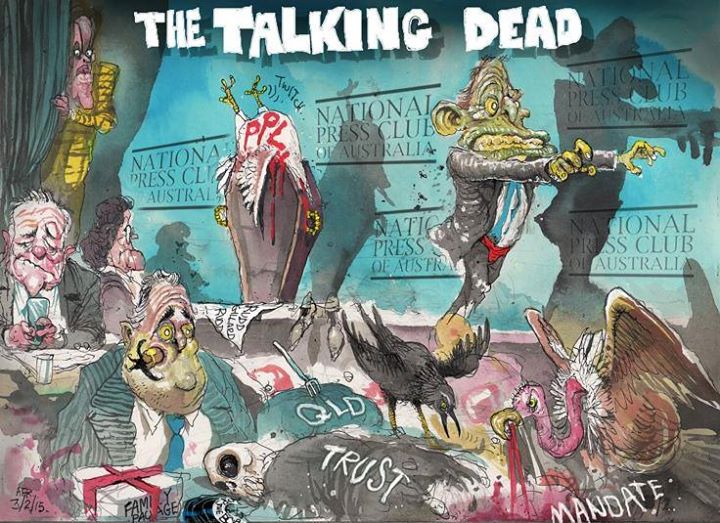
the walking dead

Abbott’s time as PM is nearly over. It just needs to be pronounced. But I can’t help thinking how much I would enjoy letting it bleed on for a little while longer.

Schadenfreude does that to you.

The real reason for the Government’s troubles: Moles and bad acting

The real reason for the Government’s troubles: Moles and bad acting.

Tony Abbott’s 67% disapproval rating is pretty bleak. But with rumours circulating of a potential leadership challenge, it’s important to remember that the problem isn’t the man — it’s the policies! Austerity policies don’t work!

This government has attempted a $7 medicare copayment, deregulated university fees, cuts to the aged pension and Family Tax Benefits, a 6 month wait for young jobseekers to access income support, not to mention unwinding all progress on climate change action and putting our renewable energy industry in jeopardy.

Let’s spread this image far and wide and get the word out; Abbott or not, we won’t stand by while this government continues its assault on everyday Australians.

Here we Joh again! ‘Tactical liar’ set to replace Newman as Qld Premier

Here we Joh again! ‘Tactical liar’ set to replace Newman as Qld Premier.

Legalized Bribery is not only an American concern. It is equally applicable in Australia and we see it in policy decisions of this government.

LAST Thursday, Sheldon Silver, the speaker of the New York Assembly for the past 20 years, was arrested and charged with mail and wire fraud, extortion and receiving bribes. According to Preet Bharara, the federal prosecutor who brought the charges, the once seemingly untouchable Mr. Silver took millions of dollars for legal work he did not do. In exchange, he used his official power to steer business to a law firm that specialized in getting tax breaks for real estate developers, and he directed state funds to a doctor who referred cases to another law firm that paid Mr. Silver fees.

Albany is reeling, but fighting the kind of corruption that plagues not only New York State but the whole nation isn’t just about getting cuffs on the right guy. As with the recent conviction of the former Virginia governor Bob McDonnell for receiving improper gifts and loans, a fixation on plain graft misses the more pernicious poison that has entered our system.

Corruption exists when institutions and officials charged with serving the public serve their own ends. Under current law, campaign contributions are illegal if there is an explicit quid pro quo, and legal if there isn’t. But legal campaign contributions can be as bad as bribes in creating obligations. The corruption that hides in plain sight is the real threat to our democracy.

Think of campaign contributions as the gateway drug to bribes. In our private financing system, candidates are trained to respond to campaign cash and serve donors’ interests. Politicians are expected to spend half their time talking to funders and to keep them happy. Given this context, it’s not hard to see how a bribery charge can feel like a technical argument instead of a moral one.

The former governor of New York David A. Paterson, for example, said that he had trouble understanding where the criminality lay in the allegation that Mr. Silver accepted payments from law firms for referrals, including referrals by a doctor to whom Mr. Silver funneled state health research funds. Mr. Paterson said, “in the legal profession, people refer business all the time. And theoretically, as a speaker, you could do that as well.”

The legal shades into the illegal. The real estate developers represented by the law firm that allegedly shuttled payments to Mr. Silver for fake legal services were also major campaign contributors. One developer mentioned in the charges gave more than $10 million to political campaigns in the past decade, including $200,000 to Mr. Silver and his political action committees.

The structure of private campaign finance has essentially pre-corrupted our politicians, so that they can’t even recognize explicit bribery because it feels the same as what they do every day. When you spend a lifetime serving campaign donors, it may seem easy to serve them when they come with an outright bribe, because it doesn’t seem that different.

Mr. Silver retained such tight control over budgets and lawmaking in Albany that his staffers were regarded as more powerful than most elected representatives. As a Democrat who cares about education, I can’t say that I loved seeing Mr. Silver, a great public school advocate, in handcuffs. For others, there’s glee in seeing the perp walk. But one high-profile indictment does not represent the dawn of a new democracy.

PM on the rocks: Abbott’s insider revolt and Fairfax’s fun

View image on Twitter

PM on the rocks: Abbott’s insider revolt and Fairfax’s fun.

Backbench Revolt Looming – » The Australian Independent Media Network

backbench2

Backbench Revolt Looming – » The Australian Independent Media Network.

Why the Liberals can’t kill Tony Abbott

Chatter among well-heeled Liberal voters on their annual New Year’s pilgrimage to the ski slopes of Europe and North America tells the story. This time last year, on her yearly trip to Aspen, one typical Liberal from Sydney’s north shore put it this way: “He’s not doing very well, is he?” A small businesswoman married to a partner in a legal firm, with teenage children at a good private school, she was disappointed but prepared to cut Tony Abbott some slack. Back at Aspen this year, sentiment had turned sharply for the worse. “Oh, he’s just hopeless,” she said. “Hopelessly bad. He’s an embarrassment.”

Abbott was already under pressure. The person who this week leaked the story that Joe Hockey and Peter Dutton argued strenuously against his proposed $20 Medicare rebate cut for short consultations upped it. The fact of the leak, rather than its content, got journalistic pulses racing, because there’s nothing press gallery journalists like more than a leadership stoush, and it seemed to presage the beginning of a good old-fashioned destabilisation campaign. The melancholy truth for Liberals is, however, that Abbott is going nowhere fast – good news for Labor and bad news for marginal Coalition seat-holders observing their own slow ride into electoral oblivion on Abbott’s coat-tails.

Does anyone see Loughnane bowling into the PMO and getting the staffer most accountable for the prime minister’s performance, namely his spouse, sacked?

Abbott’s reversal of fortune between opposition and government is a deep mystery, perplexing Liberal politicians, staffers and supporters alike. Not that there is a lot of open discussion about it in Canberra. “Everyone has to talk in whispers,” says one Liberal staffer. “Criticism is forbidden. It’s like being in East Germany and worrying the Stasi is listening.” Comparisons with Julia Gillard’s lack of political touch are becoming commonplace for Abbott but, as this comment shows, comparisons with the oppressive atmospherics of the early Rudd government, which ran on fear and humiliation, are more apt. This is reinforced by even a casual glance at the Abbott government’s staff retinue – “full of teenagers”, notes one close observer.

Just how did opposition leader Abbott, so sure of political touch, become the clunking Prime Minister Abbott even many rusted on Liberal voters now scorn?

First, hindsight makes clear that the effectiveness of Abbott’s simple “stop the boats, axe the tax and fix the budget” attack was underwritten by the political terrorism Kevin Rudd wrought on prime minister Julia Gillard in office. Rudd making Gillard look bad helped make Abbott look good by comparison. Abbott’s leadership talent may have been overestimated in the process. His three-pronged slogan may have sounded like a simpleton’s rant in the context of a Gillard government not subject to internal Rudd strafing.

Second, Abbott did not warn anyone, including his own colleagues, that he would move the Coalition policy agenda sharply to the right in office, beyond – industrial relations excepted – the boundaries established by his conservative prime ministerial predecessor, the four-election-winning John Howard. Abbott would have posed a bigger risk to Labor had he pursued the soft and subsidising economic thrust of his original spiritual and political home in politics, B. A. Santamaria’s National Civic Council. Given his political kitchen cabinet are all moderate Catholics – Chris Pyne, George Brandis and, until they fell out, Joe Hockey – this looked like a good bet when Abbott won office. But no, Abbott’s untrammelled inner right-winger, without Howard to sit on it, burst forth. The rest is polling history.

Third, Abbott’s chief of staff, Peta Credlin, has morphed from the flexible and pragmatic political operator of opposition to someone reputedly applying the hardest of hard right policy tests to ministerial initiatives crossing her desk – and every single one does. Both Credlin and her husband, Liberal Party federal director Brian Loughnane, are historically Liberal middle-of-the-roaders, not right-wing ideologues. “I’ve always highly rated Peta Credlin politically, and she’s really dropped the ball,” says one Liberal. “Normally she’d come in and say, ‘Tony, this political co-payment thing is killing us. We’ve got to drop it.’ But it’s not happening.” Says another: “She never showed any ideological interest. She was a total fucking pragmatist. Neither she nor Brian have ever been ideological.” There is no apparent explanation for this development, beyond Credlin being in Abbott’s orbit so closely for so long. But it is costing the government dearly. The political filter is gone.

Fourth, in the entire history of the Australian federation, there has never been such a conflicted troika of prime minister, chief of staff and party director as Abbott, Credlin and Loughnane. Credlin being a woman is not the issue. It could be Peter Credlin in a future Australia where marriage equality is achieved, and the issue would be the same. Loughnane is responsible for commissioning polling for the Liberal Party and using it judiciously to get the government re-elected. The polling is telling him that Abbott and his operation is dragging the Coalition steadily towards likely defeat. Normally a party director in this situation would move to either make sure the Prime Minister’s Office (PMO) is revamped and/or provide subtle assistance to an electorally saleable alternative capable of dislodging the prime minister and winning the election the incumbent cannot. But in the current formation, that cannot happen.

“It’s a huge weakness,” according to one Liberal. “Having the chief of staff married to the party director is a disaster. You need the party director to be able to say, ‘You’re dying out there in the electorate.’ ” But honestly, does anyone see Loughnane bowling into the PMO and getting the staffer most accountable for the prime minister’s performance, namely his spouse, sacked? No. Nor is it any more likely, given Credlin’s awesome persona, that Loughnane would cross her by providing the subtle assistance usually given by party directors in such circumstances to attractive potential prime ministerial successors – the kind capable of winning the 2016 election.

So it is that the Liberals are stuck with Tony Abbott. The received wisdom is that the party’s internal polling has always suggested – including before Abbott became opposition leader – that he was capable of winning an election only in the case of dire Labor dysfunction, but not in more normal political circumstances. Nothing has changed since, except that Abbott’s polling has become more dire.

But as one minister poses, “Who is running against him who could win?” Julie Bishop’s star is ascendant. Joe Hockey still has hopes. Malcolm Turnbull’s baton is within ready reach in his knapsack. Boat blitzer Scott Morrison is a party room darling. Abbott loyalist Chris Pyne, the other potential candidate, won’t run while Abbott is around. In any case, as a well-placed staffer says, “There’s no appetite among any of the key contenders – not Hockey, Bishop, Turnbull or Morrison – for a fight. They’re unhappy, yes. Very unhappy. But not the unhappiness like, ‘Now we’ve really, really got to do something.’ ”

Part of the reason is “the Gillard/Rudd problem”, as it is known – a reference to the awful political costs visibly incurred by Labor in protracted prime ministerial struggles between 2007 and 2013, the conspicuous part of ugly leadership doings that date back to the late 1990s. No Liberal MP in their right mind wants to go through that. Memories of the days when knives were sharp and flashed readily against Liberal prime ministers are long gone. There is no one much around who recalls Malcolm Fraser’s lethal manoeuvres against prime minister John Gorton, for example, or Gorton’s revenge gestures against the man who white-anted him and went on to the prime ministership, Billy McMahon.

What used to be practised with fine but bloody virtuosity in federal Liberal ranks is now a lost art. The ALP, enjoying its first leadership stability for a third of a century, is the big beneficiary. One of its now best-loved former prime ministers, Paul Keating, once characterised his own derring-do political style as “downhill, one ski, no poles”. Abbott is more like the alpine park ranger who lays the charges for planned avalanches, only to bury himself in the blast. Liberal backbenchers worry they are going to be buried with him

It makes no difference : Better salesman won’t cut it if there’s nothing to sell

WrongWayGoBack

  • January 22, 2015
  • Written by:
  • Whether it’s Abbott as PM or someone else from the Liberal government, it makes no difference. Because they are all the same. Sure, it’s fun to watch Abbott squirm as he realises he’s losing the fight. I can’t deny I’m enjoying the sense of schadenfreude that comes from watching the Liberals respond to ‘leadership tensions’, something the previous Labor government had to put up with for years. But that’s not to say that the Liberals are in the same position as the Gillard government was in, because the two situations are completely different.Gillard was running an entirely successful government and was effectively negotiating many positive policy successes with independents and minor parties as a member of a minority government. Sure, Rudd was a problem for Gillard. There’s no denying Rudd’s leaking spurred on a press pack desperate for any bite of a story that would save them from doing any policy analysis, something they’re incapable of doing. But for Abbott, Abbott is clearly the problem. His incompetence is his problem. His ineptitude and incapacity for the development of reasoned, logical, fair, sensible and importantly, popular policies, and his lack of negotiation skills to get terrible and unpopular policies through the Senate are his problem. Abbott is a problem of Abbott’s making. And it’s such fun watching the house of cards come slowly tumbling down. Especially since he has no idea what the problem really is.

    This is why I think it’s important to note now, at the outset, before a decision is made about Abbott’s future by his colleagues who are stuck between a rock of an unpopular Prime Minister and a hard place of the hypocrisy of changing leaders after the way these same very people attacked Labor for doing the same thing, that a leadership change will make no difference. The reason for this is because Abbott is not unique to the Liberal National Coalition government. He is not even rare. He’s just like all of them and his policies are ideas they all support. So why would it make any difference if someone else is PM? It’s not Abbott who has to go. It’s this government.

    Ask yourself, once they’re rid of Abbott and Peta Credlin, who would they put in their place? Julie Bishop, who is more interested in locating an earring which cost more than most workers’ monthly home mortgage payment than supporting Australians on death row in Bali? Malcolm Turnbull, the quality NBN wrecker who’s giving his Telstra mates control of a lemon of a broadband network, which relies on old technology and will barely be faster than the internet network we have already? How about Joe Hockey, the cigar smoking, best night of his life dancing, poor people don’t drive, bully boy architect of the most unpopular and unfair budget the country has ever seen, which has so far failed to pass the Senate many many months after it has been released? What about, shudder to think, Scott Morrison, who clearly takes great pleasure in the suffering of desperate asylum seekers who are begging Australia to help them save themselves? Instead of helping these desperate people, Morrison has been aiming to make Australia a scarier destination than anywhere the desperate people have fled from. Would you trust this man with your children’s future? He’s in charge of Social Services now. It’s the stuff of nightmares. Name someone else, anyone else who could take over from Abbott and you will see it’s quite clear that they are all the same. They all share the same values, values that lead them to misunderstand why they’re so unpopular. They all share the same failure to understand that their policies are to blame, policies they never took to an election. The problem is not the way the Liberals spin their policies. The turd is unpolishable and the turd is everyone in the Liberal government.

    In the simplistic media narrative that goes something like ‘Abbott can’t get his message across so the Liberals need to try a new salesperson’, there is no analysis of the core of the Liberal government’s problem. The core is that their extreme conservative ideology is disgusting and Australians don’t like it. Australians value a fair go, where a person’s post code doesn’t dictate their future success. The Liberals hate this idea. Australians believe that quality education and healthcare should be available as a right to everyone in the country, no matter their bank balance. The Liberals think people who can’t afford health and education should be denied health and education. Australians appreciate a clean environment which provides a safe climate for their futures and future generations. The Liberals cancelled the Carbon Price to help their rich business owner mates continue to pollute our environment and endanger our futures, all to maintain their rich business owner mates’ profits. Australians think we should all benefit from the rewards that come from the sale of natural resources we all own. The Liberals defended rich miners by cancelling the mining tax. Australians think those who have benefited most from the Australian civilisation – those who are the richest – should progressively pay the most tax to pay forward the opportunities they have benefited from to future generations. The Liberals think the rich already pay too much tax and should pay less, with the tax burden falling regressively on those who can least afford it. The values of Australians are fundamentally different than the values of the Abbott government. This mismatch isn’t going to be solved by cutting off the head of the snake.

    So I’ll sit back and laugh as I watch Abbott’s political career unravel, and I will appreciate the self-inflicted karma Abbott and his colleagues have brought upon themselves. But I will not entertain notions of anything changing with a new Liberal PM in the top job. The only way to solve this problem, as I suspect Australians have now worked out, is to comprehensively vote the Liberal government out in 2016, if not before.

Mr Hockey Knows The Value Of A Good Story – Unfortunately, The Liberals Don’t Have One!

working life debt

Actually, the title of this piece is unfair. The Liberals not only have a good story, they have oodles of them. And this is what’s making their narrative so confusing.

Back when Labor were in power, the narrative was easy. “We should be in power because we’re awesome, and what this country needs is strong leadership which Labor lacks (but don’t call us sexist because we didn’t say that they weren’t strong because they had a woman in charge – I mean, if Julia can’t stand the heat she should go back to the kitchen!)” But now that they’re in a position where, not only do they have to actually do something, they have to explain those decisions, it’s no longer quite as simple. And, while many of their decisions seem contrary to what they were saying in Opposition, it’s the explanations that are making these decisions look even more ridiculous.

Now I may not agree with a hard-hearted policy of let’s kick the poor, but at least if the narrative stays on the “it’s an emergency” and “we all need to make sacrifices” and “the poor are a mob of lazy leaners who need to get off their fat spotty backsides and inherit more”, then at least I can appreciate that, while the other person and I have a different value system, I can at least understand where they’re coming from. I can appreciate that they have a different moral code, where they support Ayn Rand, (who argued that it was the individual who was important and that all individuals were brilliant, unique people with a right to impose their ideas on society, so long as their ideas agreed with hers.) I, on the other hand, understand the role that luck plays in people’s lives and how I’d have my mortgage paid off were it not for the fact that Red Cadeux ran second in 2012.

While Joe’s comment about a child living till 150 has attracted plenty of ridicule, his basic point was right. If people are living longer, how do we ensure that they have an acceptable lifestyle? However, this now makes the decision to freeze the superannuation guarantee payments at 9..5%. Interestingly, Howard also froze the superannuation payments. (Are we seeing a pattern here?) We don’t want people dependent on the pension, but we also don’t want to do anything to help them be more financially secure.

However, It’s his son’s trip to the doctor that I find most problematic. He seemed to arguing that it was outrageous that he only had to pay $40. And it’s just wrong that someone like him should only have to pay that. So therefore, his logic seemed to run, with a few exceptions for the very poor, we should all have a “price signal” to stop us going to the doctors. Now let’s not bring up the fact that there’s a big difference between “someone like him” and even someone on a decent wage, let alone someone working part-time in a long paid job. The exemptions for the co-payments were pensioners, health care card recepients and children; it didn’t include “Howard’s battlers”. And it certainly didn’t include all those people who were “battling” on $150,000 when Labor wanted to means test the private health insurance rebate.

Now, I tend to think of the Medicare Levy as like insurance. Many of us won’t use up as much as we pay in any given year, but it’s nice to know that if you suddenly need a costly procedure that you don’t need to re-fincance your house, sell a kidney or run for office as a politician in NSW. Using Joe’s logic, and applying it to car insurance, it’s outrageous that someone driving an expensive Lexus should only have to pay the same excess as some driving something cheap like a Nissan, even though they’ve paid more in insurance.

And, of course, Mr Hockey tells us that high income workers work for the first six months to pay their taxes. Apart from the fact that this has been demonstrated as incorrect. (For a start, to be mildly pedantic people earn the first $18,000 tax free, so surely it’d be the last six months, rather than the first!)

So let’s get this straight. High income earners are hard done by because they pay so much tax, but they should then have to fork out more than $40 if their son breaks their arm because they can afford it. And we need to do this, along with such things as forcing our children to pay more for their university degrees, because some lucky bastard will live to be 150!

Like I said, the narrative doesn’t make sense. I’m not sure whether to feel sorry for those poor rich people paying so much tax, or be annoyed because somehow Joe Hockey managed to get by only paying $40 for his kid’s broken arm, when it cost me considerably more than that for a visit to my local doctor (when she doesn’t bulk bill me, because it’s a quick visit to renew my prescription and check my blood pressure – bloody six minute medicine.)

It’s like the way the Liberals argue for lower taxes because money’s better in people’s hands than the government’s, but when Labor gave the $900 stimulus in the middle of the GFC, we were told that this was a total waste of money because people would just waste it on pokies and alcohol. Which, strangely, was a good thing when Labor were proposing the limits on the poker machines. Then, a self-imposed limit was going to wreck the clubs, causing massive unemployment.

Labor’s narrative isn’t perfect either, of course. There are inconsistencies there too. But  I’m yet to hear them argue two opposing narratives in the same week such as the rich pay too much in tax and don’t pay enough for government services.  And certainly not by the same Treasurer.

Yep, one can certainly why Peta Credlin would want to have them all on such a tight rein. The real question is why she lets them out more than once a fortnight!

Does the average person realise how much the Abbott Government is helping the wealthy? He calls it Cool- Aid

He said it. He's doing it. (Image from northcoastvoices.blogspot.com)

  • January 19, 2015
  • Written by:
  • In opposition and in government, the Coalition has moaned with frenetic monotony that Medicare is unsustainable. The fact is, it isn’t. But while they can maintain the rage and attempt to convince everybody that the country can’t afford to keep it in its present form, they’ll find one way or another to use it as an economic scapegoat.The news that they had scrapped their planned cuts to the Medicare rebate was only a temporary reprieve as we’ve been warned that they are still committed to introducing price signals into the national icon. Why? This was summed up by Tony Abbott:

    Mr Abbott has called on the opposition and the crossbenchers to come up with alternative savings measures to pay off the debt and deficit instead of obstructing the government’s attempts to repair the budget.

    It’s the same-old same-old from Tony Abbott. Blame Labor, hit the poor. The budget must be in one hell of a mess if the country’s prosperity is at stake because of Medicare.

    With the government’s back-down on the planned cuts to the rebate we can expect a ramp-up in their rhetoric. The attempts to convince us that Medicare is unsustainable will go into overdrive.

    I agree with the government that the budget is in a shambles, but I disagree at where the fault lies. One good thing – for them – is that while they keep Medicare in the news the real culprits behind our budget woes remain out of sight. Or as Richard Denniss points out, the much talked about budget deficit gives the Treasurer the chance to keep his agenda in the public domain. Which is, of course, that the budget can’t be fixed because Medicare is the hole in the economic bucket.

    With the help of the Murdoch media not only will the Medicare bashing be kept front and centre, but the ‘real’ culprits for the deficit will be kept hidden from public view. The average punter has been deluded into believing that Medicare is unsustainable and that the only way the budget can be fixed is if services to the less well-off (aka the ‘bludgers’) are trimmed. The government and the Murdoch media have managed to sustain both the delusions rather effectively.

    I wonder if the mug punter is aware of how much the Abbott Government is actually helping the wealthy. At not only the poor’s expense, but at their’s too. The facts might shock them.

    How can we accept that Medicare is the boil on the budget’s backside when being slipped into the hands of the wealthy is enough money that, if ceased, would go close to balancing social inequality? And the budget, of course.

    Stop pandering to the wealthy, and Medicare becomes sustainable. It is the luxuries afforded to the well-off that are unsustainable. How much is it costing us? Too much. Here are some examples.

    George Lekakis writes in The New Daily that:

    Former Liberal Party leader John Hewson last year called on the Abbott government to slash the superannuation tax concessions available to high-income earners.

    One of the effects of the changes introduced by Peter Costello in 2006 is that most multi-millionaires can structure their assets so that they pay no tax in retirement even though they might be reaping more than $150,000 a year.

    In an opinion column for the Australian Financial Review last April, Mr Hewson made three salient observations about the existing superannuation tax arrangements:

    • The tax breaks on super are costing the government in foregone revenue about $45 billion a year and this is roughly the same amount that is spent each year on the age pension.

    • The dollar value of the tax breaks is growing faster than expenditure on the aged pension, making concessions on super contributions a much bigger threat to balancing government finances in the near-term.

    • The super tax concessions are skewed to high-income earners: the top 10 per cent of income earners reap more than 36 per cent of the tax concession dollars, while the bottom 10 per cent are actually penalised for making super contributions.

    Did you read that? $45 billion a year just on superannuation tax breaks. And who gets the bulk of that? Yes, the wealthy. (And it certainly makes the $7.5 billion spent on Newstart look paltry in comparison).

    This year Medicare will cost us $20 billion. I’m happy to contribute towards the cost, but I sure do hate losing out because of the $45 billion tax breaks (alone) to the country’s well-off.

    But it’s only the start.

    Of the $18 billion in lost revenue over the next four years from the abolition of the ‘mining tax’, $1.6 billion of that was “purely a gift from Mr Abbott to the miners”.

    Scrapping the mining tax will cost us $5.3 billion and who gets that? It will go mainly to the biggest mining companies:

    The mining industry is clearly at the top of the government’s priority list. They sit far above concerns about the cost of living for working families.

    Then there’s the $2.4 billion a year the government gives back to property investors because of negative gearing. How many welfare recipients have investment properties? How many of the well-off do?

    And while the price of fuel costs you a couple of dollars extra week due to Hockey’s new surcharge you might like to know that:

    A new report finds exploration by coal and energy companies is subsidised by Australian taxpayers by as much as $US3.5 billion ($4 billion) every year in the form of direct spending and tax breaks.

    Heard enough? There’s no doubt more, but this small handful of examples alone should be enough for the average person to realise how much the Abbott Government is helping the wealthy.

    Medicare – I repeat – isn’t the problem. The government is. They’re giving too much money to the rich.

Qld laws will keep more donations secret | Echonetdaily

Image from studymelbourne.vic.gov.au

Qld laws will keep more donations secret | Echonetdaily.

Here we Joh again! Newman to spend $20m in pre-election ad blitz

Here we Joh again! Newman to spend $20m in pre-election ad blitz.

Behind the lines. Australian cartoons from 2014

Choice of clothing

Abbott finds Burqas confronting

Budget reaction

We must reward lifters and discourage leaners

International relations

Indonesian wifes phone tapped by ASIO

Priority promises

Join the team

Red tape fashion

How much red tape can be removed?

The Gospel According to Bolt

BOLT 3

The Abbott Government must now change or die.

Following on from the grilling Alan Jones gave Tony Abbott on his talkback program. Andrew Bolt decided on Tuesday to weigh into the discussion about the poor performance of the government. At first glance one might say, fair enough. Putting aside the fact that Bolt and Jones write on the basis of payment for controversy, Bolt does make some valid points. He covers a wide range of topics from foreign policy to media bias. I think I agree more often than not. Did I just say that?

But there is one glaring omission. The Prime Minister seems to be responsible for nothing. It’s everyone’s  fault but Abbott’s. How can this be?

What follows is a transcript from Bolt’s blog. My comments are in italics.

The Abbott Government falls further behind in Newspoll:

In two-party-preferred terms, based on preference flows from last year’s election, Labor leads by 55 per cent to 45 per cent. The ALP’s third consecutive rise in two-party terms means the opposition has been in front of the -Coalition on this measure for 14 successive Newspolls.

I still believe this overstates the margin, and the reality is somewhere between Newspoll and Essential Media’s 48 to 52 per cent. But there is no disputing the Government has a serious problem.

At this stage in the election cycle polls are meaningless as to a pointer to who might win. However as a current form guide of performance they are illuminating. Why all of a sudden Newspoll is shadowing Morgan is a mystery. Perhaps they are calling mobiles. Given there will not be much joy in any LNP future announcements these figures will continue for months to come.

So to repeat:

– the Government’s foreign policy successes don’t much impress voters. They are important, some critical, but they will increasingly look to voters like evasive action. A smokescreen from what they’d consider their most immediate concerns.

Bolt is correct here. Abbott has looked as though he has vacated domestic policy in favour of the perception he is some sort of international statesman. Which he aint. THE G20 meeting gave him a powerful stage to articulate his vision for Australia. So he spoke about his inability to pass his unfair budget. Now that’s statesmanship for you.
And what intelligent Prime Minister PM would say.

“As for Australia, I’m focusing not on what might happen in 16 years’ time, I’m focusing on what we’re

doing now and we’re not talking, we’re acting,”

What would an intelligent 18-year-old about to vote for the first time think of this statement by the PM.

As Malcolm Farr said on insiders. ‘’He shouldn’t be left in charge of his own mouth’’

the domestic issues, especially Budget cuts and broken promises, continue to kill the Government.

In trying to sell the perception that the budget was in crisis while adding to the deficit (they are still doing it) themselves only served to highlight Abbott’s capacity for lying. If things continue the deficit will double by the time of next year’s budget. Whatever spin Abbott and his ministers put on it, he told lies to gain power and is now suffering credibility deficiency syndrome.

– weak economic growth and Budget blowouts undermine the Government’s entire argument for being.

There are reasons for the weak economic growth resulting in a drop in revenues. These could be addressed but for Abbott’s blind ideological political philosophy. Its better that the poor should pay.

– a ferocious onslaught by the media Left, especially the ABC behemoth, against the Government generally and Abbott personally, means the Government struggles to sell even its strengths.

What a ridiculously incoherent argument. The right control the vast bulk of media influence. The left have no shock jocks like Jones, Hadley, Smith and others. They have no journalists of the venom of Piers Akerman, Janet Albrechtson, Miranda Devine, Dennis Shanahan, Paul Kelly, Chris Kenny and Tom Switzer.Gerard Henderson Paul Sheehan, Miranda Divine.
They control 70% of the distribution of newspapers in the major cities. The ABC is not biased. It has a charter to uphold and is always under scrutiny to do so. Commercial stations don’t have one. It is but one TV channel against many. Given that the commercial media has vacated truthful reporting in favour of biased opinion. It is a bit rich for the most biased journalist in Australia to accuse the ABC of anything let alone bias. In any case 70% of Australians think it trustworthy. Ever watched the Bolt report?

– the Government’s media strategy is poor, too often defensive and reactive. Abbott still lacks a senior media strategist in his office – a critical and telling absence.

A media strategist will not resolve the issue of Abbott’s lying directly and by omission. Here is an example from Wednesday. When asked about the Green Fund at a joint press conference with French President Hollande the PM said that we already had a Direct Action fund of 2.5 Billion and a Clean Energy Finance Corp 10 Billion fund. The only thing wrong with the answer was that the first won’t work and it is Government policy to abolish the second. His lying knows no bounds.

– the Government has bought the myth that deeds speak for themselves and playing nice wins respect. A cameo: Tony Abbott in welcoming President Xi Jinping to Parliament yesterday praised Labor leaders Gough Whitlam and Neville Wran for fostering China ties; Bill Shorten in his welcome praised Whitlam, noted Labor leaders had worked on the free trade deal before Abbott and praised China for its global warming “deal” and the sending of doctors to treat ebola patients – all digs at bipartisan Abbott and his policies. The Government is getting killed in bare-knuckle politics.

What gratuitous nonsense. Trying to make out that Abbott is the personification of niceness when in fact he is a gutter politician of many years standing. A political thug who the pubic, it would seem, have finally woken up to. A man who has broken every parliamentary convention when it comes to the niceties of diplomacy. For a person such as Abbott, with his record, to solicit bipartisan cooperation is hypocrisy in the extreme.

– Treasurer Joe Hockey isn’t getting cut-through in the most important portfolio. A Treasurer who can’t dominate the agenda leaves a Government fatally weakened.

Totality correct Andrew. What a terrible indictment of the Treasurer of the country. Of course when he said that Global Warming and Economics don’t co-exist it was like saying blood has nothing to do with bodily function .He has no creditability what so ever. On the plus side you have to give him credit for owning up to the fact that the GFC did actually happen.

– the Government doesn’t have an effective headkicker. It lacks mongrel. Another cameo: Barack Obama won huge and positive coverage in the media for belting Abbott over global warming. The Government looked properly reprimanded, a punching bag, when it should have blasted back and won points for at least seeming tough.

The headkicker they had as Opposition Leader was good at it. As PM it is now not the done thing. All Obama did was to raise an issue of vital importance to the world. He was supported by the President of the world’s most populous nation. I think they made their point. Is Andrew suggesting our PM should have shirtfronted both of them.

– internal jealousies mean the Government’s most successful minister, Immigration Minister Scott Morrison, has been given not a single new problem to solve since stopping the boats, while strugglers are pushed in front of the TV cameras week after week.

(a single new problem to solve) Is there a daily list? Morrison’s appeal is to those in the community who are sympathetic to the demonization of people and would probably favor no immigration at all. There is nothing to suggest he would be popular in another ministry. Maybe Tourism, or perhaps I’d better not go there.

– the Government’s second most successor minister, Julie Bishop, is in a portfolio which lets her shine but does not win the government any votes.
True. Remember she had another portfolio once and got the sack for incompetence.

– the minister most admired by the Left-wing media, Malcolm Turnbull, is in a portfolio in which there is little call for him to use his undoubted influence and charm to sell the Government to its media critics. Instead, as Communications Minister he is more likely to protect the media critics from the Government.
Malcolm might have made a decent Treasurer but he is unlikely to be given the job because it comes with too much influence and power. Consequently it would make Abbott vulnerable.

– the Government has not developed a moral message – an inspiring cause – other than the constitutional recognition of Aborigines, which will actually prove marginal and divisive, not least with its own base. That agenda will also be thankless: witness Mick Dodson’s mean-spirited attack on Abbott last week. Where is the evangelism?

There he goes on the aboriginal thing again. The rotating writer. Global warming, asylum seekers, Muslims and Labor in whatever order. Abbott was the most successful Opposition Leader this country has ever seen.(depending on your mode of measurement) He won office by lying and barking negativity like a mad dog for four years. During that time he never ventured into the formulation of good public policy. As a consequence he came to power with a zeal for undoing, not doing.

– the Government has been poor in developing the “Greek chorus” effect that collectivists like Labor do so well. Too often it seems friendless. Business is slow to support it, and too rarely are the Prime Minister and his ministers seen surrounded by happy supporters. Obvious example?: the Government couldn’t or wouldn’t find hundreds of scientists and medicos to even back its huge medical research fund.

The ‘’Greek Chorus’’ or collective voices saw the total unfairness of everything conservative. Why would you expect scientists to support a medical research program while he was denouncing science with a vengeance and ridiculing it in terms of the Climate? A determination by government to limit the amount of sugar, fat and salt in processed food would achieve a similar outcome as a research fund.

– the Government can’t or won’t even energize its base with some signature campaigns and successes. It gave up the free speech fight, gave up on workplace reform and dares not challenge the global warming hysteria (indeed, its lacks the people, conviction and strategy to even attempt it). Where are the inspiring reforms – ones that its supporters will gladly man the election booths to defend?

1. Why is it that the Murdoch Press is the main agitator for more free speech? They are the pedlars of verbal violence and dishonesty .The most vigorous defenders of free speech because it gives their vitriolic nonsense legitimacy. With the use of free speech, the bigots and hate-mongerers like Bolt seek to influence those in the community who are susceptible or like-minded. 2. workplace reform is happening. Wages are in reverse. 3. You can believe the likes of Abbott and Bolt on Climate Change but I will stick with the evidence. 4. If Andrew can name a conservative reform in the name of the common good then do so.

– the Government too often radiates a lack of conviction. It often dares not dare name the cause in which it fights: it cuts (barely) the ABC without explaining that it’s too big and biased; it slashes at global warming programs without explaining why they are a useless fix to a non-problem, it resists Obama’s global warming evangelism without explaining he’s a fraud.

Perhaps the facts get in the road and are difficult to move.

– the Government has picked too many fights it cannot win, not just with the Senate but more especially with the public. It must ditch the undoable, argue only for what it can win and avoid the Senate bloc wherever possible. Bye-bye Medicare co-payment and parental leave scheme.

It was only Tuesday that Abbott told the Indian PM that he, Abbott, was a ‘’can do’’ person. And yes he should consign the co-payment and PPL to the rubbish bin. But there will be a residual price to pay for his ineptness.

– the Government seems out of synch with the times. Younger and fresher faces – women particularly – are needed in the lineup. Some of the Coalition’s most appealing talent is not in the Ministry.

Ah women. That’s always been the problem. Hasn’t it. The polls show that women and young people loath the man.

– the Liberals have never prospered without senior ministers in Victoria arguing the case, leading the charge, imposing themselves on the debate. Where are they?

That’s true. Victorians seem to have always been the more level-headed and of the ‘’small L’’ variety.

– a small point now, but why do Ministers go onto big set-piece interviews, especially with the ABC, without something new to reveal or announce? Why sit there passively while the interviewer asks the gotcha questions they’ve been working on for hours, hoping to have found the weakness?

What a silly question. The answer is obvious. There aren’t any.

Enough.

True, I have listed here the Government’s shortcomings but not its strengths and virtues. And if I were to list Labor’s failings, the list would be much longer.

But the Government cannot just motor on as Julia Gillard fatally tried, arguing that voters will eventually come around and see the gain for the pain, or see through the Opposition’s alleged failings. The polls today have a reality. Something is not working and must be fixed.

Labor lost the last election principally because of its leadership problems but the Gillard minority government never defeated on the floor of the house while at the same time passing some major reforms. Gillard could negotiate, Abbott cannot.

That fixing must start over the Christmas break. The planned minor reshuffle must be expanded. A new start must be signaled with new faces and an act of repentance. An aggressive, positive and confident media strategy must be adopted.
Get sharp. Get tough. Get assertive. Get confident. Offer inspiration. And fight.

One could argue that the damage has already been done. The electorate has labelled the Prime Minister a liar.

As I said at the start. Andrew Bolt raised a number of issues that are relevant to the LNP’s current predicament. He does not seem to apportion blame for anything to the party leader.

Real Media, Alt News, Politics, Critical Thought, War, Global events, Australia, Headlines,