
A terminally ill woman is gaoled for unpaid fines of $3,622 and, rather than receiving urgent medical care, is treated with derision and contempt before dying.
Source: Inquest into death of Ms Dhu in police custody exposes institutional racism
A terminally ill woman is gaoled for unpaid fines of $3,622 and, rather than receiving urgent medical care, is treated with derision and contempt before dying.
Source: Inquest into death of Ms Dhu in police custody exposes institutional racism

The actual cost for Australia to have a more humane immigration policy isn’t as high as you might think.
Source: $190 a head: the price of a more humane immigration policy

How is it a good moral result that Lebanon takes something equivalent to a quarter of its population, while Australia congratulates itself for taking 12,000 people?
Source: Rhetoric of Tony Abbott and Tony Blair is morally bereft

In the three years before his suicide, Hazara asylum seeker Khodayar Amini says he was twice assaulted by police and was the victim of continual harassment.

A study finds a quarter of Australian school students are not finishing Year 12, and completion rates are much worse in remote and economically disadvantaged communities.
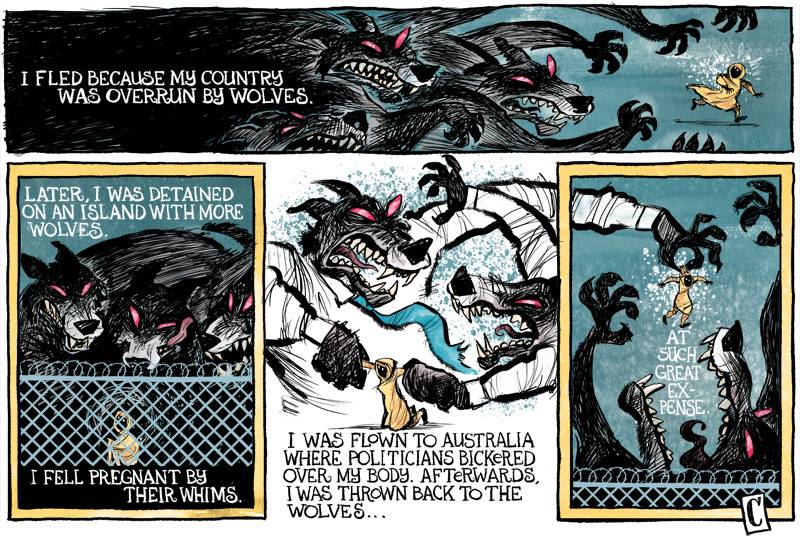
Contributing editor-at-large Tess Lawrence says is another side to the tragic story of Abyan that needs to be discussed.

Nauruan police say there is not enough evidence to prove that a 26-year-old Somali woman was raped on the island.

“I knew it would come to this,” said Liberal backbencher Russell Broadbent, talking about children in detention on ABC radio. “It has come to this again. The Australian people are standing up and saying, No, not on.”
Source: Kids in camps | The Monthly
 Rape, sexual assault and other forms of degradation typify detention for women in Australia’s processing centres. They must have the right to live free from violence
Source: The shame of Australia’s offshore war on women | Pamela Curr | Comment is free | The Guardian

The Department responded with a statement saying it “assists and supports the Government of Papua New Guinea with any individuals who seek to voluntarily return to their country of origin”.The Department said they do not comment on individual cases.


The Abbott Government wants to restrict any intake of Syrian refugees to minorities which are largely Christian.
 Lesley Williams, 68, suffered racial discrimination as an Aboriginal mother raising three kids alone. Her daughter, Tammy, 37, is a barrister who has recorded her mum’s stories for a new book.
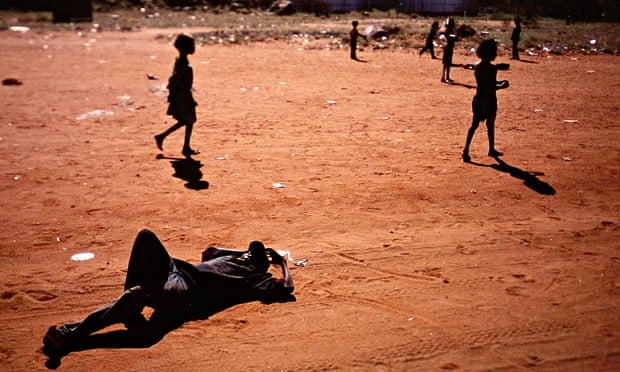
John Pilger: The mass removal of Indigenous children from their parents continues unabated – where is the outrage?
The Ahistorical Truth only tells us:

History provides the direction we need to go

Political commentator Andrew Bolt said recently that Australia is fundamentally not a…

Aboriginal groups have stepped up their campaign to stop the West Australian Government shutting up to 150 remote communities

Minister for Immigration and Border Protection, Scott Morrison, is the only minister who is not answerable to anyone for his decisions, with the exception of the decision to take us into war, which can be made by the Prime Minister alone.
New legislation passed this week gives Morrison unprecedented, unchallengeable and secret powers to determine the futures of those who come to Australia seeking sanctuary from homelands that are no longer hospitable to them. This includes the practice of refoulement, the ability to return asylum seekers to situations that are hostile and in some instances deadly without first determining if they are at risk, a practice that is inconsistent with international refugee law: Section 197 gives the government express permission to engage in refoulement irrespective of whether there has been an assessment of Australian obligations to that person.
Morrison is not required to determine in advance what risks an asylum seeker will face in being returned to the country they’ve fled, therefore, he has the power to send human beings to endure torture and death, and nobody will ever know he’s done it.
Within his area of responsibilities, Morrison is now a dictator. In the midst of a government determined to be as small a government as possible there is a department with a dictator at its head, whose control over some human beings is absolute.
In principle giving any politician, or any human being for that matter absolute power over anything, cannot be good. Absolute power corrupts absolutely. Why is it necessary?
Of course, it isn’t necessary in any way other than the political. It serves the government’s purposes to cloak the fates of asylum seekers and refugees in secrecy. It doe not make our borders any more secure, it does not prevent us from being attacked by terrorists. What Morrison’s new dictatorship does do is fly in the face of the tenets of our liberal democracy, specifically its opposition to suspicion of concentrated forms of power, whether by individuals, groups or governments.
There is no reason why the people of this country should be kept in the dark about our government’s decisions as to the fate of asylum seekers and refugees, or any other decision our government takes, unless it is a matter of security. No matter how hard the Abbott government has worked to frame waterborne asylums seekers as a threat to our sovereign borders against which we are waging a war, they are not a threat and this is not a war.
The passing of the latest legislation finalises the relentless campaign conducted by both major parties to “stop the boats.” It has taken the matter of asylum seekers arriving by boat out of the public conversation. While this will come as relief to many politicians, the rest of us should be very afraid that in our treasured liberal democracy we have a minister who answers to nobody, and will conduct his nefarious business in absolute secrecy. This cannot be good for anyone.
First published on Jennifer’s blog No Place for Sheep

The Senate crossbench has supported the passing of broad new migration and maritime powers – but what exactly do they mean for the minister, asylum seekers and Australia’s obligations under international law?
Scott Morrison is now the most powerful person in the Australian government.
The passage of the migration and maritime powers legislation amendment (resolving the asylum legacy caseload) bill 2014 has given the immigration minister, while he holds that job, unprecedented, unchallengeable, and secret powers to control the lives of asylum seekers.
Previous immigration ministers have decried the burden and the caprice of “playing God” with asylum seekers’ lives, but the government has chosen, instead, to install even greater powers in the office of the minister.
With the Senate’s acquiescence, Scott Morrison has won untrammelled power.
No other minister, not the prime minister, not the foreign minister, not the attorney-general, has the same unchecked control over the lives of other people.
With the passage of the new law, the minister can push any asylum seeker boat back into the sea and leave it there.
The minister can block an asylum seeker from ever making a protection claim on the ill-defined grounds of “character” or “national interest”. His reasons can be secret.
He can detain people without charge, or deport them to any country he chooses even if it is known they’ll be tortured there.
Morrison’s decisions cannot be challenged.
Boat arrivals will have no access to the Refugee Review Tribunal.
Instead, they will be classed as “fast track applicants” whose only appeal is to a new agency, the Immigration Assessment Authority, but they will not get a hearing, only a paper review.
“Excluded fast track applicants” will only have access to an internal review by Morrison’s own department.
The bill is a seismic piece of legislation – one that destroys more than it creates.
The government argues the new law will remove the obstructions that exist to it fulfilling its mandate of “stopping the boats”.
asylum seeker boats Australian navy personnel transfer Afghanistan asylum-seekers to a Indonesian rescue boat near West Java. Due to the passing on the amendments, the government is now entitled to return an asylum seeker to a country where they have been, or it is known they will be, tortured. Photograph: AFP/AFP/Getty Images
Critics – and they are a formidable group, including the United Nations High Commissioner for Refugees, the UN’s Committee Against Torture and parliament’s own human rights committee – say the bill strips the checks and balances that have always existed in Australia’s immigration system, and removes basic protections for those who arrive seeking asylum.
Advertisement
Australia now regards itself as free from the bonds of the Refugees Convention – a treaty Australia helped write, and willingly signed up to, more than half a century ago. All references to it have been removed from Australian law.
Instead of adhering to the established, internationally-agreed framework for dealing with asylum seekers, Australia will follow a “new, independent and self-contained statutory framework”, that sets out the government’s own interpretation of international law.
That new interpretation is apparent in this bill. Refugee law is built upon the fundamental principle of non-refoulement, which forbids returning a person to their persecutors.
It is exists not only in the Refugees Convention, but in customary law. It is recognised by every country.
Australian law now says: “it is irrelevant whether Australia has non-refoulement obligations in respect of an unlawful non-citizen”.
Stripped of the legalese, that paragraph says Australia is now entitled to return an asylum seeker to a country where they have been, or it is known they will be, tortured.
Overwhelmingly, the public focus of the legislation, and the sharp end of Senate negotiations, has been around temporary protection visas (TPVs), though they form only a small part of the bill.
TPVs have been trialled in Australia before and failed. Between 1999 and 2007 (when they were abandoned) Australia granted 11,206 TPVs. And 95% of those visa holders were ultimately granted permanent protection.
The number of boat arrivals to Australia increased after the introduction of TPVs, and more of those arrivals were women and children. (Because the TPVs forbade family reunion, entire families climbed onto boats, or women and children came to meet men already in the country.)
In the Senate horse-trading, significant concessions have been won.
Morrison has been forced to capitulate on his most fundamental commitment – the pathway to permanence – but it is a concession in principle, and name only.
In amendments to the legislation, the government has opened up the possibility – though it appears an exceedingly remote likelihood – of a temporary protection visa progressing to a permanent visa in Australia.
On November 25, Morrison said: “There’s no way I will lift the bar to give someone a permanent visa. We gave an absolute commitment on that and I’m not going to send a message … that permanent visas are on offer in Australia again for people who have arrived illegally by boat.”
This week he said, “at the end of a Special Humanitarian Enterprise Visa people can apply for visas which include permanent visas”.
The door has been opened, if only a sliver, to the possibility of a permanent visa to stay in Australia for someone who arrived by boat. But it is an unlikely reality for anyone, Morrison has said.
While anxious to keep the “sugar off the table” for asylum seekers, Morrison has offered the Senate crossbench a series of sweeteners in exchange for their votes this week.
He has promised to soften the cuts to Australia’s humanitarian refugee intake.
The government had planned to cut the number of offshore refugees resettled by Australia from 20,000 to 13,750. The new intake will be 18,750 over the next four years.
Asylum seekers will be moved off Christmas Island to the mainland of Australia while their claims are processed. Up to 468 children will be released from detention.
And about 25,000 people currently living in Australia on bridging visas will be given the right to work.
These are significant concessions, but they are decisions Morrison could have made at any time, and they are not – despite efforts to portray them as such – in any way related to the new law.
Manus Island and Nauru currently hold 2,151 refugees and asylum seekers. Detention centres there have been blighted by violence, sexual assault, and suicide attempts, but are unaffected by the new laws, or the government’s concessions.


A LONG-SERVING Australian soldier has spoken out about the state of our country’s military declaring he is “thoroughly disgusted” to serve in the army.
The 31-year-old soldier, who has requested to remain anonymous has served with the Australian Defence Force for 11 years across Australia as well as serving in Afghanistan.
It’s a role he dreamt of fulfilling, and, until a decision was handed down on military wages by the Defence Remuneration Tribunal this week, it was “the proudest thing (he) could imagine anyone doing”.
The Victorian soldier has never spoken publicly about his life as a soldier, but this week he felt compelled, he told news.com.au.
The decision to increase defence personnel wages by only 1.5 per cent, a rate below inflation that would mean a decrease in pay in real terms was the last straw.
The Defence Force member says he has “sworn to protect and serve” his country, and until now was “enormously proud to do so”.
“My identity as a Serving Member has taken some hits recently,” he said.
“The order not to wear or our uniforms in public because of an ‘unspecified’ threat — if I wasn’t scared to wear my uniform fighting in Afghanistan, I’m sure as hell not going to be scared to wear it on any Australian street. But, I’ll toe the line.
“And then there was my recent discovery as I investigated my upcoming posting, that Defence has been quietly stripping away allowances for things such as the cross country moves that it requires its members to undertake.
“I’m only going to get a third of the allowances that I got for the exact same move I made previously, and in fact am going to be out of pocket? OK, OK … You are telling me you’re only going to pay me to fly and if I choose to drive I guess that’s just my own stupid fault.
“But today, the government that I have sworn to protect and serve, and that up to this point have been enormously proud to do so, has signed off on a deal that is essentially a kick in the teeth to every Soldier, Airmen, & Sailor.
“They have given us a ‘pay rise’ of 1.5% per year for the next few years. This is more than 1.5% below estimated inflation, and 140% less than the pay rise that politicians have awarded themselves in past years.”
“And how are we, the Serving members of this countries military forces supposed to pay the government back for this paltry pay rise? By sacrificing leave days and allowances across the board. In fact, the monetary value of the lost leave days is greater in value then the extra money this ‘pay increase’ will deliver.”
Expressing his disgust at the pay increase decision the Defence Force Welfare Association has labelled “insultingly low”, the soldier goes on to sympathise with outsiders disgusted at the military.
“If you want to attack me in the street because you disdain the fact that I am an Australian Soldier, then at the very least I can understand you,” he added.
“My own government disdains me and my fellow serving members, and it disdains us publicly and with thinly disguised contempt.
“I am an Australian Soldier and, for the first time in eleven years, I am thoroughly disgusted to be one.”
The soldier told news.com.au that although he is the one who has bravely spoken out on this issue, it’s not just his battle.
“This is not my fight, it’s the fight of every serving member as of that despicable decision,” he said.
“I”m just one member of thousands who are affected, and I’m not even the worst off … I’m not currently serving overseas, where our people are actively put in harms way, and yet expected to accept a loss of, in some cases, up to a quarter of their dangerous service allowance.”
The three-year pay deal affecting Australia’s 57,000 full-time uniformed personnel and 20,000 reservists was approved by the Defence Force Remuneration Tribunal on Monday.
Defence Force Welfare Association urged the Prime Minister to intervene, saying to “insultingly low annual increase” was a strange way to reward defence personnel.
“This so-called increase represents barely half the expected annual inflation rate and an even lesser proportion of the expected rise of annual living costs,” he said in a statement.
The Government has justified the decision saying it’s all they can afford.
“We’d all like to pay our serving defence personnel more, but there’s going to have to be a very tight pay restraint across the public sector, including with defence personnel,” Prime Minister Tony Abbott told media in Sydney yesterday.
Assistant Defence Minister Stuart Robert described defence personnel’s current salaries as “generous”, citing an “enormous number of allowances”, subsidised housing and health care benefits.

Carbon emissions, such as those from the Mehrum coal-fired power plant in Germany, will have to fall to zero to avoid catastrophic climate change, the IPCC says. Photograph: Julian Stratenschulte/Corbis
Most important assessment of global warming yet warns carbon emissions must be cut sharply and soon, but UN’s IPCC says solutions are available and affordable
Climate change is set to inflict “severe, widespread, and irreversible impacts” on people and the natural world unless carbon emissions are cut sharply and rapidly, according to the most important assessment of global warming yet published.
The stark report states that climate change has already increased the risk of severe heatwaves and other extreme weather and warns of worse to come, including food shortages and violent conflicts. But it also found that ways to avoid dangerous global warming are both available and affordable.
“Science has spoken. There is no ambiguity in the message,” said the UN secretary general, Ban Ki-moon, attending what he described as the “historic” report launch. “Leaders must act. Time is not on our side.” He said that quick, decisive action would build a better and sustainable future, while inaction would be costly.
Ban added a message to investors, such as pension fund managers: “Please reduce your investments in the coal- and fossil fuel-based economy and [move] to renewable energy.”
The report, released in Copenhagen on Sunday by the UN’s Intergovernmental Panel on Climate Change (IPCC), is the work of thousands of scientists and was agreed after negotiations by the world’s governments. It is the first IPCC report since 2007 to bring together all aspects of tackling climate change and for the first time states: that it is economically affordable; that carbon emissions will ultimately have to fall to zero; and that global poverty can only be reduced by halting global warming. The report also makes clear that carbon emissions, mainly from burning coal, oil and gas, are currently rising to record levels, not falling.
The report comes at a critical time for international action on climate change, with the deadline for a global deal just over a year away. In September, 120 national leaders met at the UN in New York to address climate change, while hundreds of thousands of marchers around the world demanded action.
“We have the means to limit climate change,” said Rajendra Pachauri, chair of the IPCC. “The solutions are many and allow for continued economic and human development. All we need is the will to change.”
Lord Nicholas Stern, a professor at the London School of Economics and the author of an influential earlier study, said the new IPCC report was the “most important assessment of climate change ever prepared” and that it made plain that “further delays in tackling climate change would be dangerous and profoundly irrational”.
“The reality of climate change is undeniable, and cannot be simply wished away by politicians who lack the courage to confront the scientific evidence,” he said, adding that the lives and livelihoods of hundreds of millions of people were at risk.
Ed Davey, the UK energy and climate change secretary, said: “This is the most comprehensive and robust assessment ever produced. It sends a clear message: we must act on climate change now. John Kerry, the US secretary of state, said: “This is another canary in the coal mine. We can’t prevent a large scale disaster if we don’t heed this kind of hard science.”
Bill McKibben, a high-profile climate campaigner with 350.org, said: “For scientists, conservative by nature, to use ‘serious, pervasive, and irreversible’ to describe the effects of climate falls just short of announcing that climate change will produce a zombie apocalypse plus random beheadings plus Ebola.” Breaking the power of the fossil fuel industry would not be easy, McKibben said. “But, thanks to the IPCC, no one will ever be able to say they weren’t warned.”

The new overarching IPCC report builds on previous reports on the science, impacts and solutions for climate change. It concludes that global warming is “unequivocal”, that humanity’s role in causing it is “clear” and that many effects will last for hundreds to thousands of years even if the planet’s rising temperature is halted.
In terms of impacts, such as heatwaves and extreme rain storms causing floods, the report concludes that the effects are already being felt: “In recent decades, changes in climate have caused impacts on natural and human systems on all continents and across the oceans.”
Droughts, coastal storm surges from the rising oceans and wildlife extinctions on land and in the seas will all worsen unless emissions are cut, the report states. This will have knock-on effects, according to the IPCC: “Climate change is projected to undermine food security.” The report also found the risk of wars could increase: “Climate change can indirectly increase risks of violent conflicts by amplifying well-documented drivers of these conflicts such as poverty and economic shocks.”
Two-thirds of all the emissions permissible if dangerous climate change is to be avoided have already been pumped into the atmosphere, the IPPC found. The lowest cost route to stopping dangerous warming would be for emissions to peak by 2020 – an extremely challenging goal – and then fall to zero later this century.
The report calculates that to prevent dangerous climate change, investment in low-carbon electricity and energy efficiency will have to rise by several hundred billion dollars a year before 2030. But it also found that delaying significant emission cuts to 2030 puts up the cost of reducing carbon dioxide by almost 50%, partly because dirty power stations would have to be closed early. “If you wait, you also have to do more difficult and expensive things,” said Jim Skea, a professor at Imperial College London and an IPCC working group vice-chair.

Tackling climate change need only trim economic growth rates by a tiny fraction, the IPCC states, and may actually improve growth by providing other benefits, such as cutting health-damaging air pollution.
Carbon capture and storage (CCS) – the nascent technology which aims to bury CO2 underground – is deemed extremely important by the IPPC. It estimates that the cost of the big emissions cuts required would more than double without CCS. Pachauri said: “With CCS it is entirely possible for fossil fuels to continue to be used on a large scale.”
The focus on CCS is not because the technology has advanced a great deal in recent years, said Jean-Pascal van Ypersele, a professor at the Université Catholique de Louvain in Belgium and vice-chair of the IPCC, but because emissions have continued to increase so quickly. “We have emitted so much more, so we have to clean up more later”, he said.
Linking CCS to the burning of wood and other plant fuels would reduce atmospheric CO2 levels because the carbon they contain is sucked from the air as they grow. But van Ypersele said the IPCC report also states “very honestly and fairly” that there are risks to this approach, such as conflicts with food security.
In contrast to the importance the IPCC gives to CCS, abandoning nuclear power or deploying only limited wind or solar power increases the cost of emission cuts by just 6-7%. The report also states that behavioural changes, such as dietary changes that could involve eating less meat, can have a role in cutting emissions.
As part of setting out how the world’s nations can cut emissions effectively, the IPCC report gives prominence to ethical considerations. “[Carbon emission cuts] and adaptation raise issues of equity, justice, and fairness,” says the report. “The evidence suggests that outcomes seen as equitable can lead to more effective [international] cooperation.”
These issues are central to the global climate change negotiations and their inclusion in the report was welcomed by campaigners, as was the statement that adapting countries and coastlines to cope with global warming cannot by itself avert serious impacts.
“Rich governments must stop making empty promises and come up with the cash so the poorest do not have to foot the bill for the lifestyles of the wealthy,” said Harjeet Singh, from ActionAid.
The statement that carbon emissions must fall to zero was “gamechanging”, according to Kaisa Kosonen, from Greenpeace. “We can still limit warming to 2C, or even 1.5C or less even, [but] we need to phase out emissions,” she said. Unlike CCS, which is yet to be proven commercially, she said renewable energy was falling rapidly in cost.
Sam Smith, from WWF, said: “The big change in this report is that it shows fighting climate change is not going to cripple economies and that it is essential to bringing people out of poverty. What is needed now is concerted political action.” The rapid response of politicians to the recent global financial crisis showed, according to Smith, that “they could act quickly and at scale if they are sufficiently motivated”.
Michel Jarraud, secretary general of the World Meteorological Organisation, said the much greater certainty expressed in the new IPCC report would give international climate talks a better chance than those which failed in 2009. “Ignorance can no longer be an excuse for no action,” he said.
Observers played down the moves made by some countries with large fossil fuel reserves to weaken the language of the draft IPCC report written by scientists and seen by the Guardian, saying the final report was conservative but strong.
However, the statement that “climate change is expected to lead to increases in ill-health in many regions, including greater likelihood of death” was deleted in the final report, along with criticism that politicians sometimes “engage in short-term thinking and are biased toward the status quo”.

Updated
The senior health adviser for the Red Cross in Sierra Leone says she is embarrassed by the Australian Government’s response to the Ebola crisis.
Australian Amanda McClelland runs the organisation’s treatment Centre in Kenema, and told The World Today she was surprised the Government was not sending medical teams into Sierra Leone, and by its blanket ban on issuing visas to people travelling from those countries.
West African states have criticised the decision to shut Australia’s border, saying the move stigmatises healthy people and makes the fight against the disease more difficult.
“I am surprised … but more embarrassed, to be honest,” she said.
“It’s difficult to be here and sit with the Sierra Leone government and have them today ask me, ‘am I going to be allowed to come home?'”
She said it was particularly galling for her as she was desperately short staffed and was now calling on Ebola survivors to help.
“I’m asking taxi drivers and students to deal with Ebola, and the Australian Government is not sending doctors and nurses with 16 years of education,” she said.
“And to be honest, I’m a bit embarrassed that we don’t feel that our health system and our health personnel are qualified and professional enough to manage this.
“I mean, the Australian health care system is more than robust enough to respond quickly – if and when – a case came.
“And I think we have some of the best medical professionals in the world and experience in working in these types of environments.”
Ms McClelland was training Ebola survivors to help treat their country men and women with the deadly disease.
One of the nurses, Hawa Jollah, told The World Today she feared she would die when she caught the virus in June.
“I was vomiting profusely. I was having red eyes. I cannot recognise people. I can recognise you from your voice, but I cannot see you,” she said.
Edwin Konuwa, an Ebola survivor and nurse, was working in the Kenema Ebola centre.
“Everybody was crying for me and were told I am dead. Overnight my condition changed and I could eat and have water,” Mr Konuwa said.
He said he was not scared of Ebola anymore and wants to help patients.
“It’s not difficult for me because I know procedures and my precautions.”
Amanda McClelland told The World Today 12 of the new trainees were former nurses, all of whom were Ebola survivors.
“And we’ve actually had several survivors, [who] are not nurses, come back to the unit in the last two days and ask if they could help as well.”
The great advantage of training survivors was that they had more immunity to the disease, and could help others, particularly the children of Ebola victims, without as much fear of infection.
“We had a terrible situation last week where we had a mother with two small children, there was no-one left in the family,” Ms McClelland said.
We had a large cluster of cases after an unsafe burial, and the whole family was sick or had already died. And no-one in the community would take these children.
Amanda McClelland
“We had a large cluster of cases after an unsafe burial, and the whole family was sick or had already died. And no-one in the community would take these children.
“The mother was dying and the children were in there. We saw the children were covered in their mother’s faeces, and we went straight in and we cleaned them up.
“The little boy is Ebola free – amazingly enough – which is a huge benefit for us morally and amazing for the kids involved.”
Ms McClelland had a full staff roster but that was a week-to-week proposition.
“To be honest, we’re ok for this week but we’re not ok for next week. And we’re definitely not ok as we get closer to Christmas,” she said.
The Sierra Leone and Liberian governments condemned the Australian Government for generating unnecessary panic about Ebola.
Ms McClelland said she was concerned at least three health professionals, who were due to fill her roster next week, may now not come.
But she said health professionals knew the science and were not put off by the scare-mongering, though their families were.
“I feel quite safe here. It’s not like Mogadishu or other places I’ve been. It’s not so much ‘brave’ as ‘just needs to be done’, I guess.”

Samantha Power begins tour of worst-affected countries with criticism of international efforts
The US ambassador to the United Nations has criticised the level of international support for nations hit by Ebola as she begins a tour of west African nations at the epicentre of the deadly outbreak.
Samantha Power said before arriving in Guinea on Sunday that too many leaders were praising the efforts of countries like the US and Britain to accelerate aid to the worst-affected nations, while doing little themselves.
“The international response to Ebola needs to be taken to a wholly different scale than it is right now,” Power told NBC News.
She said many countries were “signing on to resolutions and praising the good work that the United States and the United Kingdom and others are doing, but they themselves haven’t taken the responsibility yet to send docs, to send beds, to send the reasonable amount of money”.
Besides Guinea, Power will travel to Sierra Leone and Liberia – the three nations that account for the vast majority of the 4,922 deaths from the Ebola epidemic.
More than 10,000 people have contracted the virus in west Africa, according to the latest World Health Organisation figures.
Another country in the region, Mali, is scrambling to prevent a wider outbreak after a two-year-old girl died from her Ebola infection following a 600-mile bus ride from Guinea. She was Mali’s first recorded case of the disease.
An adviser to the Malian health ministry said the 43 people placed under medical observation in Kayes in western Mali – where the girl died on Friday – showed no signs of the illness.
About a dozen other people were also being observed in the capital, Bamako, where the girl had spent about three hours visiting relatives on the way to Kayes.
Mauritania meanwhile reinforced controls on its border with Mali, which effectively closed the frontier, according to local sources.
 As well as the reintroduction of Temporary Protection Visas, which leave refugees in constant statelessness and fear of being returned to persecution, the Australian Minister for Immigration is proposing changes to the Migration Act which are utterly alarming. The ‘Migration and Maritime Powers Legislation Amendment (Resolving the Asylum Legacy Caseload) Bill 2014′ removes references to the UN Refugee Convention to allow Australia’s domestic law to ignore Australia’s obligations under international law. It also removes the ability of the High Court to challenge refugee and asylum seeker policy and operations.
The bill exempts vessels involved in Operation Sovereign Borders from the appropriate maritime laws. There will be nothing to stop fuel, food, water and safety devices from being removed from intercepted boats. The Government will have the power to send boats or individuals anywhere it chooses. The bill removes the need for Australia to have a Memorandum of Understanding in place, or for the country to be a signatory to the Refugee Convention. The bill will allow boats to be towed outside of Australian waters and left there without regard for the safety of passengers.
The bill proposes a fast track assessment process which removes access to the Refugee Review Tribunal. Fast turnaround processing was ruled illegal in the United Kingdom earlier this year due to an “unacceptable risk of unfairness”. The bill seeks to change the definition of ‘refugee’ to allow the government to reject a refugee status application if it decides that there is a ‘safe area’ in the country of origin, or that the nation’s police force is ‘reasonably effective’. This is nothing short of playing with people’s lives. It will allow the Australian government to send back asylum seekers, regardless of whether they face a real chance of torture or execution on return. What does Scott Morrison think happens to Hazara people when they are returned to Afghanistan or to Tamil people who are returned to Sri Lanka? Does he really believe that members of the Taliban or Rajapaksa’s regime are unable to travel to target their victims? If he had converted to Christianity in Iran, or spoken against the Iranian Government, would he really trust the Iranian police force to protect him?
Children born in Australia, to asylum seekers who arrived by boat, will be classified as “transitory persons”, creating a new generation of stateless people, and giving them no access to permanent residency or citizenship. Does Scott Morrison really believe that these babies pose a serious threat to Australia as we know it? Or is his distain, even hatred, for asylum seekers so great that detaining innocent children indefinitely doesn’t satisfy his lust for vengeance; does he feel the need to ensure that his punishments will continue for each of their lifetimes?
The ‘Migration and Maritime Powers Legislation Amendment (Resolving the Asylum Legacy Caseload) Bill 2014′ gives the Australian Government, under domestic law, the power to ignore international law and to engage in state-sanctioned human rights abuses. It will allow Australia to be complicit, even collaborative, in the persecution, torture and execution of innocent people. The Minister for Immigration will have absolute power, and his actions under Operation Sovereign Borders will not be brought to account by Australia’s justice system. He will become untouchable. This sets a very dangerous precedent for Australian politics and law.
I see so many people ‘liking’ and sharing messages about Australia’s terrible mistreatment of asylum seekers, on social media. I read the comments they write, pouring out their outrage and their grief. Yet, when it comes to asking them to take the time to write to politicians to urge them to oppose this horrific bill, the passion and the anger appear to evaporate. I for one, need to know that I have done everything in my power, and then some, to persuade the Senators to vote against this bill. Will you join me in writing to them? You don’t need to produce a perfectly crafted, eloquent letter; you just need to write! A few lines will do. If you are an Australian citizen, tell them that you cannot support politicians who sanction human rights abuses. If you are an expat, tell them how horrified you are at what Australia has become while you have been away. Most of all, tell them to oppose this bill.

“There’s $18 million… that we’ve provided to try and provide help to services like the Red Cross that are delivering services, delivering support on the ground in Africa,” Mr Dutton told John Laws on 2SM on October 8.
The Australian Red Cross has told Fact Check it has never received any money from the Federal Government specifically earmarked for its Ebola operations and relief effort in West Africa.
The verdict: The Red Cross has not received specific funding from the Federal Government to support its Ebola program in West Africa. The Federal Government has provided $2.5 million to four Australian NGOs: Caritas, Plan International, Save the Children and World Vision.

Australia is prepared to risk the lives of Defence personnel by sending them to face danger and uncertainty in the Middle East, where the motivation is essentially border protection rather than compassion. Aside from any deaths or injuries, many members of the Defence forces will return to Australia from the Middle East suffering post-traumatic stress disorder and place a strain on mental health services for decades to come.
Australia – already one of the richest nations on earth financially – even richer. But when asked to reach out to people in need in other parts of the world, the Government is prepared to impose extra layers of red tape.Other nations and non government organisations apply Australia’s ‘open for business’ mindset to humanitarian emergencies. For example the Jesuit Refugee Service emphasises flexibility and rapid response in the way that it responds to international emergencies. President Obama has acted quick to dispatch 3000 military personnel to West Africa. They will train as many as 500 health care workers a week, erect 17 heath care facilities in Liberia of 100 beds each, and much more. For its part, Australia is putting red tape in place to stop skilled individual volunteers who are willing and able to travel to West Africa.

Novelist says he is saddened by the Australian government’s environmental policies and prime minister Tony Abbott’s statement that ‘coal is good for humanity
Andrew Bolt’s uniform response

Notice however the T is on a dummy. He really wants his passport withdrawn
The winner of the Man Booker prize, Richard Flanagan says he is “ashamed to be an Australian” because of Australian prime minister Tony Abbott’s environmental policies.
Flanagan has won the prestigious award for his novel The Narrow Road to the Deep North, about prisoners and captors on the Burma railway.
Speaking on the BBC’s Newsnight program after the award ceremony, the Tasmanian author and committed environmentalist was asked about Abbott’s recent comment that “coal is good for humanity”. The prime minister made the comment while opening a coalmine in Queensland on Monday.
“I’m very saddened because Australia has the most extraordinary environment and I don’t understand why our government seems committed to destroying what we have that’s unique in the world,” Flanagan said.
“To be frank, I’m ashamed to be Australian when you bring this up.”
Flanagan was also asked about the repeal of the Tasmanian forestry peace deal between environmentalists and logging companies last month.
“I genuinely believe that people of Australia want to see these beautiful places, these sacred places, preserved, [but] the politics of the day is so foolishly going ahead and seeking to destroy them when there isn’t even an economic base to it, when there is no market for the woodchips that would result from the destruction of these forests,” he replied.
“I think it’s unnecessary and I think it’s just politics being used to divide people that could otherwise be brought together on all that is best and most extraordinary in our country.”

On August 4th, Julieka Dhu became another death in custody statistic to the Western Australia police and the Australian government. On that very same day, Julieka’s family and friends were devastated and very shocked- they had been told twice that she was doing ‘fine’ when she was very far from being ok. She was, in fact, grievously ill, she was wounded and she needed immediate help. She was twice cleared by Hedland Health Campus to be returned to police custody, even though an autopsy shows that at the time, she would have been suffering with a head injury, a possibly re-fractured rib, with bleeding in and around her lung. Witnesses have stated that she was begging for help but was dismissed as a ‘druggie’ and then a ‘mental case’.
Julieka was failed by the system. Nobody deserves to die like that, wounded, begging for help and being mocked and dismissed. All because she had around $1,000 in unpaid fines. This latest tragedy could easily have been prevented.
In 1987, the Hawke government set up the Royal commission into Indigenous deaths in custody, to help find out why Indigenous deaths in custody were so prevalent and to address how to stop it. When the commission handed down its findings, the Australian government lost it’s right to feign ignorance of the issue. The commission made over 300 recommendations to either eliminate or significantly reduce deaths in custody. Yet very few, if any were ever acted upon.
Twenty years of nothing while Indigenous Australians die in horrendous conditions, often for trifling offences, while under the DUTY OF CARE of police is unacceptable.
We are done waiting for the police, state or federal governments to decide that this needs to stop. We are demanding:
1. Timely coronial inquest into Ms Dhu’s death in custody
That is why, on Thursday, 23rd October, Australia will march, with a national ‘STOP DEATHS IN CUSTODY’ rally, held simultaneously throughout Geraldton, Perth, Adelaide, South Hedland, Sydney, and Melbourne. We will no longer allow the government and its agencies to ignore this issue. We will be heard!

I will govern for all Australians.
I want to lift everyone’s standard of living.
I want to see wages and benefits rise in line with a growing economy.
I want to see our hospitals and schools improving as we invest the proceeds of a well-run economy into the things that really count.
I won’t let you down.
This is my pledge to you.
-Tony Abbott campaign launch speech, August 25 2013
Nice words but let’s face it – the Abbott government doesn’t give a shit about you. The evidence is overwhelming.
With one in seven Australians living in poverty, we have a Prime Minister who spends hundreds of billions on defence, security, and buying armaments. We have a Prime Minister who is so stage-managed he refuses to face the electorate on Q&A.
Our Prime Minister for Indigenous Affairs has overseen the slashing of funding and the abolition of many successful initiatives that were working towards supporting our Indigenous people and closing the gap. But we have truancy officers aplenty, even if most of them are working for the dole.
We have a treasurer who feels those on welfare, the ‘leaners’, should be the ones to clear the country of debt. His justification for this is that he must cut spending and poor families get more money from the government than the rich, whilst steadfastly refusing to consider raising revenue by cracking down on tax avoidance.
He tells the world that our economy is in good shape while whipping up hysteria here about a non-existent emergency.
After coming to power on the promise of reducing the debt, Hockey has been borrowing so fast the net debt has increased from $178.10 billion when he took over to $217.55 billion at the end of August. PEFO numbers had net debt peaking at $219bn (12.7% of GDP) in 2015/16. The gross debt has risen from $290 billion to $345.035 billion – that’s extra borrowing of about one billion a week.
We have an education minister who has reneged on funding reform for schools, wants to make tertiary courses unaffordable, has closed down trades training centres, has insulted teachers, wasted money on a pointless review, and wants to rewrite history as a Christian crusade.
We have a health minister who is busily unwinding universal healthcare and preventative health agencies and who wants to discourage the poor from seeing a doctor.
On one hand we are warned about the alarming increase in obesity and diabetes, on the other we have the assistant minister for health, at the behest of her junk food lobbyist chief of staff, taking down a healthy food website.
Senator Nash insisted the health star site be pulled down a day after it was published in Febuary on the grounds it was published in error, despite freedom of information documents showing the minister was warned it would be published, and the states committing to spend $11 million on it.
In June, a watered down version of the site was reinstated, with the voluntary introduction period extended to five years from two and companies allowed to use the star ratings in conjunction with the industry’s daily intake guide. They also decided to continue voluntary pregnancy warning labels on alcohol, despite poor uptake by mixed drinks and so-called alcopops. Michael Thorn, the chief executive of the Foundation for Alcohol Research & Education, said it was “disgraceful” and put “booze before babies”.
“The alcohol industry will be celebrating that they have been able to successfully avoid introducing a warning label on their products for almost two decades,” he said.
One of the first steps of the minister for social services, Kevin Andrews, was to wind back gambling reform laws despite recommendations made by the Productivity Commission in its 2010 report into Australia’s gambling industry and the Victorian coroner’s report linking 128 suicides in that state directly to gambling..
This is the man who, along with our employment minister (he of breast cancer/abortion link fame), wants to see young unemployed without any income for 6 months of the year, and for the disabled to get out there and get one of those thousands of jobs that are just waiting for them if only they weren’t such bludgers. He also wants to lower the indexation rate of pensions which will cause the gap in standard of living to widen. All this while cutting $44 million from the capital works program of the National Partnership on Homelessness.
We have an environment minister who wants to cut down Tasmanian old growth forests and expand coal ports and dump sediment on the reef. He has wound back environmental protection laws and the right to appeal and gone on a spree of approving record amounts of fossil fuel production. At the same time, he has overseen the destruction of the renewable energy industry. They don’t even send him to world conferences on climate change because, after all, what could he say other than sorry.
Not content with these overt attacks on the environment, the government has quietly initiated a low key, unscheduled review into Australia’s national appliance energy efficiency standards. The only formal explanation offered to date is in the Energy “Anti-” Green Paper, which refers to “opportunities to reduce the red-tape burden on businesses”.
At least they were honest when our communications minister was appointed to “destroy the NBN” and he has done a damn fine job of it. Despite Tony Abbott’s election speech claim that within 100 days “the NBN will have a new business plan to ensure that every household gains five times current broadband speeds – within three years and without digging up almost every street in Australia – for $60 billion less than Labor,” the truth has emerged.
We will be left with a sub-optimal network, a mishmash of technologies, at a time when the world is increasingly going fibre. It will end up taking nearly as long and costing nearly as much as the all-fibre network it is replacing. The industry – and many around Turnbull – is increasingly realising this. But Turnbull will not budge.
Australia is the loser – all because of one man’s pride.
Scott Morrison, our immigration minister, is about as welcoming as a firing squad. He is like Hymie from Get Smart in his robotic determination to stop the boats at any cost. That goal apparently absolves him from any form of scrutiny, criticism, or human decency. He has a blank cheque and not one cent of it will be used to help refugees.
Despite our growing unemployment, he is also front and centre in providing Gina with her 457 visa workers – no rights, no entitlements, and if they complain they get deported.
Our minister for trade is working in secret, getting signatures on free trade agreements at any cost – it’s the announcement before the end of the year that’s important, not pesky details about tariffs and the fact that we no longer have the right to make our own laws without getting sued by global corporations.
Our attorney-general, the highest legal appointment in the land, thinks defending bigots is a priority. When faced with illegal actions by the government, steal the evidence, threaten journalists with gaol time and funding cuts, and introduce laws which remove official accountability. And while you’re at it, let’s bug the entire nation and make people prove themselves innocent. Even if they haven’t done anything wrong I am sure they have had evil thoughts.
Barnaby was last seen trying to hasten the demise of a few endangered species that are standing in the way of his dams.
Warren Truss is run off his feet planning roads, roads and more roads. Luckily they dumped that idea about releasing cost benefit analyses for any expenditure over $100 million. Thank god we got rid of that pesky head of Infrastructure Australia so we could get someone who understands our idea of what ‘independent body’ means. If the people want public transport they can build it themselves.
And how’s our girl doing? She’s looking tired to me. Making a case for a seat on the Human Rights Council whilst torturing refugees, or being sent in to bat at the world leaders’ conference on climate changed armed with nothing other than a rain forest conference, must shake even asbestos Julie’s steely resolve. The Armani suits and death stare can only get you so far. When in doubt, flirt.
I know you would like a mention Jamie Briggs but for the life of me, the only thing that comes to mind is your fawning introductions for our ‘Infrastructure Prime Minister’….
”To introduce our Tony, is what I’m here to do, and it really makes me happy to introduce to you…the indescribable, the incompatible, the unadorable….. Prrrriiiiimmme Minister!”

Western Australia and the Northern Territory are home to the majority of remote communities and camps. Many of these towns and camps were conceived by Australia’s historic and not-too-long-ago apartheid. Many of the townships and camps are former missions where children were removed to as part of the Stolen Generations. Towns were created by moving people off their Country, so their Country could be stolen, pastoralised, mined and turned into freehold land. The eugenics still odours its stench into today and will do into tomorrow. The shutting down of towns and camps, an ongoing theme in the Northern Territory, is about to grip Western Australia.
Communities up to four generations old that have been dealing with the traumas of the past will have more trauma and displacement to deal with again. They will be starved out of their communities, services phased out, their townships shut down, and then the majority of people relocated to larger towns.
Western Australia is home to 274 remote First Peoples communities – the most in the nation. Of these communities, 94 are categorised as ‘camps’ and 180 as communities or towns. The Commonwealth Government is doing a number on these communities by withdrawing its responsibility and funding for the majority of these communities – 180 of them. The Western Australian Minister for mines, energy, housing, Bill Marmion issued a statement condemning the Commonwealth’s move. Minister Marmion said that the Commonwealth’s action was “reprehensible” and would more than likely leave little option for Western Australia but to close “unsustainable camps.”
Minister Marmion said that it would cost Western Australia $10 billion over twenty years to “sustain” these communities. But the Commonwealth has withdrawn $45 million per year from the remote communities, which will affect these already starved communities. But the Commonwealth spend would have totalled to $900 million over twenty years, not $10 billion.
The State Government has a terrible record in doing next-to-nothing for remote communities, in treating these communities as second-class citizens, in dishing out inequalities, and lo and behold in closing down community services and towns. Just prior to Christmas last year, a family of eight left their community from near the Northern Territory border and lived homeless for six month on the outskirts of Perth while getting their children to school every day. Their community’s school had been closed down and they were told that the children could go to a school in Warburton, 194 kilometres from their own community. Eventually, we crossed paths and I found them interim housing because the Department of Housing and other agencies were not able to.
Last year, the State Minister for Education and Aboriginal Affairs, Peter Collier, reduced funding to resources to schools right across the State, but with the biggest cuts hitting Aboriginal remote schools.
Three years ago, the Kimberley town of Oombulgurri was shut down and its 62 homes and other buildings are now being razed into oblivion. Many of the former residents are homeless and there have been suicides. Seven per cent of the Kimberley is homeless, with nearly 100 per cent of this homelessness comprising First Peoples.
Eleven years ago Perth’s Swan Valley Nyungah Community was shut down and all the residents evicted, with many finishing up homeless. Former residents have died homeless on Perth’s streets. But there is minimal press coverage of this tragedy.
The Commonwealth will fund Western Australia $90 million for a two year “transition” – in other words the closing down of as many communities as possible. The old arguments of isolated communities disadvantaged by distance just do not wash. Mining towns whisper their way in but next-to-nothing done is forever the way for remote communities. They are not remote communities to those that live in them. You never hear of non-Aboriginal towns threatened by closure – it’s a racialised issue, it is more of the same-old apartheid.
Minister Marmion said the State Government had no choice but to accept the Commonwealth’s position. This is a bullshit statement, as the State Government has in the past refused to agree to Commonwealth partnerships and agreements – education, health and homelessness policies and deals that other States and Territories did agree to.
“This was not an agreement, it was an ultimatum. We had a gun pointed at our head,” said Mr Marmion.
The Commonwealth has withdrawn $45 million in funding per annum but Minister Marmion then slated out the potential total cost of municipal and essential services to all 274 communities of which the State certainly has various existing responsibilities for – and that with forward estimates could cost between $3 billion to $10 billion over two decades.
Minister Marmion said that because of the “Commonwealth withdrawing its responsibilities (closing some communities) may well be an outcome.”
Federal Minister for Indigenous Affairs, Senator Nigel Scullion said, “Providing essential and municipal services in towns and cities across Australia has always been the responsibility of State and local governments and it should be no different in Aboriginal and Torres Strait Islander communities.”
Labor shadow minister for native title and treasury, Yamatji man Ben Wyatt pointed out that Western Australia did not have to accept the agreement. Mr Wyatt said South Australia has refused to accept the agreement.
Mr Wyatt said that the State Government should commit to funding the shortfall but the State Government will not comment.
“This funding cut will have devastating long-term impacts on remote Aboriginal communities and many will not survive,” said Mr Wyatt.
“This funding cut will simply mean remote communities will be unable to deliver essential services.”
“It will force Aboriginal people to move from remote communities into regional centres that do not have the capacity to take on large increases in their population.”
Mr Wyatt stated that once again remote communities have not been consulted. He said that Western Australia “has failed to stand up for people in WA’s Aboriginal communities in the same way the South Australian Government has.”
Western Australia is a Australia’s backwater, maltreating worse than anywhere else on this continent its remote communities as if they comprise second-class citizens or as if they are to be considered as third-world living.
On November 5, a rally will be held on the steps of the Parliament House of Western Australia – an outcry that communities should not be closed down, which appears self-evident to most people and which has been on the table for a long time. The November 5 rally follows the September 16 rally which saw hundreds of protesters, many from Land Councils and Aboriginal organisations, gather at Parliament House to reject the State Government’s proposed changes to the Aboriginal Heritage Act which amount to nothing more than open slather for the robber baron mining giants.
 Poverty is on the rise in Australia, with more than two and a half million people – and one in six children – struggling to fulfil their daily basic needs, statistics suggest.
The Australian Council of Social Services (ACOSS) revealed in its latest national poverty report that more than 600,000 children, and one third of children in single parent families, lived below the poverty line.
The report analysed figures from the Australian Bureau of Statistics for 2012.
To be considered “below the poverty line”, a family of four needed to be surviving on less than $841 a week, and a single adult on less than $400 a week.
The 2014 ACOSS poverty report also revealed more than 40 per cent of all people on social security benefits fell below that line.
It also showed that women, people with disabilities, and Aboriginal and Torres Strait Islanders were among the worst affected.
Australia’s peak social services body said the new poverty figures should force a rethink of proposed budget cuts to welfare payments.
“For us to find that we do not have the right policies, the right measures in place for us to turn the tide on the rise in poverty in Australia, is a wake up call for all of us,” ACOSS chief executive Dr Cassandra Goldie said.
“We have to take this issue seriously. This is not the idea of if we just have economic growth, then everything will be all right.
“The reality is we need a really strong set of policies and we [need to] know what they are in order for us to make sure that every person – and importantly every child – in Australia has a decent chance to a decent start, and that we are a country that does not need to have one single person living in poverty.”
“What we are asking the Governments around the country to do is stop what we seem to be having at the moment in Australia, which is once again a blame game that the problem, if you are living on unemployment (benefits), that you are not trying hard enough.”
The Salvation Army said it supported calls for a reduction in budget cuts for welfare recipients as many Australians were going without basic necessities such as food and electricity.
The Salvation Army’s Ronda McIntyre said this was an indictment on a wealthy country like Australia.
“Poverty is about people; it’s about women and men and children,” Ms McIntyre said.
“Poverty is about individuals and families who are excluded from fully participating in society – people who are humiliated about the circumstances that they find themselves in.”
Dr Goldie also said the 2014 poverty report highlighted inequality posed by Budget proposals to reduce the indexation of pension payments to the Consumer Price Index only.
Dr Goldie said this would result in higher poverty rates over time and that pension payments should be indexed to average wages.
On a state-by-state breakdown, Tasmania had the highest number of people living in poverty at 15.1 per cent, while the ACT and Northern Territory had the lowest proportion of people living below the poverty level, at 9.1 per cent each.
The most at-risk groups included:


 olddogthoughts
You must be logged in to post a comment.