Category: Iraq


![What Iraq needs, before reforms, is the creation of an inclusive common national identity, write Freeman and Kaplan [Getty]](https://i0.wp.com/www.aljazeera.com/mritems/imagecache/mbdresplarge/mritems/Images/2015/7/22/c9543ea2fb3446e9861d517a4856a271_18.jpg "Beating ISIL: Without identity, Iraqis have no will")


PART 1, ON WHO SADDAM REALLY WAS
Tyrant, confused daydreamer… So who was Saddam, really?
Back to secularism for Iraq?


![Iraqi forces, including soldiers, police officers, Shia militias and Sunni tribes, celebrate after regaining full control of Tikrit [Getty]](https://i0.wp.com/www.aljazeera.com/mritems/imagecache/mbdxxlarge/mritems/Images/2015/6/7/b6bdc489afb54443a3cae6dd4429dc68_18.jpg "A winning strategy for the anti-ISIL coalition")


Defence department secretary Dennis Richardson has dismissed concerns that Islamic State is seeking to acquire nuclear weapons.
Mr Richardson said every terrorist organisation over the past two decades had aspired to a nuclear capability, either an atomic bomb or a radiological “dirty” bomb.
But there was no suggestion that IS, or Daesh, could do that.
“We would not see a risk in Iraq at this point in time in terms of Daesh and nuclear weaponry. We think that’s a touch exaggerated,” Mr Richardson told a Senate committee in Canberra on Monday.
Advertisement
Acting defence force chief Ray Griggs said there were appropriate precautions in place for Australian troops in Iraq if intelligence indicated there was a genuine threat.
The joint Australian and New Zealand training team have now starting training members of the Iraqi Army’s 76th Brigade
“There is no doubt the performance of the Iraq security forces has been variable. There is no dodging that,” Vice Admiral Griggs said.
“It was variable during the fight for Ramadi. There were some units that performed exceptionally well and some that performed less well.”
That was why the training mission was so critical in building the skills to retake territory.
The Iraqi Army’s 76th Brigade had even requested additional training which was a good sign.
Vice Admiral Griggs said the loss of Ramadi was a setback, although the vast majority of the city had been in Daesh hands for many months.
Despite concerns that Daesh was now poised to seize Baghdad, the security of the capital was largely unchanged.
Mr Richardson said the conflict would still be measured in years rather than months.
“It’s very important that the government in Baghdad be seen to represent all Iraqis and not just a section of Iraq,” he said.


This post originally ran on Juan Cole’s website.
Al-Khaleej (The Gulf) reports that Daesh (ISIS, ISIL) has taken new territory in the western Al-Anbar Province of Iraq and may be on the verge of taking the provincial capital, Ramadi, a week after they were decisively defeated in Tikrit in the south of Salahuddin Province. They were also pushed back from the refinery city of Beiji near Tikrit, though Iraqi authorities revealed that Daesh had slaughtered 300 members of tribes there in the past few days. Daesh killed embers of the Albu Mahall, al-Karabilah, al-Salman, Albu `Ubayd, and al-Rawiyyin tribes. Government forces received close air support from the US Air Force. But despite the success of Iraqi troops and their Shiite militia auxiliaries in Salahuddin north of Baghdad, government forces are facing setbacks to the west of the capital.
Daesh has taken al-Sufiya entirely, chasing the Iraqi army from the district. It continued to hold most of Albu Ghanim and has surrounded hundreds of families there. It has long had a toehold in western neighborhoods of Ramadi, the provincial capital of al-Anbar, and seems to be making a successful push toward the center of the town.
A member of parliament from the province, Adil Khamis al-Mahallawi, called Daesh the “Kharijites of this age,” referring to an early Islamic heretical group, more extreme members of which insisted on undeviating adherence to their understanding of Islam and excommunicated and killed those who differed with them.
He said Daesh had also killed dozens of non-combatants in the district of Albu Ghanim northeast of Ramadi
The deputy speaker of the al-Anbar provincial legislature, Falih al-Isawi, said, “The situation in the city of Ramadi is turbulent and completely bad. The entire province of al-Anbar is a inch away from being dominated by Daesh.” He also warned that Ramadi is headed for collapse.
Another member of al-Anbar’s provincial legislature, Arkan Khalaf al-Tarmuz, said that Daesh had succeeded in dominating the district of Albu Ghanim east of Ramadi, and had surrounded hundreds of families in the district. He explained that it had happened because the Sunni tribal levies of the area lack weaponry and had seen their stockpiles dwindle. They only have one security station. Likewise, the Popular Mobilization Forces, i.e. Shiite militias, had withdrawn from the area (perhaps to go fight in Tikrit and Beiji?) Al-Anbar is mostly Sunni Arab.
An official in Iraq’s security agency said that there was fierce fighting between Daesh and Iraq security forces, who are supported by tribal levies, in eastern Ramadi.


Smoke rises from buildings in Tikrit during clashes between Iraqi security forces and Islamic State militants on Thursday. Photo: AP
al-Rashid airbase: Three major Shiite militia groups have pulled out of the fight for Tikrit, immediately depriving the Iraqi government of thousands of their fighters on the ground even as US warplanes readied for an expected second day of airstrikes against the Islamic State there.
The militia groups, some of which until recently had Iranian advisers with them, pulled out of the Tikrit fight on Thursday in protest at the US military airstrikes, which began late Wednesday night, insisting that the Americans were not needed to defeat the militant Sunnis holding the city.
Together the three groups represent as much as a third of the 30,000 fighters on the government side in the offensive against the so-called Islamic State (also known as ISIS),analysts said.
Iraqi security forces prepare to attack Islamic State extremist positions in Tikrit on Thursday.
Iraqi security forces prepare to attack Islamic State extremist positions in Tikrit on Thursday. Photo: AP
“We don’t trust the American-led coalition in combatting ISIS”, said Naeem al-Uboudi, the spokesman for Asaib Ahl al-Haq, one of the three groups which said they would withdraw from the front line around Tikrit. “In the past they have targeted our security forces and dropped aid to ISIS by mistake”, he said.
Advertisement
One of the leaders of the biggest militias in the fight, the Badr Organisation, also criticised the US role and said his group, too, might pull out.
“We don’t need the American-led coalition to participate in Tikrit. Tikrit is an easy battle, we can win it ourselves,” said Mueen al-Kadhumi, who is one of the Shiite militia’s top commanders.
Iraqi security forces prepare to attack Islamic State positions in Tikrit on Thursday.
Iraqi security forces prepare to attack Islamic State positions in Tikrit on Thursday. Photo: AP
“We have not yet decided if we will pull out or not,” he said. The Badr Organisation’s leader, Hadi al-Amiri, was shown on Iraqi television leading the ground fight in Tikrit on Thursday.
The US air strikes began late Wednesday night and continued for more than eight hours, subsiding at dawn on Thursday, when Iraq’s handful of Russian-made fighter jets took over from this base on the outskirts of Baghdad and further bombed Tikrit in a succession of daytime raids.
Before starting the strikes, US officials demanded that Iranian officials and the militias closest to them to stand aside while other Iraqi forces went in to drive out the last militants in the city.
Iraqi security forces launch rockets against Islamic State militants on Thursday.
Iraqi security forces launch rockets against Islamic State militants on Thursday. Photo: AP
But a pullout by those militias, especially by the Badr Organisation, would effectively disband the largest and most effective ground force the Iraqi government has been able to field since the invasion by the so-called Islamic State last year.
The other groups that announced they would boycott the Tikrit operation were the Hezbollah Brigades, which like Asaib Ahl al-Haq is closely aligned to and supported by Iran, and the Peace Brigade, the latest name for a militia made of up followers of the Shiite cleric Muqtada al-Sadr, previously known as the Mahdi Army.
Hakim al-Zamily, one of the leaders of the Sadrist group, said his group had warned it would pull out of the Tikrit fight if the Americans were brought in. “We don’t trust the Americans; they have targeted our forces many times in so-called mistakes,” he said.
Sadr, whose troops fought bitter battles against the Americans during much of the Iraq war, said his group was pulling out because, in his words, “the participation of the so-called international alliance is to protect ISIS, on the one hand, and to confiscate the achievements of the Iraqis, on the other hand”.
Since March 2, Islamic State forces in Tikrit have been under attack by the Iraqi militias, collectively known as the Popular Mobilisation Committees, and regular Iraqi military forces, together numbering more than 30,000 fighters. The great majority of the fighters were members of the militias. Some of those fighters, particularly followers of the Badr Organisation, which is closely identified with the Iraqi government’s leaders, have so far remained in the fight.
Still, a much smaller force of Islamic State fighters has been able to hold them off in a few areas of the city for almost four weeks. In recent days, despite the claims of self-sufficiency made by militia commanders, Iraqi military officials said American airstrikes were needed to break the deadlock.
The militias who were withdrawing did not say they were quitting their positions in the Tikrit area altogether, or in adjoining areas of Salaheddin province, just returning to their nearby bases and boycotting the front-line advance.
By 10am on Thursday, the Iraqi jets had carried out four waves of attacks on Tikrit, consisting of up to five jets each from this base, taking over from the US bombers in the coalition.
As the Tikrit operation continued through Thursday, Staff General Anwer Hamid, the commander of the Iraqi air force, said that for operational reasons US aircraft would concentrate on night bombing runs, and the Iraqis would continue their daytime sorties.
“Their role in this fighting is very important to us,” he said. “They have a high number of aircraft and they have good capabilities, they can really help us,” he said.
New York Times


ERBIL, Iraq — THE Islamic State continues to control a huge section of Syria. But in Iraq, its advance has stalled. While Shiite militias and their Iranian allies fight the Islamic State ferociously, the Kurds have held a 640-mile front against the Islamic State’s advance. Their steadfastness should prompt America to rethink its alliances and interests in the region and to deepen its relationship with the Kurds — who are sometimes described as the world’s largest stateless nation.
Last week, the Sunni town of Tikrit (Saddam Hussein’s hometown) fell to largely Shiite forces from Iraq, backed by Iran. An offensive to retake Mosul, Iraq’s second largest city and the heart of Arab Sunni nationalism, is now within reach. The Kurds plan to enter eastern Mosul, where many Kurds lived before the Islamic State seized the city in June, but they say that moderate Arab Sunnis must lead the effort to retake the rest of the city — not Baghdad’s predominantly Shiite forces or the Iranian-backed Shiite militias. The Kurds point out that it was grievances against Shiite rule that helped drive Sunni support for the Islamic State in the first place.
Together with Lydia Wilson and Hoshang Waziri, our colleagues at Artis, a nonprofit group that uses social science research to resolve intergroup violence, we found that the Kurds demonstrate a will to fight that matches the Islamic State’s. The United States needs to help them win.
In Kirkuk last week, where only a narrow canal separates Kurdish and Islamic State forces, we talked to three captured Islamic State fighters, and to their captors: Gen. Sarhad Qadir, the city’s Kurdish police chief, and his deputy, Col. Gazi Ali Rashid.
General Qadir, who lost a brother in earlier fighting, has been wounded 14 times in battles with Sunni militants, most recently in a suicide attack on Tuesday. The Islamic State recently paraded Colonel Rashid’s brother in a cage, along with other Kurds captured in a large-scale offensive that stalled in late January. Arab Sunni tribes have been trying to negotiate a prisoner exchange to signal to the Kurds that they are not all aligned with the Islamic State, but Colonel Rashid has no hope. “I know my brother will die,” he told us shortly before he was severely wounded on Tuesday.
The Islamic State prisoners most likely will be executed for having committed assassinations and deadly car bombings. The three are in their early 20s; two have wives and young children. None finished elementary school. They recounted growing up in the failed Iraqi state during the last decade: a hellish world of guerrilla war, disrupted families, constant fear and utter lack of hope. They see Iran and the Shiites as their greatest enemy but they also believe that America allowed them to oppress the Arab Sunni minority for the sake of majority rule.
When we asked the prisoners “What is Islam?” they answered “my life.” Yet it was clear that they knew little about the Quran, or Islamic history, other than what they’d heard from Al Qaeda and Islamic State propaganda. For them, the cause of religion is fused with the vision of a caliphate — a joining of political and religious rule — that kills or subjugates any nonbeliever.
The Kurds’ commitment to Islam is matched by their commitment to national identity; theirs is a more open-minded version of Islam. They have defended Yazidis and Christians, as well as Arab Sunnis, who make up the bulk of the more than one million displaced persons in Iraqi Kurdistan.
But perhaps what most reveals commitment by the Kurds is how they hold the line with so little material assistance.
On the night of Jan. 30, the Islamic State used the cover of fog to attack a Kurdish battalion near the town of Mahmour. Seven Kurds were killed immediately. Their colleagues said that if they had had night-vision goggles — or better yet, thermal-imaging scopes to also detect vehicles — all would most likely be alive. When we gave them a gift of our small, store-bought binoculars with which we had been watching Islamic State movements less than one mile away, they expressed deep gratitude. As we left, a mine went off as they moved earth to make a defensive wall, for there is no demining equipment.
To be sure, coalition airstrikes have prevented Islamic State forces from deploying heavy artillery to break Kurdish lines, although Gen. Sirwan Barzani, who commands the main front between Erbil and Mosul, told us that a Pentagon lawyer must approve every strike (a policy intended to minimize chances of civilian casualties from drone attacks). Sometimes, that approval comes too late.
With its big guns vulnerable to air attack, the Islamic State adapts its tactics, piercing Kurdish lines with suicide attacks in primitively armored vehicles. One Kurdish commando near the Mosul Dam showed us, on his smartphone, a video of the approach of a steel-hardened vehicle. No amount of rifle fire or rocket-propelled grenades could stop the attack, which killed 23 and wounded 40.
Yet the United States insists that the Kurds obtain permission, grudging and often denied, from the central government in Baghdad for essential equipment to counter these and better weapons that the Islamic State seized from the Syrian and Iraqi Armies.
Meanwhile, the Islamic State won’t quit. Their wounded fighters often booby trap their bodies rather than be captured, and face down fire to recover dead comrades’ bodies. The leaders they call emirs, who are chosen because of their religious devotion and fearless effectiveness, and their foreign fighters, are especially fierce. The Westerners often die in suicide attacks; seasoned fighters from North Africa and the Middle East, and particularly from former parts of the Soviet Union (like Chechnya, Uzbekistan, Dagestan), are prominent as operational leaders and snipers. Foreign fighters return to their countries only if they escape or are sent home, because the punishment for defection is death.
Local Syrians and Iraqis conscripted to fight for the Islamic State, in contrast, are not totally committed. In one conversation picked up by a Kurdish walkie-talkie, a fighter with a local accent asked for help: “My brother has been killed. I am surrounded. Help me take his body away.” The reply: “Perfect, you will join him soon in Paradise.” The fighter retorted: “Come for me. This Paradise, I don’t want.”
The Islamic State will say to a local sheikh: “Give us 20 young men or we loot your village.” To a father with three sons, they will say: “Give us one or we take your daughter as a bride for our men.” One girl of 15 told how she was “married” and “divorced” 15 times in a single night to a troop of Islamic State fighters (under some readings of Shariah law, “divorce” is as easy as repeating “I divorce you” three times, which makes it easy to cast rape as marriage). In the face of such brutality, wavering supporters of the Islamic State could well rally to an Arab Sunni force allied with the Kurds. That is a prospect the United States, which fears leaving the fight mainly to Iran and its allies, should welcome.
As we said goodbye at the front, a young Kurdish sniper promised us she would never abandon her comrades or their cause. Will the United States deny her people the means to counter the Islamic State — for the sake of upholding the costly illusion of an Iraqi nation-state, devised from three Ottoman provinces to fit British imperial desires but now hopelessly fragmented?
Kurdish leaders say they would accept a federated Iraqi state if they were given autonomy in political, economic and security matters. The United States should have agreed to do this long ago; it’s not too late to do so now. If America does not, Iraqi Kurdistan will most likely declare itself an independent state, which Turkey, Iran and Syria will move forcefully to stop, for fear that their own Kurdish populations will try to join it.
The United States must help the Kurds translate their bravery into a true ability to defeat the Islamic State. They are America’s most reliable friends on the ground, and should be treated as such.


Iraqi officials say they are close to victory in an Iranian-backed offensive to reclaim the city of Tikrit from the self-proclaimed Islamic State. Iraqi forces and Shiite militias have reclaimed swaths of the city without the aid of U.S. airstrikes. The gains come as ABC News reports Iraqi military units trained and armed by the United States are under investigation by the Iraqi government for war crimes. Videos and photos on social media appear to show militia members and soldiers from elite units massacring and torturing civilians and displaying severed heads.
The Federal Government has praised the work of Customs officers who intercepted two Sydney teenage brothers, believed to be travelling to conflict zones in the Middle East.
The 16 and 17-year-olds came to the attention of Customs officers at Sydney Airport on Friday.
They had return tickets to an undisclosed destination in the Middle East and a search of their luggage raised further suspicions of their intent.
Customs officers determined that they were intending to travel without the knowledge of their parents.
The brothers were later allowed to leave the airport with their parents and were issued court attendance notices.
Minister for Immigration and Border Protection Peter Dutton said the teenagers were stopped on their way to a potentially very dangerous situation.
“These two young men, aged 16 and 17, are kids, not killers, and they shouldn’t be allowed to go to a foreign land to fight and to come back to our shores eventually more radicalised,” he said.
“In some cases, these young people who are going off to fight in areas like Syria will be killed themselves, and that’s a tragedy for their families, for their communities, and for our country.
“We have to be absolutely determined to stare down this ever increasing threat.”
The Foreign Fighters Bill passed by Parliament last October makes it illegal to travel to areas declared as terrorist zones, without a specific humanitarian or family purpose.
Under the bill, Customs officers are allowed to detain people at the airport if they believe they may be travelling to one of the prohibited areas.
Foreign Minister Julie Bishop has listed both the province of Al-Raqqa in Syria and Mosul in Iraq as off-limits.
Australians found to be illegally visiting the regions could face up to 10 years’ prison.
Canadian soldier Sergeant Andrew Joseph Doiron killed, three injured in friendly fire incident in Iraq
Posted

A Canadian soldier has been killed in a friendly fire incident in Iraq, in the first fatality for the country during its current mission there fighting the Islamic State (IS) militant group.
Three other Canadian soldiers were injured when Kurdish forces allies accidentally opened fire on them as they returned to an observation post, Canada’s defence department said.
The military identified the slain solider as Sergeant Andrew Joseph Doiron from Ontario, who was part of a mission in Iraq training and advising Kurdish forces.
“He was a gifted special operator and a great leader,” said Brigadier General Michael Rouleau, head of Canadian Special Operations Forces Command.
The three injured soldiers, who were not immediately identified, were receiving medical care and are in a stable condition, the defence minister said in a statement.
Canadian special forces have exchanged fire with Islamic State militants at least three times since being deployed to train Iraqi forces and also identify targets for air strikes.
Ottawa is due to decide in a few weeks whether to extend the six-month mandate of its military mission there.
In addition to about 70 Canadian special forces operating in Iraq’s northern Kurdistan region, Canada has provided six jets to take part in US-led bombing missions against IS militants.
AFP/Reuters


![ISIL has launched preemptive strikes as government forces and their allies advance into Tikrit and Samarra [Reuters]](https://i0.wp.com/www.aljazeera.com/mritems/imagecache/mbdxxlarge/mritems/Images/2015/3/1/2a36c6d8075d494aab30626d162903d9_18.jpg "Iraq launches offensive to take back Tikrit from ISIL")

Reports this week that Mosul’s central library has been ransacked by Isis and 100,000 books and manuscripts burned has cast an international spotlight on a new wave of destruction that has been raging through the northern Iraqi city since last summer.
Earlier this month the head of the UN’s Educational, Scientific and Cultural Organization (Unesco) voiced alarm over “one of the most devastating acts of destruction of library collections in human history.” Director general Irina Bokova said the destruction involved museums, libraries and universities across Mosul.
She added: “This destruction marks a new phase in the cultural cleansing perpetrated in regions controlled by armed extremists in Iraq. It adds to the systematic destruction of heritage and the persecution of minorities that seeks to wipe out the cultural diversity that is the soul of the Iraqi people.”
On Monday, Ninwa Al Ghad, a satellite channel broadcasting out of Mosul, reported that the central library had been burned with the reported loss of Iraqi newspapers from the beginning of the 20th century, as well as maps, books and collections from the Ottoman period. But confusion remains about the extent of the damage, with two local Facebook groups insisting on Thursday that, though some books were burned, the library itself was still standing.
The escalating devastation culminated on Thursday with the release of a five-minute video purportedly showing militants using sledgehammers to smash ancient artifacts in the city. The video, posted on Twitter and bearing the logo of Isis’s media arm, shows a group of bearded men in a museum using hammers and drills to destroy several large statues, including one depicting a winged-bull Assyrian protective deity that dates back to the 9th century BC.
The news saddens but does not surprise Shahla Kamal, who until last summer was a lecturer at Mosul University’s College of Political Science. In June she was overseeing students sitting an end-of-year exam when the dean told everyone to go home because of an immediate curfew.
Overnight, the Islamic State had taken over the city and imposed sharia laws. Shahla lost her job when Isis deemed the college “un-Islamic” and closed it along with the colleges of law, fine arts, physical education, languages, social sciences and archaeology.
Advertisement
Isis looted and vandalised the new multimillion-dollar physics and chemistry laboratories. Each college had its own library and these were looted, too. Some, like the library of Islamic studies, housed priceless ancient manuscripts. Not any more. The classrooms of the closed colleges and departments are now the sleeping quarters for Isis fighters, and are used as storage for their weapons cache.
In addition to the college libraries, each of Mosul University’s two campuses has a central library. Teba used to work in one of them, and visits whenever she can. The library is still intact, but Teba makes sure that squatters – who have now moved on to the campus with their farm animals – don’t use the books and furniture for firewood. She says she’s heartbroken and enraged at the fate of Mosul’s central library, and fears a similar fate for the remaining university libraries.
Mustafa was unable to salvage anything from the College of Physical Education, where he worked. The last time he went there to check on the college he was stunned to find the college’s Olympic-sized pool looking like a green swamp, and Isis fighters lounging on the furniture, their sleeping mattresses stacked up outside the dean’s office. “The Amir [Al Baghdadi] takes what the Amir wants,” the fighters said, and demanded that he hand over his keys to the department.
The college of economics and business where Soraya studied was not closed. Isis did make a number of changes, such as segregating students by gender and driving away almost all the female staff. In November 2014, Soraya quit her studies after a female Isis police officer threatened to bite her hand for taking off her regulation gloves during an exam – with the gloves on, Soraya’s pen kept slipping while she tried to write. Biting is common – one of Soraya’s friends needed three stitches on her right hand when she was bitten – and students say Isis’s female police wear a steel fitting in their mouths with jagged fangs to make their bite particularly sharp. Soraya decided at that moment to leave college and stay inside her house where she can wear anything she wants.
My family swap these stories of relatives and friends and shake our heads in disbelief. This is not the Mosul University they helped create half a century ago. In 1964, my great grandfather Abdul Fattah Al Malah, a graduate of the American University in Beirut and Oxford University, established the College of Pharmacy at Mosul University. He, and the other founders of Mosul University, all western-educated, brought a cadre of academics from Europe, the United States, India, Pakistan and several Arab countries to teach alongside Iraqi academics. That same multinational cadre went on to teach my parents who both went to study there in the 1970s.
As a child, my favourite pastime was to listen to my great grandfather reading stories to me and my cousins. Each was about the life of a groundbreaking scholar or scientist. “Education, education, education,” he would say to me, shaking his index finger like he was delivering a threat. He passed away in 1996. As much as I miss him, I am glad he is not alive to see Mosul today.


In a bold move, Daesh (i.e. ISIL or ISIS) fighters moved Monday on Kirkuk and Erbil, two cities patrolled by the Iraqi Kurdistan paramilitary, the Peshmerga (those who stand before death).
Erbil is the capital of Iraqi Kurdistan. Kirkuk is an oil city and is disputed among Turkmen, Arabs and Kurds. If Daesh, based in Syria’s al Raqqah and in Iraq’s Mosul, could capture Kirkuk, it would gain a major source of oil income.
Daesh fighters were repelled, and some number killed, by the oddest coalition you’d ever want to see. The Kurdistan Peshmerga took the lead in defending Kurdistan, but they were joined by Iraqi government security forces and by Shiite militiamen who came up from the south. These forces were given close air support by the US Air Force.
Kurdish commanders announced that they had regained control of Kirkuk and had chased away the Daesh fighters.
The Peshmerga were aided in a number of battles by the Arab Shiite militiamen, recalling their coalition at Amerli, last fall. They had also collaborated in Diyala Province more recently.
Kurdistan President Massoud Barzani visited the front and stressed that any force willing to fight alongside the Peshmerga against Daesh is welcome.
Daesh fighters also tried to take villages near Erbil, the captial of Iraqi Kurdistan. They were repelled with the additional help of US fighter jets. Dozens died in this fighting.
The cooperation achieved between the Shiite “popular forces” militias and the Peshmerga may not have been unprecedented, but it did refute observers who had predicted an Arab-Kurdish fight.
Kirkuk has an Arab population, including some Shiites, along with Turkmen Shiites– who contest Kurdish insistence on annexing it to Kurdistan. Barzani appears to have earlier been threatened by the Shiite paramilitaries’ approach. He warned that he would not let them come into Kirkuk.
His warning was in part a reply to the leader of the extremist Shiite militia, the League of the Righteous (Asa’ib Ahl al-Haqq), who had complained of the “Kurdishization” of Kirkuk. Hadi al-Ameri, head of the Badr Corps, another Shiite militia, also pledged to come into Kirkuk. The largely Shiite Iraqi army deserted its posts in Kirkuk last June, leaving the Peshmerga (who had conducted joint patrols with the army) in charge of the oil city. The Shiite militias appeared to wish to replace the Iraqi troops, laying down a marker on Arab interest in Kirkuk, which has de facto been annexed by Kurdistan.
As Daesh approached, Barzani abruptly changed his tune and welcomed the Shiite militias with open arms. (It is not impossible that Iran played a behind the scenes role in getting Barzani and the Shiites to make up. Iran supports both Iraqi Kurdistan and the Shiite militias.
This tension tells us two things. 1) The potential for further Kurdish-Shiite tension is there. And, 2), both sides are for the moment pragmatic enough to bury the hatchet in the breast of their common foe.


A Florida native told RT that he followed ‘God’s call’ when he joined Kurdish fighters in the north of Syria to battle the Islamic State (formerly ISIS). He is one of dozens of westerners who have come to the region to fight against the terror group.
Dean Parker, 49, was a surfing instructor in Costa Rica with no prior combat experience when he saw the harrowing images of Yazidi refugees fleeing to Mount Sinjar before the IS onslaught last fall. “Overwhelmed with emotions” upon seeing a refugee child “with a look of sheer terror in his eyes,” he decided to enlist with the Kurdish militia fighting the IS in northern Syria.
Parker ended up joining the Lions of Rojava, a unit of foreign volunteers attached to the Kurdish People’s Protection Unit (YPG). Famously independent, the YPG began recruiting on social media in October 2014, when the Lions of Rojava Facebook page was created.
Read moreInt’l anti-ISIS brigade: Westerners flock to fight for Kurds
“Send terrorists to hell and save humanity” proclaims the page, asking for donations to a Germany-based Kurdish charity and volunteers for the fight against IS. The Lions of Rojava have been attracting a steady stream of Western volunteers.
The Kurds are “fighting hard and fighting strong,” but “they are fighting this war against Da’ash in Syria all alone,” Parker told RT, using the Arabic name for the Islamic State. Parker explained he came back to campaign for aid to the Kurds in weapons and supplies.
Even though the Kurdish fighters lack heavy weapons, boots and even elementary medical supplies, they have successfully defended the city of Kobani from IS attack and are holding the line. “They are doing all this great fighting… with so little,” Parker said. “They need help across the board.”
Parker recalled a particularly harrowing experience of observing the Islamic State fighters abusing and killing a prisoner. He described “fair-skinned” IS fighters parading a captive before the Kurdish positions, beating him bloody, and then executing him. “After a few minutes of throwing him around like a ragdoll, one of them grabbed the guy by the back of his shirt, pulled him away from the group, and cut his throat.” After that, “they were all high-fiving each other and waving at us.”
Parker invested everything he had to go to Syria, and come back – but rather than returning to his home in Colorado, he decided to travel to Washington and seek help for his new-found Kurdish friends. “I owe them that,” he said.
“Dozens” of foreign fighters from Europe and America have joined the Kurdish militia in the fight against the IS. Meanwhile, the State Department has estimated that some 20,000 foreigners have flocked to the ranks of the terror group, including at least 3,000 Westerners.
Read more20,000 foreigners have joined ISIS in Iraq, Syria – reports
However, Sean McFate, professor of Foreign Service at Georgetown University and author of “The Modern Mercenary: private armies and what they mean to world order,” told RT that it isn’t just people like Parker who are staving off the terrorists, it’s also America’s heavy reliance on private contractors or “hired guns.”
Describing military contractors as “cheaper and more efficient” than actual US military forces, McFate pointed out they provide the government with plausible deniability, don’t count as “boots on the ground,” and can be used on risky missions in order to avoid the politically problematic issue of US soldiers coming home in body bags. “The American public doesn’t seem to care that much about dead contractors,” he added.
Islamic State Advances to Within 9 Miles of U.S. Troops at al-Ain Base in Iraq
Posted on Feb 14, 2015
By Juan Cole
The Jordanian newspaper al-Dustur [Constitution] reports that Daesh (ISIS or ISIL) has captured the al-Anbar city of al-Baghdadi in western al-Anbar Province.
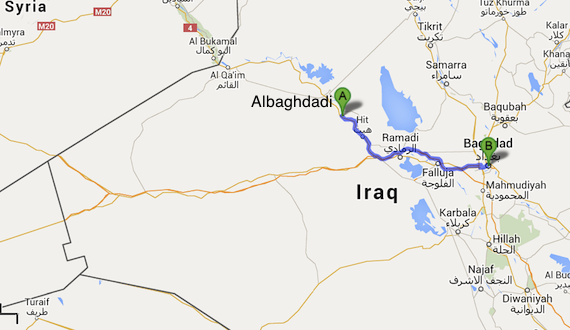
Twenty-five Daesh commandos, some of them with suicide bomb belts, then threw themselves at the outskirts of the al-Ain military base about 9 miles away, where 300 US troops are stationed. That attack was beaten off, but there were fears for the safety of the big US contingent of trainers and special forces personnel at the base.
A US General Kirby maintained that the Daesh advance was not significant and that it is rare it gains a new town. But in fact, Daesh has been expanding its territory in western Iraq, even in the face of US bombing raids. The major Iraqi town it has lost in al-Anbar Province is Jurf al-Sakhr in the far south of the province near the capital.
That the Daesh extremists could take a town so near an Iraqi base, not so far from the capital, raises questions yet again about the competency of the Iraqi army.
The Iraqi government rejected the idea of foreign infantry troops being stationed in al-Anbar, and tried to shoot down allegations that the Shiite-dominated government in Baghdad was not very interested in the fate of strongly Sunni al-Anbar.

Last summer, the group known as the Islamic State of Iraq and Syria (ISIS) swept from Syria into northern Iraq, routing Iraqi security forces and seizing the city of Mosul. Soon afterward, the group declared the establishment of a dubious “caliphate” in the area it controls and rebranded itself the Islamic State. With Iraq’s army weakened and radical militants advancing on Baghdad, the country’s Iran-backed Shia militias — which have their own history of sectarian abuses — fought back, halting the Islamic State’s progress.
The militias have successfully combated Islamic State fighters on the ground with the assistance of air strikes from a US-led military coalition. But their growing influence within Iraq’s government amid accusations that they have harmed Sunnis in areas that they control has led many to fear that the militias threaten the country’s fragile sectarian and political balance.
VICE News traveled to Iraq in December to witness firsthand how Shia militias are taking the fight to the Islamic State, and to document the fallout of their controversial rise to power.

The former Iraqi ruler Saddam Hussein was not executed as justice for crimes he committed, but for his opposition to Wall Street, political analyst Caleb Maupin told RT. The auction to sell the piece of rope he was executed with proves that, Maupin says.
READ MORE: Rope used to hang Saddam Hussein on sale for $7mn
RT: The rope is currently in the possession of the ex-national security advisor, could you please tell us how it got into his hands?
Caleb Maupin: The way the execution of Saddam Hussein was carried out, in a way that was meant to foment sectarian violence. It was an execution; it was staged in a formal way. It almost resembled the lynching with people from hostile ethnic groups shouting at him. And the fact that the rope is now on sale is just a further confirmation of the fact that the execution of Saddam Hussein had nothing to do with justice rather it was about profits.
Iraq was invaded because it had a state-owned oil company that was in competition with Wall Street banks and oil companies. And Saddam Hussein was executed not because of atrocities that he committed during the Iraq- Iran war, or any other atrocities he committed. He was executed for standing up to Wall Street and standing up to the forces that are really ruling the world, the forces of money and power.
RT: According to reports, several bidders from Iran, Israel and Kuwait have offered large sums of money to get hold of the rope, what motivations do they have?
CM: When Saddam Hussein was allying with the US during the Iraq- Iran war there were at least a million Iranians who perished as a result of his actions. But at that time he was in an alliance with the US. That is something that is not brought up in US media very often, it is the fact that at one point the US was very close to Saddam Hussein and had an alliance with him.
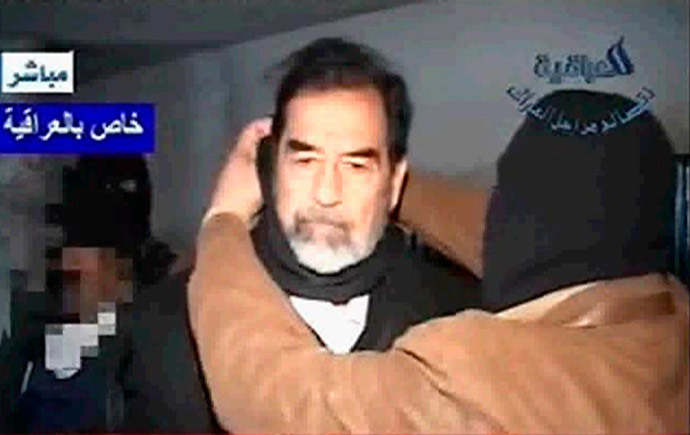
However, it is important to point out that this just shows how cheap justice has become, when they are selling the implements of execution, put up for bidding. Profits dominate everything- nothing is really sacred. Look at all the countries the US has invaded whether it’s Iraq, Afghanistan, Libya, Yugoslavia, which suffered from US bombing. Never do they bring stability, never do they bring peace, they bring further chaos and destruction. War is really motivated by profits and this is just a further illustration of that.
The people of Iraq right now live in misery – there is a refugee crisis. At least a million people have become refugees. Hundreds of thousands are dead. This is the result of the US invasion. And now the government that has been put in place by the US invasion is so corrupted that the very implements used to execute Saddam Hussein are up for sale on the internet.
RT: Some activists say that this auction is inhumane and that the money collected should go to charities in Iraq. What’s your take on this?
CM: The whole notion of auctioning off the implements for execution is really perverse and it illustrates what neo-liberalism and capitalism really is. The US said they were invading Iraq to bring democracy. They weren’t really invading Iraq to bring democracy; they were invading Iraq to impose Western capitalism on Iraq and to impose the rule of Western banks over the Iraqi people. And that is what we are seeing here in the Western world, the neo-liberal world, – everything is up for sale, everything is made for profits. You have prisons for profits, you have private police forces, you have mass homelessness and poverty. This is the reality, this is the system that the US was exporting to Iraq, and this is just a great illustration of that system.


When one of Iraq’s Shia militia commanders this week declared the province of Diyala “liberated”, few people familiar with the province believed it would be a lasting victory.
In a country with a largely Shia south, Kurdish north and Sunni west, Diyala stands as a microcosm of Iraq – a mixed population of Sunnis, Shias, Kurds and Turkmen. The apparent massacre of dozens of unarmed villagers by Shia militias is a reminder of the war within a war potentially more dangerous to Iraq than the fight against ISIL.
The accounts from survivors of the massacre in Barwana are horrifying. But particularly chilling was an account from one of the survivors, a university student, that the gunmen knew their victims.
“I realised there are two types of militias,” he said. Shia militia members from the south of Iraq, he said, were there to fight ISIL. The more lethal ones were local. Empowered by their role in the Iraqi fight against ISIL, members of the Diyala militia units on Monday used it as a way to settle scores and imprint their vision of what the province should look like.
I covered Iraq’s first elections after the 2003 war from Diyala’s provincial capital Baquba and saw Sunnis, Shias and everyone else come together as Iraqi citizens to cast their votes. From an army base in Muqdadiya, near Barwana, I reported on American and Iraqi soldiers working together to rebuild the country in that brief window when it seemed possible. And I covered Diyala when al-Qaeda in Iraq moved in and declared Baquba their capital.
Those were terrible days – bodies in the streets, unbelievable levels of violence and the question of how the country could ever put itself back together again. Iraqis are an amazingly resilient people but from the north of Iraq where Yazidis are exacting revenge on the terrible things done to them to sectarian killings this week in Diyala province, the very idea of Iraq seems to be fraying.
Even the terrible effect of bombs and mortars are easier for a community to recover from than the targeted hatred of armed men who once were your neighbours.
Early in the war, when al-Qaeda first started killing Iraqi security forces, I went along with American and Iraqi soldiers as they arrested suspects at a farmhouse. At least we consider them suspects – Iraqi security forces tend not to need a trial to consider them guilty.
An Iraqi commander watched them being tied up and said “these are the ones that are blowing us up”. “Blowing us up”, he repeated, whacking a club against his hand. There was little doubt what would happen to the suspects.
Baquba and Barwana are less than a two-hour drive from Baghdad. But for years, it’s been considered risky to drive there. Even local journalists have trouble getting around. The Iraqi Human Rights Ministry says it’s too risky for it to even try to get to Barwana.
With what appears to be a massacre in driving distance, we’re left reporting the way we did at the height of Iraq’s civil war – largely by phone. Trying to piece together what happened in a corner of Iraq that seems in danger of disintegrating even with ISIL gone.
Source: Al Jazeera
![Peshmerga armed forces of Iraqi Kurdistan put a major dent in the northern defences of Mosul, writes Knights [Reuters]](https://i0.wp.com/www.aljazeera.com/mritems/imagecache/mbdxxlarge/mritems/Images/2015/1/21/201512110854866734_20.jpg "The liberation of Mosul will have to wait")
About the Author
Michael Knights
Michael Knights is the Lafer Fellow at the Washington Institute for Near East Policy. He specialises in the politics and security of Iraq. He has worked in every Iraqi province and most of the country’s hundred districts, including periods embedded with Iraq’s security forces.
Story highlights
In the past week, the Peshmerga armed forces of Iraqi Kurdistan put a major dent in the northern defences of Mosul, Iraq’s second largest city and capital of the self-styled Islamic State of Iraq and the Levant (ISIL). The Peshmerga launched a powerful offensive on both sides of the Tigris River to the north of Mosul, extending the area of Kurdish control around ISIL strongholds like Kisik (the former base of the 3rd Iraqi Army division), Wana and Badush.
The Kurds are now 32km northwest of Mosul city to the north and are much closer, often just 8 to 16km, from the eastern areas of Mosul city. Along the Syria-Iraq border the Kurds are gradually extending their control around Sinjar and restricting ISIL use of the border areas closest to Mosul.
In the past week, the Peshmerga armed forces of Iraqi Kurdistan put a major dent in the northern defences of Mosul, Iraq’s second largest city and capital of the self-styled Islamic State of Iraq and the Levant (ISIL). The Peshmerga launched a powerful offensive on both sides of the Tigris River to the north of Mosul, extending the area of Kurdish control around ISIL strongholds like Kisik (the former base of the 3rd Iraqi Army division), Wana and Badush.
The Kurds are now 32km northwest of Mosul city to the north and are much closer, often just 8 to 16km, from the eastern areas of Mosul city. Along the Syria-Iraq border the Kurds are gradually extending their control around Sinjar and restricting ISIL use of the border areas closest to Mosul.
The federal government’s main forces are just over 160km to the south, firming up their control of Beiji, site of Iraq’s largest refinery and a vital crossroads that links ISIL areas of strength in Anbar, Kirkuk, Tikrit, and Mosul.
With international air support and intelligence, the federal government’s special forces are periodically probing the desert areas west of Mosul with a view to choking off the ISIL line of supply to Syria.
Battle for Mosul in 2015?
A new nine-brigade Iraqi army force is being slowly assembled by Iraq’s Ministry of Defence with US backing, intended to train and equip 45,000 troops specifically for the task of urban assault in the face of heavy street-by-street resistance.
At the same time another war is being fought largely unseen – the war of the coalition’s spies and sensors versus ISIL’s sentinels keeping a close eye on the citizens of Mosul.
| Iraqi army prepares for assault on Mosul |
The US and other international allies can map every structure and track every signal emanating from Mosul.
Local informants talking to the Kurds, Iraqis and Americans are helping to build a picture of life inside Mosul and the location and habits of ISIL in the city.
All these preparations are being made in advance of the main event; a storming of Mosul city during 2015. But when will this attack take place and how long will the battle for Mosul last?
For the federal government in Iraq, time is of the essence.
Baghdad’s leaders want to deliver tangible victories against ISIL in 2015, and that means liberating ISIL-held cities. Iraqi leaders may be tempted to view Mosul as the “head of the snake”, the ISIL capital within Iraq and a far more significant and populous city than ISIL’s first capital in Raqqa, Syria.
ISIL would not disappear with Mosul’s recapture, but a powerful blow would be struck against its prestige and recruitment potential. ISIL can probably muster well under 10,000 militants in a city of nearly one million residents, meaning that the balance could turn against them rapidly if the populace feels that liberation is close at hand.
Call for an early probe
These factors have led some Iraqi government planners to call for an early probe of the Mosul defences, to test whether ISIL really can control the city in the face of an imminent government offensive.
An alternative, slower approach to the liberation of Mosul is based on a different appreciation of the situation on the ground in the city.
| ISIL and its predecessors have proven effective at urban defence, in the past during the 2004 battles of Fallujah and more recently in Syria at Aleppo and in Iraq at Tikrit. ISIL is actively forcing the population to stay inside Mosul, complicating the risk of civilian casualties in any hasty attack on the city. |
ISIL and its predecessors have proven effective at urban defence, in the past during the 2004 battles of Fallujah and more recently in Syria at Aleppo and in Iraq at Tikrit.
ISIL is actively forcing the population to stay inside Mosul, complicating the risk of civilian casualties in any hasty attack on the city.
Widespread use of crude homemade landmines gives ISIL the ability to slow down the attackers as they laboriously clear mined areas.
Mosul is a large city, 26sq km, not substantially smaller than Baghdad in terms of its surface area. This means Mosul is unlikely to be secured by the limited federal forces available today.
ISIL seems to have maintained effective control over the local population in Mosul until now, though that may change when government forces draw closer.
Finally, it will be tough to isolate Mosul from Syria entirely because desert areas to the west – Ain al-Jahsh, Tall Abta, Tall Afar, Baaj – remain under ISIL control and will require both ground forces and airpower to interdict.
The Kurds have held the closest positions to Mosul city ever since ISIL overran Mosul in June 2014. In fact, to the northeast of Mosul, Kurdish forces have never been more than 13km from the centre of the city throughout the past seven months.
Now Kurdish forces make up the jaws closing on Mosul from the north and the south, but these jaws are perhaps unlikely to close entirely. The Kurds are keeping ISIL under pressure and limiting their ability to reinforce Mosul but that does not mean the Kurds are willing to suffer heavy casualties in street-to-street fighting to retake the predominately Arab areas of Mosul city, which account for almost all of western Mosul and significant neighbourhoods east of the Tigris.
Who will ‘liberate’ Mosul?
The federal government probably has to be the primary force-provider for the attack on ISIL in Mosul. If Baghdad is willing to wait until the middle of the year, or even beyond, the US will probably help to develop more powerful assault forces needed to evict ISIL, and the new police forces to reestablish control in the city.
If Baghdad wants to move sooner than the late summer there are only two options; first, a daring but extremely risky “thunder run” into the city whereby small special forces and tank units try to spark an uprising against ISIL.
| Iraqi army prepares for ‘liberation of Mosul’ |
The only other near-term alternative is reliance on predominately Shia Hashd al-Shaabi (Popular Mobilisation) units.
But these forces are arguably too small and too distracted to take on the Mosul operation as that they are fighting across a dozen battlefields right now, mainly in Shia-dominated parts of Iraq.
Nor would the Popular Mobilisation units necessarily be welcomed in Mosul city, even by anti-ISIL militants.
Though Popular Mobilisation units have supported Sunni tribes in Ramadi, Dhuluiya and Heet, the situation in Mosul may be different. ISIL succeeded in seizing Mosul partly because of local resentment against the Shia-led security forces.
Moslawis are likely to react negatively to dominance by any major outside security force, whether Shia militias, Peshmerga or even federal army forces. In 2003 when the Saddam forces collapsed, Mosul immediately became a free-for-all where pop-up militant groups vied for dominance.
In all likelihood the full commencement of the battle of Mosul will need to wait until the summer of 2015 at the earliest.
Two risks will drive decision-makers in Baghdad, Washington and Erbil to hold back from assaulting the city.
The first is the risk of catastrophic failure; the bloody repulse of a hasty attack on the city, which could negatively affect Iraqi security force morale elsewhere and transfer the initiative back to ISIL.
But a second, equally serious risk is that of catastrophic success; that ISIL control could “pop” surprisingly quickly, creating a chaotic scramble for power in Iraq’s second city between the Iraqi government, the Kurds, local Sunni militias and ISIL diehards.
If such an outcome can be avoided through the patient creation of a “day after” plan agreed upon by all the attacking forces, then the eviction of ISIL from Mosul might qualify as a “liberation” instead of just the commencement of a new chapter of fighting in that embattled city.
Michael Knights is the Lafer Fellow at the Washington Institute for Near East Policy. He specialises in the politics and security of Iraq. He has worked in every Iraqi province and most of the country’s hundred districts, including periods embedded with Iraq’s security forces.
 olddogthoughts
You must be logged in to post a comment.