
Jim Chalmers to confirm first back-to-back federal budget surpluses in more than 15 years

It’s no surprise that Jim Chalmers’ gentle challenge to neoliberal economics has generated an often rabid and intensely hostile response from the Murdoch media. To be hoped for is a more reasoned, informed national debate which focusses on, as Chalmers points to, fundamental changes to our economic environment.
Source: Jim Chalmers’ new economics: a frontal assault on capitalism? – Pearls and Irritations
This isn’t new The Government of Bhutan’s central “economic policy” focus has been the ” Economy of Well-Being” Social Democracies around the world have been practising it to some extent far more than Australia has. Some like Cuba are not even given a remote chance to practice what they preach by America. The people’s choices are always deemed ignorant by the conservatives of Western Democracies.
Bernie Sanders in America has spent his life advocating “another form of economics” always losing out, not to the Republicans but rather to the non-progressives in the Democratic Party who remain blinded to any other form of privatised economics than is currently practised. They simply hold the power and the megaphone not the logic or commonsense thought that exists outside of the current matrix we have constructed.
Yet Australia’s Conservatives and the LNP regard what Chalmers has been echoing as some radical change of life and in their kindest moments writing it off as pure fantasy. It’s not but it’s rarely spoken of out loud in Australia.
Jim Chalmers Essay
This is not to suggest that Chalmers is predicting the end of the capitalist order. Far from it. But the capitalism Chalmers envisages is one where markets must work to advance well-being. So too must governments. That’s hardly a radical view, but it has to be asserted, because governments have lost sight of that objective. Hence the importance attached to the wellbeing budget.
Source: Bear weekly roundup
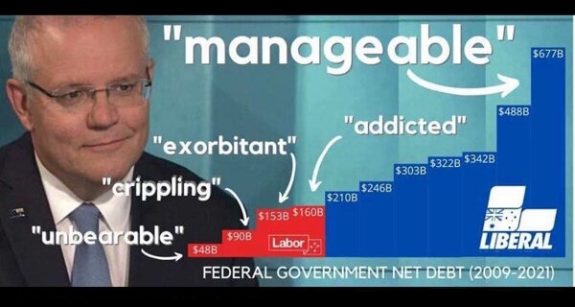
If only we had of voted Morrison in we’d have never known
“The economy was weaker in the March quarter than was forecast at election time.
“Growth at 0.8 per cent was…much weaker than what was expected for the corresponding period in the pre-election fiscal outlook”.
He added: “Consumption, dwelling investment, new business investment export and the nominal GDP were all weaker in the March quarter than was anticipated by our predecessors in the Budget and by the departments at PFO.”
“Although the national accounts are notoriously backward looking, if you think about what has happened in the economy since the end of March: inflation is higher, we have had an interest rate hike, petrol prices are up 12 per cent since the end of April, wholesale electricity prices are up 237 per cent since the end of March, and gas more than 300 per cent higher than the average of the last few years.”
Robust in parts, resilient in parts, but with rising inflation, chickens coming home to roost, and a perfect storm of energy rate spikes.
Who is it that can’t manage money?
Source: Who is it that can’t manage money? – » The Australian Independent Media Network

 olddogthoughts
You must be logged in to post a comment.