A Philistine in Phnom Penh, Part CXVII: The Anatomy of a Terrorist Attack in Jakarta, 14 January 2016
Last Thursday I got caught up in Jakarta in terrorism’s most recent efforts to scare the hell out a burgeoning democracy. It didn’t work. The predominant local reaction was “We are not afraid”.
I thought it might be worth setting out a few thoughts on what it is like to be close to such an incident. After Paris, Sydney, Ottawa, Beirut, Tunisia, El Said, San Bernardino and this week Jakarta and Burkina Faso there is a growing understanding that global terrorism is not far away but is now local and is most often now directed against Westerners.
While I was never in any danger, I was working in a high-rise building with my work team just a few hundred meters from where the terrorist attack went down. Our building went into immediate lockdown. Streets near us were soon deserted as traffic stopped. We were on the 45th floor holding a training day with our six member team as we prepared for a month’s consultancy work related to development challenges in SE Asian countries like Indonesia, Singapore and Vietnam
Our team had travelled to Jakarta from Bangkok just the night before. We arrived during one of Jakarta’s booming thunder storms and another one of the usual chaotic traffic jam. I walked from my hotel to work next morning feeling pretty good about being back in the world’s largest Muslim country even if it was as hot as ever. Indonesians are exceptionally friendly people so there are lots of greetings even for foreigners. Muslim women seem more often now to wear the najib but that doesn’t seem to stop the friendly smiles and gestures.
It was half past ten that morning when, as we sat around the conference table, we first heard the rumors of the terrorist attacks on the main street of Jakarta. We were told it was near Starbucks on the outside of the Serenah Mall. I knew the Starbucks well, having worked twice n for a few weeks or so in recent years in the nearby United Nations building which is just across the road. It seemed likely that Starbucks had been chosen because it was known to be popular and frequented by foreigners, mainly from the 20 or so UN agencies based in Indonesia.
The first concern of our team members was naturally their loved ones. Anxious calls were made to work sites and two international schools around Jakarta. We learned the schools had immediately gone into lockdowns. Everyone was established to be safe. The team members were calm but there were early reports of terror incidents in other parts of Jakarta which increased apprehension about the scale of the attack but later turned out to be false.
As with any crisis, details of what was really happening were at first sketchy. We heard early on that there was shooting; some bombs had gone off; and there were casualties. Under well-practiced drills, our building and those around us went into immediate lockdown. You feel a bit stuck when that happens!
From our 45th floor eyrie, there was no prospect of trying to escape the scene. We could see police helicopters buzzing about and hear lots of sirens below. We heard no sounds of gunfire or of bombs going off. Indonesia media websites told us that was what was happening, though, but we soon realized the accounts were not entirely accurate and switched to the ABC Australia website, CNN America and the Guardian UK who had reporters on site sending out live blogs.
It is that early fog in information that can befuddle the reaction to a terrorist attack. While there was no panic in our building, we seemed to go into a trance for the first hour and tried to work on in our consultancy preparations, but while some trawled the internet for accurate information.
We heard early on of the traffic policeman who had been shot and killed by an insurgent from a motorcyclist while he was sitting in his sun-protective cabin on the median strip. We also heard there was an assault on a Starbucks and there were casualties. Later on we heard that a Canadian trying to flee the café had been shot dead; we also learnt that a well-regarded Dutchman working with UN who had been advising on environmental policies for greening Indonesia had been seriously injured by gunshots.
We also saw on CNN two blasts in the Starbucks car park accompanied by dense smoke. That apparently marked two suicide bombers blowing themselves up, having been forced back from the café by police fire. From the bombers’ perspective, according to jihadist propaganda, their earthly martyrdom led them straight on to heaven where virgins were waiting to greet them. Two other gunmen were caught and arrested.
The police later said ISIS was behind the attack and that its organizer was an Indonesia jihadist based at the headquarters of the alleged caliphate in Rakka in Syria. He has just become a high value target and, as with the ghastly beheadings by Jihad John had ensured, his plotting will help to speed up his departure from this life.
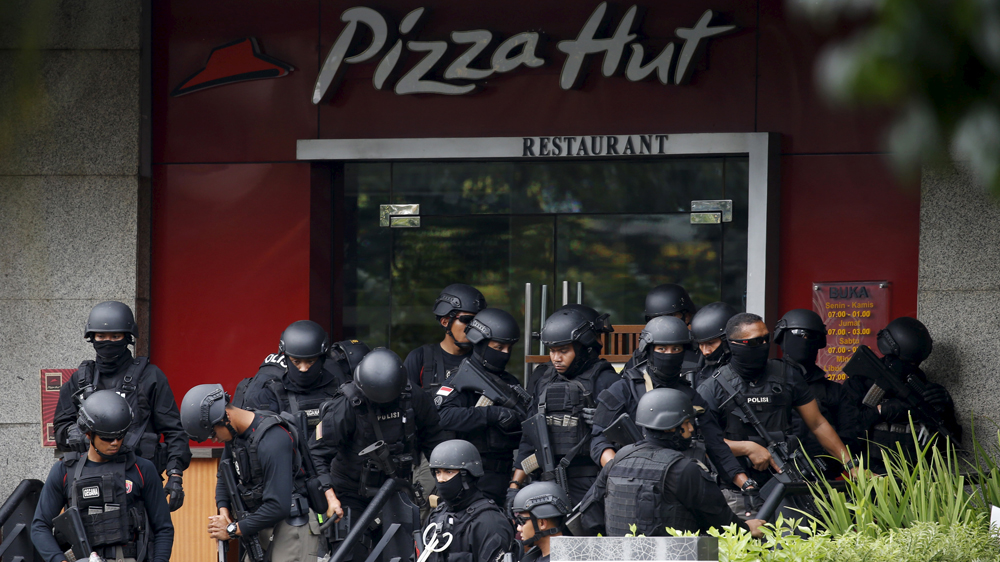
CNN also showed film of a gunman wandering about in a distracted state holding a large semi-automatic. In the close background there seemed to be crowds in their hundreds many of whom seemed absorbed by the spectacle he provided, with only some running away. Throughout the five hours of the siege police seemed to provide little crowd control. For some hours police conducted a room to room search in nearby buildings as local people and media staff watched from below. A large bomb was apparently found not far from Starbucks and thankfully defused before it could cause any mayhem.
Meanwhile, we sat upstairs in our 45th floor conference room, trying to stay updated on what was happening on the streets of Jakarta. Somehow some brave souls sneaked out of the building and bought back packs of prepared meals of steaming beef rendang. We had also made contact with our US company’s security firm, Crisis 24, in Jakarta and a very sympathetic company manager in Bangkok.
The security firm’s assistance amounted to regular calls to check on us and getting us to fill in some forms, but absolutely no practical advice on what to do. They did contact the company’s Washington headquarters but, rather hilariously, by text rather than by placing a phone call, given it was the middle of the night. Communication failures like this are not appreciated!
For other reasons we rather lost confidence in the security firm’s capacity to assist. We decided ourselves we would stay put and started to wonder how longer that might be. There were rumors of fresh gunfire. We had barely touched the food provided to us for our training day so we didn’t have any worries about food or drink. We also talked through how we might get home once the siege was over, recognizing that Jakarta might be utterly chaotic and some team-members were staying some distance away and might need to use the motorcycle taxi which can be a scary experience at the best of time.
Around 4pm we to our surprise heard the security situation was over. We packed up and took the elevator to the ground. We gained confidence as we left the lift to see the traffic had started to move again. It was chaotic outside with policemen, armed personnel carriers and street barriers everywhere. The team wandered back towards my hotel. We were stopped by police at various points who could not have been more courteous and helpful. They tried to help us find taxis for the team. When I got to the hotel, there was barbed wire outside and a number of security checks and body searches to get through. My colleagues
riding home on motorcycles (there were no taxis available) had a quite an experience in the very busy traffic that was doing its best to get out of central Jakarta.
It was kind of surreal to turn on the TV that night to see the attack was the lead news item around the world. The detestable Donald Trump even tried to boost the significance of Jakarta as yet another sign that Americans should be very afraid of the terrorist that are going to come after them.
But it was more riveting to us to see the parts of Jakarta where we are staying depicted on the news and to start to get a better sense of what actually occurred. We had heard of 17 killed and 20 injured. The total was in fact 7 killed, although today we heard another Indonesian man who was shot in the head had passed away.
Another 12 suspected terrorists have since been arrested in various outlying provinces. A number of websites expressing support for the attacks were shutdown. There was much action on social media expressing defiance against the terrorists, as well as a small demonstration we witnessed from our hotel window.
For us lucky persons who had witnessed the terror attack from a safe distance the aftermath was worse than the event. Next day, apart from form filling, registering with embassies and setting up new emergency protocols, we had to endure a long Skype debrief with security folks from the company in Washington DC who seemed at least as interested in trying to explain the communication stuff ups as anything else.
I did not hold back in describing the failures in support that had occurred but then most of all wanted advice as team leader on what we do next. Usually after such an attack all goes quiet but you can’t count on it.
Our Washington masters then made our life more difficult by requiring we not go out over the weekend, meaning a number of meetings were cancelled. Next week we are to travel everywhere for appointments in hire cars with darkened windows. However, our issues are but slight as compared to the people who live here in the long term.
The attack was nothing like as bad as Paris or the Burkina Faso assault yesterday in which 20 people died. These were some young provincial boys, some of the 700 returned and radicalized Indonesians who had fought in the war in Syria. They had been told to come to town and to lift the ISIS profile in Jakarta. This was much harder for the police to anticipate, although there had been warnings.
The police have done a great job recently in destroying structured terrorist organizations across Indonesia, with help from the Australian Federal Police, but their ability to follow other small and looser groupings of disaffected young people is not as effective.
The terrorists were not the hardened killers of the Paris massacre. Their planning was weak and they seem to have panicked early on and resorted to amateur hour. Only three deaths of civilians is nothing short of miraculous.
We all feel for the people of Indonesia who know this may happen again sometime soon. They seem resolute and determined to stay positive about life. Indonesia is a rising middle income country that still has its problems with poverty, economic underperformance, rampant corruption, worsening pollution and much environmental degradation.
Yet it was marvelous to hear the strong condemnations at Friday prayers yesterday for behavior that has nothing to do with Islam, which is of course a religion of love and mutual respect. ISIS loses every time
they mount an attack. But this was, on the other hand, a wake-up call to Asia on the reach of ISIS into different parts of the globe. What comes next and where? We shall see!
Regards
Edmund Attridge
17 January 2016
A Philistine in Phnom Penh, Part CXVII: The Anatomy of a Terrorist Attack in Jakarta, 14 January 2016
Last Thursday I got caught up in Jakarta in terrorism’s most recent efforts to scare the hell out a burgeoning democracy. It didn’t work. The predominant local reaction was “We are not afraid”.
I thought it might be worth setting out a few thoughts on what it is like to be close to such an incident. After Paris, Sydney, Ottawa, Beirut, Tunisia, El Said, San Bernardino and this week Jakarta and Burkina Faso there is a growing understanding that global terrorism is not far away but is now local and is most often now directed against Westerners.
While I was never in any danger, I was working in a high-rise building with my work team just a few hundred meters from where the terrorist attack went down. Our building went into immediate lockdown. Streets near us were soon deserted as traffic stopped. We were on the 45th floor holding a training day with our six member team as we prepared for a month’s consultancy work related to development challenges in SE Asian countries like Indonesia, Singapore and Vietnam
Our team had travelled to Jakarta from Bangkok just the night before. We arrived during one of Jakarta’s booming thunder storms and another one of the usual chaotic traffic jam. I walked from my hotel to work next morning feeling pretty good about being back in the world’s largest Muslim country even if it was as hot as ever. Indonesians are exceptionally friendly people so there are lots of greetings even for foreigners. Muslim women seem more often now to wear the najib but that doesn’t seem to stop the friendly smiles and gestures.
It was half past ten that morning when, as we sat around the conference table, we first heard the rumors of the terrorist attacks on the main street of Jakarta. We were told it was near Starbucks on the outside of the Serenah Mall. I knew the Starbucks well, having worked twice n for a few weeks or so in recent years in the nearby United Nations building which is just across the road. It seemed likely that Starbucks had been chosen because it was known to be popular and frequented by foreigners, mainly from the 20 or so UN agencies based in Indonesia.
The first concern of our team members was naturally their loved ones. Anxious calls were made to work sites and two international schools around Jakarta. We learned the schools had immediately gone into lockdowns. Everyone was established to be safe. The team members were calm but there were early reports of terror incidents in other parts of Jakarta which increased apprehension about the scale of the attack but later turned out to be false.
As with any crisis, details of what was really happening were at first sketchy. We heard early on that there was shooting; some bombs had gone off; and there were casualties. Under well-practiced drills, our building and those around us went into immediate lockdown. You feel a bit stuck when that happens!
From our 45th floor eyrie, there was no prospect of trying to escape the scene. We could see police helicopters buzzing about and hear lots of sirens below. We heard no sounds of gunfire or of bombs going off. Indonesia media websites told us that was what was happening, though, but we soon realized the accounts were not entirely accurate and switched to the ABC Australia website, CNN America and the Guardian UK who had reporters on site sending out live blogs.
It is that early fog in information that can befuddle the reaction to a terrorist attack. While there was no panic in our building, we seemed to go into a trance for the first hour and tried to work on in our consultancy preparations, but while some trawled the internet for accurate information.
We heard early on of the traffic policeman who had been shot and killed by an insurgent from a motorcyclist while he was sitting in his sun-protective cabin on the median strip. We also heard there was an assault on a Starbucks and there were casualties. Later on we heard that a Canadian trying to flee the café had been shot dead; we also learnt that a well-regarded Dutchman working with UN who had been advising on environmental policies for greening Indonesia had been seriously injured by gunshots.
We also saw on CNN two blasts in the Starbucks car park accompanied by dense smoke. That apparently marked two suicide bombers blowing themselves up, having been forced back from the café by police fire. From the bombers’ perspective, according to jihadist propaganda, their earthly martyrdom led them straight on to heaven where virgins were waiting to greet them. Two other gunmen were caught and arrested.
The police later said ISIS was behind the attack and that its organizer was an Indonesia jihadist based at the headquarters of the alleged caliphate in Rakka in Syria. He has just become a high value target and, as with the ghastly beheadings by Jihad John had ensured, his plotting will help to speed up his departure from this life.
CNN also showed film of a gunman wandering about in a distracted state holding a large semi-automatic. In the close background there seemed to be crowds in their hundreds many of whom seemed absorbed by the spectacle he provided, with only some running away. Throughout the five hours of the siege police seemed to provide little crowd control. For some hours police conducted a room to room search in nearby buildings as local people and media staff watched from below. A large bomb was apparently found not far from Starbucks and thankfully defused before it could cause any mayhem.
Meanwhile, we sat upstairs in our 45th floor conference room, trying to stay updated on what was happening on the streets of Jakarta. Somehow some brave souls sneaked out of the building and bought back packs of prepared meals of steaming beef rendang. We had also made contact with our US company’s security firm, Crisis 24, in Jakarta and a very sympathetic company manager in Bangkok.
The security firm’s assistance amounted to regular calls to check on us and getting us to fill in some forms, but absolutely no practical advice on what to do. They did contact the company’s Washington headquarters but, rather hilariously, by text rather than by placing a phone call, given it was the middle of the night. Communication failures like this are not appreciated!
For other reasons we rather lost confidence in the security firm’s capacity to assist. We decided ourselves we would stay put and started to wonder how longer that might be. There were rumors of fresh gunfire. We had barely touched the food provided to us for our training day so we didn’t have any worries about food or drink. We also talked through how we might get home once the siege was over, recognizing that Jakarta might be utterly chaotic and some team-members were staying some distance away and might need to use the motorcycle taxi which can be a scary experience at the best of time.
Around 4pm we to our surprise heard the security situation was over. We packed up and took the elevator to the ground. We gained confidence as we left the lift to see the traffic had started to move again. It was chaotic outside with policemen, armed personnel carriers and street barriers everywhere. The team wandered back towards my hotel. We were stopped by police at various points who could not have been more courteous and helpful. They tried to help us find taxis for the team. When I got to the hotel, there was barbed wire outside and a number of security checks and body searches to get through. My colleagues
riding home on motorcycles (there were no taxis available) had a quite an experience in the very busy traffic that was doing its best to get out of central Jakarta.
It was kind of surreal to turn on the TV that night to see the attack was the lead news item around the world. The detestable Donald Trump even tried to boost the significance of Jakarta as yet another sign that Americans should be very afraid of the terrorist that are going to come after them.
But it was more riveting to us to see the parts of Jakarta where we are staying depicted on the news and to start to get a better sense of what actually occurred. We had heard of 17 killed and 20 injured. The total was in fact 7 killed, although today we heard another Indonesian man who was shot in the head had passed away.
Another 12 suspected terrorists have since been arrested in various outlying provinces. A number of websites expressing support for the attacks were shutdown. There was much action on social media expressing defiance against the terrorists, as well as a small demonstration we witnessed from our hotel window.
For us lucky persons who had witnessed the terror attack from a safe distance the aftermath was worse than the event. Next day, apart from form filling, registering with embassies and setting up new emergency protocols, we had to endure a long Skype debrief with security folks from the company in Washington DC who seemed at least as interested in trying to explain the communication stuff ups as anything else.
I did not hold back in describing the failures in support that had occurred but then most of all wanted advice as team leader on what we do next. Usually after such an attack all goes quiet but you can’t count on it.
Our Washington masters then made our life more difficult by requiring we not go out over the weekend, meaning a number of meetings were cancelled. Next week we are to travel everywhere for appointments in hire cars with darkened windows. However, our issues are but slight as compared to the people who live here in the long term.
The attack was nothing like as bad as Paris or the Burkina Faso assault yesterday in which 20 people died. These were some young provincial boys, some of the 700 returned and radicalized Indonesians who had fought in the war in Syria. They had been told to come to town and to lift the ISIS profile in Jakarta. This was much harder for the police to anticipate, although there had been warnings.
The police have done a great job recently in destroying structured terrorist organizations across Indonesia, with help from the Australian Federal Police, but their ability to follow other small and looser groupings of disaffected young people is not as effective.
The terrorists were not the hardened killers of the Paris massacre. Their planning was weak and they seem to have panicked early on and resorted to amateur hour. Only three deaths of civilians is nothing short of miraculous.
We all feel for the people of Indonesia who know this may happen again sometime soon. They seem resolute and determined to stay positive about life. Indonesia is a rising middle income country that still has its problems with poverty, economic underperformance, rampant corruption, worsening pollution and much environmental degradation.
Yet it was marvelous to hear the strong condemnations at Friday prayers yesterday for behavior that has nothing to do with Islam, which is of course a religion of love and mutual respect. ISIS loses every time
they mount an attack. But this was, on the other hand, a wake-up call to Asia on the reach of ISIS into different parts of the globe. What comes next and where? We shall see!
Regards
Edmund Attridge
17 January 2016








 Unaware of the specifics: Indonesian President Joko Widodo wearing a Napalm Death T-shirt. Photo: VICE Media
 Reprieve: Hangky Gunawan. Photo: jaringnews.com
 olddogthoughts