Tag: IPCC

Rebellious Climate Scientists Have Message for Humanity: ‘Mobilize, Mobilize, Mobilize’

Scientist Rebellion

In face of the “escalating climate emergency,” the advocacy group Scientist Rebellion warns that IPCC summary to global policymakers remains “alarmingly reserved, docile, and conservative.”

Source: Rebellious Climate Scientists Have Message for Humanity: ‘Mobilize, Mobilize, Mobilize’

UN Climate Panel: 50% of Species have fled toward Poles, as Extinctions and Food and Water Shortages Burgeon

The US Republican Party may not believe in the menace of the climate emergency, but the animals are far less dumb. They are fleeing for the hills, literally. (Note that I have used “literally” correctly here.) That 50% of the tens of thousands of species surveyed by the iPCC have moved toward the poles to get away from the increasing extremes of heat is a remarkable, and alarming statistic.

Source: UN Climate Panel: 50% of Species have fled toward Poles, as Extinctions and Food and Water Shortages Burgeon

Deconstructed: The Era of Climate Denial Is Over

the Intergovernmental Panel on Climate Change, or IPCC, released the first part of its latest report on the state of the Earth’s climate. It details with greater certainty than ever before the links between human activity and extreme weather patterns: fires, floods, and rising sea levels. Journalist David Wallace-Wells and sociologist Dana Fisher join Ryan Grim to discuss the takeaways from the new report.

Source: Deconstructed: The Era of Climate Denial Is Over

PM can’t see the emissions truth for the trees

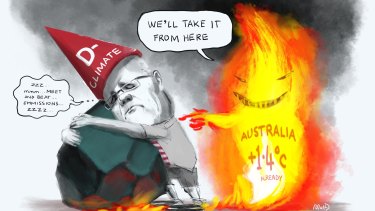
Scott Morrison asleep at the climate change wheel.

The report finds that whereas the world’s increase in average temperatures since the start of the industrial era is 1.1 degrees, our average land temperature has risen by 1.4 degrees over the past century – which does much to confirm the impression most of us have that droughts, floods, bushfires, heatwaves and cyclones are now bigger and more frequent than they used to be. Climate change isn’t coming, it’s arrived.

Source: PM can’t see the emissions truth for the trees

Old Dog Thought-

Yes, I'm stuck in the middle with you
And I'm wondering what it is I should do
It's so hard to keep this smile from my face
Losing control, yeah, I'm all over the place
Clowns to the left of me, jokers to the right
Here I am, stuck in the middle with you
Coalition climate change deniers

Fighting Fake News with REAL 11/8/21; The Shovel, IPCC Report, Climate

Can we quit coal in time? IPCC warns world has just 12 years to avoid climate change catastrophe – ABC News (Australian Broadcasting Corporation)

A shot of an active coal-fired power station near a residential area in China.

The IPCC issued its bleakest report yet this week, saying that without drastic changes, the world doesn’t have a hope of avoiding uncontrollable climate change.

Unless emissions are halved within 12 years and virtually eliminated by 2050, temperature increases will likely exceed 2 degrees Celsius.

Beyond 2 degrees, scientists predict temperature increases may spiral as the climate breaches a series of unique tipping points, such as the melting of the permafrost.

The top culprit is fossil fuels, and the instructions to Australia and the rest of the world are clear: Quit coal by 2050.

via Can we quit coal in time? IPCC warns world has just 12 years to avoid climate change catastrophe – ABC News (Australian Broadcasting Corporation)

IPCC: More Than All of Observed Warming Has Been Caused by Humanity’s Emissions

A lone sunflower ekes out a scant living at the Great Sand Dunes National Park in southern Colorado. (Image: Bruce Melton)

IPCC: More Than All of Observed Warming Has Been Caused by Humanity’s Emissions.

Fears sea levels could rise as ‘concerned’ scientists find signs huge Antarctic glacier is melting

Part of the Totten glacier in East Antarctica

New aerial ice studies have given scientists an unprecedented insight into how one of the world’s largest glaciers is melting.

The Totten Glacier drains an area twice the size of Victoria, so there’s an awful lot of ice in there, grounded below sea level, so it’s got a fair potential for sea level rise.

Glaciologist Dr Jason Roberts

The research, published in the journal Nature Geoscience, has uncovered a series of tunnels and gateways which are allowing warm water to eat away at the Totten Glacier in East Antarctica, potentially leading to a dramatic rise in global sea levels.

Dr Tas van Ommen from the Australian Antarctic Division said what they found was worrying.

“We’re realising that the East Antarctic ice sheet’s probably not the sleeping giant that we thought or at least, the giant’s starting to twitch and we’re concerned,” he said.

Scientists used planes armed with hi-tech monitoring equipment to measure the height and thickness of ice and bedrock topography beneath the massive Totten Glacier.

New aerial ice studies have given scientists an unprecedented insight into how one of the world’s largest glaciers is melting.

The Totten Glacier drains an area twice the size of Victoria, so there’s an awful lot of ice in there, grounded below sea level, so it’s got a fair potential for sea level rise.

Glaciologist Dr Jason Roberts

The research, published in the journal Nature Geoscience, has uncovered a series of tunnels and gateways which are allowing warm water to eat away at the Totten Glacier in East Antarctica, potentially leading to a dramatic rise in global sea levels.

Dr Tas van Ommen from the Australian Antarctic Division said what they found was worrying.

“We’re realising that the East Antarctic ice sheet’s probably not the sleeping giant that we thought or at least, the giant’s starting to twitch and we’re concerned,” he said.

Scientists used planes armed with hi-tech monitoring equipment to measure the height and thickness of ice and bedrock topography beneath the massive Totten Glacier.

The aerial surveys covered more than 150,000 kms over five years, and allowed scientists to map and create cross sections of the glacier for the first time.

Dr Tas van Ommen said that there was enough ice in the Totten Glacier alone to raise global sea levels by at least three and a half metres.

“That three and a half metre sea level rise would take many centuries to roll out,” he said.

“But even in this century, the last IPCC [Intergovernmental Panel on Climate Change] report said that if this kind of thing happens, it’s going to add several tens of centimeters of sea level rise to their estimate of one metre.”

Glaciologist Dr Jason Roberts agreed the melting of East Antarctica’s largest glacier could have major implications globally.

“The Totten Glacier drains an area twice the size of Victoria, so there’s an awful lot of ice in there, grounded below sea level, so it’s got a fair potential for sea level rise,” he said.

Scientists plan to use more aerial surveys and eventually underwater rovers to better understand the sleeping giant, before it wakes up

The aerial surveys covered more than 150,000 kms over five years, and allowed scientists to map and create cross sections of the glacier for the first time.

Dr Tas van Ommen said that there was enough ice in the Totten Glacier alone to raise global sea levels by at least three and a half metres.

“That three and a half metre sea level rise would take many centuries to roll out,” he said.

“But even in this century, the last IPCC [Intergovernmental Panel on Climate Change] report said that if this kind of thing happens, it’s going to add several tens of centimeters of sea level rise to their estimate of one metre.”

Glaciologist Dr Jason Roberts agreed the melting of East Antarctica’s largest glacier could have major implications globally.

“The Totten Glacier drains an area twice the size of Victoria, so there’s an awful lot of ice in there, grounded below sea level, so it’s got a fair potential for sea level rise,” he said.

Scientists plan to use more aerial surveys and eventually underwater rovers to better understand the sleeping giant, before it wakes up

Totten Glacier

Herb Van Fleet: With climate change, you can’t change the facts:

The International Panel on Climate Change is at it again.On Nov. 2, the IPCC released its latest report, “Climate Change 2014: Impacts, Adaptation and Vulnerability — Fifth Assessment.” It was written by 306 authors from 60 countries and runs 1,820 pages. And consistent with previous reports, this one portends gloom and doom for the planet unless we begin to make a concerted effort to curb greenhouse gas emissions, especially carbon dioxide.

Also consistent with previous reports from the IPCC were the reactions from the climate change deniers, especially Republicans, and more especially Sen. Jim Inhofe, the 79-year old Tulsan who was just re-elected. Inhofe is set to become chairman of the Environment & Public Works committee in January under the new Republican-controlled Senate and will be heavily involved in any legislation regarding climate change.

With that in mind, consider Inhofe’s response to the IPCC report: “It comes as no surprise that the IPCC is again advocating for the implementation of extreme climate change regulations that will cripple the global economy and send energy prices skyrocketing.”

He apparently thinks his predictions are better than the IPCC’s.

Sen. Inhofe has been the champion of climate change deniers for years. In 2012, he wrote a book on the subject: “The Greatest Hoax: How the Global Warming Conspiracy Threatens Your Future.” Not surprising for someone whose campaign treasure chest is overflowing with money from the petroleum industry and related parties.

As an evangelical, Inhofe has also claimed that human-influenced climate change is impossible because “God’s still up there,” and that it is “outrageous” and arrogant for people to believe human beings are “able to change what he is doing in the climate.” Like many other religionists in the political theater, Inhofe confuses belief and dogma with science and facts.

If Inhofe had been around in the early part of 1492, I’m pretty sure he would have been absolutely convinced that Earth was flat and that Columbus’ proposed voyage West to find the Far East was doomed to fall off the edge.

Besides the outspoken Inhofe, there are many others, mostly conservatives, who deny that climate change is caused by humans and that it is a natural phenomenon over which humans have no control.

The carbon tax, the subsidies for alternative energy sources and the retrofitting of certain industries to reduce greenhouse gases, which are suggested as means of abating human contributions to climate change along with the attendant growth in government bureaucracies, are all anathema to the right wing of the political spectrum. Big business is better than big government, they say.

Extreme politics warning as climate changes

More to come?

Recent developments on the climate change front (both from scientists and politicians) prove the issue is still vexed, but there are signs voters are warming to the scientific view, write Peter Lewis and Jackie Woods.

If there’s one thing settled on climate change, it is that the debate inevitably leads to extreme emotions, opinions and warnings of doom, be it the national economy or the global ecosystem.

Years of divisive politicking around the issue has culminated in a policy with little public support and an electorate split over an issue that scientists warn us we need to confront in the here and now.

The extremes have been on display this week, with a new report from the IPCC warning the window to act is closing, while the Abbott Government managed to finally shut the gate on a deal to enact its policy of “Direct Action” with the support of mining magnate and sometimes environmental activist Clive Palmer.

This week’s twin developments neatly sum up the debate in Australia – a scientific community calling for urgent action for the future and a political response focused on minimising impact on the here and now.

Our Essential Report shows that voters aren’t overly surprised by scientific predictions of more frequent extreme weather events.

Of those who think extreme weather events will increase, three quarters believe the increase is likely linked to climate change.

But a significant proportion, 16 per cent, still believe a link between extreme weather and climate change is unlikely.

This finding reflects a continuing divide in the community about the science of climate change. Our polling has shown a fairly consistent pattern over the last few years of about half believing climate change is real and human induced and a third believing any unusual climate antics are a normal fluctuation.

Most recently we’ve seen a decline in the “normal fluctuation” camp – down nearly 10 points since the start of the year, suggesting a swing could be on to greater acceptance of the scientific view put so forcefully by the IPCC.

The Coalition was highly effective in exploiting divisions about climate science and policy and tearing down Labor’s climate scheme, but it now faces the challenge of putting up its own credible alternative.

Direct Action has never appealed much to voters and has been consistently less popular than various options involving pricing carbon.

Support for Direct Action as the best means of tackling climate change has bounced around between 5 and 15 per cent over the past year, coming in at 10 per cent when we most recently asked at the end of September.

Adding to the complexity – as we’ve found before Direct Action gets the limited support it does from people who are less likely to believe that climate change is real and caused by human activity. In other words, Direct Action is the policy of choice for climate change deniers.

This picture suggests the Abbott Government is set to get tangled up in a political mess on climate policy in the same way Labor did – in large part because of its own determination to exploit the issue for political gain rather than work co-operatively towards a policy solution that could gain broad support.

But while Abbott has played hard on climate politics, he’s hardly the first.

The Greens have been roundly criticised for failing to make the compromises necessary to close the deal with Labor to secure the Carbon Pollution Reduction Scheme mark 1; while Labor wouldn’t have had to negotiate with the Greens if Kevin Rudd had prioritised getting a deal with Malcolm Turnbull over exploiting the political divisions on climate within the Coalition.

As it stands, Australians see a future of more frequent and extreme weather events caused by climate change, with a climate policy they’re not convinced by.

And if the expected long, hot summer eventuates, the only thing for certain is the loud voices on both sides of the debate will lock in behind their preconceptions.

Where is Team Australia when you really need it?

Fossil fuels should be phased out by 2100 says IPCC….100’s of scientists

Chimneys billowing smoke

The unrestricted use of fossil fuels should be phased out by 2100 if the world is to avoid dangerous climate change, a UN-backed expert panel says.

The Intergovernmental Panel on Climate Change says in a stark report that most of the world’s electricity can – and must – be produced from low-carbon sources by 2050.

If not, the world faces “severe, pervasive and irreversible” damage.

The UN said inaction would cost “much more” than taking the necessary action.

The IPCC’s Synthesis Report was published on Sunday in Copenhagen, after a week of intense debate between scientists and government officials.

It is intended to inform politicians engaged in attempts to deliver a new global treaty on climate by the end of 2015.

The report says that reducing emissions is crucial if global warming is to be limited to 2C – a target acknowledged in 2009 as the threshold of dangerous climate change.

The report suggests renewables will have to grow from their current 30% share to 80% of the power sector by 2050.

In the longer term, the report states that fossil fuel power generation without carbon capture and storage (CCS) technology would need to be “phased out almost entirely by 2100”.

‘Science has spoken’

The Synthesis Report summarises three previous reports from the IPCC, which outlined the causes, the impacts and the potential solutions to climate change.

It re-states many familiar positions:

  • Warming is “unequivocal” and the human influence on climate is clear
  • The period from 1983 to 2012, it says, was likely the warmest 30 year period of the last 1,400 years
  • Warming impacts are already being seen around the globe, in the acidification of the oceans, the melting of arctic ice and poorer crop yields in many parts
  • Without concerted action on carbon, temperatures will increase over the coming decades and could be almost 5C above pre-industrial levels by the end of this century

“Science has spoken,” UN Secretary-General Ban Ki-moon said. “There is no ambiguity in their message. Leaders must act. Time is not on our side.”

http://www.bbc.com/news/science-environment-29855884

Ban Ki-moon: Inaction on climate change “will cost heavily”

“There is a myth that climate action will cost heavily,” said Mr Ban, “but inaction will cost much more.”

The US Secretary of State, John Kerry, described the report as “another canary in the coal mine”.

“Those who choose to ignore or dispute the science so clearly laid out in this report do so at great risk for all of us and for our kids and grandkids,” Mr Kerry said in a statement.

The Secretary of State for Energy and Climate Change Ed Davey described the report as the “most comprehensive, thorough and robust assessment of climate change ever produced”.

“It sends a clear message that should be heard across the world – we must act on climate change now. It’s now up to the politicians – we must safeguard the world for future generations by striking a new climate deal in Paris next year,” he said.

“The UK has been leading the world and bringing the world with us. The historic agreement to cut carbon emissions in Europe by at least 40 per cent by 2030 effectively means our Climate Change Act is being replicated across Europe, just as it’s being copied in countries across the world as they seek to cap and cut their own emissions.”

Blunt language

Prof Myles Allen from Oxford University, a member of the IPCC core writing team, said: “We can’t afford to burn all the fossil fuels we have without dealing with the waste product which is CO2 and without dumping it in the atmosphere.”

“If we can’t develop carbon capture we will have to stop using fossil fuels if we want to stop dangerous climate change.”

line

Analysis: David Shukman, BBC science editor

The language in the UN’s climate reports has been steadily ratcheted up over the years, but this publication lays out the options more bluntly than before.

The conclusion that fossil fuels cannot continue to be burned in the usual way – and must be phased out by the end of the century – presents governments with an unusually stark choice.

The IPCC has tried to make it more palatable by saying that fossil fuel use can continue if the carbon emissions are captured and stored.

But so far the world only has one commercially-operating plant of that type, in Canada, and progress developing the technology is far slower than many had hoped.

So this raises the difficult question of how key governments are likely to respond.

Events in Copenhagen back in 2009, when a disastrous and dysfunctional summit failed to agree anything substantial, showed how easily rhetoric crumbles in the face of economic pressures or domestic realities.

line

The report’s clarity of language over the future of coal, oil, and gas was welcomed by campaigners.

“What they have said is that we must get to zero emissions, and that’s new,” said Samantha Smith from World Wildlife Fund.

“The second thing is they said that it is affordable, it is not going to cripple economies.”

Fierce standoff

In the IPCC’s discussions on fossil fuels, there was a fierce battle over a chart that showed how much the electricity sector needed to curb its carbon, the BBC’s environment correspondent Matt McGrath reports from Copenhagen.

According to one observer, “the Saudis went ballistic” over the chart’s inclusion.

While arctic sea ice is melting at an alarming rate, Antarctic sea ice at record levels, Dr Helen Czerski reports

Another significant fight was over the inclusion of text about Article 2 of the UN Framework Convention on Climate Change.

It quickly became a standoff between those who want the focus to be on cutting emissions against those who think the right to develop economies must come first.

An unlikely alliance between Bolivia and Saudi Arabia ultimately saw the section dropped entirely from the underlying report.

Some of those attending the talks said that tackling climate change and sustainable development went hand in hand.

“Different countries come to different perspectives” said Prof Jim Skea from Imperial College and a review editor of the report.

“But from the science perspective, we need them both. We need to walk and chew gum at the same time.”