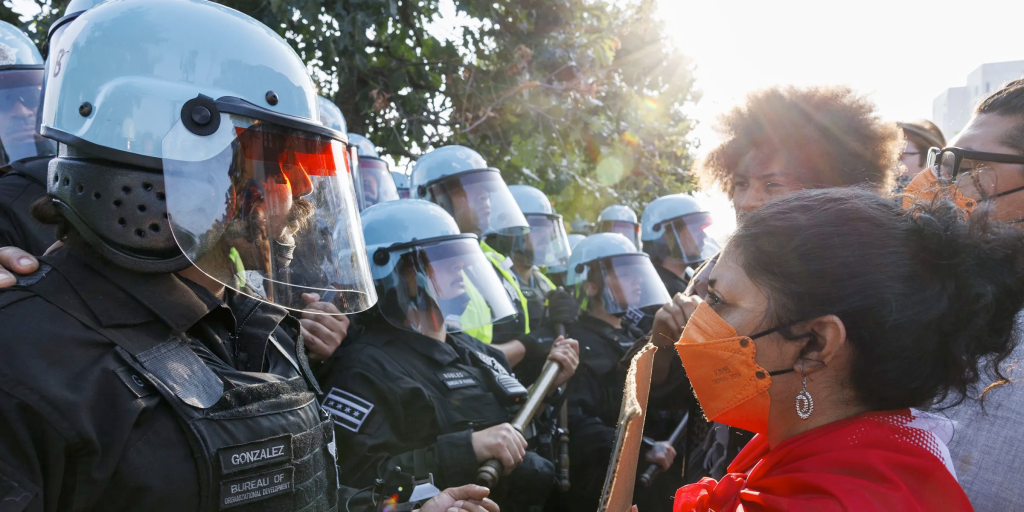
The mass arrests occurred at a protest outside the Israeli consulate. Earlier arrests left protesters hospitalized and without access to lawyers.
More Than 70 DNC Protesters Arrested, Including Several Journalists
The mass arrests occurred at a protest outside the Israeli consulate. Earlier arrests left protesters hospitalized and without access to lawyers.
More Than 70 DNC Protesters Arrested, Including Several Journalists
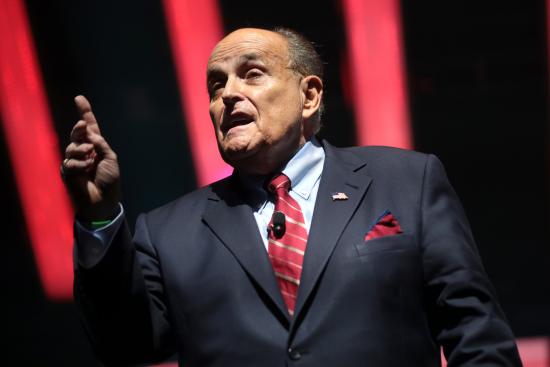
Voices of America in recent times. First there was Trump then Giuliani and along came George Santos
Source: Giuliani Now Claims Witness With Evidence On Biden Has Died | Crooks and Liars

Cuba has demonstrated that it desires nothing but peace in the region, and normal relations with its neighbor, the United States. But the United States refuses to accept this proposal. Instead, it maintains the most comprehensive sanctions in history against the small island. Instead, it falsely places Cuba on the state sponsors of terrorism list, even though it is in fact a sponsor of peace. Instead, the U.S. government and its media apparatuses choose to fabricate myths and legends, painting Cuba as the evil monster under the bed. It chooses to scare the U.S. people away from the possibility that normal relations and ending the blockade against Cuba could be good for people from both countries.
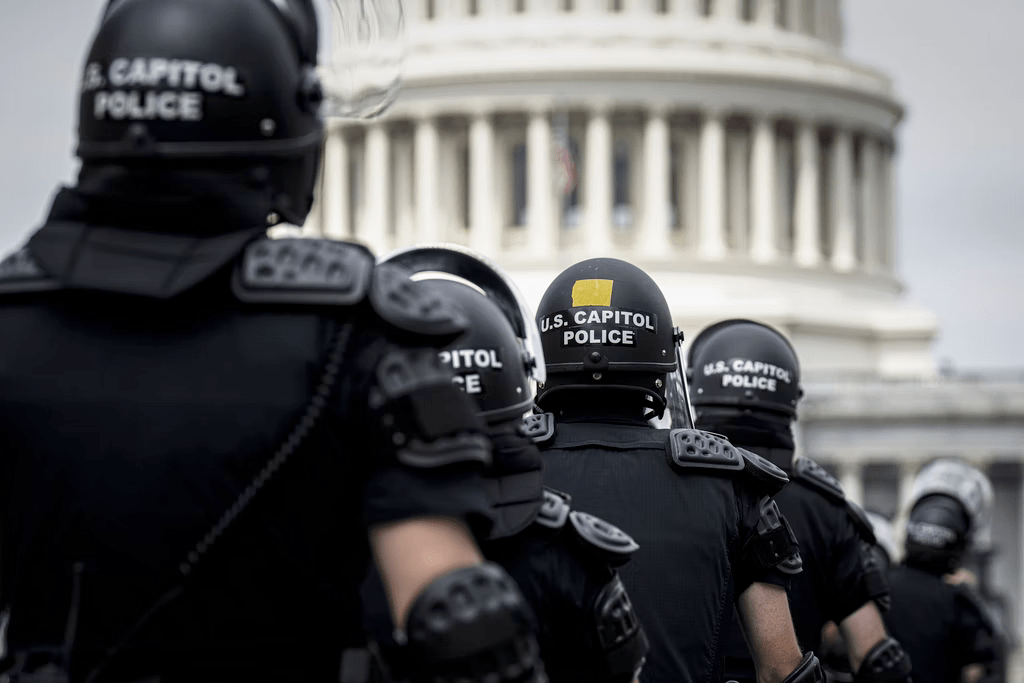
With the end of Roe v. Wade achieved, the fascist right is setting its sights on shutting down all abortion solidarity and assistance.
After Roe, Far Right Plots Fascistic Anti-Abortion Enforcement

He can be seen hereafter at the ‘command station’. He would call it that, would he not?
A very independent and highly acute observer of the provincial theatre – one who can see well through the fog – wrote to the Canberra Times on 9 August 2014:
“That foreign minister Julie Bishop would attempt to threaten Russia with further non-specific sanctions if it fails to accept responsibility for the MH17 disaster says everything about Australia’s eagerness to play cats-paw in America’s geo-political games, designed to enhance the west’s strategy of encirclement and isolation of Russia.
Never mind the fact that no-one, including America, has tabled a skerrick of evidence in support of the hysterical accusations made against Russia. Never mind credible reports suggesting that Ukrainian air force jets may have shot down the hapless airliner. Never mind the hollow pretensions of the Abbott government in claiming that it would pursue ‘truth and justice’ before pointing the finger.
And in mindlessly supporting our government’s criticism of Russia for responding in-kind to our own reckless and provocative behaviour, Opposition Leader Bill Shorten simply confirms how all sides of politics in this country are beholden to American interests and just how weak is our real capability to forge an independent foreign policy geared to support our own national interests.”
Down in thick fog.
Answers to some further questions could clear the air. For instance:
1. Is it correct that:
– on 18 July 2014, in a morning interview with a Melbourne-based radio station, hence given the difference of time only hours after the incident, Prime Minister Abbott declared that it “seems certain” that the plane was brought down by a “Russian-supplied surface-to-air missile”,
– that Mr. Abbott then proceeded to turn the political reality in Ukraine on its head, declaring: “What’s been happening for many months now is an attempt by Russia to bully a neighbour. Now this is just outrageous”,
– that, implicitly calling for massive retaliation, Mr. Abbott declared: “I don’t say there are easy responses when a large and powerful country attempts to bully a smaller and less powerful neighbour.”, and
– that in a speech to Parliament hours later, Mr. Abbott warned that: “the bullying of small countries by big ones, the trampling of justice and decency in the pursuit of national aggrandisement and reckless indifference to human life should have no place in our world”?
2. Is it correct that, following Mr. Abbott accusations of Russian “bullying of small countries”, the Labor leader Bill Shorten declared that: “the missile that brought down MH17 – and the missiles that have claimed numerous other Ukrainian aircraft – could not possibly be made by the people who possibly fired them. These separatist terrorists are obtaining these instruments of murder from elsewhere. This must be investigated – and it must be stopped”?
3. Is it correct that soon thereafter Mr. Shorten issued a blanket guarantee of Labor’s support for any government retaliatory measures against Russia. As he said: ”Labor understands the difficulty and complexity of the decisions [Abbott faces],” and “there will be many understandable calls for all sorts of action.” In particular, he indicated that Labor would support the Abbott government if it refused to allow Russian President Putin to attend the G20 summit in Brisbane this December?
4. Is it correct:
– that on 18 July 2014 the Abbott government summoned Russian ambassador Vladimir Morozov for a dressing down by Foreign Minister Julie Bishop,
– that Ms. Bishop reportedly insisted that Russia support a U.N. Security Council investigation into the crash, and demanded that Mr. Morozov answer whether Russian weapons could have been used to down the plane,
– that in a press conference following the meeting, Mr. Abbott denounced Mr. Morozov’s claim that responsibility for the crash rested with the Ukrainian regime in Kiev, and
– that Mr. Abbott warned that the events were a “test” for Russia and that its: “whole standing in the world is at risk here”?
5. Is it correct that on 19 July 2014 the Labor leader Bill Shorten repeated his call for Russia to be excluded from the G20 talks, saying to journalists: “I put on record again, if the Russian Federation doesn’t co-operate and help us get to the heart of what has really happened in this senseless act of murder, the government should indeed consider not inviting the Russian President Putin to [the G20 Summit to be had on 15 and 16 November 2014 in Brisbane,] Australia”?
6. Is it correct that, by the end of July 2014, a number of Australian policemen were stranded in a war zone with the permission of Ukraine’s president, but without the authorisation of their parliament, while Australia and most certainly its government appeared to have stumbled into a conflict about which they knew nothing and not to care to understand?
7. Is it correct:
– that on 26 July 2014 Foreign Minister Julie Bishop and her Dutch counterpart Frans Timmermans returned to Ukraine to urge the Kiev government to recall Parliament and approve the deployment of armed Australian troops to the MH17 crash site, and
– that fifty unarmed Australian Federal Police officers and forty of their Dutch counterparts had left the Netherlands for Ukraine the day before, but under Ukraine’s constitution no armed forces can enter the country without Parliament’s approval?
8. Is it correct that on 26 July Prime Minister Abbott tried to separate the downing of MH17 from the conflict itself. On that day, when asked at a press conference whether Australia would join the European Union in rumoured new sanctions, he replied: “There are two separate issues here: there’s the issue of the geopolitics of Eastern Europe – and people have their opinions on that and some countries are taking action on that – and there’s the issue of Operation Bring Them Home and my whole and sole focus is on Operation Bring Them Home”?
9. Is it correct that, after Prime Minister Abbott announced a national day of mourning to be held in the near future, and ordered all government flags to be flown at half-mast on 19 July 2014, the choice of venue fell on St Mary’s Catholic Cathedral in Sydney, St Patrick’s Cathedral in Melbourne St Mary’s Cathedral in Perth, as if they were the only places for a ‘national day of mourning’ which should be had at a public place, a non-denominational place, but in the case was insensitively forced in Catholic places of worship, with a sovereign abuse of the memory of those who were not, their families and more specifically of the many 44 Malaysian victims and their families?
10. Is it correct that Australia found itself in the extraordinary situation of having moved Resolution 2166 before the United Nations Security Council, while Ukraine was in breach of the very provision: “that all military activities, including by armed groups, be immediately ceased in the immediate area surrounding the crash site to allow for security and safety of the international investigation”?
And there is more: who, whether on the Australian or Ukrainian side, advised the Foreign Minister that the deployment of unarmed Australian policemen to eastern Ukraine’s war zone would, in fact, be possible?
What advice did the Minister receive about the fragility of the government in Kiev?
Why, during her visit on Friday 25 July, did the Minister not obtain from President Poroshenko a guarantee not to resume the offensive around the crash site?
Did she know, or suspect, that Poroshenko would order the resumption of a campaign that would contravene the very Security Council resolution she had just triumphantly engineered in New York?
Whatever the answer to those questions, the success of two Australian initiatives – the Security Council 2166 and the Australian Federal Police’s grandiosely titled Operation bring them home – now ride on political and geopolitical considerations that go to the heart of the crisis: the mixed cultural and linguistic composition of Ukraine; and the unresolved geopolitical consequences of the Soviet Union’s collapse, above all the eastward expansion of N.A.T.O. and the E.U. at the expense of Russian interests in Eastern Europe.
Operation bring them home has played well in the commercial media. But it is now manifestly putting lives on the line.
It is worth pointing out that this is not, in fact, an Australian-led mission. It is being led by the Netherlands, under the auspices of the Organisation for Security and Cooperation in Europe. But the O.S.C.E. is itself deeply involved in the current crisis. It will in time be a party to crisis talks in Belarus, brokered between Russia’s ambassador to Kiev, Mikhail Zurabov, and former Ukrainian president Leonid Kuchma.
At no point in the current Operation has anyone in the Australian government stopped to explain the relevance of the MH17 crash site to Australia’s broader national interests. Bringing back the bodies of Australian victims is politically attractive for a government which badly needs some positive media coverage. But is it actually in the best interests of Australia? And is it worth risking the lives of Australian police officers?
The Abbott Government is overly fond of the language of the military, as its ‘Boy’s own’ penchant for calling activities ‘Operations’ confirms. The feeling of macho goes with it. Even the sole woman is much of a he man in the mist.
There is still afloat an Operation for MH370 – the Malaysian airplane ‘lost’ on 8 March 2014 and believed to be somewhere in Indian Ocean; a three-star general is in charge of the Operation ‘Stopping the boats’ of asylum seekers and sending them to Australian concentration camps, and a former Air Chief Marshal, Angus Houston is in charge of Operation bring them home.
‘Does Abbott have a military-first instinct ?’ asked a lead column of Murdoch’s The Australian on Sam Roggeveen 13 August 2014.
In the early days of the MH17 crisis Prime Minister Abbott wanted to put 1,000 Australian troops onto the crash site in conjunction with 1,000 Dutch troops. Nothing better testifies to his outrage at the event and his keenness to deploy Australian assets in a cause that affected Australians. This option remained on the table for a few days.
It was never going to be viable. Yet debate around this idea continued before Prime Minister Abbott was talked around and decided it was too dangerous and inappropriate an option. Putting Australian troops into that highly charged situation would have been far too risky.
However, it offers insights into Mr. Abbott’s approach to military issues: he is impatient with limitations relating to logistics and deployment. When Australians are involved Abbott wants to make a difference as soon as possible.
“Abbott’s every instinct – wrote The Australian – is to deploy Australian military and police assets and he needs to be persuaded by his advisers from such options.” He might have added that, on MH370 and Operation Sovereign Borders as well, Mr. Abbott also chose to get the military involved.
More Reading:
The downing of Malaysia Airlines MH17 (as observed from Australia) – Part 1
The downing of Malaysia Airlines MH17 – Part 2: An avalanche of inconvenient questions
The downing of Malaysia Airlines MH17 – Part 3: Who was behind the MH17 downing?
The downing of Malaysia Airlines MH17 – Part 4: Cui prodest? Huh . . . it is the oil, men!
 olddogthoughts
You must be logged in to post a comment.