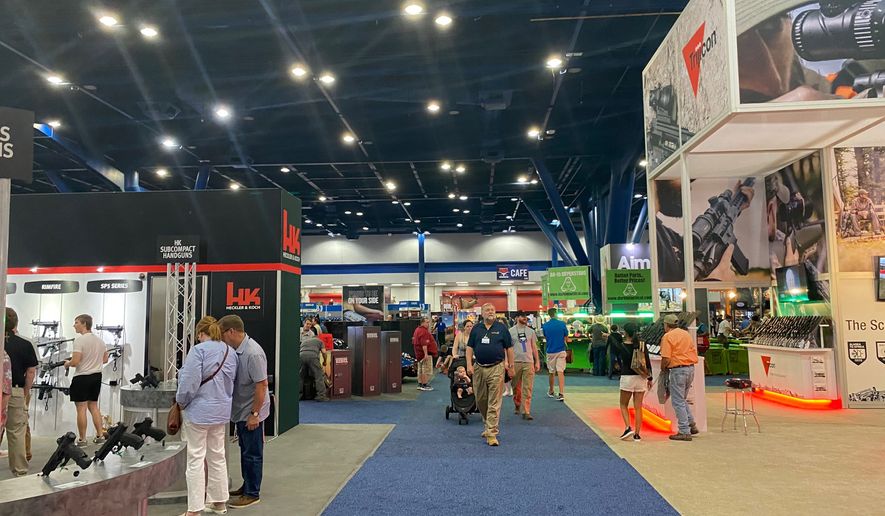
The National Rifle Association annual meeting over the holiday weekend drew a smaller-than-expected crowd, according to attendees and exhibitors, adding to the sense that the preeminent gun lobby was on the ropes.
The National Rifle Association annual meeting over the holiday weekend drew a smaller-than-expected crowd, according to attendees and exhibitors, adding to the sense that the preeminent gun lobby was on the ropes.

“The NRA has not commented — we have a longstanding policy of not commenting on ongoing investigations,” Amy Hunter, an NRA spokesperson, told The Intercept. In late 2012, after the massacre of 20 children and six adults at Sandy Hook Elementary School in Newtown, Connecticut, the NRA was faced with a strategic choice: Recognize that lax gun laws had gone too far and find some reasonable compromise, or dig in. The NRA decided to make its stand, blaming mental health care and video games for the shooting. “The only way to stop a bad guy with a gun is with a good guy with a gun,” NRA CEO Wayne LaPierre famously said. Who the NRA decides to stand up for — whose life matters, and whose doesn’t — lets us know what LaPierre meant by good.
Source: NRA Silent as Amir Locke Slain by Police for Having a Gun He Legally Owned

Pro-gun media outlets and figures have been silent after the recent release of old footage from National Rifle Association Executive Vice President Wayne LaPierre’s botched elephant hunt, during which he shot an animal four times before managing to kill it.
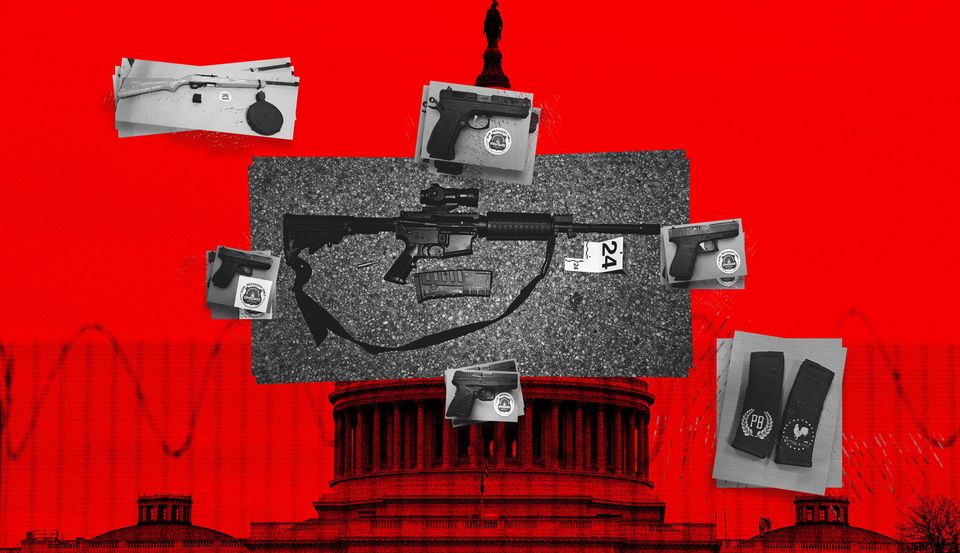
Nine supporters of former President Donald Trump, all arrested on weapons charges in connection with the storming of the U.S. Capitol, had “enough ammunition to shoot every member of the House and Senate five times,” according to a startling new report on the role of firearms in the Jan. 6 insurrection.
How The NRA Helped Foment An Armed Insurrection At The Capitol | HuffPost Australia
The Trumpster handbook is the NRA Trump isn’t original he is a reflection of his voters (ODT)
In the aftermath of Saturday’s mass shooting in El Paso, Texas, President Donald Trump has been widely criticized for spreading hateful anti-immigrant hysteria. The blame is well earned, but Trump is not alone. For years, the National Rifle Association has pushed the false narrative that law-abiding Americans are in danger from an invasion of violent foreigners crossing into the country from Mexico. The only way to protect yourself and your family, the gun lobby warns, is to stock up on weapons and take responsibility for your own safety.
The National Rifle Association on Monday named as its next president retired US Marine Colonel Oliver North, a conservative commentator best known for his central role in the 1980s Iran-Contra affair.
via NRA names Oliver North, known for Reagan-era scandal, as president
The head of the National Rifle Association (NRA) has lashed out at gun control advocates, saying Democratic elites are politicising the latest mass school shooting in the United States to try to erode constitutionally guaranteed gun rights.
“Their goal is to eliminate the Second Amendment [of the constitution] and our firearms freedoms so they can eradicate all individual freedoms.”
Freedom to shoot (OD)
The NRA’s Twitter account has been silent since the mass shooting in Las Vegas – part of a strategy to defer discussion and wait for the news cycle to move on
Source: Delay, delay, delay: how the NRA handles a crisis | US news | The Guardian

United States President Donald Trump has called the gunman who killed 59 people and wounded more than 500 others at a music festival in Las Vegas a “very, very sick individual” and said gun laws would be discussed “as time goes by”.

The gun group’s board of directors includes Ted Nugent, Tom Selleck, and Oliver North.
Source: These Are the People Who Really Run the NRA | Mother Jones

Yesterday, the New York Daily News put up a controversial cover that I thought was pretty good. Today, they are out with another cover that, I’ve got to say, is a bit much for me. It calls the alleged perpetrator of Wednesday’s massacre, Syed Farook, a terrorist (accurate!) and Robert Dear, Dylan Roof, Adam Lanza, and James Holmes terrorists (also accurate depending on your specific definition!), but then in the right hand corner it labels Wayne LaPierre, the head of the National Rifle Association, a terrorist.
Now, look, I’m not fan of the NRA, but they’re not a terrorist organization and I don’t think that term should be bandied about all willy-nilly. From 2001 to 2003, this shit happened all the time. Terrorists! Terrorists! Terrorist! Terrorists! It is not helpful. It stirs frenzy and panic in a population of people primed for frenzy and panic. We should use that term when it really makes sense, not just for political groups we disagree with.
But, on the other hand, just today Senate Republicans at the NRA’s behest voted to kill a law that would make it harder for terrorists, felons, and mentally ill people to buy guns. It’s also worth noting that most gun owners don’t even support the NRA’s radical agenda. So it’s not like I’m saying the NRA is a bunch of peachy keen cats deserving of sainthood or anything.
Relatedly, my colleague Julia Laurie spoke to a number of national news organizations about how and when they decide to call a “killer” a “terrorist.” Give it a read. Fascinating stuff.

The NRA has the noose pulled tight.
Source: Senate Republicans Vote To Let Terrorists Buy More Guns | Crooks and Liars

Details are still scare, but conservatives are flooding Twitter with racism, NRA talking points and even jokes VIDEO

US President Barack Obama on Thursday angrily called for stricter gun laws after the latest mass murder in Oregon and took aim at the powerful National Rifle Association gun lobby for blocking reform.
Source: Barack Obama says US gun laws must be changed, praises Australia again

In the United States, most people diagnosed with mental illness are allowed to buy guns. While state laws vary, federal law prohibits only those who have been committed to a psychiatric hospital or adjudicated as “mental defectives” from owning firearms.
But researchers at Duke University suspect that the law is ignoring a group of Americans who could make for potentially dangerous gun owners: people with a history of angry, impulsive outbursts. In a study published this month in the peer-reviewed journal Behavioral Sciences and the Law, the Duke team looked at more than 5,500 interviews conducted in a landmark survey of mental illness by Harvard researchers. From the interviews, they extrapolated that 1 in 10 adults in the United States has an anger management problem—and access to firearms.
One caveat: While it makes intuitive sense that angry people and guns would be a volatile combination, it’s important to note that there is no data yet on whether people with anger problems are more likely to commit violent crimes. Still, lead author Jeffrey Swanson believes that the finding is worrisome. “Probably the strongest predictor of violence is previous violent behavior,” says Swanson, a professor in psychiatry and behavioral sciences at Duke Medicine.
Swanson points to the recent shootings of three students near the University of North Carolina-Chapel Hill. The alleged shooter, Craig Stephen Hicks, had a history of threatening behavior. “People who knew him said that he was very angry; they were scared of him,” says Swanson.
And yet, in most states, even people who have committed violent misdemeanors or have had restraining orders issued against them for domestic violence are allowed to own guns.
Meanwhile, people with the types of severe psychiatric problems that lead to involuntary commitment, like schizophrenia and bipolar disorder, commit just 4 percent of violent crimes in the United States. Most people with those acute conditions are not prone to violence.
However, Swanson doesn’t believe that isolated incidents of anger should prevent people from buying guns—everyone gets angry once in a while. But “the group that we focus on goes far beyond regular anger,” he says. “These individuals are off on the extreme.” They often get into physical fights and break or smash things when they become upset.
Some states have tried to address the problem with laws that allow police to temporarily seize weapons from people whom a court deems immediately dangerous based on testimony from those who know the individual and his or her behavior. Currently, just three states—California, Connecticut, and Indiana—have versions of these laws.
In most places, a history of violence isn’t enough to make authorities think twice about whether an individual should be allowed to own a gun. “The way the law is set up now, it’s missing a lot,” says Swanson. “The most volatile people are slipping through the cracks.”


 olddogthoughts