 Politics, competition, influence and power fuel the current sectarian tensions between Shia and Sunni Muslims, the two main branches of Islam. The root of the hostil
Source: Shia and Sunni Muslims – do you know the difference? – Your Middle East
Politics, competition, influence and power fuel the current sectarian tensions between Shia and Sunni Muslims, the two main branches of Islam. The root of the hostil
Source: Shia and Sunni Muslims – do you know the difference? – Your Middle East
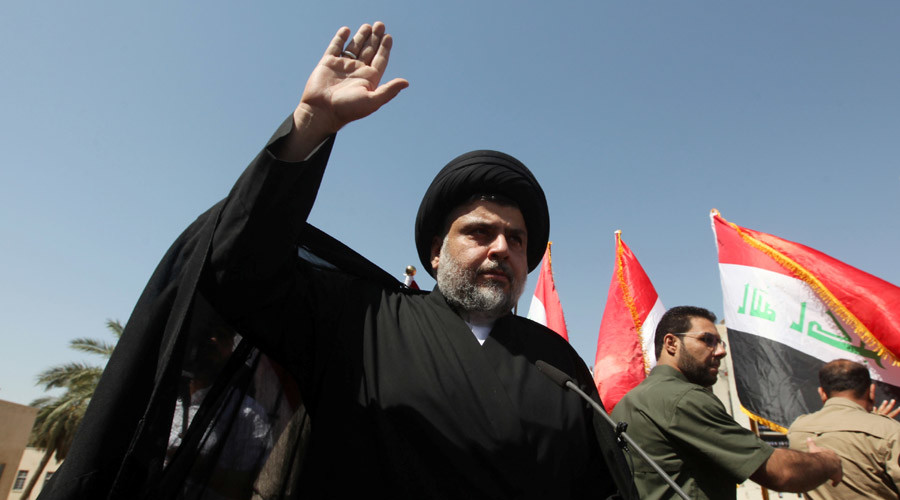
Shiite Muslim cleric Moqtada al-Sadr has called on his followers to “target” the new US troops that are about to be sent to Iraq to fight Islamic State. The statement comes after US Defense Secretary Ash Carter announced the deployment of 560 more troops.
Source: US troops in Iraq now ‘target’ for Shiite militia, influential cleric preaches — RT News

The rise of the Houthi movement in Yemen, the militias of Iraq, Hezbollah in Lebanon and even the Syrian Arab Army of Bashar al-Assad are being configured by many analysts as evidence of a wide-ranging Iranian Shiite incursion into the Middle East. The Saudi bombing campaign in Yemen, Israel’s recent bombing of Hezbollah bases in southern Syria, and Gulf Cooperation Council unease about Iraq’s Tikrit campaign are all a result of this theory of “the Shiite Crescent,” a phrase coined by King Abdallah II of Jordan. But is Iran really the aggressor state here, and are developments on the ground in the Middle East really being plotted out or impelled from Tehran?
It is an old fallacy to interpret local politics through the lens of geopolitics, and it is a way of thinking among foreign policy elites that has led to unnecessary conflicts and even wars. Polarized analysis is only good for the military-industrial complex. The United States invaded Lebanon in 1958, ostensibly on the grounds that Druse shepherds protesting the government of Camille Chamoun were Communist agents. A retired State Department official once confessed to me that many in Washington were sure that the overthrow of the Shah of Iran in 1979 by Ayatollah Khomeini was planned out in Moscow. On the other hand, I met a Soviet diplomat at a conference in Washington, DC, in 1981 who confessed to me that his country simply could not understand the Islamic Republic of Iran and was convinced that the CIA must be behind it. I would argue that Israel’s Benjamin Netanyahu and many Saudi and Gulf analysts have fallen victim to this “geopolitics fallacy.”
Iraqi Shiite militias can’t be read off as Iranian instruments. The Peace Brigades (formerly Mahdi Army) of Muqtada al-Sadr are mostly made up of Arab slum youth who are often suspicious of foreign, Persian influences. They became militant and were made slum-dwellers as a result of US and UN sanctions in the 1990s that destroyed the Iraqi middle classes and then of the US occupation after 2003. The ruling Dawa Party of Iraqi Prime Minister Haider al-Abadi does not accept Iran’s theory of clerical rule, and in the 1980s and ’90s many Dawa Party stalwarts chose to live in exile in London or Damascus rather than accept Iranian suzerainty. At the moment, Iraq’s Shiite parties and militias have been thrown into Iran’s arms by the rise of ISIL, which massacres Shiites. But the alliance is one of convenience and can’t just be read off from common Shiism.
Lebanon’s Hezbollah is strongly aligned with Iran. But it was formed around 1984 under the tutelage of the Iraqi Dawa Party in exile, and its main project was ending the Israeli occupation of 10 percent of Lebanon’s territory, which began in 1982. Its rival, the Amal Party, was more middle-class and less connected to Iran, even though it was also made up of Shiites. Exit polling suggests that some half of voters who vote for Hezbollah among Lebanese Shiites are nonreligious; they are supporting it for nationalist reasons and seeking self-defense against Israeli incursions. Lebanon is a country of only 4 million, and the Twelver Shiites are only about a third of the population, some 1.3 million, most of whom are children. The way in which Hezbollah has been built up in the Western imagination as a major force is a little bizarre, given that they have only a few thousand fighters. At the moment, they have a strong alliance with Lebanese Christians and Druze because all three generally support the government of Bashar al-Assad in neighboring Syria. But Lebanese politics are kaleidoscopic, and that political dominance could change abruptly. Lebanese Shiites are no more cat’s paws of Iran than are Lebanese Christians, many of them now allied with the Shiites and Alawites as well.
In the case of Syria, the Baath regime of Assad is a coalition of Alawite Shiites, secular Sunnis, Christians and other religious minorities. It has no ideological affinity with Iran’s right-wing theocracy. Even religious Alawites bear little resemblance to Iranian Twelver Shiites, having no mosques or ayatollahs and holding gnostic beliefs viewed as heretical in Tehran. But the question is moot, since those high in the regime are secular-minded. Iran has sent trainers and strategists to help Damascus against hard-line Salafi Sunni rebels, and is accused of rounding up some Afghan and other mercenaries for Damascus. Syria’s geopolitical alliance with Iran came about because of Syria’s isolation in the Arab world and need for an ally against nearby threats from Israel, Iraq and Saudi Arabia.
In neither Iraq nor Syria has Iran invaded or even sent infantry, rather supplying some special operations forces in aid of local Iraqi and Syrian initiatives, at government request. In both countries, Iran has Sunni clients as well as Shiite ones. In both countries, local forces reached out to Iran for patronage in the face of local challenges, not the other way around.
In Yemen, as well, the Zaydi Shiites, about a third of the population, bear no resemblance to Iran’s Twelvers. It is like assuming that Scottish Presbyterians will always support Southern Baptists because both are forms of Protestantism. The rise of the Houthi movement among Yemeni Zaydis involved a rural, tribal revolt against an authoritarian nationalist government and against the attempts by Saudi Arabia to proselytize Zaydis and make them into hard-line Sunnis, called Salafis. The Houthi family led a militant counter-reformation in favor of renewed Zaydi identity. Since the nationalist government of deposed president for life Ali Abdullah Saleh got crucial foreign aid from the Saudis, he gave the Saudis carte blanche to influence Yemeni religious culture in the direction of an intolerant form of Sunnism. The nationalist government also neglected the Zaydi Saada region in the north with regard to services and development projects. Yemeni tribes in any case do not necessarily foreground religion when making alliances; many Sunni tribes have joined the Houthis politically. While Netanyahu and the Saudis, along with deposed president number-two Abdu Rabbu Mansour Hadi, accuse Iran of fomenting the Houthis, they are a local movement with local roots, and there is no reason to think that that their successes owe anything to Iran. Indeed, most of their success since last summer apparently derives from a decision by former president Saleh to ally with them and direct elements of the Yemeni army to support them or stand down in the face of their advances. To turn around and blame these developments on distant Iran is absurd.
The motley crew of heterodox forms of Shiite Islam, Arab socialist nationalists of the old school, rural tribal good ol’ boys and slum-dwelling youth that are shaking the Middle East status quo are not evidences of Iranian influence, or, in Netanyahu’s words, “conquest.” In each case, these local forces have reached out to Iran for patronage, and perhaps there was some broad, vague, Shiite soft power involved. As noted, however, Iran also has many Sunni clients, from the Iraqi Kurds to Hamas in Gaza.
From the 1970s forward, the Egyptian nationalist regime under Anwar El Sadat turned conservative and allied with the United States and Saudi Arabia, promoting political Islam culturally and unregulated markets economically. Thereafter, a status quo prevailed in the Arab world of nationalist presidents for life and monarchs and emirs, most of them US clients and amenable to neoliberal economic policies stressing the market and distributing wealth upward from the working classes. Either explicitly or implicitly, they gave up opposition to Israeli expansionism. They crushed formerly powerful socialist, Communist and labor movements, and used oil money to bribe the public into quiescence or deployed secret police to torture them into going along. That status quo was latently Sunni, in that most elites were drawn from that branch of Islam, including the president of Iraq and the prime minister of Lebanon—neither of which are Sunni-majority societies.
Please support our journalism. Get a digital subscription for just $9.50!
In the past decade, that cozy order has broken down, in part at the hands of a new generation of Arab millennials unwilling to put up with it, but also at the hands of working-class grassroots movements. It also broke down internally. On the one hand, the nationalists in the Arab world are increasingly suspicious of the Saudi fondness for promoting Salafi fundamentalism. Thus, the Algerian and Egyptian officers are not as enthusiastic about the rebellion in Syria as are the sheikhs. And even the Americans, big champions of anti-Communist fundamentalism from Eisenhower to Reagan, have now drawn a line at Al Qaeda and ISIL, finding even Iran preferable. On the other hand, disadvantaged insurgents have risen up from below. The most important thing about these challengers is probably not that many have a Shiite coloration but that they reject the condominium of the Egyptian officer corps and the Saudi monarchs, with their American security umbrella, their free-market policies and their complaisance toward Israeli militarism (though, not all the pro-Iran movements have all of these concerns—Syria went neoliberal in the past two decades, for example). Iran is being entrepreneurial in supporting these insurgents against the prevailing order. It hasn’t conquered anything. If it has become more influential, that is an indictment of the old Sadat status quo.

With Islamic State militants just kilometres from the country’s western border, and increasingly radical anti-Shia militants to the east in Pakistan, Gareth Smyth examines Iran’s Sunni problem
Nearly ten years ago, a story circulating in Tehran had Mohammad Khatami say of Mahmoud Ahmadinejad, his successor as president, “No matter how extreme you are, you will always be in a queue behind Ousama [bin Laden].”
This may well have been an urban folk tale, but it highlighted a fear that Ahmadinejad’s assertive Shi’ism was not in Iran’s best interests. Rather than spread Iranian influence, unleash a revolution of the world’s dispossessed, or liberate Jerusalem from the Israelis, Iranian radicalism carried the danger of a backlash from Sunnis Muslims, who are around 80% of the world’s 1.6 billion Muslims, while Shia are 10-15% and a majority in only Iran, Iraq, Azerbaijan and Bahrain.
Is that nightmare now becoming real? Today the Islamic State (Isis), which regards Shia as infidels and has killed thousands, is barely kilometres from the Iranian border in Iraq’s Diyala province. But if the rapid rise of Isis to the west has alarmed the Iranian public, there are also developments to its east.
Several Pakistan Taliban commanders have declared their loyalty to Isis, including former spokesman Shahidullah Shahid. There are reports of Isis establishing an affiliate, Ansar-ul Daulat-e Islamia fil Pakistan, and luring recruits from two Sunni militant groups, Lashkar-e Jhangvi and Ahl-e Sunnat Wai Jamat.
For 30 years, Pakistan has been a centre of a brand of Sunni extremism, related to Saudi Wahhabism, that considers Shia apostates. Violence against Shia has killed thousands in recent years. In Baluchistan, neighbouring Iran, eight Shia were taken from a bus in October and gunned down in Quetta, the provincial capital.
A Human Rights Watch report in June highlighted a litany of atrocities against Shia, especially against ethnic Hazara in Baluchistan province, that have killed many hundreds in recent years, including two bombings in Quetta in 2013 in which at least 180 died.
Pakistani Baluch army recruits take part in a training exercise in Quetta in 2010.
Facebook
Twitter
Pinterest
Pakistani Baluch army recruits take part in a training exercise in Quetta in 2010. Photograph: Aamir Qureshi/AFP/Getty Images
It is not easy for Iran to isolate its own territory. Around 10 million Baluchis straddle Iran’s Sistan-Baluchistan and Pakistan’s Baluchistan, both poor provinces with widespread drug smuggling.
Advertisement
Last year Iran executed 16 members of Jundallah, which had carried attacks on Iranian security forces, mixing Baluchi nationalism with al-Qaeda style practices including beheadings, and declared its insurrection over.
But a new group, Jaish al-Adl, appeared and in February captured five border guards, provoking a drawn-out crisis that provoked major social media activity among alarmed Iranians before mediation by the main Sunni leader in Sistan-Baluchistan, Abdul-Hamid Esmaeel-Zehi, secured the release of four.
Iran fears both that the United States and Saudi Arabia have encouraged Jundallah, alleging when it captured and hanged its 27-year-old leader Abdul-Malik Rigi in 2010 that he had visited the US air base in Bagram, Afghanistan, shortly before his capture. The New York Times has recently offered new evidence of US intelligence involvement with the group.
Iran is also aware of collusion between sections of Pakistani security – especially Inter-Services Intelligence (ISI) – with militant Sunni groups, which goes back at least to both Saudi and Pakistani intelligence fuelling jihad against Russia in Afghanistan in the 1980s.
Hence the limits of last year’s bilateral agreement with Pakistan to co-operate against crime and security threats were exposed by several weeks of recent border tensions. In October, Tehran warned Pakistan after militants killed at least four Iranian soldiers or border guards, and then reportedly crossed the border (17 October) and, according to Pakistan, killed one and wounded three border guards. This culminated, a few days later, with the two sides’ armed forces exchanging mortar fire and the dispatch of a deputy Iranian foreign minister for urgent talks.
Pakistani officials have denied Iran’s claims that insurgents use Pakistan as a base, with some arguing unrest has its origins in legitimate Baluchi resentment. With support growing for Isis, this is no time to be “soft” on Shia Iran.
But for Iran, the Baluchi make a Sunni-Shia conflict domestic. Inside Iran, Sunnis are around 10% of the country’s 78 million people and are mainly ethnic Baluchi or Kurds. Extreme Sunni militancy has made far less headway among the Kurds than among the Baluchi, partly due to the influence of Sufism and the strength of pre-Islamic Kurdish culture, but a growth in Kurdish nationalism caused by both Syrian and Iraqi Kurds fighting Isis has its own implications for Iran’s 8 million Kurds.
But in any case, all Iran’s Sunnis allege discrimination in government employment and investment, and begrudge the absence of a Sunni mosque in Tehran and the common naming of buildings and streets in Sunni provinces after Shia leaders.
President Hassan Rouhani has promised to address the grievances of both ethnic and religious minorities. In last year’s presidential election, he did better in Kordistan province (which is not all of the mainly Kurdish region) with 71% and Sistan-Baluchestan (of which Sistan is mainly Shia) with 73% compared to 51% nationally. But delivery is far from easy, as Mohammad Khatami found when he made similar promises.
While there is political opposition to reform both among Shia clerics and the political class, Iranian security favours “strategic depth”, whereby border provinces are heavily militarised to create a buffer, an approach that can fuel resentment as much as improve security.
In terms of politics, Iranian leaders have been at pains to deny there is a regional battle between Shia and Sunnis and to argue that Sunni militants should be distinguished from the wider Sunni community. Ayatollah Ali Khamenei, the supreme leader, has called several times in recent months for Muslim unity. He told Iranian hajj officials in late October that the “ummah shouldn’t practise hostility towards each other, but should support each other over important global issues”.
But does at least some hostility towards Shia – and therefore rise of militant Sunni groups – stem from the behaviour of Iran and its allies?
An Iranian Revolutionary Guard covers his chest with a portrait of Lebanon’s Hezbollah leader Hassan Nasrallah.
Facebook
Twitter
Pinterest
An Iranian Revolutionary Guard covers his chest with a portrait of Lebanon’s Hezbollah leader Hassan Nasrallah. Photograph: Behrouz Mehri/AFP/Getty Images
The 2003 US-led invasion of Iraq unnerved the Sunni-led states, especially Saudi Arabia, by creating a new, Shia-led order in Baghdad that Iran welcomed. In 2008, Hezbollah’s military assertion in west Beirut, in response to a Sunni-led government challenging its security role at the airport, alienated “moderate Sunnis”. Above all, by 2012 the Syrian war appeared clearly sectarian as an Iranian-backed, Allawi-led regime confronted mainly Sunni rebels.
Since Isis took Mosul in June, Iran’s approach in Iraq has been rooted in Shia solidarity. Nouri al-Maliki, Iraqi vice-president and as former prime minister widely blamed for alienating Iraq’s Sunnis, was recently in Iran to improve what he called “mutual co-operation” against “Takfiri terrorists”. Shia militia leaders in Iraq have been quoted extolling the role of Qassem Soleimani, the head of the al-Quds section of Iran’s Revolutionary Guards, to the extent of leading a front-line operation in the recapture of Jurf al-Sakher from Isis, shunning a flak jacket in the process.
Human Rights Watch has documented abuses both by mainly Iraqi Shia government forces and by Shia militias (it has described the two as “indistinguishable”). After the killing of 34 civilians in a mosque in Diyala province in August, Joe Stork, HRW regional director noted: “Iraqi authorities and Iraq’s allies alike have ignored this horrific attack and then they wonder why the militant group Islamic State has had such appeal among Sunni communities.”
Posted
 As Australia battles violent extremism, perhaps we should ask Indonesia what is the best thing to do.
Our focus on joining the war in the Middle East has effectively derailed the so-called pivot or rebalance to Asia. We should be focussed more on our own immediate region, writes John Blaxland.
This was supposed to be the Asian century. but the Middle East’s shenanigans were like a red rag to a bull.
After the 200,000 or so estimated deaths in Syria in the last few years of conflict failed to crystallise a response, all it took was two American journalists and a British aid worker to be beheaded for the West, led by the US, to be goaded back into the fray.
And to what end?
With the Sunni heartland captured, there was little impetus for them to press far into Shia and Kurdish territory. There’s also considerable local resistance as they are not welcome there by Iraq’s Shia and Kurds, let alone among the concerned neighbouring states.
Defeating them in detail is virtually impossible. They remain well ensconced in Syria and happily blend in among the local population in the cities and towns where aerial precision targeting is of limited utility and generates considerable negative repercussions. Actions in Syria also are likely to earn the wrath of an aggressive Russian administration under Vladimir Putin. Have we thought that through? I think not. Then what do we do?
Support for the US alliance is an enduring priority and one that continues to receive widespread support across the community in Australia. But how much is enough? Are we not better suited at focusing on regional engagement in Australia’s neighbourhood? The Us thought so.
Australia has been surprisingly front-footed about offering to participate in the US-led coalition far from Australia’s shores, citing domestic concerns as a primary motivator for seeking to extinguish the flames of extremism in Iraq. Yet it was in Indonesia, in Bali and Jakarta, where Islamist extremism has most directly affected Australians not in Australia.
As Australia seeks to deal a blow to violent extremism, perhaps it is appropriate that we ask what Malaysia and Indonesia think is the best thing to do. Perhaps, as modern democracies with a predominantly moderate Muslim electoral base, they might have some pointers for us Mr Abbott. Whether our actions are helping or hindering the cause. Our efforts in the Middle East can be expected to have significant knock-on consequences in South-East Asia as well.The focus on Iraq appears to have effectively derailed the so-called US pivot or rebalance to Asia. Shouldn’t this concern our Australian policymakers, countries, shouldn’t we remain focused on regional security concerns, while America is distracted once again by the Middle East.
Instead Australia has appeared equally willing to abandon the pivot. throwing its weight and its policy efforts into the Middle East rather than its own immediate region.
A significant rethink of policy positions is in order as it is not the disengagement from the Middle East and beyond that we had been told was to be expected.
We should return to Prime Minster Tony Abbott’s advice way back when he was spouting “more Jakarta and less Geneva”, or anywhere else for that matter. Malcolm Fraser is so right that he is the most dangerous PM we have seen.
Updated
To defeat the Islamic State, the United States needs to overcome not only its own split strategic thinking in the region, but also secure the support of Sunnis inside and outside Iraq and Syria. Stuart Rollo writes.
The long-term success of confronting the Islamic State hinges is securing the cooperation of Sunnis, both within Iraq and Syria, and in governments across the Middle-East. Given that G.W Bush killed 60,000 and assisted in killing some 60,000 plus more it seems like a nigh on impossible task. How do you forgive and forget?
It will need to overcome not only its own split strategic thinking in the region, but also secure the support of its Sunni Arab allies in the Gulf States in a campaign with the essential aim of destroying the main Sunni resistance movement to two widely unpopular Shia governments, which act as proxy states of Iran.
The Islamic State’s success is due not to the appeal of its dogma, but to the local struggles between ruling Shia governments in Iraq and Syria and their disenfranchised Sunni populations.
While the ideological foundations of the Islamic State consist of a Sunni brand of fundamentalist pan-Islamism, the group’s success is due not to the appeal of its dogma, but has been the result of local struggles between ruling Shia governments in Iraq and Syria and their disenfranchised Sunni populations. Those struggles are heavily influenced by the geopolitical maneuverings of their respective Sunni and Shia patrons in the Gulf States, especially Saudi Arabia, and Iran.
Rising to prominence as “Al Qaeda in Iraq” in the immediate aftermath of the 2003 US invasion, the group weathered various political and military oscillations there, and were particularly damaged by the US-backed “Sunni Awakening” of 2006, before the 2011 Syrian uprisings provided them with unprecedented opportunity to expand and consolidate their power.
The United States maintains its stance on the illegitimacy of the Assad regime, while the Islamic State has positioned itself as the prime power in the Syrian opposition movement. The United States maintains its support for the Shiia-led government of Iraq, while the Sunni regions, long-backed by America’s closest Arab allies in the Gulf, are in open revolt, having reportedly given their support to the Islamic State. The semi-autonomous Kurdish region has declared the intention to pursue full independence, at the same time grabbing the oil rich region of Kirkuk from the ailing government in Baghdad.
The US wishes to support Kurdish military forces in their fight against the Islamic State and the system of Kurdish autonomy within Iraq more generally, yet it is a treaty ally with Turkey, a state with a long history of suppressing movements towards Kurdish independence within its own territory, and will not support the full bid for Kurdish independence. The US finds itself navigating the difficult equation of how much arms and training it can provide the Iraqi Kurds to defeat the Islamic State, while minimising the threat that such assistance could pose to the Turkish military in the future.
Perhaps the most spectacular case of contradictory strategic interests for the United States involves Iran. Long the most powerful member of the “Axis of Evil”, and the presumed target of imminent US bombardment for years, the Islamic Republic of Iran has been cast in the current conflict as America’s least likely collaborator. A united and Shia-led Iraq is in Iran’s utmost interest, as is the retention of power in Syria of the Assad regime.
The destruction of the Islamic State goes a long way towards securing both of these objectives. The more effectively the United States combats the Islamic State, the better for Iran. The more powerful and secure Iran, the less comfortable America’s regional allies including Saudi Arabia and Israel. For this reason alone the US will find it very difficult to secure genuine, long-term, cooperation from the Gulf States in confronting the Islamic State.
The ramifications of increased US military intervention will have drastic implications on the power dynamics of the region. It is doubtful that Saudi Arabia, Qatar, and other Gulf States will be enthusiastic participants in a military intervention which will empower their bitter regional rival Iran and revitalize the ailing Shia governments in Iraq and Syria that they have worked so hard to destabilize. Without their cooperation the long-term prospects for destroying the Islamic State and securing regional peace become quite bleak.

ISIS has consolidated it’s position across Syria and Iraq even eliminating opposition groups with the same goals such as the FSA in Syria. With the fog of confusion lifted the reality remains whether any rapprochement is possible with Assad and the new Iraq Government. ISIS is now calling for professionals to help consolidate their Sunni caliphate. Unlike previous rebel groups ISIS has the hallmarks of Saddam’s military invasion with it’s specific goals,targets and logistics & bringing together a growing coalition of support.
“It really is all guesswork at this stage,” said Sakhr al-Makhadhi, a British-Arab journalist and Syria analyst. “The Islamic State recently called for professionals – doctors, engineers and such – to move to its territory, so it’s clear that they view this as a long-term state building project. What this shows is that they’re lacking certain skills. They may have the manpower to fight, but not to build a state.”
It is Muslims in the Middle East who have most to worry about from the Islamic State. The decapitation of the journalist James Foley doesn’t change anything – the number of Iraqis executed by Islamic State fighters is far, far more. In a very short time the Islamic State has become the most compelling and attractive organisation for Muslim fighters around the world, more so than AL-Qaeda ever was.
For countries where Muslims are a minority like Australia paranoia has developed. The impact of this phenomenon on community relations – in Australia, Canada, India, the US, and Europe – could be devastating. Abbott for his own political advantage is calling for National Unity in the hope of restoring flagging polls. Once again, suspicions will easily be raised by Islamophobes like Andrew Bolt about Islamic State sympathisers in the west and whether they pose a threat. The news media will undoubtedly report on Australian, American or European Muslims joining the group or calling for violence in videos, further raising tensions and besmirch the Muslim faith. These very actions help recruit sympathizers amongst Australians being disparaged.
The group has prompted bomb blasts and fighting in Lebanon, and in Jordan and Kuwait the governments are worried that sleeper cells may attack at any moment. But it is Saudi Arabia that is on high alert, worried that the Islamic State group will come after them with force. In a recent interview, a senior Islamic State defector said their next stop would be Saudi Arabia, which includes Mecca and Medina. Its rulers are now in full panic, sending money to the Lebanese army, funding UN counter-terrorism efforts, and even getting senior Muftis to condemn the group. And there is reason for this panic. However for the moment their focus is firmly on the Middle East states.
The Islamic State is a direct descendant of AL-Qaeda, but there is one key difference: Its leaders believe fighting “apostates” is more important than fighting non-Muslims for now. They want to unite the Middle East under their banner before truly turning their sights on the US and Europe. In the eyes of many jihadis, the Islamic State has established the most successful and feared caliphate in recent history.
President Obama calls the Islamic State in Iraq and the Levant a “cancer.” Hassan Nasrallah, leader of Lebanon’s Hezbollah, describes ISIL as a “monster.” Sheikh Abdul Aziz al-Sheikh, Grand Mufti of Saudi Arabia, ranks al-Qaeda and ISIL, also known as ISIS, as “Enemy No. 1″ of Islam. And President Hassan Rouhani of Iran warns Muslim states to beware of “these savage terrorists,” for “tomorrow you will be targeted,” too, by ISIL.
The unanimity of hatred and fear toward the ISIL militants rampaging through Syria and Iraq is testament both to the threat they pose and to an unusual opportunity. Not since Saddam Hussein invaded Kuwait 24 years ago have the region’s most powerful players expressed such animus toward a common enemy. That’s because ISIL’s goal of replacing national boundaries in the Middle East with a Sunni Muslim caliphate threatens not just the usual “infidels”—Christians, Jews, Shiites, and other non-Sunni Muslim minorities—but the nation-states themselves.
But make no mistake: The real threat from the Islamic State is to other Muslims in the Middle East. Sooner or later people across the Middle East will have to face up to this threat.


 olddogthoughts