
Ismail al-Ghoul had become a household name for anyone following the war on Gaza. When he went to Ismail Haniyeh’s hometown to cover a commemoration of his killing, Israel assassinated him too.
Ismail al-Ghoul had become a household name for anyone following the war on Gaza. When he went to Ismail Haniyeh’s hometown to cover a commemoration of his killing, Israel assassinated him too.

Escaping Gaza has left me with mixed feelings. On the one hand, I had managed to survive a genocide that had starved and almost killed me and my family. But I was also saying goodbye to a place I had loved for my entire life. The moment we crossed into Egypt, we were destined for a life as exiles—refugees with no clear destination, searching for a place to feel at home again. Leaving behind everything we had built—every dream and ambition—was dreadful. We were forced to start a new life from scratch.
I left Gaza because I want to keep talking about it. I want to keep my home—Palestine—in my life and work. To do that, I have to stay alive, and that got harder every day in Gaza. As Palestinian journalists, we are deprived of any protection that international law or press credentials should provide. I have lost many colleagues and loved ones simply because they took on the responsibility of highlighting the struggles of their fellow Palestinians.

One can learn much about political dealmaking in New York in the late 20th century in “Without Compromise: The Brave Journalism That First Exposed Donald Trump, Rudy Giuliani, and the American Epidemic of Corruption,” a collection of Barrett’s investigative article published after his death in 2017, prefaced with essays by people who knew and worked with him.
“Without Compromise,” stands as a fitting tribute to the work Barrett did to inform the public in the city he loved. To be fair to his work the monument could perhaps be placed outside City Hall, since Barrett exposed corruption on both sides of the political spectrum, which in the New York of the ’70s and ’80s was dominated by Democrats. (Including Donald J. Trump, at that time.) But if anyone wishes to honor Wayne Barrett while sticking it to the guy who has spent his life enriching himself at the public’s expense while calling the free press “the enemy of the people,” that spot on Fifth Avenue would be perfect.
Source: The man who saw Trump coming: Wayne Barrett warned us decades ago | Salon.com

The Hill has fired Katie Halper from its morning show, Rising, for describing Israel’s policies as tantamount to apartheid. It’s a blatant act of censorship to silence a pro-Palestinian journalist.
Source: Left-Wing Journalist Katie Halper Has Been Fired for Calling Israel an Apartheid State
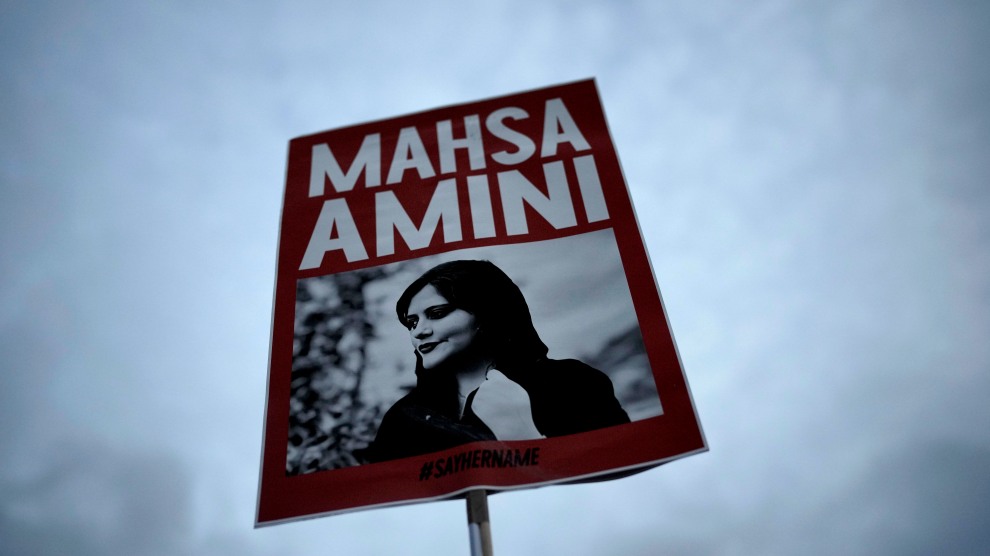
An Iranian journalist who reported on the death of Mahsa Amini has been thrown into solitary confinement, with no information about the charges against her, amid a major crackdown on the press in the country.
Let us be clear: as Australian domestic and export emissions head to 14-17 per cent of world emissions, we have a responsibility for many deaths from heatwaves, floods, storms and drought. Doctors regard Adani as a health issue and so will every other country.
Clearly, if the world is to avoid catastrophic global warming, all nations will need to share action and the recalcitrant ones will be targeted by those doing their humanitarian duty.
On being arrested, Clément said:
“That is very strange. It’s like they have something to hide, right? Because if you arrest a journalist and then you say to the journalist that he has to keep away from Adani’s sites, what’s happening on these sites?”
He may well ask the Queensland and Federal Governments what is happening. The approval processes allowing this mine are likely to become an educative international example of how not to manage the environmental, health, economic and industry needs of resource development.
For all its flaws, I love this country. If you have been born an Australian, or have become one, you have been hit by the lucky stick. But we are squandering that good fortune as surely as Steve Smith destroyed his baggy green.
Much of the mainstream media are on the same bandwagon, chiefly at Murdoch’s News Corpse, where vendetta journalism has become an art form.

From David Gregory to Andrew Ross Sorkin to David Brooks, the ranks of Washington’s hottest new club continues to swell. Call it Journalists Against Journalism — a group of reporters and pundits who are outraged that whistle-blowers and news organizations are colluding to expose illegal government surveillance. To this club, the best journalism is not the kind that challenges power or even merely sheds light on the inner workings of government; it is about protecting power and keeping the lights off.
Before today, this club could be seen as a collection of individuals. But not anymore, thanks to the hard-to-believe house editorial of the Washington Post titled “Plugging the Leaks in the Edward Snowden Case.” Inveighing against the disclosures of NSA contractor Edward Snowden, the paper wrote that “the first U.S. priority should be to prevent Mr. Snowden from leaking information” and then fretted that Snowden “is reported to have stolen many more documents, encrypted copies of which may have been given to allies such as the WikiLeaks organization.”
What’s so utterly revealing about this editorial is not merely that it reads like hard-boiled talking points given to politicians by their surveillance-industry campaign donors. No, what sets this Washington Post editorial apart — what vaults it into the annals of history — is how it is essentially railing on the Washington Post’s own source and own journalism.
Yes, that’s right, the Post was one of two news organizations that Snowden originally contacted and that subsequently began breaking the NSA stories. That means the Washington Post editorial represents the paper’s higher-ups issuing a jeremiad against their own news-generating source and, by extension, the reporters who helped bring his leak into the public sphere.
Such an unprecedented move exposes the intensity of the paper’s — and the larger establishment media’s — ideological antipathy to journalism. Simply put, the Post’s higher-ups are apparently so ideologically committed to subservience and to the national security state that they felt the need to take the extraordinary step of publicly reprimanding their own source and their own newsroom for the alleged crime of committing journalism. Indeed, their concern is not that Snowden and journalists might be muzzled, but that they might not be before they break any more news.
As overused as Watergate analogies are, one is particularly apt in this case because of the paper in question. And that analogy should be obvious: Today’s editorial is the equivalent of the paper issuing an editorial in 1972 not demanding more information from President Nixon, but instead insisting the Nixon administration’s first “priority should be to prevent Deep Throat from leaking information” and worrying that Deep Throat “is reported to have more information” that could soon be broken by Bob Woodward and Carl Bernstein.
At one level, this is all downright hilarious. But at another level, it isn’t because it potentially intensifies a larger chilling effect on investigative journalism that is happening throughout the media. After all, even though there is theoretically a divide between editorial boards and newsrooms, the former is known to speak for the decision makers at a newspaper. And here we have one of the biggest set of media decision-makers saying to reporters at the Post — and all those reporters elsewhere, who hope one day to work at the Post — that cultivating sources and working with whistle-blowers is not something that will necessarily be rewarded.
In fact, it says quite the opposite: that it won’t be rewarded, and it will more likely be frowned upon. You can bet every reporter who reads that editorial will understand that message, and many will unfortunately take it to heart.
David Sirota is a senior writer for the International Business Times


 olddogthoughts
You must be logged in to post a comment.