Tag: IMF

Egypt sells out Palestinians for $10 billion loan package – Pearls and Irritations

The border fence between Israel (Negev Desert) and Egypt (Sinai Desert)

Despite public protestations, Egyptian President Abdel Fattah el-Sisi is helping Israel transfer 1.4 million Palestinians from Rafah to tent cities in the Sinai Desert.

summarise:

1, Israeli, American and Egyptian Intel chiefs met in Paris (IMO) to put the finishing touches on a plan to expel the Palestinians from Gaza.
2, The International Monetary Fund (IMF) is about to provide Egypt with a $10 billion loan for “handling a potential deluge of Palestinian refugees that Israel seeks to ethnically cleanse from Gaza.” (The Cradle)
3, Egypt is preparing a “desert area with some basic facilities” to shelter potential refugees” in the near future.
4, The IDF has continued its daily airstrikes on civilian sites in Rafah in order to intensify feelings of high-anxiety and panic that will help to trigger a stampede into Egypt.
5, Food trucks are prevented from entering Gaza. Israel is deliberately starving the Palestinians so they will flee their homeland as soon as there is an opening at the border.

Source: Egypt sells out Palestinians for $10 billion loan package – Pearls and Irritations

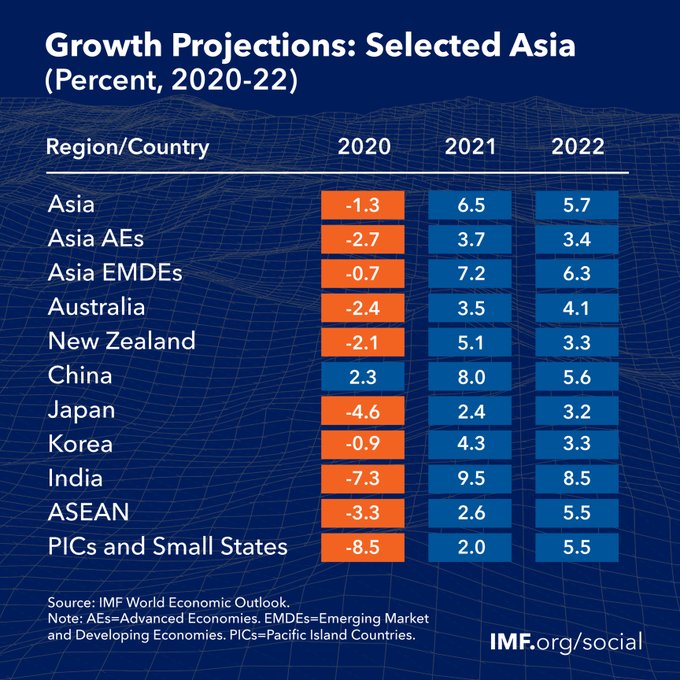
Old Dog Thought- Australia your running Last in 2021 among Pacific Nations

Image

Fighting Fake News with REAL; 21/10/21; The Shovel, Some REAL Facts not publicly told; LNP are a TEAM on multiple Planets

IMF says Australia to emerge from pandemic in fastest-growing region

Image

Morrison and Frydenberg paint themselves as being the world’s “greatest” survivors? When we are running 8th out of the pacific nations this year and predicted to be 7th in 2022 according to the IMF. That’s last out of actual Pacific nations in 21 and second last in 22. Why don’t we see these statistical hard facts on the front pages of our main stream media? Why are we treated like mushrooms?

Despite successfully containing COVID-19 in 2020, some economies in the region, including Australia, faced setbacks from an initially slow vaccination rollout, the IMF says in its regional economic outlook.

Source: IMF says Australia to emerge from pandemic in fastest-growing region

Coronavirus to cause worst economic downturn since Great Depression, IMF forecasts – Business – ABC News (Australian Broadcasting Corporation)

Children queue for soup and bread during the Great Depression, circa 1932.

via Coronavirus to cause worst economic downturn since Great Depression, IMF forecasts – Business – ABC News (Australian Broadcasting Corporation)

Filed under:

The International Monetary Fund on Tuesday warned that it might pull its support for the proposed bailout plan unless other nations agree to whittle down some of Greece’s debt. However this is still people bailing out the Loan Sharks!!

The IMF Gets Behind Greece With Debt Relief Demand

New BRICS bank to change world’s financial system

New BRICS bank to change world's financial system. BRICS New Development Bank

Russia was the first among BRICS members to have ratified the establishment of the New Development Bank, the main goal of which is to support investment projects for participating associations. The new bank is seen not only as support to economies of the five countries, but also good counterbalance to the IMF, the World Bank (International Bank for Reconstruction and Development, IBRD) and other creditors.

The history of the New Development Bank of BRICS

Russian President Vladimir Putin signed the law on the ratification of the agreement about the new New Development Bank in early March, while the State Duma of the Russian Federation ratified the agreement on February 20. The establishment of the bank and its political and economic importance in the world was widely discussed in the summer of 2014.

The BRICS countries contrived the new organization as an alternative to borrowing from the IMF. The idea of ​​this financial pool was first discussed at a meeting of the BRICS countries during the G20 summit in Los Cabos back in 2012. Brazil, Russia, India, China and South Africa approached the creation of the New Development Bank as an analogue to the IMF.

The BRICS Development Bank has pretty good prospects, given the fact that the developing countries of the bloc will continue to accept new members. On March 5, special envoy of the Russian Foreign Affairs Ministry, Coordinator of the Group of Twenty and BRICS countries, Vadim Lukov, said that it goes a number of large developing countries. Argentina, Mexico, Nigeria, Indonesia and several other countries have already announced their readiness to join BRICS.

Thus, the foundation of the New Bank will continue to grow. It is assumed already that the bank will be one of the largest multilateral development institutions with the stated capital of 100 billion dollars.


New Development Bank to replace the IMF

Will the new Development Bank be an alternative to the IMF for developing countries? Pravda.Ru asked this question to experts.

“I do not think it will be big competition for the IMF, as the IMF, as a rule, does not finance structural projects. It does not fund separate business projects. The IMF is a sovereign structure. The IMF, as we know, comes to the rescue when the entire financial system of this or that country is standing on the verge of collapse of great difficulties. Yet, the new banks of the BRICS countries will be a good replacement to the EBRD, the activity of which has died away during the recent years,” Director of the Analytical Department of Nord-Capital Vladimir Rozhankovsky, told Pravda.Ru.

The BRICS bank will become a significant competitor to both the World Bank Group and the International Bank for Reconstruction and Development, Associate Professor at the Department for Foreign Area Studies and International Cooperation at the Institute of Public Administration and Management, Roman Andreeschev told Pravda.Ru.

“BRICS members have been emphasizing the need to reform the IMF since 2009, so that the developed countries could have a more equitable system of governance in international financial institutions. This idea found support at the G20 in 2009.

“If we look at the last meeting of BRICS in Fortaleza in 2014, we will see that the declaration mentions not only the reform of the financial system, but also the reform of the UN Security Council and the reform of the UN in general, the reform of the World Bank Group. That is, we see that the ambitions and aspirations of developing countries, the BRICS countries have been growing,” said Roman Andreeschev.

Russia was the first of the five countries in the bloc to have ratified the agreement on the creation of the New Development Bank. During the BRICS summit to be held in summer in the city of Ufa, all countries of the block are expected to ratify the document too. Afterwards, over the next seven years, all five parties will need to invest $2 billion each – that is $10 billion is to be collection.

“If you look at the APEC summit that was held in Beijing this year, or at the G20 summit in Brisbane, Australia, then it becomes clear that the main question was about the construction of infrastructure to help businesses increase turnover,” Roman Andreeschev told Pravda.Ru. Many infrastructure projects are so expensive that private businesses show no interest in them because they can not afford them. Therefore, the participation of state structures in the implementation of infrastructure projects is an issue of first priority,” he said.

In turn, Vladimir Rozhankovskiy suggested that the work of the New Development Bank will work especially well at the junction of joint projects, such as Chinese projects in South Africa, Brazil and Russia.

According to the expert, the bank will work to fund joint projects, in which several BRICS members participate.

Meanwhile, officials at the Ministry of Finance of Russia expect the new New Development Bank will be operational already by the end of 2015 and will work in full force in four or five years.

Think of the World as a Country

Europe Piggy Bank

The global economy seems perplexing today: While all the traditional economic growth factors are in place (the world’s population is increasing, technical progress is huge, available savings are substantial, free trade is greater than ever), growth is slowing globally, save for the United States at this stage. And around the world, even in the United States, real unemployment has risen to record levels, investments are slowing down, inequalities are greater than ever before, especially in the United States. And the recent Baltic Dry Index (BDI) plunge (a number issued daily providing an assessment of the price of moving the major raw materials by sea, and which for a long time now has been a big indicator of impending crises) with its downward trend has caused panic to spread in the small circle of traders.

To deal with this problem, it seems that none of the conventional efforts are working: Interest rates are at their lowest; central banks are pumping an insane amount of money into the banking system; governments are plagued by record high deficits. Nothing is working. Nothing is starting. Everything is slowing down. Even prices.

What is wrong with the way the world has been functioning? How to explain that this incredible potential is not translated into practice? Economists, sociologists, political scientists throughout the world are discussing these issues ad infinitum without any convincing answer being given. And without anybody offering a new solution that is credible. Yet there is a critical need to understand the situation and to find ways to act. Otherwise, the global economy will plunge into a global depression with devastating political consequences. We will start seeing, we already see, those extreme parties taking power and democracy being questioned by the very people who pretend to speak on its behalf.

For me, the answer is obvious, although few people will admit it: The whole world economy is now a single economy. And one cannot understand it by juxtaposing the analysis of national economies and their trade exchanges. We must think of the world as a single economy; as a country. But a country without rule of law or regulatory state.

And such an economy, which was previously unknown in the real world up until today, can only, according to all existing theories, lead to an underutilization of the factors of production, that is to say to a shortfall in demand. And no regulatory state is there to compensate. In other words, the world is suffering from not having a tool able to create demand globally.

The ideal solution would be to create a World Central Bank, with democratic governance, with a world currency, able to pour massive resources on the world. In the form of money or in the form of investments in sustainable economy sectors.

The halfway solution would be to ask the G20 governments to agree to boost public investment massively, with recourse to heavy borrowing, forced if necessary, from large owners of capital.

The solution that is most in the interests of young people and employees would be a dramatic increase of all salaries throughout the world, and the acceptance of inflation. The one that is most in the interests of large owners of capital and seniors would be to make stock markets soar in order to create demand through the revaluation of wealth.

None of this will take place, of course. So the most likely scenario is that everybody will keep to oneself, to the point that they will isolate themselves from one another. But those who will create demand only at home, by massively increasing salaries or public expenditure, will quickly become dependent on imports, their currency will collapse. The United States may want to opt for this solution, as may Greece, on the other end of the spectrum. This will lead to protectionism, fragmentation, war.

It has become fashionable to say that we must think of the world as one, when talking about the climate change conference and its success. And yet, if ever there is a global conference that is urgent, it is rather one that would reform the IMF to make it more democratic and give it all its powers. Because if the world does not take action on the economy quickly, the problem of the emission of greenhouse gases will soon be resolved in the simplest way possible: There will be no one left to produce any.