Category: Future Shock

China, India, and the Emerging New World Order – scheerpost.com

Future Shock

China, India, and the United States might be when it comes to collaborating with their counterparts, they will have little choice if they are to escape an increasingly calamitous future. Like it or not, they will have to embrace some form of G-3 collaboration, however little acknowledged it may be at first. In time, as they come to recognize their mutual interdependence, they might even find themselves collaborating in a more formal, amicable manner — to the benefit of all the inhabitants of planet Earth.

Source: China, India, and the Emerging New World Order – scheerpost.com

Whose Planet Are We On? – CounterPunch.org

After almost 79 years on this beleaguered planet, let me say one thing: this can’t end well. Really, it can’t.

In fact, among those who have spoken out fearfully on the subject is the man known as “the godfather of AI,” Geoffrey Hinton, a pioneer in the field of artificial intelligence. He only recently quit his job at Google to express his fears about where we might indeed be heading, artificially speaking. As he told the New York Times recently, “The idea that this stuff could actually get smarter than people — a few people believed that, but most people thought it was way off. And I thought it was way off. I thought it was 30 to 50 years or even longer away. Obviously, I no longer think that.”

Now, he fears not just the coming of killer robots beyond human control but, as he told Geoff Bennett of the PBS NewsHour, “the risk of super intelligent AI taking over control from people… I think it’s an area in which we can actually have international collaboration, because the machines taking over is a threat for everybody. It’s a threat for the Chinese and for the Americans and for the Europeans, just like a global nuclear war was.”

And that, indeed, is a hopeful thought, just not one that fits our present world of hot war in Europe, cold war in the Pacific, and division globally.

Source: Whose Planet Are We On? – CounterPunch.org
As Falls Russia, So Falls the World – scheerpost.com

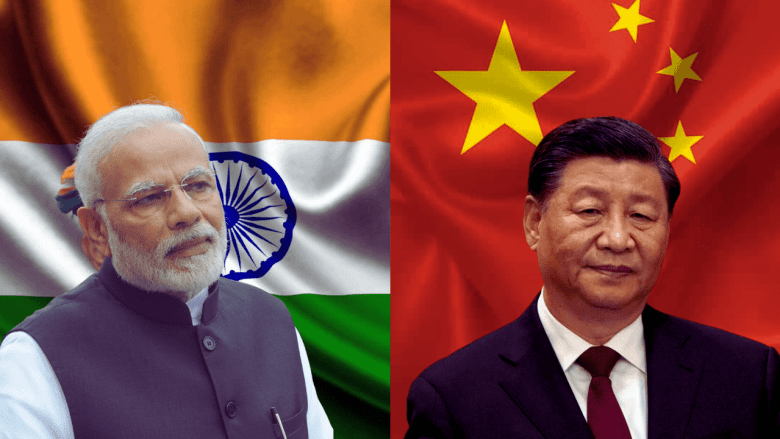
John Feffer examines what it means that North Korea has been driven ever closer to fellow nuclear powers Russia and China.

Sovereignty was once the king’s prerogative; he was, after all, the sovereign. Today’s autocrats, like Vladimir Putin, are more likely to have been voted into office than born into the position like Kim Jong-un. The elections that elevate such autocrats might be questionable (and are likely to become ever more so during their reign), but popular support is an important feature of the new authoritarianism. Putin is currently backed by around 80% of Russians; Orban’s approval rating in Hungary hovers near 60%; and while Donald Trump could likely win again only thanks to voter suppression and increasingly antidemocratic features baked into the American political system, millions of Americans did put Trump in the White House in 2016 and continue to genuinely believe that he’s their savior. Bolsonaro in Brazil, Nayib Bukele in El Salvador, Narendra Modi in India, Kais Saied in Tunisia: they were all elected.

Yes, such leaders are nationalists who often act like populists in promising all sorts of handouts and feel-good nostrums to their supporters. But what makes today’s autocrats particularly dangerous is their exceptionalism, their commitment to the kind of sovereignty that existed before the creation of the United Nations, the earlier League of Nations, or even the Treaty of Westphalia that established the modern interstate system in Europe in 1648. Both Trump and Xi Jinping harken back to a Golden Age all right — of rulers who counted on the unquestioned loyalty of their subjects and exercised a dominion unchallenged except by other monarchs.

Source: As Falls Russia, So Falls the World – scheerpost.com

Does Mideast Panopticon — Urban Surveillance and Digital Identities — foretell our Dystopian Future?

It has forever been the dream of almost every state, intelligence agency, empire and totalitarian regime to oversee the doings of all of their subjects, to detect any hint of dissent, to control their movements, to influence their thinking and even to peer into their minds. That dream has hardly ever been achieved, no matter their efforts and determination, not because of any moral qualms or principles holding them back, but simply because they lacked the tools to do so.In this decade leading up to 2030, however, things have changed.

Does Mideast Panopticon — Urban Surveillance and Digital Identities — foretell our Dystopian Future?

We Still Have to Take Donald Trump Seriously

History tells us these things don’t turn around overnight and go on for longer than is good for anyone.

The Right’s plan to take the presidency in 2024 requires a candidate with a higher-than-average disregard for the truth. That’s why Donald Trump is still their man — a fact that should worry us all.

Source: We Still Have to Take Donald Trump Seriously

A Viable Human Future Depends on Living With Less | The Smirking Chimp

We face a defining choice. We can hold to course with an economy that grows GDP to provide a few with the opportunity to make a killing as they prepare to escape to outer space. Or we can embrace the current opportunity to transition to an ecological civilization, with a living economy dedicated to supporting us all in making a secure and fulfilling living on a thriving living Earth. Awakening to the reality that we cannot eat money and there are no winners on a dead Earth points us to the latter as the clearly better choice.

Source: A Viable Human Future Depends on Living With Less | The Smirking Chimp

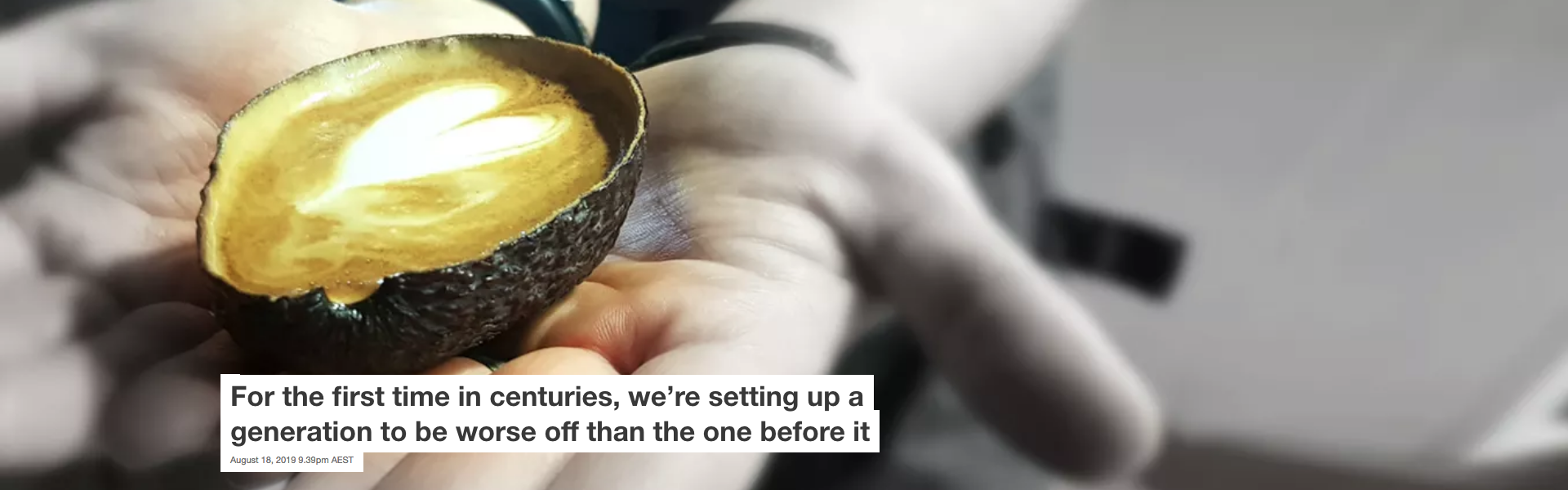
For the first time in centuries, we’re setting up a generation to be worse off than the one before it

Screenshot_2019-08-19 For the first time in centuries, we're setting up a generation to be worse off than the one before it.png For the first time in centuries, we’re setting up a generation to be worse off than the one before it

As The Climate Changes And The Earth Warms, Where’s The Safest Place On Earth To Live? | IFLScience


So, even with the inherent uncertainty in the pace and potency of these overwhelmingly negative effects of climate change, safety from it all is only likely in a handful of countries – those that currently have mild climates, that are wealthy and resource-rich, that have good healthcare systems, that aren’t politically unstable, and aren’t likely to experience dangerous weather extremes on a regular basis.
That leaves us with a pretty short list, then: Canada, Northern Europe, New Zealand, and perhaps Japan, for example. Wait, what about the Land of the Free – the wealthiest, perhaps most resourceful nation on Earth? Isn’t this a safe haven? Actually, no, not quite.

via As The Climate Changes And The Earth Warms, Where’s The Safest Place On Earth To Live? | IFLScience

50 years of change – » The Australian Independent Media Network

Future Shock

50 years of change – » The Australian Independent Media Network

The relentless, unstoppable force that spooked Murdoch and Lowy

Telstra's transition from a telco to a tech services business may be necessary, but it won't be quick or easy.

Even Murdoch is buying into it. “I read this week about my Australian friends at Westfield. They can see what Amazon is doing to bricks and mortar retail,” he told the Financial Times over the weekend.

The enormous deals signify the end of an era. But they were also fitting because 2017 was a year when technological disruption (a buzzword that is often misused, but that will have to suffice for the purposes of this column) was everywhere in corporate Australia.

via The relentless, unstoppable force that spooked Murdoch and Lowy