Tag: Brics

Resistance to Western geo-political order: building brick by BRICS – Pearls and Irritations

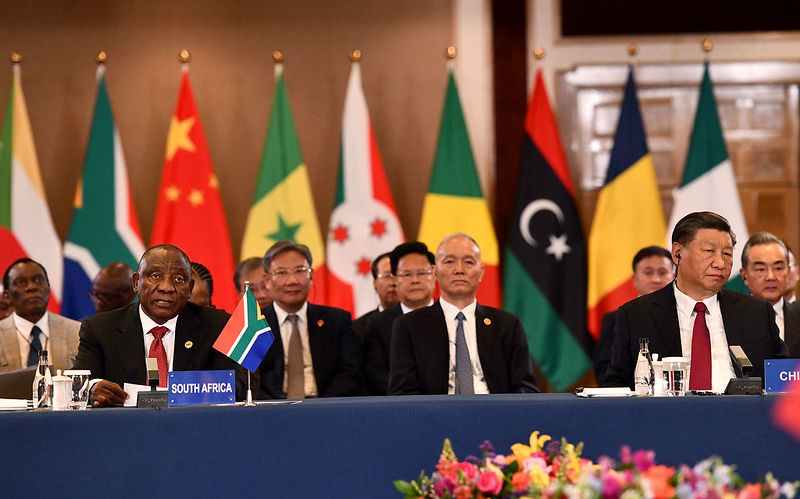
President Cyril Ramaphosa and President Xi Jinping Co-Chair the China - Africa Leaders Round Table

The 15th BRICS Summit, held in Johannesburg, has made some momentous decisions which will greatly effect the global geo-political order.

The Summit’s most momentous decision was the admission of six new nations to BRICS. The Bloc added Saudi Arabia, Iran, Ethiopia, Egypt, Argentina and UAE while leaving the door upon to further expansion.

‘We have consensus on the first phase of this expansion process and other phases will follow,’ Ramaphosa said at a media briefing.

The new members admitted include three of the world’s biggest oil producers: Saudi Arabia the UAE and Iran. This would appear to expand the influence of China and Russia in the Middle East. Recently China was able to bring to the table longstanding enemies, Iran and Saudi Arabia. Now they have both have been brought into BRICS.

The new candidates will be formally admitted 1st January 2024.

Together, the 11 countries have a population of some 3.7 billion, almost half the global populace.


Source: Resistance to Western geo-political order: building brick by BRICS – Pearls and Irritations

​West’s death squad strategy: How and why ISIS & Al-Qaeda became ‘shock troops’ of global powers

http://rt.com/op-edge/261469-isis-suicide-bomb-yemen/

Friday’s ISIS suicide bombings in Yemen and Saudi Arabia – killing a total of at least 43 people – is yet more bitter fruit of the policy pursued by Britain, the US and France and their Gulf allies for the past eight years.

This strategy – of fostering violently sectarian anti-Shiite militias in order to destroy Syria and isolate Iran – is itself but part of the West’s wider war against the entire global South by weakening any independent regional powers allied to the BRICs countries, and especially to Russia.

The strategy was first revealed as far back as 2007 in Seymour Hersh’s article “The Redirection”, which revealed how Bush administration officials were working with the Saudis to channel billions of dollars to sectarian death squads whose role would be to “throw bombs… at Hezbollah, Moqtada al-Sadr, Iran and at the Syrians,” in the memorable words of one US official.

More evidence of precisely how this strategy unfolded has since been revealed. Most recently, last Monday saw the release of hundreds of pages of formerly classified US Defense Intelligence Agency (DIA) documents following a two year court battle in the US.

These documents showed that, far from being an unpredictable “bolt from the blue,” as the mainstream media tends to imply, the rise of ISIS was in fact both predicted and desired by the US and its allies as far back as 2012.

The DIA report, which was widely circulated amongst the various US military and security agencies at the time, noted: “There is the possibility of establishing a declared or undeclared Salafist principality in Eastern Syria, and this is exactly what the supporting powers to the opposition want, in order to isolate the Syrian regime which is considered the strategic depth of the Shia expansion (Iraq and Iran).” Elsewhere, the “supporting powers to the opposition” are defined as “Western countries, the Gulf states and Turkey”.

In other words, a Salafist – that is militantly anti-Shia – “principality” was “exactly” what the West wanted as part of their war against not only Syria, but “Shia expansion” in Iraq as well. Indeed, it was specifically acknowledged that “ISI [the forerunner of ISIS] could also declare an Islamic state through its union with other terrorist organizations in Iraq and Syria.”

A forensic expert and other people look for evidence at the site of a bomb explosion at a mosque in Yemen's capital Sanaa May 22, 2015. (Reuters / Khaled Abdullah)

A forensic expert and other people look for evidence at the site of a bomb explosion at a mosque in Yemen’s capital Sanaa May 22, 2015. (Reuters / Khaled Abdullah)

The precision of the declassified predictions is astounding. Not only was it predicted that the terrorist groups being supported by Washington and London in Syria would team up with those in Iraq to create an “Islamic State,” but the precise dimensions of this state were also spelt out: recognizing that “the Salafist[s], the Muslim Brotherhood, and AQI are the major forces driving the insurgency in Syria.” The report noted that the consequences of this for Iraq would be to “create the ideal atmosphere for AQI [Al Qaeda Iraq] to return to its old pockets in Mosul and Ramadi.”

Mosul, don’t forget, was taken by ISIS in June 2014, and Ramadi fell earlier this week.

Recent months have seen the West and its regional allies massively stepping up their support for their anti-Shiite death squads. In late March, Saudi Arabia began its bombardment of Yemen following military gains made by the Houthi (Shiite) rebels in that country. The Houthis, the only effective force fighting Al Qaeda in the country, had taken key territories from them last November, and were subsequently threatening them in their remaining strongholds. This was when the Saudis began their bombardment, with US and British support, naturally, and, unsurprisingly, Al Qaeda have been the key beneficiary of this intervention, gaining a breathing space and regaining valuable lost territory, retaking the key port of Mukulla within a week of the commencement of the Saudi bombardment.

Al Qaeda have also been making gains in Syria, taking two major cities in Idlib province last month following a ramping up of military support from Turkey, Qatar and Saudi Arabia. And of course, Britain has been leading the way for a renewed military intervention in Libya in the guise of a “war against people smuggling” that, as I have argued elsewhere, will inevitably end up boosting the most vicious gangs involved in the trade, namely ISIS and Al Qaeda.

So why the sudden urgency on the part of the West and its allies to step up support for Al Qaeda et al now?

The answer lies in the increasing disgust at the activities of the death squads across the region. No longer perceived as the valiant freedom fighters they were depicted as in 2011, their role as shock troops for the West’s “divide and ruin” strategy, promising nothing but a future of ultra-violent trauma and ethnic cleansing, has become increasingly obvious. The period between mid-2013 and mid-2014 saw a significant turning of the tide against these groups.

It began in July 2013 with the ouster of Egypt’s President Mohamed Morsi following fears he was planning to send in the Egyptian army to aid the Syrian insurgency. New President Abdel Fattah Al-Sisi put an end not only to that possibility, but to the flow of fighters from Egypt to Syria altogether. The West hoped to step in the following month with airstrikes against the Syrian government, but their attempts to ensure Iranian and Russian acquiescence in such a move came to nought and they were forced into a humiliating climbdown.

Then came the fall of Homs in May 2014, as Syrian government forces retook a key insurgent stronghold. The momentum was clearly with the government side; that is until ISIS sprang onto the scene – and with them, a convenient pretext for a US-led intervention that had been ruled out just a year before.

Meanwhile, in Libya, the pro-death squad parties decisively lost elections to the first elected House of Representatives in June 2014. Their refusal to accept defeat led to a new chapter in the post-NATO Libyan disaster, as they set up a new rival government in Tripoli and waged war on the elected parliament. Yet following a massacre of Egyptians by ISIS in Libya in February of this year, Egypt sent its airforce in on the side of the Tobruk (elected) parliament; it is now, apparently, considering sending in ground troops.

Losing ground in Yemen, in Libya, in Egypt and in Syria, the West’s whole strategy for using armed Salafists as tools of destabilization was starting to unravel. Thank goodness, people in certain quarters must be thinking, for ISIS.

New BRICS bank to change world’s financial system

New BRICS bank to change world's financial system. BRICS New Development Bank

Russia was the first among BRICS members to have ratified the establishment of the New Development Bank, the main goal of which is to support investment projects for participating associations. The new bank is seen not only as support to economies of the five countries, but also good counterbalance to the IMF, the World Bank (International Bank for Reconstruction and Development, IBRD) and other creditors.

The history of the New Development Bank of BRICS

Russian President Vladimir Putin signed the law on the ratification of the agreement about the new New Development Bank in early March, while the State Duma of the Russian Federation ratified the agreement on February 20. The establishment of the bank and its political and economic importance in the world was widely discussed in the summer of 2014.

The BRICS countries contrived the new organization as an alternative to borrowing from the IMF. The idea of ​​this financial pool was first discussed at a meeting of the BRICS countries during the G20 summit in Los Cabos back in 2012. Brazil, Russia, India, China and South Africa approached the creation of the New Development Bank as an analogue to the IMF.

The BRICS Development Bank has pretty good prospects, given the fact that the developing countries of the bloc will continue to accept new members. On March 5, special envoy of the Russian Foreign Affairs Ministry, Coordinator of the Group of Twenty and BRICS countries, Vadim Lukov, said that it goes a number of large developing countries. Argentina, Mexico, Nigeria, Indonesia and several other countries have already announced their readiness to join BRICS.

Thus, the foundation of the New Bank will continue to grow. It is assumed already that the bank will be one of the largest multilateral development institutions with the stated capital of 100 billion dollars.


New Development Bank to replace the IMF

Will the new Development Bank be an alternative to the IMF for developing countries? Pravda.Ru asked this question to experts.

“I do not think it will be big competition for the IMF, as the IMF, as a rule, does not finance structural projects. It does not fund separate business projects. The IMF is a sovereign structure. The IMF, as we know, comes to the rescue when the entire financial system of this or that country is standing on the verge of collapse of great difficulties. Yet, the new banks of the BRICS countries will be a good replacement to the EBRD, the activity of which has died away during the recent years,” Director of the Analytical Department of Nord-Capital Vladimir Rozhankovsky, told Pravda.Ru.

The BRICS bank will become a significant competitor to both the World Bank Group and the International Bank for Reconstruction and Development, Associate Professor at the Department for Foreign Area Studies and International Cooperation at the Institute of Public Administration and Management, Roman Andreeschev told Pravda.Ru.

“BRICS members have been emphasizing the need to reform the IMF since 2009, so that the developed countries could have a more equitable system of governance in international financial institutions. This idea found support at the G20 in 2009.

“If we look at the last meeting of BRICS in Fortaleza in 2014, we will see that the declaration mentions not only the reform of the financial system, but also the reform of the UN Security Council and the reform of the UN in general, the reform of the World Bank Group. That is, we see that the ambitions and aspirations of developing countries, the BRICS countries have been growing,” said Roman Andreeschev.

Russia was the first of the five countries in the bloc to have ratified the agreement on the creation of the New Development Bank. During the BRICS summit to be held in summer in the city of Ufa, all countries of the block are expected to ratify the document too. Afterwards, over the next seven years, all five parties will need to invest $2 billion each – that is $10 billion is to be collection.

“If you look at the APEC summit that was held in Beijing this year, or at the G20 summit in Brisbane, Australia, then it becomes clear that the main question was about the construction of infrastructure to help businesses increase turnover,” Roman Andreeschev told Pravda.Ru. Many infrastructure projects are so expensive that private businesses show no interest in them because they can not afford them. Therefore, the participation of state structures in the implementation of infrastructure projects is an issue of first priority,” he said.

In turn, Vladimir Rozhankovskiy suggested that the work of the New Development Bank will work especially well at the junction of joint projects, such as Chinese projects in South Africa, Brazil and Russia.

According to the expert, the bank will work to fund joint projects, in which several BRICS members participate.

Meanwhile, officials at the Ministry of Finance of Russia expect the new New Development Bank will be operational already by the end of 2015 and will work in full force in four or five years.

Are the TPP and TiSA the beginning of the globalisation of health care? Health is a human right and is not for sale or for trade. The health system exists to keep our families safe and healthy, not to ensure the profits of large corporations. Breaking the control of the AMA is a first step.

Image from the smh.com.au

It’s hard not feel that we are being attacked at from all angles with corporations eying off developing and developed countries public health services for profit. With an Australian government seemingly hell bent on dismantling its Medicare system with outsourcing payments while introducing co-payments, it’s looking clearer now as to what the current Australian government has planned” writes Mel Mac.

I recently wrote about the TPP and now I think it’s time that we take a look at the Trade in Services Agreement (TiSA). It’s a services-only free trade agreement (FTA) that began in 2012 with exploratory discussions between Australia, US and the European Union (EU) for a year and with formal discussions beginning in early 2013. Australia, US and the EU take it in turns to chair the negotiations in Geneva. The services sector accounts for around 70% of Australia’s economic activity and accounts for around 17% of Australia’s total exports. Current countries negotiating the TiSA are Australia, Canada, Chile, Chinese Taipei, Colombia, Costa Rica, The European Union (representing its 28 Member States), Hong Kong, Iceland, Israel, Japan, Liechtenstein, Mexico, New Zealand, Norway, Pakistan, Panama, Paraguay, Peru, Republic of Korea, Switzerland, Turkey and the United States. These countries also account for around 70% of global trade in services. China and Uruguay have expressed interest but have yet to be invited, it’s also worth mentioning that the Brazil, Russia, India, China and South Africa (BRICS) bloc have not been invited.

The World Trade Organization (WTO) deals with the global rules of trade between nations and the General Agreement on Trade in Services (GATS) came into effect in April 1994, and involves all WTO members. The TiSA’s aim is to be compatible with GATS yet, set a new standard in services trade that covers all service sectors including health and public services; financial services; ICT services (including telecommunications and e-commerce); professional services; maritime transport services; air transport services; competitive delivery services; energy services; temporary entry of business persons; government procurement; and new rules on domestic regulation to ensure regulatory settings do not operate as a barrier to trade in services. The discussions are held behind closed doors as per other trade agreements, Wikileaks managed to leak draft text from the April 2014 round of discussions involving further deregulation of global financial services markets, despite the Global Financial Crisis (GFC). The draft Financial Services Annex sets rules to assist the expansion of financial multi-nationals into other nations by preventing regulatory barriers. The leaked draft also shows that the US is particularly keen on boosting cross-border data flow, allowing the uninhibited exchange of personal and financial data.

The Australian government has a web page for it’s involvement in TiSA and in the sixth April/May round that Australia also chaired, more than 140 negotiators and sector-specific government experts attended. There were advanced discussions in all areas of the negotiations, including on new and enhanced disciplines (trade rules) for financial services, domestic regulation and transparency, e-commerce and telecommunications, and maritime transport. TiSA parties also agreed to move to a negotiating text for air transport and market access negotiations also continued. The Global Services Coalition or “Team TiSA” organised a substantial industry presence in the margins of the negotiations and as the name suggests is pro the TiSA for the US. Trading in services has grown at a faster pace than trading in goods since the 1980s. The United Nations Conference on Trade And Development (UNCTAD) estimates that in 2013 global services exports reached $4.7 trillion and grew at an annual rate of 5%.  Overall, the services trade has grown by 95% since 2000. World Bank research shows that the services sector has become the dominant driver of economic growth in developing countries, delivering both GDP growth and poverty reduction.  In 2011, the services sector accounted for a massive 49% of GDP in low income countries and 47% in least developed countries. Team TiSA has every right to be cheering for it as it would benefit the US greatly. The US is the world’s largest single-country exporter and importer of services and they generate more than 75% of their national economic output. In 2013 the US exported over $681bn in services, resulting in a $231 billion surplus. Services exports in 2013 grew by $31.8 bn and services imports in 2013 grew by $12.9bn.

Australia chaired the ninth round early last December and this time it was attended by more than 200 negotiators and sector-specific government experts. Good progress was made in advancing the enhanced disciplines (trade rules) for e-commerce and telecommunications, domestic regulation and transparency, financial services, temporary entry of business persons, professional services, maritime and air transport services and delivery services. There was also further discussion of proposals on government procurement, environmental and energy services, and the facilitation of patient mobility. Parties reported on progress in bilateral market access discussions held since the September round and committed to advance these further in 2015. Besides the vagueness and secretiveness above and what it all means for every day Australians, one thing leaps out and that is the facilitation of patient mobility. Luckily another leak was sprung, the proposal was titled ‘A concept paper on health care services within TISA Negotiations’ and it states there is ‘huge untapped potential for the globalisation of healthcare services’ mainly because ‘health care services is (sic) funded and provided by state or welfare organisations and is of virtually no interest for foreign competitors due to lack of market-orientated scope for activity’. It was allegedly a proposal put forward by Turkey, and was discussed by TiSA members in the September round of discussions. And there are justifiable fears that they want to commodify health services globally as well as to promote “medical tourism” for patients.

Experts, such as Dr Odile Frank of Public Services International (PSI) say, ‘The proposal would raise health care costs in developing countries and lower quality in developed countries in Europe, North America, Australia and elsewhere’. Rosa Pavanelli, PSI General Secretary, also commented that ‘Health is a human right and is not for sale or for trade. The health system exists to keep our families safe and healthy, not to ensure the profits of large corporations’. The proposal could see patients being treated in other TiSA countries for reasons such as long waiting times in their home country or a lack of expertise for specific medical problems. The patients’s costs would need to be reimbursed through their own countries social security system, private insurance coverage or other healthcare arrangements.

The beneficiaries of this are the large health corporations and insurance companies, the ones actually behind the negotiations, that would benefit from an approximate $USD 6 trillion business. Public services are designed to provide vital social and economic necessities such as health care and education affordably, universally and on the basis of need. They exist because markets can’t produce these outcomes. Furthermore, public services are fundamental to ensuring fair competition for business, and they provide effective regulation to avoid environmental, social and economic disasters, such as the GFC and global warming. Even the most die-hard supporters of FTA’s admit that there are winners and losers.

New South Wales (NSW) Australia, Nurses and Midwives’ Association organiser Michael Whaites said: “Prime Minister Tony Abbott and Treasurer Joe Hockey have been saying that healthcare expenditure is unsustainable, but Trade Minister Andrew Robb is quietly engaged in negotiations that could potentially see scarce healthcare dollars going overseas”, and that “You can ask whether the government is working in a co-ordinated manner, and indeed what is their real intention on the future of Medicare?” Professor Jane Kelsey, an expert on trade in services at the University of Auckland, warns that health-service-exporting countries such as Australia could find qualified staff being diverted to health export services “that often have better pay and facilities, eroding the personnel base for public facilities and perpetuating inequalities in the health care system”. Education and training investments could also be diverted “to benefit foreign healthcare users, rather than local citizens and taxpayers”.

In August 2014 the Australian Health Department called for expressions of interest from private players interested in taking over the payments of $29bn each year in health and pharmaceutical benefits currently being managed by the Human Services. Human Services Minister Marise Payne said much of the Department of Human Services (DHS) IT infrastructure for processing the payments was old and needed to be replaced and that the private sector might have cheaper solutions. The government claims it is merely testing the market with an initial expression of Interest process, not via cost analysis or efficiencies already provided. Australia Post stuck it’s hand up from the get go and other Australian corporations that are keen are – Eftpos and Stellar (Telstra) with overseas companies being Oracle, Fuji-Xerox, SAP, Accenture and Serco.

It’s hard not feel that we are being attacked at from all angles with corporations eying off developing and developed countries public health services for profit. With an Australian government seemingly hell bent on dismantling its Medicare system with outsourcing payments while introducing co-payments, it’s looking clearer now as to what the current Australian government has planned. The rise of corporations and their lust for profits no matter what the cost is, has to stop. Governments must get out of bed with them and understand that they don’t know best and an even mix of private and government is required sometimes, but not all of the time. The people elect governments to govern and make decisions, we do not elect corporations. Take some advice from them but if you give them an inch they will take a mile as we have been seeing in recent years. Greed is worming it’s way in globally under the guise of competition and job creation. I find this very hard to believe for your average person, for the corporations yes, they keep getting richer and the equality gap wider. Low income countries delivering GDP growth and poverty reduction will be hardest hit and that’s not fair with many only just recovering from the GFC. The US has the most to benefit from this and all other FTA’s, this also needs to stop, they aren’t the biggest power anymore and even if they were why should they get all of the advantages? People over profits, after all you can’t make profits without us and there’s no need to ruin everyone globally once again for it.

This article was originally published on Political Omniscience as Corporations want to profit from global health with TiSA and the TPP.
Brisbane: Can we please concentrate on the issues?

Brisbane: Can we please concentrate on the issues?. 53953.jpeg

There are those who would like to use the G20 Summit in Brisbane, Australia, to perpetuate a hackneyed West versus East approach, at a time when the world needs to pull together. This begins with a responsible media and competent political leaders, focusing on the issues at hand instead of chasing ghosts and sowing the seeds of conflict.

Predictably, David Cameron has used Brisbane as a stage to launch a set of snide remarks about Russia, just as the host, Australian Prime Minister Tony Abbott, did recently with puerile remarks about wishing to “shirtfront” Russian President Vladimir Putin over the MH17 air disaster over Ukraine. In fact the entire Western leadership has adopted a hypocritical, dishonest and groundless campaign against Russia, its partner in two world wars, over a question which was prepared, cooked and served in the west: Ukraine. Why doesn’t Abbott confront the Ukrainian President, Poroshenko? Why doesn’t he ask why the Ukrainians do not reveal the content of the ATC tapes seized by the authorities, why doesn’t he ask the Ukrainian President about the alleged sighting of fighter jets trailing flight MH 17?

They tried it before in 2008, in Georgia, when Georgian troops murdered South Ossetian citizens, massed their troops on the border with Abkhazia and then ran screaming along with their magnificent NATO advisors as Russia taught them a lesson or four in soldiery.

They tried again in 2014, in Ukraine, when an illegal Putsch was launched in Kiev to topple the democratically elected President, Yanukovich. The West, of course, applauded at this travesty of democracy and then had the audacity to claim the moral high ground and start blaming Russia, accusing Moscow of undemocratic behavior when President Putin has been elected multiple times with whacking majorities and approval ratings several times higher than those of Cameron, Obama and Abbott combined.

Nothing did they say about the shots fired from the sixth floor of Hotel Ukraine in Independence Square against the pro-rebellion demonstrators, to create a cause and blame Yanukovich. Nothing did they say about the Fascist massacres in which burning bodies of Russian-speaking Ukrainians were tossed out of windows by Fascists as the crowds below looked on, applauded and cheered, as was the case at Mariupol. And this is the side backed by Abbott, his master Cameron, and their master, Obama?


They are quick to blame Russia for the instability in Eastern Ukraine, and to point the finger without a shred of evidence that Russia is interfering. Google these days can practically pick up a matchbox. Where are the photographs of tanks rolling across the border? There aren’t any. Maybe the BBC would like to do a copy paste job again using pics from two decades earlier and another continent?

And now we are on to the blame game perhaps Mr. Cameron and Mr. Abbott would like to comment on their own countries’ recent history of war crimes in Iraq, the country which was invaded without any justified or justifiable casus belli, the sovereign nation which was totally destabilized, whose civilian infrastructures were strafed with military hardware, whose civilians were murdered. The entire Iraq campaign culminated in the most horrific war crimes – deploying cluster bombs in civilian areas, targeting civilian homes and leaving swathes of the country dangerous through the deployment of Depleted Uranium.

The direct result of the criminal interference of the United States of America, its chief poodle, the UK, in turn its ex-colony crawling around its legs, Australia and new willing bedboy, Poland, was thousands of cases of cancer and birth defects among Iraqi children in 300 known contamination sites. The USA, the UK, Australia and Poland, in participating in the illegal invasion of Iraq, have left a radioactive legacy for decades to come.

And here they are, the West, supporting terrorists in Syria against President Assad, interfering in Ukraine, overthrowing a democratically elected Government, then supporting the side that committed massacres.

So instead of using Brisbane to launch unfounded and insolent quips against Russia, suppose the West, for once, acted with responsibility in addressing the real issues facing humankind, and not perpetuating their lies to cover up their own criminal misconduct?

The issues at Brisbane’s G20 Summit on November 15-16 are the following:

Fostering the conditions to stimulate world trade, instead of stifling it through the illegal imposition of sanctions, job creation, stimulating the global economy by 2 per cent over five years and measures to combat tax evasion, now that climate change is not on the agenda. And who was responsible for keeping it off? Three guesses.

Let us hope Brisbane is about coming together, not driving a wedge between the G8 and its diminishing sphere of influence and the BRICS, the prototype of the new model which carries the hearts and minds of humankind.

Timothy Bancroft-Hinchey