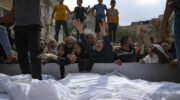
The bloodshed and loss of life is devastating, the lack of balance in reporting the conflict we watch unfold is predictable and complicit.
Source: Israeli forces have killed 2400 Palestinian children since year 2000 – Pearls and Irritations
The bloodshed and loss of life is devastating, the lack of balance in reporting the conflict we watch unfold is predictable and complicit.
Source: Israeli forces have killed 2400 Palestinian children since year 2000 – Pearls and Irritations
If the US were genuinely interested in some sort of political solution to the Israeli Apartheid practices regarding the Palestinians, nothing would be easier than to just step aside and let the world punish the Bennett government for these policies, which amount to war crimes. Washington wouldn’t even have to be proactive itself. Or Israeli officials could start being targeted for economic sanctions by the Treasury Department the way Russian high officials are being fingered. Prime Minister Naftali Bennett made $200 million with software and would feel the pain if he were sanctioned. But official Washington is so in the tank for Israeli Apartheid that making such a suggestion sounds outlandish.
In contrast, Washington is attempting to reshape the entire world so as to get Putin back out of Ukraine, and we see exactly what it looks like when an illegal Occupation is genuinely unacceptable to the White House.
Israel’s application of ‘Collective Punishment’ is currently being taken to the extreme by Putin in Ukraine when the orders like “Slay all of them” are given. In the case of Putin, he no longer cares about any negative fallout in the Trumpian world of “fake news” because news is today it seems whatever you say it is and who controls the technology to spread it.
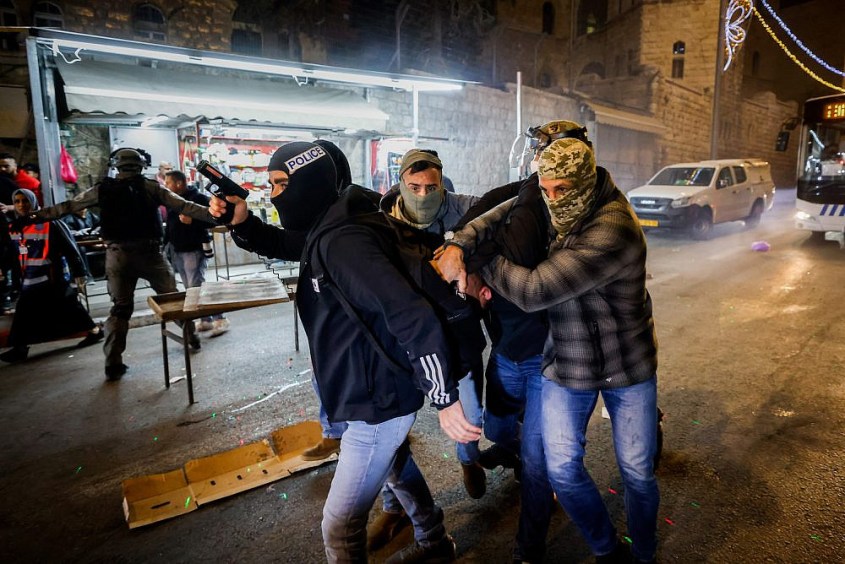
Israel’s response to a series of deadly attacks in Be’er Sheva, Hadera, and Bnei Brak over the past two weeks was as predictable as it was malicious. So far, the authorities seem to believe that the four Palestinian assailants — three citizens of Israel and one West Bank resident — acted of their own accord and without organizational backing, despite the first three identifying with the Islamic State. That didn’t stop the authorities from reacting in their usual habit. Over the ensuing days, the police ramped up patrols of Arab towns in Israel; carried out stop-and-frisks of Palestinian citizens in Jewish neighborhoods and public spaces; and clamped down on Palestinians working in Israel without permits. Several municipalities ordered construction companies to freeze their employment of Palestinian laborers, while some Israeli schools told Arab maintenance staff to work only after students had gone home. Along with raids in the West Bank, soldiers blocked Palestinian workers from entering Israel through open parts of the separation barrier, which for years had been left unperturbed with the army’s quiet consent.
This proclivity for collective punishment forms a bedrock of Israeli policy toward Palestinians.
Source: Collective punishment shouldn’t be normal – +972 Magazine

On Sunday night, a shooting attack in the Israeli city of Hadera left two police officers dead and several more people injured. It was the second attack in Israel linked to the Islamic State group in less than a week, after four people were killed in a stabbing and car-ramming attack last Tuesday in Be’er Sheva. The photos and videos released last night by the police show that the two perpetrators arrived at the scene in Hadera with an enormous amount of firearms and weapons. After the incident, which ended when undercover Border Police officers killed the two attackers during a shootout, Israeli military commentator Yoav Limor wrote in the right-wing Israel Hayom daily that the attackers had “slipped under the Shin Bet’s radar.”

Adam Raz, an Israeli researcher at the Akevot Institute for Israeli-Palestinian Conflict Research, has published in Haaretz about historical documents he found in Israeli archives that blow a hole through the used car narrative so big you could drive a truck through it. The story begins with the 20 percent of the Israeli population after 1948 that was of Palestinian heritage, typically called in the Hebrew press “Israeli Arabs” (terminology that tended to disguise their Palestinian identity, since Zionists have spent a lot of time denying there are any Palestinians, sort of the way Trumpies maintain that Biden is not actually in the White House).
At least 109 people were killed in Gaza, including 29 children, over the previous four days, Palestinian medical officials said. On Thursday alone, 52 Palestinians were killed in the enclave, the highest single-day figure since Monday.
Source: Israel-Palestine conflict: Gaza Strip attacked as IDF deployed
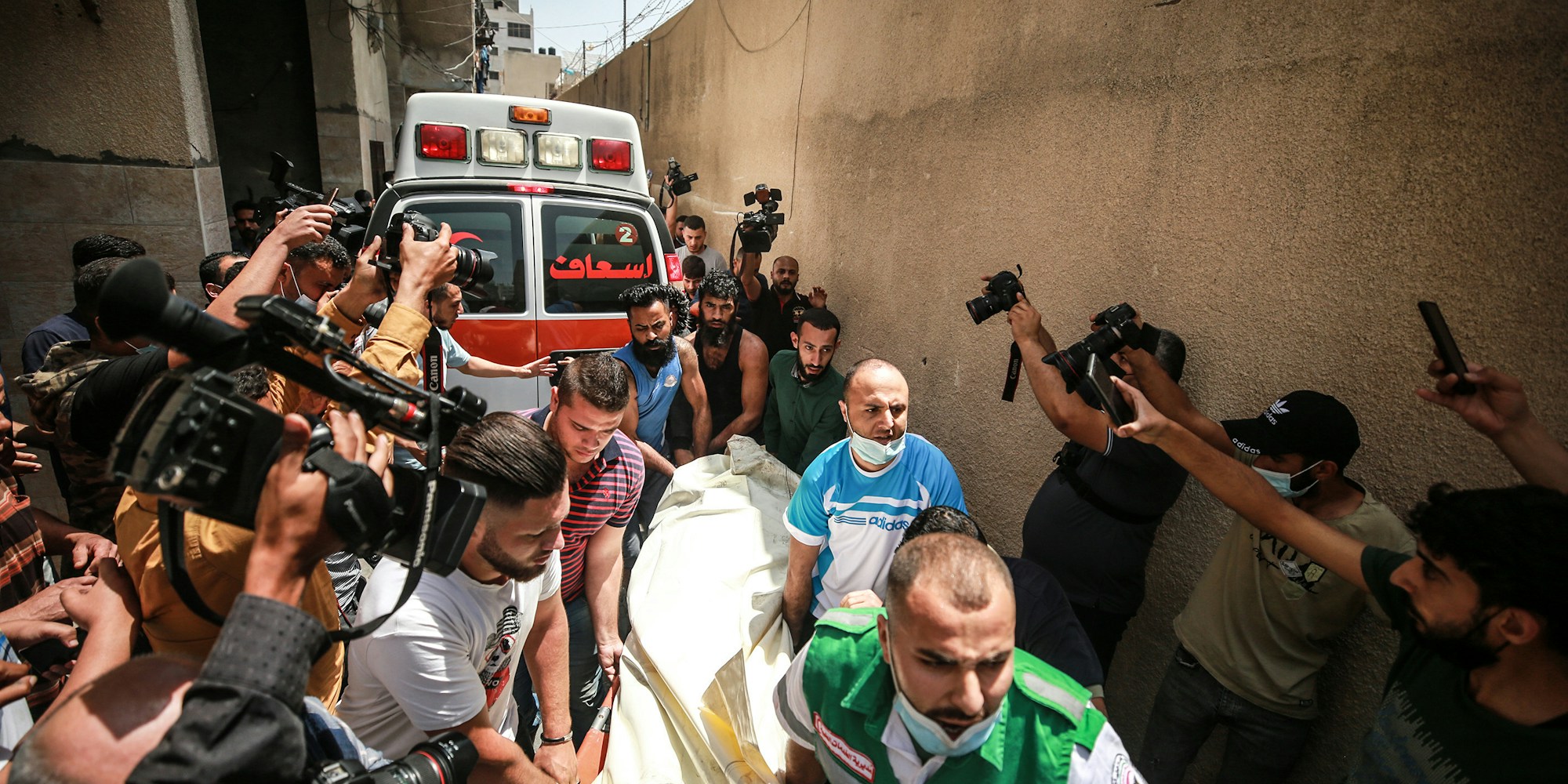
Since the first two Palestinian intifadas, camera phones and social media have changed the landscape of global outrage. Murtaza Hussain
Source: States Can’t Control the Narrative on Israel and Palestine

Even if we can’t agree on or accept each other’s historical narratives, it is still possible to acknowledge that there are both Israelis and Palestinians living here today. By Alex Stein MK Anat Berko (Likud) kicked…
Source: This land has been here longer than you and me | +972 Magazine

Nazareth – The killing of a 22-year-old Arab youth by Israeli police on November 7, has highlighted tensions that have been building rapidly between the Israeli authorities and the country’s 1.5 million-strong Palestinian minority.
Kheir al-Dein Hamdan’s shooting in the Galilee town of Kafr Kana, near Nazareth, sparked protests in most Palestinian communities inside Israel, in some incidents turning into violent clashes with the police.
A general strike was widely observed on November 8 and simmering anger is still bringing the youth out onto the streets at night in Kafr Kana and elsewhere.
Hamdan is one of scores of Palestinian citizens of Israel who were killed by police in unexplained circumstances over the past 14 years. His death, however, has magnified a mood of intense anger and frustration among the Palestinian minority, which comprises a fifth of Israel’s population.
The atmosphere was set earlier this year with a wave of violent attacks carried out by Jewish settlers targeting Palestinians in Israel, rather than Palestinians in the occupied territories, burning mosques, defacing churches and vandalising cars. Police have mostly failed to identify the culprits.
A series of events then followed, including the gruesome killing of 16-year-old Mohammed Abu Khdeir in Jerusalem at the hands of Jewish extremists in early July. Israel’s war on Gaza, which left more than 2,100 Palestinians dead, most of them civilians, also incensed the Palestinian minority.
The widespread protests over the summer were marked by frequent clashes with the police reaching a level not seen since the start of the second Intifada in 2000.
Police responded with hundreds of arrests, including of many children, often in heavy-handed, night-time raids on homes that have become a familiar sight in the occupied territories. Leading human rights lawyers in Israel have described Hamdan’s death as a police “execution”.
The intensifying efforts over the past few weeks by government officials and Jewish extremists, backed by the Israeli police, to assert greater control over the Al-Aqsa Mosque compound in occupied East Jerusalem has added another layer of distress.
Many Palestinians accuse the police of enforcing racist policies that dehumanise all Palestinians, ignore their rights and concerns, and brook no dissent, whether peaceful or violent.
RELATED: ‘We will not be silent’
For the minority, this incident was yet another graphic and shocking illustration that they are seen not as citizens but as the enemy.
Over a decade ago, that was precisely the conclusion of a state commission of inquiry into the police’s killing of 13 Palestinian citizens in towns across the Galilee in October 2000, at the start of the second Intifada.
During demonstrations against the Israeli army’s assault on Palestinians in the occupied territories, the police fired live ammunition and rubber bullets on unarmed protesters and deployed, for the first time, an anti-terror sniper unit.
The head of the commission, Justice Theodor Or, found that the police viewed Palestinian citizens in similar terms to the army’s conception of the Palestinians in the West Bank and Gaza: As an enemy to be crushed with brute force.
Justice Or also identified systematic and institutionalised discrimination against the Palestinian minority over many decades as a major contributing factor in their protests.
But what Justice Or failed to understand, or perhaps admit, was that the attitudes of the police, government and the Israeli public were shaped – and still are – by a more general political atmosphere that derives from Israel’s founding ideology, Zionism.
Israel’s Palestinian minority is viewed as the state’s Achilles’ heel; an opening for Palestinians in the occupied territories to undermine the state’s Jewishness.
The threat is seen as two-fold.
Demographically, Palestinian citizens can erode the Jewish majority by reversing the ethnic cleansing of Palestinian population in 1948 through, for example, winning citizenship for spouses from the occupied territories. Israel closed that door in 2003 with legislation effectively barring such marriages.
And ideologically, Palestinian citizens have risked exposing Israel’s lack of meaningful democracy by proving, through their own treatment, that a Jewish state cannot be fair to them.
| That the prime minister [Netanyahu] tells Arab citizens who protest that they should leave for the West Bank sends a message that getting rid of us is a legitimate political option. Transfer has entered the mainstream, and with it the right to use state violence to solve political problems. |
A political campaign by the minority for equality – urging Israel’s reform from a Jewish state to a “state for all its citizens” – is officially classified as “subversion”.
Israeli Politicians – from the right and the left – share a common view, often expressed or implied, that Palestinian citizens can never truly belong to a Jewish state. Instead, they are described variously as a “fifth column”, “Trojan horse” and “demographic time bomb”.
At a cabinet meeting on Sunday, Netanyahu told his interior minister to examine ways to strip of citizenship anyone who “acted against the state” or attacked the police.
The next day, Netanyahu told demonstrators to leave Israel and “move to the Palestinian Authority or Gaza”.
His comments have consciously blurred the distinction between the legitimate anger unleashed by Hamdan’s killing and the spate of recent attacks by Palestinians from the occupied territories on Israelis in Jerusalem, the West Bank and Tel Aviv. Dangerously, Netanyahu has implied that they are all part of the same “terrorism”.
His two most senior coalition partners have echoed him.
Foreign Minister Avigdor Lieberman praised the officers for acting “resolutely and effectively”. Naftali Bennett, the economy minister, called Hamdan “a crazed Arab terrorist” and described the police response – killing him when he posed no threat – as “what is expected of our security forces”.
Attorney General Yehuda Weinstein has ordered the justice ministry’s police investigations unit, Mahash, to investigate Hamdan’s killing. But the unit is already deeply distrusted by the Palestinian minority.
A recent report by Adalah, a legal centre for the Arab minority, found that Mahash closed 93 percent of the complaints against the police between 2011 and 2013. More disturbing, Adalah found cases were closed even when there was strong evidence of police use of excessive force.
That reflected similar failings by Mahash to properly investigate the police officers responsible for the 13 deaths in October 2000. None were ever indicted, Adalah noted.
The current police chief, Yohanan Danino, pre-empted the current investigation by saying the officers involved not only had his “full backing” but that criticism of them was “unfounded” and “irresponsible”.
RELATED: Arabs in Israel decry racial discrimination
However, suggestions that Hamdan’s killing will ignite a new Intifada, this time in Israel, may prove premature.
Much as in the West Bank and Jerusalem, a sense of hopelessness in the face of Israel’s entrenched racism and refusal to make political concessions has built to the point where it has found an outlet in spontaneous protests and outbursts of violence.
But Palestinians are more divided territorially, and their leaders ideologically, than they were at the start of the second Intifada.
Israel is offering no solutions, which is stoking the anger, but the Palestinian leaderships appear to have no credible answers or plans for how to challenge Israel. That lack of direction is stifling the organised resistance necessary for an Intifada.
Nonetheless, Hamdan’s killing and the protests of the past few days mark another milestone in the steadily deteriorating relations between a self-declared Jewish state and its Palestinian citizens.
| Inside Story – The Negev: Development or discrimination? |
According to Mohammed Zeidan, director of the Human Rights Association in Nazareth, the emphasis on protecting Israel’s Jewishness at all cost is pushing both sides towards ever-greater confrontation.
“That the prime minister [Netanyahu] tells Arab citizens who protest that they should leave for the West Bank sends a message that getting rid of us is a legitimate political option,” Zeidan told Al Jazeera.
“Transfer has entered the mainstream, and with it the right to use state violence to solve political problems.”
That message has been on prominent display recently in Israel’s parliament, the Knesset, where efforts have intensified to eradicate the minority’s political parties and representatives.
Earlier this year, the Knesset raised the electoral threshold sufficiently high that none of the Palestinian parties is likely to reach it.
A leading legislator, Haneen Zoabi, has been suspended from the Knesset, for a record six months, for expressing her opinions and is in danger of being put on trial. And Netanyahu has again compared the main Islamic Movement in Israel to ISIL and vowed to outlaw it.
It is clear to Palestinian citizens, both from incidents like Hamdan’s killing and from the contempt for their representatives, that their future in a self-declared Jewish state is growing more tenuous by the day.
For that reason, if no other, the fires burning in Kafr Kana, and other Palestinian communities in Israel, are not likely to die down any time soon.


 olddogthoughts
You must be logged in to post a comment.