Category: Iraq

Is ‘Peshmerga chic’ offensive? When 40 mill people simply want the recognition that even their allys don’t give themeven ‘Pehmerga chic’ is acceptable. However it’s weapons they need.Hey Abbott they’re winning your war without your help.

Military styles have been co-opted by both haute couture and youth culture for decades, writes Ismail [AFP]

Is ‘Peshmerga chic’ offensive? – Al Jazeera English.

Why the US Snubbed the Kurds at Meeting About ISIS: Kurds have been doing the bulk of the fighting and they are the only ethnicity that has been able to achieve any significant military victories over ISIS fighters. As usual, politics and corporate greed trumped common sense.


Why the US Snubbed the Kurds at Meeting About ISIS.

Iraqi Kurds in major offensive against ISIL : These are not who we train. However they will be the ones we turn our backs on.

Peshmerga forces have succeeded in regaining several towns and villages from ISIL [Getty Images]

Iraqi Kurds in major offensive against ISIL – Al Jazeera English.

Tony Abbott makes surprise visit to Iraq to discuss fight against Isis: 200 Australian special forces troops will soon enter Iraq to advise and assist local security forces. Any wonder we haven’t heard anything from Abbott who scrambled these forces almost 6 months ago. They are still WAITING

Tony Abbott and Haider al-Abadi

The Australian prime minister, Tony Abbott, made an unannounced visit to Baghdad on Sunday, meeting with top officials to discuss ways in which the country can aid Iraqi forces in their fight against Islamic State (Isis).

Abbott and the Iraqi prime minister, Haider al-Abadi, discussed military cooperation between the two countries, including the training and equipping of Iraqi soldiers, state television reported. The Iraqi army collapsed last summer in the face of a blitz by Isis, which now holds about a third of Iraq and neighbouring Syria in its self-declared caliphate.

During a joint news conference, Abbott said his country was determined to provide all kinds of support to Iraq in its war against terrorism. He vowed to enhance cooperation between the two countries.

Australian fighter jets are bombing Isis targets in northern Iraq as part of a US-led coalition and 200 Australian special forces troops will soon enter Iraq to advise and assist local security forces.

Meanwhile on Sunday, police said mortar shells slammed into several houses in the Shia village of Sabaa al-Bour, about 20 miles (30 kilometres) north of Baghdad, killing four people and wounding seven.

Elsewhere, police said a bomb blast on a commercial street killed two people and wounded six in western Baghdad.

On Sunday night, two bombs exploded in downtown Baghdad, killing three people and wounding 10, police said. A sticky bomb attached to a minibus also exploded, killing two passengers and wounding three, police said.

Medical officials confirmed the casualties. All officials spoke on condition of anonymity because they were not authorised to speak to journalists.

Tony Abbott in Iraq: How Australian media were left out: Abbott merely sloganises this war and has offered no indication of what we are doing there. How is he preventing it coming to Australia?


Abbott spoke with FA18 pilots on their return from an operational mission over Iraq. Pict

Tony Abbott in Iraq: How Australian media were left out.

Abbott in Iraq

Abbott in Iraq.

Democracy Now Obama is repeating the same mistakes as Cheney Bush and Rumsfeld and Abbott is doing a Howard

http://www.democracynow.org/2014/10/3/jeremy_scahill_on_obamas_orwellian_war

In Struggle for National Identity, Iraqis Rally Around Many Flags – NYTimes.com

In Struggle for National Identity, Iraqis Rally Around Many Flags – NYTimes.com.


Kurdish fighters move on ISIL’s Mosul hub – Middle East – Al Jazeera English

Kurdish fighters move on ISIL’s Mosul hub – Middle East – Al Jazeera English.

IS siege of Mount Sinjar broken, says Iraqi Kurd official – Your Middle East


Behind the media spotlight: Kurdish minority in Iran keeps pushing for freedom

IS siege of Mount Sinjar broken, says Iraqi Kurd official – Your Middle East.

ISIL sympathisers say support is growing – Features – Al Jazeera English

ISIL sympathisers say support is growing – Features – Al Jazeera English.

Humpty Dumpty is Iraq and since 2004 it can’t be put back together again. The coalition of the willing are defending a myth. Their stubborn refusal to listen to all the factions has turned this war from principal to self interest and “show me the money” politics.

Iranian air force bombs Isis targets in Iraq, says Pentagon : When my enemy is your enemy

Washington and Tehran deny coordination as part of US-led coalition against Islamic State

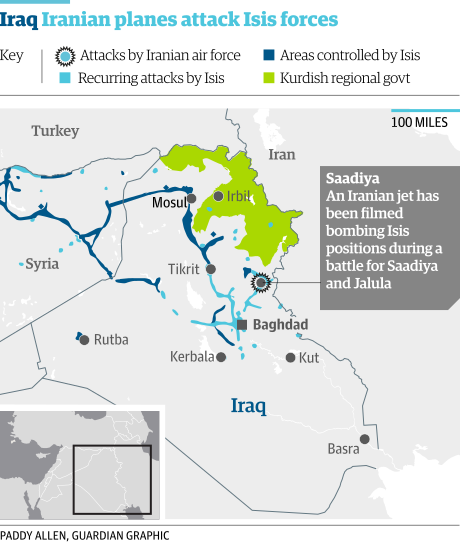
Iran’s air force has attacked targets of Islamic State (Isis) in eastern Iraq, the Pentagon has said.

Tehran has denied carrying out raids and acting in coordination with the US, which is leading a western-Arab coalition to defeat the jihadi group.

The Pentagon said air strikes in Iraq’s Diyala province were the first since Isis captured the Iraqi city of Mosul in June.

Rear Admiral John Kirby, the Pentagon spokesman, insisted that the US has not coordinated military activities with Iran. He said the US continued to fly its own missions over Iraq and that it was up to the Iraqi government to avoid conflicts in its own airspace.

“Nothing has changed about our policy of not coordinating military activity with the Iranians,” Kirby told reporters in Washington.

A senior Iranian official said no raids had been carried out and Tehran had no intention of cooperating with Washington.

“Iran has never been involved in any air strikes against Daesh [Isis] targets in Iraq. Any cooperation in such strikes with America is also out of question for Iran,” the senior official told Reuters.

In Tehran, the deputy chief of staff of Iran’s armed forces, Brigadier-General Massoud Jazayeri also denied any collaboration. Iran considered the US responsible for Iraq’s “unrest and problems”, he said, adding that the US would “definitely not have a place in the future of that country”.

Kirby’s comments followed reports that American-made F4 Phantom jets from the Iranian air force had been targeting Isis positions in Diyala. Jane’s Defence Weekly identified al-Jazeera footage of a jet flying over Iraq as an Iranian Phantom.

It had earlier been reported that Iran sent three Su-25 fighter jets to Iraq designed for close support of ground troops and that Iranian pilots flew Iraqi aircraft on combat missions.

The anti-Isis campaign has raised the intriguing possibility that the US and Iran, enemies since the 1979 Islamic Revolution, might work together against a common foe. The model has been seen as their brief cooperation against al-Qaida in Afghanistan after the 9/11 attacks. Talks about Iraq have taken place in the margins of the so-far inconclusive international negotiations about Iran’s nuclear programme.

But the US has repeatedly denied coordinating with Iran. Last month, following a personal letter sent by President Barack Obama to Iran’s supreme leader, Ayatollah Seyed Ali Khamenei, the US national security adviser, Susan Rice, said that “we are in no way engaged in any coordination – military coordination – with Iran on countering Isil [another name for Isis]”.
Iranian F-4 fighter jets fly during a military parade in April. Iranian F-4 fighter jets fly during a military parade in April 2014. Photograph: Atta Kenare/AFP/Getty Images

The two countries remain at odds over the crisis in Syria, with the US calling for the removal of Bashar al-Assad and backing rebel forces. Iran, displaying far greater commitment, provides military and financial support for his regime. Tacit cooperation between Washington and Tehran over Iraq is seen as a classic example of the notion of “my enemy’s enemy becoming my friend”. Key US allies in the Middle East, especially Israel and Saudi Arabia, fear any kind of US-Iranian rapprochement.
Advertisement

The US has not invited Iran to join the coalition fighting Isis, and Iran has said it would not join in any case. The grouping includes the UK, France and Australia as well as Saudi Arabia, Jordan, the UAE and Bahrain – Sunni Arab states which are deeply suspicious of Iran’s regional ambitions.

Iran has been actively involved in supporting the Shia-led Baghdad government and in recent weeks has gradually raised the profile of its semi-covert presence in Iraq, especially the activities of General Qasim Suleimani, commander of the al-Quds force of the Revolutionary Guards Corps. Suleimani has coordinated the defence of Baghdad and worked with Shia miltias and Kurdish troops.

The US-led air campaign against Isis began on 8 August in Iraq and was extended into Syria in September. But several countries, including the UK, which operate in Iraq, refuse to do so in Syria – highlighting confusion about overall strategy.

News of Iran’s apparently widening role emerged as minsters from the coalition met at the Nato HQ in Brussels for a summit chaired by the US secretary of state, John Kerry.

Speaking at the summit, Kerry said the US-led coalition had inflicted serious damage on Isis, but that the fight against the militants could take years.

“We recognise the hard work that remains to be done,” Kerry said. “Our commitment will be measured most likely in years, but our efforts are already having a significant impact.”

“We will engage in this campaign for as long as it takes to prevail,” he added.

Talks are focusing on military strategy as well as ways to stem the flow of foreign fighters joining Isis and how to counter its slick propaganda, disseminated on social media. The meeting will discuss ways to send “counter-messages” to de-legitimise Isis, a senior US state department official told AFP.

Juan Cole: The Bush Administration Spent Billions on an Iraqi Army With 50,000 ‘Ghost’ Soldiers – Juan Cole – Truthdig

Juan Cole: The Bush Administration Spent Billions on an Iraqi Army With 50,000 ‘Ghost’ Soldiers – Juan Cole – Truthdig.

Our SAS are training ghosts why are we there? Humpty Dumpty fell off the wall back in 2004: Abbott’s been silent for weeks talks as if we have done the job though.

Isis fighters parade through Mosul in an Iraqi army vehicle. The city was supposed to have 25,000 de

Isis fighters parade through Mosul in an Iraqi army vehicle. The city was supposed to have 25,000 defenders but 15,000 were ‘ghost soldiers’.

Iraqi government investigation finds 50,000 ‘ghost soldiers’ on army payroll

Missing soldiers explains rout of Iraqi forces in Mosul by Isis and city’s collapse in face of jihadis’ advance in June, say officials

Iraq’s new government has found 50,000 “ghost soldiers” who received army pay without showing up for work, a practice that accelerated the military’s collapse in the face of Islamic State (Isis) fighters six months ago.

The names were uncovered in an investigation inquiry launched by the prime minister, Haidar al-Abadi, who took office in September, his spokesman, Rafid Jaburi, said.

“Ghost soldiers” were are men on the army payroll who pay their officers a portion of their salaries and in return do not show up for duty, enriching their commanders and hollowing out the military force.

“Those 50,000 soldiers were revealed after an intense search through military documents and there will be a field search in order to put an end to this phenomenon and any other form of corruption,” Jaburi said.

Local officials in Mosul said the city should have been defended from an Isis attack in June by 25,000 soldiers and police, but in reality the number was at best 10,000. Islamic State militants took over the city with barely a fight.

The United States, which has spent billions of dollars trying to build up Iraq’s armed forces before it pulled out in 2011, has sent military advisers back to Iraq to train them to take on the Isis fighters who now control much of the north and west of the country.

Since taking over as premier from Nouri al-Maliki, Abadi has sacked dozens of military officials appointed during Maliki’s eight-year rule and pledged to root out corruption.

On Monday Abadi’s office announced that he had retired 24 senior interior ministry officials and replaced them with new officers under a reform plan to make the security forces “more effective in confronting terrorism”. The finance minister, Hoshiyar Zebari, told Reuters last week there was a need for deep-rooted reform of the security forces to fight corruption and mismanagement. “The military has to be cleaned of all these numbers, figures of ghost soldiers and other mismanagement,” he said.

Iran fears Isis militants are part of wider Sunni backlash

Iran’s Ayatollah Khamenei has called several times in recent months for Muslim unity. Pictured here at a Revolutionary Guard military manoeuvre in a western province near the border with Iraq in 2004.

With Islamic State militants just kilometres from the country’s western border, and increasingly radical anti-Shia militants to the east in Pakistan, Gareth Smyth examines Iran’s Sunni problem

Nearly ten years ago, a story circulating in Tehran had Mohammad Khatami say of Mahmoud Ahmadinejad, his successor as president, “No matter how extreme you are, you will always be in a queue behind Ousama [bin Laden].”

This may well have been an urban folk tale, but it highlighted a fear that Ahmadinejad’s assertive Shi’ism was not in Iran’s best interests. Rather than spread Iranian influence, unleash a revolution of the world’s dispossessed, or liberate Jerusalem from the Israelis, Iranian radicalism carried the danger of a backlash from Sunnis Muslims, who are around 80% of the world’s 1.6 billion Muslims, while Shia are 10-15% and a majority in only Iran, Iraq, Azerbaijan and Bahrain.

Is that nightmare now becoming real? Today the Islamic State (Isis), which regards Shia as infidels and has killed thousands, is barely kilometres from the Iranian border in Iraq’s Diyala province. But if the rapid rise of Isis to the west has alarmed the Iranian public, there are also developments to its east.

Several Pakistan Taliban commanders have declared their loyalty to Isis, including former spokesman Shahidullah Shahid. There are reports of Isis establishing an affiliate, Ansar-ul Daulat-e Islamia fil Pakistan, and luring recruits from two Sunni militant groups, Lashkar-e Jhangvi and Ahl-e Sunnat Wai Jamat.

For 30 years, Pakistan has been a centre of a brand of Sunni extremism, related to Saudi Wahhabism, that considers Shia apostates. Violence against Shia has killed thousands in recent years. In Baluchistan, neighbouring Iran, eight Shia were taken from a bus in October and gunned down in Quetta, the provincial capital.

A Human Rights Watch report in June highlighted a litany of atrocities against Shia, especially against ethnic Hazara in Baluchistan province, that have killed many hundreds in recent years, including two bombings in Quetta in 2013 in which at least 180 died.
Pakistani Baluch army recruits take part in a training exercise in Quetta in 2010.
Facebook
Twitter
Pinterest
Pakistani Baluch army recruits take part in a training exercise in Quetta in 2010. Photograph: Aamir Qureshi/AFP/Getty Images

It is not easy for Iran to isolate its own territory. Around 10 million Baluchis straddle Iran’s Sistan-Baluchistan and Pakistan’s Baluchistan, both poor provinces with widespread drug smuggling.
Advertisement

Last year Iran executed 16 members of Jundallah, which had carried attacks on Iranian security forces, mixing Baluchi nationalism with al-Qaeda style practices including beheadings, and declared its insurrection over.

But a new group, Jaish al-Adl, appeared and in February captured five border guards, provoking a drawn-out crisis that provoked major social media activity among alarmed Iranians before mediation by the main Sunni leader in Sistan-Baluchistan, Abdul-Hamid Esmaeel-Zehi, secured the release of four.

Iran fears both that the United States and Saudi Arabia have encouraged Jundallah, alleging when it captured and hanged its 27-year-old leader Abdul-Malik Rigi in 2010 that he had visited the US air base in Bagram, Afghanistan, shortly before his capture. The New York Times has recently offered new evidence of US intelligence involvement with the group.

Iran is also aware of collusion between sections of Pakistani security – especially Inter-Services Intelligence (ISI) – with militant Sunni groups, which goes back at least to both Saudi and Pakistani intelligence fuelling jihad against Russia in Afghanistan in the 1980s.

Hence the limits of last year’s bilateral agreement with Pakistan to co-operate against crime and security threats were exposed by several weeks of recent border tensions. In October, Tehran warned Pakistan after militants killed at least four Iranian soldiers or border guards, and then reportedly crossed the border (17 October) and, according to Pakistan, killed one and wounded three border guards. This culminated, a few days later, with the two sides’ armed forces exchanging mortar fire and the dispatch of a deputy Iranian foreign minister for urgent talks.

Pakistani officials have denied Iran’s claims that insurgents use Pakistan as a base, with some arguing unrest has its origins in legitimate Baluchi resentment. With support growing for Isis, this is no time to be “soft” on Shia Iran.

But for Iran, the Baluchi make a Sunni-Shia conflict domestic. Inside Iran, Sunnis are around 10% of the country’s 78 million people and are mainly ethnic Baluchi or Kurds. Extreme Sunni militancy has made far less headway among the Kurds than among the Baluchi, partly due to the influence of Sufism and the strength of pre-Islamic Kurdish culture, but a growth in Kurdish nationalism caused by both Syrian and Iraqi Kurds fighting Isis has its own implications for Iran’s 8 million Kurds.

But in any case, all Iran’s Sunnis allege discrimination in government employment and investment, and begrudge the absence of a Sunni mosque in Tehran and the common naming of buildings and streets in Sunni provinces after Shia leaders.

President Hassan Rouhani has promised to address the grievances of both ethnic and religious minorities. In last year’s presidential election, he did better in Kordistan province (which is not all of the mainly Kurdish region) with 71% and Sistan-Baluchestan (of which Sistan is mainly Shia) with 73% compared to 51% nationally. But delivery is far from easy, as Mohammad Khatami found when he made similar promises.

While there is political opposition to reform both among Shia clerics and the political class, Iranian security favours “strategic depth”, whereby border provinces are heavily militarised to create a buffer, an approach that can fuel resentment as much as improve security.

In terms of politics, Iranian leaders have been at pains to deny there is a regional battle between Shia and Sunnis and to argue that Sunni militants should be distinguished from the wider Sunni community. Ayatollah Ali Khamenei, the supreme leader, has called several times in recent months for Muslim unity. He told Iranian hajj officials in late October that the “ummah shouldn’t practise hostility towards each other, but should support each other over important global issues”.

But does at least some hostility towards Shia – and therefore rise of militant Sunni groups – stem from the behaviour of Iran and its allies?
An Iranian Revolutionary Guard covers his chest with a portrait of Lebanon’s Hezbollah leader Hassan Nasrallah.
Facebook
Twitter
Pinterest
An Iranian Revolutionary Guard covers his chest with a portrait of Lebanon’s Hezbollah leader Hassan Nasrallah. Photograph: Behrouz Mehri/AFP/Getty Images

The 2003 US-led invasion of Iraq unnerved the Sunni-led states, especially Saudi Arabia, by creating a new, Shia-led order in Baghdad that Iran welcomed. In 2008, Hezbollah’s military assertion in west Beirut, in response to a Sunni-led government challenging its security role at the airport, alienated “moderate Sunnis”. Above all, by 2012 the Syrian war appeared clearly sectarian as an Iranian-backed, Allawi-led regime confronted mainly Sunni rebels.

Since Isis took Mosul in June, Iran’s approach in Iraq has been rooted in Shia solidarity. Nouri al-Maliki, Iraqi vice-president and as former prime minister widely blamed for alienating Iraq’s Sunnis, was recently in Iran to improve what he called “mutual co-operation” against “Takfiri terrorists”. Shia militia leaders in Iraq have been quoted extolling the role of Qassem Soleimani, the head of the al-Quds section of Iran’s Revolutionary Guards, to the extent of leading a front-line operation in the recapture of Jurf al-Sakher from Isis, shunning a flak jacket in the process.

Human Rights Watch has documented abuses both by mainly Iraqi Shia government forces and by Shia militias (it has described the two as “indistinguishable”). After the killing of 34 civilians in a mosque in Diyala province in August, Joe Stork, HRW regional director noted: “Iraqi authorities and Iraq’s allies alike have ignored this horrific attack and then they wonder why the militant group Islamic State has had such appeal among Sunni communities.”

Iraqi PM removes dozens of commanders – Middle East – Al Jazeera English

Iraqi PM removes dozens of commanders – Middle East – Al Jazeera English.

The top eschelons of the Iraqi army removed. Why would that be to make way for Abbot’s advisers? For security reasons? Nobody can really be sure. Abbott hasn’t a clue. How safe is this deployment that has been accused of having been overpaid?

Our forgotten allies against Islamic State: Iraqi and Syrian women

Women and girls living in Syria and Iraq have been subject to gross sexual violence, economic strife and the psychological trauma of a war that, to them, seems endless. But women in these countries are not just victims of violence, they are also great agents for change. These women should be our best allies in the fight against Islamic State.

We have seen reporting on female Kurdish fighters; women who were university students, mothers and grandmothers. But women are not just taking up arms. Though missing from the news, women in Syria and Iraq are also working towards peace. For example, in the suburbs of Damascus, a women’s group negotiated a 40-day ceasefire between regime and opposition forces to allow the passage of essential supplies.

The US-led international coalition needs to go beyond seeing women as passive victims of this war. Instead, it needs to connect with these women, whose work is central to long-term stabilisation and peace in Syria and Iraq.

What is the world doing to help these women?

Nearly eight in ten of the 6.8 million people who have been displaced by the conflict in Syria are women and children. The United Nations has appealed for more than US$2.2 billion to meet critical humanitarian needs of displaced people, but the international community has committed only one-third of what is needed.

Gender concerns are being integrated into humanitarian planning and programming, but women and girls still face huge challenges.

The International Rescue Committee recently completed a large survey of Syrian women and girls. When asked “what are the biggest challenges you are facing?”, the most common responses related to the daily reality of sexual exploitation and harassment:

Constantly fearful, women and girls told us about extreme levels of harassment.

Islamic State is using sexual violence as a weapon of war. The United Nations in Iraq has said that:

… some 1500 Yazidi and Christian persons may have been forced into sexual slavery.

When sexual violence is used as a weapon of war, the social fabric needed to recover from conflict is threatened. Even the UN Security Council has stated in the past that sexual violence:

… can significantly exacerbate situations of armed conflict and may impede the restoration of international peace and security.

https://www.youtube.com/watch?feature=player_embedded&v=6ugKcwZjdxE

The women leaders we could be supporting

There is increasing acknowledgement that victory against Islamic State will take more than just dropping bombs. We know from recent experiences in Afghanistan that violent extremism thrives in places where governance and the rule of law are virtually non-existent. There, military analysts knew that coalition forces were being out-governed by the Taliban.

Local community leaders in Syria now fear that people will become radicalised in places where there is no employment, education or other opportunities. But there can be no stability if we do not address the security concerns of half the population.

October 31 marks the 14th anniversary of the landmark UN Security Council Resolution 1325 that formalised women’s participation and protection as a priority of international peace and security. It was the first in a suite of seven resolutions to acknowledge the disproportionate impact of conflict on women and girls.

Shatha Naji Hussein from the Iraqi organisation Women for Peace has won multiple global awards for her peace efforts. United Nations Assistance Mission for Iraq
Click to enlarge

That resolution obliges member states not just to protect women from sexual violence, but also to increase their participation in prevention, mitigation and resolution of conflict.

In Iraq, women like Shatha Naji Hussein work to secure the right for women to build a safer future. It’s a two-way process between civil society and government to empower women to bring about positive change in their communities. It’s women like this that the international community need to support in the fight against Islamic State.

Syrian radio talkshow host and producer Honey Al Sayed. Institute for Inclusive Security
Click to enlarge

We need to support women like Honey Al Sayed, who is promoting leadership and tolerance in Syria by communicating positive messages at the grassroots level, particularly to youth groups. She co-founded the online radio station Radio SouriaLi, which promotes civic engagement, community development and responsible citizenship, under the motto “Unity in Diversity”.

Only with local leadership can there be effective conflict resolution and transition. Women like Afra Jalabi, who started The Day After Project, have developed plans for a post-conflict, democratic Syria.

The Syrian Women’s League has conducted a comparative assessment of constitutions in the region to establish a set of guiding principles for a new Syrian constitution.

What Australia and our allies can do

At the Annual Civil Society Dialogue on Women, Peace and Security on September 23, Australia’s Minister Assisting the Prime Minister for Women, Senator Michaelia Cash, said:

… there are countless other women who have the skills and capabilities to participate in peace-building and peacekeeping. But they are denied the opportunity. This must be remedied.

Having made military commitments to the conflict with Islamic State, the Australian government now needs to prioritise the commitments made in the Australian National Action Plan on Women, Peace and Security 2012-2018. It is a whole-of-government policy, which has bipartisan support.

One of the strategies of the National Action Plan is to “take a co-ordinated and holistic approach” to women, peace and security.

Of course, Australia and our allies need to invest in the protection of women and girls affected by the conflict in Syria and northern Iraq. But as Cash rightly pointed out, women are not merely victims in this conflict: they also have vital skills and local knowledge.

To defeat Islamic State in the long run, the world needs to support Iraqi and Syrian women to be more actively involved in conflict mitigation, resolution and peace processes. Australia could be doing more – and we need to be pushing our allies to do the same.

Kurdish convoy heads to Syria to take on Islamic State. What do these Kurds have to do?

A convoy of peshmerga vehicles is escorted by Turkish Kurds on their way to the Turkish-Syrian border, in Kiziltepe near the southeastern city of Mardin October 29, 2014. REUTERS-Stringer

(Reuters) – A convoy of peshmerga fighters from northern Iraq headed across southeastern Turkey on Wednesday towards the Syrian town of Kobani to try to help fellow Kurds break an Islamic State siege which has defied U.S.-led air strikes.

Kobani, on the border with Turkey, has been under assault for more than a month and its fate has become a test of the U.S.-led coalition’s ability to combat the Sunni Muslim insurgents.

Weeks of air strikes on Islamic State positions around Kobani and the deaths of hundreds of their fighters have failed to break the siege. The Kurds and their international allies hope the arrival of the peshmerga, along with heavier weapons, can turn the tide.

The Kurdish fighters were given a heroes’ welcome as their convoy of jeeps and flatbed trucks, some bearing heavy machineguns, snaked its way for around 400 km (250 miles) through Turkey’s mostly Kurdish southeast after crossing the border from northern Iraq.

The presence of Kurdish forces passing with government permission through a part of Turkey which has seen a three-decade insurgency by local Kurdish PKK militants was an extraordinary sight for many residents.

Villagers set bonfires, let off fireworks and chanted by the side of the road as the convoy passed. Thousands took to the streets of the border town of Suruc, descending on its tree-lined main square and spilling into side streets, some with faces painted in the colors of the Kurdish flag.

“All the Kurds are together. We want them to go and fight in Kobani and liberate it,” said Issa Ahamd, an 18-year-old high school student among the almost 200,000 Syrian Kurds who have fled to Turkey since the assault on Kobani began.

An initial group of between 90 and 100 peshmerga fighters arrived by plane amid tight security in the nearby city of Sanliurfa early on Wednesday, according to Adham Basho, a member of the Syrian Kurdish National Council from Kobani.

Saleh Moslem, co-chair of the Syrian Kurdish Democratic Union Party (PYD), said the peshmerga were expected to bring heavy arms to Kobani – known as Ayn al-Arab in Arabic.

“It’s mainly artillery, or anti-armor, anti-tank weapons,” he said. The lightly armed Syrian Kurds have said such weaponry is crucial to driving back Islamic State insurgents, who have used armored vehicles and tanks in their assault.

Kurdistan’s Minister of Peshmerga, Mustafa Sayyid Qader, told local media on Tuesday that no limits had been set to how long the forces would remain in Kobani. The Kurdistan Regional Government has said the fighters would not engage in direct combat in Kobani but rather provide artillery support.

RADICAL ISLAM

Islamic State has caused international alarm by capturing large expanses of Iraq and Syria, declaring an Islamic “caliphate” that erases borders between the two. Its fighters have slaughtered or driven away Shi’ite Muslims, Christians and other communities who do not share their ultra-radical brand of Sunni Islam.

Fighters from the Nusra Front, al Qaeda’s official affiliate in the Syrian civil war, have meanwhile seized territory from moderate rebels in recent days, expanding their control into one of the few areas of northern Syria not already held by hardline Islamists.

Nearly 10 million people have been displaced by Syria’s war and close to 200,000 killed, according to the United Nations. A Syrian army helicopter dropped two barrel bombs on a displaced persons camp in the northern province of Idlib on Wednesday, killing many, camp residents said.

In Iraq, security forces said they had advanced to within 2 km (1.2 miles) of the city of Baiji on Wednesday in a new offensive to retake the country’s biggest oil refinery that has been besieged since June by Islamic State.

Islamic State has threatened to massacre Kobani’s defenders, triggering a call to arms from Kurds across the region.

The U.S. military conducted 14 air strikes on Tuesday and Wednesday against Islamic State in Syria and Iraq, according to a statement from U.S. Central Command. Eight of the raids destroyed Islamic State targets near Kobani, it said.

At least a dozen shells fired by Islamic State fighters fell on the town overnight as clashes with the main Syrian Kurdish armed group, the YPG, continued, according to the British-based Syrian Observatory for Human Rights.

It said preparations were being made at a border gate which Islamic State fighters have repeatedly tried to capture before the arrival of the peshmerga, while YPG and Islamic State forces exchanged fire in gun battles on the southern edge of the town.

The Observatory also said 50 Syrian fighters had entered Kobani from Turkey with their weapons, though it was unclear which group they belonged to. Turkey has pushed for moderate Syrian rebels fighting President Bashar al-Assad to join the battle against Islamic State in Kobani.

Rebel commander Abdul Jabbar al-Oqaidi said he had led 200 Free Syrian Army fighters into Kobani but there was no independent confirmation of this. The FSA describes dozens of armed groups fighting Assad but with little or no central command. It is widely outgunned by Islamist insurgents.

DELICATE PARTNERSHIP

The Iraqi Kurdish region’s parliament voted last week to deploy some peshmerga forces to Syria and, under pressure from Western allies, Turkey agreed to let then cross its territory.

The United States and its allies in the coalition have made clear they do not plan to send troops to fight Islamic State in Syria or Iraq, but they need fighters on the ground to capitalize on their air strikes.

Syrian Kurds have called for the international community to provide them with heavier weapons and munitions and they have received an air drop from the United States.

But Turkey accuses Kurdish groups in Kobani of links to the militant PKK (Kurdistan Workers’ Party), which has fought the insurgency against the Turkish state and is regarded as a terrorist group by Ankara, Washington and the European Union.

That has complicated efforts to provide aid.

A Syrian Kurdish official said in Paris on Wednesday that France, which has taken part in air strikes in Iraq and given Iraqi peshmerga fighters weapons and training, had yet to fulfill a promise to give support to Kurds in Syria.

France has said it was ready to help the Kurds, but we haven’t been received by the French authorities. There has been no direct or indirect contact,” Khaled Eissa, representative in France of the Syrian Kurdish Democratic Union Party (PYD), said.

French officials confirmed there had been no meetings in large part due to concern about historic links to the PKK.

Ankara fears Syria’s Kurds will exploit the chaos by following their brethren in Iraq and seeking to carve out an independent state in northern Syria, emboldening PKK militants in Turkey and derailing a fragile peace process.

The stance has enraged Turkey’s own Kurdish minority, about a fifth of the population and half of all Kurds across the region. Kurds suspect Ankara, which has refused to send in its forces to relieve Kobani, would rather see Islamic State jihadists extend their territorial gains than allow Kurdish insurgents to consolidate local power.

ISIS is a scenario to destroy Russia. Black and White spies

ISIS is a scenario to destroy Russia. 53724.jpeg

The UN Security Council unanimously, which is a rare occasion during the recent years, adopted a resolution on the fight against terrorism. Pravda.Ru interviewed executive secretary of the Presidium of the Academy of Geopolitical Problems, Araik Stepanyan, about old and new threats in the Middle East and in the whole world.

“Why did Russia support the United States? Not that long ago, there was heated debate on the USA’s interference in the internal affairs of Syria and Ukraine. In fact, the United States wants to destroy Russia by the hands of Ukrainian fascists. Yet, Russia supported the States. Why so?”

“Russia has its list of terrorist organizations. Some of them, included on our list, are not included on the list of the United States. They consider them fighters for freedom and democracy and support some of them. Russia calls for the coordination of databases of terrorist organizations, so that they are clearly considered as terrorist organizations for the whole world. In this case, it would be possible to catch members of such organizations and bring them to trial, rather than simply bomb sovereign states. Russia voted for coordinated legal international action.”

“Do we have a certain interest at this point?”

“Of course. The USA and Turkey did not consider ISIS a terrorist organization. Russia does not consider the Kurdistan Workers’ Party a terrorist organization, but the Americans consider them as such. Russia considers the Muslim Brotherhood a terrorist organization, but the Americans do not. We have different opinions. Even Egypt found Muslim Brotherhood a terrorist organization. So we do have our own interests here. Moreover, Russia may even restrict the Americans in their actions to a certain extent. It is very hard to convince the Americans to give up their positions. They are stubborn, even if they are wrong. This is their view and their policy.”

“Russian Foreign Minister Lavrov diplomatically did not name those who are directly responsible for the growing threat of the Islamic State. He said that the bombing of Libya and the Syrian conflict led to the fact that ISIS now poses a huge threat to the world. He does not call Western countries responsible for that. Is it a part of covert struggle to change the Americans’ position on Ukraine, support the USA in the fight against ISIS and obtain their neutrality in Novorossiya?”

“The rhetoric of the Russian foreign minister represents Russian diplomatic school. His remarks are indeed diplomatic. He is absolutely correct not to name responsible sides specifically, because it includes the entire intelligence network of the United States represented by Al-Qaeda and Al-Nusra, from which ISIS broke away. These are the structures that the Americans created.

“They invested from three to nine billion in Bin Laden. Where did Al-Qaeda go? Each of those organizations performs a specific function. Al-Qaeda let the Americans invade the Middle East, Afghanistan and farther – they have bases on the territory of the former Soviet Union already. Al-Qaeda quietly disappeared. But first, the American leadership was using Al-Qaeda to intimidate the world and the American society. Records of Bin Laden’s threats would appear regularly. Today, instead of audio recordings, the world watches video, in which terrorists behead hostages. And once again, the United States starts shaking the international community, convincing all and everyone that one has to bomb them and so on and so forth.”

“Do you think all of this is staged?”

“All of this is a game of the USA. They punish the forces that do not want to obey the Americans. Those who do, receive support and help from the USA. American schizophrenic McCain always speaks cynically and impudently. This is the style of American diplomacy – hypocritical and cynical diplomacy. McCain says that he is constantly in touch with American partners, that the United States considers them fighters against the regime of dictator Assad. They put Assad on a par with these ISIS thugs. If everything goes according to the American scenario, they support them. If someone goes against the US line, the Americans punish them.”

“What is the ultimate goal of this scenario?”

“Of course, the goal of the American foreign policy is to destroy Russia. Another goal of theirs is China. All of these processes that take place in the Middle East were launched in the United States targeting Russia and China.”

“Is the current bombing of ISIS in Syria a start of the operation that will then proceed to the destruction of Bashar Assad?”

“Of course. The Americans supply weapons to the so-called Liberation Army, but it is very weak. An-Nusra, ISIS and other groups captured warehouses of that army. There are no Syrians in those organizations, because the Syrians do not want to destroy their country. There are mercenaries from all over the Islamic world, from the former Soviet Union.

“By bombing, the Americans want to strengthen the organization that they control, so that this organization defeats Syria afterwards. There is a version that the head of the Islamic State, al-Baghdadi, is a citizen of Israel, who was put into that organization. He had been in American prisons, but then the Americans freed him and made him a leader. The Americans were trying to do the same with al-Nusra, but failed. Those guys were more ruthless, more cunning, more daring. ISIS crushed the Syrian opposition and an-Nusra because they had a universal ideology. Now they have territory, caliphate, leader, money, army.

“ISIS has something from everything. It has something from Jehovah’s Witnesses, from archaic Judaism, from the criminal world … That is, they built a fine, universal and simple ideology. The main idea of ​​it is the false understanding of the end of the world. To be saved, one needs to unite and go to the end of the world together. In another world, they will have beautiful women, etc.”

“If this is a script for the destruction of Russia and China, why is the Russian government being so inactive in its responses? Why doesn’t Russia ship arms to Assad? Why doesn’t Russia protest against the bombing of Syria? Where did this protest go?”

“For many years, our country was running the foreign policy of total retreat and defeat. During this time, a part of the liberal elite has penetrated into the structures of power, there is a very powerful force in oligarchic circles that do not support Russia’s national interests. They support Western policies. Our leadership is fragmented, so it can not be more confident, more rigid in its actions.”

“Probably, it could also be due to the fact that Russia is economically weak compared to America. Have sanctions put pressure on us?”

“They did, but Russia is a self-sufficient country. It has all resources that one needs. The main thing is how to organize them. If it wasn’t for those saboteurs, who had been investing in Western banks for 25 years, rather than the Russian economy, science and education, we would be the most prosperous country in the world. We have so many opportunities. Despite the brain drain during the 1990s, Russia still has a scientific and technical potential. Yet, those, who sympathize with the West, do not want that to happen. It is convenient for them to make money here and then invest it in the West. Their children study in the West. Money is invested there.

“The West accuses Russia of corruption. Where do Russian corrupt officials go? Has any of them escaped to India or China, for example? No. All of them escaped to the West. Westerners take what they want. They declared Muammar Gaddafi’s money the money of a dictator and put a trillion dollars into their pockets. They can do just the same to the money of Russian oligarchs. Just as easily, they can arrest accounts and confiscate all money. The Americans clearly gave a signal to Russian oligarchs: kill Putin or remove him by any means, and we will continue welcoming you.”

“Why doesn’t Putin respond to that?”

“We have neither NKVD, nor Gestapo. One needs to have it done in a civilized way, not to shock the society. Vladimir Putin gave a clear signal that Russia won’t let down Syria, South Ossetia, Abkhazia and the Crimea. The Americans understand that Russia is becoming stronger.”