Supporters of Darren Wilson and apologists for Ferguson officials are desperate to change the subject. Here’s why
From the very beginning, before St. Louis County prosecuting attorney Robert McCulloch had uttered the first word of his defensive and dissembling speech, the fix was in. The conspiracy this time was not to protect Officer Darren Wilson from standing trial for the killing of Michael Brown, though that was certainly related. This time, the conspiracy was to organize the announcement of Wilson’s exoneration in as provocative a way as possible. The ultimate goal was to manipulate the public and the press into forgetting the real story of Ferguson — of police brutality and racial injustice — and bickering about the morality of rioting instead.
At the very least, that’s the impression I’ve had throughout the Ferguson controversy, especially as the wait for news from the grand jury dragged on, and as the county’s offices began leaking pro-Wilson factoids like a sieve. And after witnessing last night’s spectacle, which was preceded by multiple delays and conspicuous readying of the state’s police forces, I’m no less convinced that the powers that be in Missouri approached the Wilson verdict with little concern for accountability or justice. All they wanted was to improve the Ferguson power structure’s battered images — not by doing good, but by making the protesters look even worse. It’s a tried and tested strategy; as Rick Perlstein has documented, it helped make Richard Nixon president.
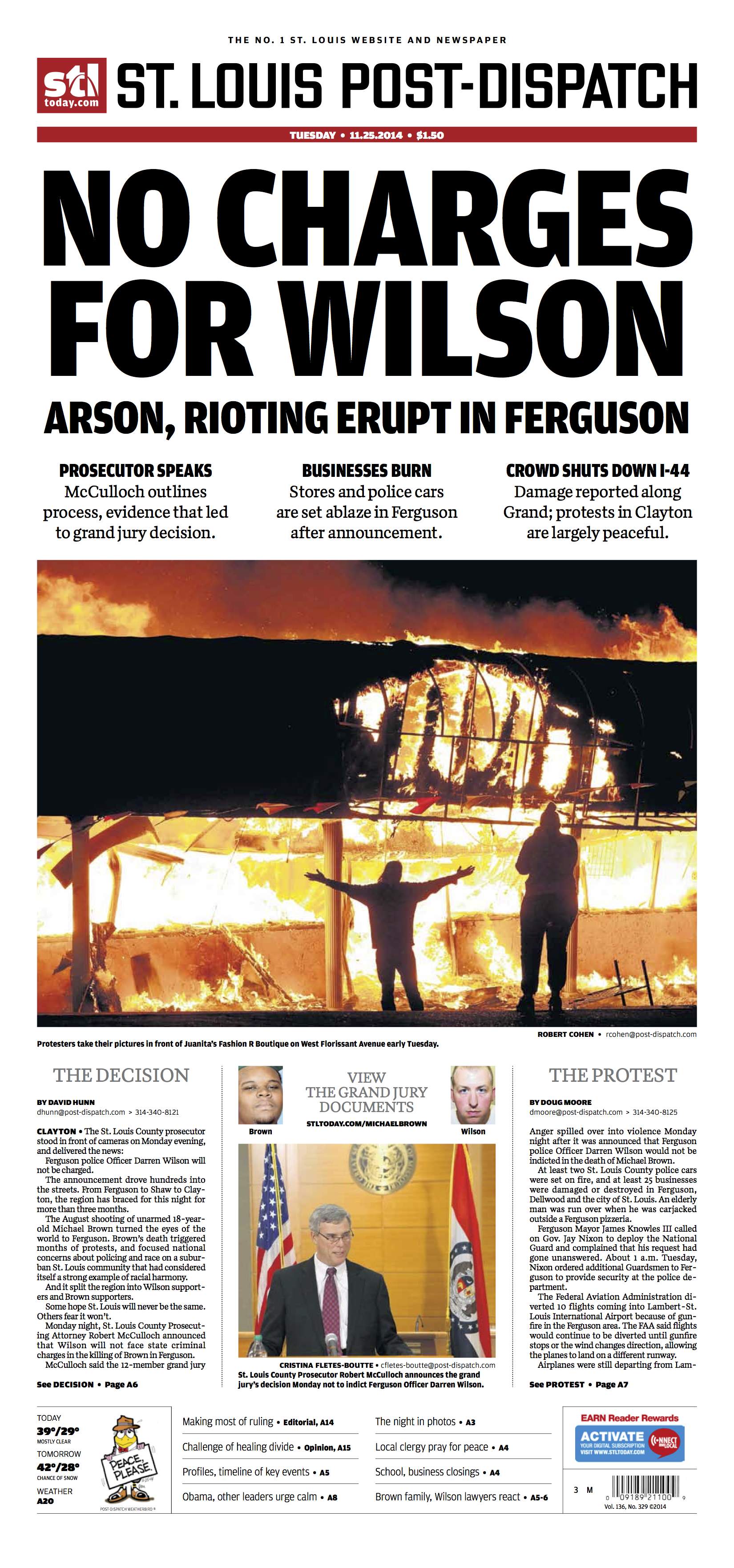
A quick look at the nation’s front pages on Tuesday indicates that the plan worked on some, but fewer perhaps than these would-be Pat Buchanans wanted. By maneuvering to incite disorder and polarize public opinion along race lines, these would-be Nixons probably thought they could “cut the … country in half,” as Buchanan recommended, and walk away with “far the larger half.” But while some of the biggest names out there fell for the trick, focusing on the small number of rioters instead of Wilson’s verdict, most editors understood that the controversy in Ferguson remains what it’s always been: A jarring and dispiriting reminder that the Declaration of Independence’s assertion of universal human equality (the “promissory note,” as Martin Luther King Jr. once called it) remains, for millions of Americans, a debt unpaid.
 Elias Isquith is a staff writer at Salon, focusing on politics. Follow him on Twitter at @eliasisquith, and email him at eisquith@salon.com.
 olddogthoughts