Tag: Death Penalty

America’s inability today shows in desparation. It’s Oligarchic feudilism showing.

Anti-lockdown protests in the US

Americans are protesting on the streets – many standing shoulder-to-shoulder and without face masks – against the coronavirus shutdowns.

In the US, the crisis has cost at least 22 million Americans their jobs, pushing the unemployment rate toward levels not seen since the Great Depression.

Many Americans, especially in rural areas and other parts of the country that have not seen major outbreaks, have urged governors to reopen their economies.

Hundreds of protesters gather outside Minnesota Govenor Tim Walz' official residence on Friday, April 17.
Hundreds of protesters gather outside Minnesota Governor Tim Walz’ official residence on Friday, April 17.Credit:AP

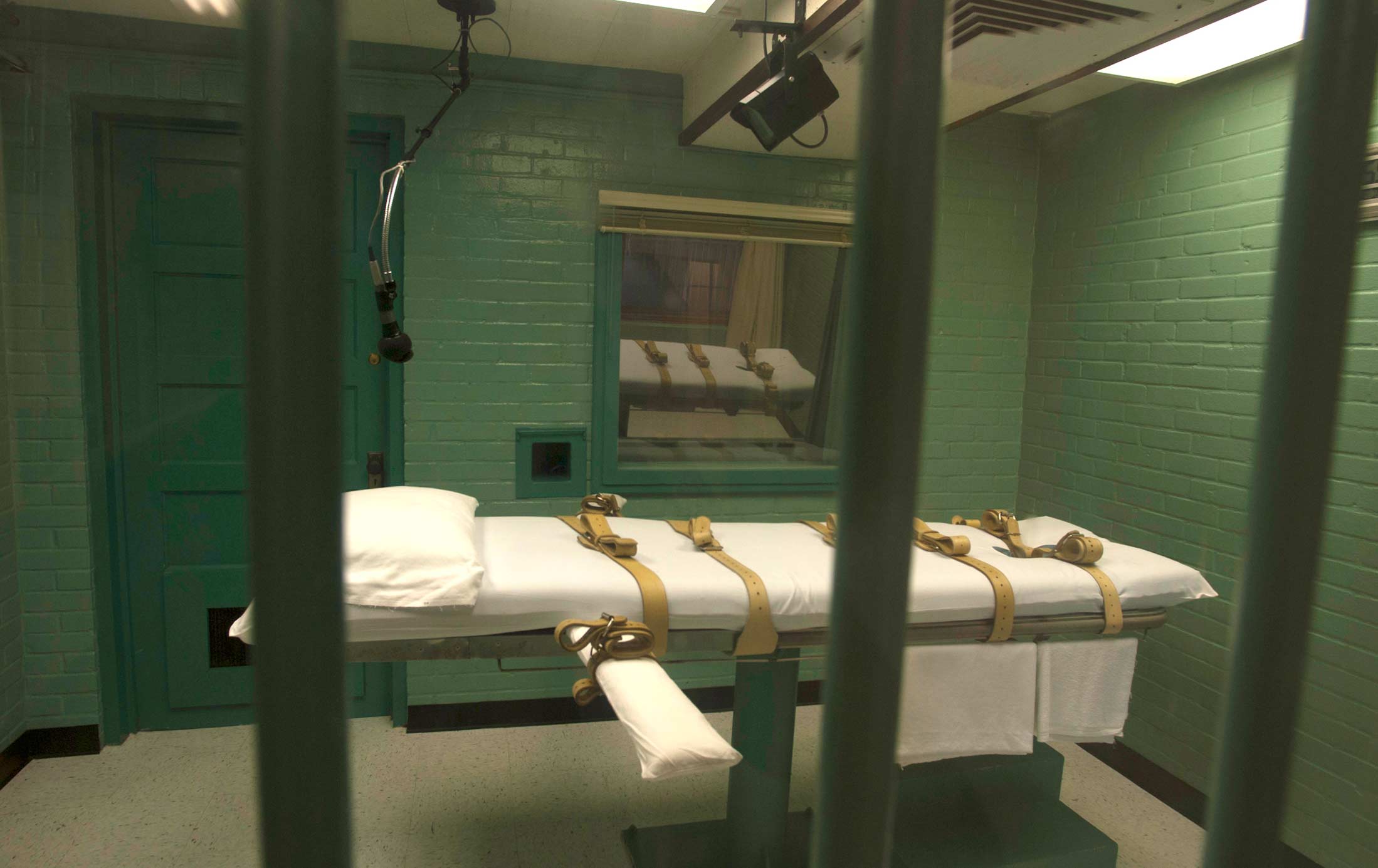
The Trump Administration’s Death Penalty Cult | The Nation

death_row_room_img

via The Trump Administration’s Death Penalty Cult | The Nation

Apartheid: Israel’s Netanyahu wants Death Penalty Solely for Palestinians

The Israeli parliament is scheduled to discuss a bill that would ease requirements on the death penalty for Palestinians next week.

Israel’s Prime Minister Benjamin Netanyahu supported a bill that would allow the imposition of the death penalty for Palestinians charged with attacking Israelis. Debate on the bill is scheduled to restart next week.

via Apartheid: Israel’s Netanyahu wants Death Penalty Solely for Palestinians

Trump & Media Focus on Muslims After Attack in NYC, Even as NYPD Says Islam Played No Role | Democracy Now!


Image result for Farhana Khera images

Trump & Media Focus on Muslims After Attack in NYC, Even as NYPD Says Islam Played No Role | Democracy Now!

700 Executions in Iran this year. The Abbott Government is doing it’s best to send 1000 Iranian back to the country from which they fled.

Amnesty International protested at what it called a

Amnesty protests ‘staggering execution spree’ in Iran

Death for Chan and Sukumaran while home-town kingpin gets reprieve

Death: Andrew Chan and Myuran Sukumaran.

Death: Andrew Chan and Myuran Sukumaran.

It’s a tale of two drug rings in Indonesia. The first manufactured kilograms of the drug ice, known locally as sabu sabu, at a factory in Surabaya and pumped it out throughout the country, hooking Indonesia’s youth. The second was the Bali Nine plot to transit 8.3 kilograms of heroin from Thailand to the streets of Australia with a brief stopover in Bali.

Suddenly, the attitude of the court changed. The death penalty, it found, violated Article 28 of the Indonesian constitution.

Both drug rings were busted by Indonesian police and the perpetrators brought to the courts. The key figures in both were handed the death penalty. But that is where the similarity ends.

Unaware of the specifics: Indonesian President Joko Widodo wearing a Napalm Death T-shirt.Unaware of the specifics: Indonesian President Joko Widodo wearing a Napalm Death T-shirt. Photo: VICE Media

The ice plot was masterminded by an Indonesian man called Hangky Gunawan. There is no dispute that he owned the drug factory, which was in Surabaya, East Java, as well as a major distribution network. It made him one of the country’s most notorious drug traffickers, and he was caught with more than 11kg of the highly addictive and dangerous drug.

When Indonesian president Joko Widodo says, as he has regularly, that drugs are destroying Indonesia’s youth, killing 40 to 50 a day, it’s this kind of operation that’s doing the damage. The United Nations Office of Drugs and Crime says Indonesia’s main drug problem comes from factory-manufactured amphetamines.

But in Hangky’s initial trial in 2007, the Surabaya district court handed down an 18-year sentence. Prosecutors appealed, and the Supreme Court changed it to death.

Reprieve: Hangky Gunawan.Reprieve: Hangky Gunawan. Photo: jaringnews.com

The case ran almost in parallel with that of Australians Myuran Sukumaran and Andrew Chan. At every step of their journey – from the Bali district court, through numerous appeals – the death penalty was reconfirmed.

In May 2011, Chan’s final appeal became case No. 37 in the Supreme Court in Jakarta, and Sukumaran case No. 38. They were seeking a judicial review from a full bench. In both cases, the death penalty was reconfirmed. The Indonesian system, they said, gave no quarter to drug convicts.

Then, with the very next case, No. 39, Hangky Gunawan made his bid for reprieve.

Suddenly, the attitude of the court changed. The death penalty, it found, violated Article 28 of the Indonesian constitution, which guarantees everyone the right to life. It went against the country’s 1999 law on human rights. The chief judge, Imron Anwari, went so far as to say the purpose of criminal sentencing was to educate, correct and prevent additional wrongdoing. It even quoted Article 3 of the UN Universal Declaration of Human Rights.

Hangky, the home-town boy, had his sentence reduced to 15 years which, under Indonesia’s relatively generous good-behaviour provisions, means he could be out in about eight. One of the judges, Achmad Yamanie, then crossed that out and reduced it even further to 12 years. He was later sacked dishonourably for that unauthorised adjustment.

But Hangky Gunawan had his reprieve.

The ruling actually, briefly, led to the hope that the Indonesian Supreme Court had found the voice of conscience when it came to the death penalty. Alas, it had probably just found a way to make an exception, though the panel, including the chief judge, were later cleared of allegations of bribery

Sukumaran and Chan, meanwhile are being moved to what is likely to be their final home; the ultramax island prison complex called Nusakambangan. They are foreigners; they have no money and therefore, in the Indonesian justice system, despite the untiring efforts of their lawyers, they have little voice.

And when the Indonesian president, Joko Widodo, was asked, upon rejecting their final plea for clemency, why he wanted to execute people who had been taking drugs out of the country, he did not even know the specifics of their case.

Such is the system of justice in Indonesia.

with Amilia Rosa

AFP’s role in Bali Nine case a ‘gross error’, should be cited when pleading for Andrew Chan and Myuran Sukumaran’s lives, lawyer says.The AFP provided Intel of an operation to smuggle drugs out of Indonesia not in. The AFP handed them to the Indonesian government knowing full well that there was a death penalty and celebrated.

Myuran Sukumaran and Andrew Chan wait in a holding cell at Denpasar Court.

One of the lawyers involved in the Bali Nine drug case says Australian police should never have cooperated with Indonesia given the likelihood of death sentences being imposed.

Brisbane lawyer Robert Myers said the Abbott Government should cite the role played by Australian Federal Police (AFP) in providing intelligence on the trafficking conspiracy when it makes a bid to save the lives of Andrew Chan and Myuran Sukumaran.

The pair are set to face the firing squad this year after a decision by the Indonesian government to go ahead with executing all 64 death row drug traffickers.

Mr Myers became involved in the case after receiving a phone call from his friend Lee Rush, the father of now convicted drug trafficker Scott Rush who is serving a life sentence, before his son left Australia.

“He called me one evening before the boys, well, particularly before Scott left Australia, with a concern that he had received a call to say Scott had an overseas ticket, he had a passport,” Mr Myers said.

“And so I said, ‘Well look, if you’ve got a concern, I’ll call a friend of mine in the Federal Police’. I knew a police officer who was on secondment and that really started the entire thing.”

The AFP’s liaison officer in Bali, Paul Hunniford, then wrote a three-page letter to the Indonesian police.

“It really said words to the effect of whatever action you see fit to take is quite alright with us, and it seemed to be an open-ended invitation to the Indonesian authorities,” Mr Myers said.

“If they wanted to take it beyond surveillance, if they wanted to arrest these people, even wanted to charge them, even wanted to subject them to Indonesian law, that the Australians weren’t going to have any problems with that.”

Australia in a ‘terribly embarrassing situation’

Mr Myers said the AFP’s involvement could help assist in saving the lives of Chan and Sukumaran.

“I suspect it may be their only hope now because, as I understand it, the Foreign Minister and the Prime Minister have appealed to Indonesia; it sounds as if the appeals have fallen on deaf ears,” he said.

There was no doubt that by allowing the Indonesians to really have cart blanche in relation to the Bali Nine, that all of the Bali Nine were being exposed to the death penalty.

Robert Myers, lawyer

“It just struck me as though if the Government, if the Prime Minister could say on behalf of the Australian Government, [that] we find ourselves in a terribly embarrassing situation because this should never have happened in the first place.”

He said had the AFP asked for cooperation from the Indonesian authorities about the groups’ movements and when they were returning to Australia, the matter could have been dealt with on home soil.

“And if there’s an appeal made on a personal basis you’d hope that the president of Indonesia might say, ‘Look, I can see you’re in an embarrassing situation where our countries are allies… we’d hate to see the Australian Government terribly embarrassed by really a very bad error, a gross error on behalf of the AFP’, which was completely contrary to its own restrictions and guidelines.

“There is no doubt that the Attorney-General would have to personally approve the cooperation between foreign entities that could result in the death of Australian citizens, and there was no doubt that by allowing the Indonesians to really have cart blanche in relation to the Bali Nine, that all of the Bali Nine were being exposed to the death penalty.”

Mr Myers said he did not know at what level the AFP’s decision was made.

“[Mick] Keelty was obviously the officer in charge of the entire show at the time.

“I don’t even know if this decision was made by Keelty but one would have thought the buck would have stopped with … well, the buck stops with the Attorney-General and my understanding is the Attorney-General knew nothing about it.”

Real Media, Alt News, Politics, Critical Thought, War, Global events, Australia, Headlines,