Tag: Charlie Hebdo

We’re all supporters of free speech … when it suits us: Surely the notion of Free Speech is an ideal that can only coincide with the ideals of Equality and Fraternity? Otherwise we hand Murdoch even more power on a platter than he has now. JE SUIS Mordecai Bromberg

Attorney-General George Brandis published a proposed revision of the Racial Discrimination Act.

Jonathan Holmes is a Fairfax columnist and former presenter of Media Watch.

For better or for worse, most Australians are not Charlie Hebdo

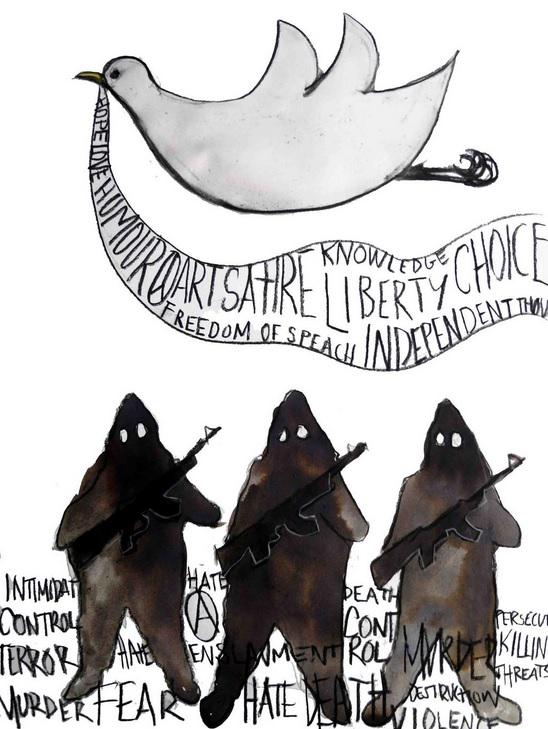
Some issues aren’t complicated. They are simple black and white. The murder of 17 French innocents, 10 of them simply for being involved in a publication that ridiculed Islam, is an outrage. It should be condemned. Je suis Charlie.

But is it so simple? The Andrew Bolt doesn’t think so. We Australians are NOT , he declares, because we don’t have the guts: “This fearless magazine dared to mock Islam in the way the left routinely mocks Christianity. Unlike much of our ruling class, it refused to sell out our freedom to speak.”

Bolt omits to point out that the murdered editors and cartoonists of were quintessential lefties themselves, who mocked and lampooned the French state and the Roman church with every bit as much gusto as they ridiculed Islam.
Attorney-General George Brandis.

But Bolt is certainly right that most Australians have shown quite recently that they don’t share Charlie Hebdo’s uncompromising views on freedom of speech.

It is unlawful in Australia to do anything in public – including the publishing of articles and cartoons – that is “reasonably likely, in all the circumstances, to offend, insult, humiliate or intimidate another person or group”, if “the act is done because of the race, colour, or national or ethnic origin” of that person or group.

There are exemptions to section 18C of the Racial Discrimination Act for the publication of fair comment on a matter of public interest, published “reasonably and in good faith”. But as Bolt discovered when Justice Mordecai Bromberg found him in breach of the act, whether an article is covered by that exemption depends not just on its accuracy, but on whether “… (in)sufficient care and diligence was taken to minimise the offence, insult, humiliation and intimidation suffered by the people likely to be affected …”

Bolt had not taken enough care, Justice Bromberg found, and not just because he had been inexcusably sloppy with his facts. “The derisive tone, the provocative and inflammatory language and the inclusion of gratuitous asides” in the articles complained of satisfied him that “Mr Bolt’s conduct lacked objective good faith”.

But I was one of those who agreed with Bolt that to make it unlawful merely to offend someone, on any grounds, is an assault on freedom of speech. I found Justice Bromberg’s judgment disturbing, and initially I supported the Abbott government’s determination to revise the act.

When Attorney-General George Brandis published his proposed revision, I changed my mind – it seemed to me that it went absurdly far in the opposite direction. (By contrast, I have no problem with the much simpler bill on the table, sponsored by Senator Bob Day and others.)

But most submissions on the government’s draft bill went further. Any revision to the act was opposed by almost every influential ethnic group; every lawyers’ organisation in the land; the entire human rights and social welfare establishment; and by Jewish, Christian and Muslim organisations. Seldom has a proposed legislative reform met such universal condemnation.

In the face of that chorus of disapprobation, and to Bolt’s disgust, the government backed down, and the act stands.

Now, of course, the federal Racial Discrimination Act does not apply to acts that concern a person’s religion – though the Victorian Racial and Religious Tolerance Act does.

Nevertheless, the very Australians who are most likely to be out on the streets today with their “Je suis Charlie” placards made it clear less than a year ago that in their view, at least so far as race is concerned, publications should not be free to give offence or to insult.

Let’s be clear: Charlie Hebdo set out, every week, with the greatest deliberation, to offend and insult all kinds of people, and especially in recent years the followers of Islam, whether fundamentalist or not.

Look at some of the magazine’s recent covers: An Egyptian Muslim Brotherhood protester in a hail of gunfire crying “The Koran is shit – it doesn’t stop bullets”; a full-on homosexual kiss between a Charlie cartoonist and a Muslim sheik with the ironic headline “Love is stronger than hate”; a naked woman with a niqab thrust up her backside.

Most of those who were so outraged by Bolt’s columns about fair-skinned Aboriginal people, and supported the use of the law against him, would find themselves equally appalled by much of Charlie Hebdo’s output. Even though the late Stephane Charbonnier, the magazine’s editor, inhabited the opposite end of the political spectrum, he shared Bolt’s determination to shock the chattering classes.

But whereas Bolt is an unashamed supporter of the Abbott government, Charlie Hebdo mocks all governments. If it were published in Melbourne rather than Paris, the magazine would be scathing about Australia’s new anti-terrorist laws, under which the government can guard all of its secrets from scrutiny and threaten any who reveal them with five years in prison, but we can keep none of ours from the government.

Yet the new laws have been greeted with tepid acceptance by most Australians. In protesting their over-reach, the media have been largely on their own. In this respect, too, nous ne sommes pas Charlie.

Perhaps that’s not surprising, when so many commentators are prepared to wind up the scary rhetoric. “A de facto world war is under way, and it has everything to do with Islam,” declared Fairfax’s Paul Sheehan on Monday.

That the murder of Charlie Hebdo’s staff was a hideous crime is beyond debate. It should be treated as such. But talk of world war brings with it a grave risk: that it will legitimise the remorseless encroachment by government on our liberties.

The enemy of my enemy is my friend, the saying goes. But the enemies of Islamic fundamentalism are not necessarily the friends of free speech.

For better or for worse, most Australians ne sont pas Charlie. It’s not such a black and white issue, after all.

Why depicting Mohammed angers many Muslims

A person reads the latest issue of Charlie Hebdo in Paris on January 7, 2015

Banner Icon Religion Depictions of Prophet Mohammed such as the cartoons published by the French satirical magazine reeling from a deadly attack are banned in Islam and mocking him angers many Muslims.

Although images poking fun at the prophet have repeatedly infuriated the Islamic world, Arab and Muslim leaders and clerics were quick to condemn the attack. Sunni Islam’s most prestigious centre of learning Al-Azhar said “Islam denounces any violence”.

The two masked gunmen who killed 12 people at the Charlie Hebdo weekly on Wednesday claimed to be on a mission to “avenge” its cartoons of Mohammed.

It follows years of controversy over such caricatures.

“This is a prophet that is revered by some two billion people… Is it moral to mock him?,” prominent Iraqi preacher Ahmed al-Kubaisi told AFP, explaining the violent reaction of Muslims to cartoons of Mohammed.

“France is the mother of all freedoms, yet no one said this (depiction) is shameful,” he said.

Outspoken former Malaysian prime minister Mahathir Mohamad said Charlie Hebdo had shown disrespect towards Islam on numerous occasions.

“Is there a need for them to ridicule Prophet Mohammed knowing that they are offending Muslims?” state news agency Bernama quoted him as saying.

“We respect their religion and they must respect our religion,” he added.

Violent protests broke out in the Muslim world after Denmark’s Jyllands-Posten newspaper published 12 caricatures of Mohammed in 2005.

Charlie Hebdo and other European publications reproduced the cartoons the following year, including one which showed Mohammed wearing a turban shaped like a bomb, making them a target of Islamist fury.

The French magazine’s offices were fire-bombed in November 2011 following the publication of an edition renamed “Charia Hebdo”, (Sharia Hebdo), with a caricature of Mohammed on the front page.

‘NO RESPECT FOR FREEDOM’

At the core of the problem is the “lack of respect for others’ right to freedom of expression” in Arab and Muslim countries, according to Hassan Barari, professor of international relations at Qatar University.

Some people “do not understand the Western context of free speech, where you can easily make a movie that is critical of Jesus.”

Mathieu Guidere, who teaches Islamic studies at France’s University of Toulouse, said that the “culture of tolerance, and acceptance of different opinion is almost non-existent in the Arab and Islamic world.”

He attributed violence to a feeling harboured by “almost every Muslim who believes that he is the defender of the prophet and of Islam.”

Barari pointed to a history of “animosity between the West and Muslims”.

“We cannot deny that anti-Western feeling in the region is related to the West’s policies. This is related to past colonialism, policy on Israel, and support to dictatorships,” he said.

EVEN POSITIVE DEPICTION BANNED

The majority of Islamic scholars ban drawings of all prophets revered by Islam, and reject the depiction of the companions of Mohammed, even when it shows them in a positive light.

“We should not open the door to people to draw the prophet in different forms that could affect his status in the hearts of his people,” said Kubaisi, the Iraqi preacher who is based in Dubai.

There is no text from the Quran or the tradition of the prophet that clearly forbids such depictions, and the ban is “out of homage and respect” to the prophets, he added.

The ban also applies to depictions of prophets and companions of Mohammed in movies and television programmes.

When a trailer for anti-Muslim movie “Innocence of Muslims” appeared on YouTube in 2012, protesters took to the streets in several countries.

Four people, including US Ambassador Chris Stevens, were killed in Libya when extremists used protests against the film to attack US interests on September 11, 2012.

In recent weeks, a number of Muslim countries banned Ridley Scott’s “Exodus: Gods and Kings” for its depiction of Moses.

Even the 1970s epic “The Message”, which chronicled the life of Mohammed and starred Anthony Quinn, did not impersonate the prophet.

“Depicting the prophets of Allah would cast doubts about their status and might include lies, because actors could never match the characters of the prophets,” said a fatwa, or edict, by the Mecca-based Islamic Fiqh Coun


Al Qaeda Source: AQAP Directed Paris Attack – The Intercept


Featured photo - Al Qaeda Source: AQAP Directed Paris Attack

Al Qaeda Source: AQAP Directed Paris Attack – The Intercept.

Calls for unity and understanding as world mourns Charlie Hebdo

View image on Twitter

Calls for unity and understanding as world mourns Charlie Hebdo.

When cartoons upset the ‘wrong people’ – Opinion – Al Jazeera English

When cartoons upset the ‘wrong people’ – Opinion – Al Jazeera English.

Paris attack struck at heart of modern French culture

Demonstrators hold a banner reading 'I am Charlie', at the Old Port of Marseille, southern France.

Paris attack struck at heart of modern French culture.

The Age Comment Letters Editorial Obituaries View from the Street Blunt Instrument You are here: Home Comment Search age: Search in: Comment France attracting special attention from terrorists

French soldiers patrol in front of the Eiffel Tower on Wednesday after terrorists killed at least 12 people in Paris.

France has a special relationship with terrorism. It is the only country to draw specific, rather than general, threats from ISIS. It is the only country to take on a terrorist organisation and expel it from a country, and it is the only country to brag recently about having none of its citizens in the hands of hostage-takers.

The United States and its allies, including Australia, have taken a fairly laissez-faire approach towards ISIS, aimed at containing rather than expelling it. Even during my visit to neighbouring Iran in November last year, the general feeling was that the government there did not seriously intend to eradicate ISIS, because it wasn’t in its interest to do so. However, France demonstrated in 2013 that with the right coalition, a great degree of confidence and a certain amount of belief, terrorist armies can be defeated even in remote, hard-to-reach places.

France’s engagement in its former West African colony Mali, alongside Malian and African Union troops, engendered a tremendous amount of hatred against it in the world of Islamist radicalism. At the time, al-Qaeda-linked militants had hijacked a local ethnic rebellion in an attempt to form a state in one of the more remote and poorly governed parts of Africa. The fact that France, a former colonial ruler with a history of brutality in the region, was invited to assist by Mali’s military dictatorship and achieved its aim quickly placed a large dent in the morale and self-belief of those who have faith in radical religious-nationalist ideology.

In the past year, ISIS has shocked the world with its speed and brutality. A neo-colonialist army with soldiers drawn from all corners of the globe, this previously obscure group has managed to dominate many parts of Iraq and Syria through military success, as well as by exploiting its reputation for causing fear and sectarian division. France refers to ISIS by the Arabic acronym “Da’ish”, rather than Islamic State, so as to disassociate the group from Islam. That is something ISIS hates and for this reason it has declared that the “filthy” French hold a special place among its enemies.

While some have considered the attack in Paris to be aimed at Europe, the result of foreign fighters returning from the Middle East or of poor integration policies, the question that remains unanswered is why has France specifically drawn such attention from terrorists? Anti-Muslim groups held huge rallies in Germany at the weekend but it was France that dealt with three impromptu terrorist attacks in December.

Even the target itself, Charlie Hebdo, which had published satirical cartoons of the prophet Muhammad, is a specifically French target. After all, these cartoons were published originally in Denmark in 2005, where the main reaction was protests from the Danish Muslim population, who felt they were being unfairly treated by mainstream Danish society. It was only a few months later, when Charlie Hebdo published these cartoons in a special issue, that outrage boiled in many Muslim countries.

Muslim attitudes towards blasphemy are the same as other religious groups. Additionally, the accusation of blasphemy, particularly insulting the prophet, has a long history of being the result of ulterior motives. The 17th century Armenian chronicler, Arakel of Tabriz, documented a dozen or so Christian “martyrs” in his lifetime in the Ottoman and Iranian empires, the majority of whom were executed when a disgruntled neighbour accused them of insulting the prophet. Similarly, several blasphemy trials in Pakistan over the past decade have boiled down to disputes over land between the accuser and the accused. The fact that a French publisher is the target of this well-organised attack and not the original Danish publisher demonstrates that this justification is window dressing for a deeper dispute between the French and Islamic militants.

Ultimately, we shouldn’t allow ourselves to be dragged into pointless debates about whether Islam or Western culture are responsible, since these debates serve the interests of those who benefit from division. As the response to the Martin Place attack last month demonstrated, people are drawn together by their common humanity. Attacks like these are not aimed only at the West, but at anyone who doesn’t accept the ideology of the attackers, whether Muslim or not. Let us not forget that ISIS’s primary aim is to first “purify” Muslims.

Dr James Barry is an Associate Research Fellow at Deakin University’s Centre for Citizenship and Globalisation, researching the role of Islam in Iranian foreign policy.

 
Real Media, Alt News, Politics, Critical Thought, War, Global events, Australia, Headlines,