Category: Wall St

Wall Street titan says America will be the next empire to decline

Bridgewater founder Ray Dalio sees trouble ahead.

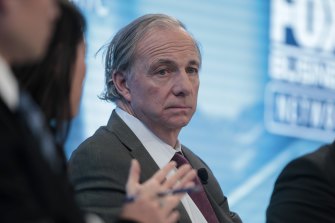
He puts the risk of US civil war in the next decade at 30 per cent, believes stock markets are soon headed for difficult times and predicts the Chinese “empire” will become the dominant global power, leapfrogging America and transforming the geopolitical landscape.

Source: Wall Street titan says America will be the next empire to decline

‘This is where we are’: Bubble fears are rising on Wall Street

Soaring indexes are raising fears of a Wall Street bubble.

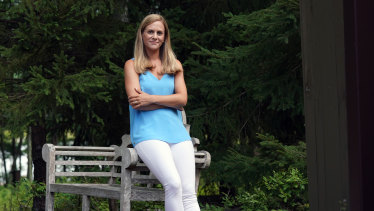
With rates so low, investors don’t have much choice for good returns outside of stocks. Margie Patel, senior portfolio manager at Wells Fargo Asset Management, said the Fed has pretty much signalled to Wall Street that it won’t allow for a big market downturn. “As long as interest rates are this low,” she said, “it’s really hard for me to see how you could have much of a correction in stocks.”

‘This is where we are’: Bubble fears are rising on Wall Street

Wall Street is melting down over the GameStop saga

Short-selling has been placed on the map once again, but this time it’s exposed an interesting double-standard that exists in the free market on how investors “should behave” in the eyes of Wall Street titans. To provide context, for those unbeknown to the workings of the free market, this beloved tradition of hedge fund managers is when investors make money off stock prices falling. In a short sell, an investor borrows a security and sells it on the market with the intention to buy it back later for less money when it falls, as expected. Remember when Eggs flew as Panama Papers spark populist anger in the streets Capitalism faces a crisis of credibility as leaked documents show global rules are rigged for the rich and powerful. As you can imagine, a downturn is the perfect time to whet the appetites of these hungry hedge funders who profiteer from the decline in a company’s value. This practice got so out of hand in 2008 that it led to U.S. regulators (as well as Australian) to temporarily ban the short-selling of stocks out of fear it would exacerbate the market downturn by perpetuating a downward spiral in stock prices during the crisis.

Wall Street is melting down over the GameStop saga

Reddit, GameStop And Wall Street: Here’s Everything You Need To Know | HuffPost Australia

The Redditors Have Revealed A Myth About The Stock Market

So what is happening with GameStop?

Reddit, GameStop And Wall Street: Here’s Everything You Need To Know | HuffPost Australia

The Response to the GameStop Fiasco Shows It’s Still Wall Street’s Economy

Now that hedge funds are losing billions to Redditors buying stocks like GameStop, Wall Street wants heavy-handed intervention into the market, and brokerages have clamped down on the upstarts. It’s a reminder that there’s no such thing as “people’s capitalism” or “shareholder democracy” — the capitalist economy is structured to do what’s best for the business elite.

The Response to the GameStop Fiasco Shows It’s Still Wall Street’s Economy

‘The Big Short 2.0’: The investors cashing in on US economic pain

As the coronavirus pandemic accelerated the demise of some brick-and-mortar retailers, a group of investors, including Catie McKee, profited handsomely.

Betting against MAGA and booming (ODT)

There is something uncomfortable about the idea of getting fantastically rich off someone else’s misfortune, which is what happens when a “short” trade — or bet against a stock or industry — succeeds. The contrast is even more startling given that the pandemic, which has devastated the economy and hurt the livelihoods of millions, has turbocharged the bets that Icahn, McKee and others placed on the downfall of malls.

‘The Big Short 2.0’: The investors cashing in on US economic pain

ASX set for heavy losses as Wall Street’s dive gets worse

The sell-off in US stocks accelerated, wiping out gains for the year in both the S&P 500 Index and the Dow Jones Industrial Average, as mixed corporate earnings and weak housing data fueled anxiety that rising prices will crimp economic growth. Treasuries rallied for a second day on demand for haven assets.

via ASX set for heavy losses as Wall Street’s dive gets worse

Donald Trump Just Made It Way Easier for Your Financial Adviser to Rip You Off | Mother Jones

The fiduciary rule sounds boring, but getting rid of it could cost you big-time.

Source: Donald Trump Just Made It Way Easier for Your Financial Adviser to Rip You Off | Mother Jones

Robert Reich: ‘The Big Short’ and Bernie Sanders’ Plan to Bust Up Wall Street – Truthdig

The Big Short film review: a good story but jarring comedy scenes

Source: Robert Reich: ‘The Big Short’ and Bernie Sanders’ Plan to Bust Up Wall Street – Truthdig

Wall Street’s Threat to the American Middle Class: ROBERT B. REICH, Chancellor’s Professor of Public Policy at the University of California at Berkeley and Senior Fellow at the Blum Center for Developing Economies, was Secretary of Labor in the Clinton administration. Time Magazine named him one of the ten most effective cabinet secretaries of the twentieth century.


Monday, January 26, 2015

Presidential aspirants in both parties are talking about saving the middle class. But the middle class can’t be saved unless Wall Street is tamed.

The Street’s excesses pose a continuing danger to average Americans. And its ongoing use of confidential corporate information is defrauding millions of middle-class investors.

Yet most presidential aspirants don’t want to talk about taming the Street because Wall Street is one of their largest sources of campaign money.

Do we really need reminding about what happened six years ago? The financial collapse crippled the middle class and poor — consuming the savings of millions of average Americans, and causing 23 million to lose their jobs, 9.3 million to lose their health insurance, and some 1 million to lose their homes.

A repeat performance is not unlikely. Wall Street’s biggest banks are much larger now than they were then. Five of them hold about 45 percent of America’s banking assets. In 2000, they held 25 percent.

And money is cheaper than ever. The Fed continues to hold the prime interest rate near zero.

This has fueled the Street’s eagerness to borrow money at rock-bottom rates and use it to make risky bets that will pay off big if they succeed, but will cause big problems if they go bad.

We learned last week that Goldman Sachs has been on a shopping binge, buying cheap real estate stretching from Utah to Spain, and a variety of companies.

If not technically a violation of the new Dodd-Frank banking law, Goldman’s binge surely violates its spirit.

Meanwhile, the Street’s lobbyists have gotten Congress to repeal a provision of Dodd-Frank curbing excessive speculation by the big banks.

The language was drafted by Citigroup and personally pushed by Jamie Dimon, CEO of JPMorgan Chase.

Not incidentally, Dimon recently complained of being “under assault” by bank regulators.

Last year JPMorgan’s board voted to boost Dimon’s pay to $20 million, despite the bank paying out more than $20 billion to settle various legal problems going back to financial crisis.

The American middle class needs stronger bank regulations, not weaker ones.

Last summer, bank regulators told the big banks their plans for orderly bankruptcies were “unrealistic.” In other words, if the banks collapsed, they’d bring the economy down with them.

Dodd-Frank doesn’t even cover bank bets on foreign exchanges. Yet recent turbulence in the foreign exchange market has caused huge losses at hedge funds and brokerages.

This comes on top of revelations of widespread manipulation by the big banks of the foreign-exchange market.

Wall Street is also awash in inside information unavailable to average investors.

Just weeks ago a three- judge panel of the U.S. court of appeals that oversees Wall Street reversed an insider-trading conviction, saying guilt requires proof a trader knows the tip was leaked in exchange for some “personal benefit” that’s “of some consequence.”

Meaning that if a CEO tells his Wall Street golfing buddy about a pending merger, the buddy and his friends can make a bundle — to the detriment of small, typically middle-class, investors.

That three-judge panel was composed entirely of appointees of Ronald Reagan and George W. Bush.

But both parties have been drinking at the Wall Street trough.

In the 2008 presidential campaign, the financial sector ranked fourth among all industry groups giving to then candidate Barack Obama and the Democratic National Committee. In fact, Obama reaped far more in contributions from the Street than did his Republican opponent.

Wall Street also supplies both administrations with key economic officials. The treasury secretaries under Bill Clinton and George W. Bush – Robert Rubin and Henry Paulson, respectfully, had both chaired Goldman Sachs before coming to Washington.

And before becoming Obama’s treasury secretary, Timothy Geithner had been handpicked by Rubin to become president of Federal Reserve Bank of New York. (Geithner is now back on the Street as president of the private-equity firm Warburg Pincus.)

It’s nice that presidential aspirants are talking about rebuilding America’s middle class.

But to be credible, he (or she) has to take clear aim at the Street.

That means proposing to limit the size of the biggest Wall Street banks;  resurrect the Glass-Steagall Act (which used to separate investment from commercial banking); define insider trading the way most other countries do – using information any reasonable person would know is unavailable to most investors; and close the revolving door between the Street and the U.S. Treasury.

It also means not depending on the Street to finance their campaigns.
A Whining Wall Street Banker Pleads for Pity: How is it the CBA Australia’s biggest bank get’s off so lightly Mr Corman?

J.P. Morgan was recently socked in the wallet by financial regulators who levied yet another multibillion-dollar fine against the Wall Street baron for massive illegalities.

Well, not a fine against John Pierpont Morgan, the man. This 19th-century robber baron was born to a great banking fortune and, by hook and crook, leveraged it to become the “King of American Finance.” During the Gilded Age, Morgan cornered the U.S. financial markets, gained monopoly ownership of railroads, amassed a vast supply of the nation’s gold and used his investment power to create U.S. Steel and take control of that market.

From his earliest days in high finance, Morgan was a hustler who often traded on the shady side. In the Civil War, for example, his family bought his way out of military duty, but he saw another way to serve. Himself, that is. Morgan bought defective rifles for $3.50 each and sold them to a Union general for $22 each. The rifles blew off soldiers’ thumbs, but Morgan pleaded ignorance, and government investigators graciously absolved the young, wealthy, well-connected financier of any fault.

That seems to have set a pattern for his lifetime of antitrust violations, union busting and other over-the-edge profiteering practices. He drew numerous official charges—but of course, he never did any jail time


Moving the clock forward, we come to JPMorgan Chase, today’s financial powerhouse bearing J.P.‘s name. The bank also inherited his pattern of committing multiple illegalities—and walking away scot-free.

Oh, sure, the bank was hit with big fines, but not a single one of the top bankers who committed gross wrongdoings were charged or even fired—much less sent to jail.

With this long history of crime-does-pay for America’s largest Wall Street empire, you have to wonder why Jamie Dimon, JPMorgan’s CEO, is so P.O.‘d. He’s fed up to the tippy-top of his $100 haircut with all of this populistic attitude that’s sweeping the country, and he’s not going to take it anymore!

Dimon recently bleated to reporters that, “Banks are under assault.” Well, he really doesn’t mean or care about most banks—just his bank. Government regulators, snarls Jamie, are pandering to grassroots populist anger at Wall Street excesses by squeezing the life out of the JP Morgan casino.

But wait—didn’t JPMorgan score a $22 billion profit last year, a 20 percent increase over 2013 and the highest in its history? And didn’t those Big Bad Oppressive Government Regulators provide a $25 billion taxpayer bailout in 2008 to save Jamie’s conglomerate from its own reckless excess? And isn’t his Wall Street Highness raking in some $20 million in personal pay to suffer the indignity of this “assault” on his bank. Yes, yes and yes.

Still, Jamie says that regulators and bank industry analysts are piling on JPMorgan Chase: “In the old days,” he whined, “you dealt with one regulator when you had an issue. Now it’s five or six. You should all ask the question about how American that is,” the $20-million-a-year man lectured reporters, “how fair that is.”

Well, golly, one reason Chase has half a dozen regulators on its case is because it doesn’t have “an issue” of illegality, but beaucoup illegalities, including deceiving its own investors, cheating more than two million of its credit card customers, gaming the rules to overcharge electricity users in California and the Midwest, overcharging active-duty military families on their mortgages, illegally foreclosing on troubled homeowners and … well, so much more.

So Jamie, you should ask yourself the question about “how fair” is all of the above. Then you should shut up, count your millions and be grateful you’re not in jail.

From John Pierpont Morgan to Jamie Dimon, the legacy continues. Banks don’t commit crimes. Bankers do. And they won’t ever stop if they don’t have to pay for their crimes.