Category: Direct Action

Voice Referendum Campaign Goes Local – » The Australian Independent Media Network

I am a private person. I don’t have a cat or a dog, and dog parks are a foreign territory to me. Yet, last week, I put on my YES t-shirt, picked up my corflutes and flyers, and headed off to a popular local dog park to talk to strangers about the Voice Referendum.

So, I have stepped up to be one of the faces of the YES campaign in my local community. A visible presence is a great encouragement to YES voters and gets people talking.

We’ll be brave and talk to strangers to encourage them to vote YES.

If things get a bit gnarly, I’ll remember the advice from the dog park, “bend your knees”, and I’ll lean into it.

Source: Voice Referendum Campaign Goes Local – » The Australian Independent Media Network

Top polluters to set own limits virtually penalty free, according to Direct Action policy paper – ABC News (Australian Broadcasting Corporation)

The Yallourn Power plant is operating at severely reduced capacity.

Top polluters to set own limits virtually penalty free, according to Direct Action policy paper – ABC News (Australian Broadcasting Corporation).

koala clings on for life while loggers cut down trees at Australian Bluegum Plantation | Daily Mail Online

'There would have been a wound in the animal that became infected and flies have moved in and laid eggs, then the maggots hatch and start eating into the wound'

koala clings on for life while loggers cut down trees at Australian Bluegum Plantation | Daily Mail Online.

Short-term political fixes pose threat to environment and future prosperity, scientists warn

Smoke emits from steel works

Some of the nation’s top scientists have warned short-term political fixes pose a threat to both the environment and the nation’s future prosperity.

The first major report in more than a decade from the influential Wentworth Group of Concerned Scientists suggests the Federal Government eliminate fossil fuel subsidies and provide tax breaks to landowners who work to protect threatened species and ecosystems.

“We’re increasingly seeing the consequences of our current short-termism and the cost that will impose on this society in the future, because, in the long run, environmental degradation will come at an enormous cost,” Wentworth Group director, Peter Cosier, said.

The report included contributions from former treasury secretary Ken Henry and Clean Energy Finance Corporation director Martijn Wilder.

The group said the Abbott Government’s tentative steps towards reforming the tax system provided an opportunity to better protect the environment.

“Tax is an effective way [to protect the environment] because it’s something you have to pay and it’s a measure which governments use all the time to pull triggers in the economy,” Mr Wilder said.

“There’s an opportunity here to look at our tax system over the long-term to make it such that it has measures that are beneficial to the environment and the economy.”

There’s an opportunity here to look at our tax system over the long-term to make it such that it has measures that are beneficial to the environment and the economy.

Martijn Wilder

The report recommends removing fossil fuel subsidies and instead paying farmers, indigenous communities and other landholders to restore and protect environmental assets.

“A farmer may take particular steps to look after and manage their land in a more sustainable fashion and by doing that they may be rewarded with some sort of tax concession,” Mr Wilder said.

Professor Bruce Thom, a founding member of the group, said with climate change predicted to bring more extreme heat, bushfires, and damaging storms, smarter planning decisions need to be made now.

“We spend 10 times more on recovery after a disaster than we spend on mitigating their impacts,” Professor Thom said.

He said he believed preparing communities for climate change has not been well coordinated to date between different tiers of government.

Professor Thom said recent discussions about tax and federalism should be expanded to include the management of the natural environment.

“The Federal Government is the driver of the economy and the states are the deliverers,” he said.

“We feel that all three levels of government must be closely working together in better managing our natural capital for the long-term future.”

The authors cite advice from the Productivity Commission, Treasury, and the Garnaut Review that an emissions trading scheme remains the most cost-effective way for Australia to reduce greenhouse gas emissions.

A copy of the Wentworth Group’s report will be sent to every state environment minister and every federal MP.

We singled out as leading. OECD Human Rights Violaters, ADF deployment enthusiasts, RET non supporters, Foreign Aid renegers… We stand Tall

 View image on Twitter

With the Abbott Government’s RET review controversially advising abolishing Australia’s renewable energy target, a new international report suggests renewables are the only way forward.

RENEWABLE ENERGIES ARE INCREASINGLY SEEN as the best solution to a growing global population demanding affordable access to electricity, while reducing the need for toxic fossil fuels that are creating unsustainable levels of greenhouse gas emissions.

That’s the underlying message of a new report ‒ REthinking Energy: Towards a New Power System ‒ published this week by the Abu Dhabi-based International Renewable Energy Agency (IRENA).

‘Rapid technological progress, combined with falling costs, a better understanding of financial risk and a growing appreciation of wider benefits, means that renewable energy is increasingly seen as the answer.’

Not only can renewable energy meet the world’s rising demand, but it can do so more cheaply, while contributing to limiting global warming to under 2 degrees Celsius – the widely cited tipping point for climate change

A technology once considered as niche is becoming mainstream. What remains unclear is how long this transition will take, and how well policy makers will handle the change.’

In the next two decades, the report noted, world electricity generation is expected to increase by 70 per cent.

But the report warned:

There is growing consensus on the threat of climate change brought on by increasing atmospheric concentrations of greenhouse gases, prompting worldwide efforts to reduce emissions.’

If business continues as usual, these efforts will not succeed. The average emissions intensity of electricity production has barely changed over the past 20 years. Gains from the increasing deployment of renewables, and less intensive fossil fuels such as natural gas, have been offset by less efficient power plants and the rising use of coal. Without a substantial increase in the share of renewables in the mix, climate change mitigation will remain elusive.’

There is also increasing concern about the health impacts of burning fossil fuels, the report said, adding the U.S. Environmental Protection Agency recently found that ill health caused by fossil fuels nationally costs between US $362 billion and $887 billion annually.

In addition, the European Union’s Health and Environment Alliance found that emissions from coal-fired power plants cost up to €42.8 billion in yearly health costs.

The report says something has to change:

‘Fossil fuels powered the first industrial revolution, but even in the new era of shale oil and gas, questions remain about their compatibility with sustainable human well-being. The stage is set for the era of modern renewable energy that is cost competitive, mainstream and sustainable.’

The report noted that the challenge today is how to finance and accelerate the continued deployment of renewables.

The report added that politicians have an important role to play:

‘If they make it clear that renewable energy will be a larger part of their national energy mix, and commit to long-term, non-financial support mechanisms, they could reduce uncertainty and attract more investors.’

Deploying renewables also stimulates economic activity, creates jobs, provides power for those left off the grid, the report said. Most renewables do not deplete finite resources and they also reduce the risk of ecological disasters.

In an accompanying media release, IRENA Director-General Adnan Amin said speeding up the adoption of renewable energy technologies is the most feasible way of reducing carbon emissions and avoiding catastrophic global warming.

Amin was quoted as saying in the release:

A convergence of social, economic and environmental forces are transforming the global energy system as we know it. But if we continue on the path we are currently on and fuel our growing economies with outmoded ways of thinking and acting, we will not be able avoid the most serious impacts of climate change.”

WE NOW HAVE SOMETHING IN COMMON WITH THE MIDDLE EAST

 View image on Twitter

 shutterstock_16148269

 
What does Australia no longer have in common with South Africa, India, China, Japan, South Korea, Taiwan, New Zealand, Finland, the Netherlands, France, Slovenia, Germany, Sweden, Norway, Denmark, Switzerland, the UK, Ireland, Costa Rica, and Brazil? As of today, unlike those other countries, we no longer have a Carbon Tax.
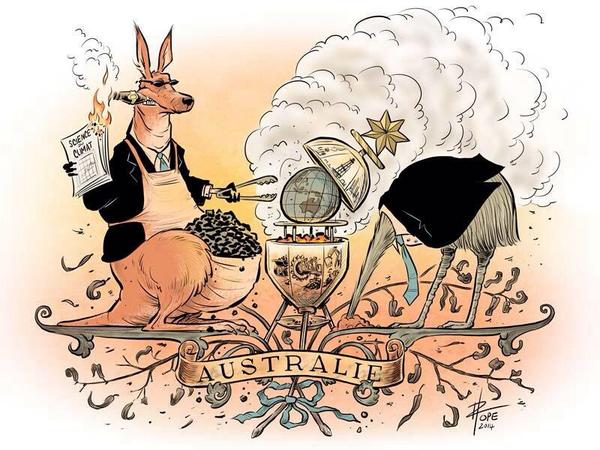
The successful repeal makes us the first nation to actually remove any efforts towards combating global Climate Change. It is, one way or the other, going to be a day that will be of enormous historical significance not just in our own history, but in the history of our relationship with the rest of the world.
I guess we have something in common with the Middle East and other predominantly Islamic countries. But also the worlds totalitarian states who have also studied where their best interests lie, Nth Korea,Russia etc

“With the Senate’s vote today, Australia not only lurches to the back of the pack of countries taking action on climate, but sees the responsibility of emission reductions shift from major polluters to the taxpayer,” said  John Connor. “The last seven years have been a sorry and sordid tale of greed, incompetence and rotten luck, which has reduced Australian policy making to scaremongering, self-interest and reckless short termism.”
Connor said that if there is any solace to be taken it’s that there is now two years of experience in Australia of carbon laws that have worked at reducing pollution in a growing economy.

Carbon pricing could endure. Alone it was not a panacea, but it was an effective central pillar to a long-term emissions reduction strategy. This is the view of the OECD, World Bank, the United Nations and many institutions like them.
On carbon pricing, Australia had got itself ahead of the curve, as it has so often on major economic reform. Doing that has always been to our advantage. We restructured ahead of others, lessened the associated pain and got on with embracing modernity.
In the two years since Australia’s carbon price came into effect, seven pilot schemes have been launched in China and perhaps the best scheme in the world started in California. Next year South Korea – our fourth largest-trading partner – begins its own national trading scheme.
Instead we have become the first country to roll back a carbon price.
This repeal is fighting against the future. That is a battle that is rarely won.

ABBOTT PLANTED A TREE DIRECT ACTION "WE ARE A CONSERVATIONIST GOVERNMENT"

Real Media, Alt News, Politics, Critical Thought, War, Global events, Australia, Headlines,