 ious
ious 
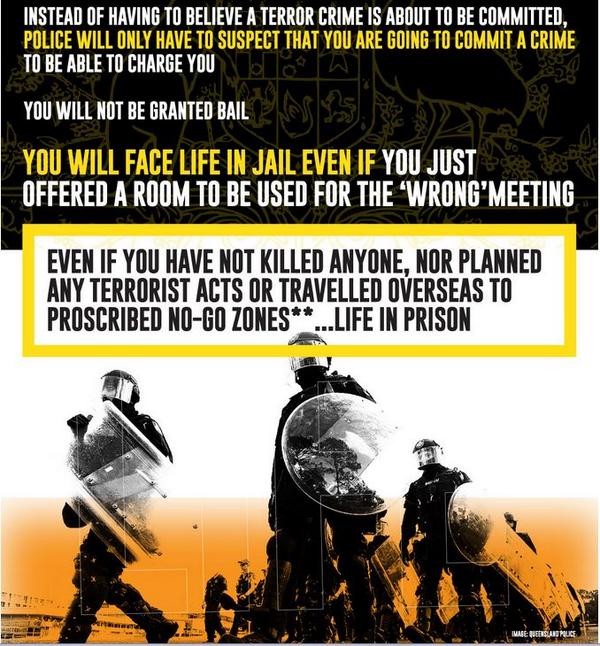
Like many things our prime minister says, it is simply a convenient lie.These are not good laws. They are not even laws to make Australia safer.These are cynical, opportunistic laws. Laws barrelled through under the spurious guise of protecting us against a fanatical foreign Islamic beheading cult with apparent links to Muslims in this country.
They are appalling laws, built on a lie.
There has never been an act of domestic terror in Australia. And no, a lone teenager committing a seemingly unplanned act of violence is neither a terror attack nor a retrospective justification for foreign military intervention and ramped up “counter-terrorism” powers.The so-called Islamic State ‒ a ragtag bunch of rebels occupying a chunk of land about the size of Tasmania half a world away, is hardly a threat to anyone — except if you happen to live in Iraq or Syria. American Homeland Security are quite clear on that
Yes, there may indeed be 50 or 60 Australians fighting with them, but that doesn’t make them a threat here in Australia — particularly after ASIO summarily cancelled their passports. Any supporters these foreign fighters have in this country ‒ a miniscule number at most ‒ are surely able to be easily monitored using existing laws and, if they commit a criminal act, arrested and prosecuted under the existing criminal law.
The real reason for these new powers has got nothing to do with Islamic State, or ISIL, or ISIS ‒ or whatever they are called this week ‒ but they are to do with closing down scrutiny of Australia’s spies and the Government unpublicised activities.
ASIO have been caught with their pants down on two majorly embarrassing occasions since the Abbott Government took power last year.
The first occurred when the ABC and Guardian Australia published leaks from former U.S. intelligence operative whistleblower Edward Snowden that our spies had tapped then Indonesian President Susilo Bambang Yudhoyono’s mobile phone for 15 days in 2009. These revelations caused a major rift with Indonesia and is still a lingering source of tension.
It was not long after this event, on January 28, that Abbott first used his famous “team” epithet, while denouncing the ABC in an interview with on 2GB with his friend, right wing Sydney shock jock Ray Hadley [IA emphasis]:
“It dismays Australians when the national broadcaster appears to take everyone’s side but our own and I think it is a problem.
“You would like the national broadcaster to have a rigorous commitment to truth and at least some basic affection for the home team, so to speak.”
Abbott went on to call Snowden a “traitor”, saying the ABC “seemed to delight” in publishing his information:
“And of course, the ABC didn’t just report what he said, they took the lead in advertising what he said. That was a deep concern.”
Abbott reaffirmed his position in a subsequent doorstep, going on to condemn the ABC for working with the Guardian, or as he put it:
“… touting for a left wing British newspaper.”
There were no surprises when the vindictive Abbott left it for his broken former rival Malcolm Turnbull to announce an efficiency review of the ABC a couple of days later. This review has now called for the ABC’s budget to be slashed with some important investigative news programs, such as Lateline, in the firing line. Turnbull has also flagged cutting $200 million from as ABC budget already cut deeply in the May Budget, blatantly breaking a clear election promise.
These terror laws will stop whistleblowers exposing the Government’s undercover operations through the media.
The problem with this is that the Coalition ‒ under Tony Abbott, avowedly “open for business” ‒ is seemingly not above using the security services in an improper way to assist private individuals and corporations. Under the new laws, any whistleblower seeking to expose the security services, for instance, helping an Australian big business on the behest of a cabinet minister looking for a cosy post-parliamentary sinecure will now be shut down and any journalists assisting locked up for a long time.
These security laws, therefore, can be seen as the next stage in the Abbott programme to hamstring the ABC as an effective source of scrutiny of Government activities.
But, even more importantly, they will make Australian journalism generally reluctant to expose the Government’s undercover activities, as this could lead to them being sent to prison for a decade.
Australia’s spy network was again in the spotlight in December last year after Attorney General George Brandis ordered ASIO to raid the Canberra offices and home of barrister Bernard Colleary, a former ACT deputy chief minister, who was representing East Timor against Australia at the International Court of Justice (ICJ) at The Hague.
This is not democracy. No wonder they don’t want a Federal ICAC.
The Islamic State is a mirage as far as we are concerned here in Australia. It is not an existential threat to us. The grave threat, in truth, is new security laws that stifle freedom of speech, remove privacy protections, gaol journalists and serve, in the end, to limit scrutiny of the Government and its operatives.
Moreover, providing new powers to secret agents, which also provides them with civil and criminal immunity is an outright danger and threat to us as citizens. It makes these shadowy figures immune to prosecution and therefore, effectively, unaccountable for their actions. Under these laws, frankly, spies can kill us and fear no recourse.
Under these laws, there is no-one to watch the watchers. Now that is truly terrifying.
In truth, we probably expect our extreme right wing Government to implement these sorts of outrageous and unwarranted laws; certainly we can see why they are doing so. It is, however, the weak acquiescence by their so-called Opposition that is most criminal part of this affaor.
We know the ALP under Bill Shorten do not want not a cigarette paper between themselves and the Government on immigration and security matters. This is the exact small target strategy using so brilliantly and effectively by former Opposition leader Kim Beazley during such events as the Tampa Affair and Children Overboard.
However, politicians who unnecessarily sacrifice the rights of the people in the interests of popularity and power show themselves up as unsuitable for high office.
By supporting these so-called “anti-terror” laws ‒ which have nothing to do with preventing terrorism ‒ the ALP, under their current milquetoast leader, have followed the Coalition so far to the right, they are no longer truly a progressive Opposition.
And now more than ever, as the Government shuts down scrutiny and proposes gaoling journalists, Australia needs a progressive Opposition
 olddogthoughts