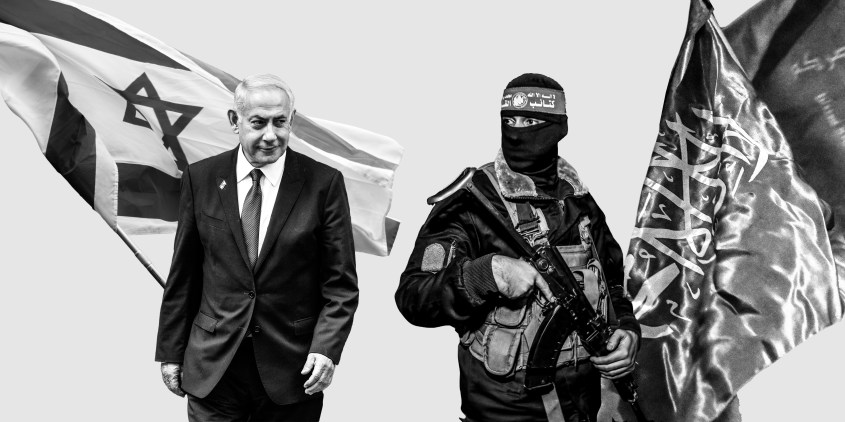

As Israel resumes its bombing of Gaza, the risk of a wider regional war grows. Mouin Rabbani analyzes the military and propaganda battles between Hamas and Israel.
You have Israel’s clownish representative to the United Nations, who attends security council meetings wearing a concentration camp outfit, or at least the yellow star, and demanding the immediate resignation of the U.N. Secretary General, whose position … He hasn’t named Israel once as responsible for anything. But he demanded his immediate resignation simply because he made the obvious factual observation that the attacks of October 7th were not the beginning of the history of this conflict, and is demanding resignations left and right.
For Israel, slaughtering 15,000 people in a month, conducting the most intensive bombing in the history of the Middle East — and we’re talking about the Middle East, not Scandinavia — has become perfectly normal. It is a state that has become thoroughly incapable of any form of inhibition. I would argue that the Israeli regime is a clear and present danger to peace in the Middle East, and, rather than drawing any conclusions, rather than or in addition to having a discussion and debate about how Israeli-Palestinian peace might be achieved, we should also be asking ourselves, should that peace be achieved? Or, rather, can it only be achieved by dismantling a regime and its key institutions the way that was done in Europe in the 1940s, in Southeast Asia in the 1970s, in South Africa in the 1990s, Southern Africa in the 1990s, and I’m sure there are other examples as well.
And, just to be clear, I’m not talking about expulsion of Israeli citizens or whatnot. I’m talking about a regime and its institutions. Again, let’s not jump to conclusions, but let’s ask the difficult questions.
Source: Intercepted Podcast: Month Two, Phase One of the Gaza War

 olddogthoughts
You must be logged in to post a comment.