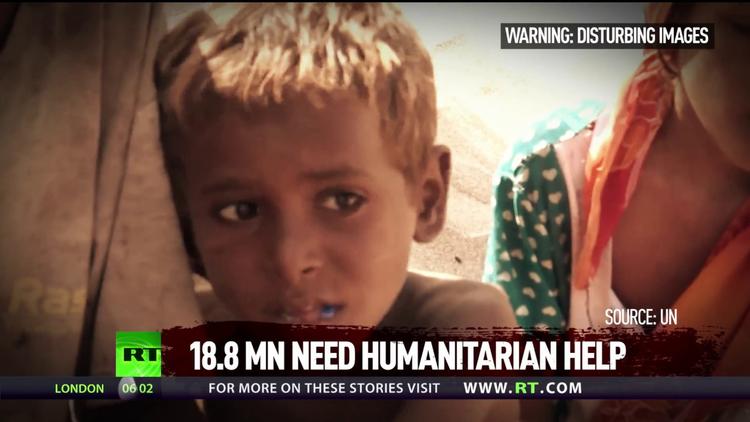
 TeleSur | – – More drone and airstrikes have rained on Yemen in the past week than in any year …
Source: Under Trump, More Coalition Strikes on Yemen in a Week than in a Year under Obama | Informed Comment
TeleSur | – – More drone and airstrikes have rained on Yemen in the past week than in any year …
Source: Under Trump, More Coalition Strikes on Yemen in a Week than in a Year under Obama | Informed Comment

US Central Command said dead and injured civilians were in ‘vicinity’ of drone strike meant for Junaid Hussain on 13 August, which was not disclosed before

“If a man beats his head against the wall,” the Italian Marxist Antonio Gramsci once wrote, “it’s his head that breaks and not the wall.” In the wake of the horrific attacks in Paris, the British political class has been suffering terrible headaches.
Source: Bombing Hasn’t Worked. Bombing Won’t Work. And Yet, We Will Bomb | The Nation

Nine Doctors Without Borders staff killed in bombing of hospital in Kunduz, as NATO admits it may have been involved.
Source: Air strike kills MSF medical staff in Afghanistan – Al Jazeera English
Washington and Tehran deny coordination as part of US-led coalition against Islamic State
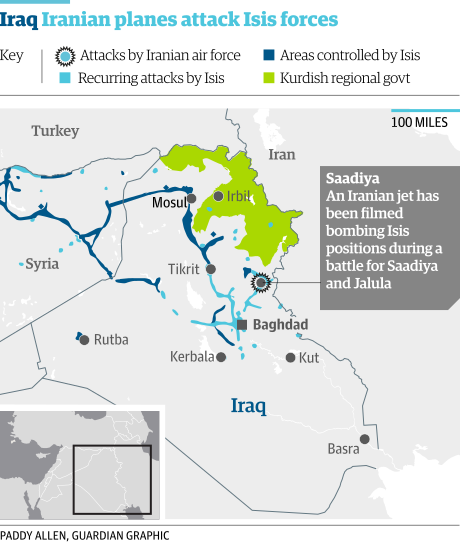
Iran’s air force has attacked targets of Islamic State (Isis) in eastern Iraq, the Pentagon has said.
Tehran has denied carrying out raids and acting in coordination with the US, which is leading a western-Arab coalition to defeat the jihadi group.
The Pentagon said air strikes in Iraq’s Diyala province were the first since Isis captured the Iraqi city of Mosul in June.
Rear Admiral John Kirby, the Pentagon spokesman, insisted that the US has not coordinated military activities with Iran. He said the US continued to fly its own missions over Iraq and that it was up to the Iraqi government to avoid conflicts in its own airspace.
“Nothing has changed about our policy of not coordinating military activity with the Iranians,” Kirby told reporters in Washington.
A senior Iranian official said no raids had been carried out and Tehran had no intention of cooperating with Washington.
“Iran has never been involved in any air strikes against Daesh [Isis] targets in Iraq. Any cooperation in such strikes with America is also out of question for Iran,” the senior official told Reuters.
In Tehran, the deputy chief of staff of Iran’s armed forces, Brigadier-General Massoud Jazayeri also denied any collaboration. Iran considered the US responsible for Iraq’s “unrest and problems”, he said, adding that the US would “definitely not have a place in the future of that country”.
Kirby’s comments followed reports that American-made F4 Phantom jets from the Iranian air force had been targeting Isis positions in Diyala. Jane’s Defence Weekly identified al-Jazeera footage of a jet flying over Iraq as an Iranian Phantom.
It had earlier been reported that Iran sent three Su-25 fighter jets to Iraq designed for close support of ground troops and that Iranian pilots flew Iraqi aircraft on combat missions.
The anti-Isis campaign has raised the intriguing possibility that the US and Iran, enemies since the 1979 Islamic Revolution, might work together against a common foe. The model has been seen as their brief cooperation against al-Qaida in Afghanistan after the 9/11 attacks. Talks about Iraq have taken place in the margins of the so-far inconclusive international negotiations about Iran’s nuclear programme.
But the US has repeatedly denied coordinating with Iran. Last month, following a personal letter sent by President Barack Obama to Iran’s supreme leader, Ayatollah Seyed Ali Khamenei, the US national security adviser, Susan Rice, said that “we are in no way engaged in any coordination – military coordination – with Iran on countering Isil [another name for Isis]”.
Iranian F-4 fighter jets fly during a military parade in April. Iranian F-4 fighter jets fly during a military parade in April 2014. Photograph: Atta Kenare/AFP/Getty Images
The two countries remain at odds over the crisis in Syria, with the US calling for the removal of Bashar al-Assad and backing rebel forces. Iran, displaying far greater commitment, provides military and financial support for his regime. Tacit cooperation between Washington and Tehran over Iraq is seen as a classic example of the notion of “my enemy’s enemy becoming my friend”. Key US allies in the Middle East, especially Israel and Saudi Arabia, fear any kind of US-Iranian rapprochement.
Advertisement
The US has not invited Iran to join the coalition fighting Isis, and Iran has said it would not join in any case. The grouping includes the UK, France and Australia as well as Saudi Arabia, Jordan, the UAE and Bahrain – Sunni Arab states which are deeply suspicious of Iran’s regional ambitions.
Iran has been actively involved in supporting the Shia-led Baghdad government and in recent weeks has gradually raised the profile of its semi-covert presence in Iraq, especially the activities of General Qasim Suleimani, commander of the al-Quds force of the Revolutionary Guards Corps. Suleimani has coordinated the defence of Baghdad and worked with Shia miltias and Kurdish troops.
The US-led air campaign against Isis began on 8 August in Iraq and was extended into Syria in September. But several countries, including the UK, which operate in Iraq, refuse to do so in Syria – highlighting confusion about overall strategy.
News of Iran’s apparently widening role emerged as minsters from the coalition met at the Nato HQ in Brussels for a summit chaired by the US secretary of state, John Kerry.
Speaking at the summit, Kerry said the US-led coalition had inflicted serious damage on Isis, but that the fight against the militants could take years.
“We recognise the hard work that remains to be done,” Kerry said. “Our commitment will be measured most likely in years, but our efforts are already having a significant impact.”
“We will engage in this campaign for as long as it takes to prevail,” he added.
Talks are focusing on military strategy as well as ways to stem the flow of foreign fighters joining Isis and how to counter its slick propaganda, disseminated on social media. The meeting will discuss ways to send “counter-messages” to de-legitimise Isis, a senior US state department official told AFP.

Syrian anti-regime rebels preparing a rocket launcher in Aleppo. Several Islamic military groups are defecting to Isis in the wake of US air strikes.
Fighters from the Free Syrian Army and several Islamic military groups say Isis is gaining allies or truces due to US bombings
US air strikes in Syria are encouraging anti-regime fighters to forge alliances with or even defect to Islamic State (Isis), according to a series of interviews conducted by the Guardian.
Fighters from the Free Syrian Army (FSA) and Islamic military groups are joining forces with Isis, which has gained control of swaths of Syria and Iraq and has beheaded six western hostages in the past few months.
Some brigades have transferred their allegiance, while others are forming tactical alliances or truces. Support among civilians also appears to be growing in some areas as a result of resentment over US-led military action.
“Isis now is like a magnet that attracts large numbers of Muslims,” said Abu Talha, who defected from the FSA a few months ago and is now in negotiations with other fighters from groups such as the al-Nusra Front to follow suit.
Assam Murad, a fighter from a 600-strong dissident FSA brigade near Homs said: “There’s no way we would fight Isis after the US military campaign against them.”
A third man, Abu Zeid, the commander of an FSA brigade near Idlib and a defector from President Bashar al-Assad’s army, said: “All the locals here wonder why the US coalition never came to rescue them from Assad’s machine guns, but run to fight Isis when it took a few pieces of land. We were in a robust fight against Isis for confiscating our liberated areas, but now, if we are not in an alliance, we are in a truce with them.”
These and other Syrian fighters told the Guardian in interviews by phone and Skype that the US campaign is turning the attitudes of Syrian opposition groups and fighters in favour of Isis. Omar Waleed, an FSA fighter in Hama, north of Damascus, said: “I’m really scared that eventually most of the people will join Isis out of their disappointment with the US administration. Just have a look on social media websites, and you can see lots of people and leaders are turning to the side of Isis.
“We did not get any weapons from the US to fight the regime for the last three years. Only now US weapons arrived for fighting Isis.”
Abu Talha said he had joined the FSA after being released from prison in an amnesty Assad granted shortly after the Syrian uprising began in March 2011, and became commander of the Ansar al-Haq brigade in Ghouta, an eastern suburb of Damascus. He became disillusioned with the FSA, however, believing it was a tool of foreign intelligence services and poor in combat. After four senior fighters in his brigade were fatally wounded a few months ago, he defected to Isis.
“Since that day, I vowed not to fight under a flag bearing the mark of the FSA even for a second. I looked around for truthful jihadis, to fight by their side. I could not find any better than the jihadis of Isis. I told my fighters: ‘I’m going to join Isis, you are free to follow me or choose your own way’,” he said.
More than 200 of his fellow fighters also declared their allegiance to Isis, a move met with opprobrium by other FSA brigades and civilians. Then the US and its allies began a campaign of air strikes.
“All those who were cursing and attacking us for joining Isis came to pledge their loyalty to Isis. A couple were FSA commanders, others were members of Islamic brigades. Even ordinary people now demand to be governed by Isis,” Abu Talha said.
Only a small number openly declared their new allegiance, he added. “Large brigades in Idlib, Aleppo, Derra, Qalamoun and south Damascus have pledged loyalty to Isis in secret. Many senior leaders of brigades in Syria are in talks with us now to get together and fight as a united force against the US aggression,” he said. His claims cannot be independently verified.
Murad, a fighter with the FSA’s 600-strong al-Ribat brigade near Homs, said an offer three months ago by the US-backed Hazem movement to supply his unit with advanced weaponry if it joined the fight against Isis was turned down.
“We rejected this attractive offer, even though we are in great need not only of weapons but food. There is no way that we would fight Isis after the US military campaign against them,” he said.
He and his fellow fighters were awaiting the arrival of Isis militants in Homs, he added. “The moment Isis fighters touch the soil of the Homs countryside, we will be the first to fight with them at the front. This [US-led] military coalition is not against Isis, it is against entire Islam.”
Fighters from Islamic militias are also joining forces with Isis. In Idlib, in north-west Syria, the Jaish al-Mujahideen army, al-Sham brigade, Ahrar al-Sham brigade and al-Nusra Front were all in conflict against Isis earlier this year. Now they are calling for an alliance. More than 1,000 al-Nusra Front fighters in the area joined forces with Isis in a single week in August, according to Ali Sa’eed, a spokesman for the FSA revolutionary command in Idlib.
Abu Talha said he was in talks with al-Nusra Front leaders, “asking them to proclaim their allegiance to Isis and be one hand to defeat Bashar [al-Assad] and all the tyrants in the world”.
“There are senior leaders of al-Nusra Front who are waiting for the zero hour to unite with us. They are more conscious now of the great risks that lie behind the new US crusade against Muslims and jihadis,” he said.
According to those interviewed, civilians as well as fighters are turning towards Isis. The group is gaining support because it implements social measures and increases security, according to Abu Talha.
“We opened 57 free public restaurants in Raqqa city, which provide three meals a day for any resident to foil any claim by a looter that he had to steal in order to feed his children. We provide free fuel to residents as well.” The implementation of sharia law had led to a huge fall in the crime rate in Raqqa and other cities controlled by Isis, he said.
In Ghouta, near Damascus, the al-Nusra Front is the dominant force, but it has lost ground to a few hundred Isis fighters, according to locals. “I can assure you the day Isis declares they are coming to Ghouta, all the people and brigades will be with them out of our dismay and disappointment,” said Fadhil Ali, a restaurant worker. “We can’t wait for the day we have Isis in Ghouta.”
Isis does not have enough weapons for the number of foreign and local jihadis wanting to join its ranks, Abu Talha said. “Jihadis in Algeria, Morocco and Yemen are declaring their allegiance to Isis. Soon we will be in Gaza and then in Iran. People are starting to be aware that Isis is defending the Sunnis.”
The growth in support for Isis was inevitable, he said. “People are suffocated and cannot stand any more. Even when you push a small cat to a corner, it will scratch you. They are slaughtering and killing us. Why should we be silent about it?”
 olddogthoughts